



Abstract
80 Days and South of the Circle feature storylines in which polar expeditions are not represented as places for the unfolding of heroized journeys; instead, their protagonists are confronted with the limits of their agency. In contrast to common pop cultural representations that turn polar exploration into a tale of individual white European men emerging triumphant over harsh nature, both video games in question emphasize the importance of cooperation for survival. The playable characters, French valet Jean Passepartout in 80 Days and British climatologist Peter Hamilton in South of the Circle, embark on their journeys to the Arctic and Antarctica, respectively, with high hopes of heroic discovery that are soon dashed by the harshness of the polar environments. As the games’ plots progress, a critique of the European imperialist-expansionist impetus of past polar expeditions emerges through the way their representation of European explorers addresses questions of nature, masculinity, and nation.
Introduction
Polar regions are a popular setting for video games of various genres. While some of these games use the Arctic and Antarctica merely as interchangeable background settings (as in several installments of the Call of Duty franchise), polar regions play a larger role in other games such as Syberia, in which a fictionalized version of Siberia's Wrangel Island figures prominently. Other examples of video games that explicitly engage with their Arctic settings on the plot level are Never Alone, which combines the puzzle-platformer genre with Iñupiaq folklore and Röki, an adventure game inspired by Scandinavian mythology in which “the child hero, Trove, solves paratactic puzzles through connection-making, lateral thinking, and perspective-taking, using her vulnerability to charm and disarm potential antagonists” (Reay, 2022, p. 560) thus challenging stereotypical ideas of heroism. In contrast to polar fiction in the form of literature and film, which is the subject of broad scholarly debate (for an overview, see Hansson, 2018 and Leane, 2018, respectively) that has recently expanded to include visual artistic practice (cf. Bloom, 2022), video games have received little critical discussion so far. Reading video games as polar fiction allows me to examine the extent to which these types of games use their unique potential as audiovisual, interactive media to continue, or renew earlier genre traditions. Because of their status as mass media that reach a wide audience, the inclusion of video games in the emerging canon of polar fiction can help initiate a broader scholarly discussion of the motif of polar exploration in popular culture. This article sets its focus on indie video games, that is, “[i]ndependent games, developed outside of the large studios” that dominate the market (Egenfeldt-Nielsen et al., 2020, p. 326). What sets these games apart is not only their comparatively low budgets but also their lower profit expectations and the concomitant reduced need to appeal to a large mass-market audience. This relative freedom from the need to maximize profitability is often accompanied by higher artistic aspirations, leading to the production of “experimental titles that often challenge conventions and seek to push the boundaries of the medium itself” (Egenfeldt-Nielsen et al., 2020, p. 111). This unique potential to create unusual gaming experiences is what makes indie games such a fascinating research subject.
In this article, I argue that contemporary indie video games tend not to heroize polar exploration and can instead be read as a critique of the European imperialist-expansionist impetus of past polar expeditions. While Leane points out that it is important to distinguish between the Arctic and Antarctica when examining polar fiction (cf. Leane, 2012, pp. 13–15), in this particular case, it is useful to discuss 80 Days and South of the Circle side by side, as both video games approach the topic of polar exploration in similar ways. Although the notion of the polar regions as the “perfect backdrop for a heroic masculinity” is still prevalent in public discourse (Bloom, 2022, p. 55), it must be acknowledged that the supposedly heroic ethos of polar exploration has also long been questioned.
As Hansson explains in relation to literature and art, “an anti-heroic discourse in dialogue with the dominant paradigm [of heroizing polar explorers] can be traced back at least to the early nineteenth century and probably much further back. The main terms of this alternative Arctic discourse were the fundamental meaninglessness of polar discovery, the description of the eventual arrival at the North Pole as only a matter of happenstance and a general debunking of the Arctic hero-myth” (Hansson, 2018, p. 48). The video games I analyzed for this article, however, go further and explicitly critique nationalist imperialist ambitions and the very idea of heroic masculinity. Instead, the games in question emphasize the importance of transnational cooperation and portray polar nature not as a virgin land to be conquered, but rather as a living entity in its own right. As this article will show, 80 Days and South of the Circle do not present the polar regions merely as a passive backdrop against which struggles for national supremacy take place, but rather endow them with a sense of agency. 80 Days depicts the Arctic as the ancestral homeland of indigenous peoples who thrive there and resist imperialist attempts to encroach on them. In both 80 Days and South of the Circle, polar nature emerges as an anticolonial force that resists European invaders by threatening their survival through blizzards and icefalls. Despite human intervention (through whale hunting in 80 Days and through the construction of research stations and alleged nuclear testing in South of the Circle), the protagonists of both games must eventually accept their inability to control their environment. In these video games, those challenging circumstances cannot be overcome by a tough hypermasculine individualistic hero, but require the protagonists to cooperate with others, even if those are supposedly enemies.
This article will combine selected close readings of text passages from both (text-heavy) games with an analysis of visual elements and gameplay mechanics. My contribution focuses on the way each of the games engages with the ideas of nature, masculinity, and nation. These three themes are the key to my reading of 80 Days and South of the Circle as deheroizing polar exploration. To make visible the entanglements between (ant)arctic natures, polar exploration, and imperialism, my article combines the ecocritical perspective of Alenda Y. Chang's Playing Nature: Ecology in Video Games with Souvik Mukherjee's Videogames and Postcolonialism: Empire Plays Back that makes postcolonial theories productive for game studies. My work shares Chang's interest in the representation of landscapes and I suggest that 80 Days and South of the Circle can be considered examples of games that use polar settings “to create entirely new sets of relations, outside of those based on dominance or manipulation” (2019, p. 23). While Chang's book informs my analysis of the visual and textual representations of polar landscapes, Mukherjee's work provides me with the tools to analyze the (post)colonial implications of certain gameplay mechanics “that [might] perpetuate the logic of colonialism instead of challenging it” (2017, p. 31). As the player takes the role of a male protagonist in 80 Days and South of the Circle, respectively, Taylor and Voorhees’ insights as outlined in their edited collection Masculinities in Play will help me to make sense of the games’ negotiation of masculinity. They explain that “games have historically served (and continue to serve) neo-colonial white-supremacist capitalist patriarchy” (Taylor & Voorhees, 2018, p. 1), and they insist that video games “help to maintain existing power relations and reroute them to adapt to historical circumstances” (Taylor & Voorhees, 2018, p. 3). How far the storytelling and gameplay mechanics of 80 Days and South of the Circle can contribute to challenging existing power relations is one of the central questions of this piece. My analytical framework combines Chang's ecocritical perspective with Mukherjee's postcolonial work and Taylor and Vorhees’ men's studies approach to show the extent to which 80 Days and South of the Circle represent polar exploration in a manner that challenges heroizing narratives.
“An Alchemical Dream of Glass and Copper and Bone”—Reimagining the North Pole as a Space of Indigenous Empowerment in 80 Days
In Inkle Studios’ 80 Days, the player takes on the role of Jean Passepartout, a French valet, who joins his employer, British nobleman Phineas Fogg, on a journey around the world. Loosely inspired by Jules Verne's nineteenth-century adventure novels, most notably Around the World in 80 Days, the player attempts to complete the trip in less than 80 days. As a piece of interactive fiction, the story is told mainly through text containers whereas visuals only play a minor role serving to illustrate certain dialogues, visualize means of transportation and announce the arrival in a new city. Inspired by Chang's observation that text-based games have the potential to “successfully foreground[…] environment […] because of and not despite [their] textual limitations” (2019, p. 24) and considering game worlds created through textual representations as “evocative spaces in their own right” (2019, p. 31), my analysis focuses on the textual level of 80 Days in connection with the gameplay mechanics. The gameplay mechanics themselves are rather simple: by selecting dialogue options, the player determines the route of the travelers Passepartout and Fogg. In the role of a valet, the player also needs to pay attention to the health of his boss and manage financial matters. To raise money for the journey, the player can borrow money from a bank, do odd jobs for hotel owners, and/or buy paraphernalia at local markets and resell them (ideally at a profit) at other locations. The setup of the game is thus firmly situated within a capitalist-colonial framework and is reminiscent of what Mukherjee has called “a colonial framing of the ludic” (2017, p. 32). The game offers the player various ways to complete the journey and encourages replaying the game multiple times to discover different routes (and the storylines attached to them).
While most possible routes are quite similar, namely following the pattern of earning money and leaving each place as quickly as possible, the storyline with the polar expedition deviates from this standard structure, both on the story level and in terms of gameplay. In the Arctic Circle, there are no local markets and no opportunities for the player to make money. Instead, the storyline focuses on the playable character's social interactions with the expedition members. Passepartout can make friends (or enemies) and/or romance a (male) meteorologist. These interconnections later prove vital to his and Fogg's survival, as this is one of the few points in the video game where the players can lose the game by failing to save Fogg's life with the favors they should have secured earlier. When Passepartout and Fogg eventually reach the North Pole, they see that it has already been claimed: Members of various indigenous peoples of the Arctic have cooperated to establish a secret shelter and research station from which they plan and coordinate their anticolonial resistance. Thus, the polar exploration plotline abandons narratives of (past) polar explorations as heroic endeavors of individualistic white European men and instead reimagines the Arctic as a space of transnational cooperation and indigenous (self-) empowerment.
According to lead writer Meg Jayanth, the Empire-critical tendencies in the game are intentional, as she set out to create “a world shaped by indigenous retrofuturisms in Africa and Asia and the Americas, which resist and disrupt the conventional narrative of history” that “goes beyond bustled-and-corseted nostalgia” (2014, n.p.). This idea of retrofuturism extends to the visual level as well, with images of experimental modes of transportation reminiscent of a steampunk aesthetic that alternate with the text boxes through which the story is told (see Figure 1). The story of 80 Days combines a “technophilic futurism” with a socially progressive stance, focusing in particular on positive representations of women, queer people, and indigenous peoples worldwide. The result is “the strange temporal mixing between the past and the future that defines retrofuturism” (Davidson, 2019, pp. 730–731). 80 Days can be read as what Davidson has termed “hopeful retrofuturism” that does not “ignore the exclusions and inequalities that are coded into past versions of the future,” but instead explicitly addresses structures of domination and reimagines them (2019, p. 734). This is particularly evident in the game's envisioning of futuristic technology as a means of anticolonial resistance. 80 Days features several plotlines that showcase how marginalized population groups use (often steampunk) technology to resist imperialist exploitation. Examples include Aouda, who is present as an Indian princess in need of rescue in Verne's original novel and whom the game transforms into a fierce mercenary leader, a fictionalized version of Queen Ranavalona II of Madagascar as an inventor of highly advanced airships, or a reimagined Zulu Emperor Cetshwayo who defends his land with animal automatons that he controls with his mind.
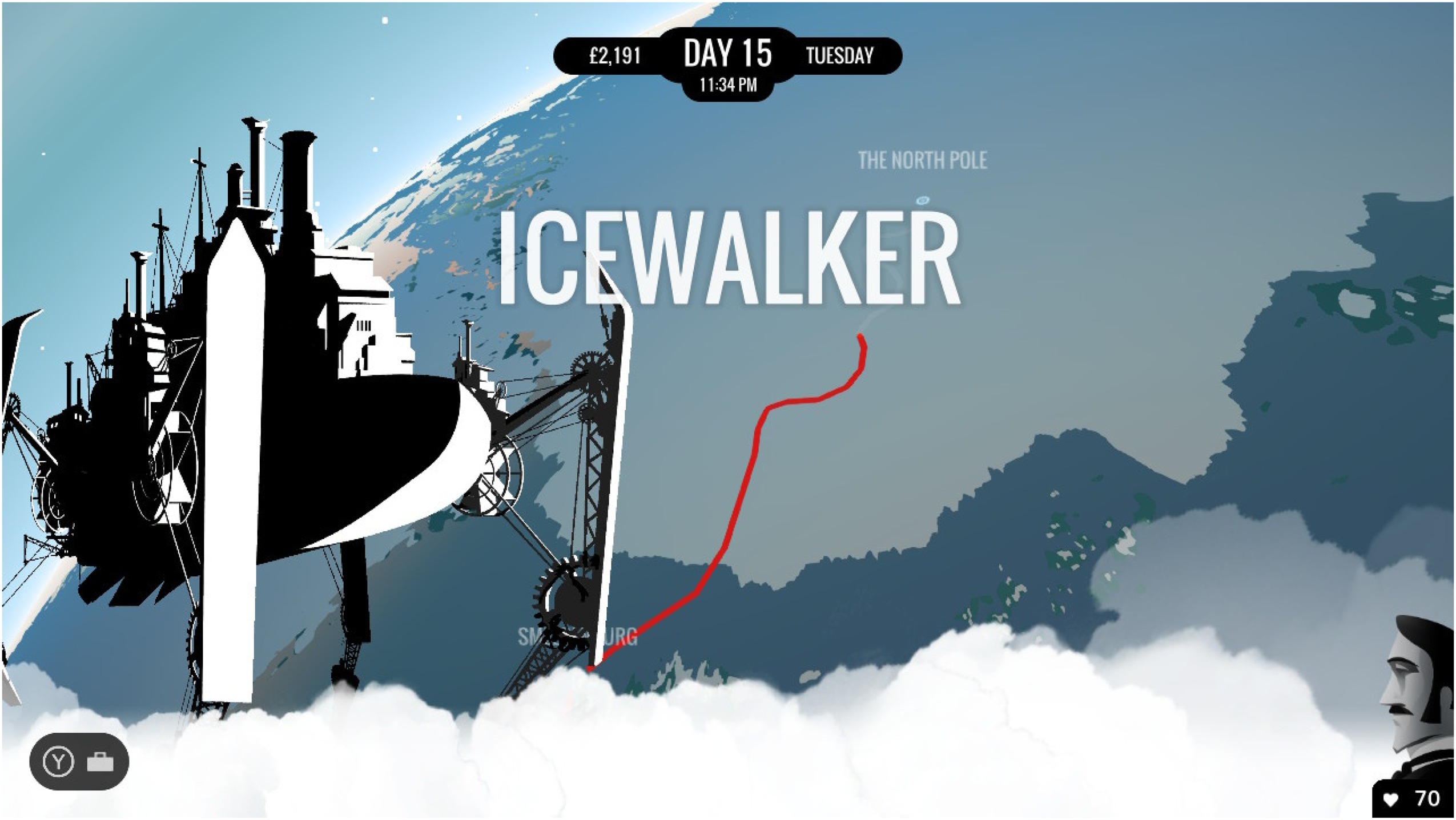
80 Days.
While the narrative of the entire game emphasizes the agency of colonized populations and their refusal to accept imperialist control, the gameplay mechanics undermine this initial impression. As the players take the role of French valet Jean Passepartout, they experience the journey from the perspective of a white European man who can move freely between different geographic regions (even though his duty to his employer limits his mobility to a certain extent). Since winning the game entails completing a journey around the world in a limited amount of time, the player's focus is less on exploring the different locales and more on quickly finding ways (and funds) to move on. Among the aforementioned options for obtaining funds for travel, the most profitable one is buying and reselling goods. Thus, although 80 Days contains several representations of anticolonial resistance on the diegetic level, the gameplay mechanics of taking the role of a privileged white European man who enjoys freedom of movement and benefits from the advantages of free trade invite players to identify with imperialist profiteers rather than inspiring empathy toward colonized populations.
However, the polar expedition storyline changes that narrative by confronting Passepartout (and by proxy the player) with the limits of his agency. In Smeerenburg, Passepartout meets Finnish meteorologist and artificer Vitti Jokinen who informs him about his planned expedition to the North Pole. Passepartout is intrigued by such a prospect: “I could not stop thinking of the North Pole: it was a dream, a myth, as much as any real place. It was one of my dreams, too—what child had not read the stories of Franklin's lost expedition of 1845 and imagined themselves finding his ship, perfectly preserved? Of sailing into the pure white and making something unknown—known?” (Inkle, 2014). This quote illustrates Passepartout's romanticized ideas that can be traced back to reading about polar exploration in juvenile literature (for more information on how books aimed at adolescents engage with historical Arctic exploration, see Hansson, 2018, p. 47). Through his fantasies of recovering Franklin's ship and of “making something unknown—known,” Passepartout casts himself in the role of a heroic explorer imagining the “pure white” of the Arctic as a blank canvas that is passively waiting for his intervention.
Due to Fogg's bribing of the expedition leader, he and Passepartout can join the mission and board an experimental vehicle called the “Ice Walker.” The fact that Fogg and Passepartout are part of the research trip because of Fogg's wealth rather than due to any scientific achievements leads to negative comments from the crew. Once the player has boarded the Ice Walker, the entire gameplay focuses on the interpersonal relationships between the playable character and the crewmembers. Options to befriend the Ice Walker's staff include attempting to assist them to hunt a whale, 1 helping a stowaway to sneak aboard, praising the cook's skills, bribing a navigator to share gossip, or intervening in a fight between the pilot and chief navigator. Additionally, the players have the opportunity to initiate a romantic relationship 2 between Passepartout and Vitti Jokinen. While this step is optional and does not entail any advantages or disadvantages for the course of the Arctic expedition, it opens up a new potential ending of the game, namely Passpartout leaving Fogg to settle down with Jokinen.
The Ice Walker's Arctic expedition is interrupted when the vehicle suddenly crashes leaving the crewmates stranded in the icescape. As several days pass, Passepartout becomes increasingly desperate: “I no longer remember what it is like to be warm. Perhaps I have never truly been so, the memories seem so fragile. They spin away like dust, like snow. There has only ever been this: cold that has not enough mercy to numb, wind that howls like a pack of wolves on the hunt” (Inkle, 2014). In contrast to the tradition of Arctic fiction using representations of “hostile nature [to] emphasise[…] [the explorers’] fortitude and reinforce[…] a model of heroic masculinity” (Hansson, 2018, p. 51), 80 Days represents the harsh environment as life-threatening and as confronting the protagonists with the limits of their agency.
Fogg is seriously injured when the vehicle collapses, and his survival depends on Passepartout's ability to secure provisions from expedition members. Contrary to other storylines in the game where a decline in Fogg's health will merely lead to delays in traveling, in this plotline, the player can lose the game by letting Fogg die. If Passepartout has managed to maintain good relationships with the other crew members, they will step in to help him with supplies. Thus, 80 Days emphasizes the value of cooperation over competition and moves away from preconceived notions of the individualistic explorer.
This negation of polar exploration as the domain of heroic individuals is underscored further when a group led by Ráijá Juho, a Sámi marine biologist who had wandered off into the distance earlier and was presumed dead by Passepartout, eventually rescues the stranded Ice Walker crew. In an airship, she takes the survivors to the sacred city of Qausuittuq at the North Pole. Qausuittuq is the name of a real-world national park in the area today known as Canada. In 1953, the Canadian government forcibly relocated several Inuit families to previously uninhabited islands in the High Arctic (including two islands surrounding Bathurst Island where Qausuittuq is located) to claim the Arctic Archipelago as Canadian territory (cf. Dumas, 2020). Thus, the game re-envisions a real-world locale of traumatic uprooting as a space for indigenous self-empowerment. In 80 Days, Qausuittuq serves as a secret shelter and research facility for various indigenous peoples of the Arctic: “This, then, is the North Pole. It is a city, with streets of carved ice, filled with a mixture of Arctic peoples: many Sámi, but also Siberian Nenets, tattooed Yupiks and Netsiliks, Alaskan Inupiats—even some Buryats and Khanty” (Inkle, 2014). This is in stark contrast to conventional Arctic fiction in which “[i]t is only rarely that the region is depicted in social terms, as a site of modernity and future possibility” (Hansson, 2018, p. 53). Evoking associations with the Inuit Circumpolar Council, 3 Qausuittuq is ruled by a democratically elected council. As the city is supposed to stay hidden, this council decides on the fate of Fogg and Passepartout.
During the council's consultation, Passepartout (and the players) learn more about Qausuittuq as they listen to a Councillor: “Qausuittuq was founded for one purpose—for the Circumpolar peoples to learn and develop the technologies of steam and oil and automata. To make them our own, before they destroy our homes, our culture, our way of life […] We have seen what has happened to the Native Americans, to the First peoples, to the Kazakhs and Buryats […] We will not let that happen to us” (Inkle, 2014). Thus, 80 Days explicitly imagines advanced technology as a potential tool for anticolonial resistance. The game represents the Circumpolar peoples not as passive victims but rather as ingenious strategists who are better equipped to cope with the challenging circumstances on the North Pole than European would-be explorers like Fogg and Passepartout. 80 Days also envisions the North Pole as a space that allows for (or even necessitates) transnational solidarity, on multiple levels: This includes the crew of the Ice Walker working together to reach the North Pole and Passepartout being dependent on the goodwill of his fellow expedition members but also Circumpolar peoples united in their resistance against imperialism.
In the end, the Council decides to keep Fogg and Passepartout in Qausuittuq indefinitely to keep the city's existence a secret. However, the men manage to escape by sneaking onto the airship of Nenets captain Ain Vanuito. Their journey back to London continues as usual with the player acquiring funding through trade or money loaning and finding modes of transportation. If choosing to stop in Nanortalik, the player can reunite Passepartout with Vitti Jokinen. If Passepartout and Jokinen had engaged in a romantic and/or sexual relationship on the Ice Walker, the player can end the game in Nanortalik with Passepartout opting to stay with Jokinen instead of joining Fogg on his trip back to London. Most other storylines lead to the same ending, that is Fogg and Passepartout returning to London either triumphantly (if completing the journey in 80 days or less) or crestfallen (if their journey has taken more than 80 days) whereupon the game prompts the player to start another playthrough. Staying with Jokinen enables the player to break that circle (to a certain extent since it is still possible to start another playthrough immediately afterward). Following the analytical framework outlined in José Esteban Muñoz's Cruising Utopia, this ending might be read as proposing “the rejection of a here and now [in this case: of servitude to Fogg in particular and capitalist colonialism more generally] and an insistence on potentiality or concrete possibility for another world [in this case: Passepartout and Jokinen spending the rest of their lives together in Nanortalik]” (2009, p. 1). However, the fact that the couple chooses to make their home in the ancestral territory of the Greenlandic Inuit thus perpetuating settler-colonialism leaves a slightly bitter aftertaste. While this ending can certainly be read as reproducing imperialist stereotypes of Arctic regions as empty spaces that await white male European conquest, it might also signify a new beginning with Passepartout and Jokinen starting their own inclusive community in Nanortalik free from the constraints of Victorian heteronormative culture living in harmony with local flora, fauna, and (potentially) people. As the playthrough 80 Days ends immediately after deciding to stay with Jokinen, presenting the player with just a newspaper headline saying “Fogg returns solo—Valet's whereabouts unknown” (together with the subheading “Arctic cannibalism rumours fly”—an allusion to Franklin's lost expedition), the game leaves the issue of Passepartout's (and Nanortalik's) future open to the players’ imagination.
My analysis has shown how 80 Days represents polar exploration in a deheroizing manner on multiple levels: instead of casting Fogg and Passepartout in the role of individualistic triumphant explorers, the game emphasizes cooperation over competition by making the formation of amicable relationships with the Ice Walker crewmates a prerequisite for winning the game. While all those instances of collaboration challenge individualizing narratives of polar exploration, it is important to note that transnational solidarity itself is not inherently anticolonial, as 80 Days features not just cooperation between the Circumpolar peoples of the Arctic but also between the potential colonizers of the Ice Walker's crew. Additionally, the North Pole is not represented as an asset to claim for a nation's glory but as a space of transnational solidarity and anticolonial resistance. Whereas the European protagonist struggles to survive in the Arctic icescape, the inhabitants of Qausuittuq have managed to use the remote location to their advantage by building a secret research facility turning the North Pole into “a site of modernity and future possibility” (Hansson, 2018, p. 53). Thus, 80 Days invites players to become aware of the imperialist impetus of historical polar exploration while simultaneously celebrating the diversity and resilience of the indigenous peoples of the Arctic. However, a straightforward reading of 80 Days as anticolonial is complicated by its general gameplay mechanics. The gameplay of moving quickly from one place to another while profiting from free trade implies a view of the exoticized locations as a playground for wealthy Europeans and may serve as an example for what Mukherjee has termed “a colonial framing of the ludic” that might “perpetuate the logic of colonialism instead of challenging it” (2017, pp. 31–32). This productive tension between explicit representations of anticolonial resistance on the story level (to which the playable character can react either supportive or deterred) and a gameplay that invites players to view the visitable locales merely as providing entertainment and exploitable resources characterizes 80 Days’ complex and nuanced treatment of colonialism of which my analysis of the Arctic expedition storyline can only provide a glimpse and that certainly warrants further research.
“Heroic Failure”—the Powerless Protagonist of South of the Circle
Set in 1964, South of the Circle tells the story of British climate scientist Peter Hamilton who struggles to survive after his plane crashes in Antarctica. While trudging through the icy landscape in search of help, Peter is haunted by memories of his former girlfriend and colleague Clara that appear in the form of flashbacks. The gameplay mechanics mainly consist of choosing dialogue options, in addition to some minor tasks such as examining one's surroundings or adjusting radio devices. Due to the linear structure of the game, the gameplay is not particularly challenging (e.g., it is impossible to lose the game), so the players can focus entirely on the story that is told. In contrast to the user interface of 80 Days which consists only of a few background illustrations and mainly requires the players to read text, South of the Circle makes more extensive use of visuals as the players move Peter across the Antarctic landscape from a third-person perspective.
Contrary to Chang's observation that “[g]ame environments […] tend to lean heavily on clichéd landscapes, abandoning any attempts at regional specificity,” the creators of South of the Circle emphasize that their design closely resembles the actual Antarctic scenery (cf. Maher, 2021) and thus conforms to what Chang terms “environmental realism” (2019, p. 22). Indeed, the players can find actual maps of Antarctic regions within the game. When one tries to use these maps for navigational purposes, however, the constant snowfall has a severely disorienting effect, obscuring any distinct landmarks (see Figure 2). The player's restricted view feels “almost claustrophobic, robbing the setting of its epic character” (Bloom, 2022, p. 31). Despite the limitation that Peter's movement is largely restricted to certain preset tracks, the player still experiences an uncomfortable lack of orientation. The fact that the maps have become practically useless creates a feeling of utter powerlessness and isolation. This sense of isolation increases when Peter eventually arrives at a research facility, only to discover that it is completely abandoned, creating the spooky atmosphere of a ghost town. Eventually, Peter returns to the crash site empty-handed, increasing the player's feelings of disempowerment and futility.
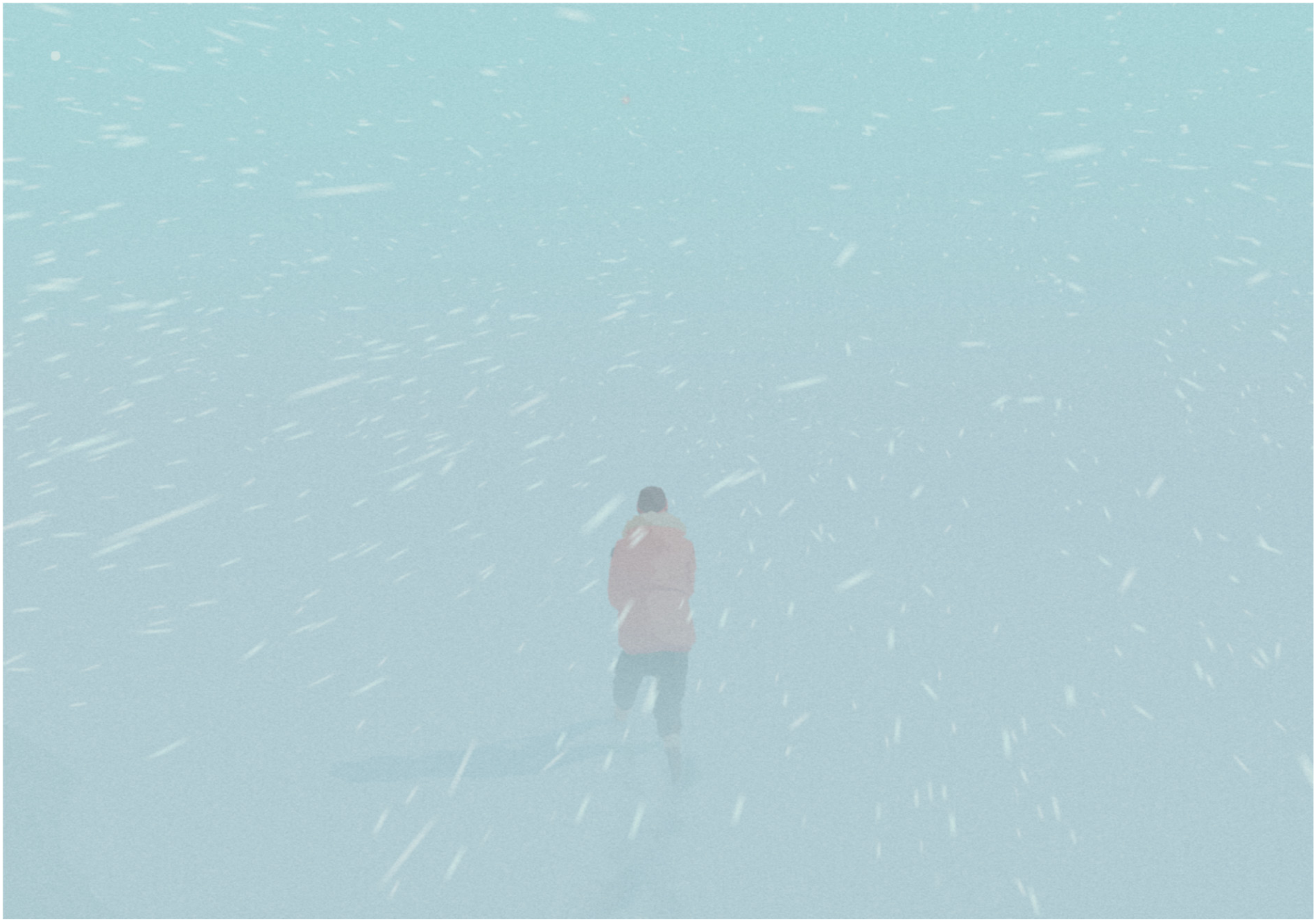
South of the Circle.
As Peter and Floyd (the pilot of the airplane that brought them to Antarctica) wait for a rescue squad, Floyd jokingly tells Peter that the British “government loves to give out honors to failed antarctic [sic] explorers” and cites Ernest Shackleton and Robert Scott as examples (State of Play, 2020). He then calls them “heroic failures” and includes Peter in his list (State of Play, 2020). Answering Auguscik's call “to rethink how heroic-era explorations are remembered and by whom” (2019, p. 60), Floyd's remark hints at a certain disillusionment with heroized representations of historic polar explorers and criticizes the political instrumentalization of Shackleton and Scott's expeditions. Bloom explains “how the traumatic experience of failure in both the British and the American expeditions was reworked to turn the official version of events into something that was at once psychically and physically undisturbing and worthy of public reverence” (2022, p. 58). By turning those unsuccessful attempts of Antarctic expeditions into inspirational stories, “failure […] can be recuperated as a heroic example of character, scientific achievement, or even honor” (Bloom, 2022, p. 58). While Peter himself appears to be led by idealistic visions of using his science to research weather patterns for the benefit of humankind, Floyd is aware of the wider political implications of Peter's (and other scientists’) work in Antarctica, particularly as it relates to international power constellations.
The Cold War figures prominently in South of the Circle: In flashbacks, the player learns that Peter's workplace, Cambridge University, is still in uproar after the discovery of the Soviet spy ring known as the Cambridge Five and that Peter's polar expedition is part of the UK's efforts to achieve what Howkins has termed “environmental authority” (2016, p. 8). Howkins defines environmental authority as “the assertion that the production of useful scientific knowledge about an environment helps to legitimate political control over that environment” (2016, p. 8). South of the Circle engages with this idea of a potential political instrumentalization of science by revealing that Peter's research stay is funded by a government agency that promises him “a practically unlimited budget for further study” if Peter uses his presence in Antarctica to report on any Soviet activities that he encounters (State of Play, 2020). Peter indeed stumbles upon a building that features the warning symbol for radioactivity on its entrance door and he eventually discovers that the reason why everybody else has left Antarctica is an incident involving radioactive radiation originating from a Soviet research facility. This part of the storyline exemplifies a representation of Antarctica as what Bloom has conceptualized as an “anthropogenic landscape,” that is, an environment shaped by human influence (as opposed to stereotypical images of pristine Antarctic nature; Bloom, 2022, p. 13). Thus, South of the Circle can be considered as participating in the recent trend of polar fiction representing human activity as the primary “source of dread” instead of the harsh natural environment (Bloom, 2022, p. 52). The game illustrates how Antarctica is “closely connected to globalized economic and geopolitical forces” through its Cold War setting (Bloom, 2022, p. 45).
The way the game engages with the Cold War ties in with Leane's suggestion that “imaginative responses to Antarctica in the twentieth century provide a unique perspective on the geopolitics of the Cold War. Its remote and isolated location enables anxieties around contagion, containment and concealment to be spatialised and explored” (Leane, 2020, p. 696). Although South of the Circle was released in the twenty-first century, this still holds true: Just as Floyd and Peter's situation appears to be hopeless, they encounter a Russian engineer who missed the evacuation. After initial distrust, the three men cooperate to repair the airplane and are finally able to leave Antarctica. Despite the hostilities between their nations, all three characters are willing to work together as their survival depends on it. Thus, South of the Circle emphasizes the importance of transnational solidarity. However, the individual characters’ cooperation is temporary and for a specific purpose (i.e., their survival) and does not have any influence whatsoever on the wider geopolitical power relations of the Cold War. Just like in 80 Days, transnational solidarity is not inherently anticolonial and pro-nature, though it does work to disrupt narratives of individualist heroism. While the departure of the plane forms the ending of Peter's Antarctic storyline, the flashbacks informing the player about Peter's relationship with Clara continue.
Following traditions of representing a trip to Antarctica so that “the journey south becomes a process of transformation, insight or self-discovery” (Leane, 2018, p. 60), Peter's character development is at the center of the game. At first, Peter appears to be a dedicated scientist who is capable of coping with the hardships of the polar environment. As the story unfolds, Peter's physical condition worsens, evident in his slower movement. Additionally, the player begins to question the accuracy of Peter's memories, depicted through flashbacks that blend visually with his journey through Antarctica. While some of those flashbacks concern Peter's childhood (and his unsuccessful attempts to conform to his father's stereotypical ideas of masculinity), most of them relate to Peter's relationship with his colleague Clara. Each flashback reveals more about Peter and Clara's romance starting with a chance meeting on a train, then continuing with both of them collecting and analyzing meteorological data together and eventually culminating in a jointly authored research paper.
As Peter reaches the Antarctic rock formation Cathedral Rocks (so named by Scottish polar explorer Albert Armitage in 1902) while searching for help, the craggy cliffs blend into the sunny mountain ranges of the Scottish Highlands, as the players learn more about Peter and Clara's romance in another flashback. Clara, who—due to the voice actor's accent 4 —appears to be Scottish, has taken Peter to her family's holiday home in a remote area of the rural Highlands. Together, they use meteorological balloons to collect weather data. Because of her familiarity with the region (and scientific competence as well as physical fitness), Clara plays a decisive role in data collection and analysis. As “the human history of the Antarctic has largely been narrated through the lens of white male heroic polar and oceanic exploration” (Bloom, 2022, p. 26), on the one hand, Clara's presence in the game and its representation of her scientific expertise works to counter such mainstream images of Antarctica. On the other hand, the parallelization of both Antarctica and the Scottish Highlands as presumably empty spaces that can be conquered by English men like Peter and serve as a vacant projection surface that lends itself to white male introspection also reproduces imperialist-expansionist stereotypes. Though if we read Antarctica (and by extension, the Scottish Highlands) as “a male testing ground” (Bloom, 2022, p. 57), Peter certainly fails that test: In the Highlands, he struggles to keep up with Clara due to his lack of bodily fitness and in Antarctica, he barely survives a few hours in the icescape.
Peter's failure is not just of a physical, but also of a moral nature: As the story told through the flashbacks progresses, Peter experiences a crisis of conscience when his supervisor Professor Hargreaves tries to convince him to cut Clara's name from the list of authors of their joint publication. Peter's feelings of being torn between his loyalty to Clara (whom the flashbacks show has done the majority of the work on the publication in question) and the expectations of the scientific community at Cambridge University with its patriarchal structure form the central conflict of the story. In the game, this is shown through the repetition of the flashback scene in which Peter's supervisor suggests not acknowledging Clara's contribution. Each of those scenes starts with Professor Hargreaves greeting Peter with “Marvellous to see you. Do come in. Take a seat” (State of Play, 2020). The repetition of this scene with minor changes each time is an indicator of the unreliability of Peter's memories.
The player's doubts concerning the degree of reliability are eventually confirmed at the turning point of the game: Clara confronts Peter about his decision to erase her name from the author's list of their joint publication. At first, this is confusing for the player as all previous interactions with Professor Hargreaves ended with Peter's refusal to comply with the request to cut Clara's name. However, during the argument, the player slowly realizes that Peter has misremembered the events and/or deluded himself into believing that he stood up for Clara while the betrayal of her trust has already happened (because otherwise, he would not be in Antarctica). All the choices that the player made to prevent that from happening are revealed as meaningless. After the argument, the player is once again thrown into a version of the scene in which Peter is asked by Professor Hargreaves to appear as the only author of his co-authored paper. Contrary to the previous iterations, the player has the choice either to accept the deletion of Clara's co-author credit or to insist on her inclusion. This is the only decision in the entire video game that influences the visuals that the player sees. If Peter defends Clara, the final image will be of the couple watching a sunset in the Scottish Highlands together, whereas the decision to give in to Professor Hargreaves’ demands will lead to an image of Peter watching the sunset all by himself.
My analysis of South of the Circle has shown how the game's narrative brings together representations of nature, nation, and masculinity to emphasize Peter's (and by proxy the player's) powerlessness. The restrictive gameplay with its minimal interactive elements works to reinforce this feeling of a lack of agency. Peter's scientific expertise in meteorology cannot help him to navigate Antarctic weather phenomena and his helplessness is illustrated through visual images in which the player's field of vision is severely restricted due to heavy snowfall. These harsh environmental circumstances are not simply shown as an obstacle for Peter to overcome on his path to greatness but take a toll on him both physically (he moves more slowly the longer the game takes) and mentally (the flashbacks that I read as his memories become more frequent toward the end of the game). In the end, it is only through the help of others that Peter manages to survive. The game's representation of the British government's decision to fund Peter's research trip not just for scientific purposes but also as a way to spy on Soviet activities in Antarctica as well as Peter's dialogue with Floyd come together to criticize the political instrumentalization of scientists and their work. Peter's struggles with conforming to stereotypical ideals of masculinity and his need to carve out a place for himself within the patriarchal structures of Cambridge University eventually lead to him prioritizing his career over his loyalty to Clara. Peter's dawning realization that he is only a powerless pawn at the mercy of higher powers (Professor Hargreaves and the British government, respectively) on the diegetic level is complemented by the player's eventual recognition that South of the Circle merely offers the illusion of choice. The outcome of Peter's story is already predetermined: regardless of which dialogue options the player picks, Peter's betrayal of Clara cannot be prevented and his polar expedition is doomed to failure from the start.
Conclusion
In this article, I have demonstrated how reading video games as polar fiction can make visible common themes across different media. On the one hand, both 80 Days and South of the Circle continue employing motifs already present in other media (e.g., literary fiction, film, caricatures, etc.) such as a critique of nationalism, imperialism, and conventional ideas of masculinity. On the other hand, the interactive elements of 80 Days and South of the Circle contribute to a very specific sense of immersion that lets the players experience the protagonist's feelings of powerlessness firsthand. Their restrictive gameplay enhances that perceived lack of agency: whereas playing 80 Days consists of selecting prefabricated dialogue options, South of the Circle has the player move the protagonist along predetermined tracks while the majority of decisions the player makes remains without consequences.
Toying with players’ expectations concerning the presumably heroic nature of polar exploration (exemplified in 80 Days through Passepartout's reception of narratives of Franklin's expedition), both games have the player take the role of a white European man who can be reasonably assumed to be privileged and powerful. This supposed dominance of the protagonist is quickly revealed as a fragile illusion since the situations in which the playable character ends up are precarious nonetheless. The games represent not individualist endurance but rather transnational solidarity as the key to survival in the harsh environment of the polar regions. This emphasis on cooperation over competition is only present on the story level and does not extend to gameplay as both games only offer a single-player mode.
By representing transnational collaboration as desirable, 80 Days and South of the Circle portray nationalist ambitions as misguided efforts caused by outdated stereotypes of masculinity. The dismantling of these stereotypes takes place through both games’ subversion of the heroic explorer myth. There is nothing heroic about Passepartout and Peter's journeys. They do not discover any places hitherto unknown to humankind; their expeditions do not lead to any new scientific insights; neither their Europeanness nor their masculinity serves to protect them from the harshness of polar icescapes; in the end, they are the ones who need to be saved by others whom they considered to be inferior to them earlier (i.e., indigenous women in 80 Days and Russians in South of the Circle). Thus, the representation of the protagonists of both games suggests a deheroization of (European) polar exploration with tales of transnational teamwork replacing the individualist heroic explorer of earlier polar fiction. However, the games’ representation of transnational solidarity mostly stays on an individual level, with temporary alliances that usually serve specific purposes. It is also important to note that the emphasis of both games on collaboration is not necessarily anticolonial or pro-nature: both 80 Days and South of the Circle feature colonizing powers working together to exploit natural resources and dominate nature. Thus, the games’ representation of polar exploration takes on complex and ambiguous qualities that go beyond a complete rejection or straightforward reproduction of heroized narratives.
While the results of my analysis point to a growing critical awareness of entanglements between polar exploration, imperialist ambitions, and stereotypical ideals of masculinity among video game creators, it should be noted that I have only taken a small body of a very specific subset of games into account: British story-driven indie video games. Future research could fruitfully explore this issue further by including video games of other genres or created in other countries to illuminate whether my results are indicative of a larger trend in the industry.
Footnotes
Declaration of Conflicting Interests
The author(s) declared no potential conflicts of interest with respect to the research, authorship, and/or publication of this article.
Funding
The author(s) received no financial support for the research, authorship, and/or publication of this article.
