



Abstract
Research has shown that seeking fun and enjoyment (i.e., hedonic reasons) motivates playing digital games. However, recent scholarship revealed that gaming also evokes eudaimonic entertainment experiences, such as meaningfulness and being moved. Yet, it is unclear whether players turn to games to have such eudaimonic experiences. Hence, the present study explored potential eudaimonic gaming motives in an online survey among fans (N = 894) of five yet-to-be-released games. Specifically, it was examined whether eudaimonic motives, derived from gaming research and scholarship in positive psychology, complement an existing scale measuring gaming motives. Exploratory and confirmatory factor analysis (split-half method) demonstrated that “Eudaimonia” represents a distinct reason to play—alongside the well-known motives of “Absorption” and “Social Interaction.” Moreover, the Eudaimonia motive for using the five games was positively related to general eudaimonic orientations in life and trait-like eudaimonic game preferences. The results suggest that digital gaming may also be eudaimonically motivated.
Modern digital games reach players of all ages and backgrounds (Entertainment Software Association, 2021). Game researchers have often attributed this broad attraction to the medium's strong capacity to evoke rich entertainment experiences (Klimmt & Possler, 2019). Although pleasure and enjoyment (i.e., hedonic experiences) arguably drove much of the medium's initial focus (e.g., Sherry, 2004), modern games have been found to evoke more complex, “eudaimonic” experiences, such as meaning, self-reflection, or being moved (Daneels et al., 2021).
Although research has shown that these eudaimonic responses are often integral to gamers’ entertainment experience (Klimmt & Possler, 2019), they have rarely been discussed as attractors motivating playing. Rather, most well-established gaming motives seem to be related to pleasure instead of eudaimonia (Possler et al., 2020). Indeed, systematic reviews suggested that validated scales on eudaimonic reasons for playing are virtually absent in the literature (Holl et al., 2023) and eudaimonic motives have been explored little in studies on eudaimonia in games (Daneels et al., 2021; Possler et al., 2022). Consequently, a scoping review of eudaimonic concepts in the gaming literature recently concluded a “relative neglect of eudaimonic motivations” research (Daneels et al., 2021, p. 186).
The present study addresses this research gap by theoretically conceptualizing and empirically investigating potential eudaimonic reasons for playing digital games. By broadening the spectrum of previously investigated motivational processes underlying gaming, we aim to better explain digital games’ popularity. Moreover, our study promises insights into the formation and nature of eudaimonia in digital games: One possible explanation for the observed lack of findings on eudaimonic gaming motives is that players may not seek out games for eudaimonic reasons but rather experience eudaimonia incidentally in search of fun (Possler et al., 2020). Simply put, game researchers may not have identified eudaimonic motives because gaming is not motivated by eudaimonia. Our study presents an initial investigation of this assumption by studying whether people have eudaimonic reasons for playing digital games.
In the following, we first introduce the distinction between eudaimonic and hedonic motives and provide an overview of both eudaimonic gaming and game motivation research. In combining these lines of research, we conceptualize eudaimonic gaming motives. Subsequently, we present an exploratory survey study of fans of five upcoming games (N = 894) that examined whether the theoretically derived eudaimonic motives complement well-established hedonic reasons for playing (Scharkow et al., 2015). Specifically, we explored whether hedonic and eudaimonic gaming motives can be analytically differentiated and how they are related to player- and game-related characteristics.
Hedonic and Eudaimonic Orientations and Entertainment Preferences
The idea that people sometimes seek more than just pleasure when engaging in activities dates to ancient philosophers (Huta & Ryan, 2010; Huta & Waterman, 2014). Most notably, Aristotle (ca. 350 B.C.E./1994) assumed that in order to live a good life, it is not sufficient to seek pleasure (hedonia), but one instead must strive for the realization of virtues or excellence (i.e., realize one's rational nature; Kraut, 2022). Aristotle referred to this way of living well as eudaimonia. Scholars have translated the distinction between hedonic and eudaimonic pursuits to modern (positive) psychology, defining them as stable (i.e., trait) or situational (i.e., state) motives for activities (Huta & Waterman, 2014). Although hedonic orientations are frequently described as seeking pleasure (e.g., positive emotions) and comfort (e.g., relaxation; Huta, 2016), definitions of eudaimonic orientations encompass components such as striving for authenticity (i.e., who one truly is), meaning (i.e., serving a higher purpose), excellence (i.e., reaching high standards), and personal growth (i.e., realizing one's potentials; Huta, 2016; Peterson et al., 2005; Vittersø et al., 2010). For example, Huta and Ryan (2010) measured general eudaimonic orientations in their Hedonic and Eudaimonic Motives for Activities (HEMA) scale as “seeking to pursue excellence […] to use the best in yourself […] to develop a skill, learn, or gain insight into something […, and] to do what you believe in” (p. 741).
Next to other areas, eudaimonic motives have been found to drive the selection and use of media entertainment. For instance, Oliver and Raney (2011) showed that movie users possess stable eudaimonic motives—trait-like preferences for movies that provide them with meaningful, reflective, challenging, and moving experiences. Similarly, Lozano Delmar et al. (2018) found two stable eudaimonic motives for watching fictional TV series: (1) cognitive-intellectual growth (i.e., preferring TV series that spark reflection, arouse curiosity, and feature original ways of storytelling) and socio-emotional growth (i.e., preferring to be socially and emotionally involved when watching). Koopman (2015) found similar motives for reading books such as meaning-making (i.e., insights and personal growth) positively predicted reading the so-called “sad books” (i.e., books featuring tragic narratives). All in all, these findings suggest that people use entertainment media not only for pleasure but also for eudaimonic reasons.
Eudaimonic Gaming Research
In recent years, game researchers adopted the distinction between hedonia and eudaimonia (Klimmt & Possler, 2019), mostly to describe digital gaming experiences (Daneels et al., 2021). The definitions of eudaimonia and hedonia in this context mostly follow earlier conceptualizations (see above). Accordingly, hedonia is typically defined as the enjoyment and fun associated with playing games (Klimmt & Possler, 2021). The definition of eudaimonia, in turn, is less consistent in game research. As a scoping review showed (Daneels et al., 2021), descriptions often include experiences such as meaningfulness (e.g., Oliver et al., 2016), being moved (e.g., Bopp et al., 2016), overcoming emotional challenges (e.g., Bopp et al., 2018), self-reflection (e.g., Mekler et al., 2018), having deep social connections (e.g., Rogers et al., 2017), nostalgia (e.g., Wulf & Baldwin, 2020), and self-transcendent emotions such as awe (Possler et al., 2018) and elevation (Daneels et al., 2020). Given that playing digital games can result in many eudaimonic experiences and that eudaimonia was found to motivate media use in general, it seems likely that eudaimonia is also an important reason why players turn to games.
Eudaimonia in Game Motive Research
Well-Established Motives of Digital Game Use
The motivational processes underlying players’ decision to buy and play digital games have been studied intensively (see Table A1 in the supplementary materials file stored in our Open Science Framework [OSF] project: https://osf.io/ezt8r/). For example, by drawing on Self-Determination Theory (SDT; Deci & Ryan, 2000), several studies have found that players’ fundamental needs to feel competent, experience autonomy, and feel related to significant others motivate digital game use (e.g., Reinecke et al., 2012; Ryan et al., 2006). De Grove and colleagues (2016), in turn, examined gaming motives based on the Social Cognitive Theory (SCT; LaRose & Eastin, 2004). Their study showed that playing games is also motivated by the desire to experience an involving story, to temporarily escape problems of everyday life, to pass the time, by habitual behavior, and by the moral evaluation of gaming as a leisure activity. Again other studies relied on the Uses and Gratifications Approach (UGA; Katz et al., 1973). Although the UGA has often been criticized for overestimating media users’ reflectiveness and activity in media selection (Ruggiero, 2009), studies identified a variety of motives underlying digital gaming (e.g., Sherry et al., 2006; Yee, 2006). Although stemming from different theoretical traditions, gaming motives identified in UGA studies largely mirror those identified in SDT and SCT research (also see Table A1).
Various attempts have been made to synthesize this research. For example, based on a systematic literature review, Holl et al. (2023) developed a scale that broadly summarizes prior findings and includes ten gaming motive dimensions (i.e., creativity/exploration, escapism, competition, prestige, enjoyment, achievement, socializing, boredom, aggression, and skill). Likewise, Scharkow et al. (2015) presented a scale encapsulating much of gaming motives research. The authors distinguish three types of motives: individual motives of immersion in fantasy worlds, experiencing competence, and exploration; social motives, that is, making friends, team-based play, and competition; and content-based motives related to the notion that players may be motivated to play a game due to its narrative, mechanics, or graphics.
As this overview shows, eudaimonic motives are rather absent in established catalogs of gaming motives. This is particularly evident when comparing the scales synthesizing the state of research (Holl et al., 2023; Scharkow et al., 2015) with the experiences identified in eudaimonic gaming research (see above; Daneels et al., 2021). Yet, it could be argued that some gaming motives may be associated with eudaimonia. For example, seeking exploration may result in meaningful insights, and making friends may lead to deep social connections. However, a study among fans of the game Mass Effect: Andromeda (BioWare, 2017) found that individual, social, and content-based gratifications (Scharkow et al., 2015) had stronger explanatory power for players’ enjoyment than for their eudaimonic entertainment experience (Possler et al., 2020). Thus, overall, it seems that research on gaming motives has mostly overlooked eudaimonia.
Existing Studies on Eudaimonic Gaming Motives
Outside of these general gaming motivation studies, some first studies have investigated eudaimonic motives (Possler et al., 2022). However, the few existing studies are characterized by at least two shortcomings: (1) they show a disparity between stable and situational motives and (2) they include a limited range of eudaimonic game motives focused primarily on meaning and reflection.
First, most studies built on Oliver and Raney’s (2011) conceptualization of eudaimonic motives for media use and, thus, defined gaming motives as stable preferences for meaningful, challenging, and moving games (e.g., Possler et al., 2020; Wulf & Baldwin, 2020). However, the decision to play a particular game is likely not only motivated by stable preferences (e.g., playing an emotionally challenging game because of a general taste for sober entertainment) but also driven by situational motives (e.g., playing a particular game because it induces nostalgia, even though it may not match one's usual preferences).
A second shortcoming of previous research is that most studies operationalized eudaimonic motives as meaning and reflection—again, following Oliver and Raney’s (2011) scale (e.g., Possler et al., 2020; Wulf & Baldwin, 2020). Thus, other conceptualizations of eudaimonia in the gaming literature, such as social connections and nostalgia (Daneels et al., 2021), are neglected by this focus, as are the previously described eudaimonic motives identified in positive psychology, such as striving for authenticity and personal growth (Huta, 2016).
Conceptualizing Eudaimonic Gaming Motives
The preceding sections paint an interesting picture: In general, eudaimonia was found to motivate media entertainment use (e.g., Oliver & Raney, 2011), and playing digital games can lead to eudaimonic experiences (Daneels et al., 2021). At the same time, eudaimonic motives are virtually absent from established gaming motive scales (e.g., Holl et al., 2023), and the few existing studies studied stable preferences for meaningful games rather than motives (Possler et al., 2022).
Two possible conclusions can be drawn from these observations. First, game research may have overlooked a central appeal of gaming—eudaimonia. One reason for this may lie in the frequently held premise of game motivation research that entertainment equates to pleasure (e.g., De Grove et al., 2016; Ryan et al., 2006). Second, the interesting picture could also indicate that eudaimonia often occurs when playing games without being sought after (for such an idea, see Possler et al., 2020). Accordingly, eudaimonic gaming experiences could be understood as evocative states, arising without players’ control, similar to how the state of inspiration is unwillingly evoked (Thrash & Elliot, 2004). Consequently, players may not seek eudaimonia when they turn to games but stumble upon it when seeking fun (Possler et al., 2020). As a first investigation of these assumptions, the present study explores players’ eudaimonic gaming motives. Given the limitations of previous conceptualizations (i.e., exclusive focus on stable preferences and on reflection and meaning), we derive potential motives from (a) research on eudaimonic gaming experiences and (b) psychological studies on general eudaimonic orientations.
Games research has characterized eudaimonic gaming experiences as personal meaningfulness, being moved, overcoming emotionally challenging situations, self-reflection, nostalgia, deep social connections, and the self-transcendent emotions of awe or elevation (Daneels et al., 2021). Given that the decision to play games has often been regarded as the result of players’ anticipated outcomes of gaming (De Grove et al., 2016; Reinecke et al., 2012) and that these expectations are likely informed by prior experiences (Atkin, 1985), it can be assumed that some players turn to games to have these eudaimonic experiences.
Research in positive psychology additionally suggested that personal growth and self-realization, excellence and reaching the best in oneself, as well as expressing one's identity and authenticity (Huta & Waterman, 2014) may be important eudaimonic dimensions, which have to our knowledge not yet been studied in the gaming context—neither in the sense of motives nor as experiences resulting from play (Daneels et al., 2021). However, these dimensions may also be of relevance in the gaming context and motivate playing, as studies found that games offer players ways to experiment with their identity (Jansz, 2005) and create better versions of their selves (e.g., Bessière et al., 2007)—mechanisms that are likely to lead to growth, self-realization, authenticity, and identity expression (Klimmt & Possler, 2021). Moreover, games usually challenge players (Sherry, 2004) and may, thus, allow them to reach excellence and the best in themselves.
In summary, we assume that the decision to play a given game is motivated by the gaming outcomes players anticipate and seek—mostly psychological states that may occur during playing or result from it (e.g., a sense of competence). Based on the gaming and psychology literature, we derived potential eudaimonic outcomes that may motivate gaming (see Figure 1). We argue that these complement the list of established gaming motives (e.g., Scharkow et al., 2015). Moreover, we consider these motives to be situational, as the gaming outcomes a player expects and seeks are likely to vary between games and situations. However, as mentioned above, individuals also differ in their overall stable preferences for (i.e., orientations toward) hedonic and eudaimonic activities (e.g., Huta & Ryan, 2010) as well as their stable preferences for hedonic and eudaimonic entertainment (Koopman, 2015; Lozano Delmar et al., 2018; Oliver & Raney, 2011), including games (Possler et al., 2020). Thus, we assume that these stable preferences act as dispositions affecting players’ situational motives for playing (see Figure 1).
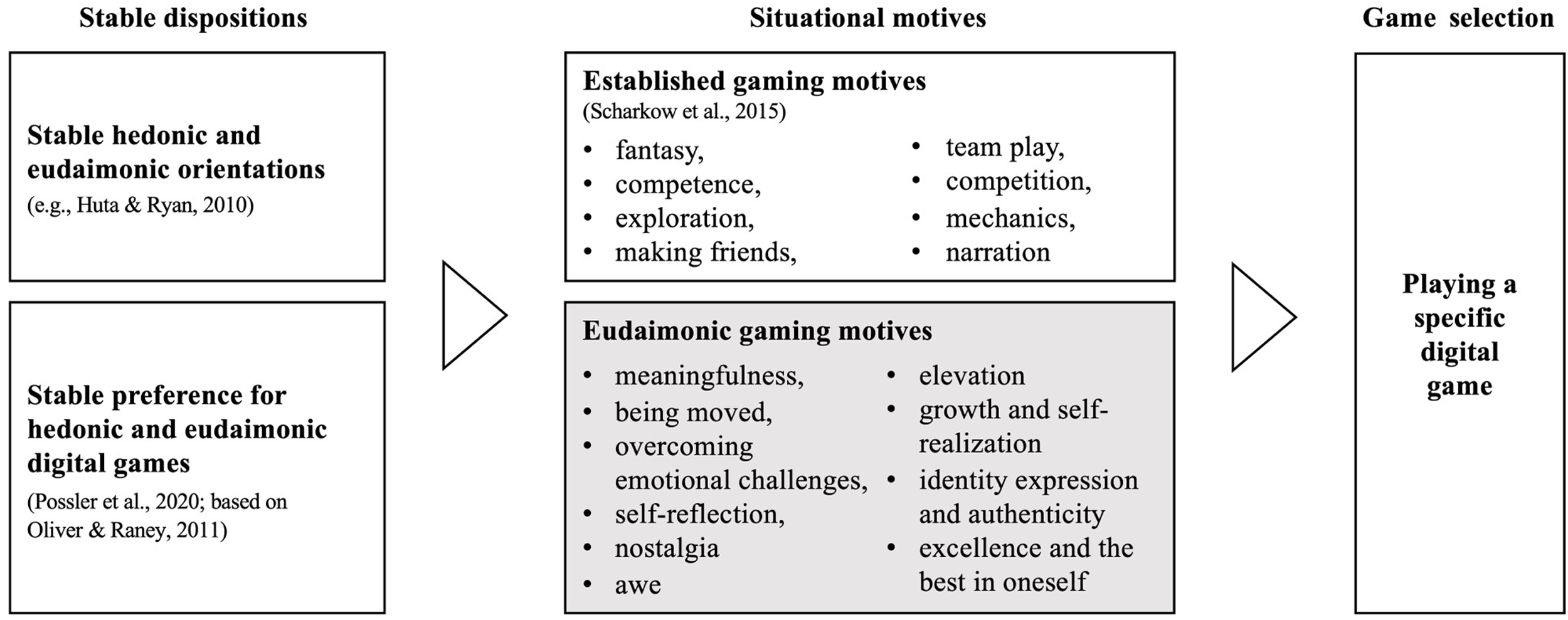
Hedonic and Eudaimonic dispositions and situational motives of digital game selection.
The Present Study
The present study explores these eudaimonic motives in a digital game context. To this end, we investigate players’ motives for playing different yet-to-be-released digital games in a survey study. We extend a well-tested gaming motives scale (Scharkow et al., 2015) to include the theoretically derived eudaimonic motives and investigate the dimensionality of the extended scale:
In the second step, we assess the validity of the extended scale by exploring the relationship between the motives and the different games. Specifically, prior research has shown that players use different games for different reasons. For example, Scharkow et al. (2015) found that several motives significantly predict players’ genre preferences. Being motivated to experience the narrative, for instance, strongly and positively predicted the preference for strategy, role-playing, and adventure games, while being motivated to experience social competition positively predicted a taste for sport and action games. Thus, we will investigate whether the motives differ between players of games of different genres/types:
Finally, we will also investigate how players’ stable preferences for hedonic and eudaimonic activities (i.e., their orientations; Huta & Ryan, 2010) and games (Possler et al., 2020) are related to their situational motives to use a given game (see Figure 1):
Method
All our study materials (e.g., questionnaires), the full data set, and the R scripts for data cleaning, processing, and analysis can be found on OSF (https://osf.io/ezt8r/).
Procedure
We conducted an online survey study to examine our research questions. The study focused on five digital games not yet released at the time of data collection (September 2021): The Legend of Zelda: Breath of the Wild 2, Mass Effect 5, Final Fantasy XVI, Far Cry 6 (Ubisoft Toronto, 2021), and Forza Horizon 5 (Playground Games, 2021). 1 There were several reasons to include these specific games in the study. First, they represent a broad range of different types of games: from a single-player game with role-playing mechanics like Mass Effect 5 to an open-world racing game with multiplayer modes such as Forza Horizon 5. This is particularly pertinent for cross-game generalizability and as a basis for examining RQ2. Second, the games are situated in well-known franchises, which facilitated the recruitment of participants into the study (see Sample). Moreover, respondents likely have clear expectations of those games based on their previous experience with the franchise. Thus, if specific experiences have occurred when playing prior titles of a franchise (e.g., eudaimonic experiences), players likely have similar expectations for future games of the series. Third, and closely related to the previous point, research has found that at least some of these franchises evoked eudaimonic responses in players: The Legend of Zelda (Bopp et al., 2016, 2018; Rogers et al., 2017), Mass Effect (Possler et al., 2020), and Final Fantasy (Bopp et al., 2016; Rogers et al., 2017). Thus, if eudaimonia motivates players to use an upcoming game, it should be observable in titles from these franchises. Fourth, none of these games were released at the time of data collection, so participants’ responses regarding their motives are not post-hoc rationalizations of gratifications obtained (e.g., “the game moves me emotionally, so this is probably why I use it”).
Five different survey links were created (one for each game studied). Before data collection started, the nature of the study was briefly introduced. Participants self-confirmed that they were at least 18 years old and offered their informed consent. All five questionnaires were identical, except that the referent game was changed. Surveys took on average 19 min to complete (SD = 18 min). At the end of the survey, participants were able to enter a lottery to win one of ten $50 USD (or equivalent) Amazon.com gift cards.
Measures
As the present analysis was part of a larger study on players’ expectations of and motives for digital game use (see companion qualitative analysis in Bowman et al., 2023), only those quantitative variables for analysis in the current study are detailed below. Additional measures not analyzed here included, among others, an introductory open-ended question about expectations for the game in question, which also served to prompt participants to reflect on their motives before answering subsequent closed questions.
The (situational) motives to play the upcoming game were measured with 29 items on a Likert scale ranging from 1 (“does not apply at all”) to 7 (“does fully apply”). Firstly, we used the gaming motivation scale by Scharkow et al. (2015), which measures (1) individual motives (i.e., fantasy, competence, and exploration), (2) social motives (i.e., making friends, team play, and competition), and (3) content-based motives (i.e., narrative, mechanics, and graphics). We added an additional item regarding “experiencing the soundtrack” as an extra content-based motive as game soundtracks were found to be a vital element of the attraction of digital games (Daneels et al., 2020; Klimmt et al., 2019). To measure eudaimonic gaming motives, we self-developed 13 items based on the dimensions discussed above (see Figure 1): seven items tapped into eudaimonic experiences identified in Daneels et al. (2021; i.e., meaningfulness, feeling moved, overcoming emotional challenges, reflection, being in awe, feeling elevation, and experiencing nostalgia) and six items measured additional eudaimonic motives adapted from Huta and Waterman (2014; i.e., personal growth, self-realization, expressing one's identity, authenticity, excellence, and reaching the best in oneself).
Stable hedonic and eudaimonic game preferences were measured following Oliver and Raney (2011), with the scale applied to digital games (Possler et al., 2020). Participants answered six items on hedonic game preferences (e.g., “Games that are enjoyable are among my favorites”) and six additional items on eudaimonic game preferences (e.g., “I like games that focus on meaningful human conditions”). Both the items on hedonic (α = .79) and eudaimonic preferences (α = .91) showed sufficient internal consistency and, thus, mean indices were calculated (hedonic preferences: M = 5.83, SD = 0.88; eudaimonic preferences: M = 5.08, SD = 1.35).
Additionally, we measured stable hedonic and eudaimonic orientations in daily activities using Huta and Ryan's (2010) HEMA scale. Consisting of nine items, this scale assessed both participants’ hedonic (five items; e.g., “seeking relaxation”) and eudaimonic orientations (four items; e.g., “seeking to do what you believe in”) in life. Again, sufficient internal consistency was observed and, thus, mean indices were calculated (hedonic orientations: α = .82, M = 5.47, SD = 0.96; eudaimonic orientations: α = .85, M = 4.81, SD = 1.31).
Sample
We recruited participants in fan communities of the selected games, through several gaming forums, including Reddit and specific forums for the games (a full list of all forums can be found on OSF: https://osf.io/ezt8r/). We received moderator approval from all forums we posted on. A total of 1552 respondents filled in the survey.
Robust data cleaning was performed, as recruitment via self-selection in forums such as Reddit with a lottery incentive can result in incomplete, superficial, or otherwise problematic responses (Shatz, 2017). We removed n = 323 incomplete responses where respondents either did not answer the introductory open-ended question about their expectations (suggesting less accurate reflections in the subsequent closed questions) or answered less than 50% of the items measuring situational gaming motives. Moreover, n = 240 respondents were removed because they provided duplicate responses to the open-ended question about their expectations, indicating that they either answered the question superficially (e.g., answers such as “no”) or may have participated more than once. In addition, we removed n = 34 participants that answered the full survey in less than five minutes or more than two hours; n = 2 minors; n = 48 participants who indicated they did not understand the questionnaire (or did not answer this question) and n = 11 “straight liners” who indicated the exact same option on all motivation items.
The final sample consisted of 894 respondents. Mean age was 27.04 years (SD = 7.49 years), with 73.5% male and 23% female respondents (3.5% other or did not disclose). Most participants reported the US as their country of residence (57.4%), followed by the UK (7.4%), Canada (5.5%), and Germany (3%), with 56 total countries represented. Finally, the sample consisted of the following distribution between games: The Legend of Zelda: Breath of the Wild 2 (n = 440; 49%), Mass Effect 5 (n = 114; 13%), Final Fantasy XVI (n = 159; 18%), Far Cry 6 (n = 135; 15%), and Forza Horizon 5 (n = 46; 5%).
Results
Dimensionality of the Extended Gaming Motives Scale (RQ1)
The dimensionality of the 29 gaming motive items was investigated using a combination of exploratory (EFA) and confirmatory factor analysis (CFA) using a split-half method. The full sample (N = 894) was randomly divided into two halves (n1 = 447, n2 = 447) so that an EFA could be performed on the first half and a CFA could be performed on the second half to replicate the factor pattern from the EFA (Wegener & Fabrigar, 2000). 2
Principal axis factoring with oblique rotation (promax) was used as EFA on the first half of the data (n1 = 447, KMO = 0.95, Bartlett's test: χ2 (190) = 6874.933, p < .001). One item was removed due to high cross-loadings (>.40) and eight additional items were removed due to low primary loadings (<.60; see Table 1; Bowman & Goodboy, 2020). Factor loadings and a parallel analysis suggested a three-factor solution (see Table 1). The first factor comprised of nine items dealing with eudaimonic reasons for playing—personal growth, reaching one's full potential, reflection, experimenting with identities, and meaning. It was termed “Eudaimonia.” Items loading on the second factor (“Absorption”; five items) reflected the motivation to dive into and explore the game, its world and story. Finally, six items loading on the third factor (i.e., “Social Interaction”) dealt with social motives—playing with or against others, making friends.
Factor Loadings for Exploratory Factor Analysis of the Gaming Motive Items (20 Items).
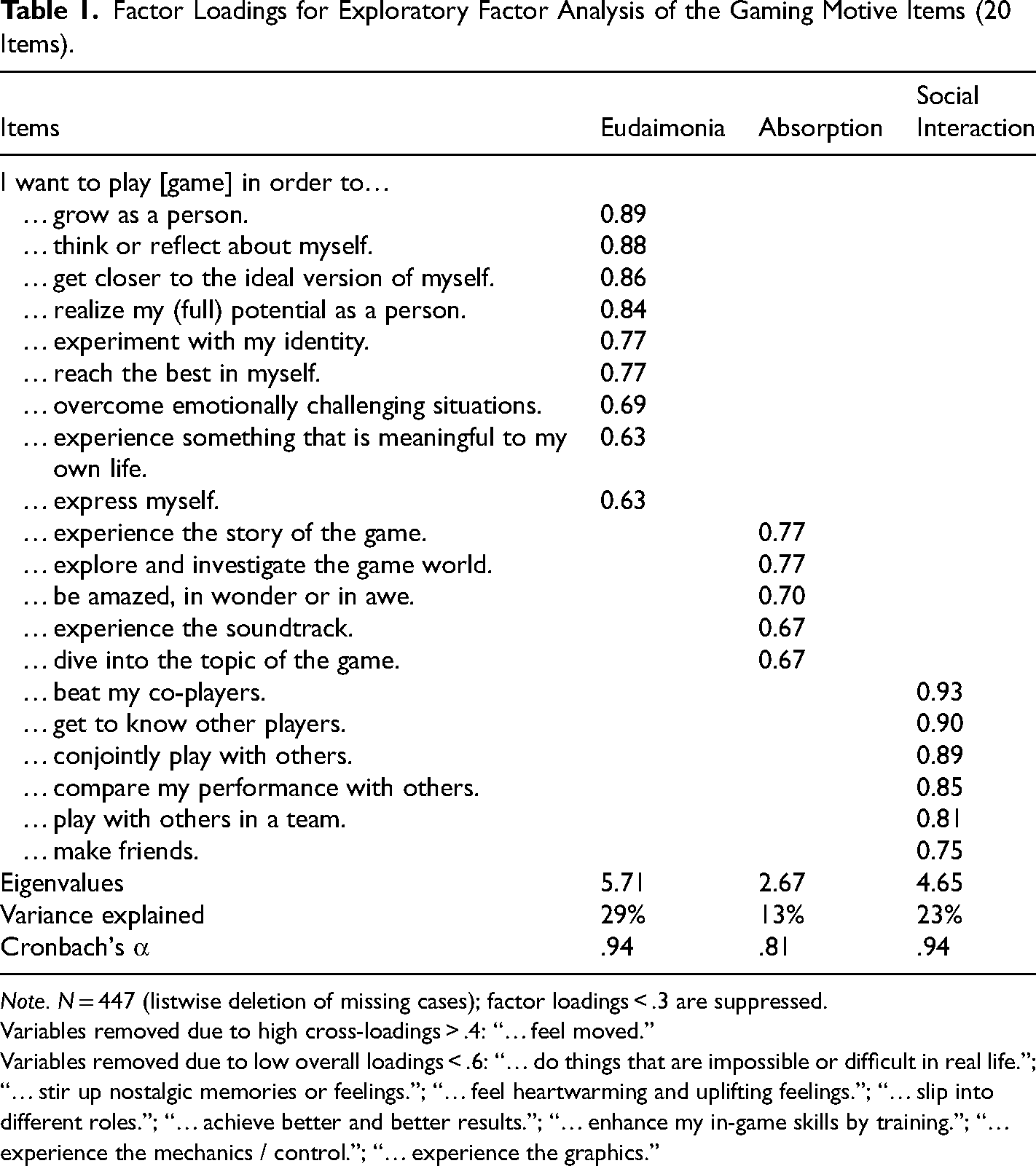
Note. N = 447 (listwise deletion of missing cases); factor loadings < .3 are suppressed.
Variables removed due to high cross-loadings > .4: “… feel moved.”
Variables removed due to low overall loadings < .6: “… do things that are impossible or difficult in real life.”; “… stir up nostalgic memories or feelings.”; “… feel heartwarming and uplifting feelings.”; “… slip into different roles.”; “… achieve better and better results.”; “… enhance my in-game skills by training.”; “… experience the mechanics / control.”; “… experience the graphics.”
The CFA with maximum likelihood estimation with robust standard errors (MLR) on the second half of the data set (n2 = 447) revealed an adequate fit for the three-factor model, χ2 (167) = 565.319, p < .001, TLI = .910, CFI = .921, RMSEA = .074, 90% CI [.068, .080], SRMR = .097 (see criteria suggested in Bowman & Goodboy, 2020). The regression weights of all 20 items were associated with their respective latent dimension at the p < .001 level. All items had factor loadings between 0.589 and 0.896 (see Table A2 in the supplementary materials on OSF, https://osf.io/ezt8r/).
As our three dimensions were confirmed and each passed an additional internal consistency test (see Table 1), mean indices were calculated. We compared the importance of the motives in a repeated measure analysis of variance (RMANOVA). The analysis revealed significant differences between the indices, ε = 0.860, F(1.72, 1535.53) = 1744.29, p < .001, and post hoc tests indicated that all three indices differed significantly (p < .001) from each other. Absorption was by far the most important reason why participants wanted to play the respective game (M = 6.06, SD = 0.96, 95% CI [6.00, 6.12]). The mean for Eudaimonia (M = 3.54, SD = 1.66) was lower and the confidence interval fell closely below the midpoint of the scale (i.e., “4”; 95% CI [3.43, 3.64]). Finally, respondents rated Social Interaction motives as even less important for the games in the current study (M = 2.66, SD = 1.74; 95% CI [2.55, 2.78]), which seems straightforward given four out of five studied games are exclusively single player games and do not afford multiplayer gaming.
Differences in the Importance of the Motive Dimensions Between Games.

Note: abcd Means with similar characters indicate no significant differences (p > .05) between games (i.e., within rows).
Method: Welch-test; Post hoc comparisons via Tamhane T2.
Method: univariate ANOVA; Post hoc comparisons via Bonferroni method.
Comparison of Gaming Motives Across Different Games (RQ2)
To investigate RQ2, we compared the importance of the three motivational dimensions across games. A multivariate analysis of variance (MANOVA) using Pillai's trace revealed significant differences between the games on the three motives, V = 0.27, F(12,1667) = 22.292, p < .001. Follow-up analysis of variances (ANOVA) showed differences for Eudaimonia of moderate effect size (η2 = .25), with a post hoc test (see Table 2) revealing Eudaimonia to be less important for Zelda BOTW II than for all other games.
Moreover, a small effect was also found for Absorption (η2 = .08). While this motive was critical for all games, its importance was significantly lower for Far Cry 6 and Forza Horizon 5 compared to the other three titles. In addition, a substantial game difference was observed for Social Interaction (η2 = .45). This motive was highly important for Forza Horizon 5 and was slightly (i.e., Far Cry 6) to considerably (i.e., Final Fantasy XVI, Mass Effect 5, and Zelda BOTW II) less important for the other games.
Relationship Between Hedonic and Eudaimonic Orientations in Life, Game Preferences, and Gaming Motives (RQ3)
To examine RQ3, regression analyses were conducted for each of the three motivational dimensions (see Table 3). To account for the multilevel structure of the data and because only within-group effects were of interest, the games were entered as an independent variable in a first block (fixed effect model: Snijders & Bosker, 2012). In the second block, participants’ HEMA scores were entered, and in the third block, their hedonic and eudaimonic game preferences.
Regression of Hedonic and Eudaimonic Orientations and Game Preferences on Gaming Motives.
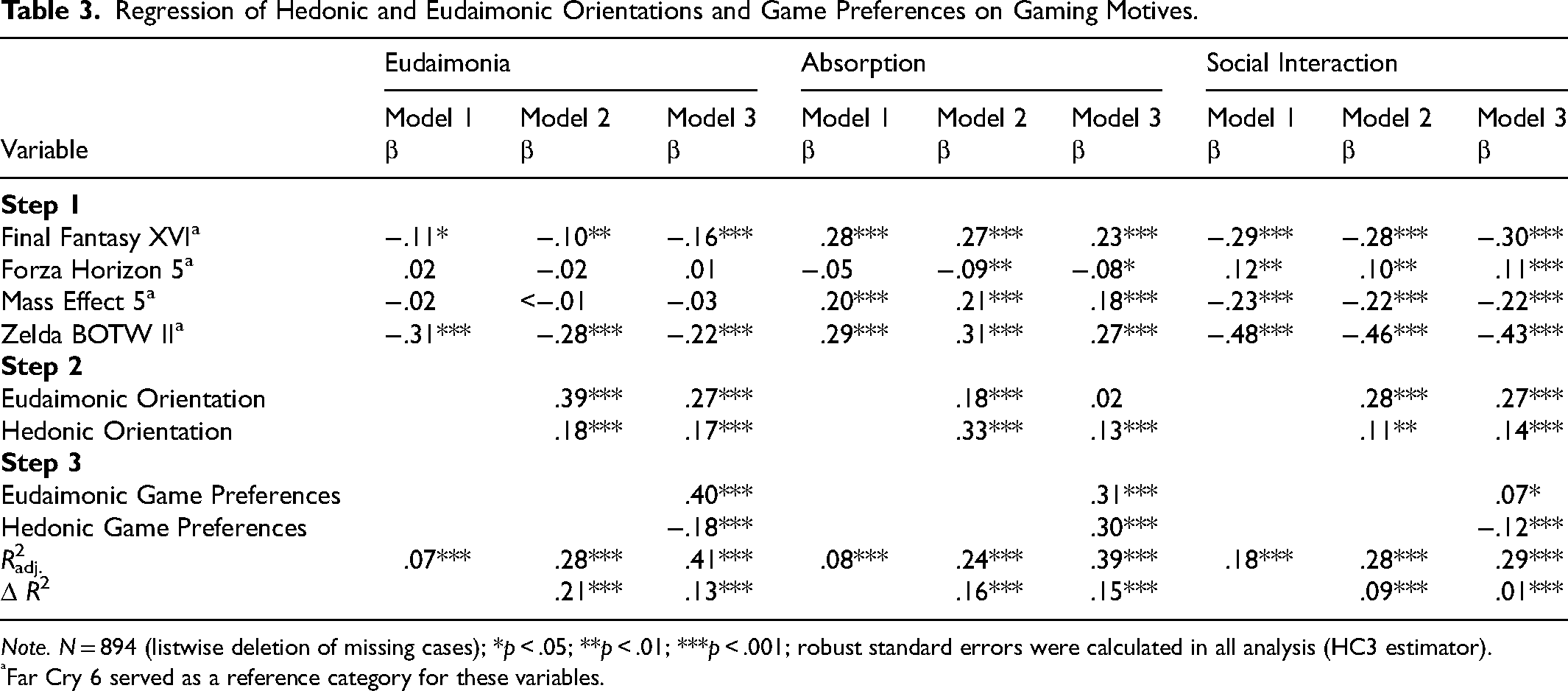
Note. N = 894 (listwise deletion of missing cases); *p < .05; **p < .01; ***p < .001; robust standard errors were calculated in all analysis (HC3 estimator).
Far Cry 6 served as a reference category for these variables.
Regarding the Eudaimonic motive, the HEMA factors emerged as the most important predictors (ΔR2 = .21, p < .001), followed by trait-like game preferences (ΔR2 = .13, p < .001). Plausibly, respondents’ general eudaimonic orientations in life (β = .27) and their eudaimonic game preferences (β = .40) positively predicted how much they were motivated to play the respective game for eudaimonic reasons. Yet, while hedonic orientations also positively predicted this motive (β = .17), hedonic game preferences emerged as a negative predictor (β = −.18).
The Absorption motive was also explained rather well by participants’ general orientations (ΔR2 = .16, p < .001) and trait-like game preferences (ΔR2 = .15, p < .001). Respondents’ hedonic orientation in life (β = .13) and their preference for hedonic digital games (β = .30) emerged as positive predictors of the Absorption motive. Interestingly, general eudaimonic game preferences also positively predicted this motive (β = .31).
Finally, it was found that game-related differences were more important (initial R2 = .18, p < .001) for the Social Interaction motive than HEMA-factors (ΔR2 = .09, p < .001) and stable game preferences (ΔR2 = .01, p < .001). Although general eudaimonic (β = .27) and hedonic orientations (β = .14) in life and trait-like eudaimonic game preferences (β = .07) positively predicted participants’ motivation to play the respective game for social reasons, stable hedonic game preferences were a negative predictor (β = −.12).
Discussion
Given the plethora of studies showing that playing digital games can evoke eudaimonic experiences (Daneels et al., 2021), the present survey study investigated whether players are also motivated by eudaimonic reasons to use games. Specifically, we explored how a broad range of eudaimonic motives derived from prior gaming research (Daneels et al., 2021) and positive psychology (Huta & Waterman, 2014) complements a well-established gaming motives scale (Scharkow et al., 2015).
Extending Well-Established Gaming Motives
The results of our survey study suggest that players are motivated by three overarching gaming motives: Eudaimonia, Absorption, and Social Interaction. The latter two mostly resemble motives well-established in gaming research: (1) Social Interaction, mostly consisting of social reasons for playing such as cooperation, making friends, or competition (De Grove et al., 2016; Ryan et al., 2006; Sherry et al., 2006) and (2) Absorption, mostly consisting of the motives to dive into a fantasy world (e.g., Scharkow et al., 2015; Sherry et al., 2006) and experience the story (e.g., De Grove et al., 2016). Interestingly, Absorption also contains motives referring to aesthetic qualities of digital games—particularly experiencing awe (Possler et al., 2018) and the game's soundtrack (Klimmt et al., 2019). This highlights the relevance of the aesthetic, awe-inspiring appeal of games for immersing players (Possler & Klimmt, 2023) and aligns with the notion that awe is not an exclusively eudaimonic gaming state (Possler et al., 2018).
Most relevant to the aim of the present study, we found that Eudaimonia represents a gaming motive in its own right and was somewhat important for participants (mean value around the scale's midpoint). This motive partly mirrors eudaimonic qualities identified in previous game research (i.e., meaningfulness, emotional challenge, and self-reflection; Daneels et al., 2020, 2021; Oliver et al., 2016; Rogers et al., 2017). However, it also contains motives discussed in broader psychological research on eudaimonia, such as personal growth, identity expression, and excellence (Huta & Waterman, 2014). The implications of this finding are twofold. First, the results suggest that eudaimonia in the context of digital games may encompass more qualities than meaningfulness, mixed affect, and reflection, which have been the primary focus in eudaimonic game research (Daneels et al., 2021). Based on our findings, this focus seems limited when trying to understand the complex concept of eudaimonia in gaming. Second, the results suggest that some experiences that have long been studied by game researchers, such as players’ exploration of their identity (Bessière et al., 2007; Jansz, 2005), may be closely related to eudaimonia. Game research's knowledge of eudaimonic motives, experiences, and related mechanisms may, therefore, be greater than previously thought. Thus, the findings also highlight the importance of a more detailed theoretical conceptualization of eudaimonia in the digital game context.
Finally, eudaimonic motives yield one common factor, which was unexpected given the number of different eudaimonic concepts proposed in the literature (Daneels et al., 2021). Presumably, this resulted from our focus on upcoming games: Without gameplay, players might not yet have a concrete conception of these games, leading to one broad eudaimonic motive. Thus, our study should be replicated with released games.
Gaming Motives: Hedonic, Eudaimonic, or Both?
Moreover, we investigated the correlations of the game motives with participants’ stable hedonic and eudaimonic game preferences and general orientations in life. Unsurprisingly, we found that the Eudaimonia motive was mostly related to eudaimonic orientations and eudaimonic game preferences, while the Absorption dimension was strongly correlated with hedonic orientations and hedonic game preferences. This further supports our interpretation that the Eudaimonia factor indeed represents a eudaimonic motive. In contrast, Absorption seems to include hedonic reasons for playing games. Nevertheless, we also found that hedonic life orientations were positively related to the Eudaimonia motive, while eudaimonic game preferences were highly positively related to Absorption. This leads us to believe that these motives cannot be deemed as exclusively hedonic or eudaimonic—which is in line with previous research showing that a game experience can potentially be both hedonic and eudaimonic at the same time (e.g., Rogers et al., 2017).
The Social Interaction motive seems to particularly defy clear categorization into hedonic and eudaimonic. Although it was correlated with hedonic and eudaimonic orientations, it was negatively related to participants’ hedonic game preferences. Prior research has indeed suggested that social interaction can not only facilitate pleasure (e.g., Schmierbach et al., 2012) but also eudaimonic experiences (e.g., Rogers et al., 2017). Against this background, future research seems warranted to investigate under which conditions social motives and experiences have a rather eudaimonic or hedonic quality. In particular, the emotional closeness to co-players might play an important role. For example, older adults reported that playing digital games is more meaningful for them when playing with close others (e.g., grandchildren) rather than strangers (De Schutter & Brown, 2016).
Game-Related Differences Point to a Broader Understanding of Eudaimonia
Finally, we compared the importance of the motives between the studied games to further assess the scale's validity. The Absorption motive was highly important for all games. This seems straightforward, as fans of a franchise (i.e., the sample in the present study) are presumably always motivated to experience the story, world, and aesthetics of a new game of this franchise. Plausibly, this motive was even more pronounced for games of franchises that typically offer rich stories (i.e., Final Fantasy, Mass Effect, and Zelda). Likewise, unsurprisingly, Social Interaction hardly motivated fans to play the predominantly single-player games examined here, with the multiplayer title Forza Horizon 5 being the exception.
By contrast, the differences observed for the Eudaimonia motive raise questions about the scale's validity: While Eudaimonia was a reasonably important motive for fans of all games, it was less central for players anticipating Zelda: Breath of the Wild 2. This seems surprising, given prior research that linked the Zelda franchise with eudaimonic experiences (Bopp et al., 2016, 2018; Rogers et al., 2017). Moreover, Eudaimonia was found to be a highly important motive for fans of Forza Horizon 5—a racing game that could be expected to deliver predominantly hedonic experiences. Thus, it may seem questionable at first glance whether the third motive identified in the present study, in addition to Absorption and Social Interaction, really reflects eudaimonia. One explanation for these surprising results may be that eudaimonic motives are not so much linked to a specific genre (Rogers et al., 2017) but to individual games. For example, while Forza Horizon 5 has a strong eudaimonic appeal for its fans, the same might not be true for every racing game. Another potential reason may lie in the individual motives that constitute this dimension: Besides emotional challenges and meaningfulness, it includes several motives that have been identified as eudaimonic in psychology (Huta & Waterman, 2014) but have not yet been studied in eudaimonic gaming research (i.e., identity expression and excellence; Daneels et al., 2021). Precisely those motives are probably not addressed by Zelda games: Due to presenting a fixed character (i.e., Link), players have few opportunities to experiment with their identity and express themselves. In contrast, Forza games seem better suited for players to reach the best in themselves (as virtual drivers) and express their identity (e.g., customizing their cars).
As a first test of this assumption, we compared the single items represented in the Eudaimonic motive dimension between the five games (see Table A3 in the supplementary materials on OSF, https://osf.io/ezt8r/). Indeed, identity exploration and growth appeared comparatively less important for fans anticipating the new Zelda game, while self-expression and self-improvement were central reasons for playing Forza Horizon 5. Therefore, we believe that the observed differences do not argue against the validity of our scale but rather plea for a broader understanding of eudaimonia in the gaming context.
Limitations
Aside from the opportunities for future studies mentioned above, the limitations of the present study also emphasize the need for follow-up research. First, we identified and subsequently tested the factor structure of the gaming motives by randomly splitting the dataset into halves. Although this procedure can be regarded as a first test, it does not replace testing the dimensionality with an independent sample (Bowman & Goodboy, 2020). Thus, replication and validity testing should be the focus of future research.
Second, participants were recruited via game- or franchise-specific subreddits and can, therefore, largely be regarded as fans of the franchises. However, the importance of the motives may differ between fans and non-fans. For example, eudaimonia might be a more relevant motivational aspect for players who are not deeply involved with a game's franchise. Therefore, a potential future research path could be to replicate the current study within a non-fan sample.
Third, while the upcoming games studied here represent different genres and game mechanics, they all belong to established franchises from major publishers (“AAA games”). It is possible that eudaimonic motives may play a greater role for games that are less aimed at mass compatibility, such as “indie games” (Juul, 2019), or focus on “serious” topics, such as “serious games” (Jacobs, 2021). A replication of our work with indie games or serious games, therefore, seems promising to test the generalizability of the scale.
Fourth, our findings are limited by their cross-sectional nature, and it would be insightful to see whether eudaimonic motives for upcoming games are stable over time (i.e., as more information about games becomes available) using a longitudinal research design. Furthermore, the current findings are only a first step in exploring whether eudaimonia is something players seek or something they experience “incidentally” in search of fun (Possler et al., 2020). Specifically, future research should investigate the predictive value of eudaimonic motives for game use. This was not possible here due to investigating a sample of fans. Simply put, all respondents already showed a high intention to play the respective games, which further stresses the importance of replicating our study with less involved players. Moreover, measuring motives and observing actual game selection in experiments seems promising.
Conclusion and Outlook
The present study originates from the interesting observation that players seem to experience a wide range of eudaimonic experiences when using digital games (Daneels et al., 2021), but it is yet unclear whether eudaimonia motivates playing (e.g., Holl et al., 2023; Possler et al., 2022). The present findings suggest that eudaimonia is a relevant motivational driver of gaming: Eudaimonia emerged as a gaming motive in its own right and showed consistent correlations with stable eudaimonic dispositions and gaming preferences and plausibly varied between different types of games. Moreover, the Eudaimonia motive was overall somewhat important for players indicating that they not only “want to have fun” when turning to digital games but also acknowledge games’ eudaimonic capacities. The results, therefore, mark an essential first step in exploring the attraction of games beyond pleasure.
If future research confirms eudaimonia as an attractor of digital gaming, it may change our perspective on eudaimonic gaming and the medium in general. Rather than being an incidental experience that players stumble upon while seeking fun (Possler et al., 2020), eudaimonia would need to be considered a gaming gratification that players (sometimes) seek and presumably find during playing. Consequently, like movies (Oliver & Raney, 2011) or books (Koopman, 2015), we may need to understand digital games as a medium to which individuals instrumentally turn for psychological growth, insights about life, and identity development—essential foundations for a psychologically good life (Peterson et al., 2005).
Footnotes
Declaration of Conflicting Interests
The author(s) declared no potential conflicts of interest with respect to the research, authorship, and/or publication of this article.
Funding
The author(s) received no financial support for the research, authorship, and/or publication of this article.
