



Abstract
Higher education (HE) has become a common pathway into game development careers. Previous research with students and educators has shown how game development HE exemplifies a “creative industries” approach that seemingly marries technical and creative skills, professionalism and passion, and individualistic entrepreneurism and interdisciplinary collaboration. However, little research has considered the varied institutional contexts such students and educators find themselves entrenched in. In this article, we argue that game development HE does not simply marry the technical and creative but is instead torn between different disciplinary cultures, ideologies, and aims. Drawing from data on 119 game development HE programs in Australia, we show that while game development HE is consistently positioned as a pathway toward student employability, just what skills and identities are emphasized as crucial for such employability varies pending on the program's institutional context—ultimately showing that combining creativity and technology is neither a straightforward nor neutral process.
Introduction
Formal higher education (HE) has become an increasingly common pathway into videogame development careers over the past two decades. Throughout the same period, the quality and worth of videogame development HE programs have been hotly debated by developers, employees, students, educators, and policymakers. Concerns abound as to the ability of such programs to adequately prepare students for game development work (Yang, 2017); the potential oversupply of graduates to local industries that do not require them (Warner, 2018); and the concern that education institutions are simply exploiting students’ excitement for videogames to bolster enrollment numbers (Wright, 2018). At the same time, excitement abounds for how formal game development education might address entrenched demographic inequalities and supposed skill shortages not only in the videogame industry, but also in broader Science, Technology, Engineering, and Maths (STEM) sectors (Langreo, 2022). An emerging body of scholarly literature has begun to critique these broad anxieties and to develop more nuanced understandings of the social contexts of game development HE. This research suggests that HE at once perpetuates entrenched hegemonic structures of the capitalist and patriarchal videogame industry, but also provides space for potential resistance and alternative pathways and identities into gamemaking (Ashton, 2009; Harvey, 2019, 2022; Kerr, 2017).
These debates take place in the context of a broader marketization of HE that narrows the holistic and democratic goals of the university toward the human capital demands of employers and, more nebulously, the identities of graduates toward entrepreneurial and individualistic identities (Brown et al., 2003; Fairclough, 1993; McRobbie, 2016; Nudelman, 2020). Specifically, game development HE has been situated within the broader rise of creative industries style programs that rebrand fine arts and cultural studies programs alike “as a way of signalling to prospective students a move from practice that looks inwards to aesthetics and craft skills, to one that looks outwards to applications of creativity outside of the arts” (Flew, 2019, p. 169). Indeed, as Professor of Screen Media Jon Dovey at the University of the West of England proposed to Terry Flew: the development of courses in games had prefigured what would become a creative industries approach, in that they combined technical and creative skills, for graduates who had to be prepared to work collaboratively, to network in a highly informal business ecosystem, and be prepared to mix highly commercial work with activities that aligned with their creative passions and desire to make a difference in the world. (quoted in Flew, 2019, p. 175)
Game development HE thus seemingly exemplifies a creative industry’s approach to education in the way it apparently marries technical and creative skills, professional business and vocational passion, and individualistic entrepreneurism and interdisciplinary collaboration.
Yet, in reality, sitting at the cross-section of technical and creative sectors, skills, and identities is at least as often a burden as it is a blessing for videogame development. Videogame development tends to “fall between the policy stools” (Cunningham, 2013, p. 34) where the logics of cultural practice frame them as too haphazard and commercially unpredictable for the tech world, and the logics of software development frame them as too industrialized and consumerist for the arts world. For both the culture and tech sectors videogames are a useful outsider, but an outsider nonetheless. Where videogame development resides within HE institutions is equally ambivalent. To develop videogames requires critical and cultural skills such as storytelling, aesthetic analysis, social analysis, visual design, and rhetoric—all traditionally the territory of Humanities, Arts, and Social Sciences (HASS) disciplines. But developing videogames also requires technical skills such as computer programming, software development, trigonometry, network coding, hardware management, and user-interface design—all traditionally the territory of STEM disciplines. Videogame development could be, and indeed is, taught within either HASS or STEM departments with drastically different emphases on different skills, different potential job outcomes, and different graduate identities and pathways. How do these different institutional contexts influence the structure and culture of game development HE programs? What skills are taught, what learning outcomes are prioritized, and what jobs are promised?
In this article, we wish to complement the growing body of research on game development HE that has investigated the perspectives of game development students and educators broadly by paying direct attention to the ambivalent and competing institutional contexts within which these perspectives are entrenched. We use the publicly available information from Australian HE institutions to map a total of 119 programs across the country that teach videogame development in some capacity. Across these programs, game development HE is consistently positioned as a pathway toward employability in the videogame industry through targeting prospective students’ existing consumerist identities; however just what skills and capacities programs emphasize varies pending on the program's institutional context as a HASS, STEM, or holistically Games department. Ultimately, drawing from this mapping exercise, we argue that rather than simply marrying STEM and HASS—as a creative industries approach to education promises—game development HE instead reveals epistemological and pedagogical tensions between technical and creative skillsets, games-centric and -diffuse graduate pathways, and individualistic and collaborative working identities.
Background
Up until the late 1990s, career pathways into videogame development were haphazard. Part-time hobbyists and full-time software developers alike would move sideways into full-time game development work after a part-time project took off, or through an opportunity provided through personal networks. However, as has been detailed elsewhere, especially through the late 1990s and into the 2000s, the videogame industry underwent drastic changes that led to game development teams growing substantially and requiring a larger number of specialists. Rather than a game being made by a single programmer or a small team of bedroom coders, teams grew to dozens, hundreds, or even thousands of designers, programmers, artists, writers, producers, actors, community managers, and so on (Keogh, 2019; Kerr, 2017; O’Donnell, 2014; Tsang, 2021).
It is no coincidence that formalized education pathways for gamemaking emerged at the same time as the team sizes required to produce commercially viable videogames grew exponentially. For the videogame industry, “accreditation of games courses [concretised] industry needs, requirements and practices of skills development” (Ashton, 2009, p. 288). Many of the earliest videogame development programs emerged as partnerships between large studios and nearby universities, providing a synergy between the needs of employers (for employees) and the needs of universities (for enrollments). For instance, Abertay University in Dundee, Scotland has since the launch of its first game development degree in 1997 had a close relationship with local studio Rockstar North (originally DMA Designs) which developed the first Grand Theft Auto title in the same year (Abertay, 2017). The earliest tertiary game development programs in Australia, meanwhile, were explicitly designed to meet employer needs with the foundation of the Academic of Interactive Entertainment (AIE) set up by founders of Micro Forté studio in Canberra to meet their own employment needs, and then expanded to meet the employment needs of other Australian studios.
As the videogame industry is plagued with well-documented labor issues such as unpaid overtime, sexual harassment, and short-term contracts (Bulut, 2020), direct engagement between videogame companies and students “serves to further secure a constant supply of appropriately trained staff accustomed to intensive working conditions” (Kerr, 2017, p. 133). Alongside a broader range of strategies such as game jams and modding that recruit enthusiastic videogame players as junior developers into the “ludic economy” (Kennedy, 2018; cf. Kerr, 2021; Kücklich, 2005), videogame development HE was from its origins presented as a streamlined pipeline through which students are taught the skills required of commercial videogame developers and then directed into waiting videogame development jobs. As Harvey (2019, p. 3) has shown, this education-as-pipeline metaphor “evokes a vision whereby if enough force is imposed at one end of the pipeline—be it pumping entrants in or ‘priming’ students for employability—students will inevitably be propelled towards success… it affirms a singular, normative direction for students, graduates, and employees to take.”
HE aligning student identities and capacities with the needs of employers is not unique to videogame development. It emerged alongside broader shifts in HE throughout the later part of the twentieth Century whereby HE's fundamental purpose came to be “the production of economically fruitful actors who can join the labour market and contribute to national growth” at the expense of “other important functions of HE, such as students’ development of strong bases of disciplinary knowledge, the ability to think critically, democratisation …, and social justice …” (Nudelman, 2020, p. 361). Although the specifics play out differently in different national contexts, this period is broadly defined by a shrinking of public funds for HE institutions alongside education's growing “marketization” (Fairclough, 1993). Students are reconfigured as customers looking to purchase a qualification commodity so institutions can attract increasingly important enrollment fees at a time of weakening social welfare structures and growing concerns about career stability. Employers do well out of this situation. Where once a HE was largely seen to provide a deeper level of disciplinary knowledge and critical capacity that employers could then build on with specialist training and graduate positions, companies now try to “break free of their social obligations to employees” and “prefer to hire workers on a ‘plug-in-and-play’ … basis, rather than having to invest in expensive and intensive training before new recruits can ‘add value’” (Brown et al., 2003, p. 114)—thus furthering the pressure on universities to produce “job-ready” graduates.
In Australia and the UK specifically, the marketization of HE has been most visible in the gradual replacement of Arts programs and departments with those of “creative industries” that rely on “strong connections between creative practice and digital technologies” and tend toward “increasingly interdisciplinary or transdisciplinary degree programs” (Flew, 2019, p. 173). The formation and subsequent critique of creative industries as both a policy agenda and a research focus has been extensively detailed elsewhere (Cunningham, 2013; Cunningham & Flew, 2019; McRobbie, 2016; Oakley & O’Connor, 2015). Suffice to say here, creative industries strive to better articulate the value of the humanities and arts in terms of economic innovation and growth to neoliberal policymakers and governments less enthused by intrinsic social value arguments (Cunningham, 2013, pp. 10–11). In a HE context, creative industries shift the focus of arts and humanities pedagogy from cultural practice and critique to the providing of creative services to a broader range of economic sectors (Bridgstock, 2011, 2013), particularly highlighting the “transferrable skills” that will get students employed somewhere over more traditional humanities goals of producing knowledgeable citizens (Fairclough, 1993).
However, one major critique of the creative industries agenda is that it does not necessarily connect creativity and technology so much as deliberately conflates them in a way that obscures more traditional and analog arts and crafts (Luckman, 2015). Oakley and O’Connor (2015, p. 3; see also Kerr, 2017, p. 6) are particularly scathing of the inclusion of the category “software, computer games, and electronic publishing” in early definitions of the creative industries, which ensured a large number of technical roles greatly inflated the employment numbers and economic contribution estimates of the creative sector. Videogames have thus always held a contested position between the creative and digital spheres, never fitting clearly in the policy frameworks, business models, or epistemologies of either. Creating videogames is, fundamentally, an interdisciplinary process that requires both technical and creative skills. It is the technical, however, that has dominated social imaginings of videogame development, with videogames seen as an exciting home of technical innovation, but less so as a home of significant cultural expression. Just as for cultural practitioners more broadly, the predominance of the technical at the expense of the creative has had a limiting impact on how the activities of videogame developers themselves have been understood as both highly skilled knowledge workers and as cultural workers developing a practice.
If the marketized and neoliberalized university is one that shapes student capacities, expectations, and professional identities toward industry-desired outcomes and ways of being, questions remain unanswered as to how the disciplinarily diverse capacities, expectations, and professional identities of videogame development are shaped by videogame development HE programs that are themselves shaped by a broader creative industries framing of cultural practice. We need to understand how the epistemological crisis that is foundational of videogame development between creative and technical skills, between computer science and arts identities and dispositions, plays out in marketized education institutions.
Methodology
To understand the institutional contexts of how game development is framed and taught, we mapped where game development is taught across Australian HE. We began with a list of 139 HE institutions sourced from the Australian Government's Department of Education. This includes Australia's 38 public universities, 6 private universities, and 99 “Other Approved Higher Education Institutions” (henceforth “other institutions”) including Technical and Further Education institutes (TAFEs) and specialist vocational colleges (see Pietsch, 2020 for an overview of Australian HE funding arrangements). The websites of each institution were searched for both undergraduate and postgraduate programs using the search terms “games,” “interactivity,” “interactive media,” “play,” and “digital media.” Third-party aggregator website Course Seeker was also searched with the same terms to identify any further programs that were missed.
Programs that were provided by each of these search terms were then evaluated to determine if they taught game development. As the goal of the dataset was to identify where and in what capacity videogame development is taught in HE, two criteria were used to determine a program's eligibility for inclusion in the dataset. An eligible program had to either:
Include at least one of the terms game, interactivity, interactive media, or play in the program or major title or Explicitly reference game development as a potential career outcome for graduates.
These criteria ensured we created a holistic dataset that did not just identify game development-centric programs, but also programs that claimed to teach game development in some capacity, such as, for example, a Bachelor of Information Technology with a Game Development major. In total, 127 programs across 44 institutions met at least one of the above criteria. Of this initial dataset, we manually removed 8 programs from the dataset. These programs mentioned game development as a potential job outcome (thus technically meeting criteria 2) but in a fleeting manner that evidenced little connection to the broader content or goals of the program. Essentially, these were programs that advertised game development as a hypothetically possible job outcome but which, upon scrutiny of the collected data, did not teach game development. This left us with a finalized dataset of 119 programs across 42 institutions that teach game development in some capacity.
Details were collected and recorded from the institution's website for each eligible program and placed into a spreadsheet. Collected information included the program's name, host department and institution, Australian Qualification Framework (AQF) level (e.g., diploma, bachelor, master), advertised learning outcomes and program aims, and promotional blurbs. Google Sheets was used to parse the spreadsheet data to determine simple quantitative trends and results such as the total number of programs, the distribution of programs across AQF levels, and so on. Discursive data (such as promotional blurbs, course aims, learning outcomes, and possible job outcomes) were entered into coding software NVivo and coded deductively (Chandra & Shang, 2019, p. 92) for themes including student identity, job-readiness, creativity, technology, and skills in order to examine the data in relation to the debates of creative industries educational approaches and marketized HE detailed above. NVivo was also used to analyze the word frequency of terms within this data.
Data collection started in the final quarter of 2020 and was completed in the first quarter of 2021. At the same time, the COVID-19 pandemic was causing havoc to the Australian HE sector as the conservative Federal Government proactively excluded universities from support structures offered to other sectors, and the international student market (itself crucial following prolonged Federal defunding) dried up (Doidge & Doyle, 2022). Tens of thousands of academics and professional staff lost their jobs, and some of the programs in our dataset were likely closed or consolidated in the volatile years following our collection. As such, the quantitative snapshot our data provides should be considered a historic one. Nonetheless, the broader qualitative trends in how HE institutions position and frame game development remain highly relevant.
Quantity and Distribution of Programs
Of the 119 identified programs across 42 institutions, 81 (68%) met our first criteria, meaning that 38 programs (32%) did not directly reference game development in their program name, but did meaningfully advertise it as a potential career outcome for graduates. About 30% of all Australian HE institutes thus teach videogame development in some capacity. It is worth noting that this figure includes all Other Institutions, most of which are highly specialised such as, for instance, the Australian College of Health and Wellness, the Jazz Music Institute, or indeed the Academy of Interactive Entertainment. Of Australia's 43 public and private universities, 29 (67%) had at least one program that taught game development. Twenty-two (51%) had more than one program, typically spread across different institutional contexts. The overwhelming majority of identified programs were for an undergraduate or lower qualification. Sixty-seven (56.7%) of the identified programs were the equivalent of a Bachelor’s degree (AQF 7) and only nine programs (7.5%) were of a Graduate (AQF 8) or Master’s (AQF 9) equivalence. No eligible Doctoral (AQF 10) game development programs were identified. While game development research is known to the authors as having occurred at a doctoral level in Australia (for instance, Barker, 2018; Carter, 2022; Muscat, 2018), this has seemingly only happened in more general doctoral programs that institutions themselves do not present as relevant to game development explicitly.
Fifty-six (47%) programs were run within HASS faculties and 38 (32%) were run within STEM faculties. Determining this was a relatively straightforward exercise of looking at the department titles (e.g., Faculty of Computer Science, Faculty of Arts, etc.). Only two programs were explicitly framed as being run as a collaboration across HASS and STEM faculties. It is possible other collaborations exist that were not apparent in the dataset, such as a HASS-based program potentially sending students to a STEM faculty for programming electives. Nonetheless, the dataset suggests that in most multi-faculty institutions, a game development program resides squarely in either a STEM or a HASS context. As such, many universities offer distinct programs in both their STEM and HASS departments. For instance, Murdoch University offers a Bachelor of Information Technology (Games Technology) in the School of Engineering and Information Technology, and a Bachelor of Creative Media (Games Art and Design) in the School of Arts.
The exception to this typically sheer distinction between HASS and STEM contexts is the 20 (17%) programs that reside in Games-specific departments in smaller Other Institutions focused on multimedia education. As such institutions focus on vocational teaching, they typically do not have traditional disciplinary faculties but instead teaching departments split along media industry sector lines such as games, music, animation, and film departments. For instance, SAE Creative Media Institute has teaching teams that each teaches into respective bachelor programs of Animation, Film, Audio, Design, and Games among others. We assume, based on our own industry knowledge and past teaching experiences, that games programs at such institutions are relatively interdisciplinary between STEM and HASS skillsets and curriculum, combining both computer programming and theoretical subjects, but determining the extent or consistency of this interdisciplinarity is unclear from the collected data and thus beyond the scope of this study. As will become clear below, however, the heightened vocational nature of Other Institutions gives Games-centric departments a particular institutional characteristic distinct from both traditional STEM and HASS contexts. 1
Imagined Student Identities and Expectations
A prominent theme to emerge from the collected promotional material was a consistent and explicit address of prospective game development students not as amateur or curious game developers, but as enthusiastic gamers—that is, as consumers of videogame products rather than as producers. Charles Sturt University's Bachelor of Computer Science (Games Programming Specialisation) is most explicit: “Calling all gamers! Here is your chance to turn your passion into a career.” Swinburne University of Technology's Diploma of Digital and Interactive Games promises that “this course will take you beyond playing games,” implicitly framing videogame consumption as a prerequisite step before progressing to videogame development. Elsewhere, the colloquialisms of videogame subcultures are used to implicitly target a videogame consumer demographic. Box Hill Institute's Cert IV in Digital and Interactive Games entices potential students to “get your career game on”; Murdoch University's Bachelor of Creative Media (Games Art and Design) promises that “in this course you’ll level up your knowledge of games art and design processes, production concepts and industry-standard tools”; and SAE Creative Media Institute's Bachelor of Game Development proclaims that “your epic adventure in gaming starts here.”
Crucially, “gamer” is not synonymous with “videogame player” as an identity. While people of all ages and genders are consistently shown to play videogames with relatively equal frequency, the gamer subculture is a particularly gendered and aged target audience and consumer identity with specific and narrow ideas about which formats and genres of videogames should be considered legitimate (Kirkpatrick, 2013; Shaw, 2012). Constructed in large part by industry and marketing discourses from the late 1980s through to the present day, the gamer provides large videogame companies a target audience of predominately young men primed to appreciate the technologically advanced and action-centric genres the industry's largest companies specialize in. The marketing discourses constitutive of the gamer identity perpetuate a broader social understanding of videogame culture aligned with notions of techno- and geek masculinity (Butt, 2022; Salter & Blodgett, 2017), which in turn consequently frames videogame development as straightforwardly a demonstration of computational prowess (Arsenault, 2017; O’Donnell, 2014). Consequently, the creative, interdisciplinary, nonlinear, and technologically constrained processes of ideation, design, negotiation, and development that together are videogame development are often reduced, in popular imaginings, to a straightforwardly technical process where preexisting technical skills are used to execute a fully formed game design concept (Keogh, 2022; Whitson, 2018; Zagal & Bruckman, 2008).
Programs in the dataset echoed these entrenched technical and linear assumptions of videogame development processes by not simply promising to teach videogame development skills, but to reveal what the skills of videogame development even are in the first place, as if all that is stopping a student who loves playing games from making their own hit is learning the syntax and operation of a few software programs. A Murdoch University program, the Bachelor of Information Technology (Games Technology) does so explicitly: Have you ever wondered how your favourite video games are developed? As a software developer and computer programmer, you’ll help turn an idea into a playable video or mobile game.
Such programs position HE as not only a pathway into videogame production, but as the way to reveal the mysteries of how one even goes about making a videogame in the first place. For the gamers that such material targets, as Charles Sturt University's Bachelor of Computer Science (Games Programming Specialisation) says explicitly, HE institutions present themselves as “your key to the field of games.” Effectively, programs rely on prospective students’ enthusiast consumer identities alongside their lack of identity as amateur or aspiring producers to attract enrollments. Students are here imagined as malleable fans onto which institutions will apply the skills, dispositions, and “masculinised labor bravado” (Harvey, 2019, p. 760) required of commercial game development companies.
Articulating Game Development Skillsets
Programs in the dataset consistently promise imagined gamer students that they will be provided the keys to the field of games through the training of core skills. However, just what these core game development skills are varies between programs in different institutional contexts. Table 1 presents the aims of a program in a STEM faculty and a program in a HASS faculty as indicative of this broader variation of different skill emphases in the dataset.
Program Aims of a Program Housed by a STEM Department (Left) and a Program Housed by a HASS Department (Right)
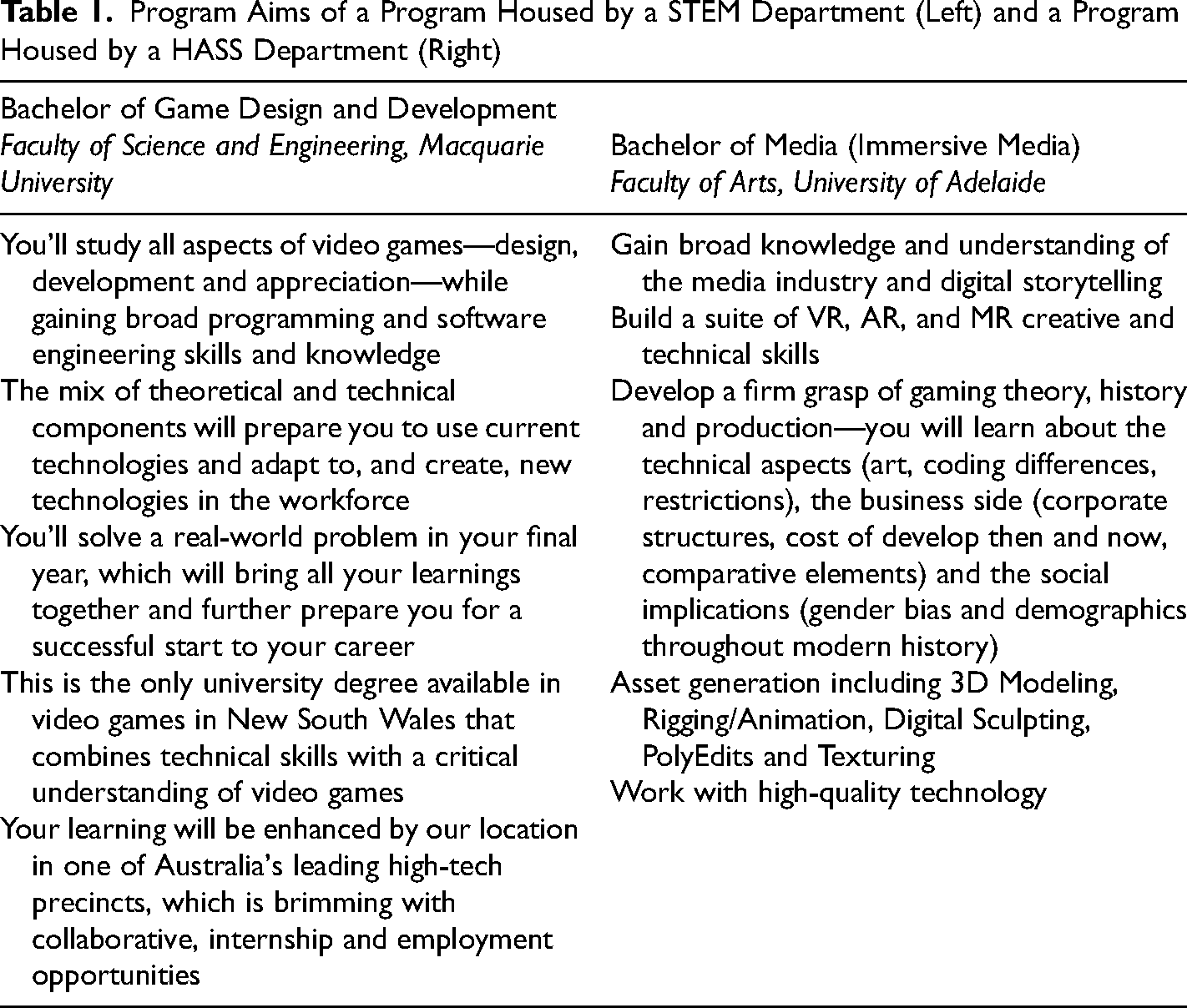
In keeping with the creative industries framing outlined above, both programs describe a mix of technical, creative, and entrepreneurial skills, knowledges, and capacities—but with varying emphasis. Macquarie University's Bachelor of Game Design and Development, in a STEM faculty, situates game design and development within “broad programming and software engineering skills and knowledge” that can be used to “solve … real-world problem[s].” The passing aside to a “critical understanding of videogames” is a stark contrast to University of Adelaide's Bachelor of Media (Immersive Media)'s extensive elaboration of “gaming theory, history, and production.” At the same time, the latter's relatively vague gesturing toward “high-quality technology” and specific skills of “asset generation” is fleeting compared to the former's broader focus on “programming and software engineering,” “technical skills,” and “employment opportunities.” For the former program, videogame development is a formal technical role that requires some additional critical capacity; for the latter, videogame development sits within a broader media form of “digital storytelling” that requires critical theory and some additional technical capacity.
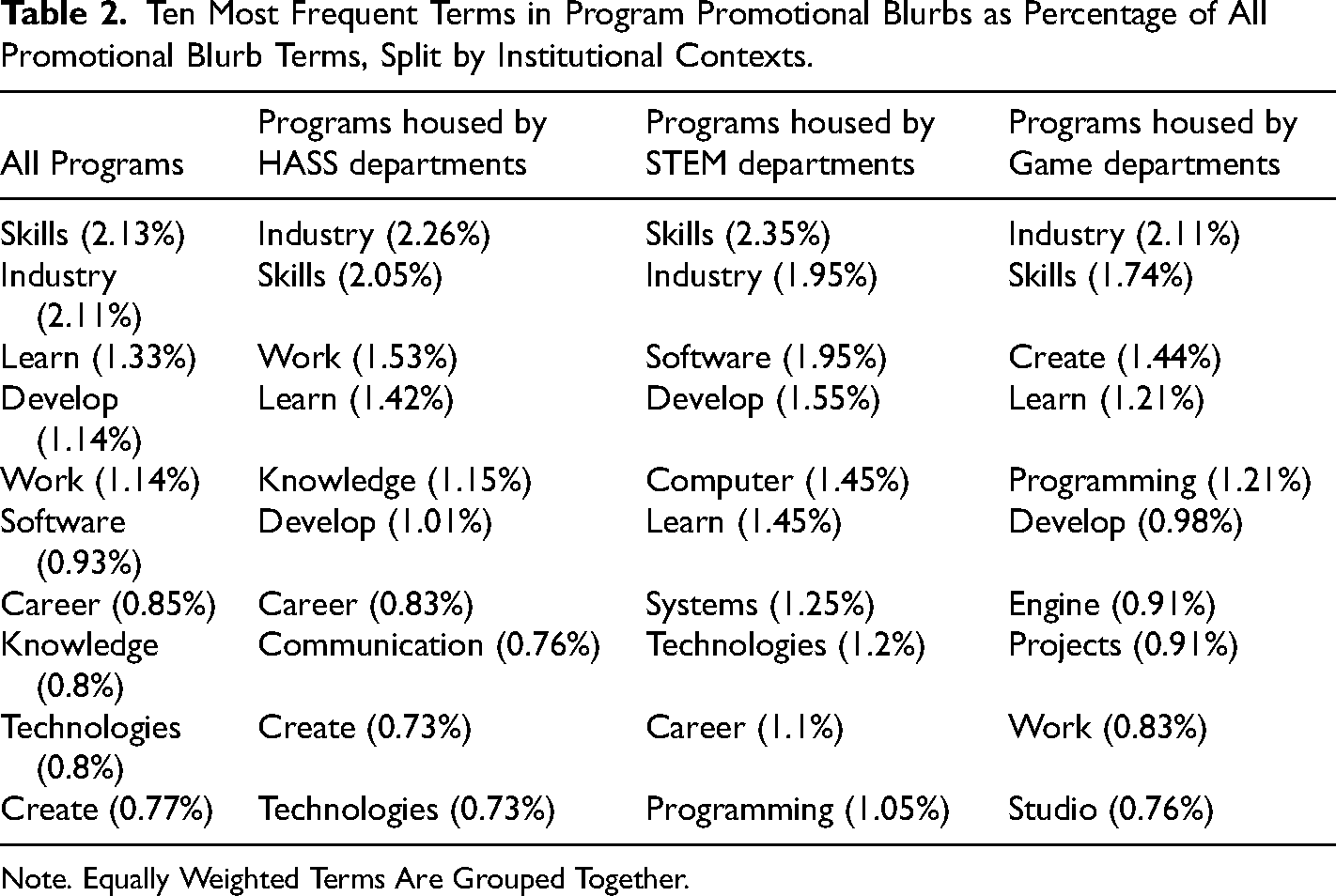
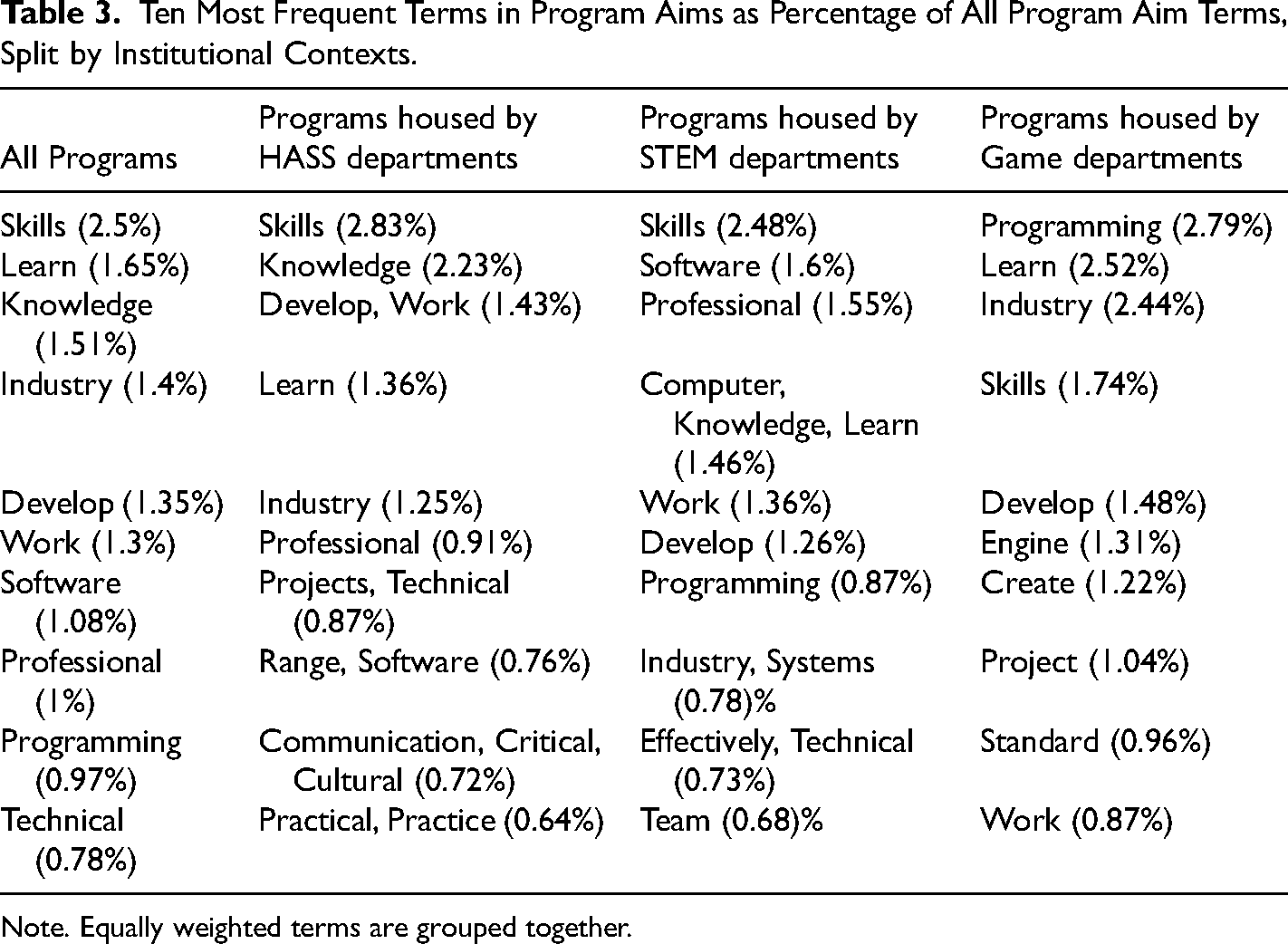
Word frequency analyses show that this institutional variation in emphasis of the technical-creative-entrepreneurial mix of skills exists across the dataset. In the promotional blurbs that describe the nature and focus of programs to prospective students, HASS, STEM, and Games department programs all emphasized “skills” and “industry” prominently (Table 2), speaking to the emphasis all programs place on accessing the employment pipeline as the reason to undertake HE in the first place. But just how such pipeline access will be obtained, as stated by each program's aims, is varied across the different institutional contexts (Table 3). HASS programs prioritize “skills” and “knowledge” in their program aims; STEM programs “skills” and “software,” and Games programs “programming” and “industry.” While “skills” dominate aim of both HASS and STEM embedded programs, the HASS-specific prioritizing of “knowledge” suggests a legacy of a traditional humanities approach to holistic education not necessarily directed neatly into linear employability outcomes. That for the STEM programs “knowledge” is usurped by “software” suggests a greater focus on technical software skills over creative or theoretical ones. Programs in Game-centric departments provide a surprising alternative focus with two of the most frequent terms in their aims being “programming” and “industry.” As this subset of the data is overwhelmingly programs housed by specialist “Other Institutions” that are explicitly vocational, we see both a presenting of videogame skills as primarily technical, much like the STEM programs, but also an even higher emphasis on the pipeline into the videogame industry specifically (as opposed toward STEM industries more generally) and on developing industry partnerships—approaches that Ashton (2009) has shown to be key for programs to attract and retain game development students.
Ten Most Frequent Terms in Program Promotional Blurbs as Percentage of All Promotional Blurb Terms, Split by Institutional Contexts.
Note. Equally Weighted Terms Are Grouped Together.
Ten Most Frequent Terms in Program Aims as Percentage of All Program Aim Terms, Split by Institutional Contexts.
Note. Equally weighted terms are grouped together.
Employability and Transferability
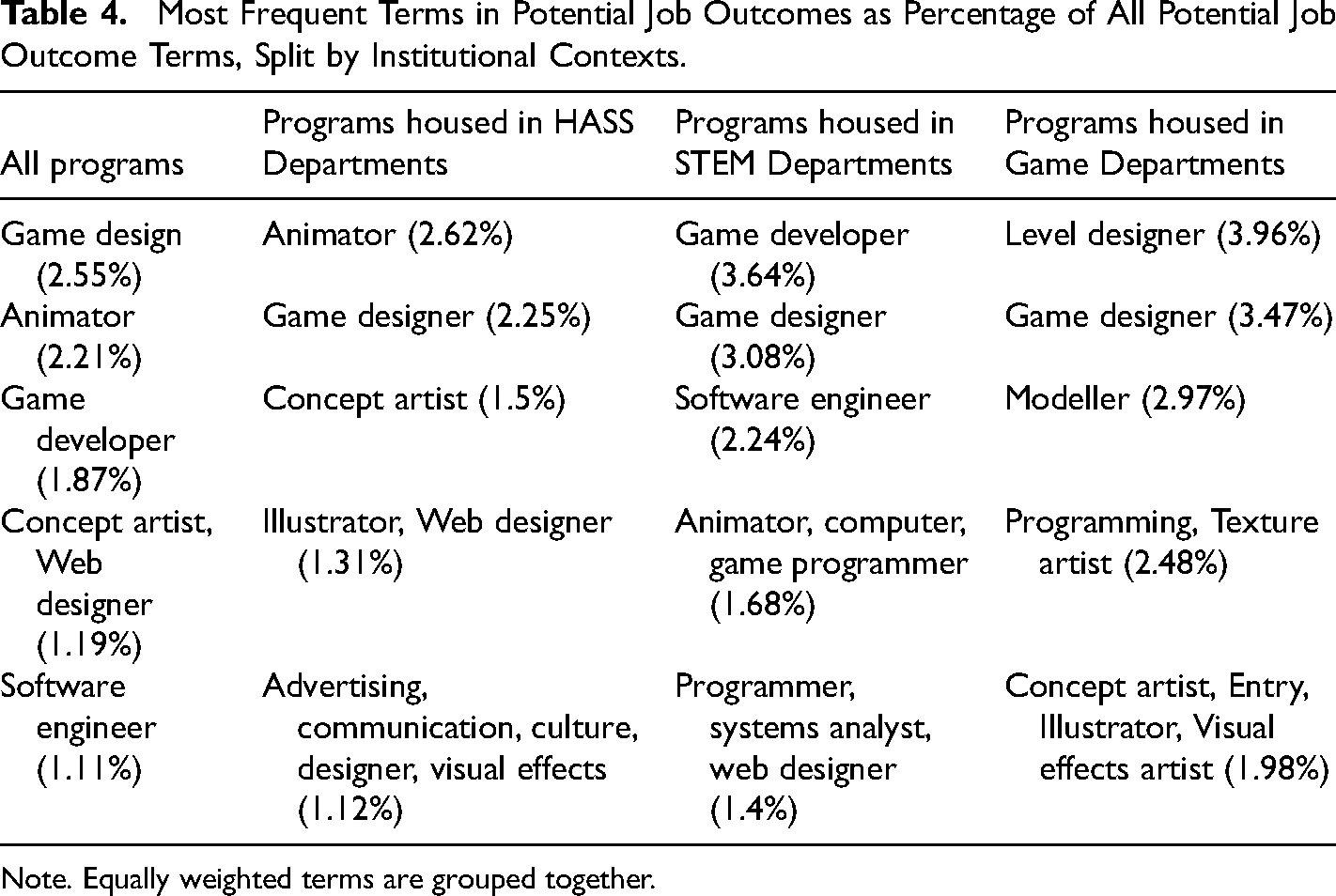
So far we have seen that HE Institutions imagine and construct potential students as passionate gamers desiring the skills of game development and a pipeline into the videogame industry to be revealed to them. What institutions then determine these skills and pathways to be is shaped, in part, by the disciplinary context of the program. Consequentially, this also influences just what employment opportunities are presented by institutions as existing for students’ after they obtain these skills. A vast range of potential job outcomes both within and beyond videogame development are advertised across the dataset, with 477 unique possibilities proposed across the 119 programs. There is, of course, not necessarily any connection between what an institution advertises as a possible job outcome, and actual graduate pathways. Nonetheless, what jobs are framed as both possible and attractive to imagined prospective students provides insights into how the program frames game development skills, and in what ways they might be transferrable (Table 4).
Most Frequent Terms in Potential Job Outcomes as Percentage of All Potential Job Outcome Terms, Split by Institutional Contexts.
Note. Equally weighted terms are grouped together.
Programs housed in dedicated Games departments, unsurprisingly, most explicitly focused on jobs within the videogame industry, with the most frequently advertised jobs including level designer, game designer, 3D modeler, programmer, texture artist, and concept artist. STEM programs, meanwhile, similarly focused on specific jobs but prioritizes generalist roles in the videogame industry (game developer, game designer, game programmer) alongside more specific technical roles not specific to games such as software engineer, systems analyst, web designer, and data scientist. HASS programs, interestingly, prioritized more visual and design roles over programming and coding roles, with animator, game designer, and concept artist the most frequent. These varied STEM and HASS foci suggest that programs in each institutional context are molded to shape existing capacities of the department (technical skills for the former, art and design skills for the latter). HASS job outcomes also more regularly rely on vague sectorial gestures over specific roles, such as “advertising,” “communication,” and “education and writing.”
When contextualizing these advertised career possibilities, Australian HE institutions regularly refer to large multinational media companies working on well-known intellectual property when telling students where a videogame development qualification might take them: Angry Birds. Candy Crush. Minecraft. Call of Duty. Grand Theft Auto. Thanks to each of these, the gaming industry today is worth billions of dollars … This degree will equip you with the skills you’ll need for a successful career designing and creating the next wave of popular video games and virtual worlds. (Macquarie University, Bachelor of Game Design and Development)
However, just as gamers typically have little understanding of the processes of game development, they have similarly been shown to have limited and market-driven understandings of the economic structure and geographic distribution of the videogame industry (Arsenault, 2017; Consalvo & Paul, 2019). The lucrative companies that produce the games that gamers are most familiar with are far removed from the local contexts of most Australian game development students where—as in most of the world beyond a few North American, East Asian, and western European cities—most videogame development teams consist of five or less workers, working in highly precarious and piecemeal circumstances that look less like established tech companies and more like garage bands (Keogh, 2021). Such teams are only rarely in a position to hire new staff, creating a challenging situation for graduates far removed from the supposed opportunities of a massive global industry. Recent surveys by the Interactive Games and Entertainment Association (IGEA) put the Australian game industry at just below 2104 full-time workers—that is 17 current videogame developers nationally for every HE program we identified.
That game development HE programs make vague gestures to the opportunities of a lucrative global videogame industry while seemingly oversupplying graduates for smaller local industries underpins most developer critiques of game development HE, such as those noted in this article's introduction. Yet, it is also entirely typical that creative practice HE programs (such as music, writing, poetry, etc.) would have more graduates than there are paid professionals in that field. While this is similarly framed as an anxiety of parents and policymakers when it comes to arts and humanities educations, it is broadly understood that such programs do not provide linear pathways into music, acting, or poetry jobs but rather a holistic creative skillset that may then be transferred to other sectors of the economy for gainful employment. Indeed, the ways in which creative practitioners transfer their skills into other sectors through the providing of creative services (as opposed to producing cultural products) is one of the primary ways creative industries researchers and policymakers strive to frame a more generous picture of the economic and job-creation value of creative work (Bridgstock, 2011; Hearn et al., 2014). Here we can consider the art student who gains employment at a marketing firm, or the poetry student who enters a company in a communication role. This potential for skill transferability, in turn, becomes a major selling point of programs that alongside igniting student passions also need to reassure students (and indeed parents) as to the availability of jobs after graduation. Such a notion of skill transferability also aligns the rise of creative industries approaches to education with the language of job-readiness and employability common to the marketized university critiqued above. As universities become more financially dependent on the career pathways of students, they increasingly speak about their students’ learning outcomes in terms of concrete “skills” that can be exploited by this or that potential employer (Bridges, 1993, p. 44).
It is thus unsurprising that ubiquitous across the programs is the notion that the provided technical, creative, and business skills taught could be used for jobs beyond game development. The University of South Australia's Bachelor of Information Technology (Games and Entertainment Design), for instance, promises to “prepare you for a career in game development but also make you eligible to pursue careers in software development, improving your employment prospects.” Flinders University's Bachelor of Creative Industries (Interactive Design), meanwhile, promises students they will “develop the creativity, strategic thinking, business capability and practical skills required for success in the creative and cultural industries sector and specifically in the design and development of games and interactive media.” Most nebulously, Murdoch University's Bachelor of Creative Media (Games Art and Design) tells students they will “develop the production, collaboration and technical skills you need to make a difference in whichever field you choose.” In each case, skill transferability is evoked to address an implicit anxiety that employment in the videogame industry might not actually be feasible.
As Brown et al. (2003, p. 110) argue, in reality employability “is primarily determined by the labour market rather than the capabilities of individuals” and thus this broad claim that students will have the capability to get employed somewhere shifts the blame of obtaining future employment onto the individual graduate rather than the education institutions or business owners. “Transferrable skills” becomes a discursive strategy through which traditional education contexts can speak the language of employability and make a case that the “skills” of the humanities and social sciences (critical thinking, communication, problem-solving, etc.) have a value for the broader economy. For game development programs, gesturing toward a general transferability of game development skills—especially by falling back on their disciplinary foundations in either computer science or more traditional visual arts—provides a way to reassure anxious students and parents that, one way or another, there will be some sort of job available on the other side of the degree—even if the institution cannot say exactly what that job might be.
Entrepreneurism and Precarity
Beyond simply promising employment in sectors beyond the game industry, HE institutions address the employment possibilities of students entering a videogame industry dominated by small independent studios through an even more nebulous and vague focus on opportunities a student might be able to take advantage of, rather than explicitly outlining of clear career pathways. For instance: Game of Thrones fans, Fortnite addicts and Pixar lovers, turn your passion into a successful career in the exciting world of film, television, gaming, and digital design… you’ll acquire the skills, mindset and contacts needed to reach the top of your game in your dream career. (Flinders University, Bachelor of Creative Arts, Visual Effects and Entertainment Design)
Here, it is not skills alone that will ensure a graduate is employable. Students also require the “mindset and contacts” for success. But then, what success (or “reaching the top of your game”) looks like has become especially ambiguous—especially in the creative industries—in a time of white collar precarity, portfolio careers, and the blurring of personal and professional achievements (McRobbie, 2016). Prospective students do not simply need reassurances that their skills will ensure their employability somewhere, but, as the University of Canberra's Bachelor of Arts (Digital Media) promises explicitly, “the knowledge that you can adapt to whatever the future holds.”
The future here is presented as both unpredictable and exciting in a way that vividly demonstrates what Kate Oakley has described as the “forced entrepreneurship” of creative workers who have no choice but to “adopt worsening working arrangements” in “rapidly changing industries” (Oakley, 2014, p. 149). Entrepreneurism and precarity go hand-in-hand in creative work, each a different way to frame a lack of job security (de Peuter, 2014), an increased reliance on self-enterprise as social welfare and worker protections deteriorate (McRobbie, 2016), and the growth of platformisation business models for cultural production and distribution that prioritize self-funded modes of creative work (Poell et al., 2022). In videogame development, forced entrepreneurship can be seen most vividly in the rise of “indie” game development where small teams of aspirants rely on platformized production software and distribution platforms to enter an overcrowded market in the hope of being the one-in-a-million success story (Lipkin, 2013; Ruffino, 2021). Indie game development has been convincingly shown to align with broader emerging structures of precarious gig economy work (Woodcock, 2021), and is also the space in which videogame development is most clearly structured as creative work (Banks, 2007; Keogh, 2021).
When the proliferation of small-scale and contingent indie modes of game development was acknowledged by programs in the dataset, it was thus typically in the positive and adventurous context of entrepreneurism that framed graduate outcomes in vague terms of “success” rather than “employment”: Given the growth in small, independent game development worldwide you’ll be introduced to the ideas of game development entrepreneurship from your first year of studies. You’ll gain the knowledge and skills related to succeeding as an independent game developer. (Bachelor of Games and Interactive Environments, Queensland University of Technology)
Some programs do not reference indie game development but entrepreneurism more nebulously, such as the Box Hill Institute's Diploma of Digital and Interactive Games that claims students will “learn how to start up and promote your own business, or be aware of how to present your game concept professionally to one of the many digital games companies”—two options that center the student's individual ideas and enterprise rather than employability. Most explicitly, Western Sydney University offers a Bachelor of Entrepreneurship (Games Design and Simulation) hosted by the School of Computer, Data and Mathematical Sciences that “will develop the mindset, risk tolerance, creativity, passion, big thinking, team formation and leadership capabilities” that are “the key distinct characteristics of high-impact entrepreneurs.” Also of note here is that despite previous research highlighting the significance of industry partnerships for developing game industry employment pipelines (Ashton, 2009), only 14 (12%) of programs explicitly noted that students would engage with industry partners in some capacity (for instance, internships). Instead, some institutions, such as the Academy of Interactive Entertainment, provide incubator programs to graduates, further encouraging students and graduates down entrepreneurial rather than employment pathways. 2
Harvey (2019, pp. 761–762) has previously identified how game development HE's emphasis on “real world education” instills in students an “affectively and discursively contradictory … labor bravado” that is “partially about the embrace of precarity and uncertainty, with game [HE] becoming a sort of formalized school of hard knocks” that prepares students to accept and even embrace the poor and intensified working conditions of videogame studios. In those national contexts where such large studios and employment opportunities are largely absent, such as Australia, this labor bravado is augmented into an entrepreneur bravado that still normalizes precarity but less so in the context of brutal working conditions and more in the context of self-driven enterprise, networking, and risk-taking.
However, producing graduates as entrepreneurs necessitates an individualistic emphasis (Szeman, 2015) that clashes with the highly collaborative and interdisciplinary nature of videogame development, even on ostensibly solo-developed games. This contradiction is rife in the dataset. Curtin University's Bachelor of Design (Animation and Game Design) promises students will “work independent and collaboratively” and “demonstrat[e] leadership skills in group projects,” implying that even as teamwork exists, all students will somehow be leaders. Similarly, University of Newcastle's Bachelor of Computer Science claims to develop in students “an ability to function effectively as an individual, as a team member in multidisciplinary and multicultural teams and as a leader/manager with the capacity to assist and encourage those under their direction.” A fundamental tension thus emerges between the entrepreneurial promise that every student will be a leader and the collaborative and collective nature of both cultural and technical work, particularly in videogame production. This same contradiction has been identified by researchers of independent videogame production more broadly, such as Whitson et al.'s (2021) work with independent developers in Canada that show how such developers use the language of tech entrepreneurism and start-ups when talking to investors or policymakers, but shift to the language of cultural sustainability and collaboration when asked directly by researchers about their ambitions. Just as for independent videogame developers themselves, aspiring students find themselves caught between tech- and cultural-sector ways of imagining skills, careers, success, and professional identity.
Conclusion
Across the 119 HE programs we identified that teach videogame development in some capacity, we see a consistent focus in line with broader trends of HE marketization on skill training and capacity building of human capital for the labor market. Programs are consistent in their focus on developing job-ready skills, fostering industry connections, and the nebulous importance of an entrepreneurial mindsets that will allow students to turn unpredictable futures into self-chosen adventures. However, within this broader commonality we also see discrepancies in how different identities, skills, and career pathways are framed by different institutional contexts. As videogame development requires the convergence of a broad range of technical and creative skills, different programs housed in different disciplinary contexts provide different emphases that in turn shift how videogame development itself is presented to students, and just what skills and potential graduate identities are presented as desirable and feasible. These varied disciplinary contexts means that not all game development HE programs are created equal—not simply in quality but in terms of the ideologies, cultures, skills, and graduate imaginaries that students are recruited into.
Videogame development is often presented as exemplary of the synergy of creativity and technology that underpins the creative industries approach, helping to present the economic value and innovations of cultural practice to neoliberal policymakers and investors. Our study of videogame development HE programs, however, points instead less to a synergy and more to a formative tension between technical and creative skillsets and epistemologies. Game development HE programs advertise the importance of the technical and the creative while positioning themselves in either technical or creative contexts. This aligns Australian HE game development offerings with findings on creative industries education broadly that demonstrate how the multifaceted reasons for which one might have historically undertaking an education in cultural practice are increasingly narrowed to purely labor market concerns. More broadly, our research suggests a need for creative industries researchers to consider what ideologies and epistemologies are implicitly adopted when technological and entrepreneurial approaches and values are aligned with those of cultural work—in educational contexts, and beyond.
Further empirical research that pays attention to the disciplinary context of videogame development HE programs is required to draw out the full consequences of these discrepancies and tensions. It is important to emphasize the limitations of this study in terms of its focus on a single geographic region (Australia), the volatility of time in which the data was collected (2020–2021), and especially in terms of our dependence on publicly available material. What institutions say about their own programs does not necessarily accurately depict how students and educators alike navigate specific topics in the classroom. For this, qualitative research with students, graduates, and educators is key, as is increasingly being conducted by researchers (Harvey, 2019, 2022; Keogh, 2023). This study's focus on the diverse discursive ways in which HE institutions imagine game development students and graduate pathways highlights the importance for such qualitative research in the future to consider disciplinary and institutional contexts.
Nonetheless, we can confidently make some preliminary conclusions as to how institutional context shape a program's ability to reproduce or challenge entrenched norms and hegemonies in videogame development. For instance, considering the significant gender imbalance of both the formal videogame industry and STEM sectors more broadly, it stands to reason that those game development programs in STEM and Game department contexts that prioritize technical skills and industry employment pipelines are likely to attract higher rates of students that already identify as gamers, and are thus more likely to reproduce rather than challenge the videogame industry's current hegemonic structures. HASS-based games programs likely suffer the same issues broadly, but by teaching videogame development more from the angle of the arts and storytelling could provide more inclusive pathways. For instance, University of Adelaide's Bachelor of Media (Immersive Media) that we saw above explicitly addresses gender bias in the industry as a topic of study. Elsewhere, RMIT University's Bachelor of Design (Games), housed in the College of Design and Social Context, has in recent years maintained gender parity of its student cohort through a portfolio and interview-based enrollment process akin to that of more traditional art schools, rather than relying on the more typical gamer-centric marketing of most programs (Penney et al., 2020). Ultimately, programs more squarely aligned with producing aspirational human capital for the videogame industry are more likely to reproduce the entrenched, hegemonic, and highly gendered norms of videogame production.
Footnotes
Declaration of Conflicting Interests
The author(s) declared no potential conflicts of interest with respect to the research, authorship, and/or publication of this article.
Funding
The author(s) disclosed receipt of the following financial support for the research, authorship, and/or publication of this article: Research for this article was funded by an Australian Research Council Discovery Early Career Research Award (DE180100973).
