



Abstract
Quest design is an important design aspect of video games. The current approach to quest design is dominated by a task-orientated paradigm in which a quest is viewed as a series of tasks to be completed as part of the narrative structure of the game. This paper presents an alternative paradigm that shifts away from the predominant task-based approach to quest design. Based on a study of existing quest models, a dual quest framework of singular and synergy quests is proposed. Within the frameworks, tasks become an intermediary step within the quest which is now focused on the transfiguration of the player character. This approach offers a practical design structure for both procedural and manual quest design.
Introduction
Development costs of video games can be even greater than the most expensive Hollywood movie. The video game Star Citizen (Cloud Imperium Games, 2022) has already cost US$400 million before its projected release date of the third-quarter of 2024 (Cloud Imperium Games, 2021). For the game Destiny (Bungie, 2014), when development and business costs such as marketing, publication, and royalties are considered, the cost of releasing the game was US$500 million (Levy, 2014). The most expensive Hollywood movie is Pirates of the Caribbean: On Stranger Tides with an estimated cost of only US$410 million (Sylt, 2014).
The development costs of video games are only expected to continue to rise, with future estimates suggesting in the region of a 200–300% increase in costs for the next generation of game consoles such as the XBOX Series X and PlayStation 5 (Dring, 2020). For this reason, there has been a long-standing interest in exploring effective techniques to reduce the development costs of video games across a range of technical and artistic areas. Folmer (2007) has explored the potential of component-based game development using commercial off-the-shelf software to reduce development costs. Procedural generation of game content has been explored by a number of authors in an effort to reduce development costs, within areas such as materials (Bernardi et al., 2020; Guo et al., 2020), animations (Gujrania et al., 2019), real-time terrain generation (Maulana et al., 2020; Olsen, 2004), level generation (Adams et al., 2017; Khalifa et al., 2020; Van der Linden et al., 2013; Yannakakis & Togelius, 2011), and narrative generation (Kybartas & Bidarra, 2017; Mason et al., 2019; Reed, 2012; Stockdale, 2021). The effects of procedurally generated content on the player's experience have been explored by Rodrigues et al. (2020).
Among the many methods of cost reduction in video games, Procedurally Generated Quests (PGQs) have received significant interest over several years (Breault et al., 2021; de Ruiter, 2020; Doran & Parberry, 2011; Kybartas & Verbrugge, 2014).
Yu et al. (2020) examined fifteen published academic papers related to PGQ. In their paper, the authors identified a quest to be “a partially ordered set of tasks that the player must complete to get one or more rewards.” However, this task-orientated approach omits consideration of the wider implications of the meaning of a quest. Within literature studies and within some video games, quests often contain a deeper meaning than just the completion of tasks. For example, the personal transformation which Joel experiences with Ellie through their post-apocalyptic quest in The Last of Us (Naughty Dog, 2013) or the implications of the genetic conditioning of Jack in Bioshock (2K Boston, 2007). Such themes of physical, psychological, or spiritual transfiguration of individuals or even the game world itself are often inspired by Joseph Campbell's The Hero's Journey (Campbell, 2008).
This work seeks to develop the understanding of quests by expanding the focus beyond the task-orientated paradigm to include aspects of the transfiguration of the player character. It will examine the definition of quests and the experience of the player's heroic character from a variety of directions to develop a novel transfiguration-orientated approach to defining quests.
Hero and Gender
In Greek mythology, Hero was the name of a female priestess of Aphrodite who fell in love with Leander. By the 1690s the term hero had mostly lost its Greek origins and adopted a mainly male aspect as it began to describe a “chief male character in a play” (Douglas, 2021). Today, the hero is often accepted as referring to both male and female protagonists, while the heroine refers to only a female protagonist.
This work will recognize that in today's society there are more accepted genders than just the biological reproductive categories of male and female. Abrams (2022) describes 68 gender identity terms in use as of 2022. For this reason, this work will adopt a gender-neutral application of the term hero.
Quest Etymology
The word quest has evolved from the Latin quaerere “ask, seek, look for” (Foster, 2021). By the early 14th century, the term maintained this meaning but had also acquired a more judicial tone, to mean “an inquest, a judicial inquiry” (Douglas, 2021). As Arthurian literature became popular, the term quest became more widely associated with adventures undertaken by medieval knights. Over time, the term developed into the old French and Anglo-Norman term queste, with the later English version converted to the quest (Linas, 2022).
Quest Lexicology
The themes present in etymological definitions continue into lexical definitions within contemporary dictionaries. Seven English dictionaries were consulted (Cambridge University Press, 2008, 2013; Collins, 2022; Collins COBUILD, 2014; Merriam-Webster, 2022; Oxford University Press, 2007, 2022), and the components of each definition of the term quest are summarized in Table 1. All the surveyed dictionary definitions agree that a quest must contain an element of searching. As for the components of difficulty and length, there is less agreement. Four of the seven definitions contain an element of difficulty, with five sources implying a component of length which can be interpreted to mean either length in space or time, or potentially both.
Dictionary Components of a Quest.
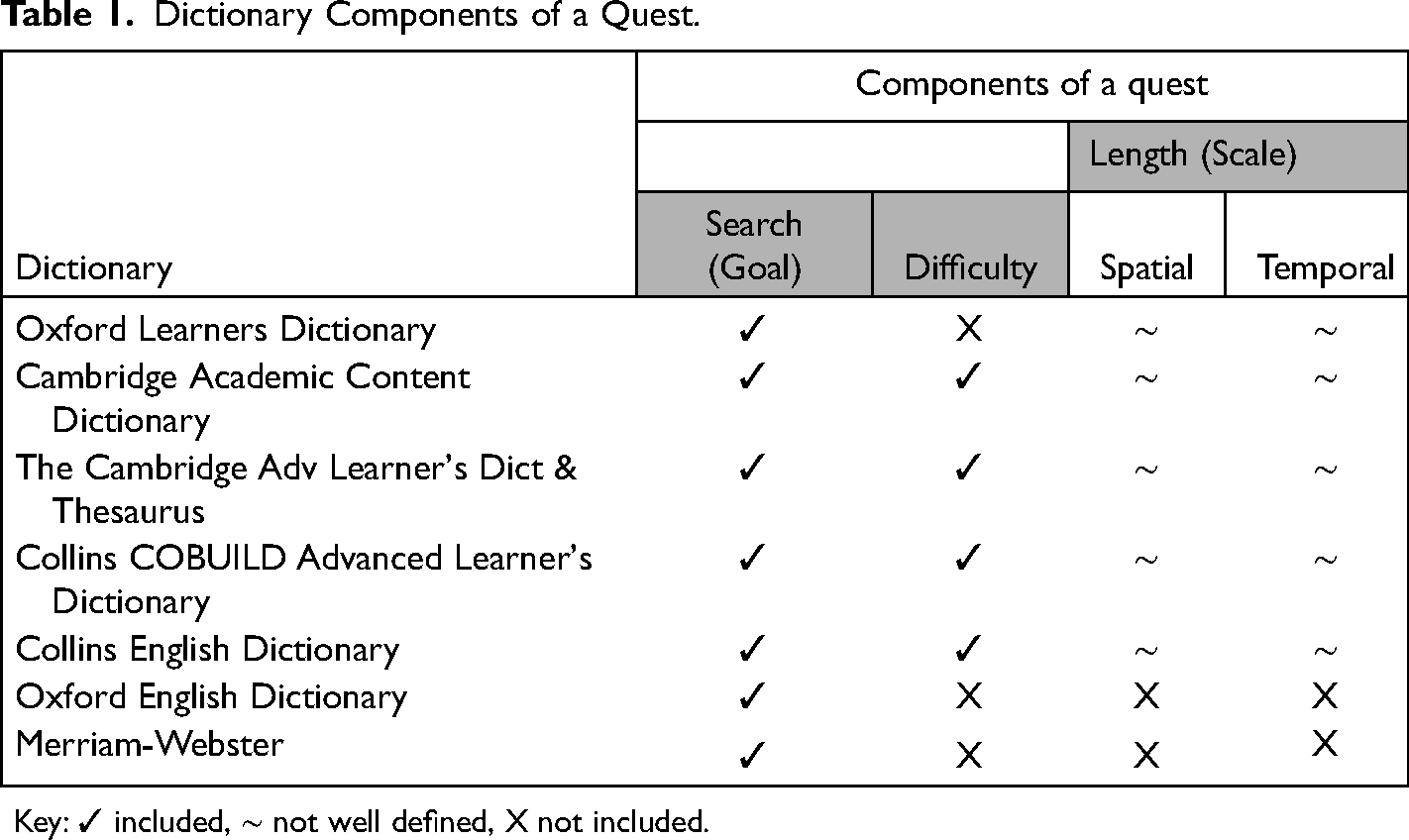
Key: ✓ included, ∼ not well defined, X not included.
Based on these findings, from a lexicological perspective, a quest can be defined as a long search over space and time for something which is difficult to find.
Defining Terms
When presented with such variation in the definition of a quest, it becomes valuable to define other relevant terms for the context of this work. The following definitions are used:
Quest Classification
There are many types of the quest within video games. Aarseth identifies three types of quests that can be combined together: place, time, and objective-orientated quests (Aarseth, 2005). Place quests involve moving the player character from one location to another which Howard (2007) suggests is important to a quest by providing interest and meaning. Time quests have some form of the time limit imposed on the player. Objective quests require specified tasks to be completed. Howard (2022) expands on this concept by identifying five types of quests in The Elder Scrolls IV: Oblivion (Bethesda Game Studios, 2006); fetch, deliver, dungeon crawl, escort, and kill which are expanded into further subcategories. It can be argued that fetch, deliver, and escort quests involve similar actions related to the transportation of a game object or character and can, therefore, be grouped under the category of transit. A dungeon crawl is arguably not a quest, but rather the process the player undertakes to complete a quest by moving from room to room.
An expanded categorization of transit/kill/use is proposed based on the type of objective, with space and time acting as controlling parameters of the quest, as shown in Figure 1.
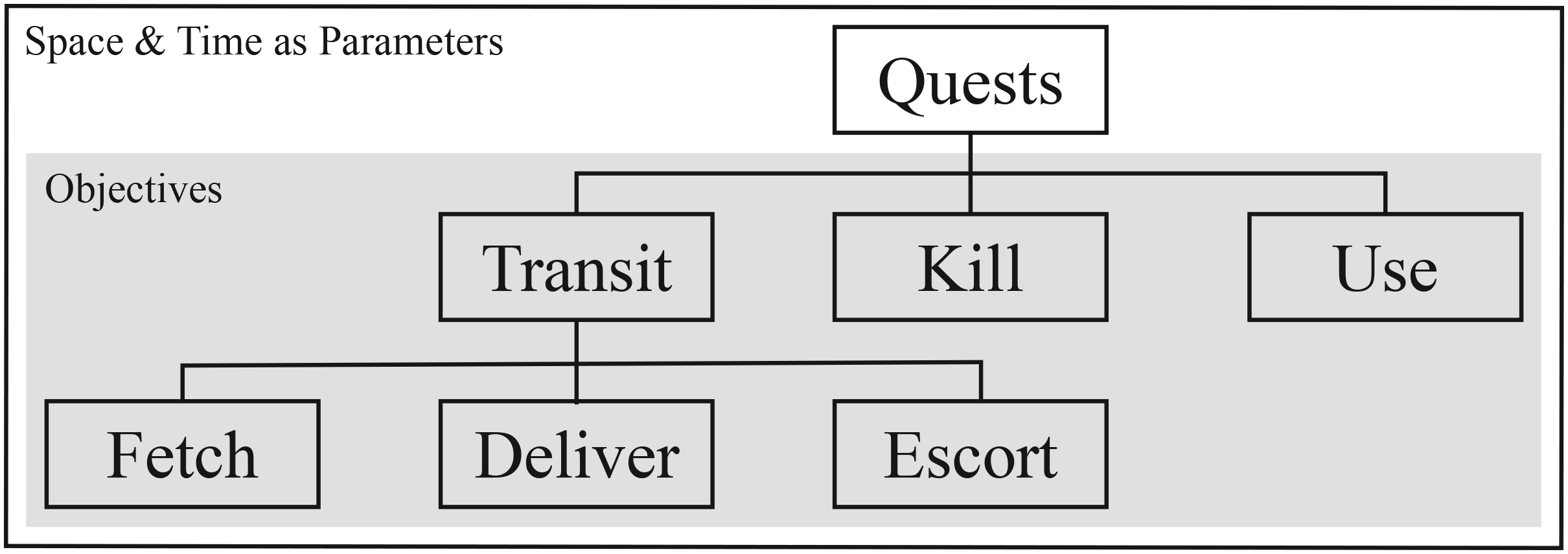
Quest classification.
Rettberg (2008) identifies quests as "tasks the player is asked to perform".
Quest Theory
Researchers interested in the topic of quests within video games have the option of approaching the subject from three standpoints, as shown in Figure 2.
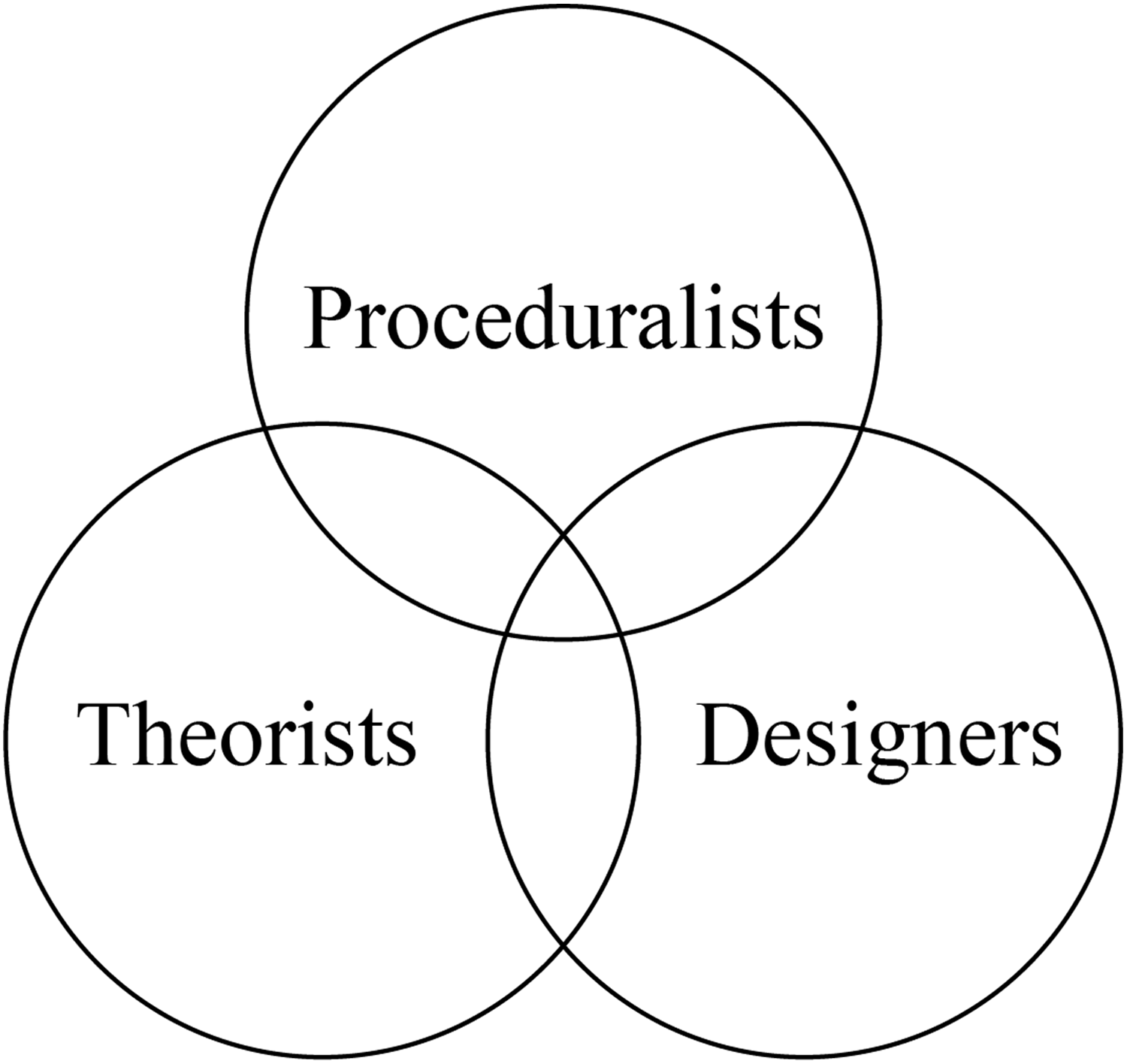
Approaches to video game quest research.
In the video games industry, an individual game developer may focus on a single approach, or adopt a fluid role across the three approaches, all of which offer many variations in their definitions of a quest.
Quest Proceduralists
Authors such as Breault et al. (2021), Doran & Parberry (2010), de Ruiter (2020), and Soares De Lima et al. (2019) focus on the question of how to procedurally generate engaging quests. In Fallout 4 (Bethesda Game Studios, 2015), a system called Radiant was developed to procedurally generate an endless supply of side-quests using a set of predefined templates. At runtime, the templates are populated with randomly selected elements such as locations, characters, enemies, and rewards. This is a typical example of a template/list approach to procedural quest generation which is straightforward to implement, and the component lists can be easily updated to add additional combinations in the future. The main criticism from players of Radiant quests, as with most PGQs, is that there is little variation in the nature of the quests which are limited to the task-orientated paradigm of transit/kill/use.
Quest Designers
Quest designers are the practitioners of the video game quest, who design and implement quests in commercial video games. Designers manually design quests by applying a range of audio, visual, and narrative tools within the framework of the game mechanics. On occasions, designers may rely on procedural generation for the main quest, but more commonly use such tools for generating side quests.
For quest designers, the quest is a functional tool used to engage the player either directly or indirectly (Karlsen, 2008) and provide the structural framework to allow the player to move forward within the narrative of the game. This is also true for side-quests which usually have no direct impact on the main quest, but instead, offer opportunities for in-game rewards or character progression. In some cases, side-quests can be the responsibility of designers, as in The Witcher 3: Wild Hunt (CD Projekt Red, 2011). Leszek Szczepanski, a senior gameplay programmer with Guerrilla Games, discussed the inherent relationship between procedural and manual quest design in his 2007 Game Developers Conference presentation (Szczepanski, 2017) which examined quests in Horizon: Zero Dawn (Guerrilla Games, 2017).
Quest Theorists
There are two distinct approaches in which game theorists can engage with quests. Those authors who have an interest in the field of game studies and those who focus on literary criticism.
Authors from the field of game studies engage with quests as part of the debate between ludology (abstract and formal systems within games) and narratology (games as a novel form of narrative). Authors examine how to create effective game analysis tools and ontologies (Aarseth & Möring, 2020) to gain an understanding of why quests fail or succeed (Tosca, 2003) from a player's perspective.
The literary criticism of quests includes works from outside the context of video games yet offers insights that can inform the design of video game quests. Auden (1961) has suggested a six-part quest structure through which he encourages the reader to reflect on how this structure can be applied to an individual's daily life as a tool of self-enlightenment. Auden also discusses how the quest has been an important survival tool for individuals and society.
Vladimir Propp published his Morphology of the Folktale in 1928 (Propp, 1928). This was a study of the morphology of 100 Russian folktales. Although not solely focusing on quests, many of the folktales Propp examined contained quest narratives as part of their structure. Through this analysis, Propp identified thirty-one narrative functions that have formed the foundation of a collection of work in the field of procedural story generation (Brusentsev et al., 2012; Cantoni et al., 2020; Fairclough & Cunningham, 2003; Gervás, 2013; Gervás et al., 2005). Arvidsson (2005) has also found Propp's functions to be an effective analysis tool within game studies. Each of Propp's stages is flexible in their implementation, as long as the function of that stage remains constant. In the process of including transfiguration within his 31 stages, Propp is acknowledging an element of the transformation of the hero.
In 1957, Northrop Frye published details of his theory of literary criticism in Anatomy of Criticism (Frye, 1957). Within this influential work, Frye does not actively explore the definition of a quest, instead, he uses the term as a search-orientated task. He does, however, recognize the personal physiological transformation through the death of the hero. Denham (2021) notes that this is only discussed in depth within the phases of the four mythoi of comedy, romance, irony, and tragedy.
Erickson (1996) explores the spatial and temporal themes of quests through his analysis of the 16th-century poem The Faerie Queene by Edward Spenser (Spenser, 1903). Unlike the quests explored by other authors, The Faerie Queene is an allegorical poem. Such poems held hidden meanings, not immediately obvious through a surface reading of the text. Even so, Spenser was quite clear that the purpose of the poem was to convey his preferred behavior of a virtuous man. In fact, he explicitly stated this by writing that his intention for the poem was to “fashion a gentleman or noble person in virtuous and gentle discipline” (Spenser, 1590).
The Meaning of a Quest
The explorations of the quest by Propp, Auden, Frye, and Spencer have been continued by contemporary authors. Bartle (2008) views quests as “goal driven pieces of narrative” while Harviainen et al. (2018) refer to a quest as a series of tasks, which Zagal and Deterding (2018) argue can be replayed multiple times by players. Aarseth (2004) argues that quests require that “the player-avatar must move through a landscape in order to fulfill a goal while mastering a series of challenges.” Løvlie (2005) uses a similar approach to define a quest as a series of meaningful actions which lead toward the resolution of a narrative conflict. These definitions are similar to the proceduralist approach in that they are task-orientated.
For Ragnhild Tronstad, a quest is more than just a series of tasks, the quest must have meaning within itself, “To do a quest is to search for the meaning of it” (Tronstad, 2001). To discover this meaning, Howard (2022) argues that it can be uncovered through the completion of challenges presented to the player.
The meaning of a quest can be viewed from two perspectives. It can be purely mechanical, where uncovering the meaning of a quest is to uncover the reward for completing it. Alternatively, there can be a deeper meaning to the quest, a hidden philosophical or emotional meaning embedded throughout the whole quest, not just at the point of completion. The most influential work to propose this deeper meaning is Joseph Campbell's The Hero with a Thousand Faces (Campbell, 2008). First published in 1949, his work has influenced a generation of writers, filmmakers, and academics. It identified a remarkable number of consistent themes across many of the world's mythic quest traditions. Campbell developed this study into a model called the Monomyth. The Monomyth describes seventeen stages that a hero typically experiences during their quest as they travel from their ordinary world, into the special world, overcoming numerous challenges to achieve the boon, before returning back to the ordinary world.
Throughout Campbell's seventeen stages of the Monomyth, the hero faces regular challenges from the moment the Call to Adventure forces the hero to make a difficult decision to leave the safety of the Ordinary World. Through The Road of Trials and even on the return journey through the Magic Flight, there can be threats to overcome. Hercules faced his 12 labors, and even after defeating Grendel's mother, Beowulf must then fight a dragon to defend his new kingdom. On returning home after his adventures, Odysseus is still faced with the challenge of testing the loyalty of his wife and dealing with her suitors. The multiple challenges which a hero faces within the Monomyth are clearly not trivial, they are difficult. They are designed to test the physical and/or mental resolve of the hero. In the return, the hero or the ordinary world is transformed attaining a higher state or level of understanding than that which was present at the start of the quest.
Another common theme within mythological quests such as Jason and the Golden Fleece, The Odyssey, or The Quest for the Holy Grail is that the hero must travel great distances to reach the boon, and then travel great distances back to their ordinary world. While traveling great distances is not essential within the Monomyth, it is nonetheless a common theme.
With a large spatial displacement comes the implication of a large temporal displacement. Odysseus's quest to return home was not completed within a few minutes or hours. Neither was Frodo's quest to destroy the One Ring or the quest of King Arthur's knights to find the Holy Grail.
This spatial and temporal journey is expressed in circular form in Campbell's Monomyth where the hero arrives back where they started in a transformed state, as shown in Figure 3A. This circular concept can be enhanced to more clearly demonstrate the transformational components by displacing the end point of the circular path vertically on the
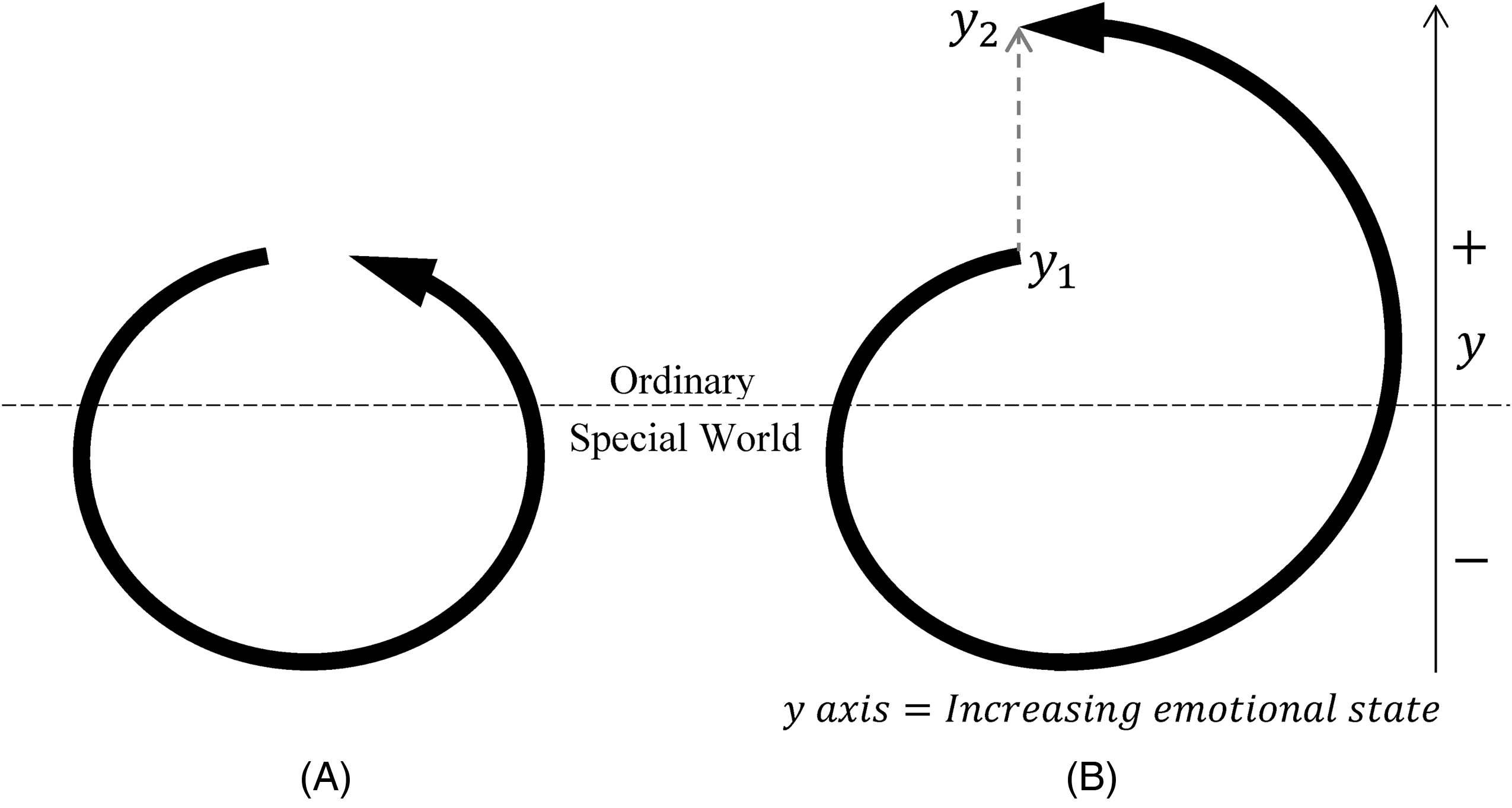
Proposed monomyth emotional path. (A) Standard Monomyth Path and (B) Proposed Monomyth Transformational.
In the proposed new model of Figure 3B, the
This elevated status can be applied to two aspects of the player’s character. The first takes place within the task-orientated paradigm in which completion of the task can provide a functional reward to enhance the numerical characteristics of the player character such as strength or possibly making new powers or characteristics available to the character. The second application is the transformation of the character from their initial status to a higher level of understanding or being, as can be seen with, Dionysos who was a mortal man elevated to the status of a god when he demonstrates his supremacy of over death by returning his mother Semele from Hades (Atsma, 2022).
While side quests typically offer functional rewards, the main quest focuses on offering thematic rewards. When considering the theme of apotheosis from Campbell, transfiguration from Propp, and self-enlightenment from Auden, there is a common theme of transfiguration to a higher level of understanding. The designer created quests in video games do make use of this theme in some cases. In Half-Life 2 (Valve, 2004), the main protagonist Gordon Freeman evolves from an unassuming scientist to a revered savior of the human race. In Horizon Zero Dawn (Guerrilla Games, 2017), the discovery of advanced technology eventually transfigures Aloy from an outcast to a savior status, with statues being built in her honor in the sequel game Horizon Forbidden West (Guerrilla Games, 2022).
It is this thematic significance of transfiguration which is lacking from the task-orientated paradigm and implies an alternative model of transfiguration-orientated quests.
The Transfiguration Oriented Paradigm
To look for a lost collar button is not a true quest
To closer examine the themes contained within the transfiguration-orientated paradigm a comparison of nine quest models was conducted (Auden, 1961; Burton, 2019; Campbell, 2008; Carriger, 2020; Frye, 1957; Murdock, 2020; Propp, 1928; Schmidt, n.d.; Vogler, 2007). Some overlap in the meaning and events of specific stages across these models was identified, however, there are no stages that are consistently present across all the models. The names of the stages in the nine quest models do not always convey the real meaning of that stage which the authors intend. It is therefore necessary to understand the meaning of each stage rather than focusing on the descriptive title. The most common themes in each model are collated in Table 2 and are grouped into three stages.
Quest Themes.
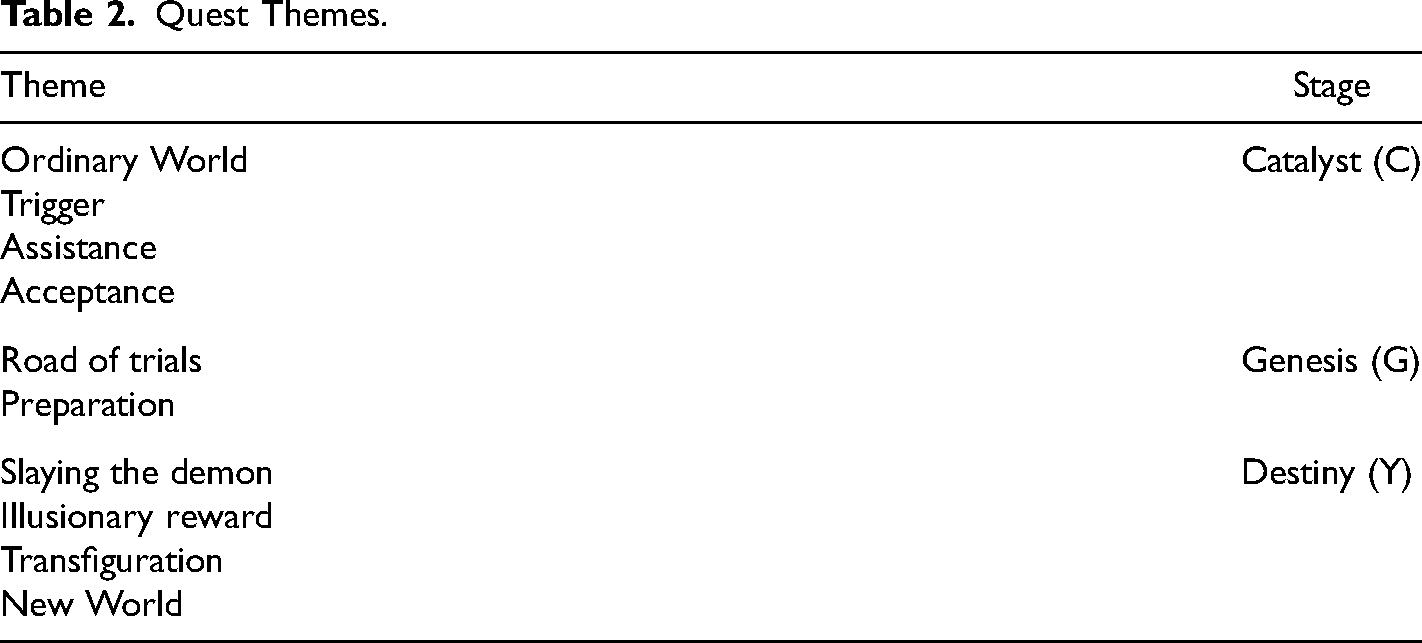
The model in Table 2 represents a high-level thematic quest model which is expressed in Definition 1 as a 3-tuple.
Definition 1: Generalized Quest.
This approach to defining a quest creates a transformation-orientated paradigm within Figure 3B, moving away from the purely functional development of the character as seen in the task-orientated paradigm.
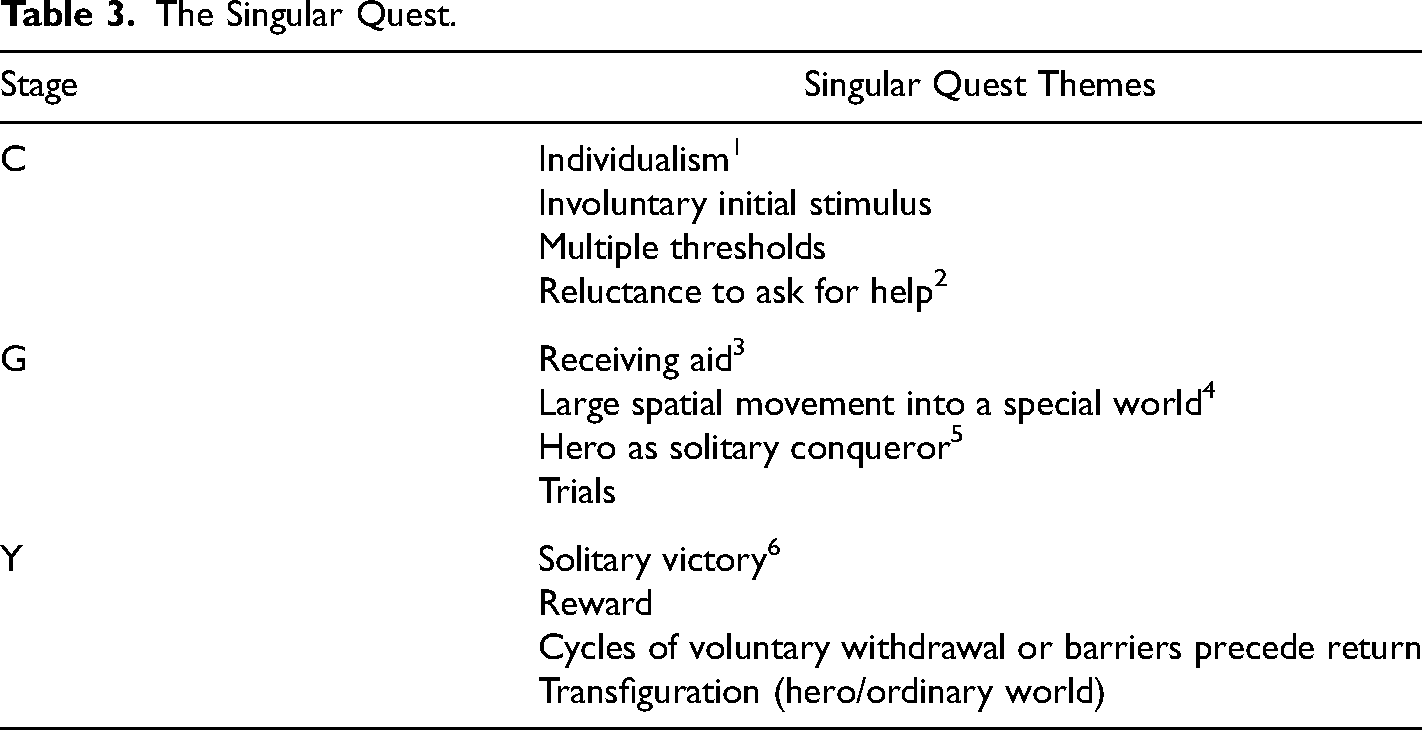
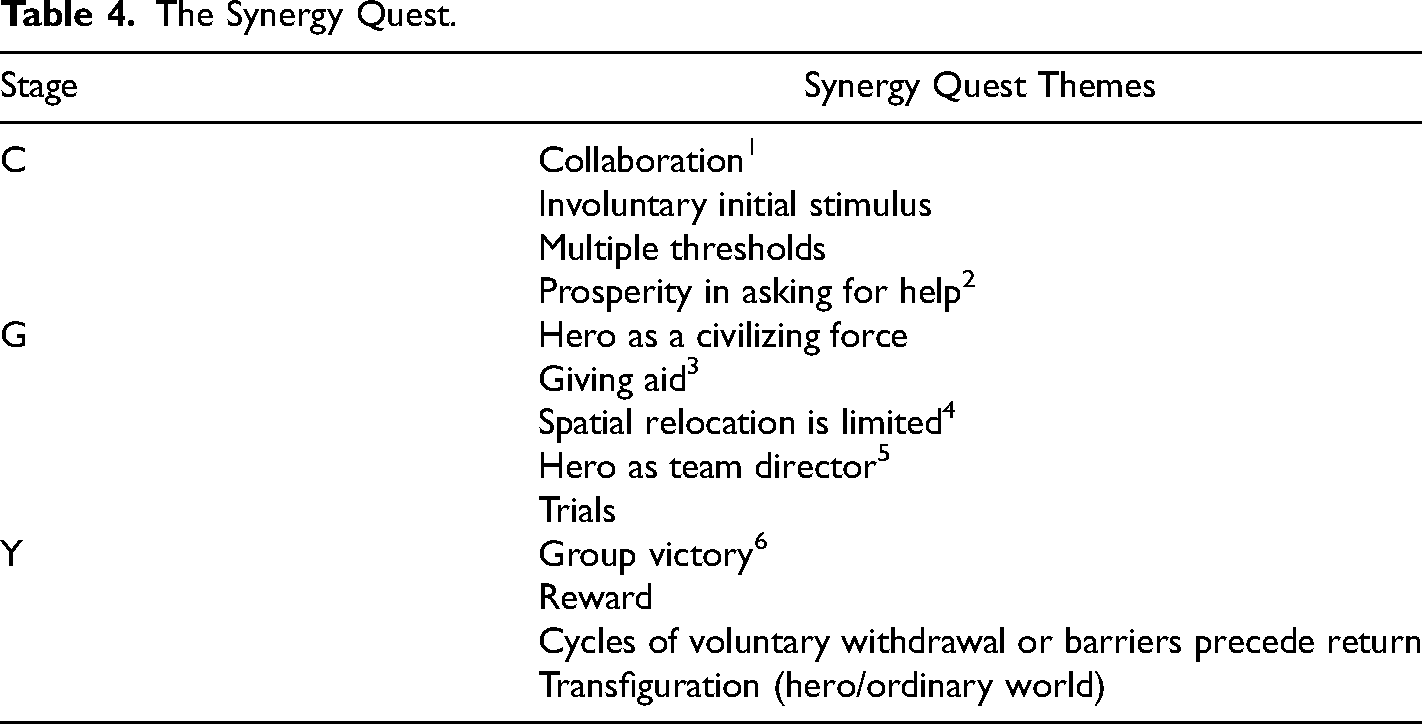
Recently proposed feminine-based quest models proposed by Burton (2019), Carriger (2020), Murdock (2020), and Schmidt (n.d.) propose contrasting themes beyond mere sexual differences when compared to models proposed by Auden (1961), Campbell (2008), Frye (1957), Propp (1928), and Vogler (2007). The feminine-based models bestow themes of delegation and collaboration over individualism, giving aid over receiving aid, limited rather than large spatial movements, and reunification rewards. Consideration of these divergent themes leads to the identification of two approaches to expanding the generalized quest model from Table 2. These are the singular and synergy quest models.
The singular quest in Table 3 is undertaken by a sole individual who receives help from others, sometimes reluctantly, where long distances are traveled to a final solitary victory. This form of the quest can be seen in Greek heroes such as Bellerophon, who received help from Athena to capture Pegasus a winged stallion, after which Bellerophon completed this task by himself.
The Singular Quest.
The synergy quest in Table 4 is collaborative, help is sought after, and aid is mainly given by the hero rather than received. Spatial relocation is less pronounced, and the final victory is achieved through collaboration. The Greek myth of Jason and the Golden Fleece requires Jason to seek help by assembling a crew to sail on the Argo with him to recover the fleece.
The Synergy Quest.
In either transfiguration quest, the full meaning and implications of the quest are gradually uncovered throughout the quest, becoming fully understood at the transfiguration stage. Now that the meaning has been discovered, the quest becomes part of the character’s (or ordinary world) history, and cannot be repeated (Tronstad, 2001).
This dual approach to defining a quest includes six antithetical stages between the models, indicated by matched superscript numbers. For example, Individualism1 in the singular quest of Table 3 has an opposite stage of Collaboration1 in the synergy quest in Table 4, and Solitary Victory6 in the singular quest is opposed by Group Victory6 in the synergy quest. This offers significantly different play experiences: solitary versus collaboration, receiving versus giving aid, large or small spatial displacement, and singular versus group victory. The differences between the singular and synergy quests can be expressed through Definitions 2 and 3.
Definition 2: Singular Quest.
A partially ordered set (
When considering the task-orientated definition of a quest from Yu et al. (2020), tasks now become a component part of a transfiguration quest, rather than the quest itself. Instead of using the term task, the term trial is now used in its place to convey the theme of evaluation of progress toward the final transfiguration. Trials can be defined as a partially ordered set (
The theme of destiny includes the ultima, the final battle, E which is the entity or event to overcome and B is the boon received after defeating E. An optional partially ordered set (
The quest takes place within a large spatial movement as previously discussed in the case of Jason and the Golden Fleece, The Odyssey, and The Quest for the Holy Grail. This is represented by enclosing the definition within
The synergy quest presented is represented as Definition 3.
Definition 3: Synergy Quest.
In addition to common elements from the singular quest, the synergy quest Qr has substituted
Together, the player character and N form a group and move through the game world as one unit. A set of delegated commands become available to the player G, where
A smaller spatial displacement is experienced which requires the definition to be enclosed by
Side quests (Suter, 2021) are an important addition to the main quest. Both the singular and synergy quest models can be modified to define side quests by removing F from Definitions 2 and 3. This removes the element of transfiguration but leaves all other elements intact. The boon B now acts as the main motivation for the side quest and will provide the player character with non-essential equipment or character trait enhancements. If I is present, this now acts as one or more barriers to returning to the main quest line. If I is not present, the absence of both I and F combined with the removal of B constitutes an adventure where there is no specific boon beyond the experience of overcoming the various trials.
Conclusion
Yu et al. (2020) have identified that the lack of an accepted definition within procedural quests generation can inhibit research in this field. While it is not the intention of this work to compound these problems, the novel approach presented here aims to extend the current task-orientated approach to procedural quest design to include aspects of the transfiguration of the player character. For example, the work of Aarseth (2005) with the three types of quest (place, time, and objective) merely needs to shift its definition from considering these elements as quests themselves into internal parameters of the dual transfiguration quests. By embracing the dual transfiguration quest models, a wider range of quest-based experiences can be achieved, particularly within the domain of quest proceduralism.
It has been shown that by modifying the structure of Definitions 2 and 3 other gameplay experiences can be created within the paradigm such as side-quest (by removing
Through consideration of the start and end states of the player character, the quest now provides progression, which leads to the transfiguration, of the player character. As a result, the quest becomes less mechanistic and more meaningful to the character. It is the entire journey from the initial starting state of the character to their transfigured end state which provides a holistic gestalt meaning to the quests rather than individual events within the quest.
Procedural quest generation still has many complex factors to consider if it is ever to emulate the quality and depth of humandesigned quests. These include the integration of audio, visual, narrative, and emotional design elements which are not yet fully expressed within procedural quest design. As research continues to improve the procedural generation of these elements, the dual transfiguration quests can offer a framework around which they can be integrated.
Within the games industry, the singular and synergy quest models can be used as a framework for designing hand-crafted quests by providing guidance on the key stages to be included to ensure there is an element of the growth of the player character which develops to a state of transfiguration. For PGQs, the dual transfiguration quests provide a framework to add meaning and therefore increased engagement. It encourages proceduralists to expand the task-orientated paradigm by considering how to develop an algorithmic approach to the transfiguration of the player character. Several questions can now be explored such as how to define start and end states for the transfiguration process, what type of thresholds can be defined to determine when the transfiguration process is complete and how can the algorithm consider the characteristics and influences of the game world.
Further research is intended to explore the practical implementation of the singular and synergy quest models, as a novel approach to reducing development costs of video games, while also providing variation in procedural quest design.
Footnotes
Declaration of Conflicting Interests
The author(s) declared no potential conflicts of interest with respect to the research, authorship, and/or publication of this article.
Funding
The author(s) received no financial support for the research, authorship, and/or publication of this article.
