



Abstract
Developed by Omocat and released in December 2020, OMORI is a surreal psychological horror role-playing game. The game follows the titular protagonist Omori as it examines such sensitive topics as suicide, grief, death, and depression. Such traumatic events are triggered in several planes of existence—White Space, Headspace, and Black Space—leading to anxiety, regression, and resurfacing trauma. In our article, we examine such representations of trauma with particular attention to the role of environmental design. The planes represent different approaches to memory, trauma, and repression, which Omori and the player navigate in non-linear, recursive paths. We analyze how each space seeks to illuminate and explore aspects of trauma in its respective atmosphere. Through environmental design, OMORI provides players with three distinct experiences with escapism and trauma that are representative of the experiences of trauma victims, ultimately elucidating the psychological phenomenon on a larger scale to de-stigmatize trauma.
Introduction
OMORI is a game that makes thematic use of environmental design and intertwines the foundation of the game's structure with its theme. Developed by Omocat and released in December 2020, OMORI is a surreal psychological horror role-playing game. The game follows the titular protagonist Omori and explores his experiences with grief, memory, and nostalgia (Fukunaga, 2021). In the game, the child Omori traverses through several planes of existence—White Space, Headspace, Faraway Town, and Black Space. For the purposes of our article, we will not be concerned with Faraway Town, but only focus on the spaces that exist in Omori's mind. These different planes represent different approaches to and experiences of memory, trauma, and repression, which Omori and the player navigate in non-linear, recursive paths. The game examines such sensitive topics as suicide, grief, death, and depression. Throughout the game, Omori and the player have a foreboding sense of tragedy, although its source is unclear. Only in the final moments of the game is the tragedy actually revealed.
The titular character, Omori, and by extension the players, are greeted with this message in White Space at the start of a new game: “Welcome to White Space. You’ve been living here for as long as you can remember” (OMORI). The monotonous nature of the space, which makes it seem like one has been there for a long time and time does not pass by quickly, also reveals a darker underlying side of the sparsity of the space: an avoidance of trauma. Trauma plays a central role in OMORI. Asked about why they decided to create a game that deals with anxiety and trauma as an integral part, the developer responded: “Actually, the main intention of the game wasn’t to talk about anxiety and depression, but of course, thanks to the plot, we had to talk about these themes. A lot of the team members, myself included, struggled with depression, and writing was a way to cope with it. A lot of themes throughout the game reflect personal experiences …” (Omocat interview, 2021). Such traumatic experiences are triggered in other parts of the game, leading to anxiety, regression, and resurfacing trauma. In our article, we examine such representations of trauma with particular attention to the role of environmental design in OMORI. The study of environmental design, sometimes called level design, examines different elements of a game's levels and discerns the effect of those elements on the overall player experience. A level is an area within a video game where an objective is to be completed (Wolf & Perron, 2014, p. 216). The level acts as the basic building block of the video game. This significance makes its study essential to gaining an understanding of any other element within video games. The way a level is designed creates an aesthetic atmosphere that both characterizes that level and guides the player toward the target objective (Schell, 2008, p. 381). The study of level design examines different elements of the level, such as layout and visuals, and attempts to discern how these elements act together in shaping the gaming experience within that level, in addition to aiding the overarching tone and thematic concerns of the game.
Overall, a single playthrough of OMORI presents the player with three aesthetically and symbolically distinct areas and communicates its main ideas regarding trauma primarily through exposure to those areas. The player begins their journey in White Space, a purgatory-esque minimalistic room. Secondly, they explore Headspace, a vibrant and nostalgic vast world full of adventure and childhood memorabilia. Lastly, the player is teleported into Black Space, a horrifically unhinged space filled with disturbing entities and cryptic content. Each of the three areas is characterized by a distinct aesthetic atmosphere curated through the combination of music, visuals, and exploratory elements. Each space seeks to illuminate and explore aspects of trauma through its respective atmosphere. Through environmental design, these spaces represent different psychological phenomena that arise as a result of exposure to trauma.
As outlined by the SAMHSA Clinical Guide for assessing victims of trauma, such phenomena include avoidance, regression, and anxiety (SAMHSA, 2014). The most prominent phenomenon the game explores, however, is escapism and its use as an unhealthy coping mechanism. OMORI seeks to represent trauma and the use of excessive escapism to cope with it. This representation of trauma makes the experiences of traumatized individuals visible and tangible to players through the game's environment. In their exploration of mental health and online multiplayer gaming, Colder Carras et al. (2018) state that “online interactions allow individuals with mental health challenges to receive much needed social support and a sense of connectedness or belonging, which are ideal interventions for individuals with suicidal ideation and behavior” (p. 2). Through the distinct atmospheres in OMORI, each area fulfills a different thematic role pertaining to the overarching theme of trauma and escapism, which provides a different experience with it that deepens a player's understanding of them. Through environmental design, OMORI provides players with three distinct experiences with escapism and trauma that are representative of the experiences of trauma victims, ultimately elucidating the psychological phenomenon on a larger scale to de-stigmatize trauma.
Avoidance in White Space
White Space is the first of the spaces that the player encounters. It is monotonous and minimalistic in terms of both narrative and gameplay. Within the game, a character describes the space as “an emptiness, a home without warmth. A place to survive, but not to live” (OMORI). In terms of landscape, White Space is devoid of color and solely consists of one room that is sparsely decorated (Figure 1). Through an insistent minimalism in the visual and aural landscape, White Space presents a hollow, risk-free form of escapism. Its minimalistic and hollow nature allows Omori to exist in an environment free of triggers and memories related to his trauma, providing a form of escapism that heavily relies on monotony.
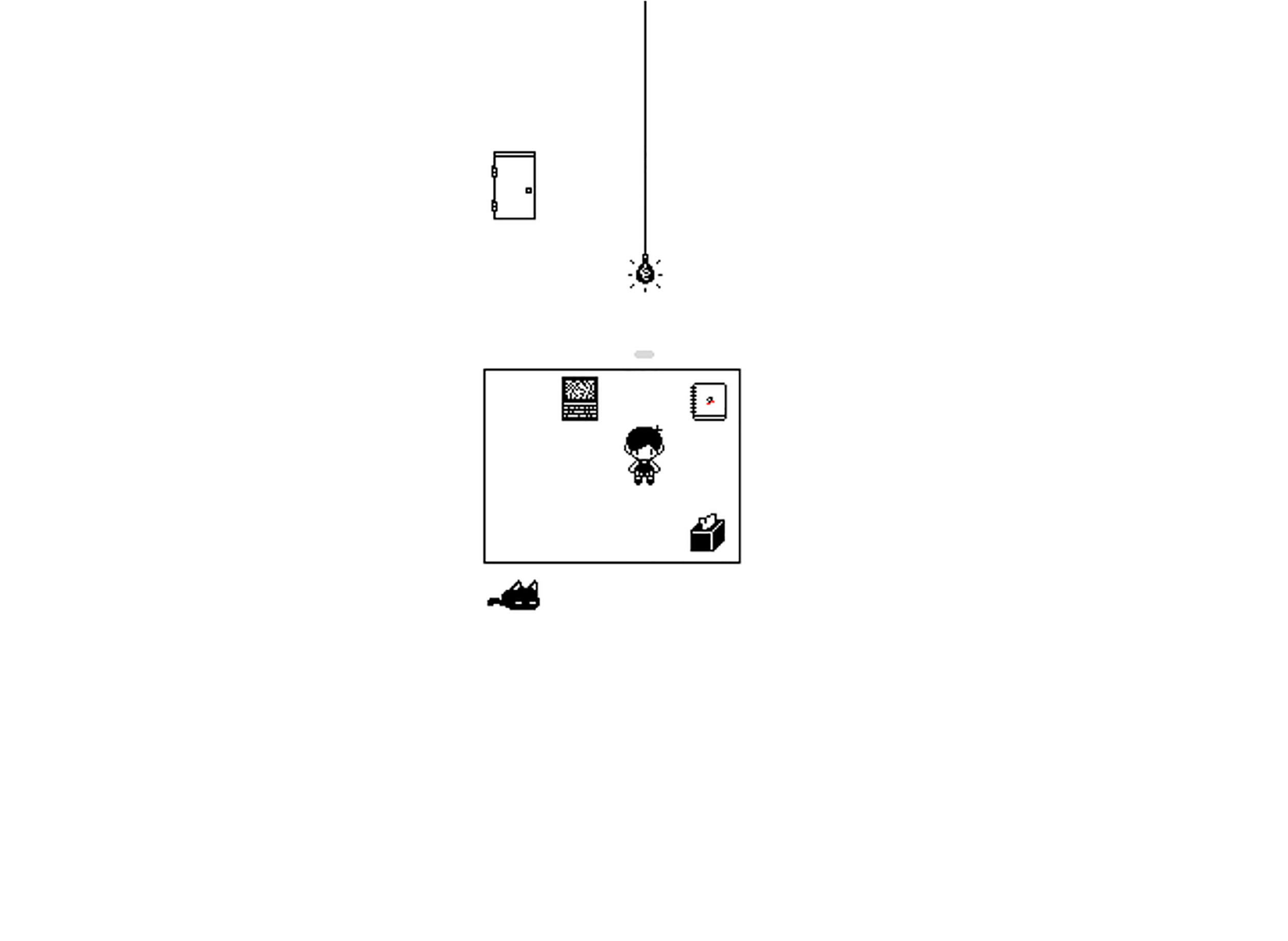
White Space layout.
This minimalism is first seen in the visual landscape presented to players. The color scheme of White Space is entirely devoid of any saturation and consists entirely of black and white. These colors are neutral and resist the invocation of any strong emotions, as opposed to the use of bright colors in other spaces, which naturally work to invoke strong feelings such as anger or excitement (Joosten et al., 2010, p. 2; Valdez & Mehrabian, 1994). Moreover, the existing color scheme is solely composed of flat colors and almost entirely lacks shading. The noticeable lack of shadows, such as different shades of gray, make the visual landscape lack variation and depth. The limited color palette and flatness of White Space makes it feel more uniform, bland, and predictable. This predictability reinforces its role as a hollow and plain retreat for Omori.
This pattern of minimalism is also apparent in the items with which the player is presented as they enter White Space. As players begin to explore this space, they begin to notice how sparsely decorated it is. The only items in the space are a laptop, a tissue box, a sketchbook, a cat, and a black light bulb. These items are placed relatively far apart from one another, making the space look and feel even emptier. The room is small in comparison to the large white expanse surrounding it. The emptiness is further exacerbated by the black light bulb's string, which hangs from an extremely high ceiling. The ceiling's height is even referenced in the text presented to the player if they interact with the light bulb, saying, “A light bulb hangs from the ceiling, wherever it is” (OMORI). This statement textually reinforces how high the ceiling is and overall makes the space feel endlessly large. The emptiness of the space eliminates the possibility of triggers or stimuli relating to trauma that are likely to cause an adverse emotional reaction (SAMHSA, 2014, p. 68).
In addition to their visual arrangement, interacting with the aforementioned objects within White Space provides an additional layer of nuance to its minimalistic escapism. After acclimating to White Space's general appearance, players will begin exploring the space and interacting with the objects they encounter. Much of the text presented through interaction with these objects reveals key details regarding Omori's experience in White Space and gives players a deeper understanding of the role it plays in Omori's life. Firstly, interaction with most objects suggests that existing in White Space does not feel pleasant or homely, but often understimulating and boring. If the player interacts with Mewo, the black cat, they will be presented with the following text: “Meow? (Waiting for something to happen?)” (OMORI). Similarly, booting up the laptop will present the player with numerous journal entries, many of which say: “Day ???: Today I spent time in White Space. Everything was okay” (OMORI). These textual instances reveal the slow and understimulating nature of White Space, wherein “everything” is technically “okay,” but a pervading sense of boredom and loneliness is present (OMORI).
The text presented to the player also reveals that inhabitants of this space, namely Omori, lose their concept of time due to the monotonous and non-progressive nature of the space. In addition to phrases like “Day: ???,” it is apparent in the text the player receives as they first spawn within White Space: “Welcome to White Space. You’ve been living here for as long as you can remember” (OMORI). These quotes reinforce the monotony of White Space and reveal its repetitive and flat nature. Through this textual information solely accessible through exploration, players are informed of Omori's feelings of loneliness and boredom, but ultimately stability, within the space. They slowly begin to understand White Space not as a simplistic liminal pit-stop merely acting as a vessel between other spaces, but as its own space that provides Omori with a particular experience with escapism that other spaces lack. Its simplicity and sparsity are revealed to have thematic importance, as the player discovers direct textual references to it and is invited to examine it critically.
White Space's avoidance of triggers and trauma through textual information and visual design mirrors a real phenomenon experienced by traumatized individuals. According to SAMHSA's clinical guide regarding trauma and treatment, “Avoidance often coincides with anxiety and the promotion of anxiety symptoms. Individuals begin to avoid people, places, or situations to alleviate unpleasant emotions, memories, or circumstances” (SAMHSA, 2014, p. 73). Much like White Space, avoidance of traumatic memories provides momentary solace and safety from anxiety. White Space's reflection of real escapist behaviors through environmental design makes the space's avoidance and sparsity feel even more thematically significant and reinforces its particular role in Omori's life. Furthermore, the revelation of this information through text that can only be accessed through exploration places even greater focus on the space's environment and invites the player to be particularly attentive to it.
The aforementioned textual information also mirrors the boredom and solitude the player feels as they explore the space. When players first spawn in White Space, they are unable to access other areas until they have interacted with every object present within the room, in addition to walking through the space and repeatedly attempting to explore the empty areas. In other words, the game requires the player to dedicate a substantial amount of time to exploring White Space and familiarizing themselves with its atmosphere before allowing them to advance. Since the number of objects within the space is limited, it takes very little time to exhaust all interactions with the available objects, leaving a large amount of time for wandering through the emptiness of White Space. Thus, players may find themselves growing restless as they continually wander beyond the confines of the room only to be met with desolate and bare space before promptly being teleported back to the room. In addition to the space feeling monotonous and understimulating, it is also free of risk and challenge as it contains no enemies and combat encounters, making it impossible to lose or get a “Game Over” screen. It is the only space in the game where the possibility of failure and harm is nonexistent.
The way players experience White Space's safe uniformity closely mirrors the way Omori experiences it, making the textual information provided by the objects, and by extension, Omori as a character, relatable. Through being able to relate to textual instances such as “Waiting for something to happen?” and “You’ve been living here as long as you can remember,” players gain a deeper understanding of the type of escapist experience White Space provides and its role as a place of a monotonous and solitary, but ultimately safe, environment. Their experience with White Space and their opinions of it now closely align with Omori's, making him easier to empathize with and ultimately making the game's escapist elements more immersive and digestible.
While the hollow and uniform monotony of White Space is integral to its role in Omori's life and the player's experience alike, the nature of White Space also shows a slight progression away from uniformity to mirror the progress Omori and the player are making in discovering the details of the traumatic incident. Moreover, it mirrors the avoidance of trauma and the emotional turmoil that arises as a result of deviation from it. This progression is mostly absent in the space's visual design, but is present in the musical tracks that play in the space and their gradual evolution from synthetic uniformity to organic disarray.
The first track that plays in White Space is an 8-bit track entitled 002 WHITE SPACE. Since this track's melody is recurrent within White Space, it eventually comes to auditorily embody and represent the space and can be considered its leitmotif. In terms of genre, 8-bit music is a style of electronically synthesized music reminiscent of arcade video games. Due to its origin, this musical style is known for being minimalistic and simple (Driscoll & Diaz, 2009). 002 WHITE SPACE is melodically sparse and repetitive, making it uniform in a similar vein to the other environmental elements of White Space. Additionally, its electronic nature makes it feel more synthetic and controlled. For this reason, this track closely aligns with White Space's uniformity and monotony. Since it only plays at an early point in the game, this track's sparsity reflects both the player's and Omori's distance from the traumatic and triggering event, and the stillness that results from that distance. Moreover, it mimics the type of avoidant escapism that has been strongly present in White Space thus far. According to SAMHSA, avoidance is characterized by a strict evasion of triggers and reminders of past trauma (SAMHSA, 2014, p. 75). This behavioral pattern is deliberate and calculated, and often characterized by the adoption of rigid routines that aid in the aforementioned evasion. The rigid and calculated nature of avoidance as a coping mechanism is reflected in this track's synthetic and uniform nature, as it avoids melodic diversity. Thus, this track is emblematic of the type of monotonous and avoidant escapism that White Space provides.
As the player gains closer proximity to the traumatic incident, this avoidance begins to unravel musically. This shift can be seen in the second track of the space, entitled 096 WHITE SPACE. This track carries the same melody as the first, but the aforementioned 8-bit style has been replaced with an echoey piano. Furthermore, the piano is played in a hesitant and erratic way, heightening a pervading sense of anxiety and uncertainty. The track features a mixture of individual notes and chords. The parts that are “hesitant” or “choppy” are all individual notes. While these choppy and imperfect notes are not developed enough to be considered leitmotifs on their own, the overall melody is still White Space's leitmotif and ultimately reflects the space's aesthetic and narrative role, making its gentle descent into disarray representative of a larger change in both the player's and Omori's understanding of White Space. The track's use of a traditional instrument as opposed to synthesized music demonstrates a shift away from artificiality, and subtly grounds the space's environment in reality. Thus, this track environmentally moves White Space away from the rigid and strict uniformity that is characteristic of avoidance, mirroring the progress the player is making in terms of moving away from avoidance as well.
More importantly, the track's hesitation and shakiness mirrors the experiences of traumatized individuals as they come in contact with triggers after engaging in avoidance and escapism for prolonged periods of time. As discussed by SAMHSA (2014), interacting with triggers in an unexpected manner elicits an adverse psychological reaction and leads to emotional dysregulation and disarray (SAMHSA, 2014, p. 66). This dysregulation is depicted in the track's disorderliness and overall sense of anxiety. Through this track, the space's music mirrors the jarring nature of the information to which the player and Omori are being exposed and the negative emotions that arise as a result of that exposure. Thus, it musically depicts the erratic psychological reactions of a traumatized person to triggering content through its use of environmental design and music.
In addition to the narrative progression found within the environmental design of the individual space, there is an interrelationship between White Space and the other spaces, primarily Headspace. Though White Space is the first location accessed by the player, they often return to it in succession to Headspace. This abrupt return occurs due to missteps in Headspace, as Headspace is occasionally hijacked by triggers and traumatic memories as a result of its eccentric nature. In avoidance of those triggers, players suddenly find themselves in a space entirely free of them as a result of its sparse and hollow environment. When players are suddenly teleported to White Space after being highly engaged and immersed in exploring Headspace's overpopulated atmosphere, White Space's minimalistic nature becomes even more jarring and noticeable as a result of the juxtaposition between the respective environments of the two spaces. The abruptness of the transition from one space to another highlights the differences in atmosphere between the two and dramatizes White Space's minimalistic and hollow environmental design. Through contrast, it makes the space feel even emptier and more sparse than it might have felt on first access. Additionally, it places greater emphasis on the specific escapist experience it provides to both Omori and the player and ultimately reinforces the space's role and significance in his life.
Regression in Headspace
In contrast to White Space's minimalism and sparsity, Headspace, the second area of the game, is characterized by its colorful nostalgia and seemingly endless adventure. It consists of fourteen whimsical locations and is the most time-consuming space of the game due to its heavy focus on exploration. Through its childlike and whimsical environmental design, Headspace provides an escapist experience that heavily relies on the invocation of nostalgia. Headspace provides a type of escapism that is fundamentally different from that of White Space, but it still aims to achieve the same end result of distancing Omori from his traumatic memories. The space dramatically submerges Omori and the player in expansive whimsical worlds and childhood memorabilia in hopes of distracting them from the trauma and burying it entirely.
This is apparent first in the color scheme of the space. Headspace maintains an extremely vibrant color palette, often featuring saturated pinks, yellows, purples, and greens. The wide range of variations in color makes the palette eye-catching and highly engaging, inviting the viewer to closely examine the visual landscape. This significance of color variation is reinforced by Joosten et al.'s research (2010) pertaining to color psychology and video games: “video game players … use visual aspects (including color) of the videogame to make sense of the situation,” reinforcing the idea that distinct color schemes invite players to pay close attention to the visual landscape and rely on it in their exploration (Joosten et al., 2010, p. 5).
The colors are highly saturated, avoiding the incorporation of muted neutrals and dark shades, which keeps the space's mood from feeling heavy or dreary. Studies pertaining to color psychology show that palettes that are high in saturation elicit strong psychological reactions and lead to higher levels of attentiveness and excitement. Wilms and Oberfeld (2017) have used participants’ skin conductance and heart rate as a measure of psychological arousal in reaction to different levels of saturation and found that higher saturation elicited significantly stronger reactions (p. 1). Moreover, this color palette invites specifically positive emotions such as “surprise” and “joy,” actively dispelling any negative feelings of suspicion and unsettlement that both Omori and the player may feel (Joosten et al., 2010, p. 2). Additionally, bright and saturated colors are often associated with children, as they are consistently used in children's media and products, which heightens the sense of nostalgia that characterizes Headspace and demonstrates a fixation on the state of Omori's childhood before the traumatic incident. Headspace's attempts to elicit strong emotions as a means of generating nostalgia align with Russell Hochschild's (2012) perspective on “the unmanaged heart” (p. 193). The author argues that while adults must bear the onus of managing their emotional states, children are able to freely and shamelessly experience strong and unmanaged emotions: “the more the heart is managed, the more we value the unmanaged heart” (Russell Hochschild, 2012, p. 192).
This fixation on childhood and nostalgia becomes more apparent as the player is given the opportunity to explore the various locations within Headspace. Through their fantastical and eccentric environments, these locations are characterized by an atmosphere of childlike whimsy. One such location is Neighbor's Room, a colorful playroom with a fantastical element. The first area encountered in Headspace, Neighbor's Room sets the tone for Headspace overall (Figure 2). This area utilizes a palette of bright colors. The staircase features a pastel rainbow palette; the walls and floor feature various hues of pink and purple; and the remaining objects feature whites, pastel yellows, and grass greens. This vibrance immediately creates a sense of fun and joy (Joosten et al., 2010, p. 2). Moreover, the palette makes use of analogous colors or colors that are adjacent to one another on the color wheel. Analogous colors often create a soothing and harmonious atmosphere, which further lulls the player into a sense of comfort.
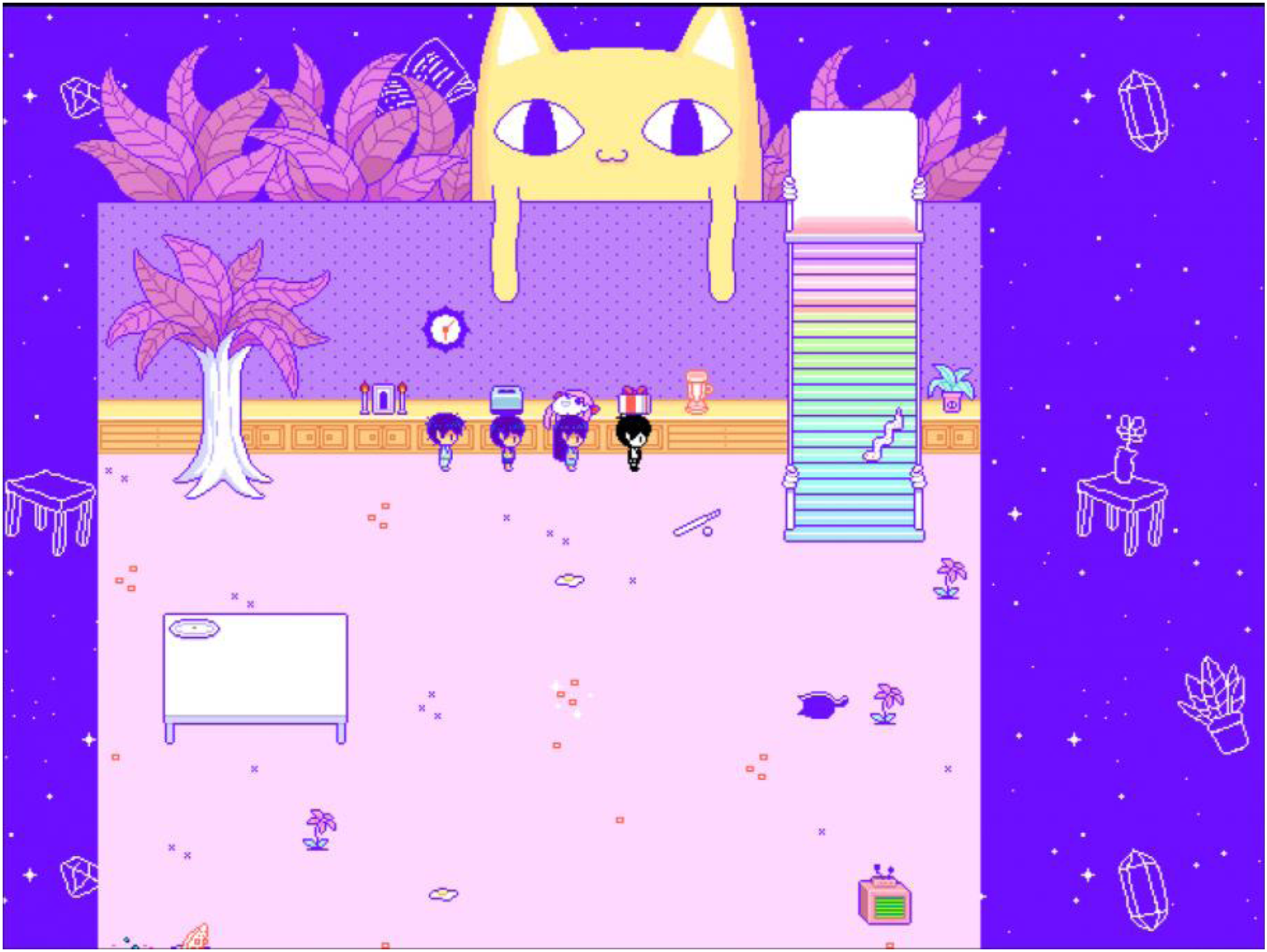
Neighbor's room layout.
Most significantly, other aspects of environmental design, namely the overall layout and objects present, are reminiscent of children's playrooms and exacerbate the aforementioned juvenility of the location. The design cues are also reminiscent of “Cute em up” games from the 1980s, which were fond of using playroom iconography and pastel shades. In OMORI, toys are littered throughout the room, such as in the baseball bat on the ground, the snake toy on the stairs, and the doll on the counter. Other items typically found in children's classrooms and nurseries are also present, such as the television and the trophy. Additionally, the space features fantastical and whimsical elements and objects. This whimsy is most clearly seen in the presence of the giant yellow cat, framing the space and giving it a fantastical and cartoonish aura. The growth of a tree and flowers indoors, the hole in the ground in the shape of a cat, and the tentacle sprouting from the floor also heighten the sense of imagination and eccentrism. They provide the space with a sense of childlike whimsy and fantasy that is reminiscent of childhood media and stories. Since these items are closely associated with childhood, they reflect Omori's life before the incident and provide a place of escapism that mirrors its juvenility and innocence. The space's childlike aura feeds into Omori's nostalgic longing for a bygone era of his life characterized by safety and childlike innocence, prior to his trauma.
Omori's regression to an era before the traumatic incident reflects and mirrors a well-documented phenomenon in the field of trauma psychology. Upon observing children who were victims of childhood trauma, one can observe that they attempt to regress to an earlier point in their childhood prior to the traumatic incident. Venger and Morozova (2011) suggest that this regression happens in pursuit of the past's safety and comfort, as “a child … tries to return to the previous system of relationships with those around him or her, as the previous system of relationships guarantees care and protection and in this regard is safer than the new context” (p. 2). Through the curation of a space that is reminiscent of Omori's childhood through visual elements of environmental design, Headspace becomes a haven of escapism and safety, allowing Omori a second chance to bask in the comfort that his pre-trauma childhood once provided. Similarly, Caruth (1991) argues that “historical memory … is always a matter of distortion, a filtering of the original event through the fictions of traumatic repression” (p. 185). Headspace's role as a place of whimsical nostalgia reconfigures and redefines Omori's childhood. His childhood is no longer a history of his experiences as a child, but is now an idealized version that exists solely to feed into traumatic repression and fend off triggering memories.
Unlike White Space's avoidant escapism, this type of escapism is characterized by a busy and highly stimulating atmosphere that seeks to distract the individual from any triggers. Additionally, the inclusion of child-associated items invites the player to reminisce on their own childhood, invoking feelings of nostalgia. This nostalgia is associated with a feeling of innocence and comfort the traumatized individual believes they lost as a result of their trauma, and this type of escapism rekindles it. This nostalgia becomes a vessel through which the player can relate to Omori's affinity for childhood and juvenile comfort, enjoying the space in a way that feels personal to their own childhoods. Through relating to the safety Omori finds in nostalgia, they experience Headspace in a similar way to him.
Music as another element of environmental design also strengthens the invocation of nostalgia within Headspace. The majority of tracks in Headspace are 8-bit, a digitally synthesized form of music. In addition to being minimalistic and repetitive, 8-bit music is strongly associated with arcade games and games developed for old consoles, like the Gameboy or the NES. A slew of retro mini consoles has emerged in the last decade, confirming a considerable market for video game nostalgia. 8-bit music is often considered “retro” and, when used in modern games, largely invokes feelings of nostalgia as it is reminiscent of childhood games such as Legend of Zelda or Mario. One game that is especially reflected in Headspace's nostalgic and retro atmosphere is EarthBound, which is known for its bright colors and comforting familiarity, juxtaposed against its serious and often grim subject matter. Makai (2018) addresses this rise in nostalgic aesthetics, noting that “a number of indie titles … adopt the graphics and music of a bygone era, delivering gameplay reminiscent of arcade and console titles of the past” (p. 2). Makai (2018) lists 8-bit music as an element that is often used in evoking nostalgia: “nostalgia … exploits the associations the players have with certain historical eras, including earlier eras of video gaming” (p. 1). This exploitation of nostalgia can be seen in Headspace's music, where the 8-bit genre is used in inviting players to reminisce on their own childhoods. Through cheerful 8-bit tracks such as World's End Valentine and Tussle Among Trees, Headspace reminds players of games from their own childhoods.
Although retro games have a reputation of being difficult and often clunky, they also invite players to recall a time in their lives when gaming was a non-taxing and non-demanding hobby. To the casual gamer, games were often singleplayer and the pressures of achieving higher ranks and competitively outdoing other players were much less pronounced. Moreover, both game mechanics and narratives were simple and direct. This association with effortlessness and ease creates a false sense of simplicity, suggesting that the game is exactly as fun and cheerful as it seems and is not critically and intellectually demanding whatsoever. It recalls a time of the player's life that is characterized by that ease and simplicity and ultimately tries to hide the game's nuanced and demanding nature. Thus, the non-taxing and nostalgic nature of 8-bit music and pixel graphics urges players to allow themselves to be submerged in nostalgic escapism in the same way Omori is. Elements of environmental design, such as music and visual landscape, invite players to liken their experience to Omori's and experience Headspace's nostalgic escapism first-hand, helping them develop a deeper understanding of its role in his life.
The narrative progression in Headspace begins to mirror both Omori and the player's experience as they gradually discover aspects of Omori's trauma and ultimately gain closer proximity to the traumatic event. This is first reflected in the visual environmental design of Headspace. Though Headspace's locations mostly maintain a vibrant and childlike aura, Headspace's facade slowly begins to unravel as the game progresses. In its early stages, this unraveling is often observed through the brief appearance of creepy and disturbing entities, such as the one represented in Figure 3. Entities like this typically appear for a very brief period of time, making them a temporary part of Headspace's visual environmental design. These entities, canonically referred to as “Something,” are visually reminiscent of Mari's corpse, typically characterized by their glaring eyes surrounded by a mass of black hair (Figure 4) (OMORI). The image of Mari's corpse haunts Headspace and is repeatedly expunged in a manner that echoes Kristeva's theory of abjection, which denotes an expulsion of that which distresses oneself and causes a “collapse” in “meaning” (Kristeva, 1982, p. 2). Kristeva considers corpses to be “the utmost of abjection” and “life infecting death” (Kristeva, 1982, p. 4). Headspace makes an active effort to eradicate these entities upon appearance. Carr et al. (2020) acknowledge the intersection between monstrosity in horror media and Kristeva's abjection, arguing that, “[Horror games and films] both feature monstrous ‘things’ that blur the divide between human flesh and alien otherness” (p. 150). The “Something” creatures inhabit an uncanny space, existing somewhere between “human flesh and alien otherness” due to the fact that they are directly derived from Mari's corpse while still monstrous and alien in appearance (Carr et al., 2006, p. 150). Their presence is usually short-lived as they are promptly abjected by Headspace to avoid a “collapse” in “meaning” (Kristeva, 1982, p. 2) and is auditorily reinforced as their appearance is always punctuated by a jarring and creepy sound, which momentarily interrupts Headspace's otherwise cheerful 8-bit music.
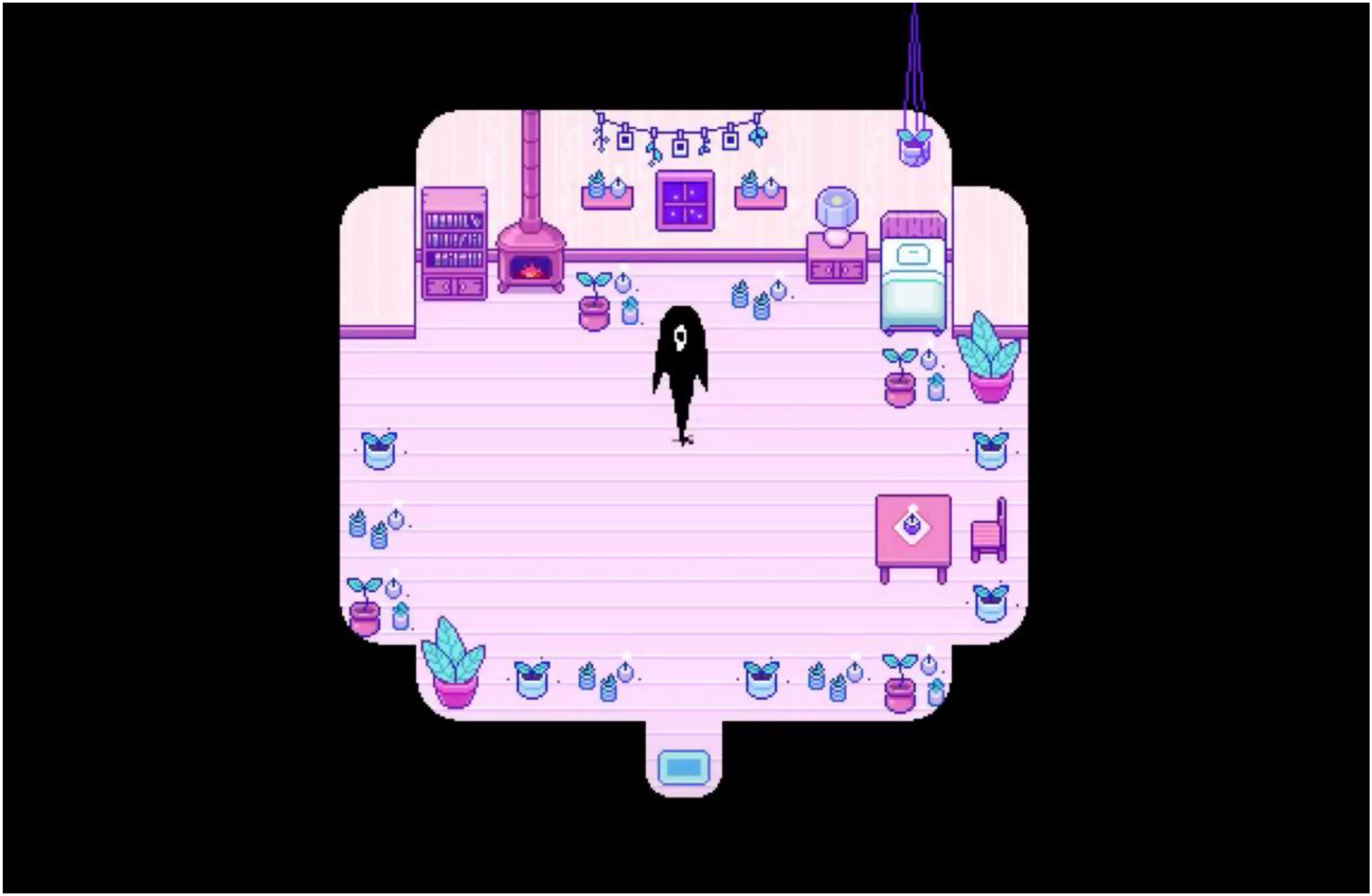
Disturbing entity in the Headspace.
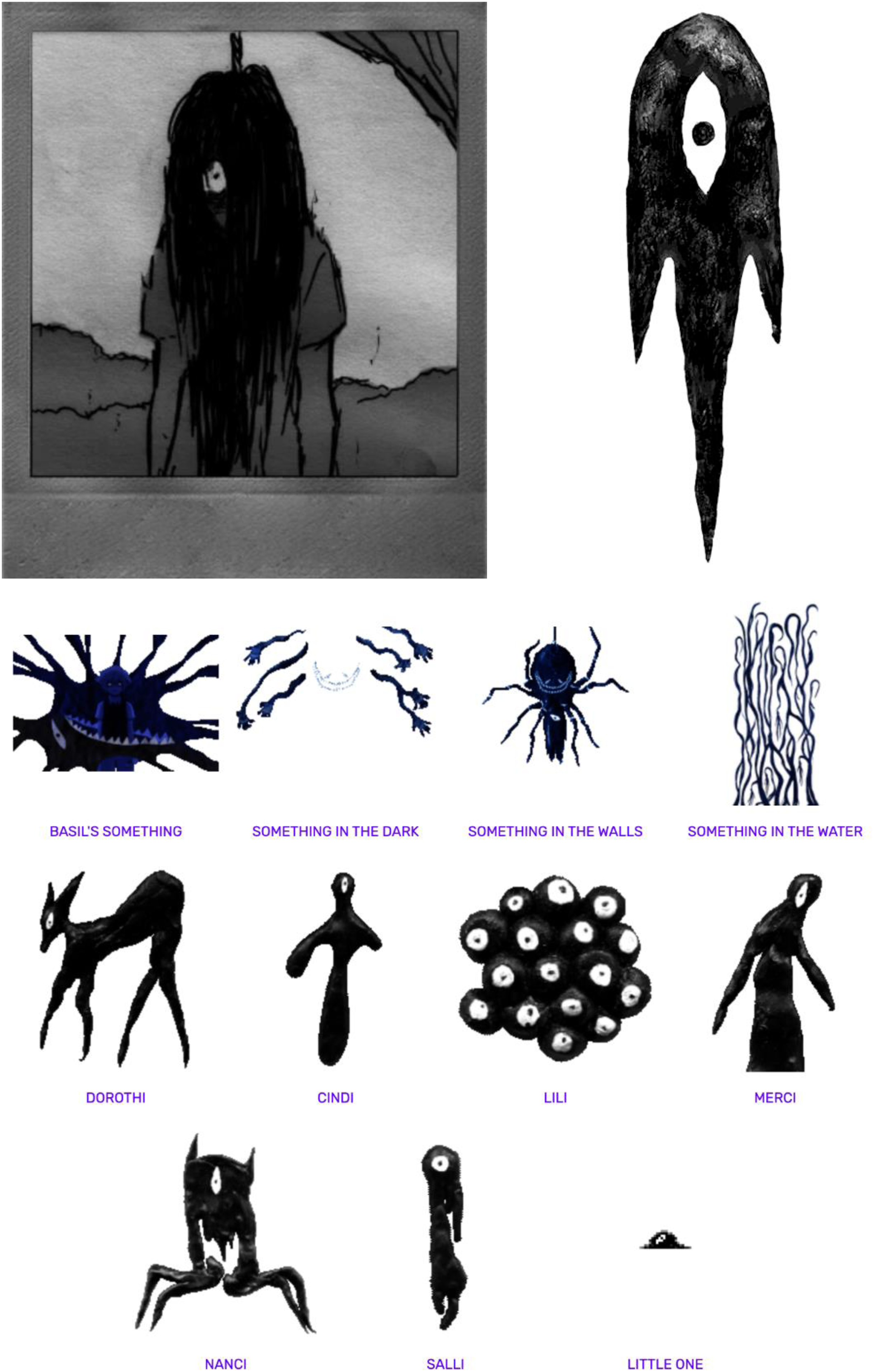
Something. Clockwise from the top left: Mari's corpse, the primary form of Something, and different but less frequent variations of Something (acquired from https://omori.fandom.com/wiki/SOMETHING).
This atmospheric interruption alerts the player of the presence of something sinister and disturbing, eliciting feelings of horror and shock. It piques the player's curiosity as they await more appearances in hopes of learning more about the horror that lurks behind this vibrant facade. These abrupt intrusions also mirror the experience of intrusive memories or hallucinations. According to SAMHSA (2014), victims of trauma may experience sudden cognitive lapses, such as hallucinations or intrusive memories that abruptly put them into contact with deeply triggering memories or visions (SAMHSA, 2014, p. 66). Caruth (1991) also reinforces the significance of such interruptions: “trauma describes an overwhelming experience of sudden, or catastrophic events, in which the response to the event occurs in the often delayed, and uncontrolled repetitive occurrence of hallucinations and other intrusive phenomena” (p. 181). Their inclusion in Headspace's environment once again mirrors the experience of victims of trauma and further grounds this progression in psychological phenomena.
These intrusions often seem nonsensical and random due to a noticeable lack of context surrounding them, causing feelings of confusion to arise in the players. This confusion is also in line with Caruth's perspective on the non-linearity of trauma: “we can begin to recognize the possibility of a history which is no longer straightforwardly referential …, that is, of permitting history to arise where immediate understanding may not” (p. 182). Through presenting hallucinations and flashbacks of Omori's traumatic experiences out of context, the game once again mirrors the way trauma is experienced in the real world.
This confusion, caused by Headspace's frequent abjection of any context surrounding Mari's death, is a primary contributor to the way the game constructs a horrific atmosphere. In his discussion of horror in the 2005 first-person shooter game F.E.A.R., Spittle (2011) posits that “Horror's interest in the abject—that which must be cast out in order for us to survive—is powerfully realized in games that position the gamer as in peril, at least symbolically, of death” (p. 314). OMORI never places the player in peril of death. Rather, the threat is unknown and the player is unsure of the implications and dangers of the horrific entities and memories that sometimes appear in Headspace before being routinely and actively expunged. This lack of information creates a sense of uncertainty that is ultimately at the core of what makes the game scary, as players have no reliable way of predicting what these entities are capable of.
Headspace also “occupies the realm of the uncanny” (Spittle, 2011, p. 314). It constantly feels “not quite right, familiar but unfamiliar,” since it is a joyful and comforting space that is sometimes interrupted by horrific entities that slip through the cracks, making it uncanny (Spittle, 2011, p. 314). As Spittle (2011) states: “The uncanny, for Freud, is predisposed to remind us of home. This may be the home of our subjectivity or home as represented by a particular place. In the common horror motif of the haunted house, we experience the odd feeling that this place used to be home and that it is no longer home—it has become an uncanny house” (p. 314).
Headspace is nostalgic to both Omori and the player. However, the horrific entities within it make Headspace feel haunted and grant a sense of artifice to Headspace's homeliness and generate a permeating sense of artificiality and distrust that ultimately make Headspace an environment in which the player no longer feels safe. This sense of peril is exacerbated by Headspace's more frequent slip-ups, which frame it as an unreliable space with a faulty filtering system. Kristeva (1982) characterizes abjection as an insecure and unreliable process, describing it as “a violent, clumsy breaking away with a constant risk of falling back” (p. 13).
This faultiness becomes more apparent towards the middle of the game, where these interruptions become more substantial and long-lasting. Their effects on the player become more pronounced as the player is suddenly teleported to entirely new locations that are disturbing in nature, but are ultimately still a part of Headspace. One example of this is the Lost Library, which the player abruptly accesses in succession to a lighthearted Headspace main quest. In terms of narrative, this location is a significant part of the player's pursuit of the traumatic event as it contains several books that document some of Omori's memories, providing more information regarding his childhood. The environmental design reinforces this progression towards the “truth” as this space is characterized by an eerie and disturbing aura (Figure 5). The space's color scheme is extremely dark and dreary, mainly consisting of desaturated blues and blacks. The space seems deserted and desolate with pervading cobwebs, overgrown vines, and cracks in the bookshelves. The music of Lost Library reflects this aura of dreariness as its music diverts from the cheerful nature of Headspace's 8-bit music. Its main track, entitled Lost Library, is entirely played on piano and feels slow and lonely. Shuffling and miscellaneous noise can be heard in the background of the main melody. Its stagnant and echoey melody reinforces the desolate aura of the location, further exacerbating the overarching sense of loneliness and dread.
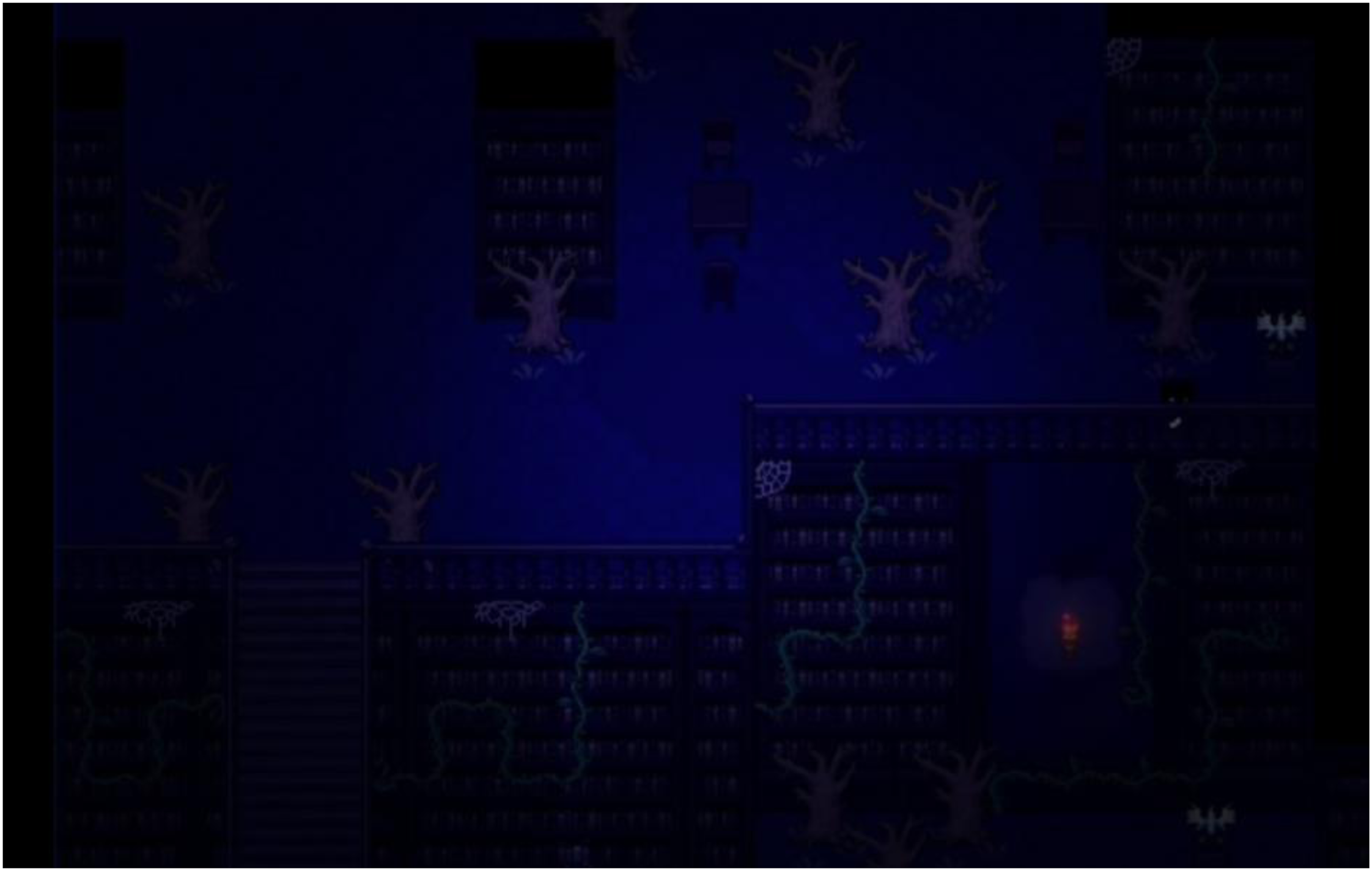
Lost library.
The visual landscape of Lost Library's newfound dread and darkness, reinforced by the slow and dreary music, reflects the formation of deeper cracks in Headspace's vibrant facade. Locations such as this one become more common and every incident through which the player receives information regarding Omori's trauma occurs in a landscape akin to this one, characterized by darkness and horror. These locations form an association between eerie environmental design and Omori's trauma since the two are consistently presented alongside one another. Each time the player is abruptly presented with an eerie location, they now anticipate the revelation of key information pertaining to Omori's trauma. Consequently, this association makes Headspace's cheerful and whimsical atmosphere feel artificial, as it slowly comes to represent a distance from the traumatic event.
According to Spittle (2011), the piecing together of a once fragmented identity through elements of environmental design is “common in video game fictions, particularly those belonging to the survival horror genre” (p. 318). The identity of the protagonist in the first-person shooter game F.E.A.R. “becomes apparent through narrative clues found on laptops, messages on answer phones, and in a series of hallucinations the player experiences as they make progress through the game,” which infuses the game with the “contemporary […] search for identity” and invites the player to engage with the fear of never finding oneself (Spittle, 2011, p. 317). Spittle (2011) relates this environmental scramble to Martín-Barbero's (2016) ideas regarding the “unease of the ‘I’.” Martín-Barbero (2016) argues that the contemporary world is plagued with an almost primal urge to defend one's own identity and personhood against a world that supposedly threatens it (p. 624). This internal struggle for identity, accompanied by the scramble for any identifying details in the surrounding environment, is widely present in OMORI. Through suddenly providing players with swathes of characterizing information that would otherwise be entirely hidden, locations like the Lost Library invite players to actively piece together as much of Omori's identity as possible on their own accord through the area's environment. In addition to recalling contemporary fears of never finding oneself, the player's active effort to piece together a broken identity through rediscovering lost memories directly mirrors Omori's experience with his own identity and personhood.
Early in the game, it becomes apparent that Omori's real name is “Sunny,” and Omori is an imaginary version of himself that only exists in Headspace. Thus far, we have been simply calling him “Omori” for simplicity purposes, as it is the name used for the majority of the game's narrative. Omori is Sunny's supposed ideal self—he's popular, happy, and perpetually living in an era prior to the traumatic incident. As a character, Omori's existence is built on repression and denial of reality, making him the glue that holds Headspace together and keeps up its artificial facade. Sunny, on the other hand, is a social recluse—he has not left his house since the traumatic incident 4 years ago and has lost all his friends, but has recently regained the drive to break out of his escapist cycle, forming tension between his motives and Omori's. This identity crisis culminates in the final boss fight of the game, in which the player, acting as Sunny, must fight Omori. Sunny aims to destroy Headspace and finally face reality (and must defeat Omori to do so), while Omori wants Sunny to retreat to Headspace forever and entirely abandon reality, forcing Sunny to commit suicide as a final act of divorce from reality. Thus, a crisis of identity is at the crux of Omori's trauma. It is central to the game's overall conflict and emblematic of the tension between Headspace and reality. Inviting players to resolve this crisis through helping Sunny find himself ultimately deepens players’ understanding of the severe impact trauma can have on identity and selfhood.
Returning to Headspace's cheerful and vibrant environment following several of these eerie locations invokes feelings of restless curiosity that work against the inertia of Headspace, as the player longs for more information regarding Omori's traumatic incident but must wait until another creepy location appears. This waiting, in turn, creates feelings of resentment towards Headspace, as the player must now traverse several cheerful and whimsical locations for prolonged periods of time before more elements of the incident are revealed, making the exploration of Headspace feel like a chore. Many players have expressed annoyance with the sheer expansiveness of Headspace, commenting on how “slow” its locations feel and stating their desire to gain more information regarding the “truth” instead (Lvl's Review of OMORI, 2021). This invocation of resentment is significant, as it creates a stronger desire to pursue the “truth” and invites players to be more critical of Headspace's artificiality as they begin to resist being immersed in its escapism. The whimsical and nostalgic environment that was once cheerful and comforting is now seen as an obstacle that must be overcome to access the “truth.”
Resurfacing Trauma in Black Space
Once the player finally completes their exploration of Headspace and traverses all of its locations, Black Space is created, giving the player access to more information about the traumatic event in Omori's life. While the previous locations provided two distinct modes of escapism, Black Space signifies a final divergence from that escapism and is characterized by the raw and horrific revelation of the trauma's source. This divergence is largely communicated through the space's eerie and disturbing atmosphere and environmental design, creating a sense of fear and anxiety in the player that mimics Omori's as he finally confronts the source of his trauma. According to SAMHSA (2014), traumatized individuals often experience extreme anxiety, fear, and emotional dysregulation as they abruptly encounter elements of trauma they have taken extreme measures to avoid since they register the resurfacing of trauma as an active threat (SAMHSA, 2014, p. 20). Moreover, Black Space is entirely themed after the horrific creatures and memories expelled by Headspace, thrusting players into a space completely characterized by the abject without Headspace's protective measures for the first time. Consequently, Black Space's environmental design represents the feelings of extreme danger and disorientation, making them accessible and tangible to players.
This effect is partially achieved through the organization of the space as a whole. It is divided into eighteen sections, accessible through doors. Outside those doors, Black Space is visually sparse (Figure 6). Though this layout is minimalistic and simplistic, it is visually disorienting due to the arrangement of the doors. Instead of being arranged in an orderly and logical fashion that adheres to our spatial understanding of walls and rooms, the doors appear to be floating in a void. The doors are presented on their own, with no walls surrounding them to indicate the size of the room to which they provide access. The ground lacks any detail, heightening that sense of disorientation and reinforcing the sense that they are floating in a void. Due to this arrangement, players already feel a sense of confusion and perplexity while entering the space as it subverts their understanding of spatial awareness.
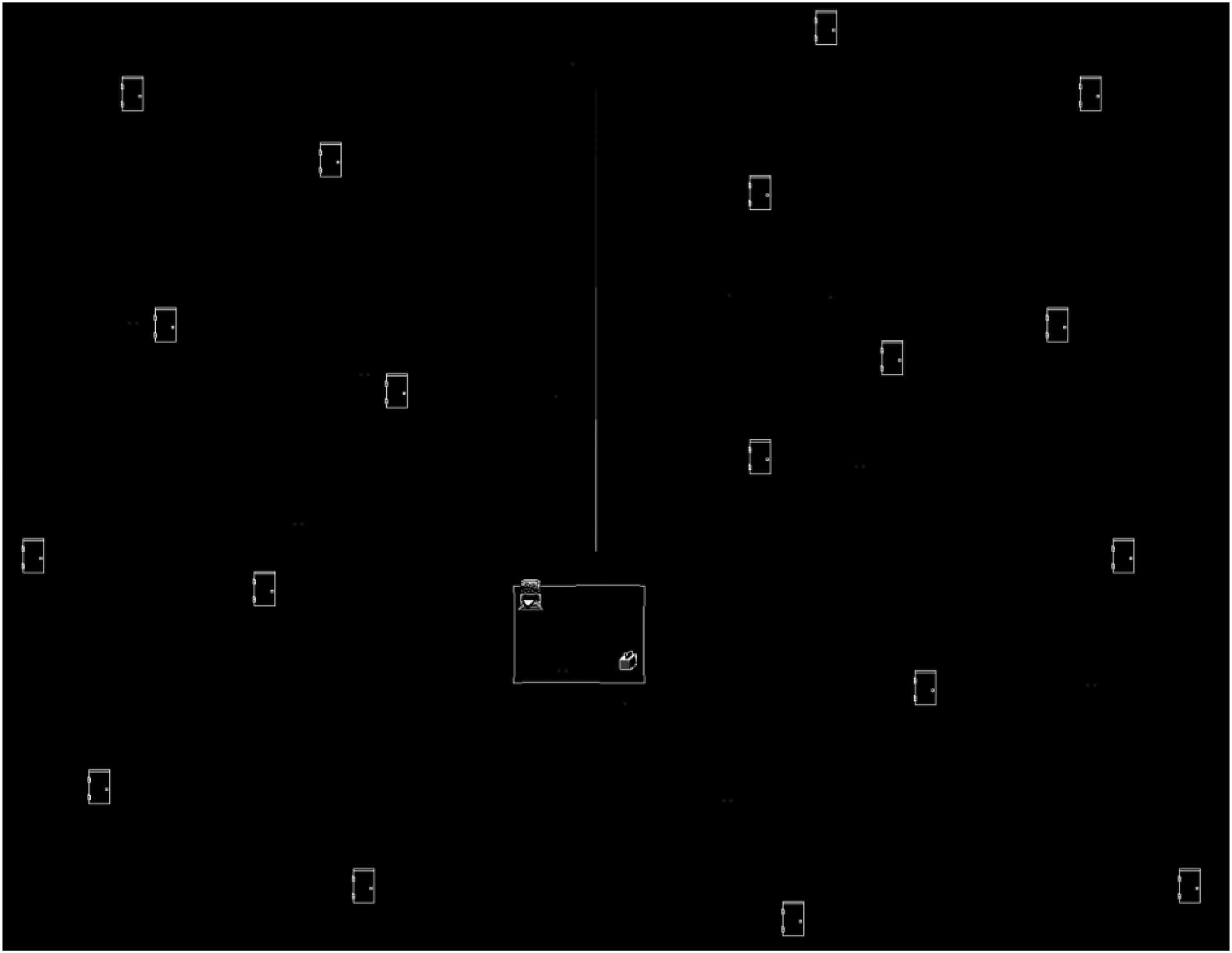
Black Space layout.
This unconventional arrangement makes it difficult for players to instinctively understand where to go, eliciting feelings of anxiety and confusion that mimic the experience of trauma recovery. These feelings of confusion are reflected in SAMHSA (2014), as traumatized individuals who are newly being reintroduced to elements of their trauma in therapy often struggle to make sense of the traumatic memories in a productive and recovery-driven manner and feel a strong sense of perplexity and disorientation as a result (SAMHSA, 2014, p. 20). Moreover, such disorganization is essential to Caruth's (1991) understanding of non-linear traumatic memory in which “the future is no longer continuous with the past, but is united with it through a profound discontinuity” (p. 184).
These feelings of confusion set the tone for the remainder of Black Space, as the individual rooms are also characterized by a sense of disarray and disorientation. The majority of the rooms are heavily populated with the horrific entities that were once abjected from Headspace. Since the nature of these entities is largely unknown to the player, feelings of fear and uncertainty arise due to a lack of information and experience. This fear is heightened by Headspace's framing of these entities as abject and dangerous, as the player is now surrounded by them in an uncontrolled and unpredictable space.
Black Space's horrific unpredictability is exacerbated by the fact that the rooms are almost entirely unrelated to one another in terms of visual presentation and environment. The only shared factor between those rooms is their relation to Omori's trauma, with each room representing that trauma in a different but ultimately jarring and disorienting manner. This variation in the atmosphere is more clearly seen when comparing the visuals of the rooms in a side-by-side manner (Figure 6). Raft Area is entirely colored in highly contrasting blacks and whites, while Neighbor Area mimics Headspace's design in its bright and colorful palette. Similarly, Beach Area and Disco Area feature muted and low-contrast color palettes, while Spider Area and Faceless Area feature extremely saturated tones contrasted against a pitch-black background. These differences can also be seen when comparing the stylistic nature of the respective areas. The lineart and shading in both Raft Area and Disco Area, for example, are textured and unkempt, almost mimicking the texture of crayons. Meanwhile, the lineart and shading in Neighbor Area, Beach Area, and Spider Area are clean and orderly. Furthermore, their visuals are reliant on pixel art, adhering to the artistic conventions of 8-bit games. Through examining visual environmental differences, it becomes clear that different areas of Black Space are highly varied. This difference creates a sense of unpredictability and mystery that heightens the disorientation that pervades the space, as players are unable to establish patterns and expectations for it. Thus, they are unable to purposefully explore as they normally would and must enter these rooms with little expectations and simply acquiesce to the game's structure. This aesthetic variability is common in indie RPG horror games and is most commonly traced back to the 2004 Japanese psychological horror game Yume Nikki (which translates to Dream Journal), where the player explores protagonist Madotsuki's dreams with seemingly no narrative structure or chronology. Much like Black Space's rooms, these dreams often exhibit extreme aesthetic and technical differences from one another and are filled with eerie and unsettling entities, making exploration of these unpredictable and ungovernable spaces both difficult and horrifying.
Regardless of visual differences, these areas of Black Space are similar in the sense that they both reveal elements of Omori's trauma. In all areas, Omori's best friend Basil undergoes some kind of turmoil once the player is finished exploring the location, revealing a fear Omori harbors in regard to losing his loved ones. This disorienting and unsettling event is established differently in each room, depicted in a way that adheres to its respective environment and aesthetic. As the player enters Raft Area, they are met with the soft playing of a guitar. The use of the guitar adheres to the room's visual environment as it features a background drawn through traditional means, as opposed to digital ones. A non-digital instrument, the guitar further grounds the room in “reality” and moves it away from the digital artificiality of other rooms such as Neighbor Area. Following Basil's death in the room, however, the music makes an eerie shift and the guitar ceases to play. Instead, the player is met with the sound of static, in addition to the faint beating of a heart. This shift happens alongside the revelation of Basil's death, establishing a sense of horror and eeriness and leading the player to feel uncomfortable and fearful. In addition to the music, the room's visual environment reinforces this sense of discomfort. The heavily textured coloring style, coupled with the high-contrast black and white color scheme, is unsettling and unexpected. The texture in the coloring style feels unstructured, making the visual landscape feel unfinished and unpolished, and thus unpredictable. This feeling reaches its climax when Basil is revealed to have died in the tunnel pictured in Figure 7.
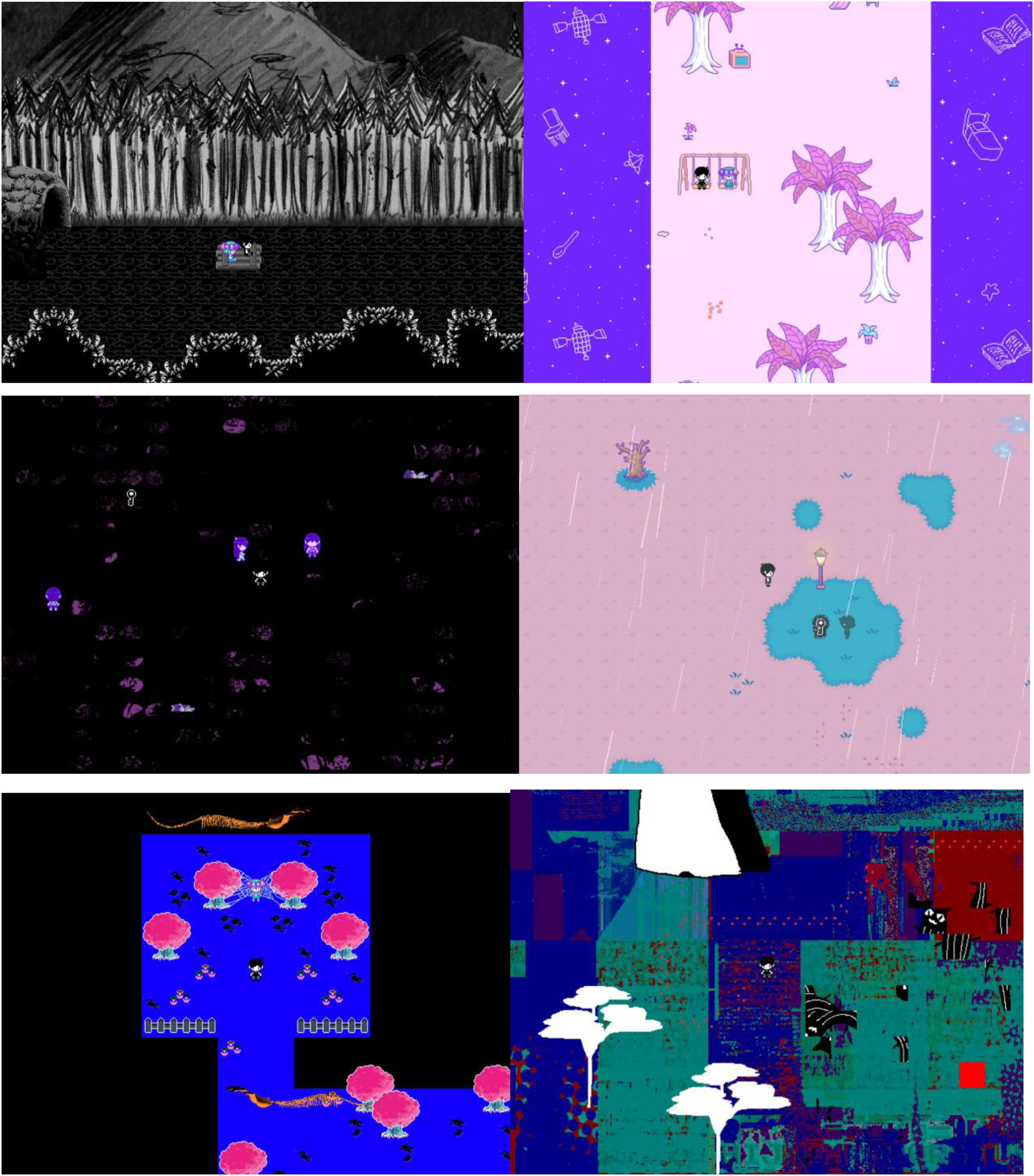
Areas in Black Space. Clockwise from the top left: Raft Area, Neighbor Area, Faceless Area, Beach Area, Spider Area, and Disco Area.
Neighbor Area follows a similar narrative path, with Basil suddenly being decapitated, The childlike demeanor of the space deteriorates as the room begins to glitch. Digital glitches begin to appear, mimicking the appearance of technical malfunctions. In addition to general elements of the background glitching, the malfunctions can also be seen in the character's portraits, which now appear to be extremely disfigured (Figures 8 and 9). These glitches alert the player to a gradual deterioration in the room's playful facade and mirror the horrific turn of events. This shift is also seen in the room's music. The first track is entitled Friends and at first appears to be the same as the track Lost at a Sleepover, which plays early in the game and is associated with Omori spending time with his friends. However, the track Friends begins to fall apart at 00:28, foreshadowing the unraveling of the room's cutesy aesthetic. Glitches begin to pervade the track, causing the melody to deteriorate and becoming more frequent as it continues. Following Basil's death, an entirely different track plays. Entitled Friendsssssss, the new track vaguely carries the melody of the previous track, but presents it in a glitchy and eerie manner.
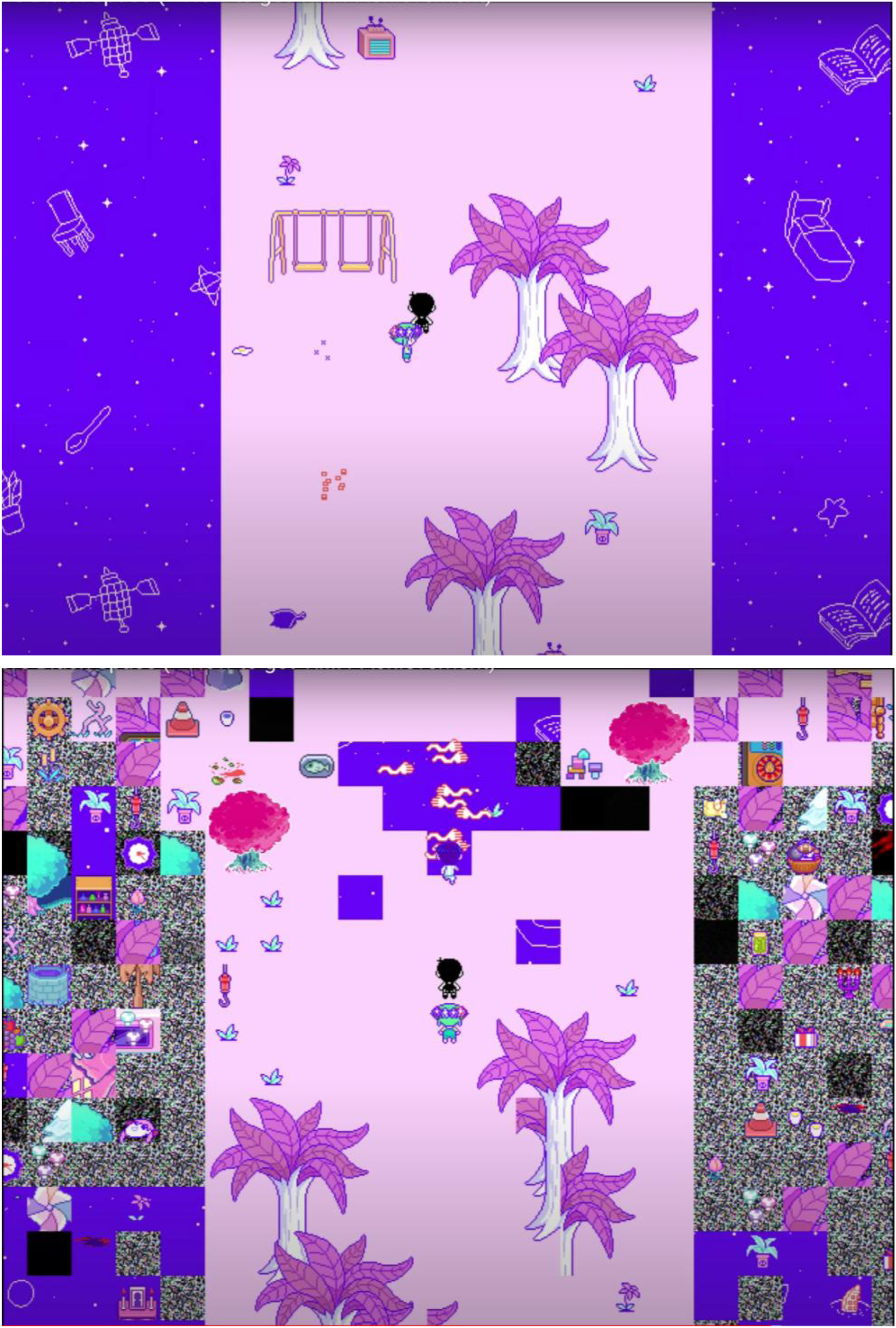
Neighbor area in Black Space before and after glitches.
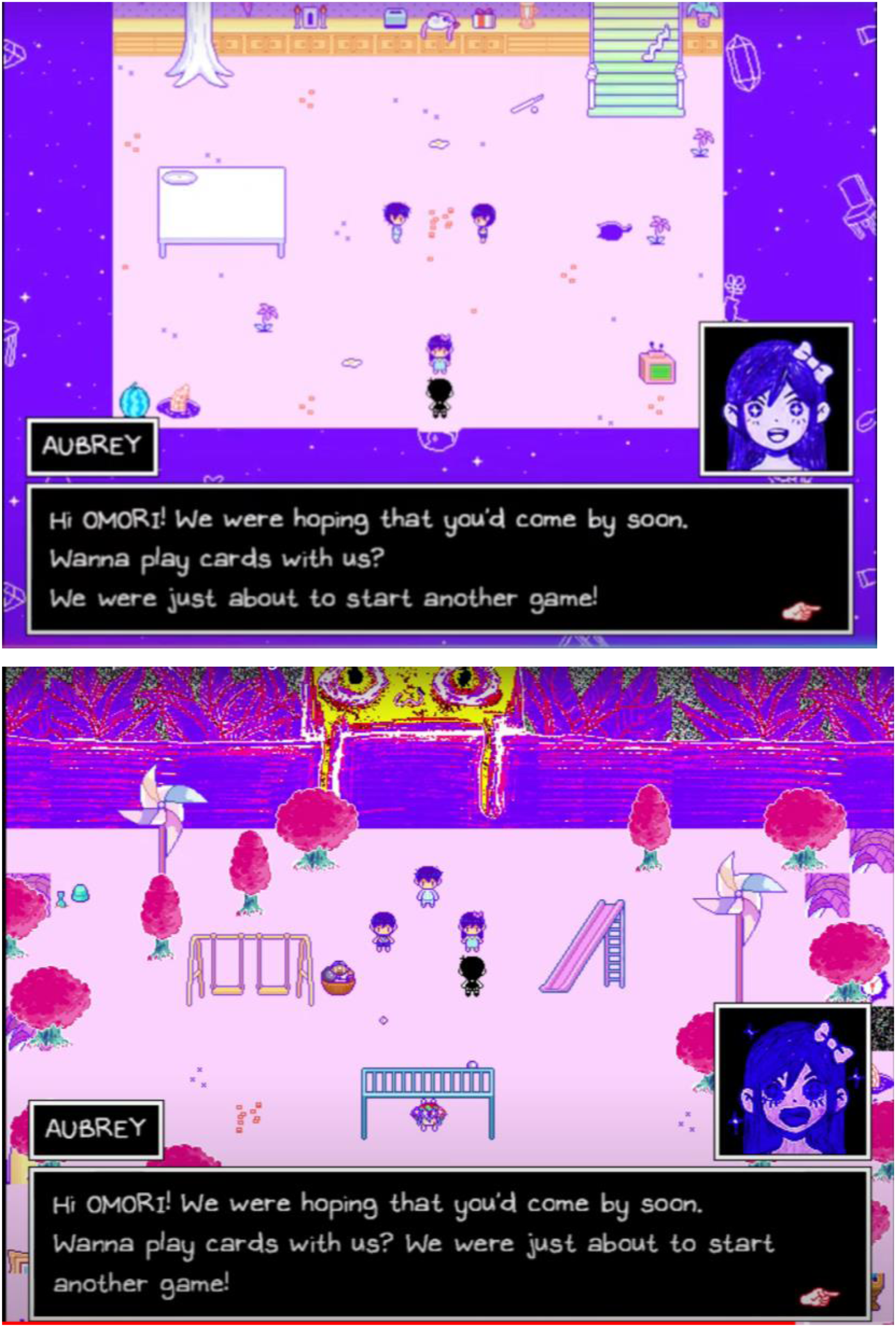
Aubrey's character portrait before and after glitches. Note that the first screenshot was taken in Headspace, not Black Space, and was only included for comparison purposes.
This shift in elements of the room's environmental design, such as visual layout and music, reveal Omori's fears regarding death, as the climax of the room's aesthetic deterioration occurs directly following Basil's death. This claim also applies to Raft Area, as the room's gentle strumming of the guitar immediately gets replaced by static and the sound of a beating heart as soon as Basil dies. Environmental design is used in both rooms to reveal the same plot twist and fear in two entirely different manners. The revelation of the same plot twist in both rooms emphasizes specific fears of Omori's and heightens Black Space's horrific and disturbing atmosphere overall. It reinforces the sense of fear and emotional disarray that arises as a result of triggers (SAMHSA, 2014, p. 20). Gradual environmental deterioration is commonly used in games to incite fear and disorientation and signal an incoming threat. For instance, the first Max Payne game by Remedy features the titular character walking a blood-red thread between various spaces, with his surrounding environment becoming increasingly fragmented in terms of both visual and musical design.
Basil's recurring death in Black Space can also be viewed as an abject occurrence that was once repressed due to Headspace's self-preservation. Early in the game, Basil goes missing under horrific circumstances and the player's primary objective is to find and rescue him. However, Headspace's adventurous and colorful environment routinely distracts from this distressing objective and actively abjects any memory of Basil, causing our party to forget him entirely. Since Black Space is characterized by the presence of the abject, the once-abjected fear of Basil in peril resurfaces and repeatedly demands to be confronted by both Omori and the player. This recurring death is also reflective of Caruth's (1991) ideas regarding the discontinuity and non-linearity of re-experiencing trauma. However, the variation and difference between the rooms create an atmosphere of uncertainty and instability as the player explores Black Space, rendering them unable to recognize aesthetic patterns in the environment and to explore with a purpose.
This sense of confusion and instability is more apparent in other rooms of Black Space that are characterized by an even more intense sense of disarray and disorganization. Some rooms lack a storyline entirely and simply present players with disturbing and eerie atmospheres. One such room is Pain Area (Figure 10). The room is extremely dark in both color and lighting and has no discernible ground or walls. It is populated by creepy entities, arranged in a random manner throughout the room, and displayed against a backdrop of TV static and blue footsteps. These entities are once again visually reminiscent of Mari's corpse, acting as a disturbing reminder of Omori's once-repressed involvement in her death. The room's music follows this pattern of eeriness and disarray, as the one track is suspenseful and eerie in nature. The player can only exit this room once they have explored it in its entirety, with no focus being placed on an overarching narrative or a central event that occurs. Through the lack of narrative progression, the focus is primarily placed on the disarray of its overall aesthetic and environmental design. This focus on the room's chaos, as opposed to a controlled storyline, makes it difficult for players to make sense of the room and situate it in the game's larger narrative, heightening feelings of disorientation and perplexity. Rooms like this one exacerbate the overarching sense of disorientation, confusion, and fragmentation that characterizes Black Space. Through its horrific sense of disorder, Black Space resists the orderly and straightforward nature of White Space and the comforting and cutesy nature of Headspace. This unique sense of chaos makes Black Space seem raw and unfiltered, breaking away from the artificiality of the other spaces and ultimately making it feel closer in proximity to the traumatic incident.
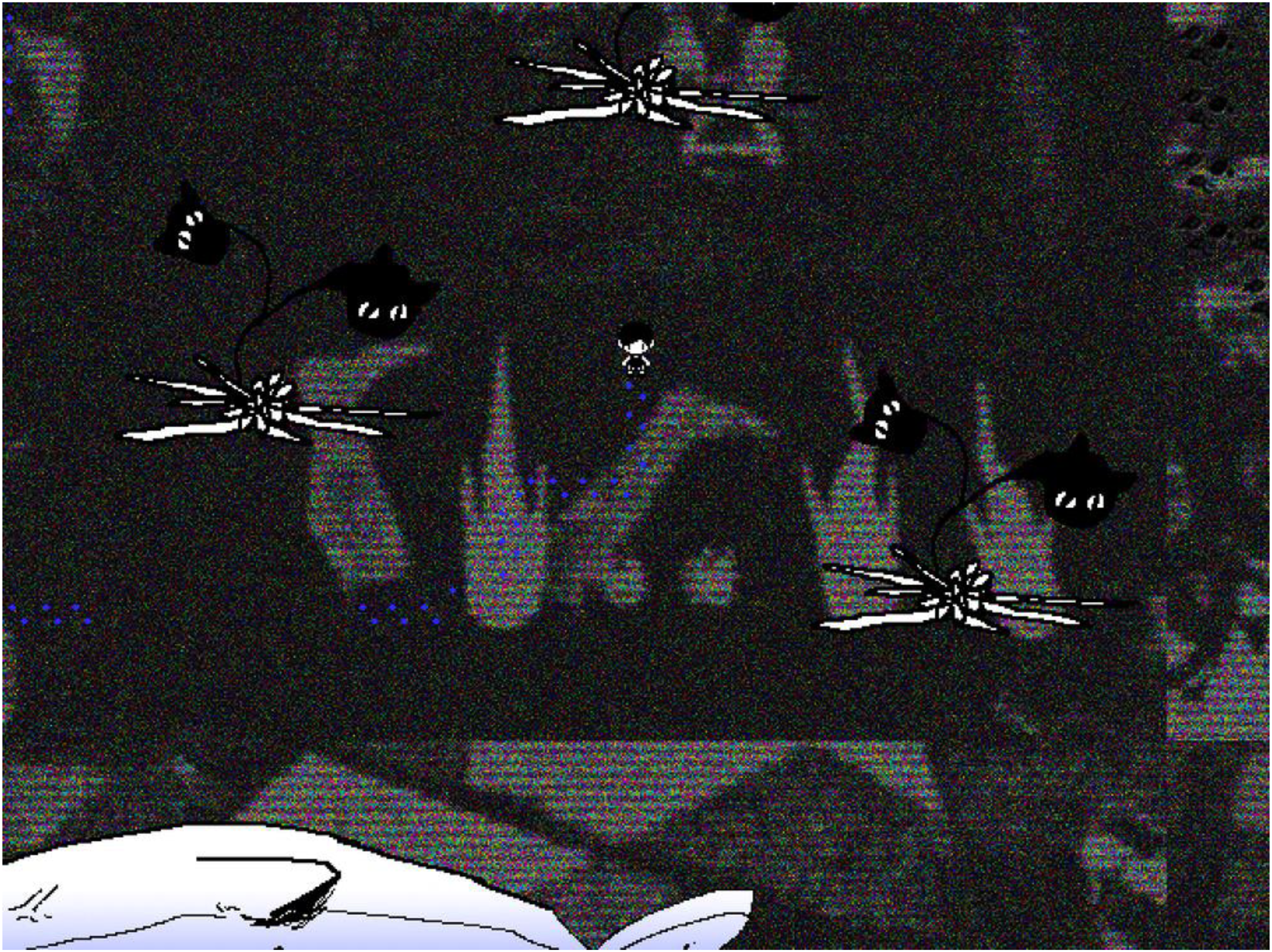
Pain area in Black Space.
One common thread among the rooms is their continual horrific depiction of Omori's trauma and fears. Through this space's disarray and horror, the player's experience mirrors Omori's as he finally confronts his trauma. Entities, memories, and facts that Headspace once abjected now cover the entirety of the player's gaming experience, demanding that both Omori and the player confront them without Headspace's filters and safety nets. Upon inducing anxiety and fear as the player finally encounters the traumatic event, Black Space takes the player through the experience of suddenly interacting with past trauma and triggers as a traumatized person, inviting them to relate to Omori.
More importantly, these emotions often mirror those felt during the person's original traumatic experience and dramatically intensify if the person has been engaging in avoidant or escapist behaviors (SAMHSA, 2014, p. 73). This connection especially emphasizes and clarifies Black Space's relation to escapism, as it does not simply mirror the disorganized psychological state of any traumatized person coming into contact with triggering memories. It rather depicts the extreme disorientation and disarray that arises when a person who has deliberately and vigilantly evaded memories of trauma through the use of maladaptive escapism finally faces their traumatic memories. This context intensifies the horrific and bizarre nature of Black Space, as every location the player has encountered thus far has been characterized by a single and distinctive goal of maintaining an escapist homeostasis, whether through uniform avoidance or idealized nostalgia. Through Black Space's disturbing and horrific content, a sense of emotional dysregulation and intense fear pervades the space and likens the player's experience to Omori's. It provides players with a deeper understanding of the psychological behavior the game explores and the consequences of engaging in it.
Conclusion
OMORI engages with trauma and escapism in a manner that is unique to the video game medium. The game depicts the experience of escapism and engages the player with it through its artistic and strategic use of environmental design. The distinctive atmosphere of each space helps depict real psychological phenomena associated with escapism and trauma, such as avoidance and anxiety. Through the use of environmental and atmospheric elements in representing these experiences, the game visually and orally provides a tangible image of them and ultimately makes them accessible to players. Trauma is a nuanced and complex subject and can be extremely challenging to define and represent. OMORI's environmental design seeks to make the unseen visible and provide an exploration of these experiences. These depictions can deepen players’ understanding of escapism and trauma overall. The game helps generate empathy towards individuals who have undergone similar experiences and marks a step closer towards de-stigmatizing the discussion of matters related to trauma and mental health as a whole. Through experiencing White Space's monotony, basking in Headspace's comfort, and enduring Black Space's horror, the player experiences escapism similarly to Omori and is granted a deeper understanding of the psychological phenomenon as a whole.
In addition to the psychological experience of escapism, examining OMORI's strategic use of environmental design deepens our understanding of the video game medium on a larger scale. Through exploring OMORI's implications regarding escapism, players gain a more nuanced understanding of how video games can be used in engaging with the deeply nuanced and complicated subject matter, such as trauma.
The impact of video games on the public perception of mental health extends beyond their narrative exploration of these matters. Video games are also gaining relevance within the field of psychology, as they are being used more frequently in therapy. VR games, for example, are being incorporated into exposure therapy since they provide a healthy space for the individual to interact with phobias and triggers without the threat of danger (Powers & Emmelkamp, 2008). More commercial games are being used to help patients understand and confront their own mental health issues in an immersive way that allows them to connect with other people in similar positions. Overall, video games are gradually being perceived as psychologically beneficial and are slowly playing a bigger role in shaping how both the general public and people within the field of psychology understand psychological phenomena, better equipping them to treat and address such issues.
Footnotes
Declaration of Conflicting Interests
The author(s) declared no potential conflicts of interest with respect to the research, authorship, and/or publication of this article.
Funding
The author(s) received no financial support for the research, authorship, and/or publication of this article.
