



Abstract
In this article, we argue that the pervading hegemonic narrative on gamers’ eating culture emphasizing hedonistic and fast foods is a one-sided storyline that highlights a potentially harmful gamer stereotype. To that end, we reveal the variety of gamers’ food consumption and broaden the narrative depicting the relationship between gamers and eating. Our literature review shows the dominance of the Junk Food Gamer narrative in extant research. However, by using a social constructionist narrative approach to analyze ethnographic observations and interviews, we show the emergence of an alternative, yet interrelated narrative: the Home Food Gamer. In addition, we utilize the idea of the Rubik's Cube to illustrate the actualization of multifaceted and contextually-bound gamer narratives that enable expanding the prevailing understanding of geek cuisine by shedding light on the variety of gamers’ food consumption. In this way, we participate in the ongoing discussion to unravel stereotypical assumptions about gamer culture.
Introduction
We are all familiar with stereotypical portrayals of gamers in popular culture—when a crime TV series or an advertisement features a gamer, we see a figure sitting alone in front of the computer, usually in a dark room. More often than not the gamer is portrayed as a chubby young male guzzling energy or soft drinks, such as Coca-Cola or Mountain Dew, and eating something unhealthy, like chips or Domino's pizza. All of these characteristics appear to be entangled with his lifestyle choice of spending (too) much time playing video games. Indeed, popular culture instantiations connect gaming with junk food and unhealthy eating (Chess et al., 2016; Cronin & McCarthy, 2011b). According to Cronin and McCarthy (2011b), much of gamers’ social image derives from movies and television, which they claim produce “whimsical documentation or comic representation.” Kowert et al. (2012, 2014) discover that movie and TV stereotypes of online gamers associate them with negative traits such as overweight, laziness, poor hygiene, aggressiveness, and social isolation. The narrative of the junk food gamer is also frequently supported by research (e.g., Cronin & McCarthy, 2011a, 2011b; Nichols et al., 2006). To illustrate, Cronin and McCarthy (2011a, 2011b) show that gamers snack in unhealthy and hedonistic ways as a social rite and as an expression of rebellious behavior.
How accurate is this depiction of gaming culture and its take on the consumption of food and drinks? To what extent is it an overstatement originating from outsiders who cannot see the whole picture? Moreover, which are the cultural tropes sustained by the gamers themselves?
In this article, we argue that this hegemonic narrative is an overly one-sided storyline about gamers’ eating culture—geek cuisine, if you will. To support our argument, we examine the variety of gamers’ food consumption practices to discover alternative narratives that potentially challenge or enrich the predominant gamer discourse. In order to push forward a more dynamic understanding of gamers’ food consumption, we take inspiration from Syrjälä et al.'s (2017) conceptual construction of “snackscape,” which delineates how snack-eating encompasses shifting meanings, manifestations, and locations at different times and changing contexts. We base our study on narrative research, which regards storytelling as a powerful tool to influence others and communicate between people (Eriksson & Kovalainen, 2015, p. 215). Consequently, it is unsurprising that stereotypical portrayals are commonly used in popular culture to convey various narratives quickly and efficiently. Yet, looking from the social constructionist narrative perspective, which argues for the importance of stories in producing our understanding of realities (Ibid.), such one-sided representations of gamer culture are problematic for at least two reasons.
First, popular culture powerfully shapes the public, accepted and sustained—often one-sided—image of a particular group of people, idea, or community (Le Grand, 2020; Lundahl, 2020). For example, the “hipster” is typically portrayed as a young middle-class cultural intermediary who engages in a particular set of reflexive and trendy consumption practices, often in gentrified urban spaces and linked to creative industries—inducing both denigration and admiration in others (Le Grand, 2020). As certain kinds of representations are increasingly often reproduced in social processes, they become normalized as truths and natural categories of everyday life (Burr, 2015, p. 5). This kind of narrow image may be detrimental to gamer culture, as it affects how people outside the scene view its natives. Non-gamers indeed attach stereotypical beliefs to gamers—for example, they are seen as unpopular, unattractive, non-dominant, and socially inept (Kowert et al., 2012). Furthermore, Stone's (2021) recent findings show that the negative view of the gamer stereotype is prevailing and well-recognized by both non-gamers and gamers themselves.
Second, the narrative of geek cuisine may be harmful to the gamers themselves. The functionality of representation is one of the key premises of social constructionism (Wetherell & Potter, 1988, pp. 169–170). It refers to the idea that ways of representation have their consequences. Therefore, as subject positions such as “unhealthy eater” are continually sustained, it is increasingly natural for people (i.e., gamers) to occupy these positions (i.e., eating unhealthily gradually becomes a socially accepted norm). Thereby, the unbalanced cultural portrayal of gamers might actually support unhealthy practices such as eating convenience foods. Aligned with this stereotypic representation, many food companies have identified and profiled the gamer-consumer segments. To illustrate, energy drink manufacturers are actively targeting their products (e.g., Mountain Dew's MTN Dew Game Fuel) and marketing campaigns (e.g., Red Bull) to embrace and solidify their role in gamer culture. The ethicality of such targeting has indeed been questioned recently (Lopez Frias, 2021).
At least in the LAN context, unhealthy eating practices appear to prevail: Gamers were found to exceed the recommendations of healthy eating as their daily energy intake reached around 4,500 kcal in Krarup et al.'s (2022) study. In comparison, the recommended daily energy intake for women is 1,950–2,500 kcal and for men 2,800–3,150 kcal in Finland (Valsta et al., 2018). In everyday life more generally, the nutritional quality of foods and drinks consumed by heavy gamers is poorer in comparison to non-gamers (Moore & Morrell, 2022). When it comes to general suggestions on healthy eating, according to WHO, a healthy diet is rich in fruits, vegetables, legumes, nuts, and whole grains and low in sugar (should account for less than 10% of total energy intake), fats (should account for less than 30% of total energy intake), and salt. Unsaturated fats (e.g., from fish and nuts) are preferable to saturated (e.g., from butter and cheese) and trans-fats (e.g., from baked, fried, and pre-packaged foods; WHO, 2020).
Against this backdrop, we contend that it is pivotal to uncover the variety of gamers’ eating practices in order to redirect public narratives, increase awareness about the multiplicity of gamers’ culture and enhance gamer well-being. In this, we advocate and respond to the call by Stone (2021) to fight against the traditional gamer narrative by producing counternarratives. We base our research on the social constructionism paradigm, which ontologically relies on the idea that there is no single truth about representing “geek cuisine,” “gamer,” “gaming,” or even about “reality.” Instead, representations are continuously produced and reconstructed in the social interaction and talk between individuals (Gergen, 1996; Guba & Lincoln, 1994, p. 111). Thereby, an unavoidable starting point in social constructionist research is to deny the existence of any fixed categories such as stable gamer types. Indeed, social constructionism fundamentally challenges any taken-for-granted understandings, including the preconception that gamers are unhealthy eaters, and seeks to look beyond these deeply-rooted belief categories (Burr, 2015, pp. 2–3). Therefore, we ally with the social constructionist research stream that uses stories to allow marginalized views to question more conventional narratives and offer alternative ones (Boje, 2001).
The article proceeds as follows. First, we highlight the dominant narrative of the snacking gamer emerging from extant research. In this section, we review those gaming studies that have directly or indirectly addressed food consumption and eating. This encompasses analyzing the ways in which gamers are portrayed in relation to snacking and eating, and what food and drinks they consume. We then interpret what type of narrative on geek cuisine the prior literature has brought forward. In this interpretive review, we rely on the classical sociological food consumption antinomies (Warde, 1997): Health-Indulgence, Economy-Extravagance, Convenience-Care, Tradition-Novelty, and Individuality-Community. They have been used to analyze a great variety of issues such as media representation of food (Schneider & Davis, 2010) and everyday convenience food consumption practices (Meah & Jackson, 2017).
Second, we analyze our ethnographic data, which we gathered at two LAN events. We relied on both making field observations and conducting on-site interviews to reveal how food antinomies play out in real-life gaming contexts. Third, based on our interpretive findings, we discover an alternative gamer narrative and utilize the idea of the Rubik's Cube to illustrate how more multifaceted gamer narratives can emerge. With these efforts, we extend the prevailing understanding of geek cuisine, which enables us to contribute to discussions that call for a more multidimensional view of gamer culture (e.g., Kallio et al., 2011; Stone, 2021).
Delving into the Hegemonic Narrative: The Junk Food Gamer
To showcase the hegemony of the Junk Food Gamer narrative in extant academic research, we review the geek cuisine literature in two overlapping phases. First, we identify the prior studies that have studied gamers’ food consumption and discuss what products are eaten and how. Second, we interpret the meanings given to food and eating in these studies to highlight the resulting narratives of gamers. In other words, in our review, we first seek to establish an objective state-of-the-art picture and then offer a subjective evaluation of what it implies.
Our literature review followed the procedures of Creswell and Creswell (2018). To identify the relevant literature, we created a list of search terms that included “gamers” and “LAN” with “food,” “drinks,” and “eating.” We then carried out searches in various databases such as Google Scholar, ACM Digital Library, Emerald Insight, and ScienceDirect. When we found potential publications, we inspected their references and citations for others. We also combed for other relevant publications by using the author names that popped up in the earlier phases of our review as search terms. At the outset, our analysis reveals the need for more research on gamers’ eating practices, as only few studies have touched upon gamers’ food consumption. We identified a scant 16 such studies. Table 1 summarizes the findings of our interpretive review. The second column illustrates that apart from the publications by Cronin and McCarthy (2011a, 2011b, 2012), Luomala et al. (2017), and Law (2020), the role of food and eating has received cursory attention only. Mostly, food is mentioned in passing as something that is simply available or consumed by participants.
Interpretation of Food in Prior Studies.
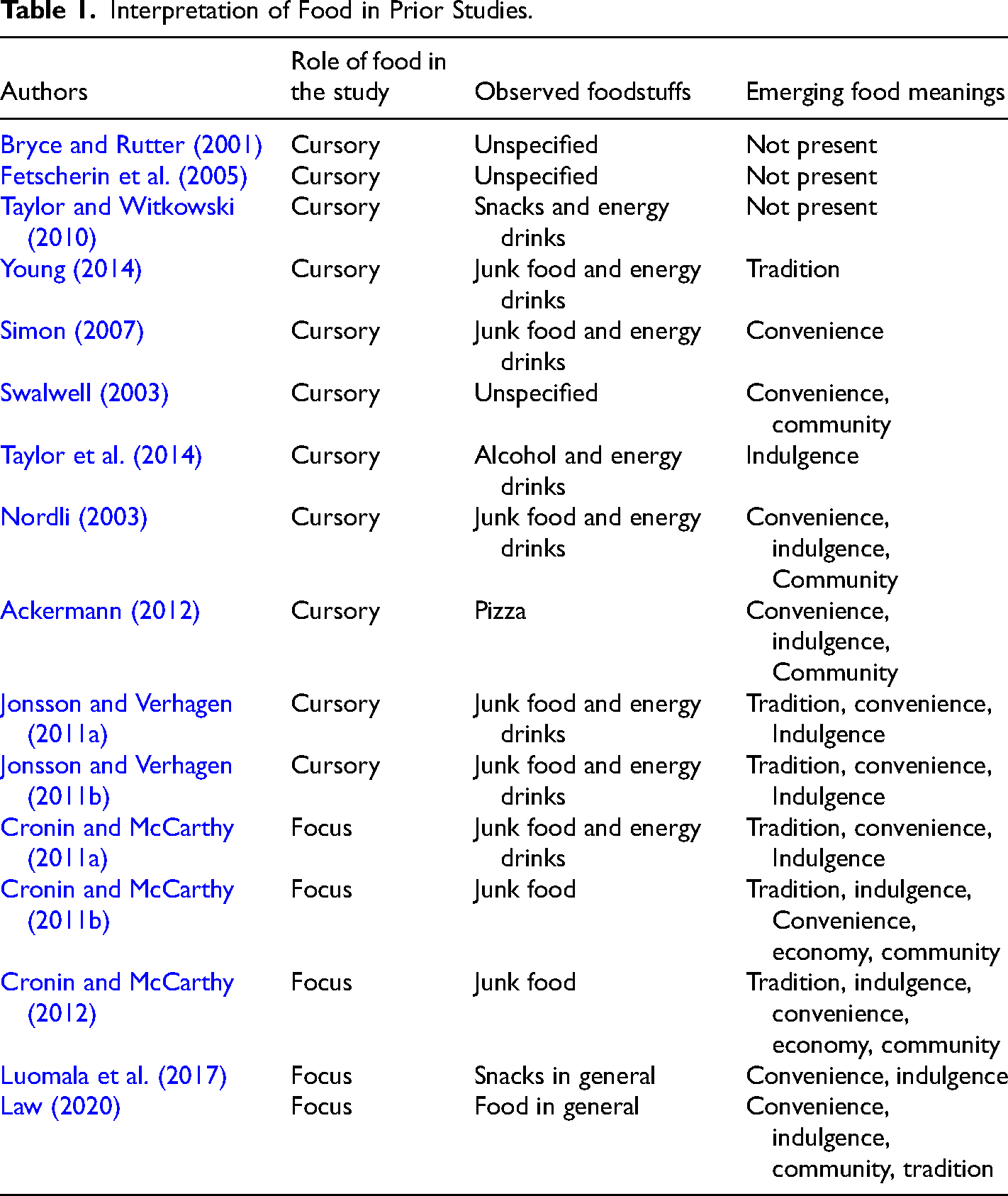
The third column contains tangible examples of the foodstuffs observed in each of the papers. Most mentioned foodstuffs included energy drinks, sodas, junk foods, pizza, candy, convenience foods, and hamburgers. Typically, the brands of the foodstuffs were not explicitly mentioned, but when they were, brands such as Coca-Cola, Cadbury, Doritos, Ben & Jerry's, and Haagen Dazs came up (Cronin & McCarthy, 2011a, 2012; Nordli, 2003). The inquiry of Luomala et al. (2017) stands out—unlike the others, which are qualitative studies carried out at LAN parties or other gaming-oriented spaces, it is a quantitative survey testing preferences for various snacks among gamers. To further testify to the prevailing hegemony of the Junk Food Gamer, supporting evidence comes from the medical field. In their exploratory study, Krarup et al. (2022) observed and measured voluntary participants’ caffeine and energy intake and various biosignals (e.g., blood pressure and heart rate) during a 42-h period. The research setting simulated a LAN party in terms of schedule and activities, including a snack and beverage bar (provided by the researchers). The results lined up with the Junk Food Gamer stereotype/narrative, and referred to the possibility of detrimental consequences for cardiovascular health in the long term.
Our interpretations of what food meanings are addressed appear in the last column. In this exercise, we rely on well-established sociological food antinomies that reflect the society-level structures that guide consumers’ food choices (e.g., Luomala et al., 2004; Warde, 1997). Food antinomies are described as bipolar opposites capturing food meanings of Health and Indulgence, Novelty and Tradition, Economy and Extravagance, Convenience and Care, and Individuality and Community (Leipämaa-Leskinen, 2007). We use the opposing poles of the antinomies as an interpretive lens for making theoretical abstractions concerning food-related meanings, and they therefore cannot be found in the papers as such.
Convenience and Indulgence emerge as the most prominent food meanings. Convenience is usually discussed as a justification for consuming ready-made food. In turn, Indulgence takes the most prevalent food meaning—it encapsulates the gamers’ cultural norms and expectations of hedonistic behavior at communal events, no matter whether at a large LAN party or a gaming session with friends. Similarly, Community, referring to social meanings of food, and the Traditions pervading the gaming culture are also used for justifying (usually unhealthy) food choices. Finally, Economy emerges only a few times, thus playing a non-significant role.
In the following, we deepen our analysis of the food consumption meanings with the help of the antinomies (Leipämaa-Leskinen, 2007; Warde, 1997), and discuss how they contribute to producing the narrative of the (junk food) gamer. Table 2 describes the ways in which various food meanings present themselves in prior gaming studies. Our findings reveal that the Junk Food Gamer in fact dominates the current academic discussion.
Production of the Junk Food Gamer Narrative in Past Research.
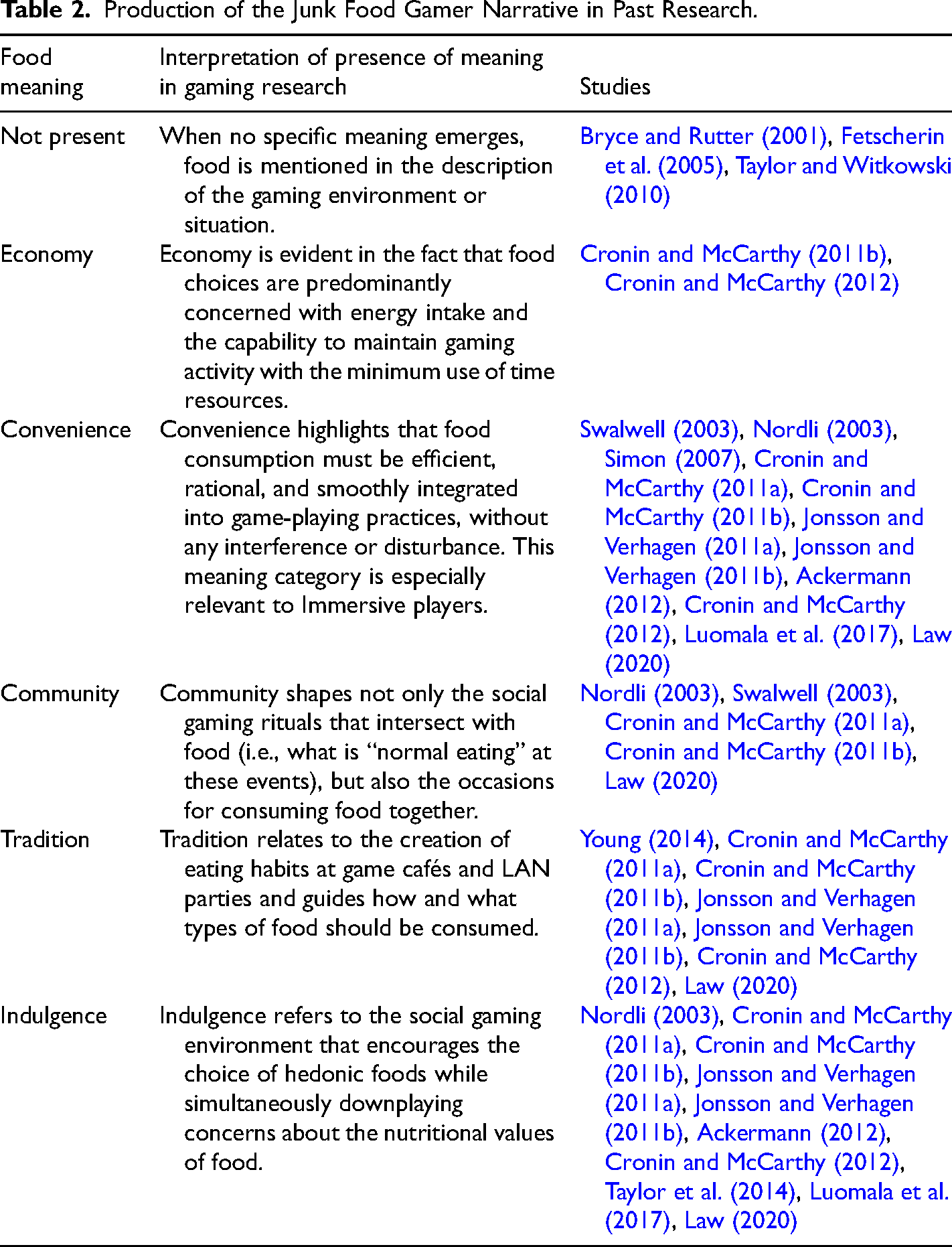
The Economy and Extravagance antinomy originally deals with the monetary value of food (Leipämaa-Leskinen, 2007; Warde, 1997). However, the gaming culture literature does not include any direct indications of the money spent on or the price of food, for instance. However, if we widen this concept to include any kind of a resource, such as the time used to obtain something, then the Economy meaning becomes evident in the extent to which gamers are ready (or not) to use their personal and community time for food preparation and consumption. In Cronin and McCarthy (2011a, 2011b, 2012), gamers value time, so foods are either precooked requiring minimal preparation time or made ready to be consumed from their packages (i.e., snacks) during gaming.
As regards the antinomy of Convenience and Care, gamer research highlights that together with Economy, Convenience drives gamers’ eating habits and choices toward fast foods. At gaming events, eating should be efficient (Cronin & McCarthy, 2011a, 2011b; Jonsson & Verhagen, 2011a, 2011b; Law, 2020; Simon, 2007) and the food should neither stain equipment nor hinder the usage of gaming apparatuses (Cronin & McCarthy, 2011b, 2012; Jonsson & Verhagen, 2011a). This seems especially relevant for players who seek to immerse themselves in the game (Luomala et al., 2017). The availability of (fast) food, whether delivered or on hand at the gaming location, in practice qualifies as a requirement for larger and well-organized gaming events (e.g., Ackermann, 2012; Nordli, 2003; Swalwell, 2003).
Individuality and Community is another antinomy that gravitates toward only one end of the spectrum. Namely, Individuality remains subdued in the gaming community's food choices at both smaller and larger gatherings (Cronin & McCarthy, 2011a, 2011b; Law, 2020). Although expressing one's Individuality shows in community members’ visible and valued artifacts such as gaming apparatuses (Nordli, 2003; Simon, 2007; Swalwell, 2003), participants at these events follow the informal rules that have been formed by the Community and its Tradition of (unhealthy) food consumption. Cronin and McCarthy (2011b) summarize the role of food in the gaming culture; it is both nourishment and enjoyment at the same time. However, the differences in Community members’ dietary preferences exert some degree of variation in their food choices (e.g., Cronin & McCarthy, 2011a; Law, 2020).
The Tradition and Novelty antinomy in turn unanimously leans toward Tradition. As noted above, the Community of gamers draws on informal social norms and habits formed by shared Traditions that prescribe certain kinds of food choices and preferences (Cronin & McCarthy, 2011a, 2011b, 2012; Jonsson & Verhagen, 2011a, 2011b; Law, 2020). This shows, for example, how gaming events are categorized: as special leisure-time parties that require a hedonistic approach in all respects (Cronin & McCarthy, 2011a, 2011b). The hedonistic tendencies and choices created by the communal Traditions steer eating behaviors at these events, separating them from regular day-to-day activities on every front (Young, 2014). The gaming subculture is no different in this regard; it can be compared to sporting events (Holt, 1995; Ireland & Watkins, 2009) and seasonal festivities (Belk, 1990) in which indulgent eating can be an essential part of the experience.
The final antinomy, indeed, oscillates between the opposite meanings of Health and Indulgence. We claim that there appears to be no room for Health in-game culture-related food consumption research, as it seems to be suppressed by the dominant presence of Indulgence played out in the hedonic settings of gaming parties (e.g., Ackermann, 2012; Cronin & McCarthy, 2011a, 2011b, 2012; Jonsson & Verhagen, 2011a; Law, 2020; Nordli, 2003). To consolidate our interpretation, prior studies have also noted that gamers consume various unhealthy beverages such as energy drinks and even alcohol (e.g., Law, 2020; Luomala et al., 2017; Swalwell, 2003; Taylor et al., 2014).
We conclude that the hegemonic narrative the extant research constructs is that of the Junk Food Gamer. Figure 1 shows our interpretation of how the food meanings of Economy, Convenience, Tradition, Community, and Indulgence come together to produce this narrative portrait.
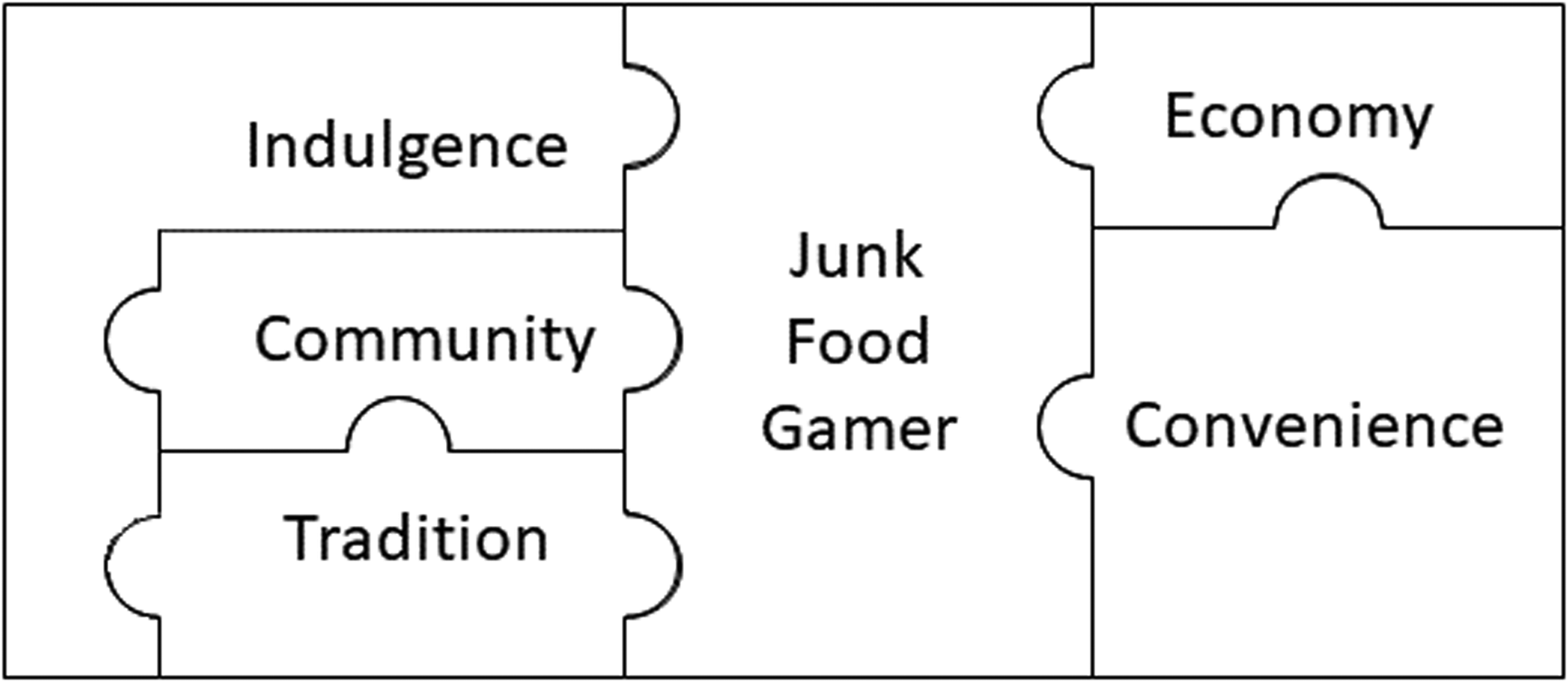
Meaning building blocks of the Junk Food Gamer narrative.
The figure illustrates how—on the basis of our review—we interpret food meanings to assemble together in the case of the Junk Food Gamer narrative. The meanings of Economy and Convenience are interlinked pieces of the “puzzle,” referring to how a Junk Food Gamer prefers fast and easy food that does not take too much of their (gaming) time. On the other hand, the food meaning of Indulgence is intertwined with Community and Tradition. This union encapsulates how hedonistic and unhealthy eating habits pervade social traditions at LAN parties and other joint gaming situations constructed within and by the Community. Furthermore, the size of the pieces in the puzzle roughly delineates the pervasiveness of each of the food meanings in the Junk Food Gamer narrative. In a similar vein, the position of the pieces imitates the way in which food meanings appear to be intertwined in previous research. As the graphical presentation of couplings from each of the “meaning” pieces highlights, they all participate in the creation of the narrative jigsaw puzzle that holistically tells the story of the gamer as a “convenience-seeking hedonistic junk food community member.”
Methodology
The Nordic gaming scene served as the context for our research. When defining the concept of scene, Gosling and Crawford (2011, p. 136) note that this term “allows us to understand how gaming and game-related narratives are located within the ordinary and everyday lives of gamers but take on greater significance within certain physical locations.” As our data generation took place at LAN events, we join Tyni and Sotamaa's (2014) view that the participants in particular events are part of their community “only through a sense of identity, but at certain times and in certain places—especially once the annual event is happening—openly celebrate the particular scene.”
In practice, we gathered our ethnographic data at two LAN events in the spring of 2017. They took place in different regions of Finland and around one hundred gamers participated in each of them. During the LAN parties, a multidisciplinary team consisting of seven researchers from game studies, information technology, cultural consumer research, and food science carried out non-participant observation. On the one hand, in order to maintain a certain degree of coherence, we conducted our structured observations in repeated cycles (every one to two hours) and were guided by a predefined scheme (i.e., we wrote down the “facts” about gamers’ food usage patterns, including the drinks and products consumed and the ways, times, and places of eating). On the other hand, to fully capitalize on our interdisciplinary background, we also took unstructured field notes describing every aspect of the activities, surroundings, and interactions at these LAN events.
Furthermore, during the fieldwork, we carried out qualitative interviews. Following the general guidelines of narrative interviews (Eriksson & Kovalainen, 2015, p. 220), our interviews were open-ended and conversational, allowing the participants to talk freely and tell their stories in their own words. Naturally, the interview topics covered food consumption but were also concerned more generally with gaming and everyday life, including insights on the kind of games the informants play, the social aspects of gaming, and the nature of the (physical) environments in which gaming occurs. Thus, this rich data enabled us to extend our understanding of gamers’ food consumption beyond these special occasions. As regards the term “scene,” we view our informants as representatives of a particular cultural group that comes alive at these special events, which are an inseparable part of their lives (Tyni & Sotamaa, 2014). This helps us to distinguish the phenomena that are specific to this scene from those that are part of the larger cultural context (e.g., youth subculture). Further, we considered every informant's story as a micro-narrative consisting of their subjective, contextual, and selective discussions (Elliott, 2005; Makkonen et al., 2012) on their daily eating habits and practices, both in everyday life and at LAN parties.
We interviewed a total of 43 Finnish gamers, either individually or in pairs. They were mostly males (41), aged from 10 to 38 years (M = 16.8). The interviews were conducted in a quiet area outside the main event hall or other gaming hotspots. We informed participants about our presence with screens and notes inside the venue. To increase their willingness to take part in our study, the prospective informants could participate in a lottery for a gift card (€ 50) for Steam, Valve's digital distribution service for games. As a few informants were minors, we asked their parents (after the event, if not present) for permission to interview their children for use as raw data in our study. We gave our informants pseudonyms to guarantee their anonymity. Interviews were recorded and videotaped. They were later fully transcribed by a professional service-provider, amounting to 174 pages.
We followed the procedures of the “analysis of narratives,” in contrast to those of “narrative analysis,” referring to the idea that narratives are regarded as a form of representation (Eriksson & Kovalainen, 2015, p. 221). Moreover, constructionist research focuses not only on the content of data, but also on how the content is produced through varied use of language (Eriksson & Kovalainen, 2015, p. 20). In a similar vein, we address the variety of socially created narratives on snacking gamers. In particular, when we analyze gamers’ micro-narratives together with the observational data, we focus on both meaning and performance in the material as a whole (Eriksson & Kovalainen, 2015, pp. 222–223). In the case of meaning, the thematic analysis concentrates on discovering “what” is told about food and drink consumption practices. In turn, performance pertains to zooming in on “why” the narratives are told the way they are. In this dissection, we rely on the classic sociological research on food consumption antinomies (Warde, 1997) to interpret their presence in our data. As Eriksson and Kovalainen (2015, p. 215) put it, “people tell stories to each other in order to accomplish something.” Thus, we aim to highlight gamers’ intentions and let their voices be heard. During the interpretive analysis, individual informant micro-narratives and other sources of data were combined as the narrative of the researchers, which synthesizes the multitude of story components together in the light of our theoretical understanding (Eliott, 2005; Makkonen et al., 2012). This synthetic narrative showcases how the extant, hegemonic narrative of the snacking gamer is both sustained and contested by alternative storylines.
Emergence of the Home Food Gamer Narrative
Our empirical analysis unearths two ambivalent, yet occasionally overlapping narratives. On the one hand, the hegemonic narrative of “the Junk Food Gamer” drips through, especially from our observational data. At LAN parties, the junk food narrative starts manifesting itself already at the entrance lobby. To illustrate, at one of the events, the first thing the participants encounter is a stand where the organizers sell unhealthy snacks, such as Nestlé's candy bars and Taffel's potato chips. Also, the ready-made pizzas produced by the sponsor of the event, a major Finnish food company, are noticeably targeted at gamers. Similarly, the other LAN event is sponsored by a well-known Finnish energy drink. Its logo and brand are visibly displayed at the entrance—there, drinks are stacked next to the ticket booth and every gamer gets a can when they purchase their tickets.
Inside the dark main gaming hall, our observations confirm that the foods and drinks consumed during LAN events mostly consist of energy drinks (e.g., Coca-Cola and Teho [transl. Power]), coffee, pizza, potato chips (e.g., Taffel and Pringles), convenience foods (e.g., toasts, quesadillas), and candies. These can be seen at computer stations all around the venue. In the afternoon, visible consumables frequently include sodas and energy drinks, accompanied by convenience and junk foods. Later, in the evening, when the participants begin to show signs of needing something more filling, they organize a joint order of pizzas for both shared and individual consumption. One observer describes this kind of situation as follows: At around eight, pizza is delivered to the gaming venue – many of the gamers take a short break from playing. Some of them share a pizza, some eat their own. Energy drinks and Coca-Cola are their typical beverages of choice. Few other kinds of foods are eaten at that time of night. (Author 2, LAN 1, first night at 8 pm).
Hence, we identify the existence of the nexus of food meanings at the LAN events: Economy and Convenience alongside Indulgence, Tradition, and Community. Community is evident not only in the chosen foods, but also in how gamers take breaks and socialize while eating. However, we do note that a few gamers brought easy-to-eat, but healthier foodstuffs, such as ready-made salads and fruits (e.g., grapefruits) with them.
On the other hand, when we talk with gamers about their daily food consumption, the narrative begins to change. In fact, some prior studies indicate that gamers themselves imply that they do not eat like this all the time (Cronin & McCarthy, 2011a; Jonsson & Verhagen, 2011a; Law, 2020). Indeed, most of our informants live with their parents—and at home, instead of pizzas and energy drinks, they eat home-cooked foods and dinners with the rest of their family. This is illustrated by our informants: It's a separate thing. Our family eats at a specific time. There's no gameplaying at the table. (Eric, 20)
Well, whatever's served at home. It's food, ordinary home cooking, usually. (Tom, 18)
To deepen our analysis of the emergent narrative, we interpret our data in relation to food consumption antinomies. First, when considering the antinomy of Economy and Extravagance, it appears to merge with Convenience and Care. As in the previous literature, Economy does not refer to its original meaning of monetary value, but instead to the resource of time. The interviews show how in terms of Economy and Convenience, there is a division between eating at home and with friends somewhere else. One of our informants puts it as follows: And when I’m gaming with friends, we go somewhere, and we usually have frozen pizzas and frozen baguettes, stuff like that. When we’re somewhere else, eating is easier, ‘cos there's no specific time, like, “dinner is at six,” or whatever. So when I’m not home, eating is easier, there are no specific times. (Eric, 20)
Author 1: And you don't have to think about the health aspects.
Yeah, no salads. (Eric, 20)
Our data suggests that home emerges as a place where Care is present; there, food is prepared at specific times (e.g., family dinners), and it has nutritional qualities that gamers ignore when they meet up elsewhere. In contrast, Convenience and Indulgence dominate when eating while gaming with friends; foods are precooked, do not include “greens” and are not tied to a specific time or place. The act of game-playing seems to regulate food consumption, as the LAN-goers eat only when they need energy and do not waste time on cooking. One of our informants emphasizes this shift of control from internal to external, as she explains how her eating habits while gaming has changed due to peer feedback. You should eat during the breaks, because otherwise it's pretty distracting. My friends tell me, “Your aim is off – are you eating again?” So now I eat during breaks. (Amelia, 13)
We, perhaps self-evidently, note that the food consumed while playing should be fast to cook and eat so that it does not hinder the gaming experience. Convenience can also concern the potential of food to mess up the game-playing instruments. For this reason, gamers typically do not eat while playing, as one of our informants explains:
Not at the same time – a keyboard full of crumbs. (Eric, 20)
In spite of this, some gamers have noticed a recent change in their eating habits at LAN events. Namely, when the core activity, gaming, ceases, the Community takes over the Convenience and the functional values of food. Thus, we propose that gamers can temporarily highly appreciate the social aspects of eating. Well, I could say there's one difference at least – in recent years, what we’ve done is, we’ve got together as a group and gone out for a kebab or something. Like, we don't just pop over to the fridge for a quick bite and then back to the PC. So maybe eating has also become more of a social situation, not just something we do to postpone hunger. (Andy, 21)
However, we recognize that food remains located on the Indulgence and Convenience sides of the antinomies—and thus does not support healthier choices. Regarding the antinomy of Health and Indulgence, our informants know that healthy food is important, but acknowledge that their diet at LAN events represents the opposite of that. These two quotes vividly highlight this. It's much unhealthier, I guess, and it's not a regular thing, how should I say it … you just eat and don't think much about what you’re munching on. You just stuff your face with everything. (Mark, 26)
Yes. A lot. Usually when you go to a LAN party, you already know you’re not gonna eat anything healthy during the weekend. But then it's a year, half a year to the next LAN party. (Lee, 17)
Lee recognizes the difference in eating at LANs and the times between them. The following quote clarifies this difference by raising the point that LAN days are special and do not fully represent gamers’ whole life and diet. We talk about LAN hangovers – when you’ve been guzzling energy drinks and eating candy all weekend, gone out for kebabs three days in a row, then afterwards real food tastes good again. It's like you have this healthy normal life from morning to night, then it's no big deal if you go to a LAN party on a weekend or out for some other kind of fun, it's no problem. The main thing is that you’re eating healthy during your daily life. (Martin, 23)
Thus, gamers acknowledge the hedonistic and unhealthy nature of LAN events. They even use the term “LAN hangover” to refer to the aftereffects of excessively indulgent food and energy drink consumption at the event. At the same time, they state that this is balanced by their “normal life eating” both before and after this special event. These observations lead us to the final antinomies: Tradition and Novelty, and Individuality and Community. They essentially epitomize the gist of LAN culture, as the following playful bantering between two informants reveals. Martin, 23: Yeah, but when it's, like, the weekend, well, you sorta give yourself permission to eat, you tell yourself it's ok – and for me, too, LAN parties always kinda involve the things that go with LAN culture, y’know what I mean, there's always some candy maybe, and energy drink, that's the classic thing …
Andre, 28: Yeah, there's no point stressing, it's a LAN party and time to chill, you know.
Martin, 23: Yup, guzzling energy drinks is part of LAN culture. The main thing is that you show up anyway.
Andre, 28: And bad food at a kebab joint or someplace.
Martin, 23: Yeah, we always eat shitty food when we meet up.
Andre, 28: Nobody really comes here with a salad bowl.
Tradition and Community seep through the LAN culture and its natives. A LAN event occurs at a certain time and specific place where the members of this Community relax amongst like-minded people. LAN food needs to be fast and heighten the sensory pleasure of the overall experience.
Yet, gamers do make their own individual decisions. Single voices can be heard telling their story of a personal change in thinking and habits. Tom's account illustrates this kind of transformation. All that snacking … When I was younger, in junior high, I guess I snacked, but then I stopped. Or maybe it fell by the wayside when I adopted healthier eating habits and daily routines … My attitude is that if I don't buy something from a store, like chips or stuff like that, I won't eat it, either. I usually eat nutritious food. (Tom, 22)
In conclusion, our application of the antinomy lens to food consumption at LANs or other gaming events can be characterized by the strong presence of Convenience, Economy, and Indulgence, following the Traditions of LAN culture, and strengthened by Community interactions. As the venue changed to regular day-to-day life gaming, the building blocks of the “Home Food Gamer” (Figure 2) change.
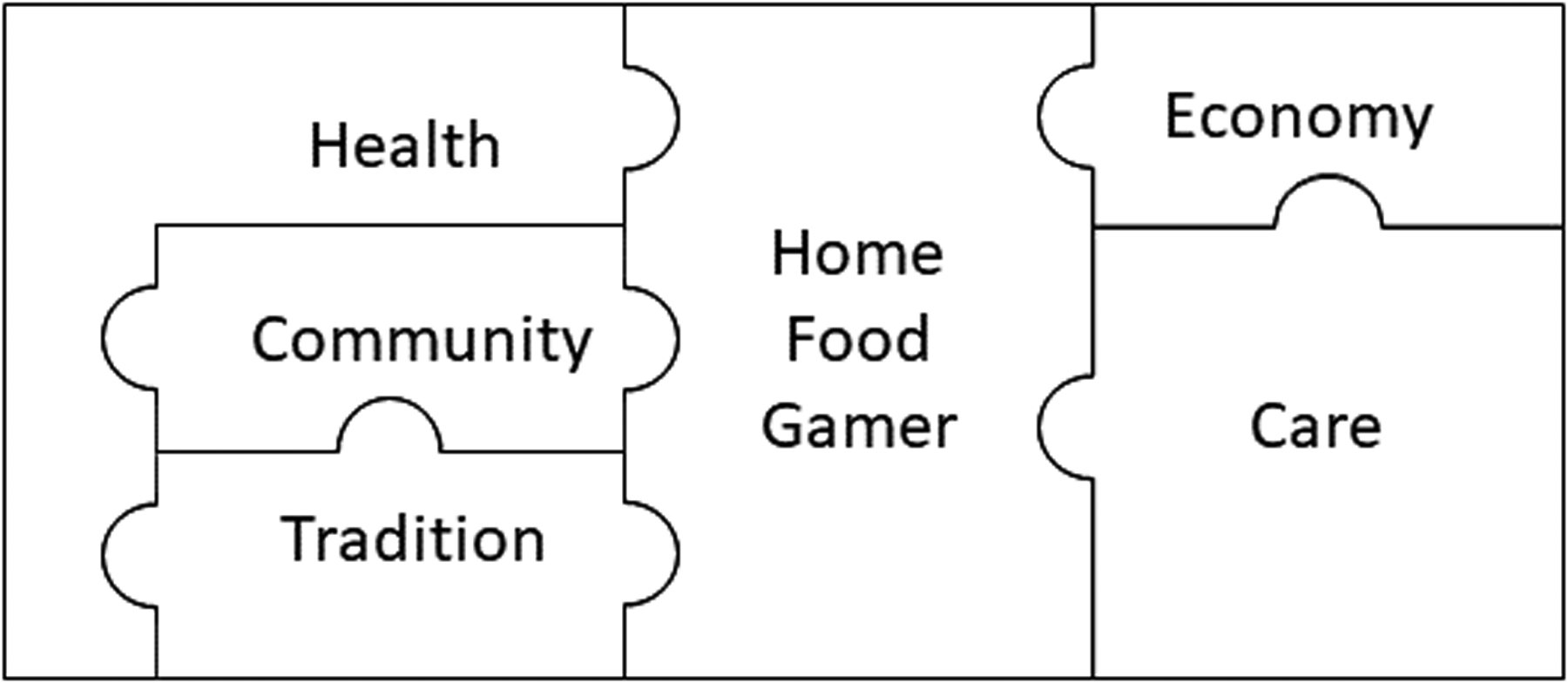
Meaning building blocks of the Home Food Gamer narrative.
Similar to our illustration of the Junk Food Gamer, here we draw a sketch of the Home Food Gamer by visualizing how the “meaning” pieces of the narrative puzzle come together. Again, the sizes of the pieces roughly describe the pervasiveness of each of the food meanings and the relative positions symbolize their apparent interconnections. Here, Indulgence gives way to Health, and the influence of Tradition and Community come from gamers’ home and family environment instead of the LAN culture. Health is noted as an important factor, as denoted by the large size of the piece of the puzzle and by its dominant position, especially when gamers train to become better, as this requires stronger physical fitness. Convenient fast foods consumed during gaming breaks are replaced by Care and Economy, as the food is now prepared at home and consumed with the family, outside the magic circle of gaming. Gamers acknowledge the difference in their diets between these two settings and are aware that the LAN culture is the driving force in changing their behavior.
Discussion: Toward More Multifaceted Gamer Narratives
The observational data we collected at the LAN events easily evokes the familiar narrative of the hedonistic gamer with a hunger for junk food. It also noticeably emerges from the interviews when we discussed food and eating in relation to LANs and other social events with our informants. In contrast, when we shift our attention to gamers’ home-eating and everyday life, the portrayal starts to look incomplete, or even inaccurate. Gamers eat regular homemade food with their family at the dining table. These mundane “gamer family meals” strike us as clearly healthier than the foods and drinks consumed at LAN parties. In fact, the higher frequency of family meals leads to better nutritional health for children (Dallacker et al., 2018). We call this narrative the “Home Food Gamer.”
Apart from the Health-Indulgence and Convenience-Care antinomies, the Junk Food Gamer and Home Food Gamer narratives generally appear to share many food meanings. However, the socio-contextual interpretations of the meanings vary greatly depending on the gamer narrative in question. To illustrate, Tradition and Community show how these meanings stem from different social surroundings that push forward different communal norms, rules, and values in regard to food consumption. Similarly, when the LAN gamer culture induces fast food and easy eating (Indulgence, Economy, and Convenience), the social surroundings of the family highlight self-cooked meals with higher nutritional values. This echoes the findings that situational contingencies have an effect on consumer perceptions of whether nutritionally orthodox or, in contrast, indulgent food serves their subjective well-being (Luomala et al., 2018). We summarize our food meaning analysis concerning the two alternative gamer narratives in Table 3.
Two Gamer Narratives in the Light of Interpretative Food Meaning Analysis.
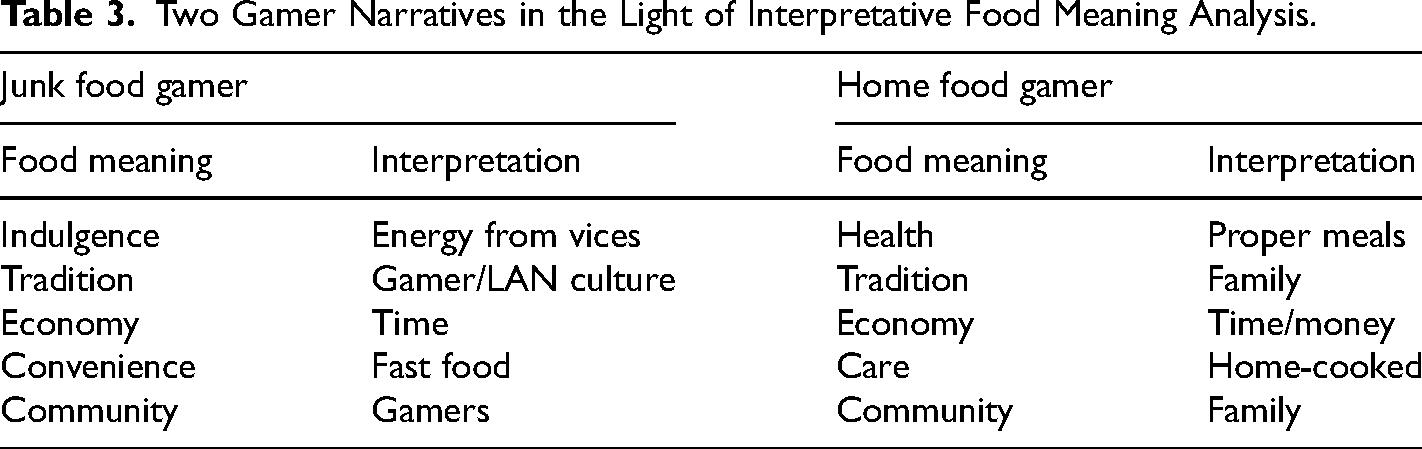
Our contextualized gamer narratives link us to the discussions on foodscapes (Johnston & Baumann, 2014). This literature highlights the social construction of food consumption by relating it to places, people, meanings, and material processes. Focusing on snack consumption, in particular, Syrjälä et al. (2017) identify a snackscape called “in front of the screens.” This refers to snack consumption occasions that combine playing digital games with convenient and easy eating. However, their finding reflects the one-dimensional view of digital gaming, since in actuality foodscapes constantly form and change as their interrelated elements affect each other (Dolphijn, 2004). To cultivate this idea, we suggest that gamer narratives actualize themselves in certain momentary and situational social contexts, enabling the gamers to occupy varying positions relating to food consumption with changing meanings.
Thus, the label “Junk Food Gamer” is simultaneously both right and wrong. When this narrative emerges, the unhealthy foods consumed become intertwined with gaming events (place), social relationships with other gamers (people), hedonistic and convenient food meanings, and minimal material processes, as practically no preparation efforts are carried out. These elements together construct a foodscape that is typical of LAN events—allowing the Junk Food Gamer narrative to actualize. Therefore, depending on the environment, event, other people, shared meanings, and material processes, the food antinomies manifest themselves differently, thereby transforming the gamer narrative. If we portray gamers by their consumer food habits, we have to acknowledge that today's Junk Food Gamers could tomorrow follow the same diet as their family (i.e., Home Food Gamer) or, for example, a nutritional program that helps them to perform well in their other hobbies (e.g., sports). In this way, we need more plural and contextually-bound narratives to describe present-day gamers (also, Stone, 2021). We illustrate this multifaceted nature of gamer narratives with a Rubik's Cube (see Figure 3).
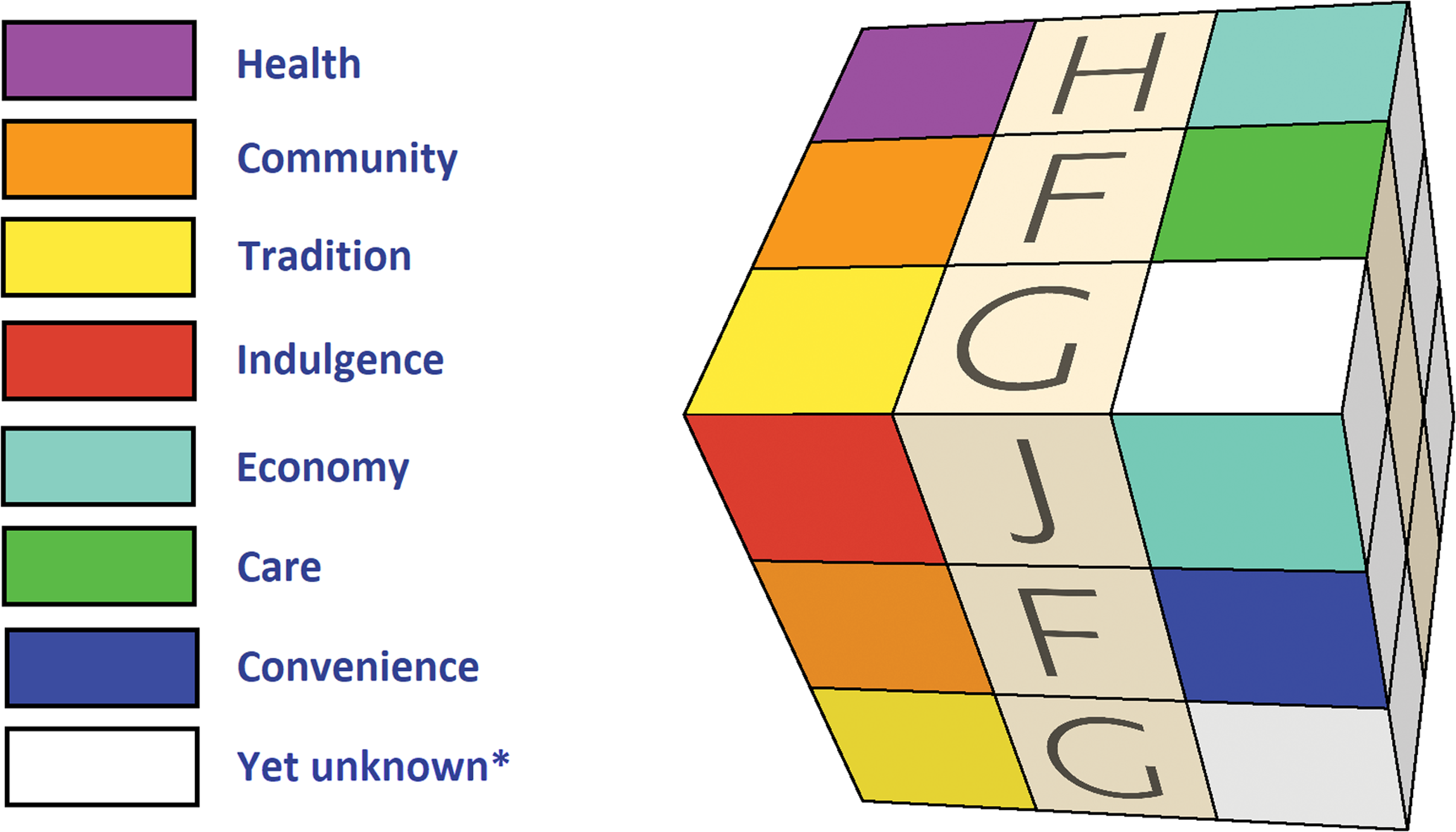
A Rubik's Cube illustration of multifaceted gamer narratives (*reserved for new potentially emerging food meanings).
With our Rubik's Cube illustration, we promote the view of bringing forward multifaceted and changing gamer narratives, in which JFG stands for Junk Food Gamer narrative and HFG for Home Food Gamer narrative (see Figure 3). Further, the colors of the cube refer to the food meanings discovered in the current study, whereas the white-colored box highlights those meanings (e.g., environmental friendliness, or fair trade) that may potentially emerge in future studies on gamer narratives. In effect, cube rotations reveal different gamer narratives, as the contextual elements combine in unique ways, depicting a gamer entering a novel foodscape. The Rubik's Cube eloquently visualizes the contextual and fleeting fusion of different food meanings resulting after certain cube rotations (i.e., gamer inhabiting a particular foodscape). Our thinking concurs with Hall (1992), who describes a subject whose identity is constructed in relation to “meaningful others”—providing him/her with the values, meanings, and symbols of the surrounding culture—and likewise we perceive gamers as part of these interactive role systems that generate cultural multiplicity. In the role systems, the meanings related to consumption objects, such as food, may act in two ways (Arnould & Price, 2000): both outside to construct the shared social world, such as the gamer culture, and inside to strengthen the gamer identity. Consequently, the gamer emerges as an active meaning-maker who lives in dynamic interaction with various social, cultural and consumption worlds, thus taking part in the coproduction of possible foodscapes. According to Gidden's (1984) structuration theory, these surrounding worlds create boundaries for thinkable behaviors (e.g., what to eat in certain situations), but individuals can still autonomously form their personal opinions and tastes, and therefore shake their old habits (e.g., the few gamers eating salads at LAN parties). To conclude, although the Junk Food Gamer narrative persists (or exactly because it does), we call for future studies to produce a wider understanding of the multifaceted nature of gamers’ food culture. After various cube rotations, what kinds of other gamer narratives may appear in different social circumstances involving food consumption? Can certain changes transpiring and intermingling at individual, communal and cultural levels be associated with the genesis of these alternative gamer narratives?
Conclusion
In this paper, we have examined how previous studies have contributed to the creation of the dominant narrative of Junk Food Gamers. This popular perception is based on a narrow window of observations on gamers’ life when they attend special events—LAN parties. These events are to gaming culture what concerts, match days or national celebration days are for “non-gaming cultures.” We stress that celebratory events almost by definition fuel hedonistic consumption habits—also outside the gaming genre (Belk, 1990; Holt, 1995; Ireland & Watkins, 2009).
In addition to analyzing the prior “food and gaming” literature, we observed gamers’ behaviors and recorded their talk at the LAN events. We found that outside these events, many gamers follow healthier choices or the diets of their families. Our observations partly support those of Cronin and McCarthy (2011a, 2011b, 2012), Jonsson and Verhagen (2011a, 2011b), and Law (2020). We also complement Law's (2020) work on food consumption at video gaming events by extracting Warde's (1997) antinomies from the ethnographical material, and by extending the empirical scope from LAN parties to the everyday life of gamers. Moreover, our analysis converges with the meta-analytical work by Marker et al. (2019) showing that “a strong link between video gaming and body mass as respective associations are small and primarily observed among adults.” Therefore, especially in the case of children and adolescents, the assumption of a direct linkage between higher body mass and sedentary video gaming is ambiguous.
Cronin and McCarthy (2011a) note that social gaming as a culture represents “gustatory rebellion and prolonged hedonism” (p. 736). Our interpretations suggest that gustatory rebellion does not impregnate LAN culture, whereas hedonism strongly pervades it. We also sense a change in how gamers generally view their food and eating choices. As eSports are conceptualized as a social practice that also pervades other game-playing arenas (Seo & Jung, 2016), we can anticipate its healthier lifestyle will have a growing impact across various game cultural contexts. However, at the same time, gaming events may not embrace this change (Jonsson and Verhagen, 2011a, 2011b). It is well-known that changing snacking habits from unhealthy to healthy is a complicated and daunting task (e.g., Yan, 2015). Nevertheless, and perhaps counterintuitively, gaming and gamification more generally can also be harnessed to serve children's transition toward nutritionally better eating regimes (Chow et al., 2020). In fact, adult consumers themselves hold positive views about the potential of gamified food packages and ICT devices to help them in leading healthy lives (Lemke & Schifferstein, 2021; Syrjälä et al., 2020).
In conclusion, our study indicates that gamer culture cannot be profoundly understood by only considering its most obvious manifestations such as LAN parties. These gatherings epitomize gamers’ immersion in their passion and celebration of their community. Yet, as these events do not reveal how gamers live their lives outside them, we need counternarratives to combat stereotypical storylines about gamers (Stone, 2021). In the current paper, we have scrutinized two contextual narratives of gamers as food consumers: Junk Food Gamer and Home Food Gamer. Our work extends the prevailing understanding of geek cuisine by combining novel conceptual ideas with a rich ethnographic approach, enabling us to advance the extant game culture theorizations involving food consumption. Self-evidently, more research is needed to develop a fuller picture of the nexus between game and food cultures. To that end, we introduce the concept of the multifaceted gamer, depicted as a Rubik's Cube that can be rotated to reveal different narratives materializing in plural foodscapes. To thoroughly deconstruct the multifaceted gamer, we need future studies on various occasions in their everyday lives. Only after extensively mapping out this terrain, can we expect to gain more diverse interpretations of narratives (i.e., reveal other outcomes from the cube rotations); for instance, to decipher how the gamers interact and overlap with other cultural groups to produce varying narratives beyond the current discoveries.
Footnotes
Declaration of Conflicting Interests
The author(s) declared no potential conflicts of interest with respect to the research, authorship, and/or publication of this article.
Funding
The author(s) disclosed receipt of the following financial support for the research, authorship, and/or publication of this article: The research reported in this article has been conducted as a part of the Co-Creative Snacks project, which is mainly funded by the European Regional Development Fund via Tekes—the Finnish Funding Agency for Technology and Innovation. The article is also funded by Consumers' Everyday Practices as Bellwethers for Digitalization project funded by Foundation for Economic Education and Finnish Cultural Foundation, Middle-Ostrobothnia Foundation.
