



Abstract
Professional gaming is organized competitive digital gameplay supported by advertisers and businesses. With its rising popularity and spectatorship, virtual gaming as a profession is now a reality. The aim of this paper is to evaluate peer-reviewed articles from the past two decades that empirically examine gaming as a profession or the myriad facets of being a professional gamer published in scholarly journals. The themes that emerge from the results of the included studies (n = 32) are (a) the socio-cultural appeal of gaming as a profession, (b) socio-psychological elements of pro-gamers’ everyday lives, and (c) the health and physiology of pro-gamers. It is found that the literature on health and physiology (n = 14) overshadows other dimensions of pro-gaming in academic research. In conclusion, studies must reflect on gamers’ legal status as working professionals, their organizational contracts, and the legality of the industry country by country to fill the research gap.
Keywords
Introduction
Professional gamers, or pro-gamers, are people who compete in electronic sports (esports), that is, organized video game spectator tournaments or leagues sponsored by game companies, business organizations, or advertisers with a specified goal/reward, such as earning a championship title or prize money (Establés et al., 2019; Newzoo, 2022). Esports is a billion-dollar industry that is projected to reach a spectatorship of 640 million by 2025, making it a popular career choice among teens and young adults (Newzoo, 2022; Seo, 2016).
Video game historian Smith (2020) writes that Steve Russell’s creation of Spacewar! was a watershed moment in the history of video gaming that set into motion events leading to the development of electronic games. The author notes that Pong, an electronic pinball machine manufactured in 1972 by Nolan Bushnell, was the first-ever commercially successful arcade video game that brought billions in profit to the company Atari. The period between 1979 and 1983 was the golden period for the gaming industry, as some of the most successful games of all time, such as Space Invaders and Pac-Man, were released with the help of modern computing (Smith, 2020). In the 1990s, electronic giants such as Sony and Panasonic forayed into the gaming industry (Malliet & De Meyer, 2005). They popularized home gaming by manufacturing consoles—devices that could be linked with television sets to play games.
Video games developed as an extension of the entertainment industry (De Schutter & Brown, 2016) but are now valued as a tool that positively impacts fields as diverse as education (Granic et al., 2014), healthcare (Jung & Gillet, 2021), military training (Rayner, 2012), disaster management (Weyrich, 2021), business marketing (Borowy, 2013; Reitman et al., 2020), corporate management (Kumar & Raghavendran, 2015), and tourism (Shaheer, 2022). Digital games have a style, format, and visual richness that is only matched by the diversity of experiences they provide to their users, such as fun, immersion, and challenge (Cairns et al., 2014; Gee, 2008). Unlike conventional media forms, video games are interactive in the sense that the gamers actively participate in the game's storyline and choose their course of action (Granic et al., 2014). The social experiences gained and relations formed in the virtual world of gaming are as crucial as real-life experiences and relationships (Cade & Gates, 2017).
The active engagement of commercial enterprises in the game broadcasting industry, and the expertise required to play games at the elite level, professionalized gaming christening it esports, wherein gameplay transitioned from a casual playing activity to a spectating sport, mobilizing the emergence of the esports industry (Jenny et al., 2017; Kim & Thomas, 2015). However, the legitimacy of esports as sports has been a contentious issue dating back at least to 1999, when the English Sports Council refused to recognize the United Kingdom Professional Computer Game Championships as a sport (Jenny et al., 2017). The skeptics question the use of physical skill sets in esports and how it can be institutionalized and governed as companies design digital games for profit (Abanazir, 2019; Jenny et al., 2017).
The dispute is laid to rest with the announcement that esports will officially debut as a medal event in the 2022 Asian Games (Olympic Council of Asia, 2021). The International Olympic Committees’ (2021) strategic roadmap (Olympic Agenda 2020 + 5) recommends “the development of virtual sports and further engage(ment) with video gaming communities,” making it highly likely that esports will eventually be included in the Olympics as well.
In light of the recent developments, it can be argued that pro-gamers have diverse opportunities in the field, and amateur or hobbyist gamers can venture into competitive gaming as successful professionals. Pro-gamers are the key stakeholders in the gaming industry (Kim & Thomas, 2015; Newzoo, 2022), but there is a dearth of literature relating to them (Salo, 2021). Systematic reviews on esports have till now examined its psychological dimensions, gamer performance, its similarity with gambling, and the vulnerability of players (Bányai, 2019b; Pedraza-Ramirez et al., 2020). Our study aims to contribute to the research gap by summarizing and analyzing the key findings of the state of the art in pro-gaming research.
Methodology
For the purpose of our study, we chose systematic literature review (SLR), as a research approach as it allows for the detection of the greatest number of relevant publications meeting predetermined eligibility criteria addressing a particular topic (Pereira et al., 2018). We used the Sample, Phenomena of Interest, Design, Evaluation, and Research Type (SPIDER) framework to delineate the inclusion criteria (see Table 1) instead of the conventional Population, Intervention, Comparison, and Outcome framework that limits the search to quantitative studies (Methley et al., 2014).
Inclusion Criteria Based on the SPIDER Tool.
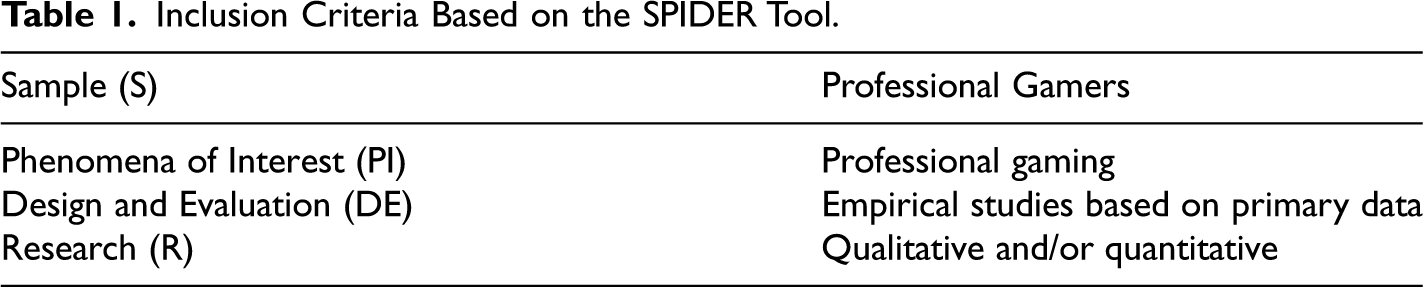
Our inclusion criteria were quantitative and/or qualitative studies in the English language that analyzed primary data obtained from professional gamers. Gamers who earned exclusively from streaming and were not professionally engaged in esports were not considered for the study. We set the base year as 2000 for the keyword search, as pro-gaming saw a meteoric rise at the turn of the millennium (Banyai et al., 2019b; Borowy, 2013). Based on the inclusion criteria, a keyword string search ((Professional AND (Gaming OR Gamer)) AND (Quantitative OR Qualitative)) was done on the entire article from an exhaustive list of 10 databases—ScienceDirect, Emerald, Scopus, ProQuest, Sage, EBSCO, Jstor, Wiley, Web of Science, and University of Chicago Press—till December 2020 (see Supplementary material, Appendix A for article distribution across databases).
Additionally, we used relevant articles by manually searching Google Scholar. We also used the results of Google Alerts from January 2021 to May 2022 to ensure that our review remained up-to-date while the data from SLR was being screened and analyzed. Google Alerts is a valuable research tool to keep up with the latest trends in a given field, as it sends users links to up to three articles daily in their registered mail (Munawar et al., 2021). The entire selection process is depicted in Figure 1.
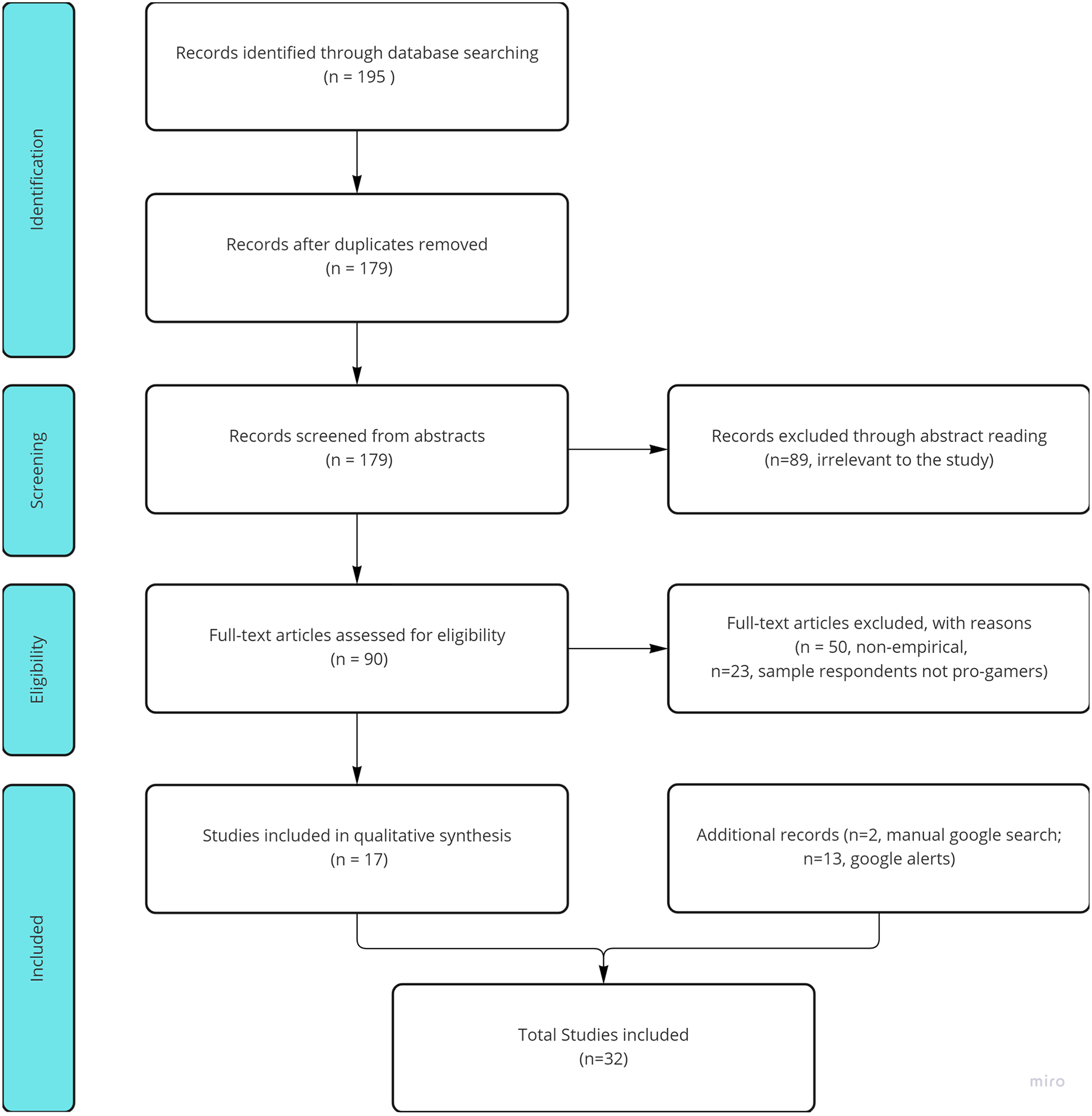
Flow diagram of article selection based on preferred reporting items for systematic review and meta-analyses (PRISMA).
Results
Three themes emerged from the final selection of 32 papers (see Supplementary material, Appendix B for a detailed table of the included studies): (a) the socio-cultural appeal of gaming as a profession, (b) socio-psychological elements of pro-gamers everyday lives, and (c) health, physiology, habits, and performance of pro-gamers.
Socio-Cultural Appeal of Pro-Gamers
Video gaming is a worldwide socio-cultural phenomenon, with the game experience being the outcome of the synergy of technology, marketing, and culture (Jin & Chee, 2008). Gaming is promoted as a new cultural movement by the governments of several countries; for instance, China and South Korea accorded formal recognition to pro-gaming as a real sport in the years 2003 and 2009, respectively (Kim & Thomas, 2015). Five studies have mapped the pro-gaming landscape in South Korea and China, albeit with different focuses.
Kim and Thomas (2015) examined the South Korean pro-gaming culture, where gaming is a legitimate sport and a much-desired profession among teenagers. They note that players enjoy a high value in society, much like star athletes, and are celebrated as cultural leaders, in stark contrast to their early association with internet addiction. The authors trace the first use of the word “pro-gamer” to the late 1990s when the StarCraft game competitions were initially organized in South Korea, aided by sponsorships from Samsung and Korea Telecommunications. It was then that professional gamers began to be structured into teams.
As opposed to the value placed on pro-gamers as ambassadors of nations’ soft power, Rea (2019) throws light on how gamers playing non-competitive games such as Massively Multiplayer Online Role-Playing Games in PC Bangs (Korean internet cafés) are lamented as social outcasts in South Korea. The author points out that, unlike the grandeur of a professional StarCraft match, PC Bang, with its low indoor illumination, shuttered windows, and regulated temperatures, creates an aura of isolation from the outside world and is a place where gamers are found playing for days in seclusion, losing a sense of time. He states that the spatial aesthetics of PC Bangs are deplored as “filthy,” and “dirty,” and the gamers playing in them are labeled as “chutkori” (a derogatory term alluding to someone who spends too much time at certain locations like nightclubs or cafés).
The author explains that the two gamer categories of professional gamers and PC Bang gamers reflect the South Korean cultural chronotope that positions pro-gamers above PC Bang gamers in the social hierarchy. While pro-gamers are praised for mirroring the country's high-speed tech-savvy progress (as competition warrants them to be highly skilled and knowledgeable about the games’ hardware and software interfaces), the once popular PC Bangs are associated with societal decay (where slower games are played) where decent individuals are not expected to be present. The prejudice against PC Bangs is ironic, considering how they provided 24-hour low-cost internet access when broadband subscriptions were too expensive for many Korean households during the 1990s. Moreover, it was at PC Bangs that the first informal gaming tournaments began that eventually led to the popularity of esports (Rea, 2019).
Three ethnographic studies situate the evolution of professional gaming in China against Mianzi—the country's conservative cultural norm that evaluates a person's social standing (Zhao & Zhu, 2021), the progressive neoliberal economy (Lin & Zhao, 2020), and the political goal of peddling the nation's soft power to the world (Szablewicz, 2016).
Countries that co-opt neoliberalism as an indicator of global political-economic progress view humans as self-improving subjects who should constantly work towards their progress and govern themselves (Ganti, 2014). Authors Lin and Zhao (2020) note that China adopted the neoliberal economic model in the late 1970s, and when esports began in the country in the 1990s, it caught the imagination of the government, which saw in the pro-gamers ethos of the neoliberal spirit and the potential to augment the nation's soft power in the global stage, contribute to the digital economy, and foster nationalism amongst the younger generation. In the game world, individuals exercise active choices that determine the game outcome, much like the reality of the neoliberal market, where individuals are expected to function as competitive self-governing subjects in charge of their lives to succeed (Lin & Zhao, 2020). Thus, the game world helps individuals internalize neoliberalism in an imaginative, fun, and exciting way.
Adding to the narrative, Zhao and Zhu's (2021) research calls attention to China's cultural measure of social status, that is, mianzi (usually associated with academic success). The authors explain that Chinese citizens do not accord the same prestige to gaming as the country's neoliberal government, thereby creating a chasm for the pro-gamers who have to prove their worth in society by highlighting the meritocratic (competitive) element of esports while masking its inherent precarity (lack of a regular income and short-lived career).
In the face of the country's duality in vetting esports as a legitimate profession, Szablewicz (2016) finds that the Chinese government promotes opulent esports tournaments as a pop culture good to create a spectacle that portrays a well-manufactured narrative of Chinese urban expansion, capitalist consumer culture, and patriotism. Doing so entails redeeming digital games in the eyes of a skeptical public that frequently demands internet café closures and restrictions on all forms of digital gaming. The intricacies of the Chinese esports spectacle serve as evidence of the contentious identity of digital gaming in China, which has one of the world's highest concentrations of digital gamers (Szablewiczs, 2016).
Gender in Gaming
Even though gaming is typically ahead of the curve in terms of technology, video games have served as men-centric virtual playgrounds, disincentivizing women's participation in esports (Buchholz, 2022; Taylor, 2012). The Gamergate controversy is a prime example of the problematic construction of gender in gaming that has unquestionably affected female gamers.
Gamergate was a backlash against women's participation in the video game culture that took the form of a sexist and misogynistic harassment campaign in 2014 and 2015 using the hashtag #Gamergate on various online platforms (Bulut, 2021; Dowling et al., 2020; Mortensen, 2018). Gamergaters were self-proclaimed gaming nerds who considered the issues of feminism, ethnic diversity, artistic acknowledgment, and social criticism in video games to threaten the masculinist gamer identity of a white young heterosexual man (Bulut, 2021; Salter, 2018). In 2014, Gamergaters began harassing female game developers such as Zoë Quinn and Brianna Wu, feminist media critic Anita Sarkeesian, and other female gaming industry professionals with death threats, rape threats, and doxing (Todd, 2015).
Gamergate points to the gendered hierarchy that exists in the video gaming community. However, when it comes to female pro-gamers, we only found two studies illuminating their professional experience in esports. Zeolides’ (2015) article evaluates the inherent sexism and gender discrimination in esports. The author analyzes the online identities of professional gamers Kelly “MrsViolence” Kelly and Matt “NaDeSHoT” Haag. By comparing the online personas of a female pro-gamer to that of her male counterpart, Zeolides (2015) shows that when it comes to building and managing their brands, female professional gamers face more challenges than male pro-gamers in esports. Because of their gendered performance, young women are put in a risky situation in terms of their financial security and sense of self. The author notes that esports, a subculture of the excessively masculinized video game culture, is a strictly regulated environment that rejects any expressions of femininity that might challenge heteronormative masculinity as a normative value of gaming. When building their online identities, women pro-gamers have more challenges than their male counterparts since they are forced to explain, negotiate, and act on their femininity to get online prominence that can be commoditized.
Yusoff et al.'s article (2021) explored the drivers of female participation in male-dominated esports and their subsequent transition to the professional scene. In their interview with six female pro-gamers, the authors found that support and encouragement from primary (parents) and secondary (coworkers, the media, coaches, and opponents) socialization agents are increasing and prompting more female gamers to pursue gaming as a career.
The two studies show that female pro-gamers face the same issue of gatekeeping in gaming as casual female gamers. However, aspiring female gamers can make it as esports professionals with proper assistance and support. The increasing participation of women in esports calls for greater academic attention to study the status of professional female gamers in the field. It would aid in understanding how far the esports community has progressed since the Gamergate scandal.
Socio-Psychological Elements of Pro-Gamers’ Everyday Life
Gamer Identity and Career Trajectory
Three studies have mapped the trajectory of a gamer's career from that of an amateur to a professional and how that process shapes their identity. Kim and Thomas (2015) identified five stages in a pro-gamer's career. They state that the journey of a pro-gamer starts with the stage of enjoyment, wherein they are part of amateur teams and aspire to gain visibility in the pro-scene. In this phase, gaming is a serious hobby, and gamers have fun. When sponsors scout for new talent and hire gamers to be a part of their pro-teams, only a select few with good competitive skills make it to the next level, the struggling stage. The transition from being a casual gamer to a professional is a career shift that gamers struggle with, as now gaming is no longer a leisurely fun activity but work.
After making it to the professional ranks, gamers enter a new phase known as achieving, in which they set their sights on becoming the team's captain. Outstanding gamers move up the professional ladder and gain recognition. The elite status, however, is challenging to hold on to for long with the constant influx of new talent aware of the elite gamers’ play styles and strategies. Pro-gamers face a career decline in the slumping stage. In the final stage of recovery, gamers bounce back from the slump by reinventing their gameplay or moving on to other peripheral roles such as coaching, casting, or managing.
In Seo's (2016) investigation of the social environment of professional gaming and its self-concept dynamics, the author finds that players derive long-term benefits, such as a sense of self-actualization and a deeper understanding of identity, by pursuing professional gaming. Furthermore, the author remarks that amateurs who become pro-gamers establish high criteria of excellence and connect passionately with the activity they are engaged in due to the internalized esports ethos that exhorts values like fairness, respect for others, and the pursuit of personal growth. The study's findings reveal three phases of an amateur's transformation to the status of a pro-gamer that are mapped onto Campbell's (1965) framework of “the hero's journey”—a hero being someone who dedicates their life to a greater purpose while confronting adversity and triumphing over it. During the “call to adventure” stage, new gamers play for entertainment and are introduced to the mainstream gamer community. While forging connections with others in the online gaming community, their personality evolves, and they embark on the “road to trials.” The journey of amateur gamers culminates when they acquire sufficient skills and become “master of two worlds,” that is, professionals.
In an alternate approach, Meng-Lewis et al. (2022) opine that a gamer's journey is not necessarily linear and use the Chaos Theory of Careers (CTC) to reflect the complexity of a pro-gaming career. The authors note that a career in esports is not built via meticulous preparation but rather by taking advantage of fortuitous events. The five tenets of CTC highlighted by the authors to explicate the chaotic career graph of a gamer are (a) Initial conditions (personal circumstances, congruence between talent and interest, opportunities, and networking) that set the stage for a gamer's entry into the world of gaming, suggesting that becoming a pro-gamer may be accidental. The authors subdivide the initial conditions into internal (natural skill and ability of a gamer) and external (socio-political, economic, technical, and environmental factors). With external conditions, the barrier to entry for esports becomes minimal in terms of resources and effort. (b) Attractors (people's ethical, motivational, or preference boundaries) act as constraints that guide gamers in an otherwise demanding career. With dedication and mental fortitude, professionals endure stress and accomplish goals. (c) Complexity (change and chance events) marks the third tenet of CTC, as most pro-gamers have a short-lived career. Professionals face tough competition and are prone to loss of employment. Gamer recruitment and selection are usually random, and unplanned media exposure/live broadcasting adds to chaotic career outcomes. (d) Patterns and fractals—despite being chaotic, esports careers have an emerging ordered pattern. The job relies on cognitive awareness, and players labor long hours under intense pressure with little time for interpersonal connections and social life. (e) Constructions—the last tenet of CTC posits that a lack of control or predictability allows gamers to actively create their futures. A pro-gaming career being nonlinear and complicated to forecast, the players accept the emergent order's ambiguity and stay flexible.
Labor and Skills
The precarity of digital labor in esports is examined by Johnson & Woodcock (2021), who highlight how pro-gamers labor precariously on behalf of third-party stakeholders (advertisers, sponsors, game developers, and team organizations) of the industry to fund their careers. The study reveals that success in the industry is contingent upon age (world-class gamers don't sustain their talents until age 30), leaving professional gamers with the same career insecurity as professional physical sports players but with significantly lower career incomes and fewer alternatives for future work in other areas (such as television, charity, and endorsements). Tournament income being a major source of earning for professional gamers, it varies with time, scale, and scope of tournaments adding to the precarity of a gaming career. The competitive world of gaming requires that pro-gamers are the best of the gamer lot.
Bonilla et al. (2022) identify three crucial skills to succeed in the industry. First, there are technical-tactical talents, which are esports-specific skills and knowledge. The second is psychological abilities (attention span, emotional resilience, ability to adjust in a group, control of thoughts and behavior, and ambition level), which help gamers mentally handle competition and training. The last dimension relates to good habits and activities (nourishment and rest) that pro-gamers take to care for themselves and preserve their health, especially in competitive situations.
Taylor (2016) studies how gamers legitimate their occupation through digital performative labor. The author notes that a video camera is a promotional tool via which esports is popularized to a broader audience through live tournament casts, player interviews, and highlight reels of online and offline events. The co-located, digitally mediated spectators boost the gaming industry's competitiveness. The camera elicits unique embodied arrangements typical of professional gaming, such as coded communication, dramatizing in-game events, and hypermasculine posturing. A gamer's success not only depends on their competitive standing but also on their media popularity. Thus, the pro-gamers “play to the camera,” where having an audience equals expertise and status. Professional gaming's legitimacy and appeal depend on playing for spectators. Being in promotional videos and tournament broadcasts is prestigious. The study posits that digital play definitions must be founded on larger practices, infrastructures, and industries (Taylor, 2016).
Player Type and Play Style
While addressing the motivational differences for playing games among the four types of gamer categories (professional, hardcore, social, and casual), Maher et al. (2018) found that gaming is an end in itself for hardcore professionals. In contrast, casual-social players play to fulfill other purposes (socialization, dealing with boredom). Casual gamers use gaming to accomplish goals, such as breaking up with job monotony, dealing with boredom, following a social media trend, or engaging themselves for a short period. The social gamer prioritizes the social components of gaming, such as connecting and having a pleasant time with friends, over winning a game. As opposed to gamers who view gaming as a means to a goal, hardcore gamers and professional gamers see gaming as an “end in itself.” Hardcore gamers are driven by the desire to advance in the game and develop their gaming abilities but do not regard themselves as professionals. These gamers may find themselves surrounded by companions who are not as enthusiastic about gaming as they are; nonetheless, this does not prevent them from engaging in intense and passionate solo games. Professional gamers devote considerable time to practicing and honing their talents and view gaming as a professional sport, placing a premium on winning competitions.
Building on earlier research (Kim & Thomas, 2015; Seo, 2016) that found competitive and self-improvement goals among pro-gamers, Bányai et al. (2020) looked at the predictors of a pro-gaming career among professional gamers. Their study found that higher levels of competitiveness, skill development, and social motivation predicted pro-gamers’ career planning. Younger gamers were also more likely than older gamers with competitive gaming experience to seek employment opportunities in professional esports. They also noted that amateur gamers might be exposed to high expectations or risk becoming a problematic videogame user owing to their motivational shifts in the wake of the hypercompetitive esports industry. While gaming motivations explained roughly 30% of the variance in their study, support networks (e.g., parental perceptions), availability of training prospects (e.g., fellowships, sports associations), differences in culture, and society's attitudes toward esports were also found to be significant explanatory factors.
Clarifying the difference between player type and play style, Hrabec (2017) explains that while player type categorizes individuals based on shared personality traits, style is more personal and distinctive, which represents how an individual executes an action regardless of who they are and why they act a certain way. The author finds seven general play styles—asocial, social, aggressive, defensive, tactical, strategic, achievement, logistic, and metagaming. Asocial style is disharmonic, disregards game goals, and violates game regulations. Its subcategories (griefer, noob, newbie) are based on players’ willful wrongdoing (cheating, hacking, exploiting). Griefers do worse by blocking teammates or killing themselves. Despite having gaming expertise, noobs are unaware of their offenses, while newbies are unfamiliar with game norms. Unlike the asocial style, social players are cooperative, courteous, and show leadership. Its subcategories are dependent on a player's standing in a team: high-status (most skilled), medium-status (less competent but valuable), and low-status (mediocre and inexperienced players). Aggressive and defensive styles concentrate on initiative and risk assessment. Aggressive and defensive strategies emphasize initiative and risk. Aggressive players seek to win as rapidly as possible regardless of the risks involved, whereas defensive players remain cautious. Tactical and strategic styles are influenced by cognitive processes. Strategic thinking is long-term; tactical thinking is opportunistic and split-second. The logistic style manages game resources and usually wins a competition based on the number and scarcity of items, points, weapons, gold, or other game assets. The achievement approach lets players win on talent, experience, and dedication. The writer concludes that pro-gamers follow the seventh style of play, that is, metagaming, in which the gamers gain a competitive advantage by exposing and manipulating their opponents’ moves while simultaneously being unreadable to others.
Team Dynamics and Performance
Cohesion is vital for forming a professional esports team. Macedo and Falcao (2020) study team cohesiveness in a competitive environment with transient memberships. Camaraderie-filled teams are more durable and perform better, according to the research. When permanent teams form, members benefit from a well-known activity and goal. They engage in team training, game analysis, and contests. Teams have an active communication network (many chat channels) for players to build coordination in the face of competitive challenges (e.g., developing strategies and tactics, organizing competitions, sharing information, and marking leisure activities). In ephemeral groupings, however, participants form a few days or months before an event to win it, then disperse afterward. Due to a lack of time together, such teams lack camaraderie, loyalty, coordination, and accountability, hurting group performance. When a team reunites for a tournament, members have to rediscover each other’s playing styles and how to collaborate. The authors suggest that if a competitive squad is serious about pro-gaming in a local context, they should get to know each other outside and within their sport.
Similarly, Algesheimer et al. (2011) examined team performance by looking at how shared behavioral intentions are influenced by the logical and motivational aspects of strategic group consensus and how expected emotions affect team motivation. The degree of cohesiveness within a team was found to be positively correlated with the length of time the team has been together. Team heterogeneity has also been shown to positively influence team operations, especially in competitive contexts where innovation and data integration are paramount. As long as the specified communication standards are correctly implemented and obeyed, communication amongst diverse virtual team members may be quite successful. The authors note that a team's past performance is critical to establishing a dynamic, evolving model of teamwork. By analyzing past performances, team members can better assess their current resources, capabilities, and weaknesses, set more realistic future goals, reach a strategic consensus, and plan successful operations to meet performance goals.
Witkowski (2018) similarly contributes to the study of team dynamics. The author observed that expert-level play by pro-gamers is characterized by inter-corporeality (shared perceptions of the group to their play), inter-team embodiment (recognizing, negotiating, and positioning oneself and the team toward the rival teams’ inter-corporeality), and interplay (the range of interrelated activities that create effective teamwork) between players.
Physiology and Health of Pro-gamers
Health and physiology is the most researched aspect of pro-gamers, with 14 studies dedicated to them.
Pro-Gamer Physiology
de Gortari and Griffiths (2015) and de Gortari et al. (2016) studied the occurrence of Game Transfer Phenomena (GTP), a term indicating the effect of prolonged gameplay on individuals’ senses, perceptions, thoughts, and behaviors. It was observed that while professional gamers appear to be less vulnerable to GTP, the ones who do, tend to be more seriously affected by it. The study explains that as professional gamers play a specific game, they are relatively cushioned from the impact of GTP as opposed to non-professional gamers who play a variety of games. Han (2012) studied the effects of video games on professional gamers and patients with online game addiction (POGA) and compared the results with a control group of the non-gaming cohort. The research found that pro-gamers and POGA have different brain features. It was noted that anterior cingulate activation is elevated (even better than healthy controls) in professional gamers due to their more regimented lifestyle, which includes fewer behavioral disruptions, a long training program, and the stress of competing.
In another study on the ramification of prolonged screen time, Sanz-Milone (2021) examined the sleep patterns of gaming professionals and found that pro-gamers suffer from poor sleep quality, increased sleep latency, decreased sleep efficiency, and excessive daytime drowsiness. Similarly, Lam et al. (2022) found that pro-gamers are more prone to neck and back pain than non-professionals. Pro-gamers sit for lengthy periods with poor posture to play. The study suggests implementing physical training programs and other ergonomic factors as preventive measures. Considering the ergonomic factors, Li et al. (2022) studied the impact of mouse design on pro-gamers’ performance. It was found that pro-gamers favored the 80-gram mouse over the 87-gram mouse even though there were no significant differences in terms of muscle activity, hand motion, usability, or tiredness. They also exhibited faster hand movements and accelerations.
Similarly, three studies (Bickman et al., 2020, 2021; Wechsler et al., 2021) found that pro-gamers perform better than non-professionals due to better hand-eye coordination, mental strength, response time, game knowledge, and tactical comprehension. However, Sousa et al. (2020) observed that pro-gamers’ faster response times are marred by less accuracy and impulsiveness. The authors point out the necessity of taking breaks from gaming to prevent cognitive fatigue.
Physical Health
In a survey to study the gaming regimen and physical workout routine of pro-gamers, Kari and Karhulahti (2015) found that pro-gamers train for 5.28 hours per day, of which 1.08 hours are spent on physical fitness, which is three times the daily 21-minute exercise recommended by the World Health Organization. More than half of the respondents (55%) reported that including physical exercise as part of their training improved their competitive performance, and the other 45% workout to maintain their overall physical and mental health. The results of the study suggest that the media tends to overstate the time spent on training (12–14 hours) by pro-gamers. The authors explain the discrepancy and report that gamers spend 12–14 hours per day on esports-related activities such as group discussions, video analysis, strategic talks, promotional events, and interviews, but only the time spent playing or exercising counts as training. It is indicated that the pro-gamers’ training regimens may positively influence the physical activity habits of new players who admire them.
The results of the study are buttressed by Giakoni-Ramírez's (2022) work, which finds that almost 93% of pro-gamers are physically active and have a standard body composition. Players with low levels of physical activity were found to have positive values on all dimensions of motivation, that is, the more a gamer plays, the more motivated they are. The motivation was revealed to be higher in Latin America vis-a-vis Europe. The difference in the motivation levels in the two regions was explained by the fact that the esports ecosystem is still nascent in Latin America, prompting Latin American gamers to play more to be recognized in the scene.
Mental Health
While noting that a growing number of studies have focused on the link between gaming problems, gaming motives, and mental health, Bányai et al. (2019a, 2019b) state that the difference between casual gaming and pro-gaming is overlooked on those fronts. According to the authors’ findings, esports gamers spend more time playing video games on weekdays and weekends than non-esports gamers. Furthermore, pro-gamers scored better than casual gamers on measures of gaming motives such as social interaction, competitiveness, and skill improvement. In line with the research on gaming disorders, Maldonado-Murciano (2022) observed that, compared to non-professional gamers, professional gamers spend more time gaming and are exposed to high levels of stress, making them more susceptible to disordered gaming habits.
Discussion
The paper aimed to review empirical studies on pro-gaming and the myriad facets of being a pro-gamer. We reflect on the socio-cultural appeal of gaming, the everyday lives of pro-gamers, aspects of pro-gamers’ health and physiology, and the status of women in pro-gaming. We observed that pro-gamers are exhorted to be digital vanguards of an increasingly computerized society. Esports is peddled as soft power by governments on a global platform to underscore their countries’ technological prowess. The allure of gaming, however, is not without its detractors.
Gaming is vilified for denigrating the youth culture as teens are inclined more towards video games than academics. The status of pro-gamers thus oscillates between the two schools of thought—one that accepts it as a natural development of information society and the other that sees in it the depravity of the modern world. In context to the appeal of gaming in society, we see how gamers navigate through the competitive world of esports to become professionals. The journey, though precarious and without the guarantee of attaining the title of an elite gamer, is intrinsically rewarding for those who undertake it. The fulfillment lies in converting a leisurely pursuit into a career. The spillover effects of job satisfaction are also seen in gamers’ health and physiology. Unlike game addicts, pro-gamers are physically active and have a disciplined lifestyle. They have faster in-game responses and higher skill sets than amateurs. However, prolonged gameplay and the pressure of competition affect pro-gamers’ sleep cycle and induce stress and fatigue. It is advised that they rest and take periodic breaks to prevent such issues.
A key trend to note is that academic interest in pro-gaming piqued in the last 10 years, and it is only since 2020 that most studies surfaced (see Supplementary material, Appendix C for year-wise article distribution). Rising research in esports is due to the pandemic that disrupted traditional sporting events creating fertile grounds for esports, the digital nature of which acted as a tremendous competitive outlet during the crisis (Block & Hack, 2021). Several sports organizations and their sponsors ventured into esports to avoid loss and maintain their brand value during the lockdown (Ke & Wagner, 2022). The lingering effect of COVID-19 resulted in an audience expansion beyond industry estimates in the Middle East, Latin America, North Africa, and Southeast Asia that will continue through 2025 due to the increasing popularity of mobile titles on live-streaming services (Newzoo, 2022).
Nearly a third of all esports income is generated in China—plausibly explaining why the Asian pro-gaming scene has been dissected from multiple angles (see Supplementary material, Appendix D for region-wise article distribution). While young males make up the bulk of esports followers, the number of female esports fans has climbed to 34% (Newzoo, 2022), and women are keen on making a career out of it (Yusoff et al., 2021). Concerns, however, remain as elite gamers are still men and female gamers have to work doubly hard to merit the same status as them (Kari & Karhulahti, 2016; Zeolides, 2015). The anonymity of online gaming spaces means that female gamers are subjected to harassment and sexual misconduct (Ruvalcaba et al., 2018).
To avoid the vitriol, female gamers prefer playing single-player games, avoid playing with strangers in multi-player games, use gender-neutral usernames or characters to conceal their gender, or simply ignore the negative comments and highlight their skillsets as a defense mechanism (Cote, 2017). Apart from gender, socio-economic factors play a key role in influencing gamer identities as access to real-world technical resources translates to opportunities in the virtual world of gaming, as gamers with poor backgrounds cannot afford to invest years with the hope of making it big someday (Vilasís-Pamos & Pires, 2021). Pro-gamers do not appear out of thin air; instead, they are formed by a bigger social process where the possibilities and realities of professionalization include, among others, indoctrination into highly instrumental play by peers, institutional factors, money, interactions with technology, and broader cultural problems around gender and play (Taylor, 2012).
Conclusion
Once deemed remarkable or unique, work behaviors become typical for a substantial segment of the population over time, and expectations of what is considered normal in the workplace are also altered (Huws, 2013). Pro-gaming is a shining illustration of how an internet gaming activity meant for entertainment turned into a full-time job. While it would have been unimaginable until a few years ago to make money playing games, organizations pay athletes to practice and compete in esports. People, particularly the younger generation, are adapting to the changing nature of employment in the modern world.
This paper reviewed empirical work on pro-gamers cutting across fields, and most studies were found to have focused on the health and physiology of gamers than on pro-gamer practices and work culture. Studies on the socio-cultural appeal of pro-gamers are concentrated in Korea and China. The theme needs exploration beyond Asia. Future studies can look at the social perception of professional gaming in North America, South America, Europe, Africa, and Oceania. The newness and intricacies of the field call for greater attention to gaming as a profession and gamers as digital workers. Taylor (2012) notes the precarious legal status of pro-gamers as they have little negotiating power when signing contracts, as esports regulations are primarily ad hoc. The number of professional outfits players can work for is still tiny compared to other sports (or occupations); therefore, their working circumstances are still largely informal and interpersonal (Taylor, 2012).
Future studies can dive into the legal status of gamers as working professionals, their organizational contracts, and the country-wise legitimacy of the field to provide fresh insights into the current network society and the lives and careers of people engaged in it.
Supplemental Material
sj-docx-1-gac-10.1177_15554120231154058 - Supplemental material for Professional Gaming and Pro-Gamers: What Do We Know So Far? A Systematic Review
Supplemental material, sj-docx-1-gac-10.1177_15554120231154058 for Professional Gaming and Pro-Gamers: What Do We Know So Far? A Systematic Review by Isha Bihari and Debashis Pattanaik in Games and Culture
Supplemental Material
sj-docx-2-gac-10.1177_15554120231154058 - Supplemental material for Professional Gaming and Pro-Gamers: What Do We Know So Far? A Systematic Review
Supplemental material, sj-docx-2-gac-10.1177_15554120231154058 for Professional Gaming and Pro-Gamers: What Do We Know So Far? A Systematic Review by Isha Bihari and Debashis Pattanaik in Games and Culture
Supplemental Material
sj-docx-3-gac-10.1177_15554120231154058 - Supplemental material for Professional Gaming and Pro-Gamers: What Do We Know So Far? A Systematic Review
Supplemental material, sj-docx-3-gac-10.1177_15554120231154058 for Professional Gaming and Pro-Gamers: What Do We Know So Far? A Systematic Review by Isha Bihari and Debashis Pattanaik in Games and Culture
Supplemental Material
sj-docx-4-gac-10.1177_15554120231154058 - Supplemental material for Professional Gaming and Pro-Gamers: What Do We Know So Far? A Systematic Review
Supplemental material, sj-docx-4-gac-10.1177_15554120231154058 for Professional Gaming and Pro-Gamers: What Do We Know So Far? A Systematic Review by Isha Bihari and Debashis Pattanaik in Games and Culture
Footnotes
Declaration of Conflicting Interests
The author(s) declared no potential conflicts of interest with respect to the research, authorship, and/or publication of this article.
Funding
The author(s) received no financial support for the research, authorship, and/or publication of this article.

Supplemental Material
Supplemental material for this article is available online.
Author Biographies
References
Supplementary Material
Please find the following supplemental material available below.
For Open Access articles published under a Creative Commons License, all supplemental material carries the same license as the article it is associated with.
For non-Open Access articles published, all supplemental material carries a non-exclusive license, and permission requests for re-use of supplemental material or any part of supplemental material shall be sent directly to the copyright owner as specified in the copyright notice associated with the article.
