



Abstract
This article proposes a new framework for analysing how developers structure – and players experience – history and heritage in historical video games. Drawing on the theory of mashups, this article demonstrates how historical games generate ‘technocultural mashups’ by cutting and pasting aspects of cultural heritage into the gameplay experience and then challenging players to further adapt this. ‘Technocultural mashups’, the article suggests, exploit a cultural precedent in the recombination of art, music and video, but also a Web 2.0 precedent that enables alternative modes of production, communication and consumption based on the affordances of new media. Assassin's Creed Odyssey is used as a case study to better understand the relationship between game design and the simulation of cultural heritage. By looking at fan-made trailers, as well as gameplay, paratexts and player-generated content, this article explores how ‘technocultural mashups’ enable players to participate in a networked historical imaginary.
Theorizing Mashups
Honest Game Trailers, a YouTube channel established in 2014, purports to offer ‘the TRUTH about your favourite Video Games’. It does so overlaying gameplay clips with a self-aware commentary that compares and contrasts design choices within the context of 21st century media culture. The Honest Trailer for Assassin's Creed Odyssey (Ubisoft, 2018) makes use of mashup culture for comedic effect. Against a backdrop of clips from ACO's open world, the narrator quips that those who ‘dive into’ the experience are rewarded with a game that ‘painstakingly recreates moments in history so you can murder everyone that lived there’ (Fandom Games, 2018). The trailer goes on to outline the plot, which revolves around a Spartan mercenary who embarks on an ‘odyssey’ across the ancient Mediterranean to expose a nefarious cult. In the process, the trailer uses mashups to identify how, despite the historical setting, the gameplay is reminiscent of the fantasy world of The Witcher 3 (CD Projekt RED, 2015).
Digital mashups, and parallel practices such as remixes, memes and collages, offer a dynamic means of recontextualizing sources (Broida, 2008; Ingham, 2017; Navas, 2010). Cook (2013, p. 59) argued in his study of music mashups that they have ‘unrivalled power to force connections between disparate ideas’. In our example, the trailer picks up on the competing artistic and commercial pressures of historical games, the idea that players can ‘look, kill’ but cannot ‘touch’ the past represented therein (Politopoulos et al., 2019, p. 322), by satirizing an industry that is a responsible stakeholder of historical reconstructions, and a profiteer of those reconstructions. The dissonance achieved, both here and in the trailer's allusion to the fantastical gameplay, is possible because, as Navas (2010, p. 172) argues, mashups ‘do not “cite” but rather materially copy from a source’. In editing clips together, mashups draw attention away from the act of duplication, focusing attention on emergent messages, as well as renewed appreciation of the content and its potential for reuse (Booth, 2012; Voigts, 2017). Mashups are inherently playful and suit the genre of parody well. They are not beholden to canonical or legal divisions or interpretations. In fact, mashups thoroughly divest themselves from such restrictions. They have an inherent, transgressive function in their borrowing that transcends issues of accuracy and originality and welcomes participation (Gunkel, 2012; Voigts, 2017).
Jagoda (2018, p. 134) has articulated how video games, due to the way they bring about change, generate concepts that ‘serve as a medium through which both gamers and nongamers might better understand contemporary technology and a culture characterized by digital and networked media’. Building on Rollinger (2020) and Clare (2021), I suggest we extend this line of thinking into video games set in antiquity and, following Jagoda's call for a shared language of video games, investigate how ACO generates ‘technocultural mashups’. In this article, I argue that technocultural mashups disclose a new method by which developers structure – and players experience – cultural heritage in contemporary historical video games.
Let us break down the types of technocultural mashup found in ACO. Most follow the pattern established by Honest Trailers. They can be understood as ‘cultural mashups’ in that they copy from different traditions (myth/history), media (film), and bodies of knowledge (archaeological evidence) to manufacture a composite. In Navas’ words (2010, p. 167), the ‘effectiveness’ of these types of mashup ‘depends on the recognition of pre-existing’ information to chart new connections. There are, however, other mashups in ACO. I define these as ‘technical mashups’, as they pay heed to the concept of mashups in web-design. This involves the use of APIs to perform complex tasks, for instance embedding services on websites, as exemplified by Google Maps (Navas, 2010; Sonvilla-Weiss, 2010). While these mashups happen behind the scenes, they have the potential to alter the state of play. Technocultural mashups in historical games are an integrated phenomenon, drawing on both a cultural precedent in the recombination of language, art, music, and video, but also a Web 2.0 precedent that enables alternative modes of production, communication, and consumption and allows – through player generated content – for active participation in a networked historical imaginary.
A Prologue to Mashups
ACO's prologue recreates the Battle of Thermopylae, a climatic episode in Herodotus’ Histories where the Greeks – and notably the Spartans – faced off against the Persians. It is significant, however, that only the prologue focuses on Thermopylae. The game effectively models the proem of Thucydides’ The Peloponnesian War, written after The Histories, which deals sparingly with the Persian Wars before shifting focus to the conflict between Athens and Sparta, something that the game also does. ACO's ordering copies directly from the historical record, as well as emulating the practice of continuation in ancient historiography, where the opening pages of later histories picked up their narrative from earlier historical works (Wallace-Hadrill, 1986). This cultural mashup, however, is not the only reproduction at work. The prologue also copies from the film 300 (2007). The developers, of course, could have represented the Battle of Thermopylae in any number of ways, and yet it is the film, and in turn its comic-book source material, that feature prominently. Equivalence can be found in everything from the fighting sequences and visual aesthetics to the landscape and Persian advance. At the same time, the prologue is clearly not 300, because film, while influential in shaping the substance of ancient historical games (Clare, 2021), has structural limits that games do not. The game duplicates, but also updates, 300, cutting in additional details, notably bronze armour for the Spartans and period-authentic clothing for the Persians. Meanwhile, gaming tropes alter, enhance and recapitulate this cultural mashup. There is a boss battle with a Persian general, as well as a pertinent intertextual ‘ability’ called the ‘Spartan Kick’. The mechanics of this ability are lifted from a famous scene in 300 (itself inspired by a tale in the Histories), where Gerard Butler, playing king Leonidas, propels a Persian ambassador into a stone well with his foot, proclaiming ‘this is Sparta!’ ACO reshapes the slow-motion kick from the film as a tactical device, with the player empowered to create their own cinematic moments that translate the spectacle of film into in-game strategy. Similarly, the game's prologue is both a homage to (and copy of) ancient narratives, and something more, a chance to game the outcomes of these narratives.
At points throughout the prologue, fighting tips are superimposed on the screen. Our first example of a technical mashup, these instructions insert a combat tutorial into the prologue's narrative. The focus on training serves a practical function, helping players to develop dextrous hand-eye coordination. There is also, however, an imaginative function at work, as the player is rewarded, on completing the prologue, with a cut scene that reflects on the historical significance of Thermopylae. The character of Leonidas, having opened the game with a speech in which he claims ‘the Persians come to make slaves of us all’, calls the battle ‘a day the world will remember’. This neatly encapsulates the idea that Thermopylae holds in the Western tradition as a ‘clash between Freedom and Slavery’ residing at the ‘axis of world history’ (Cartledge, 2006). Players are thus inducted as performative agents in the generation of particular modes of historical understanding. We can think of this in terms of Bogost's concept of ‘procedural rhetoric’ (2007, p. xi), the idea that games act persuasively ‘through rule-based representations and interactions’ and generate ‘possibility spaces’. When it comes to historical games, technical mashups teach players how to engage with – and contribute to – what McCall (2020) has termed ‘historical problem spaces’. The technocultural mashups in ACO's prologue further the potential for games to act as ‘systems for historying’ (Chapman, 2016), suggesting that history is not only a possible space to explore and problematize through play, but also that the experience of history in games necessarily takes the form of a technocultural mashup.
One of the most enduring metareferential questions in the Assassin's Creed franchise centres on what type of access to the past do virtual simulations allow. The prologue's answer is a technoculutral mashup, a Baudrillard (1994) simulation that never proceeds to simulacrum, curtailed by the way it copies the real. After combining the real with copies of other imagined worlds, the prologue invites players to interact with, and immerse themselves in, a clash of realities more fantastic than hyperreal. In this way, technocultural mashups fulfil Boym's declaration of ‘simultaneity’ (2001, p. 347), representing a cultural memory that allows for the ‘total recall of undigested information’. Taking both a cultural and technological form, this mode of recollection is a type of renewal. It acts in a way that is, to borrow Boym's typology, both ‘restorative’, attempting ‘a transhistorical reconstruction’, and ‘reflective’, focusing on the ‘ambivalences of human longing and belonging’ that refuses to ‘shy away from the contradictions of modernity’ (2001, p. xviii).
In Game Mashups
ACO's prologue sets the scene for the mashups that follow. One side-quest, entitled ‘The Goddess’ Hunt’, given by the NPC Daphnae, requires the protagonist to dispatch several oversized beasts roaming the gameworld. Daphnae's directions are simple – go to this place, kill the animal and retrieve its pelts. These missions, known as ‘kill quests’, adapt monster hunts from fantasy franchises such as The Witcher 3. They also cut in details from the Labours of Herakles. The aim is not to (re)tell the story of Herakles. Classical names are simply applied to the animals that populate the gameworld. While ostensibly a minor act of appropriation, this example reveals the complexities inherent in the types of ‘transformation’ (Voigts, 2017, p. 286) that mashups enable. The reproduction of names such as the Nemean Lion and the Erymanthian Boar demonstrates a distinctly Heraklean inspiration. However, as with all mashups, this act of duplication does not depend on faithfulness to a particular source. The reuse of names must be understood within the wider context of the quest, which mashes the Nemean Lion with the ‘Kretan Bull’, ‘Kalisto the Bear’ and the ‘Lykaon Wolf’. This mashup is transformative in that it takes recognizable Classical precedents and combines them with other, unconnected Classical allusions. Such an abundance of references fulfils the requirement of a mashup, namely ‘the existence of prior content to be remixed and remade’ (Bruns, 2010, p. 27). When it comes to antiquity, there is a great deal of content to repurpose, and mashups provide a means to exploit this. What matters here, though, is that in lifting disparate references to form a new questline, ACO offers players the chance to both have a world suffused with the Classical, and to enjoy this too. Daphnae's quest invites players to recognize, play with and indeed perform the cultural mashup in effect, in this case by choosing how to assimilate the quest's rewards, which include ‘Artemis’ Bow’, the ‘Daughter of Artemis’ crew option for the protagonist's ship, as well as the option to lead the ‘Daughters of Artemis’, Daphnae's society of female warriors.
‘The Goddess’ Hunt’ imports creatures from myth into the historically-framed gameworld. Whereas monstrous beasts are quotidian in fantastical worlds, here the player is presented with creatures from the myths that circulated in the historical world the game aspires to recreate. An awareness of this paradox is promoted at the diegetic level when Daphnae notes that the beasts have been ‘placed here by the gods as trials’, and therefore do not fully belong. Daphnae is correct that these creatures do not belong within the historical landscape of Thucydides’ Peloponnesian War, nor the historiographical tradition that Thucydides is credited for creating (Goldhill, 2002). These creatures do, however, play an important role in the worlds of Homer and Hesiod, and were a prominent feature of ancient Greek visual culture. Even Herodotus, in his Histories, leaves space for the role of the gods in mortal affairs (Woodman, 2003). Interestingly, Daphnae says that she is seeking someone ‘who straddles our world and the gods'’. This is not only a reference to the setup of ACO, where the player straddles past and future, utilizing advanced technology to experience the memories of the protagonist, but also a rejoinder to the problem posed by the creatures’ presence. They straddle multiple traditions, and so, Daphnae implies, must the player. Far from being asked to choose between traditions, the player is given access to whichever best serves the narrative and gameplay. This approach is reinforced during the main quest when the protagonist is told, outside the gates to a fully realized Atlantis, that ‘we all know that the Greeks wrote about mythical beings, but in this reality some of them are more than mythical’. Meanwhile, on Crete, three comic side-quests (‘Minotaur de Force’, ‘What Lies Below the Surface’ and ‘No more Bull’) allow the player to disrupt an elaborate ploy to entrap tourists and fleece them of their valuables. In these quests, the Minotaur is revealed as a man in a costume, a fitting exposé for a game that (mostly) adopts the realist aesthetic of historical fiction (Groot, 2016) and even attempts to debunk the existence of mythical creatures and gods. As the two brothers who accompany the protagonist in ‘What Lies Below the Surface’ say on their way to confront the fake Minotaur:
Behold, brother; the home of the Minotaur!
Isn't he supposed to live in a labyrinth?
That's a myth.
Isn't the Minotaur a myth?
No, he's the half-bull, half-human bastard son of King Minos’ wife.
…Sounds like a myth to me.
I hear the Minotaur was slain by Theseus.
Impossible! If Theseus killed the Minotaur, how can it be here?
The player is presented with the idea that these stories are, in Scully's words, ‘figurative’, and that ‘the Greek people understood these myths as fictional stories’ (Garst, 2019). At the same time, as Scully notes, there was a ‘movement of people who believed that the Greek myths were expansions of normal historical events’. This Euhemerist approach acts as a precedent for the game's adoption of the fantastic as a means of transporting players to the mythical landscape of ancient Greece. In one quest, the protagonist uses archaeological evidence, specifically the Phaistos disk, to unlock and explore Daedalus’ mythical Labyrinth, follow Ariadne's rope and kill the Minotaur, who turns out to be a guardian for an ancient civilization of advanced beings. It is not just history that the game painstakingly recreates, but a range of Classical material. Ubisoft's in-house academic consultant revealed that the developers were keen to immerse themselves in the history and culture of ancient Greece (Reinhard, 2019). The results of this immersion can be felt in the barrage of exaggerated cultural mashups that the player encounters, from the rivalry of the Greek playwrights Euripides and Aristophanes at a party, which mashes the plot of Aristophanes’ Frogs with the discourse from Plato's Symposium, to the ruins of Archaic temples and Mycenaean palaces that puncture the landscape (Rollinger, 2020, p. 38). Cameron (2018), writing under #ACademicOdyssey on Twitter, put it thus: ‘the ruins of the past litter the game's present, a present that is most commonly encountered in our world as a ruined past’. The game presents Classical Greece as a point between ruination, its own majestic buildings, which can be explored through parkour, destined to become the ruins from museums today. In its mashup of time and space, ACO brings the player face-to-face with the transient nature of individual cultures, while also allowing players to experience those cultures in decidedly untypical ways. As Reinhard (2018, p. 6) argues, games that ‘contain a visual archaeological/heritage component’ are a type of ‘cultural appropriation’ that ‘remix[es] a physical reality’ in order to create new narratives, material cultures, and artefacts that should be studied on their own terms. The result is an expansive, decentred experience of ancient Greek history/heritage that allows for scepticism and reification, dramatic irony and earnest play.
The player's guide through these mashups, perhaps unsurprisingly, is Herodotus. The author of The Histories adjudicates the game's mashup of the mythical and historical. While Herodotus is forbidden by the protagonist to write about the events that form the main quest, thus creating space for the game's narrative in what has been left unsaid, he remains a check against the more unbelievable aspects of the game, much as he refrains from taking stories at face value in The Histories. During a conversation between Herodotus and the captain of the protagonist's ship, Barnabas, Herodotus says: ‘I’m on the hunt for truth. Gods know not all your myths are accurate’. Barnabas, meanwhile, is more superstitious, claiming that myths ‘come from the gods themselves, who are the most reliable sources we have’. Herodotus is presented, as in The Histories, as someone who inquires, whereas Barnabas is firmly of the opinion that the gods are responsible for everything. At the close of the conversation, the protagonist says, ‘it doesn't matter who's right or wrong’, offering a summary of how the game chooses to present the multiplicity of ancient Greece and its reception. The cultural mashups in the game permit the player to segue between different and frequently competing imaginings of ancient history, mythic and otherwise, dipping their toes into each, without ever having to settle with just one. The impact of this experience is such that ACO, according to reviewers, is truly ‘epic’ (Clark, 2018), with its sprawling Homeric narrative, exploration of war, and bloodstained, tumultuous encounters with monsters and the divine. It is Assassin's Creed Odyssey versus The Odyssey, to use the framing of the mashup channel Cassetteboy.
Far from being confined to ACO's narrative, cultural mashups impact all levels of game design. Paratexts, such as the titles of quests, provide a continuous exchange of farcical mashups. These include ‘Socrates’ Trial’, ‘Waiting for Galarnos’ and ‘Of Minotaurs and Men’. In-game achievements offer a similar experience with titles such as ‘Are You Not Entertained’, lifted from Gladiator (2000) , to ‘The Midas Touch’ achievement for engraving. Since players are notified of an achievement through the superimposition of a Classical icon, the titles of achievements are also subject to a technical mashup. The in-game appearance of the icons, along with the list of achievements on the launch-platform, encourages players to seek out opportunities, facilitating a reward mechanism that tracks gaming progress, allows for comparisons with other players, and aligns the gameplay with broader cultural heritage. In-game items follow a similar pattern, where, as Lowe (2021, p. 90) argues about versus games, ‘designers and players find merit in the malleability of history’, turning ‘ancient Greece and Rome into ingredients for a cultural mishmash’. One of the legendary armour sets is named after the Mycenaean king Agamemnon, who famously led the Greeks against Troy in Homer's Iliad. Not only does the set come with gaming perks that boost destructive capabilities, but the left pauldron, itself a 15th century invention, is a copy of Agamemnon's supposed death mask (Figure 1). In ‘pil[ing] intertext on intertext’ (Cook, 2013, p. 62), this mashup meshes discredited but relevant archaeological evidence with a-historical armour styles and appropriately framed gameplay bonuses. This not only makes for aesthetic in-game screenshots, but also reveals the way cultural heritage is redeployed across the gaming experience.
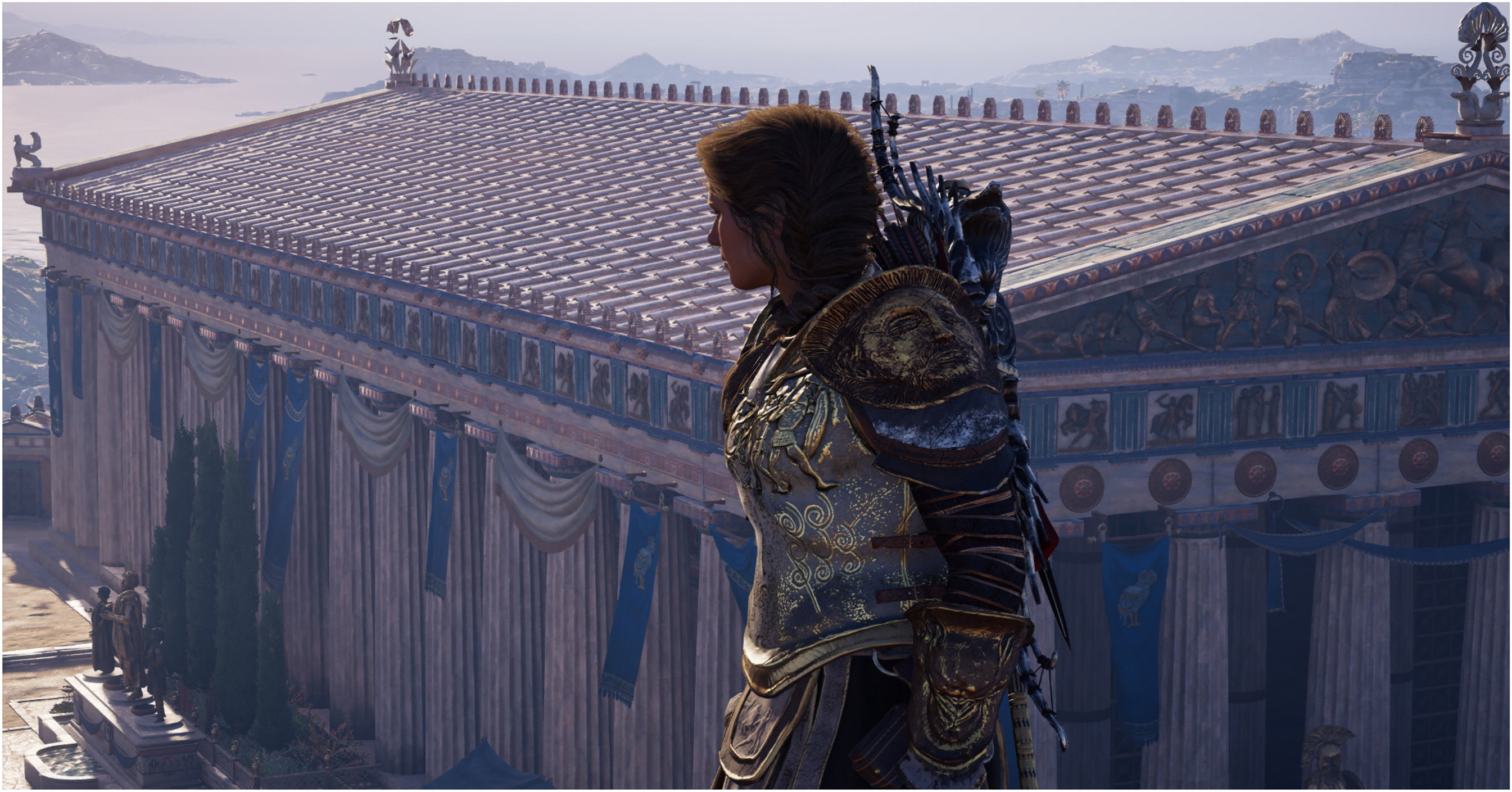
The protagonist on the Acropolis (Assassin’s Creed Odyssey, 2018). Screenshot by author.
By aligning different elements of cultural heritage, mashups can draw attention to the ‘friction’ (Cook, 2013, p. 57) between competing traditions. This is exemplified by the ‘hints’ on the loading screens. Some recommend benchmarking the game or suggest how to generate resources. Others highlight facts about the ancient world. The latter have been collected and analysed for their historical acumen (Brouwers, 2018). Such attention is hardly surprising considering how effectively the game establishes ‘atmospheres of the past’ and evokes feelings of ‘authenticity’ (Zimmermann, 2021; see also Lorber & Zimmermann, 2020). Take, for example, the hint that draws attention to the game's use of polychromy (Figure 2). ‘Ancient Greece’, the player is told, ‘was more colourful than the white marble we see today. Temples and sculptures were painted with organic, mineral, and metallic pigments’. This colour is then supplied by the game engine, imparting urban spaces with a brilliance that demands and rewards the exploration available. The hint, however, also raises important questions, since some statues are left in their iconic white form. As Voigts (2017, p. 292) argues about digital memes, ‘the transgressions of cultural recombination force audiences to re-examine existing norms’, which in this case requires a mashup that draws in what players expect, namely white statues, and also, following academic debate and popular exhibitions, antiquity in colour (Panzanelli et al., 2008; Rollinger, 2020, p. 38), thus opening a dialogue between received imaginings of antiquity. Such ‘hints’ present a technical mashup, in that they augment the loading screen. The augmentation is informative, but also acts as a call to action. The benchmark hints encourage players to check their framerate, CPU, and GPU stats against optimum settings. The same process is arguably in effect with the historiographical tips, which encourage players to test their understanding of antiquity during their playthrough. As with the technical mashup in the prologue and the superimposition of achievements, the loading screen hints administer a mashup that ‘trains’ players to make use of historiographical tips as they would system-related/gaming ones. Depending on how receptive players are to such historical clues, the game offers them a chance to achieve a greater fidelity of simulation, a deeper understanding of the gameworld and its appropriation of cultural heritage.
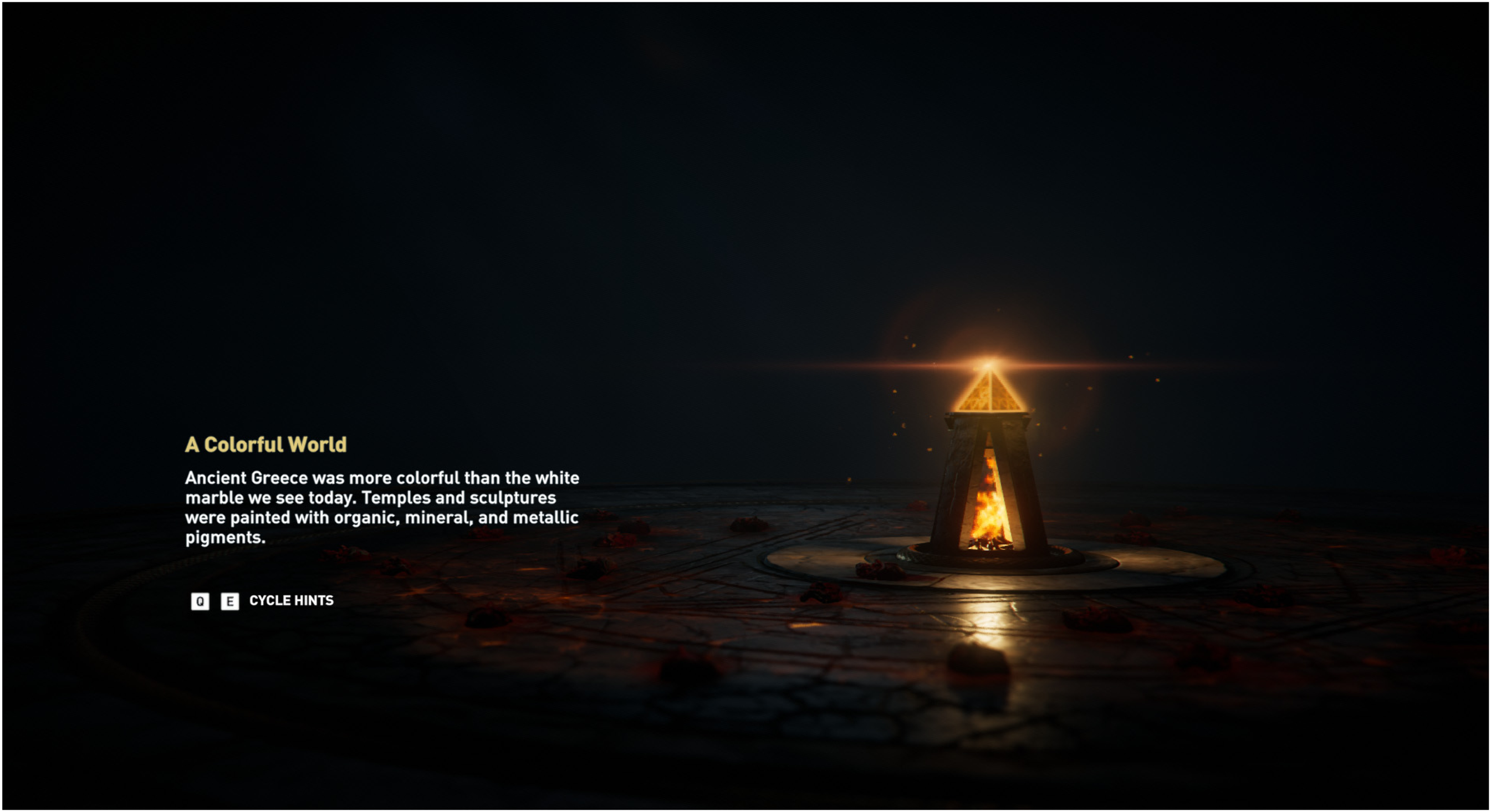
Loading screen (Assassin’s Creed Odyssey, 2018). Screenshot by author.
The technocultural mashups in effect on the loading screens find their logical outcome in ACO's Discovery Mode, which allows players to take a non-combative, pedagogical tour of ancient Greek sites and daily life. In Discovery Mode, ACO sheds its RPG heritage to create what Spring (2015, p. 218) has called a ‘scholarly game’, capable of ‘translating historical scholarship that meets the standards of the discipline into game play‘. While still recognizably the world of ACO, the Discovery Mode merges archaeological research, museum exhibitions, and scholarship with gameplay exploration and customization to present ‘a form of virtual heritage tourism’ (Politopoulos et al., 2019, p. 319). This has the added effect of ‘blurring the differences between history, games, and heritage’ (Rollinger, 2020, p. 39). The point of mashups, as we saw with Honest Trailers, is to reveal something through comparison. This type of technocultural mashup means that, in the words of Garst (2019), ACO can sustain ‘a time-travelling subconscious’ along with a reconstruction that can be ‘held to the same standard’, as scholarship.
The final example I want to look at is the game map. ACO's map offers multiple ways to interact with its wine-dark visualization of the Mediterranean. The map can be embellished with various icons that can be toggled at whim. One such icon identifies ‘historical locations’ (Figure 3). Maps have always held a privileged function in terms of signifying the real (Wake, 2016). Technical mashups, like Google Maps, encourage users to associate virtual space ever more closely with the real through satellite imagery, street views and the ability to locate businesses. The technical mashup that underpins the game map enables players to personalize their encounter with historical space. Identified by an icon in the shape of an eye, the ‘historical locations’ feature sanctions an objective gaze that cuts through the fantasy elements on display (such as certain locations), as well as the digital layers simulating space and time, revealing how the game has spliced history/heritage. The player is endowed with a god's eye view of these mashups, while also being able to ‘dive into’ and further transform them.
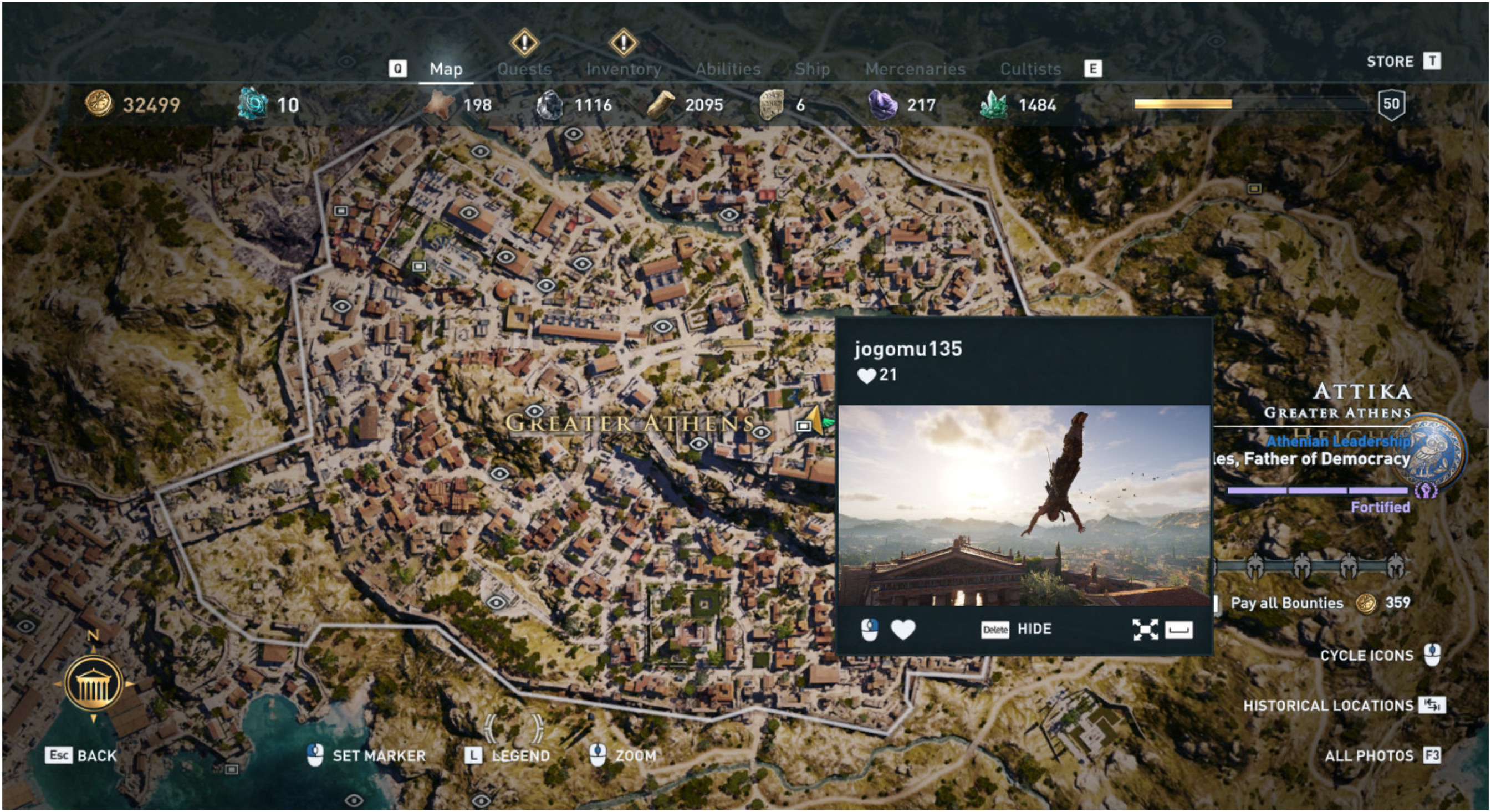
In-game map (Assassin’s Creed Odyssey, 2018). Screenshot by author.
Such mashups, in the words of Murray (2018, p. 196), ‘bracket and domesticate the historical into a particular understanding and then … invoke intervention via the medium's interactivity’. For example, players can ignore the presence of historical locations by turning them off. Equally, they can capture and ‘upload’ images of these locations and share them via the map with other players using an in-game camera (Figure 3), thus contributing to, while also updating, the game's use of mashup. Sontag (2008, p. 22) identified how the photographic image can be both ‘discontinuous’ and ‘adjacent’. The snaps taken by players demonstrate this in action. Shots of the protagonist riding fantastical mounts in front of Classical buildings interrupt the game's realist tradition. At the same time, they create a powerful contiguity between the experiences shared by players, reinforcing the idea of technocultural mashups as a playful means of engaging with cultural heritage, and indeed with history (Lünen et al., 2020).
Player generated mashups are not insignificant. Within a year of launching, over 43 million photos had been shared (Ubisoft, 2019). The trailer for the photo mode (Ubisoft, 2018) puts things into context: ‘What you leave behind in this world is not … engrained in stone monuments but what is woven into the lives of others’, a comment directed not only at players’ diegetic choices, but also the artefacts created through the photo mode. Here, the experience and production of cultural heritage is mediated in real time through a collage of player documented experiences, which are interleaved with other playthroughs by the technical mashup of the game map. In Calvino's Invisible Cities (1997), Marco Polo describes fantastic and improbable places to the emperor Kublai Khan. One of them, Eudoxia, contains a map-like carpet of the city. Calvino explores how this ‘map’, which does not, and cannot look like Eudoxia, being two-dimensional, manages to show its true nature. The paradox of the map is that in capturing the city from above, frozen in a single moment, it describes the relationship between its constituent parts, something much harder to experience in the city itself when faced with its perpetual motion and distractions. The photo mode of ACO similarly captures the configuration of the networked historical imaginary that video games enable; that is, cultural mashups engendering further cultural mashups via new media that seemingly enable players to ‘participate in history, or even to (re)enact it’ (Rollinger, 2020, p. 39).
Conclusion
The breadth of material used to create ACO necessarily makes mashups the most effective means of presenting it, not only technically, in terms of cutting down the number of spaces, characters, and ideas to be rendered, with repeat patterns found throughout the gameworld (Politopoulos et al., 2019), but also in terms of charting new, collaborative endeavours that turn inside out the relationship between Classical materials and their reception. The Honest Trailer puts it another way, stating the game has been ‘stuffed like a foie gras goose’. The narrator does, however, point out that a lot of people want their games like this, and that he has to ‘respect’ that. Mashups are, according to Cook (2013:, p. 57), ‘a paradigm case of different elements being deployed … in multimedia style, through continuous collisions or negotiations among heterogeneous elements, giving rise to meanings that are emergent, unpredictable, and frequently ineffable’. Further study, likely in the form of a video game ethnography (Beavers, 2020), is necessary to fully understand the impact of technocultural mashups. What I have shown is that ACO engages in this practice at various levels, flattening elements of Greek history, architecture, archaeological reconstruction, myth, oral storytelling, ideology and reception, licencing them to exist in the same space. This flattening, however, does not do away with difference. As Booth (2012) writes, mashup culture ‘enables, rather than inhibits, the production of meaning through temporal fluidity’, and that ‘when different tastes mingle, new ideas form and vast differences can be bridged’. Technocultural mashups do not to reduce the ancient world to its source material or any one interpretation but rather combine material to form an original experience. With players having gone on to use ACO's Story Creator Mode to generate/share over 17,000 original quests, this experience is clearly inspirational.
Booth (2012) describes mashups as ‘an amalgam of different tastes, different temporalities, and different genres, all productively synthesized into a larger cultural metaphor’. When it comes to history and heritage, we can think about the effects of mashups in historical video games by turning to the narrative set-up of the Assassin's Creed franchise, which takes place on two levels. On one level, modern-day characters are ‘transported’ back to historical periods (the other level) through technology fuelled by artefacts and bloodlines. The game empowers players to jump in and out of these diegetic levels, to reflect on the mashup of past, present, and future by drawing attention (both visually, narratologically and in dialogue options) to the fact the player is experiencing a simulation of a simulation that purports to offer time travel. These metareferential moments point to the way in which technology enables complex cultural mashups, as well as how we might understand these mashups. As the example of ACO demonstrates, technocultural mashups offer the chance to ‘relive’ the past through new media, to experience events and see historical figures in their ‘original’ setting, all while reflecting on the fragmented and preferential nature of cultural heritage. At the same time, players are copying the underlining mashup structure of such games by sharing their immersive experiences of - and creative approaches to - history and heritage in real time with other players, and are thus engaged in the production of a networked historical imaginary powered by technocultural mashups.
Footnotes
Declaration of Conflicting Interests
The author(s) declared no potential conflicts of interest with respect to the research, authorship and/or publication of this article.
Funding
The author(s) received no financial support for the research, authorship and/or publication of this article.
