



Abstract
Interaction with non-player characters (NPCs) that simulates one-sided social interaction is a common feature of many role-playing video games (RPGs). This kind of interaction may be described as parasocial. Parasocial phenomena have been identified across media, but there are few studies which detail how they function within specific video games. This article marries close analysis of the video game Undertale with theories of parasocial phenomena to examine how effective parasocial relationships (PSRs) are created with its cast of quirky, loveable monsters. The article uses players’ reception of the game in the form of Steam reviews and Let’s play content to evidence players’ attachments to NPCs and uses the concept of parasociality coupled with close reading to explore why. The paper concludes by considering what insights analysis of PSRs in video games can provide regarding both our relationships with the technology that facilitates them, and our off-screen relationships.
Introduction
Interest in the application of frameworks of parasocial interaction (PSI) to video game characters has been steadily increasing as character design becomes more nuanced (as detailed in Elvery, 2022). Although there are papers dedicated to considering whether the theory is applicable to video games in general, there is a notable lack of studies that apply this concept to specific games and analyse how PSIs are created in relation to certain characters. This paper first conducts a literature review detailing theories of parasocial phenomena, before applying the techniques detailed to the popular game Undertale (Fox, 2015). Undertale has been chosen not only due to its success (96% of the 108,784 reviews on its Steam page are ‘Overwhelmingly Positive’ at time of writing), but also due to the reputation of its fanbase who form parasocial relationships (PSRs) with the game’s cast of loveable monsters – the fame/infamy of which is detailed in Spencer’s 2017 article and Super Eyepatch Wolf’s (2020) video. Individual player responses also speak to this: when sorted by ‘Most Helpful’, Undertale’s top Steam review, as of January 2022, states: ‘for the first time in my life, I felt like I had friends’ (Toph, 2022). This paper utilises such Steam reviews and Let’s Play content (gameplay footage with commentary), as well as academic articles, to support its claims. I chose to use videos by creator jacksepticeye as, with 27.9 million subscribers, he is one of the biggest Let’s Play YouTube creators and his content was broadly accepted by the fandom and noted for contributing to the game’s popularity (Spencer, 2017), which points to a consensus regarding his delivery of, and reactions to, the game. The Steam reviews selected were among those voted ‘most helpful’ when reviews were sorted by ‘all time’, or at the top at the time of writing. As well as applying theories of PSI to the video game, this paper also draws upon theories of Fantasy and Gothic Literature, which are used to facilitate close reading of its monsters. This approach narrows the focus of the analysis from the application of parasocial theories in general, to how the narrative and form of Undertale creates the conditions for PSI to be deeply affecting. This paper also posits that, when done well, PSRs with non-player characters (hereafter NPCs) can be as varied and complex as social relationships and provides analysis of both ‘healthy’ and ‘unhealthy’ forms of parasocial behaviour to consider what these can teach us about social dynamics.
Undertale, Subversion and Parasocial Phenomena
Undertale is a single player role-playing video game (RPG) created by Fox, an indie developer, who drew influences from Japanese games such as Mother 2 (1994), a game later released to Western markets as EarthBound (1995) and Moon: Remix RPG Adventure (1997) that received an English translation in 2020. The player controls a human who falls into the Underground realm of monsters and must battle or befriend them to reach the surface. The tutorial is set in the ruins, where the player meets a flower monster called Flowey, who attacks them. They are saved by Queen Toriel (short for tutorial), who teaches the player about the Underground. Toriel wants to adopt the human, as she mourns the loss of her son Asriel and her adopted child Chara (the first fallen human) who died. This tragedy led to her separation from her husband King Asgore, who guards the barrier between worlds until he collects enough human souls to open the door to the human world. The player must complete the tutorial by killing or sparing Toriel, then journey through the Underground choosing to battle, or spare, the monsters. The three main playstyles are neutral (the player kills some, but not all monsters), pacifist (all monsters are spared) and genocide (all monsters are eliminated). The player does not choose or create a character at the start of their game: their actions determine who their character becomes. In a neutral/pacifist run, the player controls Frisk – a human who befriends monsters – and during a genocide run they control Chara – a malevolent entity who destroys them. The status of the monsters in the Underground depends upon player choices: if players focus on combat, gameplay conforms to stereotypical generic RPG mechanics, whereas if players befriend monsters, these mechanics are subverted – combat becomes a form of PSI.
Parasocial Phenomena
Undertale offers a form of mediated sociality that draws upon techniques utilised in older media to offer an affective parasocial experience. Parasocial relationships, composed of PSIs, are concepts utilised in cross-disciplinary media studies, notably Television Studies, Psychology and Game Studies. The development of the concept and its application to Game Studies is also briefly outlined by Elvery (2022), the research for which formed the foundation of the below analysis. The term ‘parasocial interaction’ was coined by Horton and Wohl (1956), who define PSI as one-sided social engagement mediated via a mass media figure (such as a television personality) that elicits feelings of intimacy from the viewer akin to the experience of a ‘face-to-face relationship between spectator and performer’ (p. 215). This ‘one-sided’ (p. 215) form of interaction shares similarities with social relationships, such as how first impressions are formed upon initial viewing, and a feeling of familiarity that builds due to an ‘accumulation of shared past experiences’, that creates a feeling of a history with the performer for the viewer (p. 216). This is coupled with techniques designed to invite intimacy including conversational delivery in an informal atmosphere, and phrasing that creates the impression that personas are ‘responding to and sustaining the contributions of an invisible interlocutor’ (Horton and Wohl, p. 217). As Liebers and Schramm (2019) identify in their literature review on PSI, Rosengren and Windahl (1972) revived the concept, which was further developed by Rubin, Perse and Powell (1985) whose 10-item scale is the most widely applied tool of measurement. Further development on such scales continues, as detailed in Auter and Palmgreen’s (2000) work, in which a summary of prior scales can be found.
The term ‘parasocial phenomena’ (p. 4) (PSP) was coined by Liebers and Schramm as shorthand for a broad spectrum of PSI and PSR to encompass all parasocial activities. They differentiate between PSI and PSR, using the term PSI to define interactions with the media figure taking place during media consumption, and PSRs to describe PSP moving beyond media consumption, which ‘encompasses cross situational relationships between the audience and media characters’ (p. 5). Parasocial interactions, then, are fleeting encounters that, over time, comprise the PSR – a lasting affective impression left upon the viewer, carried with them in the media figure’s absence.
Giles (2002) distinguishes between types of figures that facilitate PSI and PSR, creating three categories situated on a continuum from social to parasocial. At the social side of the spectrum lies ‘first-order PSI’ (p. 249), which describes media figures such as talk show hosts that project a persona that feels familiar. Viewers could plausibly meet these figures face-to-face – social interaction and its consequences are possible. ‘Second-order PSI’ refers to representations of fictional characters played by actors – social interaction with actors is possible, but not with the character. Purely PSI lies with ‘third-order PSI’, that consists of ‘fantasy or cartoon figures who have no real-life counterpart’ (p. 294). This article investigates third-order PSI with NPCs in video games. Whilst making use of these definitions, this article diverges from Giles’ assertion that ‘the interaction becomes weaker according to the authenticity or realism of the representation of the person’ (p 294), arguing that third-order PSI can facilitate high levels of affective engagement, making interactions with the on-screen persona feel social. This paper responds to both Giles’ and Liebersand Schramm’s work that highlights the need for investigations of PSP across different types of media by using the concept as a tool for the analysis of video games.
Research applying PSP to video games and technology is varied. An early study by Nass and Moon (2000) investigates the application of social rules and expectations to computers. Later research covers topics such as the interaction between PSI and identification (Klimmt, Hefner & Vorderer, 2009) and its applicability to player-avatar interactions (Banks and Bowman, 2013; Chung, deBuys & Nam, 2007; Jin and Park, 2009; Loyer, 2015). Notable advancements regarding PSP’s applicability to digital media include work by Hartmann (2008) and Kavli (2012). Hartmann argues that the PSP facilitated by digital media is more complex than the mass media Horton and Wohl describe due to its interactivity which contrasts with the simplicity and unilateral nature of PSP with mass media figures (p. 186). Kavli disagrees, arguing that player-NPC interaction is less removed from Horton and Wohl’s theorisation of PSI than Hartmann suggests, noting that, in most games, although players ‘may get the impression that the conversation involves [them] and the digital persona, the persona can only follow the static dialogue tree defined by a programmer’ (p. 86). However, Kavli argues this does not diminish the effect of PSR, observing that ‘some game characters succeed in establishing a relationship with a player that is so deep and heartfelt that the player wishes to break the boundaries between the digital and physical world in order to pursue the relationship’ (p. 86). Interactions must feel realistic, rather than be so; the number of ways a player can interact with a character is less important than how believable they are. Hartmann states character believability depends on whether users ‘attribute a general intelligence and self-determination (i.e. an “intentional stance”)’, which, according to Hartmann, is even more important than how the character looks (p. 189). This of particular importance when considering NPCs with an abstract or cartoonish design, such as in Undertale. Even if, as Kavli argues, the conversation is technically one-sided, video games that offer interactions which feel realistic as interactions simulate greater reciprocity than PSI with a film or television character as the responses of NPCs in video games like Undertale adjust according to the player’s actions.
Throughout the reviewed literature, it is broadly agreed that PSP with fictional characters can serve as an extension of, and supplement for, healthy social interaction. Giles’ model ‘presents PSI as an extension of normal social activity by considering shared and different qualities of social and parasocial encounters’ (p. 298). Jarzyna (2020) has proposed that platforms such as Netflix and social media paired with the COVID-19 pandemic has resulted in PSI serving as ‘social surrogacy’ (p. 1), in which PSI is being used as a means to decrease the deficit in social needs and supplement real relationships by ‘filling social needs and decreasing loneliness’ (p. 1); and Cohen (2014) states that relationships with fictional characters are ‘meaningful to us and in that sense they are very real’ (p. 142). There is also research which suggests that ‘through parasocial relationships, people with low self-esteem can gain some of the benefits of real relationships without the fear of rejection’ (Derrick, Gabriel & Tippin, 2008, p. 278). Parasocial relationship with NPCs is not a replacement for social interaction, but can offer an alternative way to gain some of its benefits.
Monster Symbolism in RPGs
Monsters are a common fixture of RPGs, but deploying them for PSI is not their traditional use. Undertale subverts monstrous symbolism and RPG conventions to change the role of the monster from enemy to desirable companion who can facilitate PSP. At first, the game appears to conform to pre-established norms of form and genre, which, as Youngblood (2018) identifies in his paper on Undertale and critical literacy, works when the player has an ‘already-established gaming literacy’ regarding conventional RPGs (p. 162). In traditional digital RPGs, such as Baldur’s Gate (1998) (influenced by tabletop game Dungeons and Dragons (1974)), players journey through maps to complete quests, encountering friendly NPCs who serve as props or contribute to the player’s progression by providing information, items or plot development. They are also likely to encounter hostile NPCs, sometimes in the form of humans (such as bandits) and often in the form of monsters (such as orcs and kobolds). Conventional RPGs possess both unique and duplicate enemies. Fights with unique enemies, often referred to as boss fights, generally have narrative significance and/or present an increased challenge to the player. These encounters make up the minority of battles in more traditional RPGs, such as Baldur’s Gate, and the majority of the hostile NPCs the player encounters are generic, often unnamed monsters deployed in duplicate. In Baldur’s Gate, the player encounters monsters such as spiders, who do little more than attack the player. Clearing an area of monsters makes the maps safer and easier to navigate and yields rewards such as loot and experience points (EXP). In most cases there are no emotional stakes involved in dispatching such enemies: they exist for the purpose of adding challenge; as game studies scholar Švelch (2018) states, ‘role-playing games trivialise the unknown, the mythical and the monstrous and turn it into neat tables of cookie cutter monsters; into pests that need to be cleared’ (p. 10). In such games, minor monsters are treated as a renewable resource, allowing the player to repeat the process of eliminating them to gain EXP, making the player more powerful by increasing their level (LV) – a process colloquially referred to as ‘grinding’. Depending on the player’s actions, the threat level of an NPC can change, and some can be placated without violence by using magic, but this is not a normalised mode of interaction – even creature collection games such as those in the Pokémon franchise, which allow for PSRs, often constitute some form of combat and domination via which this relationship is expressed.
Monster Symbolism in Undertale
In Undertale the monsters that trigger combat encounters can be befriended or eliminated. Undertale has a similar encounter structure to conventional RPGs; however, its subversion of this structure affords each encounter, with both unique and duplicate enemies, greater significance. There are three main types of enemy in Undertale, ranging from low difficulty monsters that spawn in duplicate, unique mini-bosses who pose a moderate challenge, and unique boss characters who are the most challenging foes in the game. Showing mercy enables further interaction with the monsters, allowing for the development of PSR with bosses, and conversation with mini-bosses who can be found at ‘Grillbys’ (Figure 1) after fighting them. This subverts standard RPG conventions: rather than monsters being obstacles to overcome, it is rather the player who intrudes on the Underground and disrupts the monsters’ lives. If the monsters are dispatched, they provide EXP to the player which increases their LV and makes them stronger, similar to conventional RPGs. However, this dynamic is problematised by the reveal that here ‘EXP’ stands for ‘execution points’ which increase the player’s ‘level of violence’ (LV), drawing attention to the moral cost of combat in a way many RPGs do not. This frames violence as a choice with consequences, rather than naturalising it. Grillby’s bar. Undertale. Screenshot by the author.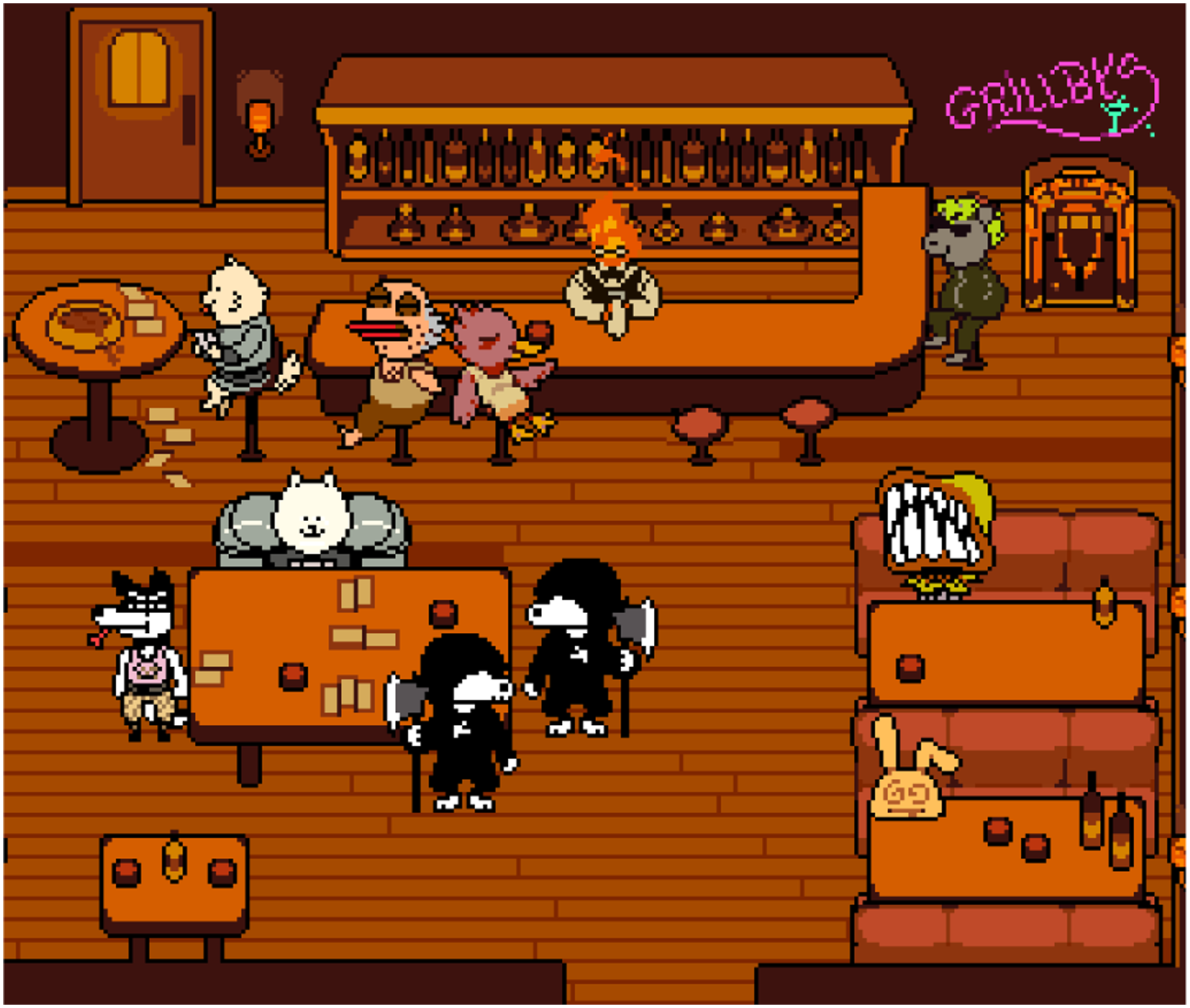
The choice between peace and violence would hold little weight if not for the emotional bonds formed with the game’s cast of monsters which subvert the standard conventions of hostile NPCs. Carroll (1990), a film scholar and philosopher, outlines the different ways the monsters can be defined in relation to viewer response; this formulation helps elucidate how Undertale subverts the conventional notion of the monstrous when defined against it. According to Carroll, monsters can be classified by how ‘characters of these different respective genres react to them’ (p 54), a response which he argues has a ‘mirroring-effect’ (p. 18) wherein the audience responses are parallel to those of the human characters’ in the story (p. 19). Two of Carroll’s monster types are pertinent in relation to the analysis of Undertale. Fairytale monsters can be threatening but are viewed by human characters as ‘part and parcel of nature’ in their world (p. 54) whereas arthorror monsters are both ‘threatening and impure’ (p. 28). Such monsters are regarded by the humans in their narratives ‘as abnormal [and] as disturbances of the natural order’ (p. 16) and provoke ‘threat and disgust’ (p. 28) due to their status as ‘classificatory misfits’ (p. 191). The idea of monsters as a conceptual misfits is influenced by the work of Fantasy theorist Jackson (1981), who claims that Fantasy is interested in uncovering ‘an absence of separating distinctions’ and the dissolving of ‘limiting categories’ (p. 48). Carroll agrees that horrific monsters ‘problematize standing cultural categories in terms of interstitiality, recombinative fusions of discrete categorical types, and so on’ (p. 176.). Unlike Jackson, who argues Fantasy ‘attempts to create a space for discourse other than a conscious one’ (p 62), Carroll does not conceptualise Fantasy as that which has been repressed but rather as ‘possibilities that are generally unnoticed, ignored, unacknowledged, and so forth’ (p. 176) much like literary scholar Cohen who describes monsters as the embodiment of human knowledge which has been ‘hidden away at the edges of the world and in the forbidden recesses of our mind’ (1996, p. 20). Thinking about monsters in this manner conceptualises them as representing issues that people do not want to address.
Undertale’s narrative largely conforms to these aforementioned theories, reconceptualising the monstrous throughout the routes through the game. The monsters of Undertale have been hidden away; they lived on the surface as fairy tale monsters, until the humans declared war, emerged victorious and trapped them in the Underground. The Ancient Glyphs in the location Waterfall state that humans attacked the monsters because they felt threatened by the monsters’ capability to absorb human souls and become ‘a horrible beast with unfathomable power’ (Fox, 2015). This dissolution of boundaries, and the threat it entails, changes the category of the monsters from fairy tale to arthorror – their existence is deemed incompatible with humanity. It is the humans’ banishment of the monsters that categorises them as horrific, a concept which is consistent throughout the game. During the pacifist route, the player is threatened by monsters (who attack primarily to defend themselves). When players do not gain EXP, the monsters become increasingly threatening in battle as the disparity between their stats and those of the player’s increases, making fights more challenging. However, the player’s non-combative responses can neutralise the threat on both sides: choosing to befriend monsters reduces the number of hostile NPCs in the game. By contrast, during a genocide run – characterised by eliminating every monster – the player becomes increasingly threatening by accumulating execution points, raising their level of violence and strength. The player becomes ‘a horrible beast with unfathomable power’, a change reflected in the game. The character stops responding to humour, their internal dialogue becomes increasingly sinister (Figure 2) and at save points instead of the message ‘you are filled with determination’ a counter displays how many monsters are left to kill. As Youngblood observes, ‘the entire gameworld seems terrified of the player’s presence’ – the music becomes ‘distorted’ and all ‘normally friendly monsters that would speak to Frisk leave the game entirely’ (p. 164). The player’s actions make PSI impossible: the role of the player as human is problematized, demonstrating the fluidity of monstrosity as a category. Toriel’s Kitchen, Genocide Route. Undertale. Screenshot by the author.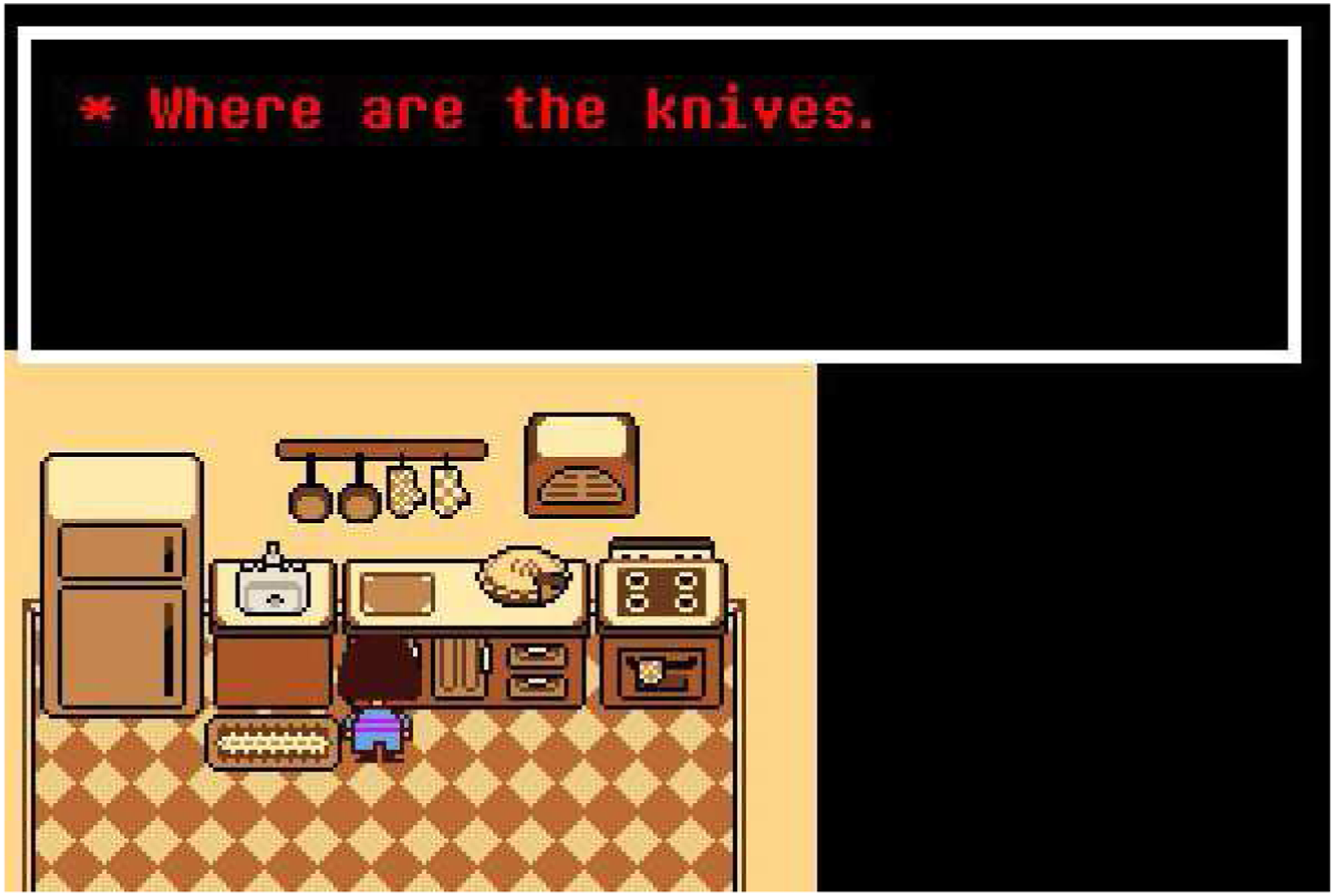
Extending Carroll’s definitions of monsters to Undertale explains why the choice between attacking the monsters and befriending them becomes impactful: players, by their actions, determine whether the monsters are experienced as a threat to be exterminated, or a natural part of the fictional universe. However, this is not the primary reason this decision is so affecting. Although the monsters in Undertale blur conceptual boundaries, what they articulate is more relatable than revelatory. Fox’s monsters do not express a deep, repressed truth as Jackson may suggest, nor induce the fear and disgust that Carroll’s arthorror elicits. Whilst the human player has the option of becoming threatening and fear-inducing, Fox’s ‘classificatory misfits’ are misfits in the colloquial sense of the word: they are dorky. Undertale’s monsters represent aspects of human nature and social interaction that are awkward and flawed in ways which are remarkably ordinary.
Undertale’s Loveable Monsters
When a new player begins Undertale without prior knowledge of spoilers, they may question why they should spare the monsters, due to their pre-established gaming literacy, as well as the EXP rewards which make killing the monsters the most immediately gratifying thing to do. As Mexi (2015) writes in their Steam review: Following the motto on the store page, ‘the game where you don't have to destroy anyone’, the game always tries to nudge you in that direction, taking a back seat in your mind and reminding you to ‘Spare them!’. And of course, you answer with ‘Why? Why should I do that when it offers me the option to kill anyone I want right in front of me? What's in it for me?’ And that's where the game literally turns into a personal experience, as everyone has a different response for the game's selling point. And boy, does it turn to black or white pretty fast from here.
Motivation to spare the monsters may stem from the desire to replay the game and experience all its content, but not all players choose to complete the genocide route. Part of the appeal of choosing the pacifist route by refusing to fight are the PSIs it facilitates. Fox’s monsters subvert established conventions of monstrosity by being both monstrous and extremely ordinary. Their quirky personalities, expressed via simple flavour text coupled with their cartoonish design, help negate the potential threat by transforming revulsion into recognition. As cartoonist McCloud (1994) observes in Understanding Comics, cartoonishly simple appearances allow ‘amplification through simplification’ (p. 30), increasing the ‘universality’ (p. 31) of the representations. The monsters in Undertale do not represent a mysterious, unknowable other, but one that is both approachable and recognisable. Even duplicate enemies have personality and character motivations. Whimsun, for example, is a monster ‘too sensitive to fight’ and is easily frightened and painfully apologetic; Woshua (Figure 3) is a ‘humble germophobe’ so obsessed with cleanliness that dirty jokes disgust them; and Loox is a monster who alternates between imploring the player not to ‘pick on him’ whilst picking on the player. Each monster provides commentary on, and representation for, everyday realities and inconveniences of human existence that often go unmentioned, including social anxiety, traits of obsessive-compulsive disorder and bullying. By giving monsters these characteristics and the player the option of sparing them, the game supposes these issues should be understood and accommodated, rather than ignored or eliminated. NPC Woshua and full combat menu. Undertale. Screenshot by the author.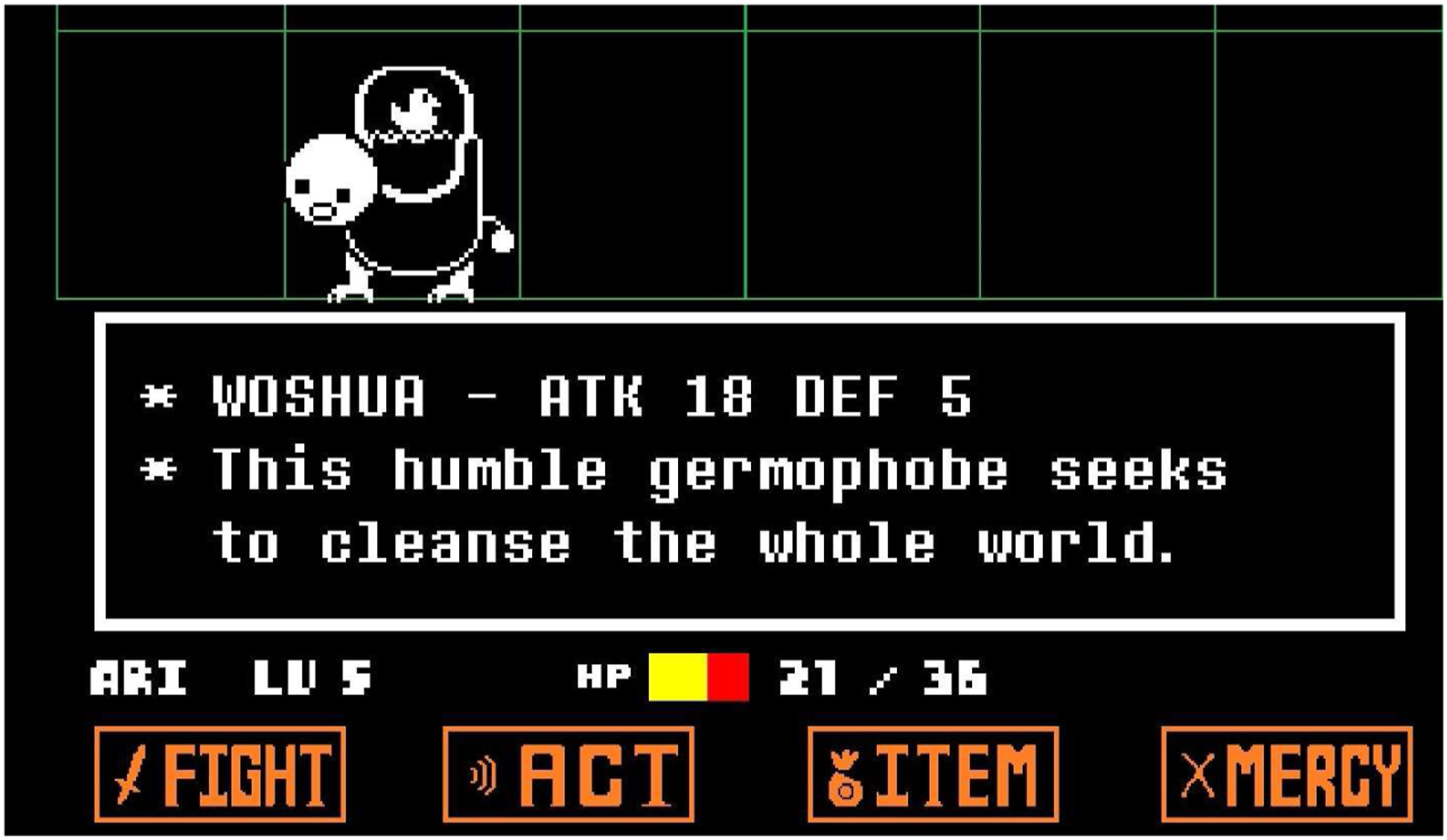
Such understanding is neither easy nor immediately gratifying. Interacting with the monsters is less straightforward than engaging in combat and, as with social situations, the correct way to communicate is not always immediately obvious, requiring the participant to learn from their mistakes. Actions that seem innocuous to the player may not be received as such: combat averse Whimsum can be spared from the start of the encounter and will hyperventilate if terrorised, but will run away if consoled; Woshua can be spared if the player allows themselves to be washed by them and will attack the player if they attempt to touch them before doing so; picking on Loox awards the player extra EXP but invites more intense attacks from the monster, who can only be spared if the player chooses not to pick on them. To spare the monsters without the aid of external guides, the player must carefully consider which action will best accommodate the monsters’ differences. These exchanges facilitate an experience of PSI via their appearance of reciprocity, with both parties’ responses to the other adapting to the situation. As Youngblood observes, playing the pacifist route can be challenging because as well as denying the player the opportunity of levelling up to increase their durability, the game requires they pay attention: pacifist players ‘must come to “master” ways of thinking about empathy, [and] community building’, whilst the game ‘reinforces through its playable systems that such a process can be hard - even enough to almost cause the player/individual to quit’ (p. 163). Rather than yielding gains in power or granting the player a feeling of mastery for dispatching an enemy, showing mercy to monsters may make the player feel somewhat inadequate until they have spent the requisite time getting to know the characters. Encounters with duplicate monsters, which can be classified as a form of PSI, do not allow for the development of PSR as the relationship does not develop, but is contained within each individual encounter which forms a part of the player’s experiences of the Underground as a community. It should be noted that even when PSR with certain characters is not included in the game’s narrative, such PSR can occur outwith the game due to fan engagement (see Super Eyepatch Wolf’s (2020) video for an overview of Undertale’s prolific fandom).
Beyond PSRs?
Encounters with boss monsters form the most impactful affective experiences, converting PSI into PSR. The interactions the game offers with its main cast move beyond PSI by creating an experience that feels reciprocal: unlike TV personalities, characters in the game are programmed to respond to the player’s actions and the changes in the world state, which makes them seem more lifelike and gives the player’s actions consequences. This is further intensified by the game’s performance of sentience via the inclusion of characters who have a meta-awareness of the game as a game, meaning ‘the weight of a dark choice is huge. Nothing can be taken back, and it forever changes your playthrough. Reset the game, and the characters know. Events change’ (Mexi, 2015). Characters who perform meta-awareness are Sans and Flowey, whose relationship with the player changes depending on which route is played. Sans and Flowey are the inverse of each other: the player’s PSR with Sans is characteristic of more conventional, healthy friendships and their PSR with Flowey is based on power, control and uncertainty.
Sans the skeleton is an important citizen of the Underground: he is a devoted brother to Papyrus and popular with other monsters. His dialogue, often punny, is written in his namesake Comic Sans font, which has a soft aesthetic, and is accompanied by a sound effect reminiscent of a low chuckle, that functions as his voice. Sans follows the player throughout the game because he promised Toriel that he would watch over them. Like the other monsters, Sans’ character is one of duality: he is endearingly ordinary, but functions as the main, most challenging antagonist during the genocide route. This duality is hinted at throughout, beginning with the player’s first impression of him which sets the tone for the developing PSR. The first meeting occurs when the player emerges from the ruins and into a wooded area. The woods have a sinister feel, which is commented on by Let’s Play creators, such as Jacksepticeye (2015a) who says: ‘this place is freaky’ (52:21). As the player moves through the forest, a shadow can be seen in the trees and a branch mysteriously breaks behind them. Not long after, the player approaches a bridge, and a cut scene begins – they are unable to move as a shadow slowly approaches from behind. The greeting text fills the box slowly across the silent screen. The shadow requests a handshake and when the player character accepts, a long, raspy fart breaks the tension. When Sans is revealed, the font changes and the animated character in the game world addresses Frisk, whilst his portrait faces the player, giving the impression of direct address (Figure 4). Sans. Undertale. Screenshots and annotations by the author.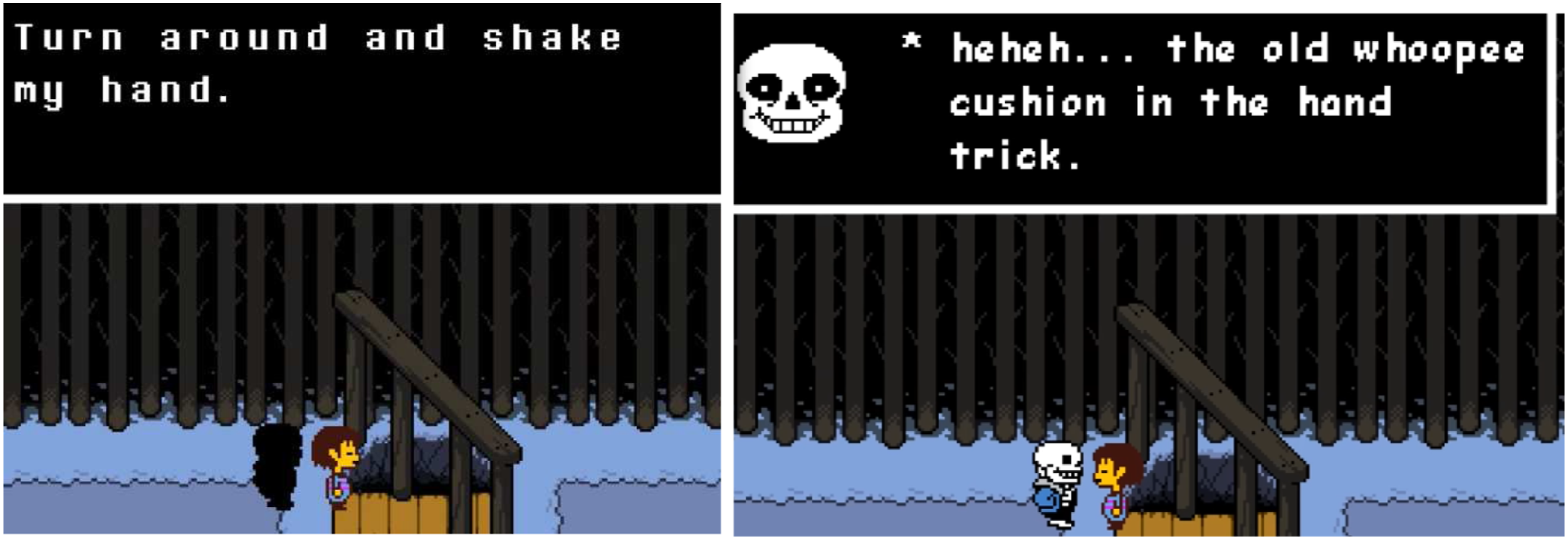
Repeated encounters with Sans build familiarity, facilitating PSR. Social interaction with Sans in neutral or pacifist runs has an easy, casual nature similar to friendship. During one encounter, Sans takes the player out to eat. Other NPCs greet Sans as he enters the bar, giving the impression that the skeleton is familiar to other monsters in the Underground, who hold a high opinion of him. The bartender also greets Sans, who notes the skeleton was only recently at the establishment for breakfast, suggesting he is a character who exists outside of his interactions with the player, making him feel more lifelike. Sans makes another fart joke, further creating familiarity which contributes to his history with the player. Sans asks the player whether they would like a burger or fries, allowing them to use an on-screen menu. Whilst waiting, Sans asks their opinion of his brother (who the player has encountered prior); this is both a discussion of the narrative events of the world and a subtle conversation about the game which implies the player’s opinion matters. Discussing others is a common social technique used to help ‘humans develop trusting relationships and foster social bonds’ (Stambor, 2006) – discussing NPCs with NPCs mirrors this, contributing to the lifelike feel of the PSR. After their order arrives, Sans and the player are lit by a spotlight and the tone becomes more serious. Sans asks the player to ‘keep an eye out’ to see whether someone is using echo flowers to play a prank on his brother. According to popular psychology citing the Benjamin Franklin effect (named after an anecdote in his autobiography ([1791] 1993)) and a study developed by Jecker and Landy (1969) which uses Festinger’s (1957) cognitive dissonance theory, doing someone a favour makes the giver more inclined to like the recipient to maintain the alignment between their thoughts and actions. Sans’ speech during this exchange further contributes to the realistic feel of the scene; for example, he says: ‘by the way, I was going to say something, but I forgot’ suggesting his dialogue is a thought process, including mistakes characteristic of spontaneous speech. Furthermore, interactions with Sans fortify a sense of familiarity with the player by acknowledging it – for example, at the telescope in Waterfall, Sans says to the player: ‘since I know you, you can use it for free’ before pranking them. This continuity and the characterisation of Sans as a part of the Underground’s social fabric positions him as a likeable, dependable character and strengthens the portrayal of the Underground as a community in which the player can feel included.
As well as being a part of the Underground community, Sans’ meta-awareness of the game differentiates him in a way that makes him appear more lifelike. Unlike more minor characters, who interact with Frisk, Sans reveals he knows about the player controlling them. When the player reaches their destination – King Asgore’s castle – they are greeted by Sans, who is obscured by shadow as he was during their first meeting (Figure 5). Like the first meeting, both Sans and the player character are silhouettes, but Sans’ font changes to a more sinister non-Comic Sans style while he explains the mechanics of the game. The player is judged according to their LV, which triggers a slightly different response dependent on how many monsters the player has killed; there are many different outcomes, but three main categories: pacifist, neutral and genocide. If the player chose not to kill, Sans states they ‘did the right thing’. If the player gained a neutral world state by killing, but not eliminating, every monster, Sans answers with various degrees of severity – killing one monster results in Sans accusing them of doing it to see what he would say about it and calls them ‘a gross person’, whereas if the player gets to LV three, Sans says that they could ‘do better’. Throughout many of the judgements, Sans hints that it is likely he and the player have conversed before, for example, at LV nine he suggests ‘chances are I’ve already tried to steer you in the right direction’ and asks the player what he can do to change their mind. If the player obtains LV 15 or higher, Sans accuses them of searching out monsters to kill them, which is likely. If a player activates a genocide run by killing enough monsters to trigger a kill cap, which stops them spawning, they must battle Sans who keeps track of how many times they fail. These meta interactions contribute to the realism of the PSR by addressing the player, creating the illusion of awareness. This emphasises that the player’s actions have consequences which transcend the save/load process and impact the world state, subverting the conventions of traditional RPGs, which allow reloading to change a decision. As CtrlAltDestroy (2015) comments in their review: ‘You […] need to live with whomever you decide to be, because the game won’t let you ignore what you have done’. The power acquired through gaining LV and EXP not only alters the state of a game that is not easily changed (except via a clean installation), but also comes with a moral judgement attached. Players are encouraged to weigh the benefits of power and the thrill of combat against the cost of their relationships with the inhabitants of the Underground. Sans’ Judgement. Undertale. Screenshot by the author.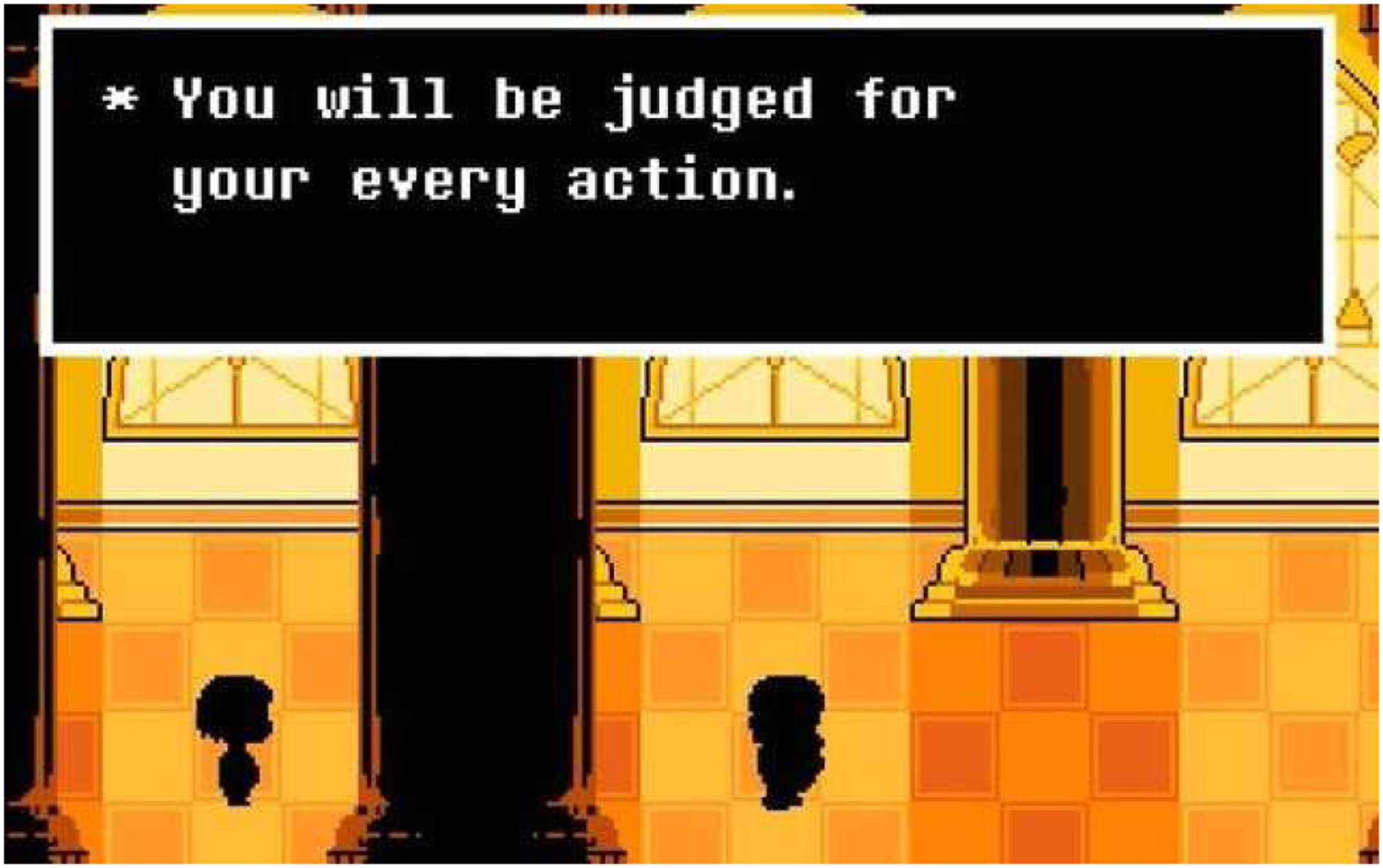
Much like social relationships, not all PSRs are positive, nor predicated on functional behaviours. Undertale’s other central PSR is with Flowey; this PSR is complicated and dysfunctional but offers the opportunity of a rewarding ending if the player navigates through the hardship it involves across multiple styles of playthrough. Flowey is the form that Asriel, son of Toriel, took after he died. Asriel went to the surface to lay his sibling’s body to rest and was attacked by humans. He managed to return to the Underground and was reincarnated as Flowey, an animate flower unable to feel emotion, desperately searching for it and longing for the friend he lost. The PSR with Flowey is one of power and control rather than friendship, and by choosing to engage in PSR with Flowey, the player forsakes all other PSI in the game by eliminating the monsters. Flowey and Sans are foils to each other. Sans seems threatening at first, his monstrous qualities signposted by his skeletal design and the shadows which sometimes obscure him, making him appear threatening. His sinister appearance, however, is undermined by the comical nature of his character and his behaviour only becomes dangerous should the character treat him, and the monsters, as a threat by using violence against them. His presence throughout the game acclimatises the player to him gradually and he becomes a reliable fixture who helps the player integrate into the Underground, encouraging them to participate in social interaction with other characters and act morally, which diverges from the usual ‘grind’ characteristic of more conventional RPGs. In contrast, Flowey’s harmless appearance conceals his monstrous status. Flowey encourages violence, attempting to isolate the player from other social contact and position himself as their sole support and source of understanding, persuading them to view other monsters as threats to be eliminated. Contrasting with Sans, Flowey’s instructions encourage the player to adopt a more conventional mindset towards gameplay; he describes how he has taken this approach himself, playing through the world and resetting it multiple times until growing bored. Rather than being found in predictable places in the Underground as Sans is, Flowey appears at seemingly random times, sometimes only for a matter of seconds, easily missed – as demonstrated by Serosaki’s (2016) YouTube video that records these brief and sporadic appearances, slowing the footage to make it easier for the viewer to see. Like Sans, Flowey displays meta-understanding of the game as a digital world influenced by the player, but uses it to guide the player towards making harmful decisions, starting from their first meeting when Flowey tells the player they must ‘kill or be killed’. The contrast between Sans and Flowey is further highlighted by their boss fights. During a neutral run, Flowey’s non-threatening façade changes into something alien and horrifying (Photoshop Flowey), whereas Sans remains the same. Although Sans appears sinister, he uses his power in the manner of a hero – to defend his world against a monstrous threat. Flowey, on the other hand, looks innocent but absorbs human souls and uses this power for violence. This subverts the idea of what it means to be a human or a monster, especially as human souls facilitate Flowey’s horrifying transformation. Flowey is contaminated by his experiences of humans and becomes a monster because of how humans (as a group) treated him, whereas Sans’ relationship to the player is determined by their actions. This subversion draws attention to the fragility of the human/monster binary and the idea that what defines a monster is a matter of perspective: behaviour can change depending how one is viewed and treated by others (Figure 6). Flowey, Sans' Boss Battle, Photoshop Flowey. Undertale. Screenshots by author.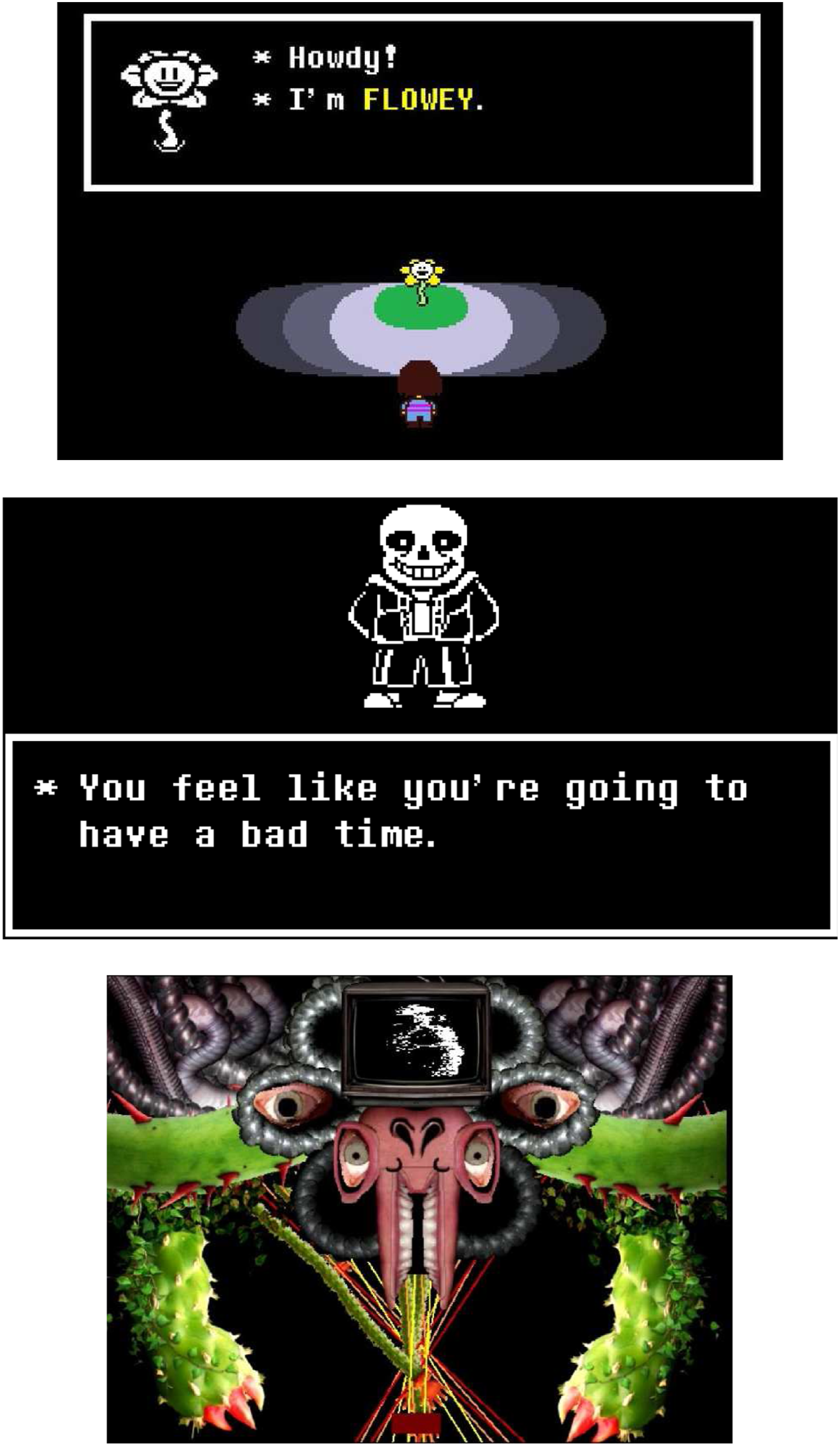
Similarly to Sans, PSR with Flowey is strengthened by the perception of a shared history. With Sans, this history is created with the player, during gameplay, taking place during social interactions which encourage community. In contrast, the majority of the player’s shared history with Flowey is something explained to the player, rather than including them. Unlike Sans’ direct address which establishes PSR with the player, Flowey’s efforts to establish a relationship are directed at the player character, Chara, their adopted sibling who ‘hated humanity’. Playing the game as directed by Flowey, coerces the player into fulfilling the role of Chara by materialising their violent impulses. This is intended to trap the player in the game so Flowey can spend time with their sibling. When the player encounters Flowey after killing Toriel in a genocide run, Flowey addresses them as Chara, exclaiming that they are ‘inseparable after all these years’. They make a plan to become ‘all powerful’ by killing every monster in the Underground, which, if carried out, culminates in the erasure of the world. Interaction with anyone but Flowey is replaced with violence and increasing amounts of solitude as the player eliminates monsters and wanders through a desolate version of the map. During a genocide run, the game has an entirely different tone. During his Let’s Play, notes that the main town is ‘not cheery anymore’ (41:25) and ‘the whole place is empty’ (44:11). Chara refuses to participate in social interaction with monsters, including playing along with their puzzles, and moves of their own volition in cut scenes, demonstrating that Chara’s agenda has subsumed the player’s agency. As the monsters are eliminated, the Underground becomes increasingly desolate, and the music changes to a distorted version of Flowey’s theme ‘Your Best Friend’. Before the completion of their plan, Chara kills Flowey without direction from the player. The mindset that Flowey helped create as a way to control the player is turned upon him: the ‘us versus them’ mentality may strengthen a dynamic temporarily, but once all other monsters are excluded, Flowey becomes its target. Thus, the PSR between the player and Flowey developed throughout a genocide run is proven to be unsustainable: it includes the player, but ultimately exists between Flowey and Chara. By participating in their toxic dynamic, which eventually leads to Flowey’s death, the player is denied the opportunity to learn about Flowey/Asriel’s backstory and misses much of the game. The PSR formed with Flowey during a genocide run demonstrates that, much like relationships, not all PSRs are healthy. Participating in toxic relationship dynamics in Undertale comes with instant gratification in the form of EXP and Flowey’s intense attention, which is comparable to ‘love bombing’, a term used in popular psychology to describe overwhelming the object of one’s desire with intense affection to establish control, rather than an equal and caring relationship (see Lamothe, 2019; Degges-White, 2018; Strutzenberg, Wiersma-Mosley, Jozkowski, & Becnel, 2017). Furthermore, Flowey is a persona, who coerces the player into playing the role of someone else, the role of Chara. The player, in a sense, surrenders their agency, allowing the game to play them – literalised by their avatar’s possession by Chara. This PSR is emblematic of how prior experiences, when unacknowledged, can lead to the repetition of harmful patterns and signals the dangers of unquestioningly adopting the roles assigned to us by others, including those roles we adopt and behaviours we enact during play.
If the player refuses to do as Flowey suggests and does not trigger the genocide route, they have the opportunity to get to know the character behind Flowey’s persona – Prince Asriel. To do so, the player must defeat the persona of Flowey (Photoshop Flowey, in a neutral run) and his other forms (the God of Hyperdeath and Final Form, in a pacifist run). These routes give the player the opportunity for the player to treat Asriel as a person, rather than a monster, and instead of fighting, help them work through their issues and establish a PSR based on understanding. During a neutral route playthrough, Flowey has a meta-awareness of the game, and manipulates the software to control the player. After the boss fight with King Asgore, if Asgore is spared, he is killed by Flowey, who crashes the game to punish them for refusing to play by his rules. If the player reloads the file, they are faced with a blank screen, then Flowey taunts them, telling them their save file ‘is gone forever’. Flowey then takes the form of Photoshop Flowey, who the player must battle to regain control of the ‘broken’ game by using the dislodged ‘Act’ buttons to call for help and heal (Figure 7). Winning this challenging battle is only made possible by the game rapidly saving itself, which allows the player to progress a little, even after dying. This performance of game breaking, before and during the battle, coupled with the more ‘realistic’ image of Photoshop Flowey, serves to instantiate the digital world of the Underground as a believably real space. The battle is framed as a struggle against a fantasy monster for control of software, which, to users, is symbolically ‘real’, blurring the boundaries between the fantasy world of the narrative and the reality of the technology which mediates it. Those who play without prior knowledge of these mechanics express confusion and concern their technology has broken, without realising it is intentional. For example, when the game crashes in jacksepticeye’s (2015b) Let’s Play, he asks: ‘What happened? Did the game close? The game crashed! Ok please tell me that was supposed to happen. It seemed like a very coincidental time for that to happen’ (17:11–17:29). The unexpected disruption of play via game breaking mechanics elides the fantasy world with the player’s reality, causing cognitive dissonance in which the capabilities of the software, performing malfunction, are temporarily forgotten. Performances of Game breaking. Undertale. Screenshots by author.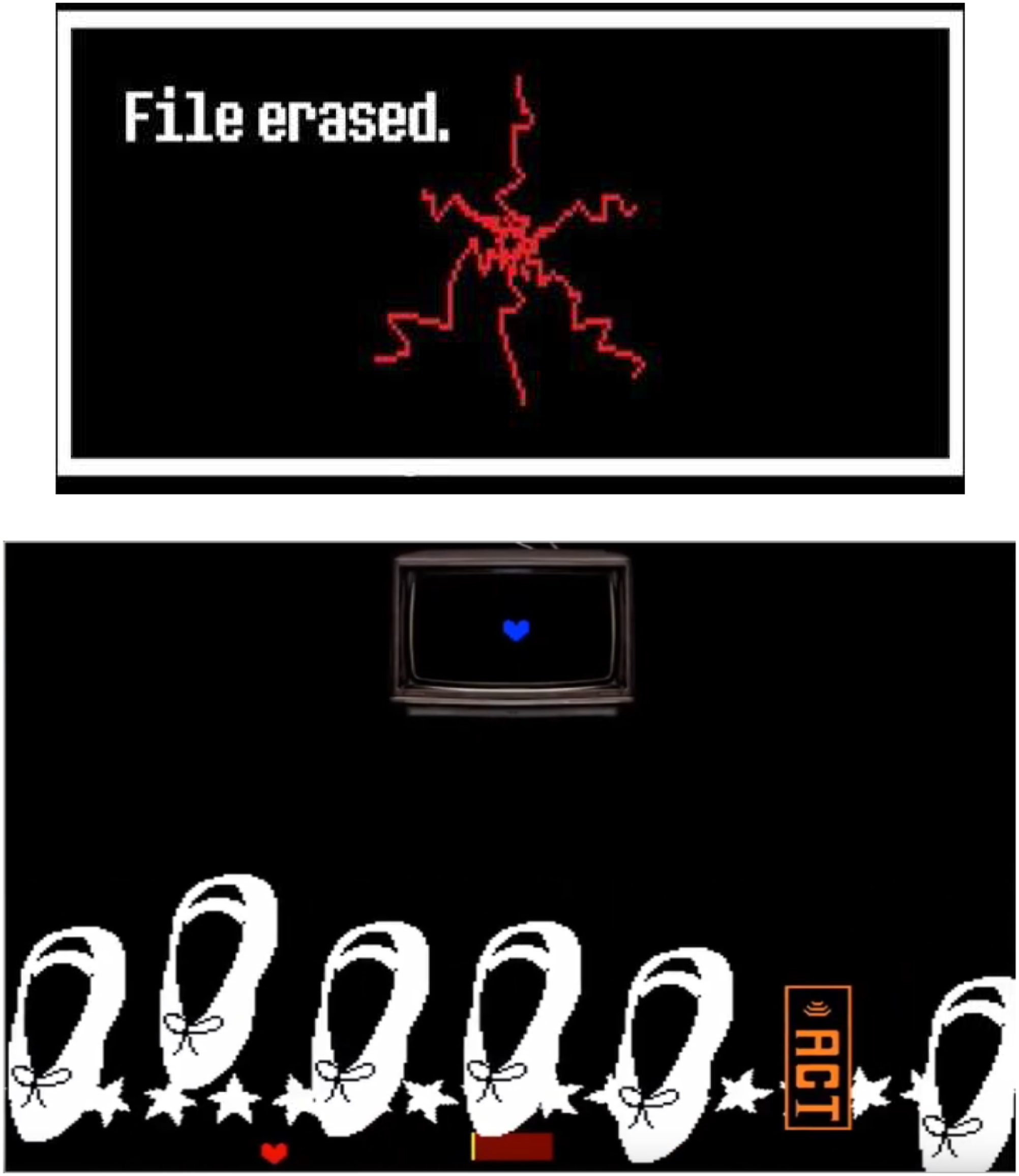
After the player completes a neutral run, they have the option of doing the requisite tasks to trigger a pacifist ending. After the ending sequence of the neutral run, Flowey appears, commenting on the unsatisfying nature of the ending: ‘If you really did everything the right way/why did things still end up like this?’. He then hints at how the player can improve things, suggests befriending NPCs and implies that he cares about the player’s happiness. Although Flowey seems encouraging at first, his true attitude is revealed by comments such as: ‘if you had just gone through without caring about anyone/you wouldn’t have to feel bad now’. The dissonance between the two attitudes demonstrates the gap between Flowey’s actions and intentions, highlighting the controlling dynamic of the PSR. After the player meets the conditions for a pacifist ending, their battle with Asgore is interrupted by the monsters the player made friends with. Flowey entraps them, revealing his plan to steal their souls to access his most powerful form to keep the player from beating the game, stating: ‘If you “win”, you won’t want to “play” with me anymore. And what would I do then?’ Flowey’s meta-awareness of the game contributes to the creation of PSR, as rather than being content to play his part in the narrative, he appears to realise his existence is contingent on the player’s interaction with him; Flowey’s desire to connect with the player is an extension of his desire to exist. When Flowey reverts to the form of Asriel Dreemur, the player must battle him with the help of the other monsters, who can be called upon using the ‘save’ function. Unlike Flowey, the monsters are hopeful they will be able to leave the Underground and return to the surface and want to help the player complete the game by breaking the barrier between the Underground and the surface. The player must save each monster during the battle, including Asriel. At this point, Asriel’s backstory is revealed and he reverts to his childlike form. Asriel confesses he was unable to feel love as Flowey, and it was only by absorbing the souls of the other monsters that he gained access to compassion. Asriel then uses the monsters’ souls to dispel the barrier, then turns back into a flower and is, once again, unable to love. Before leaving, he encourages the player to return to the surface: ‘It’s best if you just forget about me, OK? Just go be with the people who love you.’ The game closes by showing the monsters happily existing on the surface world, a world which is a stylised representation of our own (Figure 8). This ending advocates for the integration of the game world with the human world – games need not be an insular and entrapping experience, but form part of our wider experiences. Just as the monsters integrate with the ‘real’ world, experiences of video games can follow players, especially fans, into their off-screen lives. Monsters on the Surface. Undertale. Screenshot by the author.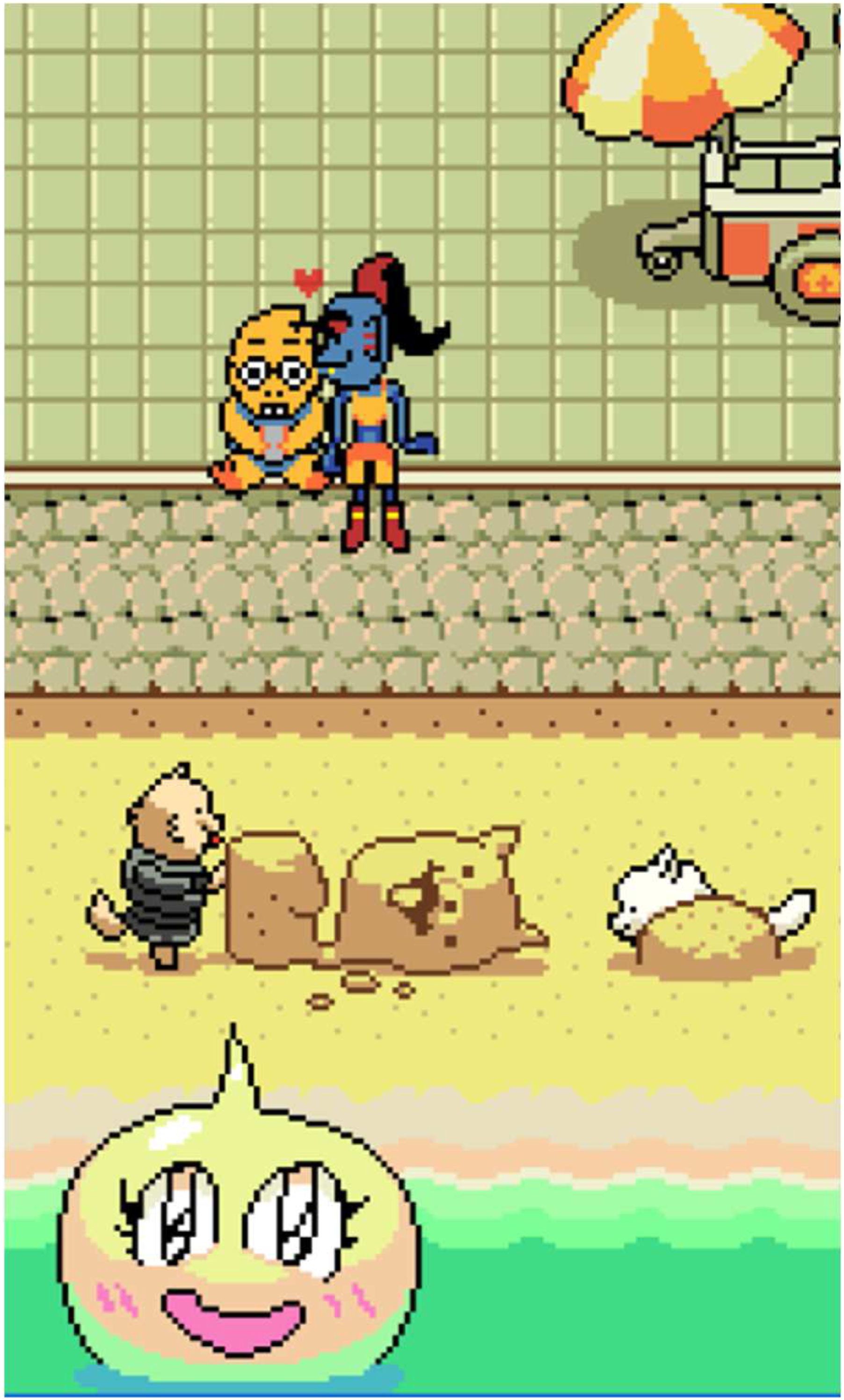
Conclusion
By relating its differing playstyles to contrasting types of PSR, Undertale offers insight into the similarities between technology and relationships: both are systems with elements outside of our control, both include the negotiation of shared realities and emotion, and both can be systems of coercion, or sites of care and collaboration. Undertale asks the player to question their approach to both gameplay and relationships and consider the dynamics created by each. PSR with Flowey, developed via gameplay which follows more standard RPG conventions, is individualist and predicated on power imbalance – a dynamic which is ultimately unsustainable and results in his demise. Conversely, the PSR with Sans and Asriel, which are developed in playthroughs counter to convention, encourage care, mutual understanding and community building. Including PSR as an integral function of the game draws attention to the parallels between our relationships with people and our relationship to technology: we must avoid acting without thinking, and always interrogate systems that are naturalised.
As this paper demonstrates, the question of whether theories of parasociality can be applied to video games is no longer relevant, as it is quite clear that players can form PSRs with characters. The more interesting question for further studies to address is how and why – a question with answers that will vary from game to game. Furthermore using a method that combines theories of PSI with close reading can contribute to game design by demonstrating how video games attempt, succeed and fail in creating effective PSI. Additional research in this field research will also benefit our understanding of the intersections between socialisation and technology by detailing various types of parasocial dynamics across different games and considering what they can teach us about social interaction.
Footnotes
Acknowledgements
This manuscript benefitted from the advice and support of my supervisors Matthew Barr and Matthew Sangster, as well as the feedback of my colleagues Sarah Stang and Francis Butterworth-Parr. It was also improved by the kind and skilful labour of two anonymous reviewers.
Declaration of conflicting interests
The author(s) declared no potential conflicts of interest with respect to the research, authorship, and/or publication of this article.
Funding
The author(s) disclosed receipt of the following financial support for the research, authorship, and/or publication of this article: This publication was supported by the University of Glasgow’s Lord Kelvin/Adam Smith (LKAS) PhD Scholarship.
Author Biography
 .
.