



Abstract
This study investigates parasocial relationships between adolescents and a genre of TikTok microcelebrities who construct themselves as “Internet Parents.” We analyze Alex and Melinda Griswold's construction of themselves as the “mom and dad of TikTok” through their videos, comment sections, and off-platform interactive content. We ask how the Griswolds construct parasocial intimacy through modes of familial address, how viewers make sense of parasocial intimacy, and how the Griswolds monetize familial parasocial intimacy. Findings reveal how the Griswolds construct parasocial intimacy with their audience through the use of adoption rhetoric and engaging narrative structures, which viewers identify with by expressing their desire for a parent–child relationship with the Griswolds as their adopted children. However, these moments of parasocial intimacies become transformed through influencer economies that commodify social relationships. Ultimately, we consider the ethical obligations of the Griswolds to their target audience of adopted children.
“Bro, y’all are the best parents ever.” This statement, and many others like it, fills the comment section of Alex and Melinda Griswold's TikTok page. As the self-proclaimed “mom and dad of TikTok,” Alex and Melinda Grisworld produce content for individuals who may be in search of parental figures online. The Griswold's content reassures individuals of love and care, provides parental advice, and imagines fictive parenting scenarios that are particularly applicable to younger viewers. This content generates a specific form of relationality between the Griswolds-as-parents and their viewers-as-children. In fact, adolescents have long formed parasocial relationships (PSRs) with the characters and individuals within the media they engage with (Hoffner, 1996; Rosaen & Dibble, 2008), and the Griswolds are just one example of creators who utilize PSRs as a driving force to maintain their fanbase on TikTok. Accordingly, our study analyzes Alex and Melinda Griswold as a proxy to understand the development of PSRs between TikTok creators and their target audiences, who are often adolescents and emerging adults.
Launched in 2017, TikTok allows users to upload short-form videos between 15 seconds and 10 minutes long. As Abidin (2021) highlights, TikTok has emerged as a popular site for content creators who can seemingly surface overnight if their videos are pushed onto the For You 1 page. Due to TikTok's popularity with emerging adults, it is likely that TikTok serves as an important vehicle for the experience of parasocial interactions (PSIs) that solidify into PSRs. Subsequently, this paper seeks to provide a deeper understanding of how TikTok creators intentionally construct PSRs with their audiences and consider the ethical implications of targeting younger users online.
One such form of content creation on TikTok that directly addresses adolescents is what we conceptualize as the Internet Parent, which we define as content creators who position themselves in a parental role to their internet audience, often to fill a perceived lack of parental support. Although multiple creators assume the Internet Parent role on TikTok, such as @YourKoreanDad and @YourProudDad, Alex and Melinda Griswold are the only couple who portray a set of married parents by creating videos as the “mom and dad of TikTok.”
To highlight how the Griswolds construct parasocial intimacy through imagined kinship, we first introduce the Griswolds in the context of parental microcelebrities and review relevant literature on PSRs. We then qualitatively analyze the videos and comments of the Griswolds’ TikTok videos to understand the contours of parasocial intimacy based on kinship. Following this analysis, we contextualize the Griswolds’ content through a sponsored mobile game on Ripple that places the user as a member of the Griswold family. Our analysis throughout is centralized around the question of how the Griswolds, as exemplars of the parasocial intimacy within the Internet Parent genre, construct imagined kinship through affective communication.
Alex and Melinda Griswold as parental microcelebrities
The Griswolds act as microcelebrities who engage in intentional self-presentation strategies to create relationships between themselves and their viewers (Marwick, 2017). Originally coined by Senft (2008) and expanded by Marwick (2013), microcelebrity is “both the state of being wellknown to a niche group of people, and a practice where people present themselves as carefully constructed personas, create affective ties with audience members, and view followers as fans” (Marwick, 2017: 1). These practices take many forms; such as distinct modes of address, self-branding, presentation of authenticity, and a myriad of platform-specific communicative methods (Marwick, 2017). Microcelebrities have been studied in relation to particular platform cultures, such as Twitter (Austmann, 2014), YouTube (Marwick, 2015), and TikTok (Abidin, 2021) and have been found to prioritize characteristics of ordinariness and authenticity rather than exceptionality (Chaiuk et al., 2021).
One of the earliest manifestations of parental figures-as-microcelebrity is the mommy-blogger (Lopez, 2009), wherein mothers “chronicle their adventures in childrearing, reporting from the trenches of domestic life” (Hunter, 2016: 1307). Heather Armstrong, who started her online blog in 2001, declared that her blog would begin hosting ads on her website as blogging full time was her means to support her family, a decision she anticipated her readers would be upset with (Hunter, 2016). Today, the commercialization of mommy-blogs has become standard practice as mommy-bloggers also act as influencers for other moms, encouraging new mothers to buy particular products for infants through brand deals (Canduela et al., 2023; Hunter, 2016). Despite what appears to be parenting advice, mommy-bloggers can lead new mothers to question their parenting self-efficacy compared to the content they see and read (Germic et al., 2021; Ouvrein, 2022). As their children age, some mommy-bloggers also pivot to family influencer content, where children play active roles in content creation, but many do so without appropriate compensation and protection for their labor (Abidin, 2015b; 2017).
Compared to mommy-bloggers, parental figures on TikTok appear to construct their image such that those seeking parental figures are the primary audience, not fellow parents. The Griswolds do not have children of their own, but use their audience as an inroads to create content centered around an imagined familial relationship between themselves and their audience. As of August 2023, @Alexgriswold has 5.1 million followers on TikTok and 1.84 million subscribers on YouTube. The Griswolds regularly receive between 300,000 and 7+ million views on their videos, but stopped posting on TikTok in May 2023 after slowing the number of videos produced over the months prior, only to repost old videos in September 2023, and announce their child in 2024. Although earlier videos are no longer accessible, the Griswolds first described themselves as the “mom and dad of TikTok” on January 14, 2020, and posted a video titled “Mom and Dad Checking in” on February 4th. It was on February 13th that @AlexGriswold began posting with the structure that would become the basis of the family dynamic. This post begins with “Happy Valentines from your Mom and Dad,” transitioning into a supportive message for those who are “hopelessly single.” By late March and early April, this dynamic became their primary form of content creation.
On TikTok, Alex and Melinda Griswold are not the only figures of internet parents. Gaining popularity in 2020, a set of TikTok Dads achieved virality. Notable examples are @YourKoreanDad, @YourProudDad, and @DadAdviceFromBo. These TikTok Dads produce different iterations of the internet parent genre but are centralized around fostering PSRs where they act as the father figure, similar to Alex Griswold's role in his content. Although there are other figures of the internet parent on TikTok, the Griswolds provide a rich site for analysis as they are the only married couple and the only account to explicitly claim that consuming their content constitutes adoption as their internet children.
Affective communication on TikTok
Creators adopt a multiplicity of communicative styles on TikTok, including the creation of content that adheres to trends, makes use of shared sounds, and extends memes through duplication and replication (Schellewald 2021; Zulli and Zulli, 2020). Although some creators take a documentation approach to content in which they post about their everyday lives, others prefer to post short-form comedy skits (Schellewald, 2021). The “virality-centric platform logic” (Zeng & Kaye, 2022: 80) of TikTok encourages the formation of niche subcultures emerging from viral moments. Narayanan (2022) explains these micro-recommendations are not a product of some inherent algorithmic “secret sauce” (para. 2) but a result of TikTok's ability to prioritize exploratory recommendations rather than repetitive recommendations. In contrast to other platforms, TikTok's short-form scrolling results in a relatively low cost for a bad recommendation, as users can easily scroll past a video without the risk of getting off the app. For example, Maddox and Gill's (2023) examination of BookTook found that TikTok's recommendation feature generated micro-recommendations to sustain particular niches relevant to popular novels. These sets of micro-recommendations allow for increased personalization of the feed through successful exploratory recommendations and the emergence of niche TikTok communities. Similarly, an Internet Parent niche on TikTok might coalesce a series of micro-recommendations across different TikTok parents.
TikTok users also envision and experience that platform as a space of intimacy and social connection and trust the TikTok algorithm to bring them into community with other users (Şot, 2022). Previous research has demonstrated the ability of users to foster intergenerational solidarity during times of intense social distress, such as COVID-19 (Nouwen and Duflos, 2022). In particular, Şot (2022) found the combination of TikTok rising to prominence during COVID lockdowns alongside the perception of TikTok personalized recommendations led to users and creators alike to perceive TikTok as an intimate platform, compared to the rampant commercialization and seemingly random recommendations of other platforms. As Şot (2022) notes, TikTok creators also constitute these micro-communities as intimate through intimate forms of address and the careful construction of “an audience-oriented image” (1499). For example, multiple creators interviewed by Şot (2022) directly noted that they constructed an image of an older sibling to invoke a further sense of intimacy. This intertwined nature of intimacy, parasociality, and community highlights an opportunity for creators to potentially capitalize on PSRs targeted toward emerging adults.
Additionally, TikTok's perceived intimacy potentially serves as a lure for what Berlant (2011) describes as “the affective structure of an optimistic attachment” (2). The optimism of an attachment for Berlant (2011) can be understood as a generative “force” that brings individuals into an affective social arrangement that would not be possible without another person (1-2). As Ahmed (2004) notes, affect, as the preconsolidation of emotive intensity, serves as a binding force that coalesces objects and people into coherent collectives (119). We understand intimacy as an attachment that denotes “an aspiration for a narrative about something shared,” (Berlant, 1998: 281) which is developed by the imagination of an object as promising a potential future. This process of envisioning attachment constitutes an object or structure as promissory, where its meaning and value is imbued through the habitual processes that assign potentiality to certain affective arrangements (Anderson, 2023: 399). For example, the kinship arrangement of the traditional nuclear family produces the object of the “happy family,” which serves to “make visible the fantasy of a good life” (Ahmed, 2010: 46). This fantasy promises an idealized future, but is one based on heterosexual domesticity and the reproduction of masculine power (Ahmed, 2010; Hill-Collins, 1998). In this sense, the Internet Parent genre might be understood as a promissory object that aspires toward a healthy nuclear family. Although this substitutive fantasy mirrors the logic of the chosen family, it relies upon the kinship structure of the nuclear family and the so-called “traditional” values that deny alternative familial possibilities for disenfranchised groups (Hill-Collins, 1998: 65). By doing so, the Internet Parent can provide users with a sense of comfort in imagining a nuclear family that has never existed in a meaningful sense.
We understand the Griswolds as an aperture to understand TikTok as an affective arrangement, through which TikTok users construct affective ties of intimacy by creating relational ties with their audience. We adopt Slaby et al.’s (2019) conception of affective arrangements as “a material-discursive formation as part of which affect is patterned, channeled, and modulated in recurrent and repeatable ways” (5). These affective arrangements connect multiple individuals, structures, and spaces into “performatively open-ended” processes that give birth to new relationships (Slaby et al., 2019: 5). On TikTok, the algorithmic recommendation system and the technical affordances of short-form video, combined with the affective intimacy of PSRs create “a kind of active allure,” producing moments of affective resonance (Slaby et al., 2019: 5). TikTok niches, such as the Internet Parent, potentially emerge within a larger sociotechnical context that primes audiences for parasocial intimacy.
Parasocial kinship and intimacy
We understand parasocial experiences to exist on a continuum of PSIs, PSRs, and parasocial attachments. A PSI can be understood as a “simulacrum of conversational give and take” (Horton & Wohl, 1956: 215) where the audience feels a “sense of mutual awareness, attention, and adjustment” (Hartmann & Goldhoorn, 2011: 1107). Experiences of PSRs are consolidated through a series of PSIs and are defined by Tukachinsky and Stever (2019) as “generalized emotional and cognitive involvement with the character that can occur outside the context of any particular media exposure situation” (2). A PSR can solidify to produce parasocial attachment, understood as a “sense of felt security and safe haven” (Stever, 2017: 95) that is derived from a PSR.
Parasocial relationships serve as an important socialization process and can aid individuals’ sense of community, mental health, and act as coping mechanisms (Tukachinsky & Stever, 2019). However, the literature is divided about the extent to which PSRs function as a substitute for real-life social interactions. Those who propose PSRs can act as substitutes for real-life sociality have found that PSRs are more prevalent in individuals with high anxiety, feelings of needing to belong, and loneliness, indicating that PSRs fulfill social roles unmet by in-person relationships (Greenwood & Long, 2009; Wang et al., 2008). Writing in the context of idol culture, Cheung and Yue (2012) found that parental absence “would prompt the adolescent to idolise star idols to seek compensation” for the experiences adolescents felt they lacked (41). A meta-analysis conducted by Tukachinsky and Stever (2019), however, nuances this claim and suggests that there is a difference between situational and chronic loneliness such that chronically lonely individuals are not more likely to form PSRs. Rather, individuals who are “experiencing a temporary deficit in certain types of relationships also report greater PSR in contexts that fulfill that particular loss” (Tukachinsky & Stever, 2019: 20). Consequently, an absence of parental figures may prompt adolescents to form PSRs more than those who do not experience this lack.
Whereas most research has focused on the development of PSRs as determined by an imagined friendship or romantic involvement, fans sometimes imagine familial relationships with the object of their parasocial attachment. Zhou (2021) found that Chinese players of the game “Travel Frog” would “project their desire to live freely onto the frog and expressed their ideal parent-children relationship by viewing the game character as their child” (42). Similarly, Yan and Yang (2021) describe how fans engage in “parakin relationship” (2594) through the imagination of idols as their siblings or children. Parakin relationships manifest through narratives of fans as “co-cultivating idols” (Yan & Yang, 2021: 2596), imagining their labor as the supportive care of a family member. As noted earlier, content creators often construct their authenticity and relatability by evoking the image of a sibling, auntie, or a grandparent. Moon and Abidin (2020) note that the Youtuber “Korean Grandma” worked to foster intimacy and connection with her audience by adopting this role of the “online Ajumma,” a Korean pronoun referring to “middle-aged and married women” (175). Additionally, Bhardwaj (2023) argues that audiences apply the moniker of “aunties” (115) externally onto figures to symbolize a politicization of their actions. We understand these as situating how familial traits become the basis of parasocial attachment. The concept of parasocial parental attachment is helpful here to describe the “transference of parental attributes to favorite celebrities or famous personae in adulthood” (David et al., 2019: 387). In this sense, we understand the Griswolds as constructing a parasocial parental attachment from their audience through the formation of parasocial intimacy as kinship.
Although terms such as PSR, PSI, parasocial attachment, and parasocial kinship describe different aspects of parasocial experience, parasocial intimacy provides a clear through-line to understand how parasocial experience is mediated by the social codes of intimacy and the associated attachments. This offers a way to bridge the gap between approaches grounded in cultural studies and the social scientific approaches common within the study of PSRs. Whereas Horton and Wohl (1956) understood parasocial intimacy as the feeling of emotional closeness at a distance, we understand parasocial intimacy as the creation of an affective attachment premised upon a shared narrative between a media personae and a viewer. This account of parasocial intimacy forwards not only the experience of feeling close but also highlights how this perception of intimacy constructs an optimistic attachment toward what the PSR provides for all participants. In this sense, parasocial intimacy can serve as a source of monetization or social support for creators. At the same time, it might provide a sense of companionship for viewers experiencing bouts of loneliness.
Parasocial intimacy with figures on social media differs from parasocial attachments to more traditional celebrities. In contrast to conventional celebrities who “convey a sense of distance and hierarchy,” influencers often construct “reciprocal intimacies” by addressing their fans as a collective community, replying to their messages, disclosing personal information, and appealing to a sense of authenticity (Abidin, 2015a). Authenticity, thus, manifests as the impression that an influencer is more real or “raw,” through the sharing of their actual life (Reade, 2021: 2). Importantly, however, these processes result in the formation of parasocial intimacy not with the influencer themselves but their carefully crafted authentic persona (Marwick & Boyd 2011). Abidin (2017) explores that this can result in the crafting of an aesthetic “calibrated amateurism” (7) in family vlog content, wherein influencers rely upon contrived authenticity to create relatability.
The intertwined relationship between perceived parasocial intimacy, authenticity, and monetization results in influencers struggling to decide whether to monetize intimacy. As Arriagada and Bishop (2021) explore, influencers must “reconcile two seemingly contradictory poles: commerciality and authenticity” (4). Influencers are perceived to be effective marketers because their authenticity is assumed, and thus, their recommendations are personal rather than purely commercial (Frowijn et al., 2022). Subsequently, expressions of intimacy are linked to commerciality, where the disclosure of personal expression becomes a way to construct a community with economic implications. In the case of Zoe Sugg, a beauty influencer, Berryman and Kavka (2017) explain that her “‘big sister’ persona” allows for Sugg to gain credibility as a brand influencer (3). Following Raun (2018), we understand intimacy as a form of “social capital,” that not only grants authenticity but also signifies a potential for monetization (110). This, however, can be a double-edged sword. As Maddox (2021) argues in an analysis of ASMR YouTubers, this perceived economic and intimate reciprocity can lead to hateful responses if a creator changes their content or ceases to make content. If fans believe that their parasocial intimacy funds the creator's lifestyle, they might expect invasive information from the creator in return (Trifiro, 2022).
Given the emergence of the Internet Parent as a unique form of address and the established relationship of PSRs to the well-being of adolescents, we now turn to material construction and consequences of Internet Parents by exploring rhetorical modes of address, comments from viewers, and how monetization complicates parasocial intimacy by drawing attention to the capitalist nature of Internet Parents’ relation to their “children” followers.
Method
Data collection
We utilized Alex and Melinda Griswolds’ content as an exploratory case study to understand the emergent TikTok genre of the Internet Parent. Due to the absence of research on the intersection between parasocial parental attachment and microcelebrity, an exploratory case study is useful in providing a vocabulary to understand the relationships between adolescent audiences and online influencers. Materials included in the case study include (a) a set of 30 videos under the Griswold’s playlist “with Mom and Dad,” (b) the top ten comments under each of these 30 videos, (c) a set of 10 additional videos where the Griswolds describe the adoption process and struggle with the parasocial parent role, and (d) sponsored game content starring the Griswolds through the application Ripple: Join the Story that narrates the viewer's adoption into the Griswold family. These materials were selected as they reflect the Internet Parent role, with the Griswolds explicitly addressing the audience as their children. As the “with Mom and Dad” playlist only included the fictionalized scenarios of parenting, we believe that it was necessary to contextualize those scenarios with emic descriptions of the adoption process by the Griswolds along with their own feelings about their role as an Internet Parent. These additional videos were not the subject of thematic comment analysis. Videos for analysis were downloaded from the Griswolds’ TikTok account using a web-scraper. We transcribed the top 10 comments from each of the original 30 videos, including replies from the Griswolds. This resulted in 297 comments from audience members and 120 comments (including replies) from the Griswolds that were collected in August 2023. Due to ethical concerns regarding the privacy of adolescent commenters, we have redacted commenters’ usernames and chosen not to link to individual TikToks.
Analysis
Using a multimodal approach, we analyzed the discursive and visual elements of the Griswolds’ videos and off-platform content to understand how the Griswolds construct PSRs. Following Mordecai (2023), we understand individual features of the video as “communicative avenues” (6) through which meaning is made. The videos were subject to a content analysis on narrative structures and modes of address present within the Griswolds’ videos, highlighting how microcelebrities address their TikTok audience to cultivate PSRs (Zamora-Medina et al., 2023). The same approach was applied to analyze the Griswolds’ sponsored Ripple experience, with a particular focus on game-play elements and UI.
Next, we used reflexive thematic analysis (Braun & Clarke, 2006; 2022) to code the top 10 comments of the original 30 videos within the “With Mom and Dad” playlist. On TikTok, the first 10 comments on a video are usually those that are most popular with other users. That is, the comments that appear at the top of a video's comment section are those that have been “liked” the most by others, as well as those that have been replied to by the creator of the video, and comments from verified accounts. Following Abidin et al. (2020), we understand that the comment section is essential for understanding how communities form on TikTok (Chen et al., 2022; Gallagher, 2021). While analyzing these comments, we paid particular attention to how both viewers and the Griswolds participated in processes of relationality. Here, we sought to understand how influencers strengthen ties with their audiences and nurture social capital through how commenters identify with their prescribed social role by creators, in this case, as adoptive children (Trittin-Ulbrich & Glozer, 2024). In accordance with Braun and Clarke's (2006; 2022) reflexive thematic analysis, we developed semantic codes into latent constructs independently of one another before generating a cohesive codebook. An example of a code within the codebook was “feels love,” which was used for comments where individuals expressed feeling loved by the Griswolds. We reviewed our coding for each video with one another, and after coding, four initial themes were generated. The code of “feels love,” for example, was central to the generation of the theme of affective resonance. After further reflection, we collapsed the data into three themes to aid in conceptual clarity. Refinement consisted of synthesizing the themes of permission-seeking and disclosure into validation, as the comments in the original two themes encompassed one another.
Findings
How do Alex and Melinda Griswold construct PSRs with adolescents through modes of familial address?
Within the Griswolds’ content on TikTok, two discursive techniques emerged as central to how the Griswolds construct PSRs with their audiences. When engaging in practices of familial address, the Griswolds heavily rely on the rhetoric of internet adoption, as well as a recurrent narrative structure to keep audiences engaged and supported.
Adoption rhetoric and identification
The Griswolds address their audience as their internet-adopted children. This adoption is simple; individuals must watch at least one of the Griswolds’ videos to be adopted. As the Griswolds stated in a video in February 2022, “If you’ve watched any of our videos, you’re adopted, if you follow us, you’re adopted.” In April 2022, Alex Griswold asserted that “with over four million of you adopted on” TikTok, they could become the most followed account on TikTok with “shows, merch, movies, and apps… and you’ll be at the center of it all, our internet adopted kids.” Their goal was to adopt “everyone on the internet,” and everyone would be “happy because they’ll be in this family.” Adoption as consumption invites viewers to imagine their consumption as part of an imagined two-way relationship, opening up avenues for parasocial intimacy.
Within the videos on the “With Mom and Dad” playlist, the Griswolds only use shared pronouns to describe themselves and the viewer. In the videos, “Mom and Dad” always are “we” or “us,” and the viewer is always referred to as “you,” as both the viewer and the adoptive child. In almost every video, Alex Griswold plays the role of both the father and imagined child, while Melinda is the mother. In videos for historically gendered scenarios (e.g., getting your first period with mom and dad), Melinda plays the role of both mother and child. The Griswolds are not merely describing how they might respond to a situation but performing the action with the viewer as a shared participant. The use of shared pronouns and formalization of the adoption process represents the concretization of parasocial intimacy as an affective attachment between the Griswolds and their viewers. As individuals begin to identify as their roles in a shared narrative, those roles slide into place as an organizing force between the viewers and the Griswolds. This process of identification thus renders the Griswolds legible as internet parents and invites the audience into a parasocial kinship insofar as they understand themselves as the adopted child.
Engaging narrative structure
The “With Mom and Dad” videos follow a similar narrative structure that begins with the Griswolds naming a scenario where parenting might occur on a short title screen (see Figure 1), followed by acting out the scenario according to how they would handle situations as parents. The fictional scenarios range from “forgetting to defrost the meat” to “coming out” as queer. Video topics are either violations of parenting requests (e.g., breaking a house rule) or depictions of adolescent experiences (e.g., doing the dishes, having a panic attack). The Griswolds respond to these scenarios with one of two ethos within all of the videos. First, they express endless love, acceptance, and wealth as their response to every situation. For example, in the video “panic attacks with mom and dad,” Alex narrated they would “affirm that you’re safe // give you as much space // or comfort that you need // and as you calm down // we’ll remind you // that we love you // that anxiety // is something we all deal with.” This structure is echoed in videos such as “coming out with mom and dad” or “being afraid of the dark with mom and dad.” In a video about being caught staying up all night, the Griswolds resolve the scenario by buying a surprise trip to Disney World. Secondly, the Griswolds sometimes turn the scenario into an absurd storyline. For example, the Griswolds created an elaborate story of kidnapping in a video about a child running away, resolved by the Griswolds rescuing the child and feeding them chicken nuggets.
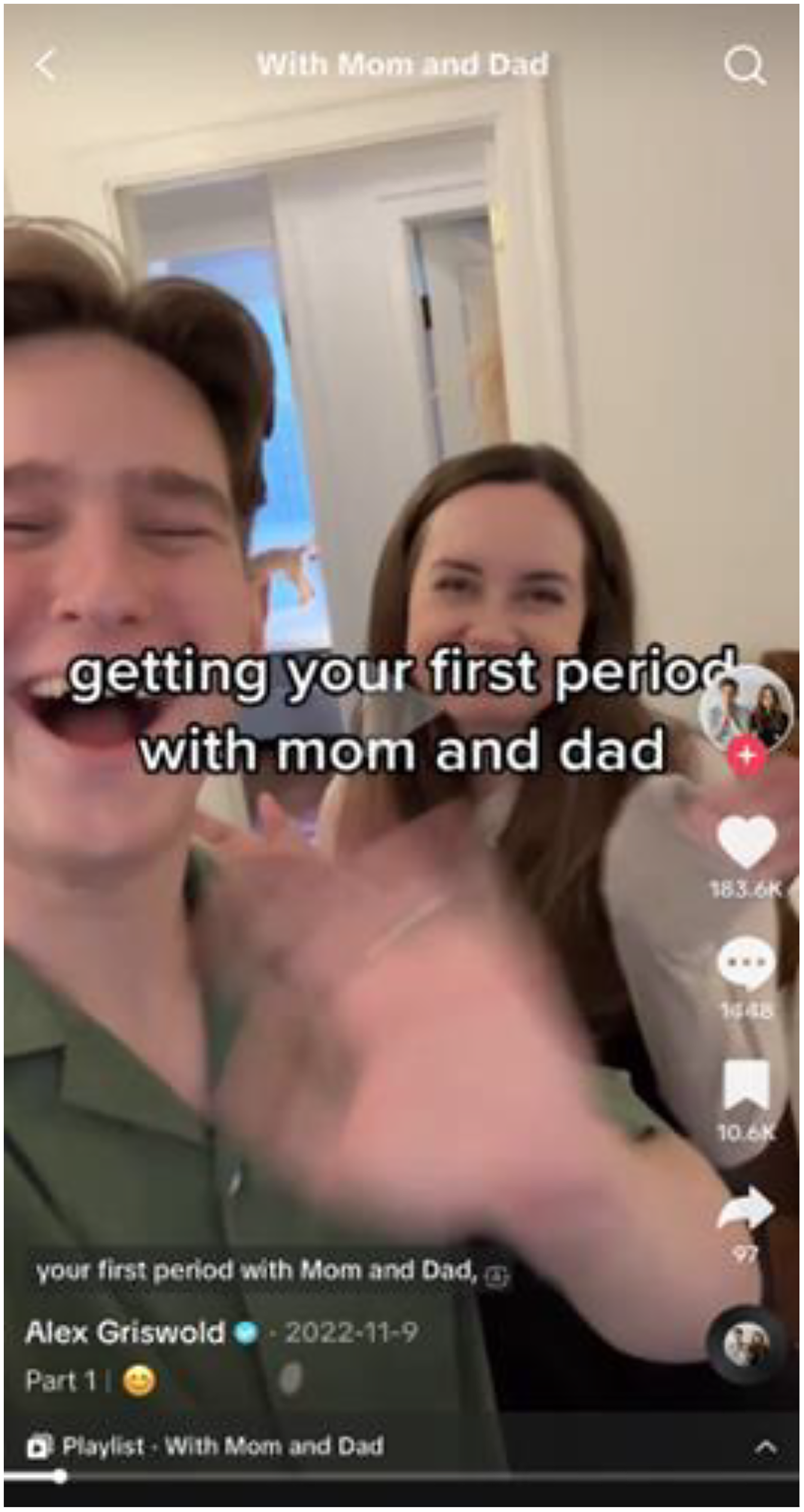
Example title screen of “With Mom and Dad” video.
One of the most common narrative structures the Griswolds use is reminiscent of the infomercial “but wait, there's more” which leaves viewers in a state of suspense, always resolved by the narrator. Often, this is done by the Griswolds as a rhetorical move to remedy the unpleasant emotions of their “internet children” or correct common parenting wrongdoings. For example, in the video “failing a test with mom and dad,” the voice-over and captions say “you’ll tell us that // you got an F // we won’t say anything // and then we’ll tell you // to go to your room // you’ll be be scared // but not for long // because when we come // to your room // we’ll bring you a folder // of every test we ever failed // remind you that no one is perfect.” This “but not for long” structure appears in nearly every video in the playlist and appears to be used as a transition between parenting approaches and children's emotions.
How do viewers make sense of Alex and Melinda Griswolds’ rhetorical address of the viewer as an adopted TikTok child?
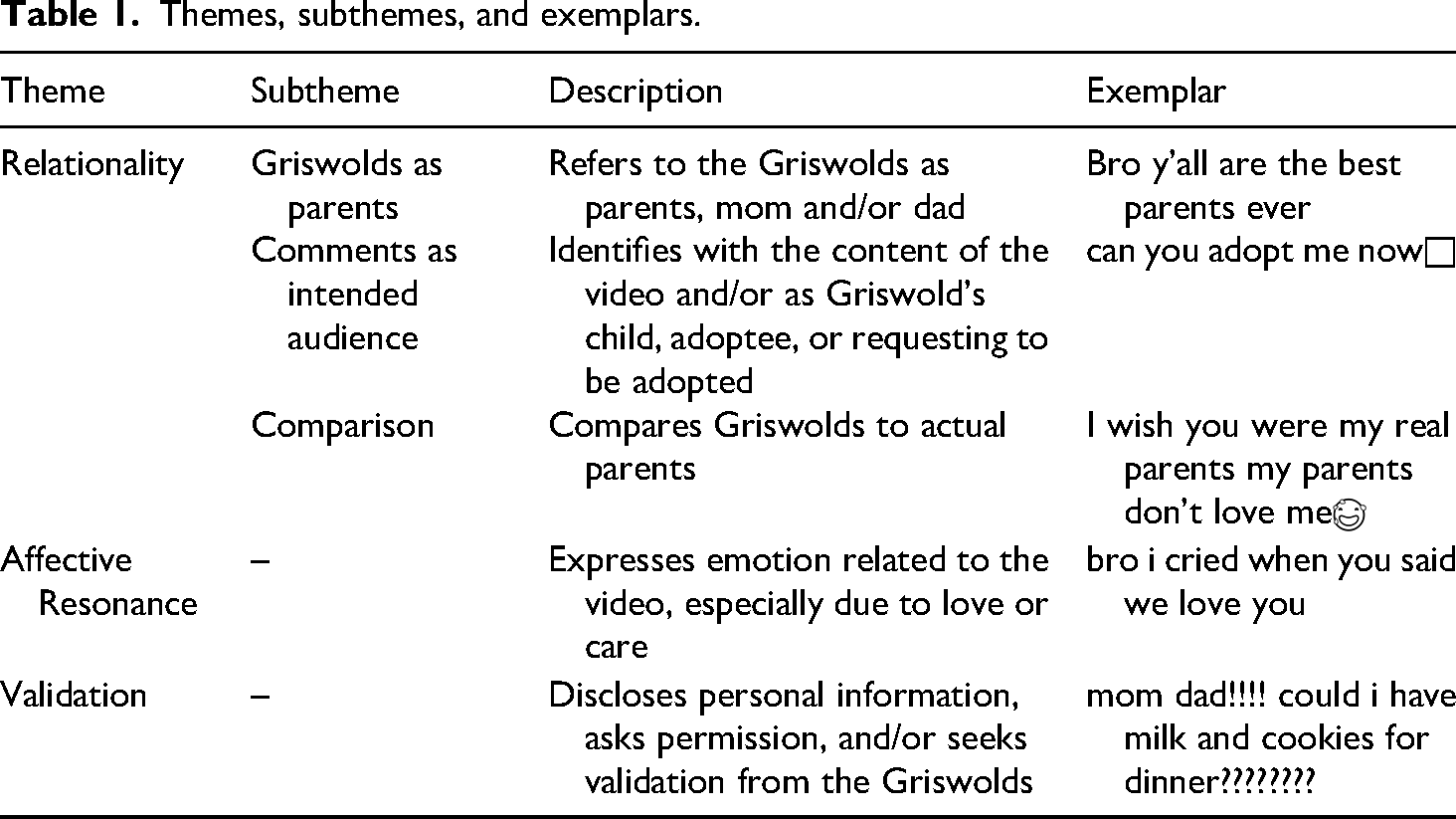
Three major themes encompass how viewers interact with the Griswolds within the comment section; those that signal relationality, those that seek validation, and those that demonstrate affective resonance with the video. These themes overlap in many cases as they are complementary to one another, such as how identifying the Griswolds as parents often included an expression of emotive love. Below, we explicate each theme by highlighting the ways commenters respond to videos within the “within Mom and Dad” playlist. Table 1 organizes the themes, subthemes, and provides example comments from the data.
Themes, subthemes, and exemplars.
Relationality
The first theme of relationality illuminates how viewers understand their relationship with the Griswolds, which occurs by addressing the Griswolds as parents, accepting the role as the intended audience, or comparing the Griswolds with real-life (i.e., “IRL”) parents. As the Griswolds’ “internet-adopted children,” commenters participate in this parent–child relationship by referring to the Griswolds as their parents. Examples of comments that directly reference the Griswolds as either “mom,” “dad,” or “parents” are “Best parents ever  ,” “But mom and dad I'm 13!,” and “Yay thank you mom and dad love you.” These references to the Griswolds as parents, not as creators, represent the translation of individual moments of media exposure into consolidated PSRs. Viewers also understand and identify themselves within the designated audience role as the Griswolds’ child. This can take the form of identifying as the Griswolds’ child, adoptee, or requesting to be adopted, as well as identifying with the scenario that comprises the video's content. For example, viewers expressed sentiments such as “
 sign here to legally adopt me” to which the Griswolds replied “mom
  &
& dad
dad ,” and acted as if the Griswolds have parental jurisdiction over them, asking questions like “What happens if I cuss.” Viewers do not just see the Griswolds as a parental-figure but see themselves as a child-figure in this PSR as well.
Additionally, commenters compared the Griswolds as their internet parents with their real-life parents. These comparative comments often said something to the effect of “I wish my parents were like this.” Viewers would reference how Griswolds’ performance of parenthood would be preferable compared to their IRL parents. Responding to a video about failing a test, one viewer said “This made me feel happy cuz I failed a test today and my irl parents were very mad.” One viewer expressed “I wish you were my parents my parents don’t love me  ,” and another viewer described how forgetting to defrost meat would result in their mom yelling at them “for not taking out the meat and then 5 min later” acting like their “best friend.” Viewers appear to be able to make sense of their own experiences in relationship to their PSRs, particularly within the parent–child dynamic.
Affective resonance
Affective resonance describes comments where the video prompted an emotive expression. These are moments where emotional connection with the Griswolds is represented, tying the structure of attachment toward an optimistic intimacy. As Slaby et al. (2019) note, resonance is a result of the immersion of an individual within an affective arrangement and represents the concretization of affective attachment. One commenter noted “I cryed when you said we love,” while another commenter asserted that they were “SOBBING,” to which the Griswolds responded with “ .” Other comments merely expressed thankfulness and appreciation for the videos. A noticeable number of comments explicitly said “I love you” to Alex and Melinda, which the Griswolds would also reply to, often with heart emojis. The Griswolds’ videos sparked emotive responses to a sufficient degree that viewers felt it necessary to publicly express their love, highlighting the existence of PSIs with the Griswolds. These moments are particularly important because they represent the consolidation of ephemeral moments into generalized intimacy.
Validation seeking
Lastly, commenters often sought validation from the Griswolds through requests for permission, disclosures of personal information, and comments that had no purpose other than to elicit a response from the Griswolds. One of the common iterations of this theme was the disclosure of personal information. One viewer wrote “MOM DAD I AM A TRANSGENDER FTM AND BISEXUAL,” and another viewer commented that they were someone who “doesn’t have friends.” A seemingly older fan commented on a video about boyfriends that they had dated their “divorced husband [for] 14 years” and after 10 years of marriage, “he left me.” Other users directly asked questions of the Griswolds that could be validated with the creation of a video or a reply. These comments are often the basis of the “with mom and dad series” and are clearly visible within the videos themselves, such as “Can you do ‘coming out’ with mom and dad?,” a video the Griswolds made after an influx of requests. These requests for validation through specific videos provide insight into what the Griswolds’ viewers imagine as an ideal parental figure; that is, a parent who confronts every situation with endless acceptance and unconditional love.
How do affective attachments become monetizable by the Griswolds?
The Griswolds often leverage their parasocial intimacy through traditional influencer revenue models. As TikTok Partners, the Griswolds are able to leverage their community and popularity to receive revenue from the TikTok creator fund. On TikTok and YouTube, the Griswolds have sponsored posts from Amazon, Extragum, Cirkul Water Bottles, Nord VPN, and the American Dermatologist Association. Although only the Extragum advertisement was performed in the Internet Parent persona, the others were likely made possible due to their already existing popularity and perceived parasocial intimacy. Although not the subject of the paper, YourKoreanDad parlayed his image as an Internet Parent into an Alaska Airlines advertisement where YourKoreanDad—along with Snuggies, Carebears, a dog, and Mother Nature—argue for Alaska Airlines to be included in the care coalition. Perceptions of parasocial intimacy are directly connected to perceived marketing value (Trittin-Ulbrich & Glozer, 2024), and the Griswolds have taken on this for their financial profit.
In addition to traditional influencer revenue models on TikTok, the Griswolds, in partnership with Ripple: Join the Story, released an interactive story-based mobile game titled “ALEX GRISWOLD Is YOUR INTERNET DAD!” Introduced by the Griswolds on April 8th 2023 in a TikTok titled “this is the best way to make it official,” Alex described the game as “a way for you to officially be the favorite kid.” The Griswold's game is built upon a relatively simple gameplay interface modeled around the process of texting members of the Griswold family (Alex, Melinda, and a set of imaginary family members who are all pictured as Alex and Melinda Griswold in different outfits). In the game, the user is formally adopted into the Griswold family and must navigate a conflictual relationship with their imagined siblings over access to a newly renovated room. Users are given a set of individuals to text, and the story progresses via a set of text messages that a user can send to their siblings, parents, and grandparents. Text messages are prewritten for the user and only sometimes provide the user with more than one option. Based on these responses, the story and relationship with the case of Griswolds can change, with some texts resulting in disappointment from their family members.
Importantly, “ALEX GRISWOLD IS YOUR INTERNET DAD!” provides a contrasting model for how parasocial kinship can be monetized, even as it departs from traditional models of authenticity. The Griswold's Ripple experience uses microtransactions to allow users access to premium content through either individual purchases or an up-front $13.99 purchase (now discounted to $6.99). Users can purchase pay-walled images, alternative text options, and speed up in-game tasks. In the case of pay-walled images, the game will provide options to gain access to premium images, such as Alex and Melinda's wedding pictures. Users are sometimes provided the option for a different message if they spend a certain amount of in-game currency, which helps in achieving the ideal ending of the game, and in other cases, prevents the Griswolds from being “disappointed” in a response. Although there are moments of authenticity being directly monetized, such as the disclosure of personal images, the Griswolds also monetize an experience of imagined intimacy, which relies upon a purely fictional experience. These experiences are validating not because they represent an authentic truth of the Griswolds but rather because the user finds joy in the imagination that the Griswolds would perform this care if they were thrust into such a situation.
The Griswolds’ Ripple experience represents a model where a PSR is not merely a preexisting source of authenticity to be monetized but a monetizable process in itself. This is distinct from authenticity as a source of credibility for brand recommendations. Instead, it is an experience that monetizes a simulated relationship between the audience and the Griswolds. Taking the Griswolds’ claim that consuming their content is a process of adoption, the Griswold's use of Ripple expresses a virtual materialization of parasocial intimacy that is now expressed as personalized. For example, in the first text conversation, Alex ends the conversation with “Okay, talk later! LOVE YOU!” and the user is forced to respond with “love you too.” On TikTok, viewers responded to videos about the Ripple experience with comments such as “IVE BEEN PLAYING WITH YOU GUYS FOR A FEW WEEKS” and “I played the game and it's so good, now I finally have an even greater connection with my internet parents.” These reactions demonstrate (a) the interplay between the already existing social role of the Internet Parent and the Ripple story package, and (b) the ability to monetize the parental role rather than Alex and Melinda's personal authenticity. These processes matter because they highlight how affective arrangements of intimacy are habituated through the process of commercialization. Suppose marketing agencies begin to understand parasocial kinship as a particularly valuable motivator for customers. In that case, this model of parasocial attachment might become more common and even a template for AI chatbots.
The creation, identification, and monetization of the Internet Parent
Through the rhetoric of adoption, the Griswolds position themselves as adoptive parents to the viewers without the actual conditions for a genuine parent–child relationship. We conceptualize the relationship constituted by the Griswolds and their audience as one that exists beyond the typologies isolated in the majority of parasocial research. Instead, and following Yan and Yang (2021), the Internet Parent is a form of parasocial kinship defined by an imagined familial relationship between the audience and the Griswolds. This kind of parasocial kinship can be understood as a form of attachment that organizes intimacy and connects disparate objects and people into a shared narrative. Although the viewers receive the gesture of parental care and an imagined nuclear family, the source of attachment is itself ephemeral and unstable as the Griswolds are structurally unable to provide parental care in a meaningful sense. It is an asymmetrical form of intimacy, where the idea of the Griswolds serves as the organizing principle for an affective experience of care. In this sense, the affective pull of parasocial kinship might not be the effect of a particular emotive state but rather the affective comfort in the belief that there is someone who cares. Users who do not feel that care in their family lives might feel as if TikTok algorithmically recommended them to their Internet Parents, knowing what the user needed (Şot, 2022). Echoing Tukachinsky and Stever (2019), viewers experiencing an acute lack of love, support, or economic stability from their family might find joy in an ideal family, even if viewers might only experience it when watching a video. This interplay of algorithmic perception and comparative experience to their IRL families highlights how the specter of parental absence acts as a motivation or rhetorical context for the Internet Parent.
As is the case with many internet personalities with large followings, the Griswolds can profit off of their sustained intimate connections with their audiences through sponsored posts and exclusive products (Abidin, 2015a; Trittin-Ulbrich & Glozer, 2024). However, in the case of the Internet Parent, specifically the Griswolds, intimacy becomes an unlockable goal through capital expense. That is, within Griswold's Ripple experience, users can pay to unlock the couple's wedding photos or purchase more favorable text responses to receive “love” from the gamified simulation of the Griswolds as their adoptive parents. This process of exchanging microtransactions for affective moments of parasocial intimacy blurs the lines between intimate connections and personal advertisements (Lee & Seo, 2024), which is particularly problematic for adolescents who may already be seeking out connections that fill the parental role on the internet.
The commercialization of parasocial intimacy of the Internet Parent through gamified microtransactions is more concerning given previous research that has found how teen gamers become more alienated from themselves and their peers as social activities become commodified (Lee & Seo, 2024). This monetization process, made possible through Ripple and influencer economies (Abidin, 2021), then, may work in a way that isolates adolescents from their friends, which makes it even harder for those adolescents who seek out parental figures online to make true interpersonal connections because of how alienated intimacy has become from real life. To this end, the monetization and commercialization of the Internet Parent may exacerbate the interpersonal and social problems that motivate adolescents to seek out parasocial figures to fulfill that role in the first place, creating an endless cycle of relational gaps that seek to be filled with internet personalities. Additionally, fulfilling the role of the Internet Parent may not be due to altruistic means for creators who choose to do so, but rather motivated by success in generating revenue when catering to an adolescent audience. To this end, the explicit monetization of the parent–child PSR may have far-reaching consequences if impressional individuals come to understand interpersonal relationships as those that are constituted by power imbalances and monetary exchange.
Mediated parental absence and ethics of PSRs
Although the Griswolds described themselves as “the parents of TikTok” for three years, they were not consistent in their parental commitment. By May 2020, the Griswolds were already conflicted with the parental role, to the point the Griswolds declared they “weren’t mom and dad anymore.” By their own admission, “it got kind of weird, and we felt like we weren’t being ourselves, and I got depressed.” Viewers responded with jokes and sadness. The top comment with 53.9k likes reads “ORPHAN PARTY  WOOHOO.” Others responded sorrowfully; one viewer said “I just lost a mom and a dad today.” Another said “I guess I will leave thenKI only came for the mom and dad cause they made me feel better.” One month later, the Griswolds began describing themselves as their viewers’ “new best friend.” Then, in July of 2022, Alex and Melinda were back as “mom and dad of TikTok,” but only as parents occasionally visiting their children. The Griswolds were fully “back” in September and declared “not being mom and dad was a big mistake.” For those who feared future abandonment, Alex and Melinda offered an “extended lifetime warranty” for viewers to show the Griswolds if the Griswolds “ever try to bail.” This fear may have actualized as the Griswolds stopped posting on TikTok and YouTube in May 2023 after a string of paid partnerships. There was no public post announcing their exit, and viewers left comments asking what happened and expressing how they missed their internet parents. However, the Griswolds returned in September 2023 with a repost of the video “being sick with mom and dad,” with the caption “We’re back.” There was no explanation for why they stopped posting beyond a comment stating “we were hibernating.” Since returning, the Griswolds have released sponsored posts, reposted older videos, and announced Melinda was pregnant.
The case of the Griswolds poses a few questions about the ethics and obligations of PSRs. What obligations do the Griswolds have to their adopted children? Obligation is admittedly a fraught concept when applied to parasocial intimacy. As Abidin (2013) demonstrates, the idea that content creators are “obliged to safeguard their readers’ vested interests” (8) creates the condition for privacy violations and hateful messages. In that sense, content creators have no obligation to produce content outside of contractual obligations. Is it different if the creator monetized PSRs for viewers with unstable familial structures? The answer is complicated. It would be impossible to claim that the Griswolds are obligated to make content indefinitely; yet, the Griswolds monetized children experiencing some sort of parental absence and then disappeared off TikTok, only to return as a disengaged internet parent. Intimacy is a two-way street, and the Griswolds are not performing as Internet Parents out of pure altruistic intentions, as they financially profit. The dual-sided nature of parasocial intimacy, and its monetization, highlights an obligation on the terms on which content creators create attachments, and then potentially abandon them. Yet, these attachments are not to the physical presence of the Griswolds but rather the gestures of care they produced. This means that these attachments are habituated and formed whether or not the Griswolds continue to produce content, and the Griswolds ought to understand ensuing ethical quandaries. At a minimum, we understand that the Griswolds should be cognizant of the parental parasocial attachment they have created and announce the temporary or indefinite suspension of content if they choose to stop producing content.
Conclusion
Although impossible to speculate on the interiority of the commenters’ lives, comments indicate that some viewers perceive the Griswolds as filling in for their parental figures when their parents do not provide love or support. To this end, the Griswolds’ content may be motivated to remedy a perceived need in the lives of adolescents online. This perceived need can be accentuated as childcare costs steadily rise, divorce rates fluctuate, and inflation forces many parents into states of financial precarity. Even if it is impossible to predict whether these particular material conditions produce the basis for the Griswolds’ appeal, it is likely that they contribute to a desire for expressions of care that the Griswolds provide. However, as seen with the Griswolds, the creation of parasocial intimacy with an Internet Parent also inaugurates the possibility of parasocial parental absence, manifesting as a parental parasocial breakup and reinvigorating the cycle that inspired Internet parent content to begin with.
Internet parents on TikTok exist as microcelebrities that construct PSRs with their audiences in order to serve specific parental roles. In the case of Alex and Melinda Griswold, specific modes of address that construct their audience as internet-adopted children encourage viewers to construct themselves in this fictive role within a parent–child PSR. However, this relationship is complicated; although Internet Parents seek to fill parental gaps, their gestures of care can be revoked at any time. Given the contested feelings the Griswolds hold about their own role as Internet Parents, attention should be paid to how assuming a parental role affects both creators and their viewers.
Footnotes
Funding
The authors received no financial support for the research, authorship, and/or publication of this article.

Notes
Author biographies
Jacob Kenton Smith is a PhD student of Communication at the University of North Carolina at Chapel Hill. His research interests include eco-fascism and live-streaming platform communities.
Emily A. Mendelson is a doctoral student in the department of communication at the University of Illinois Urbana-Champaign. Her research interests include sexual communication and mediated communication about and within interpersonal relationships.