



Abstract
This article explores how the process of designing videogames may be meaningful–that is, accomplish a larger existential fulfilment or purpose. We use a reflective methodology which triangulates the creative practice of making a videogame with reflections both during and post-practice against philosophical ideas of meaningfulness. Two ideas of meaningfulness emerged. The first is the generative capacity of subjectivity, where meaningfulness is anchored to our investment as creators, as well as in the intertwining of personal histories, experiences and memories between reflection and action. The second is the flourishing of the self in terms of inner growth and self-discovery out of journeying inherent in the game design process. The significance of our enquiry is three-fold: to more holistically understand videogames as being meaningful, to present a reflective methodology to facilitate such understanding, and to more broadly consider videogames as an instantiation of how media is itself existential.
Introduction
[Videogames] continued to be seen largely as the leering, rowdy, smelly neighbors who may be fun to hang out with at a barbecue but no one would invite over for a serious, heart-to-heart conversation. And yet, video games were here to stay. ∼Doris Rusch (2017, pp. xx–xxi)
Long associated with pleasure, entertainment and, more controversially, violence (Anderson et al., 2007), critics, scholars and gamers also debate whether videogames can be what we might call ‘meaningful’–that is, accomplish a larger fulfilment or purpose in some existential sense. In their classic book Rules of Play, Salen and Zimmerman’s (2003) descriptions of what they call ‘meaningful play’ (34) centre around how video gameplay may be meaningful to the player – for example, a player’s action is meaningful if it is made discernible to the player that their action led to a distinct outcome or change in the story. In Homo Ludens, Johan Huizinga (1950) examines the meaningfulness of play not only as culture, but the root of all human activity.
However, the issue of videogames being ‘meaningful’ in that larger sense of existential fulfilment is more tellingly rooted in the 2005 shot fired by Pulitzer Prize–winning film critic Roger Ebert of how games can never achieve the stature of art. Ebert declares: ‘To my knowledge, no one in or out of the field has ever been able to cite a game worthy of comparison with the great dramatists, poets, filmmakers, novelists and composers’ (Ebert, 2005a, np). For Ebert, the issue lies in ‘the nature of the medium’, where games ‘require(s) player choices’. Conversely, films, poetry and other forms of ‘art’ require ‘authorial control’ (Ibid). Many agree with his stance. As one reader wrote in a mail response to Ebert: ‘VGs (videogames) may be entertaining, escapist, enjoyable, and absorbing, but so is masturbation… What art does that VGs do not, and probably never will, is edify and ennoble’ (quoted in Ebert (2005b), np).
In this article, we extend thinking on this question of videogames being ‘meaningful’ in whether and how, taking Ebert’s words, they may ‘edify and ennoble’ in terms of pointing to or enabling larger understandings of life and being alive. Numerous scholars (e.g. Aristotle cited in Kraut, (2019); Cottingham (2003); Eagleton (2008); Frankl (1946)) distil such contemplations into existential concerns: for what should a human live so as to discern a purpose in living, and so that their existence has dignity? What may the conclusions be on the conditions of being human by way of understanding what it means to be alive?
As will be discussed, scholars (e.g. Rusch (2017)) have analysed videogames as being meaningful in this sense by how they illuminate human experiences such as grief, joy, loss, sorrow, as well as create emotional experiences (Isbister, 2017). Others have conducted studies of video gameplay as eudaimonic experiences which provide insight and fulfil complex psychological needs (e.g. Ryan et al. (2006)). However, less attention has been paid to videogame design itself as being meaningful. This article thus focuses on the question: how may the creating of videogames present existential concerns and evocations of being human?
This consideration is important for three reasons. The first is to more holistically understand videogames as being ‘meaningful’ in light of their contested status as described above. On one level, understanding videogames to be meaningful may be based on a ‘technocratic’ harnessing of narrative design, visual structure, character development, story themes, music and so on (Chen, 2008; Highland & Yu, 2008), as any number of Gamasutra articles instruct. A mastery of those technical components is undoubtedly important and will create more memorable gameplay. However, our position is that a comprehensive understanding of games as being meaningful lies in thinking through its making process not only in terms of professional design, but also as a human individual of subjective experience and desire for growth who digs deep to understand their existential purpose. Meaningfulness is a concept which reaches far in terms of considering both the wider sense of the world and our relations with and place in it, as well as our individual inner lives and motivations. To understand the meaningfulness of media thus requires more than technical mastery, but also a conversation integrating existential philosophy and introspective understanding of the artefact, including its processes of becoming. Our article presents insights of the meaningfulness of videogames out of this broader perspective and opens up the study of this question to a more reflective lens.
In relation to the last, the second importance of our enquiry is to present a methodology for research into such questions which interrogate the inner life, the personalised and the abstract. Game and media studies generally tend to steer away from reflective methodologies, preferring critical readings out of theory or analyses of data from conventional research tools such as interviews and questionnaires. Yet as the complexities of lived experiences and practices become more apparent, not to mention changes in the nature and locations of data (Benozzo et al., 2013; Pink et al., 2018), their methodologies correspondingly warrant more personal approaches. In this sense, our article also explicates a reflective methodology of introspection applied specifically here in relation to game design, but hopefully also pertinent to all creative processes.
The third reason is in the wider context of further understanding the meaning of media itself as an existential concern. Taking specifically from John Durham Peters (2015), media are more than their content and message. Media are themselves existential: they provide the conditions for our existence; they disclose being. Or, as Peters (2015) puts it, ‘a medium must not mean but be’ (14). Thinking through the meaningfulness of game design is thus also about the larger thinking of our existential being via media. In that larger consideration lies the conversation of how we stay alive as humans; how we find the ‘will to meaning’ (Frankl, 1946); how we discover and realise the things for which are worth living.
This article will use a reflective practice-based methodology which centres on the researchers’ creative practice of making a videogame. Through its processes of ideation, design and implementation, the researchers’ reflections from both during and after the practice are then analysed against philosophical ideas of meaningfulness. We present two findings of meaningfulness from our practice of videogames design. The first is the generative capacity of subjectivity, where meaningfulness is anchored to investment as creators, as well as in the intertwining of personal histories, experiences and memories between reflection and action. The second is flourishing in fulfilment of inner growth and self-discovery, specifically in relation to journeying as inherent in the game design process. Together, these findings reveal how videogame design is not only a process of technical and creative production, as is already covered by much of the current literature (e.g. Kramarzewski & De Nucci, 2018). Just as importantly, if not more so, it is also generative of insights into one’s sense of worth, purpose and place in the world. It is meaningful on those terms.
Games and Meaningfulness
The irony of Ebert’s position on videogames not being art is in his either overlooking or ignorance of the many historical debates and defences of film itself as art (e.g. Bazin, 1967; Benjamin, 1969). For that matter, the emergence of virtually every new media technology or form – from photography to cinema – receives this interrogation of its validity for ennobled human expression. Films, too, started out as ‘penny pleasures’ in the Nickelodeon era both in the United States (Hansen, 1991) and Britain (Burrows, 2004), associated with working class and immigrant culture and generally disdained by the upper classes. The heights of ‘art’ films so beloved by Ebert emerged not only out of technological advancements of cinematography which brought more beautiful shots onto the screen. More importantly, their significances were shaped by discourse of socio-cultural histories, changing shapes of the canon and critique of definitions of art. The histories of any media or artistic form repeatedly show how their stature depends on the maturity of the discourse to fight back against prevailing attitudes, re-define validity and structure endorsement.
Since at least 2005, the videogames discourse has indeed fought back as scholars, designers and critics argue how videogame content can be mature and important on social and political terms. These terms include videogames as being ‘serious’ (Woods, 2004), ‘reflective’ or ‘moving’ (Bartsch et al., 2014; Isbister, 2017), ‘avante-garde’ (Cole & Gillies 2019) and ‘educational’ (Barr & Copeland-Stewart, 2021). Ian Bogost (2007) argues for the expressiveness and ‘unique persuasive powers’ of videogames through ‘procedural rhetoric’, albeit in the arenas of politics, advertising and learning, if not (though not impossible) for existential meaning. Rich research (e.g. Ryan et al., 2006; Oliver & Bartsch, 2010; Oliver et al., 2016; Tanenbaum & Tanenbaum, 2009; Cole & Gillies, 2019; Kümpel & Unkel, 2017) also report findings of various nuances of eudaimonia (cf hedonism) in gameplay or gratifications which fulfil psychological needs from precisely the making of player choices so derided by Ebert.
Other scholars argue for videogames as communications or conveyances of inner, even religious, experience. For instance, the practice of gaming itself contains ritualistic behaviours which align with religious practice (Highland & Yu, 2008). Geraci (2014) describes activities and imaginations by gamers in videogames such as World of Warcraft which provide them religious meaning and sanctity, as does Hutching (2019). Nardi (2010) uses anthropological study to understand the meaningfulness of player experience in terms of aesthetics and digital performance mastery. The transferences of avatarial identities, subjectivities and presence (Pearce, 2009, 111–123) similarly provide expressions that enable meaningful experiences in videogames and videogame worlds.
Game scholars and critics have also analysed videogames as artefacts about the human condition which ‘offer a new means of thinking about more timeless, existential problems’ (Ervin, 2017, 193). For instance, Highland (2010) argues for videogames as metaphors for players’ spiritual existences, thus providing experiential understanding of reality and purposes of life. His position resonates with what Rusch (2017) calls ‘deep’ games, or games that may constitute metaphors or expressions of the human condition and channels for fundamental human experience, such as love, death, growth, pain and suffering. Such games include Firewatch (2016), described as ‘the videogame that deals with dementia, loneliness, love and death’, (Ahmed, 2016, np) and That Dragon, Cancer (2016), which captures a family’s grief of a child facing and dying of terminal illness (Green, 2017). Jason Rohrer (2007) describes his game Passage as an example of ‘very abstract metaphors for the human condition’ (Dahlen, 2010). The increasing popularity of DIY games via accessible game tools such as Twine and sok-worlds or through game jams also places on the cultural radar a vast tranche of amateur experimental games. These works from mostly non-professional game enthusiasts similarly become creative expression for personal meaning and gratification, no matter how rudimentary or elementary (Anthropy, 2012).
In short, the state of games and game discourse today indubitably recognises and understands videogames as a medium capable of delivering more than commercial success and entertainment. Indeed, the growth of game culture demonstrates more than even craftsmanship, persuasive power, emotional intensity, artistic and educational value. Importantly, games have been shown to achieve the Ebert-ian stature of ‘art’ – if not to ‘edify and ennoble’, then at least to sincerely express and convey a little of what it is and means to be human, and thereby be meaningful.
The Meaning of Meaningfulness (A Very Brief Philosophical Background)
But what does it mean for something to be meaningful, specifically in the sense of accomplishing fulfilment or purpose in some existential sense? Answering this question entails long and deep resonances of human understanding through millennia of arguments and counter-arguments which pit philosophy against religion against scientific thought to the point of, as Eagleton (2008) puts it, ‘the eclipse of meaning’ (56). An overview as brief as this section can only trace its most salient and broadest sweeps of reflection, and only those most germane to our argument.
One major school of thought on a meaningful life is for it to be about the flourishing of ourselves as human beings. For instance, Aristotle argued that the function of every living being, including humans, is to attain eudaimonia. Often taken to mean ‘happiness’, (Cambridge Dictionary 2021) eudaimonia more accurately translates from its Ancient Greek to mean ‘flourishing’, ‘well-being’ or ‘fulfilment’, (Kraut, 2019) or the virtue or excellence of the entity’s characteristic function. Where the ability to reason is the characteristic function of human beings, Aristotle holds that ‘human good turns out to be [rational] activity of soul in accordance with virtue’ (as quoted from Duignan, nd, np). Circa 3rd century BC, the Hellenistic philosophy of Stoicism also prescribed fulfilment as ‘to live in accordance with nature’ (secundum naturam vivere, as quoted by Cicero (Long & Sedley 1987, 63A, 63K)). In contemporary terms, Cottingham (2003) similarly takes ‘flourishing’ as ‘directed towards the flowering of our human nature’ (71, emphasis in original) via activities or projects which develop human capacities for feeling and reason. He thus argues for such flourishing of human nature – of becoming ‘what is noblest and best within us’ (Ibid) – as the benchmark for ‘worthwhile activities’ to be meaningful.
A second school of thought on a meaningful life is for it to achieve or engage with particular objective goods that are mind-independent—that is, something which discretely exists and does not depend on human cognition or imagination for its validity (Khalidi, 2016, 223). These objective elements hold an inherently worthwhile condition that confers meaning for anyone, regardless of what they want or choose (Trisel, 2017). Examples of mind-independent objective goods for meaning range from knowledge and friendship to morality and creativity. For instance, British philosopher Bertrand Russell (1961) argues that meaning arises from having and exercising freedom. Out of the bleak prospect where the ‘whole temple of Man’s achievement must inevitably be buried beneath the debris of a universe in ruins’, (39) Russell holds that humans are nevertheless free in their thoughts to ‘defy ... a hostile universe’ (40) and to choose their ‘worship’ of objective ideals of goodness, beauty, art and creative idealism. In such freedoms thus lie meaning: ‘In spite of Death…Man is yet free, during his brief years, to examine, to criticize, to know, and in imagination to create. To him alone…, this freedom belongs; and in this lies his superiority to the resistless forces that control his outward life’ (39). More obliquely, the literary theorist Terry Eagleton (2008) argues that the meaning of life is not so much a ready answer or ‘solution to a problem’ but ‘a matter of living in a certain way’ (94) – namely, with agapē love, or love that is impersonal, unselfish and which treats the other with decency and ‘the space in which he might flourish’ (96–97). For Eagleton, meaning in our lives is attained through this objective way of life with love and concern for others.
Against, though also often in conjunction with, the objective goods for meaningfulness is the notion of the subjective, whereby a meaningful life arises out of achieving what one believes to be important, desires or has established as a personal goal (Emmons, 1986; Klinger, 1977). This school of thought is most prominent from psychological studies of well-being, where an important factor is ‘the motivational component of meaning’, (Ryff, 1989; Ryff & Singer, 1998) or ‘finding an overarching goal or mission to which one’s life can be dedicated’ (Steger, 2012, 166).
In turn, the premises of what counts as and the reasons for constituting a personally meaningful goal are complex. Some psychologists develop such personal meaningfulness out of motivations closely aligned with one’s authentic self (Deci & Ryan, 2000; McGregor & Little, 1998). One striking instantiation of motivation is sociologist Pierre Bourdieu’s (1998) crystallisation of an agent’s subjective motivation for their action as ‘investment’, which he synonymises with illusio (from Huizinga) and libido. This investment is the specific interest of acting in an objective social space which is also complicit with the agent’s physical and mental being – the action matters subjectively because of how ‘the game’ has been ‘imposed and introduced in [the agent’s] mind, in (their) body’ (77). Within such interest, people enter a field or commit themselves to a challenge, be that professional or social. Because they are ‘invested in the game’, they ‘(take) the game seriously’; they ‘admit that the game is worth playing and that the stakes created in and through the fact of playing are worth pursuing’. Their interest or investment is ‘to recognize the game and to recognize its stakes’ (76–77). While Bourdieu does not specifically link his analysis to a philosophy of meaningfulness, the self-interested motivations in illusio inherently connect to the sense of purposefulness which constitutes existential meaningfulness. Where social agents desire, act and invest themselves in a field, in that investment lies core senses of what is surely meaningful to them.
Finally, the philosopher Richard Taylor (1984, 256–268) contrasts the objective against the subjective. Taylor recalls the Greek myth of Sisyphus condemned by the gods to push a boulder up a hill only for the boulder to roll down once it reaches the top so Sisyphus’s task is never complete. Here, Taylor points out Sisyphus’s ‘picture of meaningless, pointless toil, of a meaningless existence that is absolutely never redeemed’ (257, emphasis in original). However, Taylor puts a twist in the myth where if Sisyphus was rolling stones up the hill to assemble ‘a beautiful and enduring temple, then the aspect of meaninglessness would disappear. His labors would then have a point, something would come of them all’ (259). An objective good – beauty and legacy – redeems the pointlessness of Sisyphus’s exertions. Taylor adds a further twist: suppose again that the gods ‘implant[ed] in [Sisyphus] a strange and irrational impulse; namely, a compulsive impulse to roll stones’ (Ibid). Sisyphus’s fate then becomes not a condemnation of result-less activity, but its opposite where Sisyphus ‘is absolutely guaranteed [his life’s desire’s] endless fulfilment’: ‘his life is now filled with mission and meaning’ (Ibid). The difference lay in the subjective recognition of inner desire or impulse in the task. Out of that reconciliation between activity and personal motivation thus arises meaning.
Methodology: Reflection-in-Practice
With the ideas above doubling up as criteria for considering what is existentially meaningful, we set out to create a game on an approach of reflection-in-practice to investigate the meaningfulness of game design. Our methodology lies in tenets of practice-based research, cf practice-led research (Candy, 2006; Haseman, 2006). Out of Haseman’s (2006) taxonomy, practice-led research is where creative practice is combined with theoretical research to develop an original contribution to knowledge. This research is generally conducted not so much in terms of straightforward problem-solving as is the usual route of research, but also out of encompassing what Haseman (2006) writes ‘is best described as “an enthusiasm of practice”’ (100). Practice-led research intrinsically results in new artistic forms representing knowledge, and as such its spirit is also about defying strictures of the academy requiring research outputs and claims to knowing to be in writing or symbolic language.
Conversely, practice-based research is concerned with increasing knowledge about the processes of professional and creative practice. The basis of practice-based research extends on existing work regarding knowledge gained through self-discovery, practice, engagement and activity (Ingold, 2013; Korn, 2013), as opposed to thinking, theorising and documentation. Ingold (2013) formulates this opposition as a particularly neat binary between the theorist and the craftsman: the former ‘makes through thinking’; the latter ‘thinks through making’ (6).
Practice-based research continues from these ideas of knowledge acquisition out of practice, doing and making. However, it focuses not so much on knowledge through practice, but knowledge about practice through practice, or reflection about practice in the midst of practice. Their respective enquiries are related, if still distinct. Donald Schön (1983) sets this learning in what he calls ‘situations of practice’, (15) which he describes as ‘problematic situations characterized by uncertainty, disorder and indeterminacy’ (16). Schön’s concern per his path-breaking book, The Reflective Practitioner, is thus with understanding practice from and within the fluidity of practice itself, or what he calls ‘knowing-in-action’ (50). He sets up this process of understanding in opposition to what he calls ‘the model of Technical Rationality’ (21). On this model of rationality, Schön prescribes the application of scientific theory and technique to problem-solving and instrumental decisions. While beneficial in many ways, Schön also critiques Technical Rationality for its restrictive linearity and logical positivism and argues that their limitations do not permit true knowledge, particularly in professional practices such as design and management.
As such, Schön argues for ‘knowing-in-action’ to be reached by the reflective practitioner through strategies of ‘reflection-in-action’ 1 such as experimentation, invoking repertoires of examples, building virtual worlds and re-framing enquiry. While Schön anchors his discussion in relation to utilitarian practices such as engineering design, psychotherapy, town planning and management, his inspiration of the ‘reflective practitioner’ has been applied to diverse forms of practices. These include teacher training (e.g. Tajik and Pakzad (2016)), nursing, social work and creative professionals (as does Schön himself also refer to different kinds of professionals such as sports players, jazz musicians and architects). In that sense, we also take Linda Candy’s explicit inspiration from Schön in her book, The Creative Reflective Practitioner, where Candy extracts from a range of reflective interviews with creative practitioners, such as in art, design, music and media, to ‘reveal the diverse ways in which practitioners engage in their creative practices’ (3). Inherent in Candy’s work is explicit acknowledgement of Schön’s ideas about how knowledge about professional practice emerges, operates and evolves through the uncertainties, fluidities and contingencies of practice itself.
For our mission to draw insight about meaningfulness in how we design games, our methodology involves an approach of practice-based research out of Schön’s framework of the reflective practitioner and his principles of reflection-in-action. However, while Schön’s ideas of reflection-in-action are key inspirations, our interest diverges slightly from his (and Candy’s). Our concern is not so much about the realisation and acknowledgement of professional knowledge within practice. In that sense, we are not interested in how game designers solve problems or acquire knowledge of their practice in the course of what they do as practitioners, important as that is.
Rather, our concern here as reflective practitioners – or, so to speak, as ‘researchers in the practice context’ (68) – is to pinpoint the aspects and channels of practice within which we may find ‘meaningfulness’ in convergence with the background of topical literature as discussed above. Our purpose is to paint a ‘rich picture’ (Candy, 2006, 21) of our game design process so as to offer it as a narrative of meaningfulness, rather than one of technical moves and creative procedures of art work, story, characters and so on. In this sense, we engage with reflection-in-practice beyond not only the Technical Rationality of Schön’s concerns, but also the kind of tacit professional knowledge, problem-solving, intuition and appraisal out of ‘situations of practice’ that he sought to uncover. For us, reflection-in-practice here is about capturing knowledge of the same fluidity of ‘situation of practice’, but describing and interpreting them on a different channel: one set not to the technical (no matter its re-definitions and the re-drawing of its boundaries), but to the relatively different frequency of humanities enquiry, namely, to understand the meaning, values and significance of what we do – in this case, designing a game.
In our methodology, we deployed a three-segmented approach to facilitate Schön-ian reflection-in-practice for our enquiry. The first segment, naturally, is the creative act itself – that is, to make something, the process of which we could then situate our reflection. For this component, we designed a 3D first-person exploration videogame prototype titled Los (downloadable from https://tinyurl.com/c624t8nt), taking from the Old Norse word ‘los’ which refers to the breaking up of an army. Rebecca Solnit (2010), herself referring to ‘los’ in her book A Field Guide to Getting Lost, subsequently connects demobilisation to self-discovery: ‘I worry now that many people never disband their armies [from the meaning of military disbanding out of ‘los’], never go beyond what they know’ (40). 2 The title thus seemed appropriate for our mission as well as the nature of the prototype as an exploratory game. We created the prototype with 3D modelling and 2D graphics programmes, and the gameplay mechanics and systems were implemented in the Unity game engine with native code and visual scripting software. Developmental work included writing a game design document, creating mood boards as visual tools, and developing and writing a story and script. The latter was recorded with a voice actor; foley sound effects, such as the creaking of doors and clanging of wood chimes, were also prepared and mixed with a digital audio editor.
The second segment is to implement ways of setting aside conscious reflection on the creative process. This becomes a balancing act between maintaining a distanced critical alertness to the process (and also documenting the inherent reflection) while not excessively or counter-productively interrupting the flow of the process of doing. In this respect, we subscribe to Schön’s (1983) argument that reflection does not necessarily interfere with action. More often than not, they are complementary, whereby one feeds into and extends onto the other (276–283). Action triggers reflection, and re-framed action in post-reflection temporarily concludes thought. Hence, this segment of our method involves conscious and scrupulous recording not so much of the creative process itself, but the intentions, ideas, inspirations, difficulties, contradictions, conflicts of thoughts – indeed, all reflections – which emerged through the practice. This recording took various forms, depending on the occasion and most suitable medium for capture: handwritten notes in notebooks; diagrams of thought processes in digital journals and sketchpads; collations of digital photographs and online images as traces of inspirations; and journaling and conversations between the authors to document the emotional and affective tones of introspective reflection. Here, we also take the spirit of Benozzo et al.’s (2013) ideas of what they call ‘movement-data’, where data is conceptualised ‘as a wave, as flow, as liquid’ so that it ‘is already there and here, only partially accessible’ (309). Rather than something identified and collected from participants in formalised exercise, data is also that which is emergent. It is lived, sensed and moved through by researchers, as we ourselves lived, sensed and moved through our lives’ encounters with and against our creative work.
The third segment is a post-mortem on conclusion of the practice, particularly appraising from hindsight the introspective journey towards the completed prototype. Questions to guide our appraisal include what were the inner processes that most facilitated (and most challenged) the realisation of the prototype? Which personal aspects turned out to be the biggest inspirations for the work, and why? What were the underlying thought processes that constituted the creative practice? Where Schön (1983) discusses these ‘at leisure’ reflections in terms of how they translate into practical knowledge about the practice, our aim in pursuing these extended reflections is to ideate them into notions of meaningfulness. This ideation is via not only being technical creative practitioners, but also human creators with problematic memories, lived histories, emotional knots and subjective complexities. To cut through the central bind of our research question – where and how game design can be an existential question of our being in the world – is to also identify where and how the ‘messiness’ of being human is brought into the created work and becomes part of the creative process. The focus of this segment is thus to introspect the creative practice of game design on those terms, and then triangulate against both the data of reflections-in-practice from the second methodological segment and philosophies of meaningfulness (see the “Meaning of Meaningfulness (A Very Philosophical Background)” section). In that three-way convergence, we present some ideas on how meaningfulness arises and runs through our creative process of game design, to which we now turn.
Discussion: The Meaningfulness of Game Design
Two spotlights emerge out of our reflections: (i) the generative capacity of subjectivity and (ii) the flourishing of the self out of inner growth and self-discovery from journeying as inherent in the game design process. They are not entirely unrelated; one bleeds into and affects the other. Nevertheless, they are sufficiently distinct to stand as separate discussions.
Subjectivity
Discussions of existential meaningfulness couch the subjective in terms of one’s internal reality – for example, the internal re-framing which marks the conceptual difference between the Sisyphus of pointless labour and of mission and meaning (Taylor, 1984, 256–268). In that respect, two states of mental life orientate the subjective meaningfulness of our creative practice. The first is that of illusio in the Bourdieusian sense, where our subjective reconciliation or internal reality of our creative selves takes on that track of investment. For us, our subjectivities of our identities as creators facilitate our illusio or investment in the game. Creating Los thus becomes more than a personal goal, but a specific interest with stakes that we personally recognise; it is the game. We recognise the stakes not in terms of the game’s potential popularity or commercial value nor even for the purposes of this article. Rather, making Los is important to us because of who we are and our commitment to that part of our identities. In a journal kept by the first author, he notes the ambiguity of his motivations: ‘Is it (i.e. the anxiety of creative practice) more that I am very invested in the research and the making of the game though…maybe this is why the anxiety comes in? I want the research to be useful?’ Through further conversations, we realise the meaningfulness of creative practice to ourselves in large part because of this subjective rationalisation which constitutes our personal motivation in Bourdieusien interest and investment: our practice matters because of how we identify ourselves to ourselves and, in that sense, how we identify the ‘game’ and its stakes for us. We act with interest because we are creators. The ‘game’ is important to us because if we do not produce Los, we will not be who we think we are. The meaningfulness of the practice thus arises from our subjective impulses yoked across personal interest, investment, identity and recognition of the stakes involved.
The second mental state of subjectivity is the personal histories and memories we bring to our work. During the initial phase of exploring inspirations for the story of Los, a suicide happened in the family of the first author. The bereaved suffered from depression, a shadow that had also always loomed over the family. In his journal entries, the first author notes how the suicide raised reflections on his past conversations with his brother on existential angst: There was a particularly tough period he [the first author’s brother] went through where he and I exchanged messages and phone calls about how he was feeling or at least as much as he could get out. A lot of it was really tough for him to articulate and unlock (first author’s design journal, 2020).
In turn, this process of accessing and introspecting subjective experience provides creative direction. Reflections and conversations with family on the tragedy of the suicide are integrated into story themes of existential concerns in Los, whose protagonist finds phone messages (e.g. Figure. 1), journals and letters in a story of discovering familial love and redemption. As traces of the personal experiences undergone at the time, some journal entries are also transcribed or adapted into messages which feature in the game. Screenshot from Los displaying a phone message thematically inspired by personal conversations.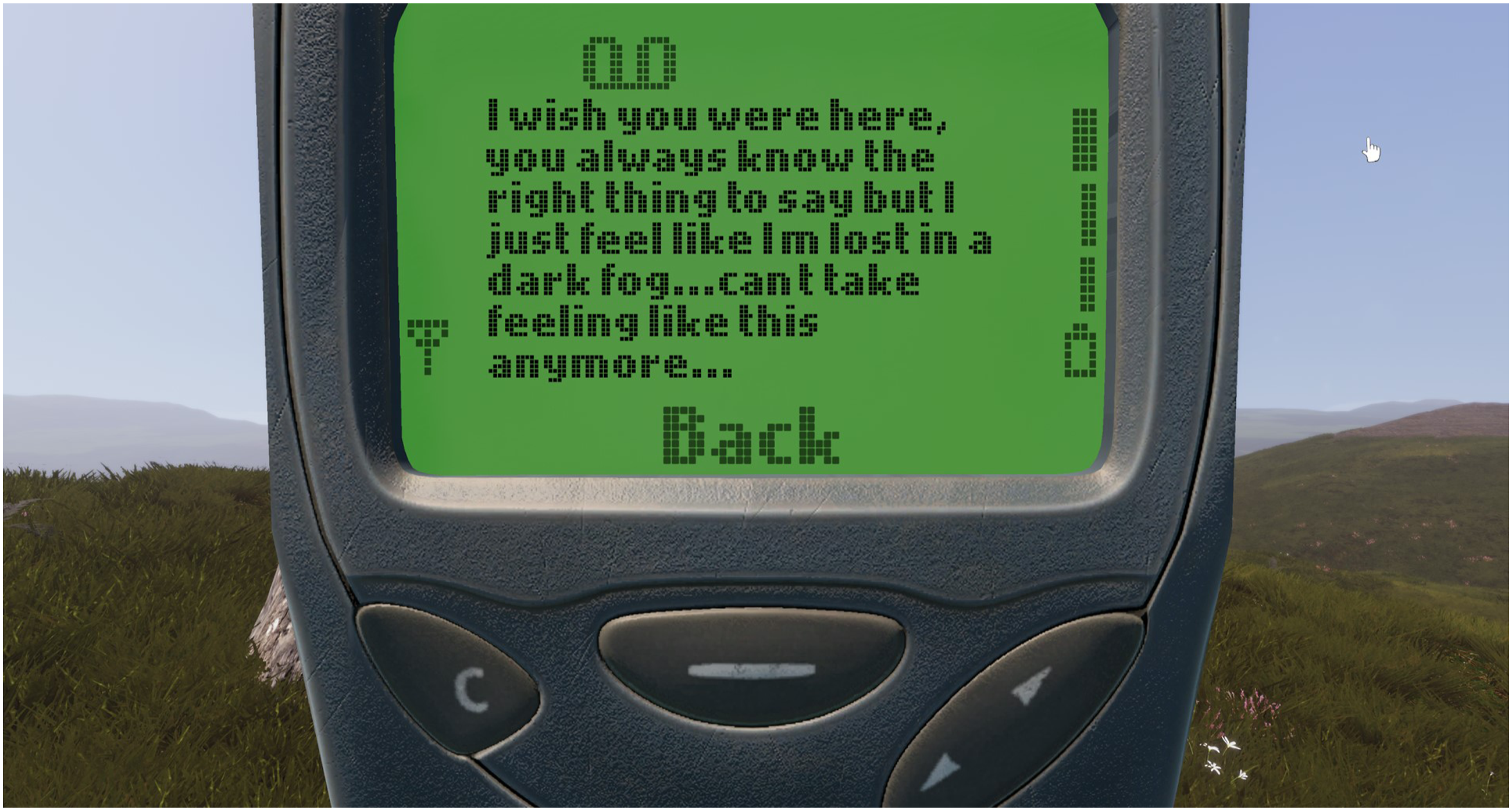
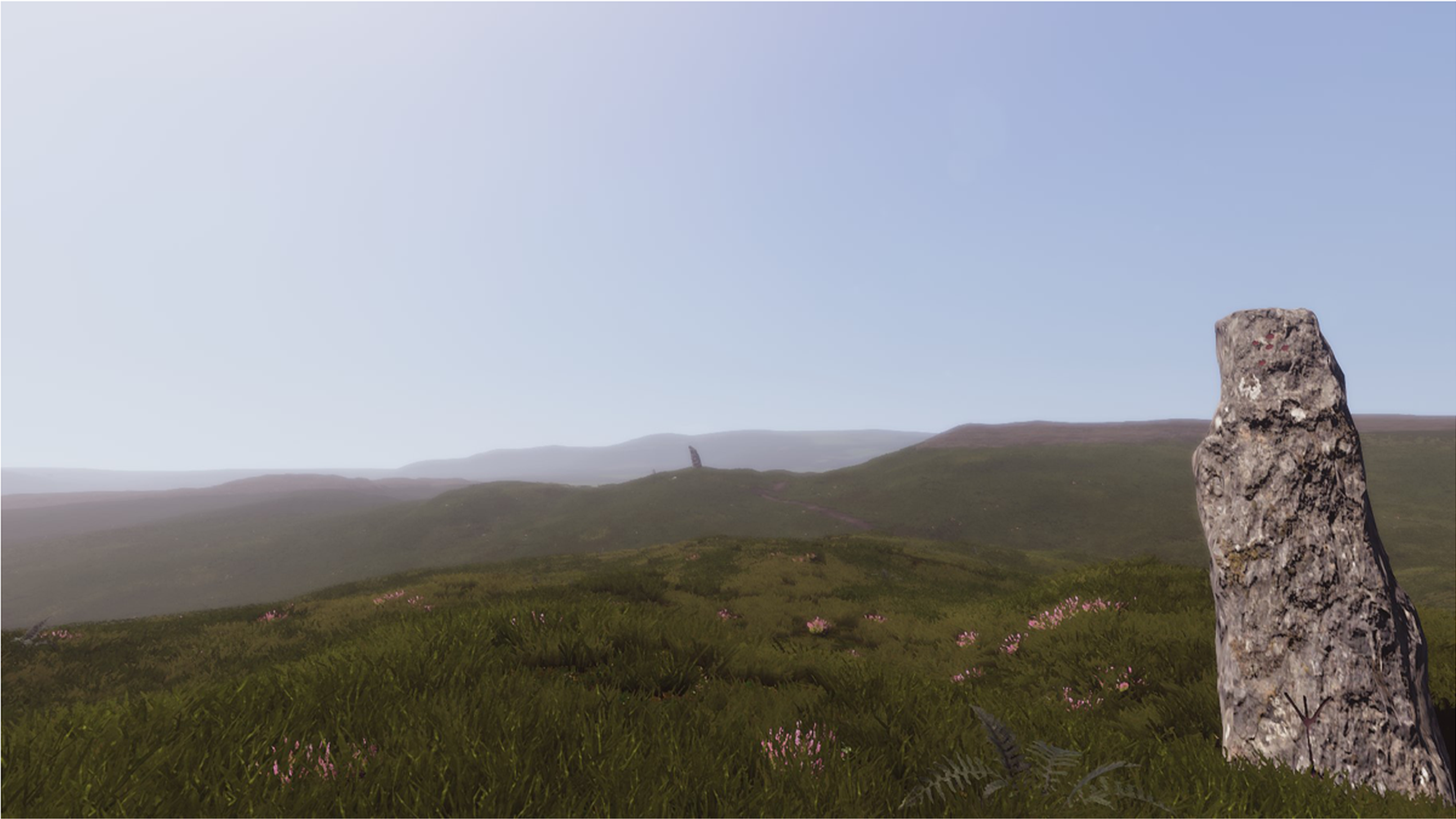
We also harness personal experience in deciding treatment of space and time for Los. Being a videogame designed for exploration and contemplation, it is important that Los’s environment facilitates freedom and lack of inhibition. Drawing on our own thoughts and feelings about solitude, remoteness and disconnection, we realise our personal connections to such affective notions primarily through evocations of isolated rural environments, nameless places and open spaces, however those concepts may be defined and/or related to each other (e.g. Tuan (1977)). Our thoughts centre on how to ‘create the experience of being alone, which for me seems to be a remote place, away from civilization, usually quite hard to reach. There is little or no human presence and a freedom to explore the landscape’ (first author’s design journal, 2020). We talk about where and how we take walks as evocations of getting lost and self-discovery. We draw on online images as affective triggers, such as landscapes of remote Norwegian mountain plateaus like Hardangervidda in southern Norway and Nordic islands such as Rolvsøy (Figure. 2, cf Figure. 3). Example of a reference image (the Hardangervidda plateau). Screen capture from Los’s environment as a comparative against its reference image.
In turn, these interconnections prime our mental states for designing Los as a videogame about freedom and autonomy for the player. We bring into play our personal evocations as keys in conceiving the colours, terrain, atmosphere, lighting and flora of Los’s virtual environment. We sketch and visualise the game environment (Figure. 4) in light of feelings, thoughts and conversations as described above. In this visual thinking, we are also inspired by what Paul Carter (2004) calls ‘material thinking’, or an ‘intellectual adventure peculiar to the making process’ (10). In this approach, we understand the digital world of the prototype and the game engine through dealing with the (paradoxical) ‘immateriality’ of the virtual in terms of the digital software’s modelling polygons, vertices, digital painting and texture maps. Through this convergence of ‘material thinking’ and personal experience, the practice of designing the videogame thus also becomes a nexus of connections across the subjective and the practical. Each informs, realises, extends and manifests the other in reciprocal supposition and exchange. Early test of Los’s island environment as taken from design journal.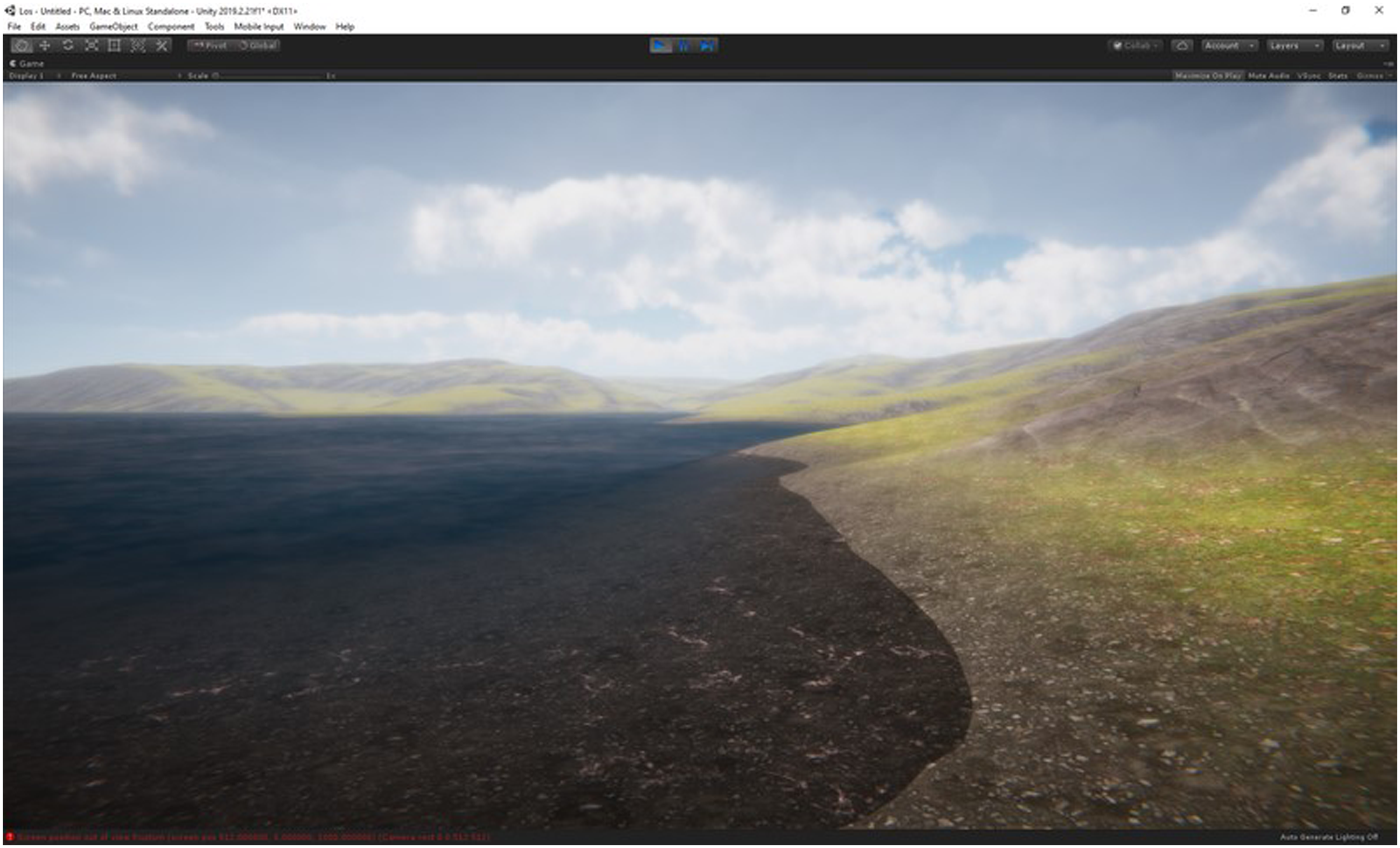
In these two ways, meaningfulness in the game design process is not simply solicited through the subjectivities of what we feel to be significant and important to us, even as we harness personal thoughts and feelings to orientate the prototype’s development. On these terms, it is unsurprising that creative work as a vital channel of personal expression should carry a streak or more of autobiography. That Dragon, Cancer (2016) is an example par excellence as a videogame containing play vignettes around a seriously ill child made by a husband and wife team who indeed lost their youngest son to cancer. It is clearly a meaningful game with multiple accolades and much positive critical reception highlighting its emotional impact, as is also the making of it to its creators who described the game as both a reconciliation of their child’s death and celebration of his life (Green, 2017).
However, the meaningfulness of game design is not always so clear-cut. The key here is to highlight a subtler triangulation of reflective practice against subjective experience and philosophical meaningfulness. We only perceived in retrospect our clarity on the distinction between the technical actions of the game design process – the sketching, coding, colouring, etc. – and the subjective threads of personal experience which ran through it, and how they fed and grew each other. At the time, the weaving of private histories and existential experiences into the prototype simply felt inherently ‘right’ as a knowledge that was difficult to articulate. We needed the disconnected method of reflection to realise that the exposing and unfolding of personal existential experiences was a kind of instinctive and intimate knowledge which vitally formed and informed the work. More importantly, that integration illuminated for us the meaningfulness of the creative process. Making this game is meaningful not only because it expresses in direct or indirect ways a little of what has been lived and the experiences which have been undergone, although that is certainly one part of it. More than that, its meaningfulness emerges from intertwining between subjective experience, making/‘material thinking’, intuition and personalised impulse. The creative practice is meaningful because, and only out of retrospective contemplation, its actions and reflections of personalised events and lived experience make sense against and with each other.
At the same time, we also present a cognitive understanding of objective goods as part of the meaningfulness in our making of Los, principally of beauty and family as knit together through tragedy, kinship and love. Meaningfulness of game creatorship, then, lies in the subjective and the objective: the former in terms of how it intertwines action and reflection; the latter on how making the game also realises objective goods. Without excessive mining into definitions of the objective good, we certainly also designed Los to serve beauty (articulated in terms of the game’s environment design, for which, as mentioned, we took inspiration from landscapes which personally affected us) and familial agapē love (as an integral theme of the prototype’s story which involves the introspection of the protagonist and their sibling about the loss of their father and finally discovering the parent’s love for them). While these objective goods intertwine with the personal, making the game also attains meaningfulness because we recognise items in the game as being objectively meaningful.
Flourishing
The second tenet of meaningfulness to emerge from our reflections relates to how we conceive of the cycle of struggle, overcoming and renewal in creative practice. Such cycles commonly relate to religious ideas. For instance, belief in reincarnation as held in major Asian religions revolves around continual processes of birth, death and rebirth (samsara) until a state of enlightenment (nirvana) is achieved for liberation from samsara.
However, for us, the meaningfulness of the cycle of struggle and renewal instead resonate with inner growth and self-development through overcoming obstacles, pain and anxiety. As discussed above, the flourishing of and fulfilment as a human being is linked to the meaningful life. We read this flourishing not just in terms of developing ourselves to the best that we can be in terms of our human capacities for rationality, freedom, etc. We also read flourishing by way of developing inner growth out of resilience and strength earned only by having overcome pain and obstacles. Such flourishing is to achieve something more than maintaining the brute husk of being human. It is also about the meaningfulness of constant endeavour and of raising courage to meet challenges despite the void and uncertainty of outcome.
Through our reflections, we map such flourishing out of the game design process through a conceptual scaffolding of journeying that features dominantly in myth narratives, with concomitant themes of growth and change. One such narrative is the monomyth, which Campbell (1988) describes as beginning with a hero answering a ‘call to adventure’, or a sign where ‘(t)he familiar life horizon has been outgrown; the old concepts, ideals and emotional patterns no longer fit; the time for passing of a threshold is at hand’ (51). The hero answers the call by embarking on a journey, undergoing trials which transform their consciousness where they achieve inner fulfilment, grow and flourish as individuals, and leave behind their old self.
In our mapped reflections, the research question for this article forms our immediate call to adventure, although its circumstances stem from deeper desires to better understand the profoundly affective experiences of both videogames and the playing of them. The journey itself, then, is the making process from conception to finalisation of output.
As with the mythic adventure, creating is neither easy nor straightforward. In part due as well to the subjective recognition of the stakes ‘in the game’ (as discussed above), our creative process inevitably begins with struggle manifest as a state of anxiety from uncertainty and unknowing about what needs to emerge from the void, and how it should do so (Figure. 5). Many creative professionals have similarly alluded to this sense of ‘the state of creation’ (Levine & Cerny, 2020, 13:10) in its pain, rejection, anxiety, uncertainty and unknowing (e.g. May (1975); Higgs & Tichen (1998); Carabine (2013)). Significantly, their descriptive terms or metaphors are also that of journeying, questing and exploration fraught with stress and tension. The game designer Ken Levine (2020) describes his specific process of creation as one of ‘revving the engine up’, and of being ‘on this run of all these really obsessive thoughts’ while also ‘need[ing] to get into that stage [of anxiety] so I can come up with ideas that are different’ (13:20). UK sculptor Anish Kapoor refers to how ‘one has to dare [to work, play, experiment]. I don’t really know what I’m doing, but I’m gonna go there so wholeheartedly it feels inevitable’ (as quoted in Carabine (2013), 67). In these descriptions lie key ideas not only of movement and expedition – of ‘revving up’ the engine and of ‘going there’ – but also overcoming obstacles of obsessiveness, anxiety and uncertainty. First author’s journal notes on creative anxiety and void.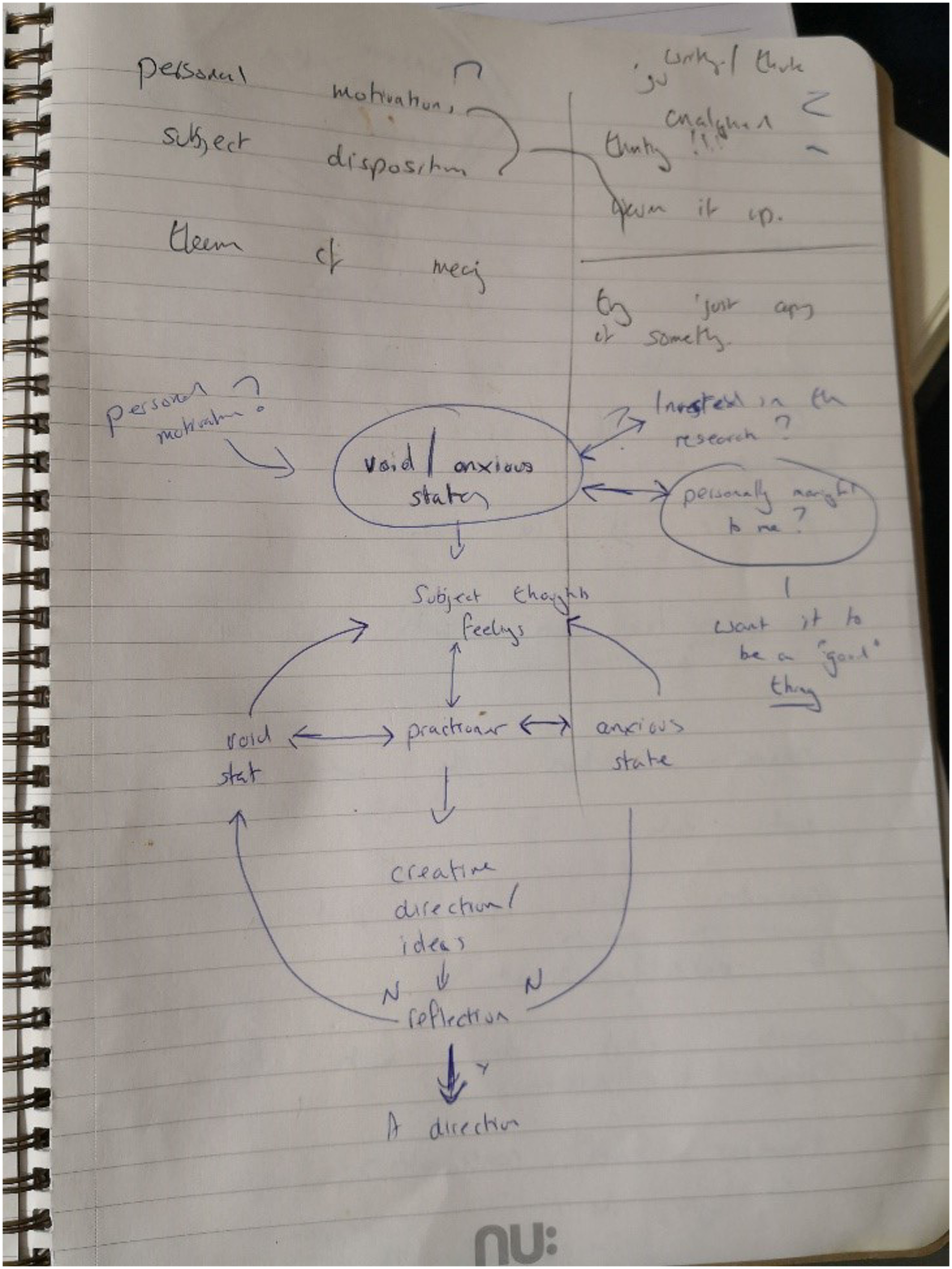
The key in our findings here is to recognise these states of pain, anxiety and discomfort as integral to being meaningful via the concept of a journey and its Campbell-ian resonances of inner growth and transfiguration. Journeying in this sense thus connects intrinsically to ‘flourishing’ as one of the philosophical keystones of meaningfulness: the pain in the journey is necessary in order for the activity to be worthwhile and productive; the growth is worthwhile only because it was borne out of a journey of pain, and flourishing only comes to pass out of that growth of ourselves as invested practitioners.
In this sense, the void and anxiety with which we find ourselves for Los becomes a paradoxical orientation for the creative process, producing a cyclical process of reflection, generation and rejection of ideas as the journeying towards a creative direction for the final output. Yet that journey is also profoundly introspective – it is not only a seeking of direction and paths to a manifest external output. As discussed, the process is also an often difficult and resistant self-exploration of ourselves as creative practitioners and as human beings with difficult histories, painful memories and lived experience. Figure 6 shows our conceptual diagram for these stages and tenets of the creative journey, formalised out of the authors’ journal entries and conversations. Conceptual model of the process/journeying of creative practice.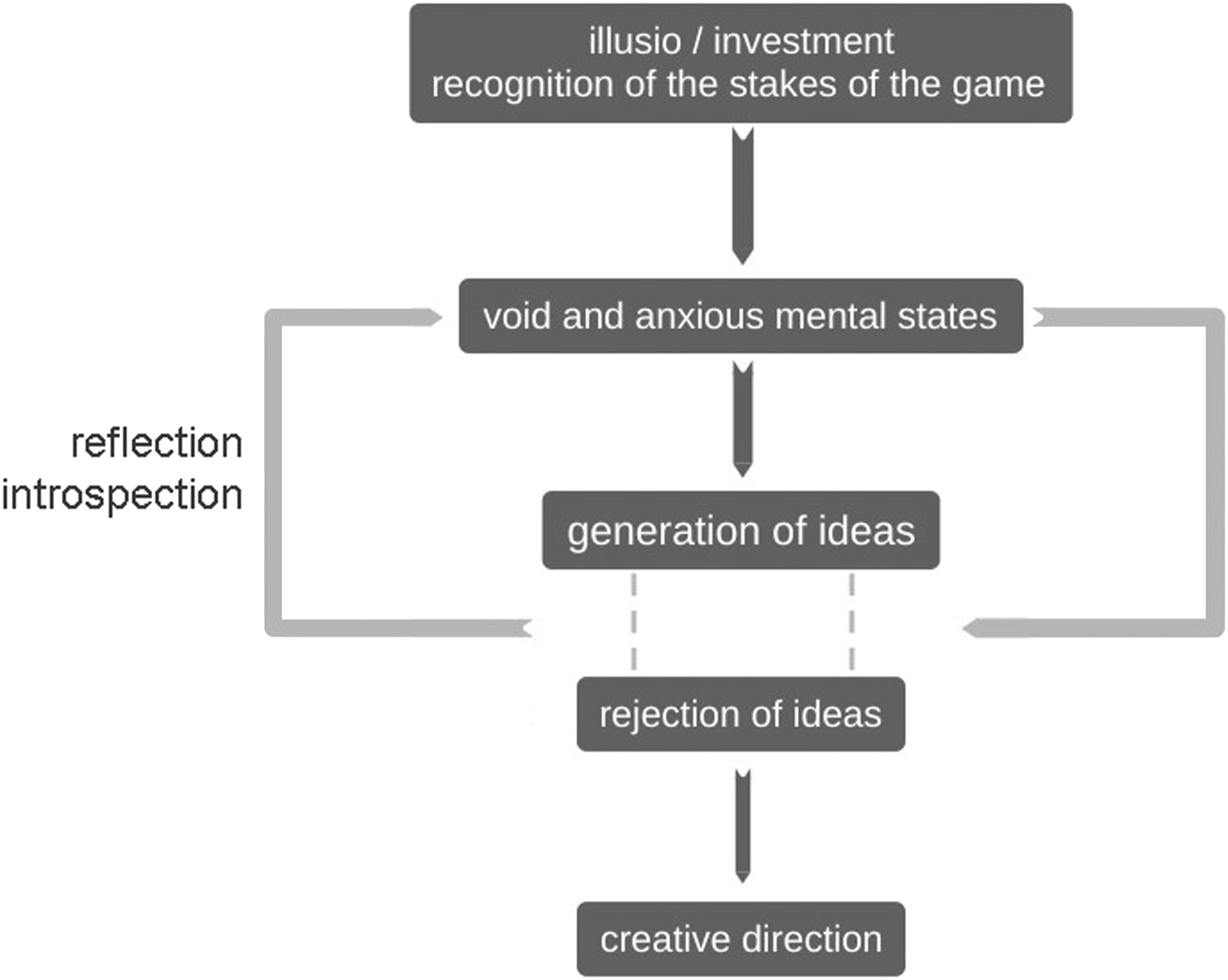
This conceptualisation in Figure 6 demonstrates the holistic and paradoxical space for the creative process through anxiety and uncertainty and so on to creative generativeness. In this space, too, is the harnessing of personal introspection, thoughts and feelings for the journeying which, as it unfolds, become the barometers, reflectors and triggers of inner growth and self-discovery. Reading the creative process as a spiritual journey with the role of myth as its framework thus informs why and how it might be meaningful. Such meaningfulness is not because of any specific value to its end results. Rather, it is because as a process it can be picked apart into a deeper, more abstract and more personal signification intrinsically linked with self-discovery, inner growth and, ultimately, a little more knowledge and maturation for the flourishing of the self. These outcomes translate into our inner richness as practitioners with fulfilled investment in our creativity and as human individuals made more aware of how our introspections, affects and emotions tie up with our practice. The meaningfulness of process in this sense becomes existential, where process and media provide the conditions for our growth and, in turn, our being and becoming of who we are.
Conclusion
In this article, we sought to better understand how game design may be understood as being ‘meaningful’. From a reflective methodology which triangulated creative practice, reflections on process and (brief) literature on the philosophies of meaningfulness, we presented two tenets of meaningfulness in game design. The first is in terms of subjectivity, where meaningfulness is anchored to the creators’ investment in the ‘game’ of making. We also channelled subjective meaningfulness through intertwining personal histories, experiences and memories between reflection and action. The creative process was thus meaningful not only in terms of autobiographical detail, but by being a conversation between reflection and action where one led from, fed into and developed the other. Our reflections also revealed the process of making the game as one which served objectively meaningful goods of beauty and familial love. The second tenet of meaningfulness is in terms of mapping creative practice as a journey, where the states of anxiety, void and uncertainty act as the hurdles out of which growth and self-discovery may develop, and the individual may flourish.
Our intention in this article was to interpret or ‘paint’ the game design process in a particular light. We do not mean this picture as a universal application. Not all creative processes need to be meaningful or interpreted as being meaningful. Games can be and are made out of all kinds of motivations. For instance, game design may also be read as processes of technical achievement and craft. Our aim was to present a different consideration of the game design process. In the process, we also wanted to demonstrate a reflective methodology as an approach for drawing insights not only about game design, but creative processes in general. In a broader picture, we also hope this article may initiate different conversations as to how we may more widely understand and continue to develop games, game design and gaming culture to be more than just entertainment and for pleasure. Games belong well and truly in our cultural tranche of objects and processes about the meaningfulness of being human. That makes them important. At the end of the day, meaningfulness is the light out of the often brutal storm of life. It is that from which we find and draw the will to live and carry on.
Footnotes
Declaration of Conflicting Interests
The author(s) declared no potential conflicts of interest with respect to the research, authorship, and/or publication of this article.
Funding
The author(s) disclosed receipt of the following financial support for the research, authorship, and/or publication of this article: This work was supported by XR Stories, using public funding as part of the Creative Industries Clusters Programme, an £80m initiative led by the Arts and Humanities Research Council, part of UK Research and Innovation. XR Stories is based at the University of York.

Notes
Author Biographies
Tim Newsome-Ward is an independent videogame designer and developer. He is the lead designer and co-founder of Desktop Daydreams Studios and has designed and developed various videogames.
Jenna Ng is Senior Lecturer in Film and Interactive Media at the University of York, UK.