



Abstract
The goal of this article is to propose Game World Design and Analysis for Socio-Ecological Systems (GAS), a framework for the design and analysis of game worlds through socio-ecological systems lenses. Game World Design and Analysis for Socio-Ecological Systems invites designers to a structured reflection of their choices regarding game world correspondence with a real or fictional reference system (assessed through accuracy, comprehensiveness, and balance) and game world consistency. The framework spells out the main elements to be included in the game world for that to be a credible socio-ecological system. The GAS framework is demonstrated on Nusfjord (2017) as an exemplar of natural resource management–themed analog game. The framework is built using an interdisciplinary approach to game studies, history, media and literary studies, and natural resource management research. The application of the framework has the potential of making the design and analysis of game worlds more relevant to the sustainability discourse of the 21st Century.
Introduction
Against the backdrop of the global development challenges of the 21st century, systems thinking is increasingly important for people’s daily lives. Games also exhibit this trend, with scholars pleading for incorporating more complex systems concepts into commercial games as a way to offer “a public outlet for exploring the complex interdependencies of a changing world” (Kelly and Nardi, 2014, no page). While this is a timely and sensible advice, how to follow it is not straightforward, either from a design point of view or a game analysis one. This study aims to offer concrete guidance on how the concept of systems and, more specifically, socio-ecological systems (SESs), can be included in games, be they digital or analog, by proposing a framework for the design and analysis of game worlds: the GAS framework—
After describing the GAS framework and its potential users (i.e., game designers and game analysts), we demonstrate its use from an analyst perspective, by examining Nusfjord (2017) as an exemplar of natural resource management–themed game. This is a successful and high profile board game, with a clear economic development theme and placed in a historical context. In this game, the players take the roles as the owners of a major fishing company in Nusfjord, a small fishing village in the Lofoten archipelago in Norway. Nusfjord is a real place and the Lofoten fishery is a significant part of Norwegian coastal and fisheries history. Nusfjord the game is designed by Rosenberg (2017) and it is published for the commercial entertainment market. The scope of the game analysis is to demonstrate the applicability of the framework in relation to the discourse on sustainable SESs management.
This study contributes to the debate on whether and how contemporary board games could become more progressive in their depiction of SESs (e.g., LaPensée (2016)). Today’s game designers have certain responsibilities, and transforming players for the better is one of them (Schell, 2019). Designers have the challenge, and opportunity, to design for innovation, to produce ground-breaking player experience by trying to solve difficult problems in game design such as addressing the relationships between games and learning, or asking difficult questions about what games are, what they can be, and what their impact is on the players, both individually and culturally (Fullerton, 2018). Responding to these demands, the GAS framework empowers designers to move players from having a simplified concept of the world they are immersing themselves in during play to reflecting on all dimensions of SESs and, as such, be more aware of the world they live in. The benefits of using GAS as a design tool range from streamlining world design practices to helping the designer in becoming an active agent of change through creating meaningful play.
Socio-Ecological Systems
Within a system, the component parts and the static relationships among them are the structure of the system, whereas the changes that occur in those components and the relationships among them over time are the processes characteristic of the system (Raser, 1972). Thus, in order to simulate any system, one must be able to describe both the structure and the processes of the system. Since SESs are a set of critical resources—natural, social (including cultural), and economic—whose flow and use are regulated by a combination of ecological and social systems (Redman, Grove, & Kuby, 2004), in their case, the structure includes component parts from both ecological and social systems. Fisheries, forestry, agriculture, water harvesting, or urban areas are examples of SESs. These are all instances when humans intervene in a natural environment that, in turn, shapes humans and their societies. A SES can be described in various ways: a coherent system of biophysical (e.g., grass and rocks) and social factors (e.g., rituals and employment) that regularly interact in a resilient, sustained manner; a system that is defined at several spatial, temporal, and organizational scales, which may be hierarchically linked; and a perpetually dynamic, complex system with continuous adaptation (Redman et al., 2004). As explained in Weber (2019), SES components interact in nonlinear ways that make responses and the effects of change difficult to predict. Socio-ecological systems function in a two-way feedback loop, in which a change in one subsystem can impact the other, and vice versa. Socio-ecological systems are hierarchic, for example, governmental institutions on city level, provincial level, or national level are hierarchical levels within the social subsystem, or the Antarctic Atlantic, the Weddell Sea, and the Larsen Ice Shelf depict a nested ecosystem with subsystems of different spatial scales.
As Ostrom (2009) explains, “SESs are composed of multiple subsystems and internal variables within these subsystems at multiple levels analogous to organisms composed of organs, organs of tissues, tissues of cells, cells of proteins, etc. In a complex SES, subsystems such as a resource system (e.g., a coastal fishery), resource units (lobsters), users (fishers), and governance systems (organizations and rules that govern fishing on that coast) are relatively separable but interact to produce outcomes at the SES level, which in turn feedback to affect these subsystems and their components, as well other larger or smaller SESs.” In real life, managing these systems without taking into consideration all their components and the relationship between them is considered a wicked problem, numerous examples showing how challenging it is to develop fisheries, forestry, agricultural exploitations, mining, or urban areas in a sustainable way (Defries & Nagendra, 2017).
The SES that is included in the demonstration of the framework proposed by this study is fisheries. As explained in Syed, Borit, & Spruit (2018), the two main dimensions of a fishery are the human dimension (i.e., human agents, communities of these, and their institutions) and the natural dimension (i.e., biotic, such as predator species and prey species, and abiotic, such as water temperature and nutrients).
Worldbuilding
There are three dimensions that characterize every game (Aarseth, 2003): gameplay (the players’ actions, strategies, and motives), game structure (the rules of the game, including the simulation rules), and game world (fictional content, topology/level design, textures, etc.). As such, there are many types of game design (Brathwaite & Schreiber, 2009): system design (the creation of rules and underlying mathematical patterns in a game), user interface (the design of how the players interact with the game and how the player receives information and feedback from the game through game components), and world design (the creation of the overall backstory, setting, and theme of the game; it often determines the scope of all the other design tasks related to the game).
The game world exists in the imagination of the player, and the game is a doorway to this world (Schell, 2019). The world presented by the game cues the player into making assumptions about the rules of the game (Juul, 2005). For example, if an object looks like a fishing boat, it is supposed to catch fish. At the same time, the rules of the game cue the player into imagining the world (Juul, 2005). For example, if one rule is that all the fish is sold at the end of a round, the player can imagine that there is a market for that fish, even though this market is not explicitly described. Thus, through the combination of rules, mechanics, and components, games create an imaginary world that the players experience. The actions made by players convey a sense of a connected whole: players create a story in the world of the game through the actions they make (Arnaudo, 2018). Worldbuilding is the design of this imaginary world, often beginning with space and time representations, but “potentially including complete cultural studies of inhabitants, languages, mythologies, governments, politics, economies, etc.” (Fullerton, 2018) Designing game worlds bears similarities with the design of imaginary worlds for other media, for example, movies, literature, or extended reality (Zaidi, 2017). As such, methods to build worlds or analyze them can be borrowed and used across media.
According to Wolf (2014), imaginary worlds have three properties that have to be taken into consideration during the worldbuilding process: invention, completeness, and consistency. Invention can be defined as the degree to which default assumptions based on the real world (or Primary World) have been changed in the game world (or Secondary World), “regarding such things as geography, history, language, physics, biology, zoology, culture, custom, and so on” (Wolf, 2014). Designers can decide if they want to invent a lot of the world (e.g., names, artifacts, technologies, customs, landmasses, animals, creatures, and laws of time and space), like in Gloomhaven (2017), which takes place in a fantasy setting. Designers can also stay as close as possible to the real world, like in Agricola (2007), where players are farmers in 17th century Germany. The second property, completeness, refers to the degree to which the world contains explanations and details players could expect. Besides the quantity of details included, a sense that the world has a background and history is also necessary for it to seem complete. The third property, consistency, is the degree to which world details are feasible and without contradiction (e.g., the world of The Manhattan Project: Energy Empire (2016)). Lacking consistency may make a game world seem sloppily constructed, or even random and disconnected. Inconsistencies may appear in the storyline, background details, world infrastructure, or world mechanics. As each of these properties grow, worldbuilding becomes more challenging because increased completeness requires more complex consistency checks, while consistency will limit what kind of invention is possible when the world grows. Thus, all three properties should be considered simultaneously as the world takes shape. The optimal combination of invention, completeness, and consistency would make a game world more or less believable, possibly having consequences on gameplay and the feeling of immersion (Wolf, 2014), although sometimes players may become less interested in the representational level of the game and more focused on the rules of the game (Juul, 2005).
When building a game world based on real places, people, or events, one also invokes history. Whether or not the game is designed as a historical game cannot be easily decoupled from the way in which it makes use of aesthetics that evoke a historical setting. Considering that games contribute to constructing players’ understanding of their own past, it is critical to engage in the debates surrounding the legitimacy of games as historical representations (Begy, 2017).
In the context of a game that invokes a historical setting, an important element is that games are processes, not artifacts, and through gameplay they provide players with agency in how the representation of history is constructed and experienced (Kapell & Elliott, 2013). Furthermore, games allow players to both experience a systemic context for the actions they make as well as the consequences of these choices. The place of history in games is not only limited to illustrate actions and reactions but to foster engagement with the past. Returning to the argument made by Begy (2017), this makes questions of legitimate use of history apparent. The representations of history that players experience in games can form or shape their understanding of history. This means that game designers have the responsibility to reflect on the degree of accuracy (or the degree of invention, to use Wolf’s terminology) they aim for when the game worlds they design incorporate or simulate the real world, and to make their decisions explicit, to avoid misunderstandings. For example, Twilight Struggle (2005), which simulates the Cold War between the United States and the Soviet Union, uses the discredited geopolitical “domino theory” as the basis for its simulation, which makes an engaging game, but can promote misunderstanding of the complexity of the Cold War (Harrigan & Wardrip-Fruin, 2011).
GAS Framework
Description
While there are several influential publications for guiding game design (e.g, Bjork & Holopainen, 2005; Duke, 2014; Elverdam & Aarseth, 2007; Engelstein & Shalev, 2019; Järvinen, 2008; Juul, 2005; McCall, 2020; Schell, 2019), none of these includes a detailed description of how to design the game world. Facing this challenge when designing our own games, we decided to build the GAS framework as a solution that we first used ourselves and then decided to share with the wider community. Since worldbuilding is an exercise undertaken in a variety of other fields (e.g., movies, literature, or mixed reality experiences), although the terminology applied to the process may differ (Zaidi, 2017), advice on worldbuilding from these related media can be adapted for game design, and we have used this approach when building GAS. As noted by Rapoport, “[…] frameworks are neither models nor theories. Models describe how things work, whereas theories explain phenomena. Frameworks do neither; rather they help to think about phenomena, to order material, revealing patters …” (Rapoport 1985, page 256). As such, we have chosen to call our design and analysis tool a framework.
The
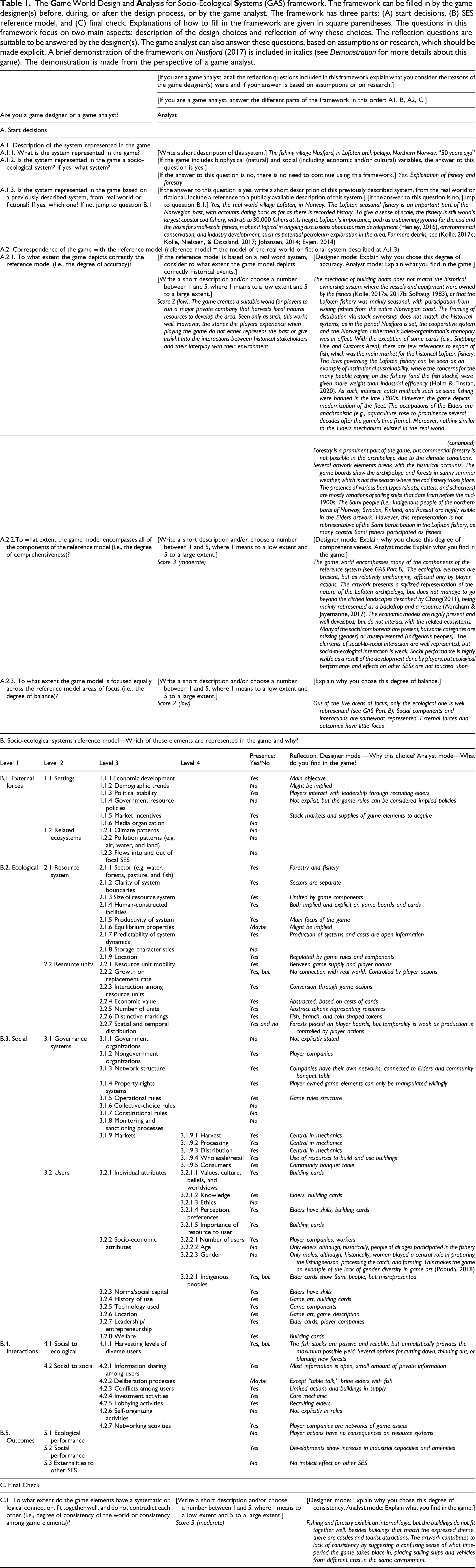
The core principles of the framework are (1) games are vehicles that transport their players between different realities (Peters & Westelaken, 2014); (2) games tell stories through the combination of content and mechanics that create a consistent world where players have agency (Arnaudo, 2018); (3) like other forms of media, games are lenses through which their users experience and gain awareness of different topics (Schell, 2019). The framework is divided in three parts: decisions that are taken in the beginning of the world design phase (Part A), reflection over general elements of a SES (Part B), and considerations that have to be made in the end of the world design phase (Part C), although these considerations can be kept in mind throughout the design process.
The elements listed under Part A of the GAS framework invite to structured reflection over the correspondence between what is intended to be represented through the game world (or the Secondary World) and a previously described system, either fictional or real world (or the Primary World). We call this previously described system a reference system. Building on Wolf’s concepts of invention and completeness presented in the section Worldbuilding and on (Smythe & Thompson, 2015) practical approach to capturing internal cognitive representations of a real world, the GAS framework includes three reflection points: (1) The degree of accuracy, understood as the extent the game world correctly depicts the reference system. (2) The degree of comprehensiveness, understood as the extent to which the game world encompasses all of the components of the reference system. (3) The degree of balance, understood as the extent to which the game world is focused equally across the reference system’s areas of focus.
The elements listed under Part B of the GAS framework build on a fusion of two of the most relevant SES frameworks used in natural resource management (Charles, 2000; Ostrom, 2007, 2009). Ostrom’s multitier framework for analyzing a SES provided our GAS framework the conceptual tiers and linkages among the elements that constitute a SES. Because SESs are decomposable systems, each of the highest-tier conceptual elements can be unpacked and related to other unpacked elements. Thus, Part B of the GAS framework is organized in levels. Charles’ depiction of the fishery system provided some additional elements related to the natural, human, and management systems that interact in an SES where humans rely on the harvesting, processing, and distribution of goods. The framework can be used with any (game)world that is intended to be a representation of a SES (e.g., fisheries, forestry, aquaculture, farming, mining, or city development).
Part C of the GAS framework brings attention to the extent in which game elements have a systematic or logical connection, fit together well, and do not contradict each other, that is, degree of consistency of the world or consistency among game elements. Although the GAS framework includes this reflection point as a final check, the degree of consistency should be kept in mind throughout the design phase, especially when building complex worlds where various elements build on each other.
The framework accommodates both qualitative and quantitative minds, as the reflection over the degree of each specific measure (e.g., balance and accuracy) can be made by writing a short description and/or by using a partly anchored 5-point numerical rating scale, which is generally considered to provide the respondent sufficient enough graded choices (Burke Johnson & Christensen, 2014). When used by designers, reflection on this degree happens in the beginning of the process (i.e., one decides how historically correct the game should be and then designs game elements), while when used by analysts, this reflection is made in the form of an evaluation performed after analyzing the game.
Users
As mentioned above, we envisage two types of users of the GAS framework: world designers and researchers/analysts. Thus, the framework can be used in a designer mode or an analyst mode. These users can be cross-media world designers and researchers/analysts (e.g., board games, video games, comics, film, literature, extended reality, etc.), although the wording of the framework focuses on game designers/analysts. Practitioners with a specific interest in generating worlds, or in creating meaningful play by helping the players make sense of the complex interdependencies of a changing world, can use the GAS framework as a complementary tool to any other tools that are out there on game design, for example (Raphael, Bachen, Lynn, Baldwin-Philippi, & McKee, 2010; Schell, 2019), or on worldbuilding, for example (Wrede, 2009; Zaidi, 2017). An important aspect of using the GAS framework, regardless the mode, is that, while other similar frameworks or worldbuilding processes focus mainly on separate elements of a world (Zaidi, 2017), GAS provides a method to depict the interconnections of these elements within a system. By being straightforward and providing a worked example, the framework can be easily embedded in everyday practices of designers and analysts.
Worlds designers, be they worldbuilding practitioners across media, graphic designers, or designers of bits for games (e.g., character meeples and shaped resources), can use the framework as a checklist or a fill in matrix. However, the elements of the GAS framework are not exhaustive, and items can be added as needed. The framework does not list items in order of importance because their importance varies in different contexts. However, it must be made clear that these items are not isolated silos and the SES is not the sum of the elements, but emerges from their integration within a game and through the meaning created by the player from the game manual, title, box, rules, and other elements before, during, or after playing the game. As also explained by Wrede (2009), while many of these elements may be helpful or crucial to certain game worlds, they will not all apply to every world. It is not necessary for a designer to include all, or even any, of the elements in order to start or finish designing. The idea is simply to provoke designers into thinking about the ways their settings and backgrounds hang together or not from a SES perspective. The GAS framework should not be considered an exhaustive and final list, but as a starting point from which each individual designer can compile a personal list. The number of elements may lead to confusion about what is essential to the game world and what is not, and render the process of building a coherent world challenging, especially if designers are picking and choosing elements from different categories. If coherence is relevant for the game, then we advise game designers to have this property in mind when reflecting over the framework elements. Moreover, as Flanagan (2009, p. 261) noted, “most players are not attracted to overly didactic communication,” thus designers have to reflect over what is the right balance of elements for their game world in order to create a safe place where players feel comfortable to play, even in a critical way.
As in the case of designers, the GAS framework can be used as a complementary tool to any other tools that are out there on game analysis, for example (González & Adelantado, 2016; Lindley, 2003). By operationalizing elements of a SES, it is possible for researchers/analysts to assess the SES representation in the game and reflect over what critical theories can be used for analyzing some elements of the game or the game as SES (e.g., eco-criticism or indigenous criticism).
Demonstration
Proposing guidelines seems easier than applying them. Thus, in order to show the applicability of the GAS framework and to encourage the reader to use it, we provide a demonstration of the tool from an analyst perspective in Table 1. In order to help the reader follow the comments included in the demonstration, we provide here a general description of this game. For the purpose of this study, the Nusfjord coastal area in Norway is considered our focal SES. In Part B of the demonstration, the game elements in Nusfjord the game are mapped to the SES elements of the framework.
Summary of the main aspects of the game Nusfjord (2017). Classifications with asterisk are reported from www.boardgamegeek.com, June 5, 2021.
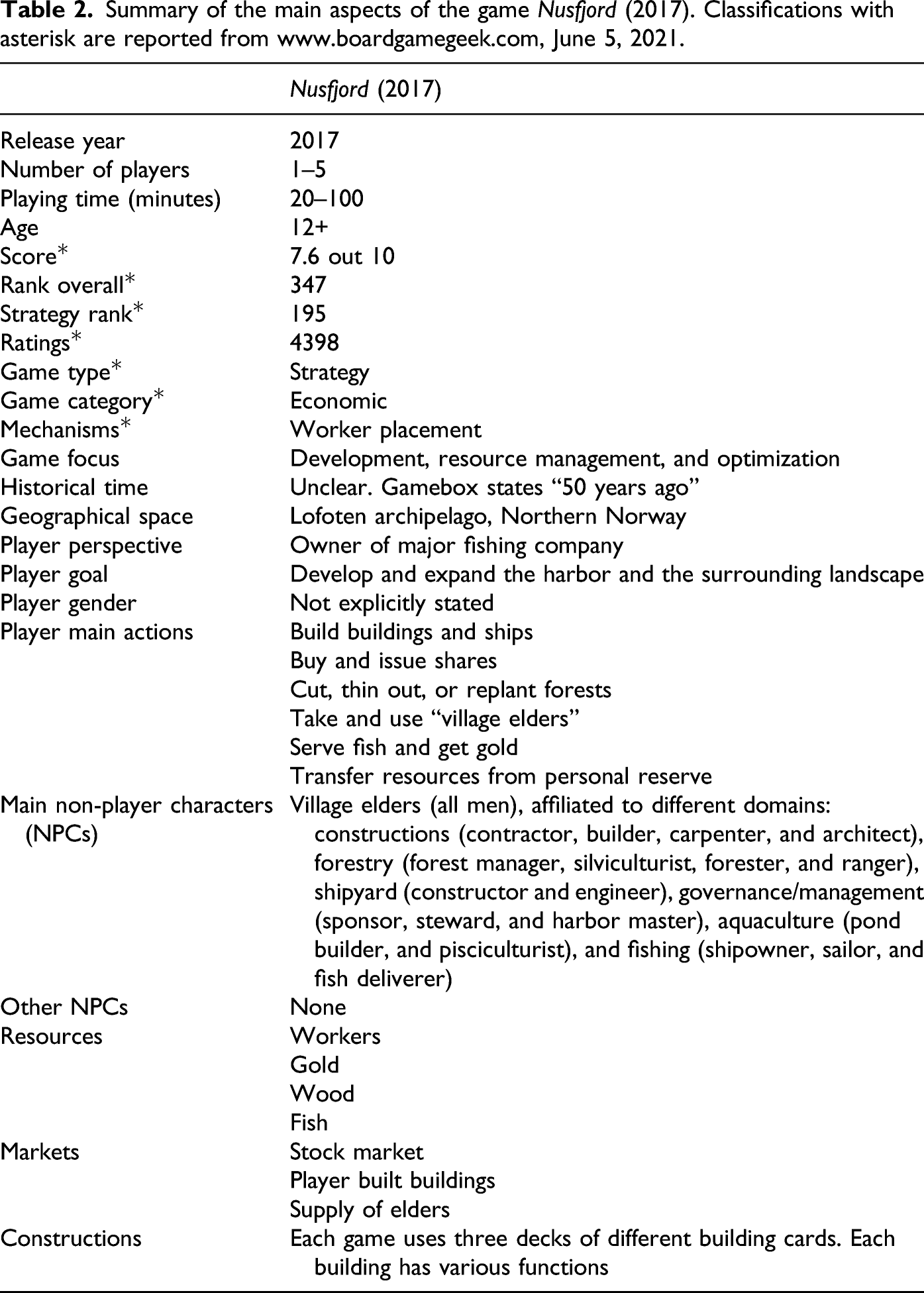
Here, we use the terminology from Engelstein and Shalev’s Building Blocks of Tabletop Game Design (2019) to reference the game mechanics. Nusfjord is a competitive game (STR-01). The goal of the players is to develop and expand their harbor and the surrounding area. Each player has their own harbor area board, with dedicated space for buildings, forest tiles, and ships. The game comes with the different decks of buildings that emphasize different elements of the game: “herring,” “codfish,” and “mackerel.” There is a small element of Hidden Information (UNC-08), as each player gets a private hand of buildings in the mid-stages, which they can build before these enter the common pool. The worker mechanic reinforces the economic development theme, as the actions in general do not involve fishing. Players can reserve special actions by recruiting special Elder cards.
Conclusions
Based on SES theory and worldbuilding design principles, our study expands the pool of tools available to the critical game designer by introducing the GAS framework, a tool for design and analysis of game worlds through SESs lenses. The framework shows how focus on the components of SESs can inform decisions taken when designers engage in worldbuilding for games, or researchers analyze game worlds. Through focusing on the accuracy, comprehensiveness, and balance of the elements in a game world, it is possible to gauge the correspondence of the game world with a given SES. Not all games aim for historical accuracy or lifelike settings, but by analyzing these elements, designers or analysts can structure their critical reflection on the values and mental models that are embedded in games and how they shape the narratives players create when playing them.
We present a brief demonstration of the framework in the analyst mode by examining the SES of Nusfjord (2017), that is, mapping the game elements of Nusfjord into the general components of a SES. The demonstration shows how the game has moderate comprehensiveness and consistency, in addition to low balance and accuracy. The game designer has stated that the development of the game began as a stock market game (Weber, 2017), which is visible in the game’s catch distribution mechanic. However, in Nusfjord, harvest of resources has no lasting consequences, and the function of the environment is to provide resources for the expansion of the players’ companies. The underlying paradigm that focuses on development and growth without posing any questions about scarcity and sustainability is, unfortunately, common in games (Kelly & Nardi, 2014). The actions of players will not affect the sustainability of the fish stocks, and while it is possible to deforest the game world, players can reforest the island instantly.
The GAS framework is intended as a tool that can be combined with other approaches and frameworks, contributing insight on how fields pertaining to governance and natural resource management can be combined with game studies. In light of the current focus on human impact on the natural environment, reflection on how human beings understand their relationship with the resource systems human society depends on is too important for games not to treat seriously. In future research, the GAS approach can also be operationalized more specifically on other topics dealing with sustainability.
The GAS framework is a potentially powerful tool for designers (and game analysts alike) to guide the players through the complexity inherent in SESs, as playing (simulation) games is considered a way to understand complex systems of relationships and to acquire a holistic sense of how everything is connected (Schell, 2019). We believe that this move can be achieved through restructuring the design of game worlds around structured reflection about the system to be depicted by the game. “Through participation in a game, the players experience environments and situations where they have meaningful interactions with the elements that are present in the game, creating a space for questioning the content of the game” (Flanagan, 2009). Such questioning, coined as “critical play,” is characterized by a careful examination of social, cultural, political, or even personal themes that function as alternates to popular play spaces. Since the meaning players will extract from their play emerges from the choices made by the designers, it is important to be conscious about what implicit mental models are embedded in the game by these choices. As such, the GAS framework can support designers in their iterations of creating meaningful play by adding reflection points on how the complexity of SESs is considered in the values embedded in their design.
Footnotes
Acknowledgments
This research was supported by the project SimFish ‐ Innovative interdisciplinary learning in fisheries and aquaculture (UiT Fyrtårn 2015 and NUV-P47/2016). The authors would like to thank Kristine Ask, for her comments on an early draft, and Bjørn‐Petter Finstad, Petter Holm, Bruce Edmonds, and Loïs Vanhée, for useful discussions and advice.
Declaration of Conflicting Interests
The author(s) declared no potential conflicts of interest with respect to the research, authorship, and/or publication of this article.
Funding
The author(s) disclosed receipt of the following financial support for the research, authorship, and/or publication of this article: This work was supported by a UiT The Arctic University of Norway grant no. UiT Fyrtårn 2015 and Norgesuniversitetet grant no. NUV-P47/2016.
