



Abstract
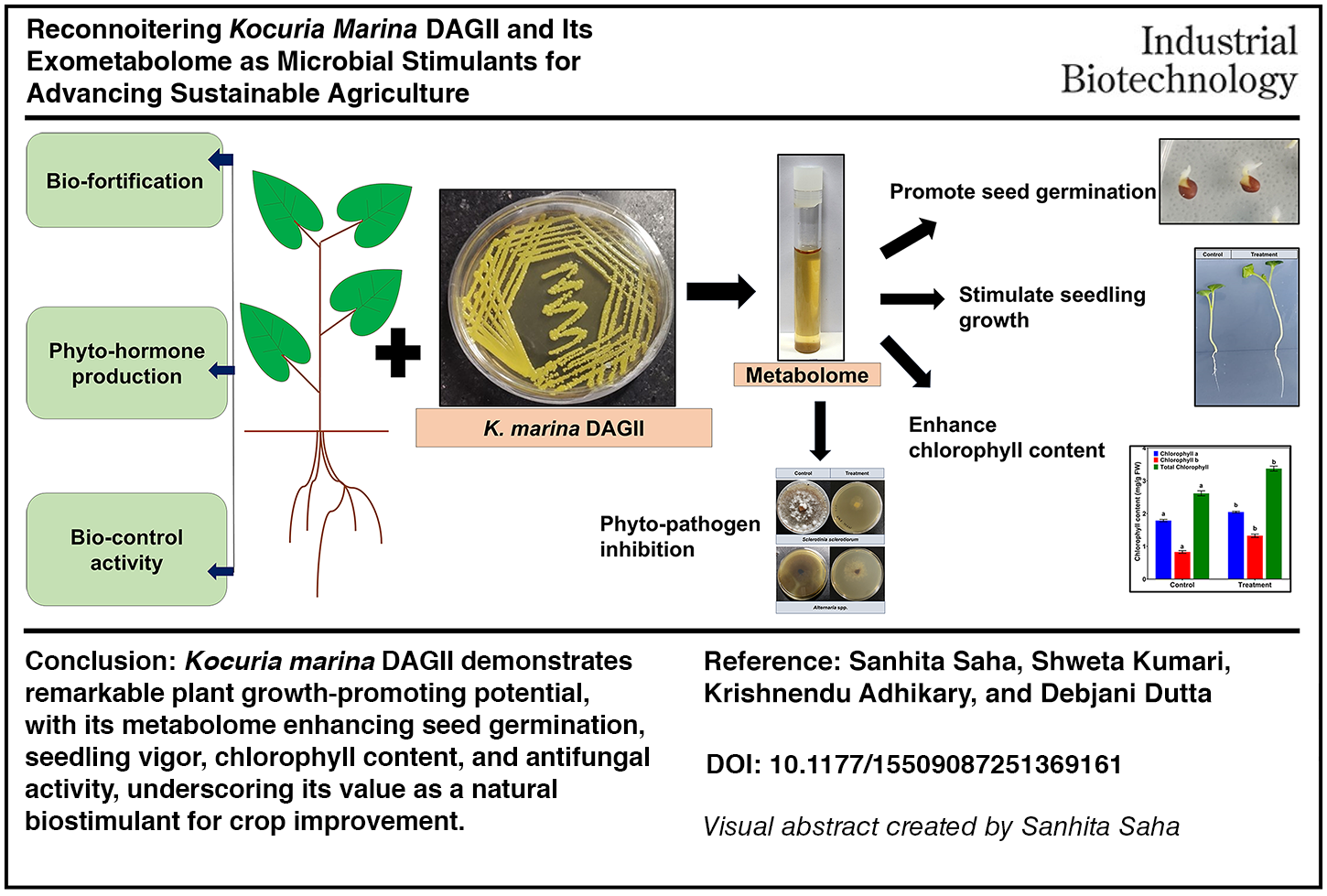
Sustainable approaches to modern agriculture are essential for ensuring food security, reducing environmental degradation, and addressing socioeconomic challenges. Biostimulants have emerged as a promising, eco-friendly alternative, helping to reduce the reliance on agricultural chemicals and promoting more resilient and sustainable farming systems. This article was designed using a two-way process, where the effect of Kocuria marina DAGII as a plant growth promoter was studied. In the second part, the exometabolome was applied to mustard plants (Brassica juncea), a crop of significant agricultural importance, to assess its impact on stimulating growth and seed development. K. marina DAGII helped micronutrient solubilization and organic acid production, facilitating the absorption of essential nutrients. Nitrogen fixation was confirmed, as the bacterium could produce ammonia. The bacterium synthesized growth-promoting phytohormones, including indole-3-acetic acid (651.86 μg/mL) and gibberellic acid (368 μg/mL). Siderophore formation demonstrated its ability to chelate Fe3+ and detoxify harmful metals. Hydrolytic enzymes, siderophores, and hydrogen cyanide production reflected its strong biocontrol properties. Seed biopriming with exometabolome resulted in a 26.34 ± 1.52% increase in seed germination, along with a 71.74 ± 4.95% improvement in vigor index and a 49.35 ± 2.2% increase in total chlorophyll content. The exometabolome showed in vitro antifungal activity against Sclerotinia sclerotiorum and Alternaria sp., two major mustard pathogens, aiding plant disease protection. The genotoxicity study confirmed the biocompatible nature of the bacterium and its exometabolome. This study establishes a foundational framework for assessing the industrial applicability of K. marina DAGII as a biostimulant, aiming at enhancing sustainable agricultural productivity while maintaining environmental integrity, thereby facilitating its development and commercialization as an eco-friendly agricultural solution.
Keywords
Get full access to this article
View all access options for this article.
References
Supplementary Material
Please find the following supplemental material available below.
For Open Access articles published under a Creative Commons License, all supplemental material carries the same license as the article it is associated with.
For non-Open Access articles published, all supplemental material carries a non-exclusive license, and permission requests for re-use of supplemental material or any part of supplemental material shall be sent directly to the copyright owner as specified in the copyright notice associated with the article.
