




Abstract
With more than 2.5 million catalogue records the British Museum’s digital collection database is one of the largest museum databases in the world, constituting a primary point of access to the collections both internally and externally. But its recording systems, developed over multiple generations, contain problematic data in a structure dominated by a single language. This article focuses on efforts to transform a portion of the data within the structural complexities. In 2021, a Hawaiian language research group was formed at the British Museum. Named Keaukānaʻi, this group supports the development and integration of a new taxonomy in ʻōlelo Hawaiʻi (Hawaiian language) for describing Hawaiian ancestral treasures physically at the museum. The authors reflect on the work initiated to deconstruct taxonomical violence, and to build a new path forward for hosting, integrating and centering an indigenous language and associated knowledge at the British Museum. The article presents key steps while also discussing the challenges and limitations encountered.
Keywords
Introduction
As the primary bearer of worldview, language has incredible power and its operation in institutional spaces is an indicator of the larger dynamics and cultural norms at work (Fantini 1989; Wong 2014). Historically, Western museums in general and ethnographic museums in particular have undoubtedly shaped for themselves a specific authority by crafting narratives about the “ethnographic Other,” often through de-centering and overwriting Indigenous words and associated systems of knowledge (De L’Estoile 2010 [2007]; Karp and Lavine 1991; Sousa Santos 2014). In the words of the renowned scholar Moana Jackson eloquently expanded upon by Cairns (2018), Kaihāpai Mātauranga Māori (Curator) at Te Papa Tongarewa/National Museum of New Zealand: “[. . .] museums are dangerous because ʻthey are the namers of names’, [. . .] [they] have the power to define and confine knowledge, and for indigenous people, this can amount to historical erasure of their own narratives or even complete silencing.” In both physical and digital museum spaces, reconnecting ancestral treasures—that which museums refer to as collections—to the language and worldview from which they come is a first step in rectifying long-standing imbalances in mana (power relations) and attending to kuleana (responsibilities that accompany privilege)—as described in ʻōlelo Hawaiʻi, the Indigenous language of Hawaiʻi.
A museum database can be envisioned as both a stage that crystallizes these dynamics and as a mechanism by which change can be enacted. Recent literature has highlighted how such systems, like museums themselves, are not neutral. Their structures, emphases, and silences may perpetuate inequalities and may embody ways of thinking which are discriminatory, colonial, and exclusionary (e.g., Turner 2020). The digital collection database of the British Museum (hereafter BM) in London has been developed over more than four decades. Its structures and the information captured within have their roots in paper cataloguing systems, some of which originate in the eighteenth century, framing a specific worldview and with English as a dominating language. 1 With the decision to publish the data online in 2004—and the actual launch in 2007 (described by Szrajber 2008; Griffiths 2010)—data and database structures which were originally developed for internal purposes, largely by and for Western cultural elites, have become a primary point of engagement with the museum collections for global audiences. These include Indigenous communities whose cultural treasures have become the protagonists and the witnesses of the power relations at play. Amongst them, mea kupuna (Hawaiian ancestral treasures) physically at the British Museum—forming one of the largest and most significant assemblage outside of Hawaiʻi 2 —have inspired the work presented in this article.
As in other institutions, work is underway to address issues of problematic and outdated language in the database, as well as to develop more inclusive and flexible cataloguing practices, drawing on a growing body of research and guidelines on decolonial and ethical cataloguing (e.g., Collections Trust 2022; Lawther 2021, 2023; Modest and Lelijveld 2018; Pringle et al. 2022). With 2.5 million records in the BM’s database, and data embedded in complex and long-standing structures, this is inevitably a slow and gradual process (Figure 1). There are already important foundations in place for the incorporation of non-English language terms in the database, with considerable numbers of terms with no close English language equivalent, a practice going back to the initial development of the in-house authority files (Szrajber 2008, 5–6). Yet, significant work remains to be done to meaningfully host and integrate Indigenous languages into this system, and to align database practices with global initiatives advocating for protecting and perpetuating endangered languages, such as the Year (2019) and the Decade (2023–2033) of Indigenous Languages.
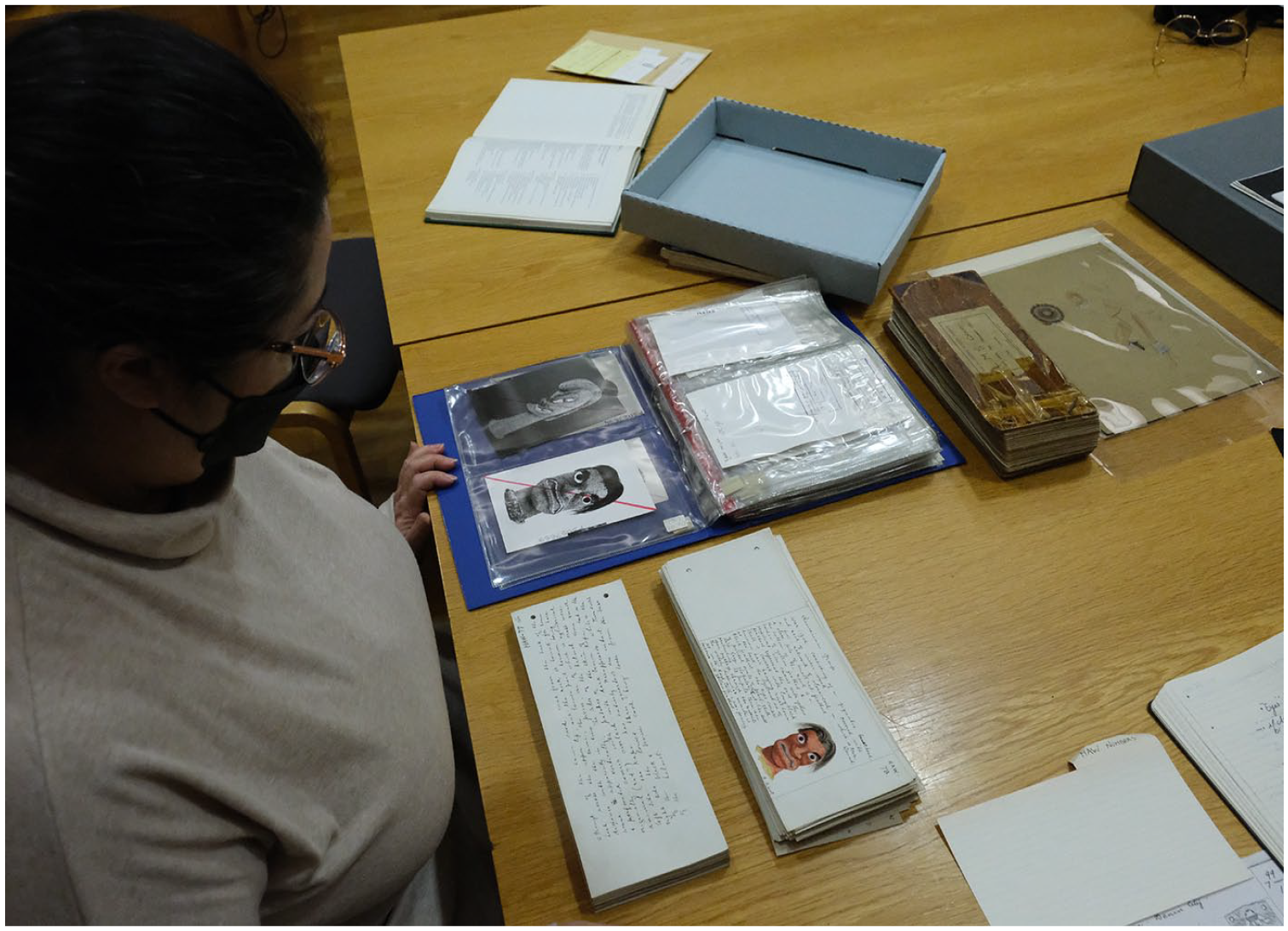
Leah Caldeira examines historical archives associated with the Hawaiian collections at the British Museum. Photograph: Alice Christophe, © The Trustees of the British Museum, 2022.
Building on these foundations and expanding possibilities, the Benioff Oceania Programme—a three-year initiative at the British Museum—was established in 2020. The programme was dedicated to the stewardship, research and curation of the Hawaiian and Rapanui collections at the museum. As part of this body of work, a Hawaiian language advisory and research group named Keaukānaʻi was envisioned and established.
“Keaukānaʻi” (from ‘ke au, the current; “kānaʻi,” smooth, calm, of the sea) literally translates to a “gentle ocean current,” or smooth ocean pathway. Beyond its literal meaning, this name also invokes a powerful supernatural being who was known to ferry important people and things between Hawaiʻi and other lands with speed and purpose (Hoʻoulumāhiehie 1907). Keaukānaʻi can be called upon for protection and to assist in the journeys of people, gods, and other items and entities as they flow between and back to the Hawaiian Islands. Dedicated to nurturing a flow of knowledge between Hawaiʻi and England, the Keaukānaʻi group is composed of cultural knowledge holders, ʻōlelo Hawaiʻi (Hawaiian language) speakers and linguists, and Hawaiian language sources and taxonomy specialists, including the authors of this article (Christophe 2022). The group sources relevant language and knowledge from published writings, including from specialized literature and from a large corpus of digitized 19th century Hawaiian-language newspapers. Findings are compiled and combined into data which is integrated into records within the BM’s authority database.
This work aims to (1) accurately restore use of ʻōlelo Hawaiʻi describers for these mea kupuna, (2) provide a culturally relevant context in the digital space that enhances rather than diminishes their mana (inherent and accumulated energy), and (3) create smooth pathways of entry and engagement for Hawaiian language speakers and cultural practitioners whose primary point of contact with these extremely valuable mea kupuna is the database. Not only does this work assist the BM in reckoning with and attending to the kuleana (responsibility) that comes with stewarding mea kupuna, it also creates a powerful opportunity for the institution to help lift the status of ʻōlelo Hawaiʻi.
This article is an effort by its authors—members of Keaukānaʻi joining hands with staff of the BM—to unpack and reflect on two years of work that consisted in unraveling and deconstructing taxonomical violence in authority records associated with the Hawaiian collections at the BM, and building a new path forward for hosting, integrating and centering ʻōlelo Hawaiʻi and associated knowledge in these records. As this paper is being composed [2023], the work continues and the group is finalizing the linguistic and historical research that feeds this process of transformation. Integration and articulation of this knowledge into “data” reshaping a portion of the “authority database” has begun, but a larger upload is underway. In this article, the authors thus discuss a work-in-progress, sharing the initial intentions and framework of this project, reassembling practice and process, and reflecting on the challenges and limitations encountered.
Note to the Reader
While this paper combines multiple voices and viewpoints, the authors wish to present this endeavor as the work of a group and to move away from identifying individual authors for each section as in other collaborative publications (e.g. Scorch et al. 2020). This choice of positionality is not, on our part, an attempt to further erase Indigenous agencies in this work, but rather a reflection of a collective process during which vision, knowledge and intentionality have been respectfully and fluidly negotiated.
Terms in ʻōlelo Hawaiʻi (Hawaiian language) are not italicized in this article as they are not regarded as foreign terms. They are translated into English language in parentheses throughout the paper according to their meaning within each individual context and paragraph. By doing so, we reflect on the complex nature of translatability (Wong 1999), a mechanism approached here with agency and purpose. When the meaning of a term is deemed stable throughout the paper, the term is only translated upon first inclusion in each section. This is the case for the following terms: “ʻōlelo Hawaiʻi” systematically translated as Hawaiian language, and “mea kupuna” consistently used to refer to “Hawaiian ancestral treasures.” 3
Laying a Foundation: The Benioff Oceania Programme (2020–2023)
In 2020, a three-year program dedicated to transforming the research, stewardship, and curation of the collections from Hawaiʻi and Rapa Nui under the physical care of the British Museum (BM) was established. The first task of the Benioff Oceania Programme and associated lead curator—Alice Christophe, an author for this article—was to survey the breadth and depth of the collections from these islands while laying a foundation for the vision, the intentions, and the methodologies for the years to come. As the museum and the world endured the COVID-19 pandemic, both city commutes and international travels were brought to a halt. Physical access to collections became an impossibility for museum staff and community members alike. Though “temporary,” this time stretched space in ways that acutely emphasized colonial legacies and relationships to place(s), with ancestral treasures here, their people there, and limited ability to move in-between. In this context, the British Museum’s database became both the unique tool through which this initial phase of research could be undertaken, as well as, at the time, the sole point of entry into the collections for Indigenous communities around the world, including in Hawaiʻi.
The framework of the program—described elsewhere (Christophe 2022)—as initiated in these difficult times consisted in interrogating and progressively transforming the practices through which mea kupuna (Hawaiian ancestral treasures) are stewarded while at the BM. Stewardship is here understood in a holistic way, i.e. as a practice that includes physical and spiritual care, collections access, research, documentation, cataloguing, exhibition, and conservation. 4 In this framework, community members are not only regarded as a key target audience of curatorial work, but as collaborators and co-stewards by whom and for whom museum practices are reshaped toward renewed purposes, serving community needs, aspirations, and living practices first and foremost.
As this framework was being established, it became clear that stewarding and caring for ancestral treasures from Hawaiʻi should involve an attempt to address and redress the epistemologies and the taxonomies associated with them. In particular, the terms used as “describers” or “Object Names” in the BM’s database operated as a problematic and limiting layer to enable experiences and research of mea kupuna by co-stewards and global audiences. These limitations formed the impetus for assembling, in 2021, a Hawaiian language research and advisory group composed of Native Hawaiian members: N. Haʻalilio Solomon (Assistant Professor, Kawaihuelani Center for Hawaiian Language, University of Hawaiʻi at Mānoa, Honolulu, Hawaiʻi), Leah Caldeira (Director of Library & Archives and Curator for Cultural Resilience, Bernice Pauahi Bishop Museum, Honolulu, Hawaiʻi), Hina Kneubuhl (Hoa Unuhi [translator] at Awaiaulu, Inc. and co-founder of Kealopiko), later joined by Pilialoha Kamakea-Young (ʻōlelo Hawaiʻi teacher and Kaʻi Unuhi [translation trainer] at Awaiaulu, Inc.); working with Alice Christophe (then Benioff Curator for Oceania, British Museum, London, UK) and Victoria Donnellan (Catalogue Manager, British Museum, London, UK). In March 2021, the group was named Keaukānaʻi to evoke and invoke fluidity and movement of knowledge, people, and things between Hawaiʻi and London.
Language as Advocacy: Keaukānaʻi’s Purposes and Intents
The 19th and 20th centuries were a sociopolitically volatile period in Hawaiʻi. Multiple factors and happenings threatened ʻōlelo Hawaiʻi (Hawaiian language) in these times, including but not limited to mounting American interests in the islands, the overthrow of the Hawaiian Kingdom in 1893, and the 1896 legislative decision known as Act 57 which imposed English as the official language of education in Hawaiʻi. These changes contributed to a significant shift away from ʻōlelo Hawaiʻi toward English (and Hawaiʻi Pidgin English), endangering Hawaiian language. The 1970s sparked Hawaiian language revitalization efforts which began to reverse the language decline, but much work remains to be done. Recorded numbers of speakers vary considerably, from 5,000 to 7,000 (Brenzinger and Heinrich 2013) to upwards of 20,000 people with varying levels of fluency (US Census Data 2000 as cited in Ng-Osorio and Ledward 2011). Irrespective of numbers, the language is still very much endangered and its status suffers under a lack of proper funding, policy, and planning. In spite of a successful grassroots movement, ʻōlelo Hawaiʻi remains un(der)represented in many domains, including public spaces like museums where mea kupuna (Hawaiian ancestral treasures) are stewarded. When the language is indeed used in public spheres the representation is often more tokenistic than communicative, 5 disconnected from historical linguistic norms, and sometimes misappropriates both language and culture.
Initiatives aiming for meaningful representation of Hawaiian language and a Hawaiian worldview for collections records are in development among various institutions and organizations in Hawaiʻi. For instance, the project team of Ka Wai Hāpai is currently undertaking monumental tasks towards the development of an Indigenous Hawaiian Knowledge Organisation System (KOS) for library and archival entries (Joyce and Long 2022). The work of Keaukānaʻi is nowhere near as expansive as that of Ka Wai Hāpai, and is focused exclusively on mea kupuna (Hawaiian ancestral treasures) stewarded at the British Museum.
Meaningful integration of ʻōlelo Hawaiʻi and ʻike Hawaiʻi (Hawaiian knowledge) into the British Museum’s (BM) database is envisioned by Keaukānaʻi as an act of language advocacy that addresses problematic history and the needs of the growing number of ʻōlelo Hawaiʻi speakers and researchers. The group seeks to transform the database towards an experience supporting language revitalization and normalization by restoring the use of ʻōlelo Hawaiʻi describers for mea kupuna physically at the museum, and by building a cultural context for these treasures anchored in Hawaiian-language materials. The work draws from vast reserves of ʻōlelo Hawaiʻi writings from the nineteenth century to uplift the voices of Hawaiians more proximal than ourselves to mea kupuna. This endeavor rebuilds relationships between material representations of culture and intellectual ones that have long gone unrecognized.
Further, Keaukānaʻi aims to trace the language surrounding mea kupuna over time. Such a diachronistic analysis seeks to help audiences better understand the time of production of ancestral treasures, their origins, movements, and destinations, as well as the methods used to care for them. Our work presents historically-informed uses of language connected to mea kupuna and the cultural practices in which they are embedded. Given the fact that mea kupuna themselves form a significant part of our understanding of culture, reintegrating ʻōlelo Hawaiʻi in the spaces they inhabit has the potential to deeply impact and support the expansion of the language into contemporary contexts and spaces, physical and digital alike. This work demands both diligence and thoroughness in research, as well as a willingness to pursue integrations within existing and complex systems such as the British Museum’s collections database.
The British Museum’s Collections Database: Overview and Integrations
The British Museum collection database uses MuseumIndex+ (MI+), a collections management system developed by System Simulation, a UK-based company. 6 It has been adapted with bespoke features for the museum’s use, but remains compliant with SPECTRUM, the UK collection management standard. The BM database contains a large number of data fields, structured into sections for ease of data entry and retrieval. For example, the “Object” section contains key fields describing objects, such as “Object Name,” “Physical Description,” and “Material,” while the “Production” section contains fields including “Production Place” and “Production Ethnic Name.” The data which can be entered into many of these fields is limited by controlled terminologies, thesauri or authority lists, which have been developed in-house, to aid with consistency and retrieval of information. 7 The British Museum publishes its collection through an online interface known as Collection Online (https://www.britishmuseum.org/collection). This draws directly on the data in MI+—with slight variations in how categories are ordered and named—updating nightly with any new information entered into the internal database, with the exception of sensitive and personal information.
When cataloguing an object, museum curators typically check the relevant thesauri, or authority lists, to select the appropriate term. If the “Object Name,” “Material,” “Person,” “Place,” or other category of information required does not already exist in the lists—as was the case for object describers in ʻōlelo Hawaiʻi prior to 2022—curators can propose it as a new candidate term for integration. The term will then be reviewed by the Catalogue Manager (currently [2023] Victoria Donnellan, co-author of this paper) in order to ensure it is properly integrated into the existing data structures, and consistently applied across the whole collection.
Many of the authorities and thesauri are hierarchical, so a term has to be placed into the correct position in the hierarchy to facilitate searches by “Broader Terms.” Duplication also needs to be avoided to ensure accuracy of data retrieval. For example, if a user searches for “clothing” they should be offered all the “headgear,” and that will include all the “helmets” as well as all the “hats,” “caps” etc. Poly-hierarchies (i.e. the ability to place a term under multiple Broader Terms) add additional sophistication of searching and classification, as helmet is also placed under the Broader Term “armour.” If one term is a close equivalent of another—for example, variant spellings (such as “fishhook” and “fish-hook”)—the established procedure is to select a “Preferred Term” and note the alternatives as non-preferred, that is, “Use For” (as labelled in MI+) or “Also Known As” (as labeled in Collection Online) terms. Each term may also be clarified with a “Scope Note,” a free text field for entry of explanatory notes, recording definition(s) and usage(s) of the term. These are unevenly used across the database but represent an additional resource of information, accessible but not currently searchable through the online interface. 8
The power dynamics at play within the construction of a database structure are suggested by the words used in this description of standard documentation practice at the British Museum, which speaks of “controlled” terminologies, “authority” lists, “preferred” and “non-preferred” terms. The “authority,” the “control,” and the “preference” invoked are those of the institution, and those who authorize, control, and determine preferences are therefore the members of staff who work on these terminologies on behalf of the institution at any given time. 9 In approaching this project, the aim of the British Museum staff members involved in the work was to open up authority to Keaukānaʻi and be as flexible as possible in finding mutually agreed ways to meaningfully host the knowledge produced. 10
Inevitably limits would be set by an institutional desire to maintain the integrity of the current database structure as a whole, upholding a need for “consistency” that shapes the system. As discussed by Keaukānaʻi in initial meetings, these systematic needs alone reveal a tendency to treat diverse knowledge as data and to fit this data into existing structures. In part, this is due to practical and fiduciary limitations: systems are slow and expensive to change, and very many internal and external stakeholders are involved in processes of transformation of existing categories as well as additions of new ones. 11 There is, however, more at play than practicalities alone. While data systems by definition inevitably remain systems, this treatment aiming for consistency across and within histories and cultures represented at the museum reveals a perspective on the world and on how, by whom and for whom it is inhabited, experienced and classified.
Developing Process and Practice
Between 2021 and 2023, Keaukānaʻi met every month digitally, and in person during visits to London and to Hawaiʻi supported through the Benioff Oceania Programme. Initial meetings used to assess the existing data demonstrated a need to tackle several subsets of the “authority database,” including specific geographical terms, materials, people’s names and biographies, and describers (or “Object Names”) associated with Hawaiian ancestral treasures. Instead of addressing all subsets for a selected number of object records, we decided to focus on object describers (for instance, “helmet,” “necklace,” “bowl” etc.) across the Hawaiian collections at the BM. While only a first step towards reintegrating ʻōlelo Hawaiʻi (Hawaiian language) and ʻike Hawaiʻi (Hawaiian knowledge) into the database, it felt like an important place to begin rectifying misrepresentations of Hawaiian material culture. Statistics for general database searches for all collections at the BM show that Object Names (describers) only come in fifth position as a point of entry for users that rely on the existing thesauri in their searches. 12 However, our experiences and interactions with community members in the Pacific and Hawaiʻi suggest that, alongside places and people, describers rank high as a search tool to access ancestral treasures. Describers also hold a prominent place in the current design of Collection Online [2023], appearing first in pages showing search results, and also positioned at the top of each object record, in large and bold font (Figure 2).
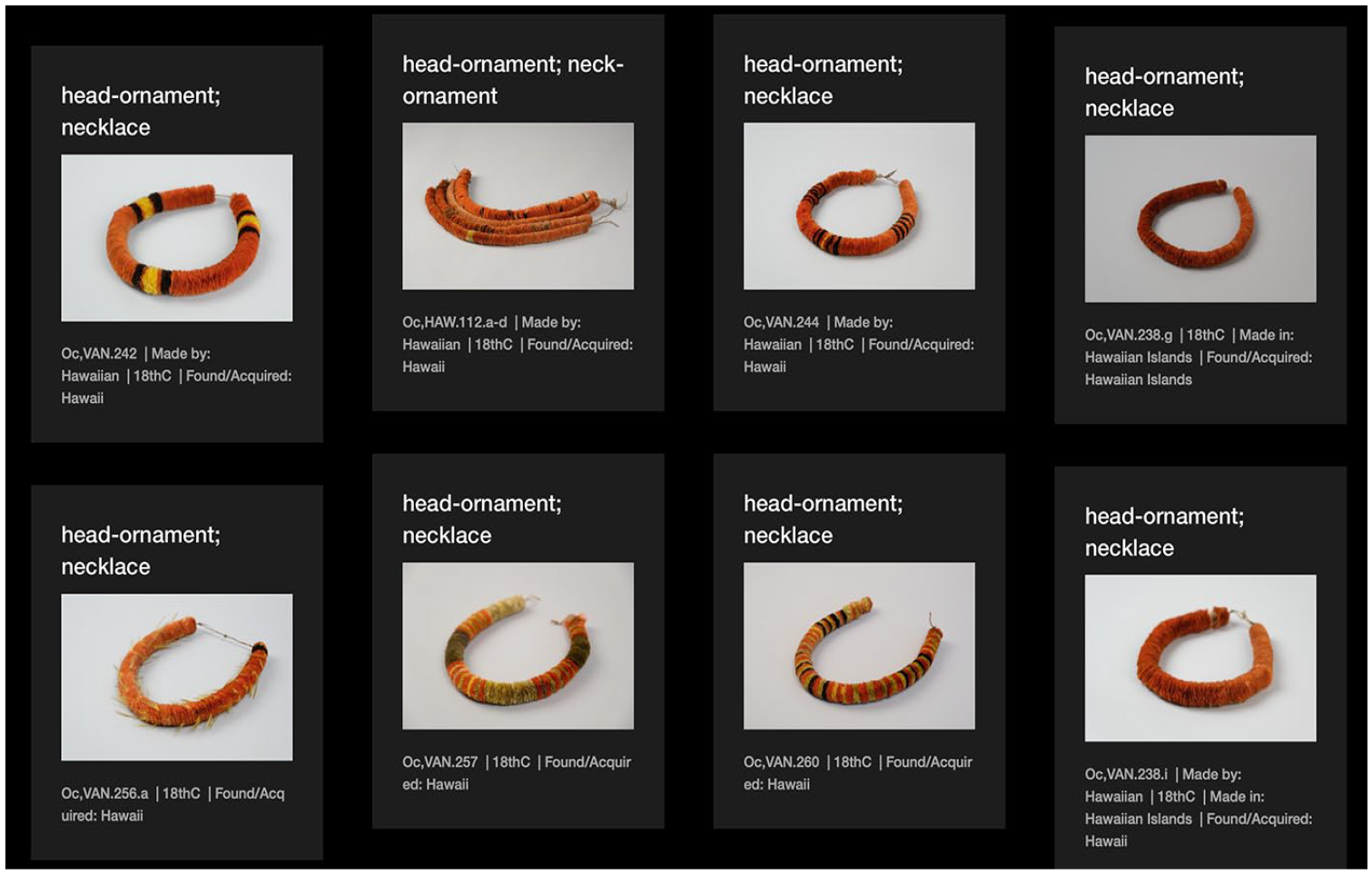
Screenshot of search results showing the prominent position of the English language describer “head-ornament” (within the “Hawaiian Islands” collections) on Collection Online, prior to the integration of the Hawaiian language term “lei hulu” by Keaukānaʻi. New lei hulu photography displayed here was taken through the Benioff Oceania Programme. Photograph: © The Trustees of the British Museum, 2023.
“Object Name” Versus “Describer”
In ʻōlelo Hawaiʻi (Hawaiian language), common nouns or describers impart positional meaning to material forms by grounding them within broader practices, times and places. In addition to referring to material forms through common nouns (“this is a loincloth”), the agency and status of such forms and entities is sometimes elevated through the bestowal of a proper name (“this loincloth is named ʻIkuā” 13 ). Proper names further index layered meaning to material forms through references to moʻokūʻauhau (origin), specific chiefs and ancestral bodies, places and events, and so on. Proper names equally have the ability to shape and influence people, things, and situations. Real harm can come when a name is not respected (Pukui, Haertig, and Lee 1972, 94–106). Honoring names of people, places, and things is a loina (cultural norm) that remains strong in Hawaiʻi today.
In an effort to uphold this loina and the worldview embedded in ʻōlelo Hawaiʻi, Keaukānaʻi chose to move away from using the database category term ‘Object Name’ (displaying as “Object Type” on Collection Online) to describe common nouns associated with mea kupuna (Hawaiian ancestral treasures). Instead, in our framework, we referred to such common nouns as “describers.” By doing so, we aimed to create space in our practice for the possibility of locating and recording—in a separate field—the proper names that may have historically been given to mea kupuna, and acknowledge their absence when such proper names do not appear.
Overall, inherent challenges remained in identifying historical describers, and opportunities to locate proper names for mea kupuna were rare. As we developed our process, we were mindful that our findings would inevitably be limited and shaped by the resources available and by our positionality. Our recording methods aimed to both hint at the limitations of the existing and new datasets, and to hold space for future generations to critically engage with the new data.
Workflow and Sources of Knowledge
In 2021, the initial workflow mapped mea kupuna (Hawaiian ancestral treasures) at the museum and associated terms through a practice-based lens. Based on conversations with a limited number of cultural practitioners, a preliminary list of describers was assembled for their respective areas of expertise. This initial set was then used as a foundation to approach historical sources, accounts and terms.
While the Benioff Oceania Programme was collaborating with and learning from cultural practitioners in co-related projects (Christophe 2022; Figure 3), Keaukānaʻi solidified a desire to establish a list of describers compiled from existing written literature, and to craft a taxonomy by building on them through further research in other bodies of archives. We brought the collections into a parallel with Arts and Crafts of Hawaiʻi by Te Rangi Hīroa/Sir Peter Henry Buck (1957), a scholar of Māori (Ngātu Mutunga) and Pākehā (Irish and English) descent through his mother and father respectively, and a former Director at the Bernice Pauahi Bishop Museum (Honolulu, Hawaiʻi). This trusted resource, authored by a multilingual scholar, describes in great detail material productions and practices of Hawaiʻi, and is grounded in Te Rangi Hīroa’s knowledge of Polynesian material culture gained through his heritage, through fieldwork and international travels to study museum collections, and through a thorough grasp of available literature (Force in Te Rangi Hiroa [Buck] 1964, iii). It was assembled in a place (Bishop Museum) where, and a time (the mid 20th century) when, significant linguistic and historical research was being undertaken by Mary Kawena Pukui and others, leading to the creation Pukui and Elbert’s (1977) Hawaiian-English dictionary. In fact, Pukui and Elbert were involved in reviewing the Arts and Crafts of Hawaiʻi manuscript before publication, researching Hawaiian words in archival files, and seeking accuracy of spelling and definition (Spoehr in Te Rangi Hiroa [Buck] 1957, v).
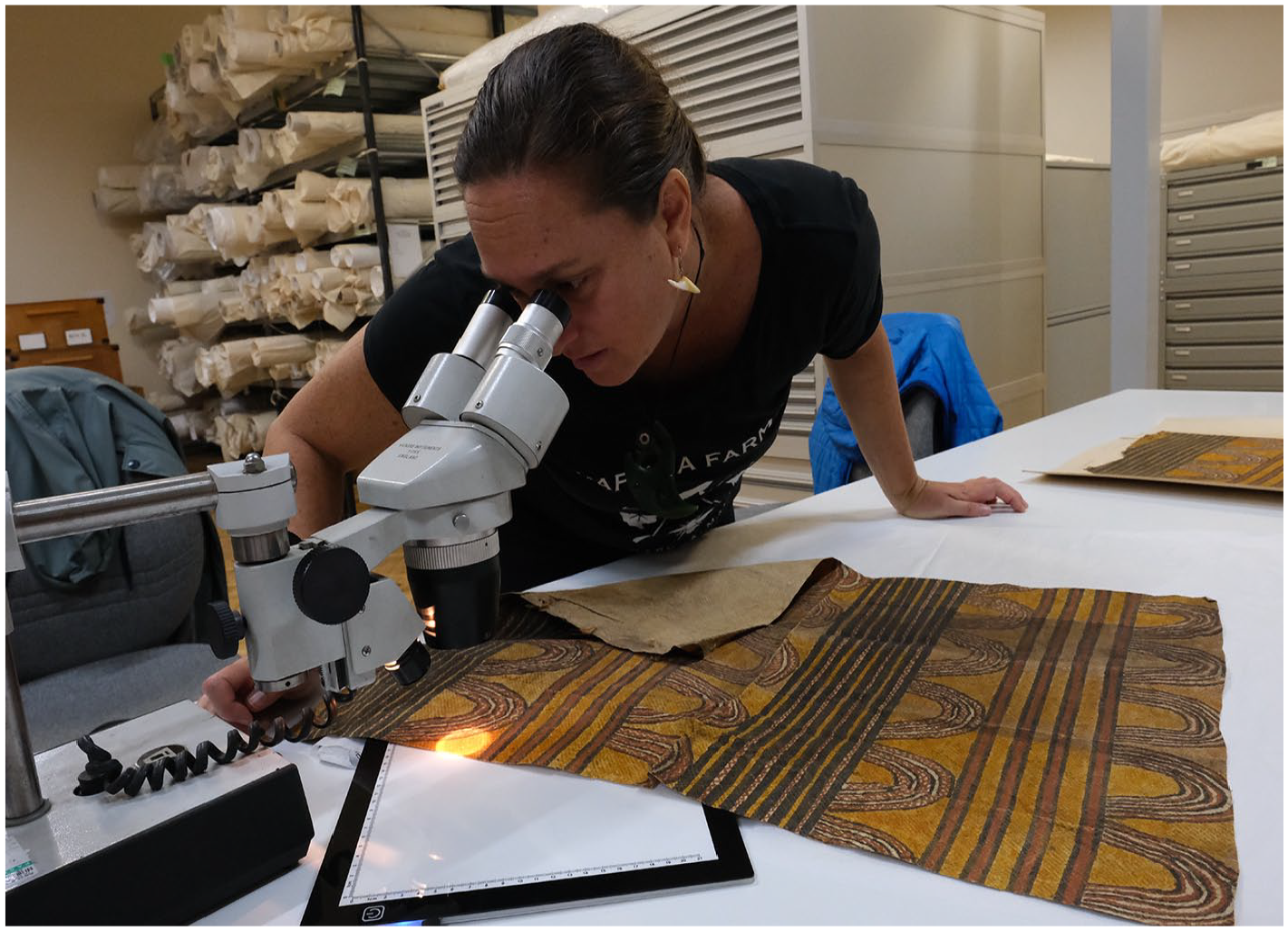
Hina Kneubuhl conducts research on the materiality and making of barkcloth in the British Museum’s collection storage (barkcloth numbered Oc,HAW.20). Photograph: Frøya Crabtree, © The Trustees of the British Museum, 2023.
Through this resource and other bodies of specialized literature, we identified approximately one hundred describer terms that could be used to tag mea kupuna (Hawaiian ancestral treasures) in the database. Though not a majority, these included a few terms that are rare, if not absent, in early Hawaiian language literature but that have become significant in more recent works and in the ways in which practitioners describe these material forms—for instance, “lapaiki” (small drum), “lei kāmoe” (garland of feathers flipped downward that are sewn such that they lie on top of the previously-sewn feathers), and “lei poepoe” (garland of feathers flipped upward such that they fan out separately from adjacent feathers). While imperfect, our process attempts to recognize how the research remains limited to certain primary sources and domains of language use, and acknowledge the possibility that these terms not (widely) attested in the nineteenth century print media may have been transmitted intergenerationally and maintained in oral tradition. In any case, this step in the process began Keaukānaʻi’s linguistic and historical research into a large number of Hawaiian sources.
A working datasheet was created with each describer term forming a row. Column fields were added to match available fields to create new describer terms in the BM’s authority database and facilitate a future data migration. 14 Additional fields were supplemented to support the research process, providing space for individual references encountered and for comments. For each describer term, in separate columns, the definitions provided by Te Rangi Hiroa (1957), Pukui and Elbert (1977 [1957]) and Andrews (1865) laid a foundation for inquiry into a variety of sources. When and if the term was not defined by either of these scholars, the absence of the term definition was clearly stated in the relevant field, suggesting that such absence too could hold meaning.
The group split tasks from this point forward. A subgroup worked on the linguistic and historical research for each term and its articulations into the datasheet, continuing to record individual sources in separate column fields and noting absences. During these sessions, the subgroup regularly returned to individual object records on Collection Online to ensure alignment between ancestral treasures and their describers. Another subgroup pulled from these findings to form final scope notes for uploads, and to establish co-relations between these future new terms and existing English describers and between Hawaiian terms themselves. Throughout this process, Victoria Donnellan was regularly consulted by Keaukānaʻi to ensure compatibility with the museum’s system.
The work conducted by members of the group that focused on linguistic and historical research relied heavily on the use of a significant repository of Hawaiian knowledge: the Papakilo Database. 15 This platform is digitally hosted by the Office of Hawaiian Affairs, and pulls from Hawaiian digitized archives physically located in a consortium of participating institutions. Nūpepa ʻōlelo Hawaiʻi (Hawaiian language newspapers) are at the core of this resource. Between 1834 and 1948, nearly one-hundred different newspaper titles in Hawaiian language were serially published, amounting to over 125,000 densely printed pages (Nogelmeier 2010, 59). Together they form an invaluable repository of cultural, historical, and contemporary knowledge as well as a space for engaged discourse created predominately for and by the Hawaiian people. Of the nearly 125,000 original newspaper pages, approximately 76,000 were digitized and uploaded to the Papakilo database. Roughly 30,000 of these newspaper pages are text searchable, comprising only 24% of the whole corpus (Sai-Dudoit 2023). Through this interface, Hawaiian language newspapers became of foundational importance to the work of Keaukānaʻi despite limited searchability.
Forming Data and Preparing Data Integration
After noting definitions from the publications mentioned above, Keaukānaʻi searched for each describer term in nūpepa ʻōlelo Hawaiʻi (Hawaiian language newspapers) through the Papakilo Database. In a dedicated field of the datasheet, the date of the search was recorded along with the number of hits per spelling and their respective date ranges. The group also recorded any conceptual variations in term use as well as pertinent articles (with article reference) that further clarify or question the understandings of describer terms. Of particular note when analyzing and compiling the data are instances where describer terms are transformed over time in either meaning and/or application. Though infrequent, searching Papakilo also resulted in the (re)discovery of references to specific mea kupuna (Hawaiian ancestral treasures) that may prove essential in later provenance research.
In parallel with the Papakilo search, variations of meaning in additional specialized sources and publications were also noted in separate fields. Occasionally, terms more specific than those originally listed in the spreadsheet were located. Consultation of the collections allowed the group to confirm whether or not they should be added to the describer taxonomy.
When the research phase reached a satisfactory point, a “Preferred Term” (i.e. how the term appears in database object records and is displayed on Collection Online) was added for each describer, privileging a specific spelling. Alternative spellings and close synonyms were recorded in the “Use For” category. A “Scope Note” was crafted, compiling and combining all definitions and findings into one free text field to be displayed and accessible (but not searchable) on Collection Online. The Scope Note is also preceded by introductory text crediting Keaukānaʻi. 16
Ahead of data migration and integration into the BM database, the group also anticipated placement within the hierarchy of terms by identifying “Broader Terms” within the existing English language thesaurus. The tagging of Broader Terms was key as it determines the position and searchability of the new ʻōlelo Hawaiʻi term amongst these legacy terms. This approach changes the practice from solely a Use For function, which was initially considered to integrate the work of Keaukānaʻi but that is more focused on horizontal integration (often through spelling variations). In a Use For scenario, “malo” is a variation of “loin-cloth,” but this does not allow for the exploration of relationships within the legacy structure, and search specificity is reduced. A user might search for loin-cloth, then narrow their search, likely through a filter such as Place or Ethnic Group, to arrive at records for malo.
By contrast, when integrated into the poly-hierarchical legacy system as a stand-alone term, malo can be tagged as a “Narrower Term” for several legacy terms, including but not limited to loin-cloth. Malo then becomes a unique and fully searchable term, integrated into the system through formal and plural linkages. The English language user can search for the legacy term loin-cloth, and arrive at a set of object records for all loin-cloths in Collection Online, to include malo. Further filtering in perhaps “Object Name” or a link through a record tagged as loin-cloth, will then lead to mea kupuna tagged as “malo.” Whereas an ʻōlelo Hawaiʻi search on malo will arrive directly to that set of object records specific to malo.
While an elegant search for an ʻōlelo Hawaiʻi user (if the describer term is commonly known), the search process for the English-language user does not necessarily change. Multiple steps or filters are and have always been required. However, the more ʻōlelo Hawaiʻi describers that are integrated into the legacy system, the more fluid and inclusive searchability becomes for either language user in locating and navigating the Hawaiian records. Inclusivity, as embedded in Hawaiian praxis, is also demonstrated once either user views an actual record for a malo. Both language users will be welcomed into a fold of Hawaiian knowledge that begins by seeing the term malo at the very top of these records. This act upholds kuleana (responsibilities) while also increasing the visibility of the language on an international platform. This approach provides access paths in both languages, but allows for the Hawaiian describers to take their rightful place, powerfully signaling to speakers of ‘ōlelo Hawaiʻi that these spaces are for them too. The larger Hawaiian worldview in which these concepts are embedded is addressed in the second layer of our work, captured in the Scope Note for each term.
Pilot Term: Linguistic Approaches and Historical Implications
In contexts of language revitalization (and loss), it is critically important for language advocates—especially those engaging in public-facing language work—to be diligent in researching and interpreting historical meanings and definitions of words embedded in primary sources. Keaukānaʻi’s research records multiple definitions of a describer term without actively connecting their various meanings, and largely leaves aside those unrelated to material culture. In that sense, we regard some examples of polysemy in ʻōlelo Hawaiʻi as coincidental. In spite of the logical felicitousness or compelling tendency to do so, we avoid linking multiple meanings for any given term.
As in any language, polysemy in ʻōlelo Hawaiʻi (Hawaiian language) allows for multiple meanings represented by a single form. For example, the word “kiʻi” means “image, statue, picture” as well as “to fetch, to procure.” While both significations are indexed by a singular lexical item, the two meanings are not necessarily connected, and a connection between the two would be difficult to corroborate historically.
With limited access to primary sources and native speakers, as well as the disruption of intergenerational transmission of cultural and linguistic norms, misunderstanding of meaning becomes widespread, sparking misinterpretations of Hawaiian words such as “haole” (foreigner), whose original meaning and pronunciation has been analyzed as “hāʻole,” where “hā” (breath) and “ʻole” (negative marker) combine to mean “one without breath.” Proponents of this etymology cite historical accounts about the first foreigners who arrived in Hawaiʻi who did not exchange hā (breath) with the locals, for whom it was customary to touch noses (honi ma ka ihu) when greeting another and simultaneously inhaling. However, this theory weakens when we consider that Kamapuaʻa—an important figure in Hawaiian culture whose arrival in Hawaiʻi far predates that of any westerners—was referred to as a “haole nui maka ʻālohilohi,” or “big, bright-eyed foreigner” (Fornander 1919, 319). On its own, “’hā ʻole maka nunui” makes little syntactic or semantic sense, and none in the context from which this example is drawn, thereby supporting the spelling as haole and its translation as “foreigner.” Furthermore, the pronunciation of this word as haole by many native speakers (not hāʻole) whose voices endure in audio archives today sufficiently confirms our analysis.
To illustrate the dynamics of Keaukānaʻi’s research, we present how launching a pilot term eventuated in productive insight and defensible conclusions. The case study highlighted here involves “mahiole,” whose definition (and spelling) we borrow from the Pukui and Elbert (1977) dictionary. In October of 2022 mahiole became the first ʻōlelo Hawaiʻi describer term to be integrated into the MI+ database and published on Collection Online (Figures 4 and 5).
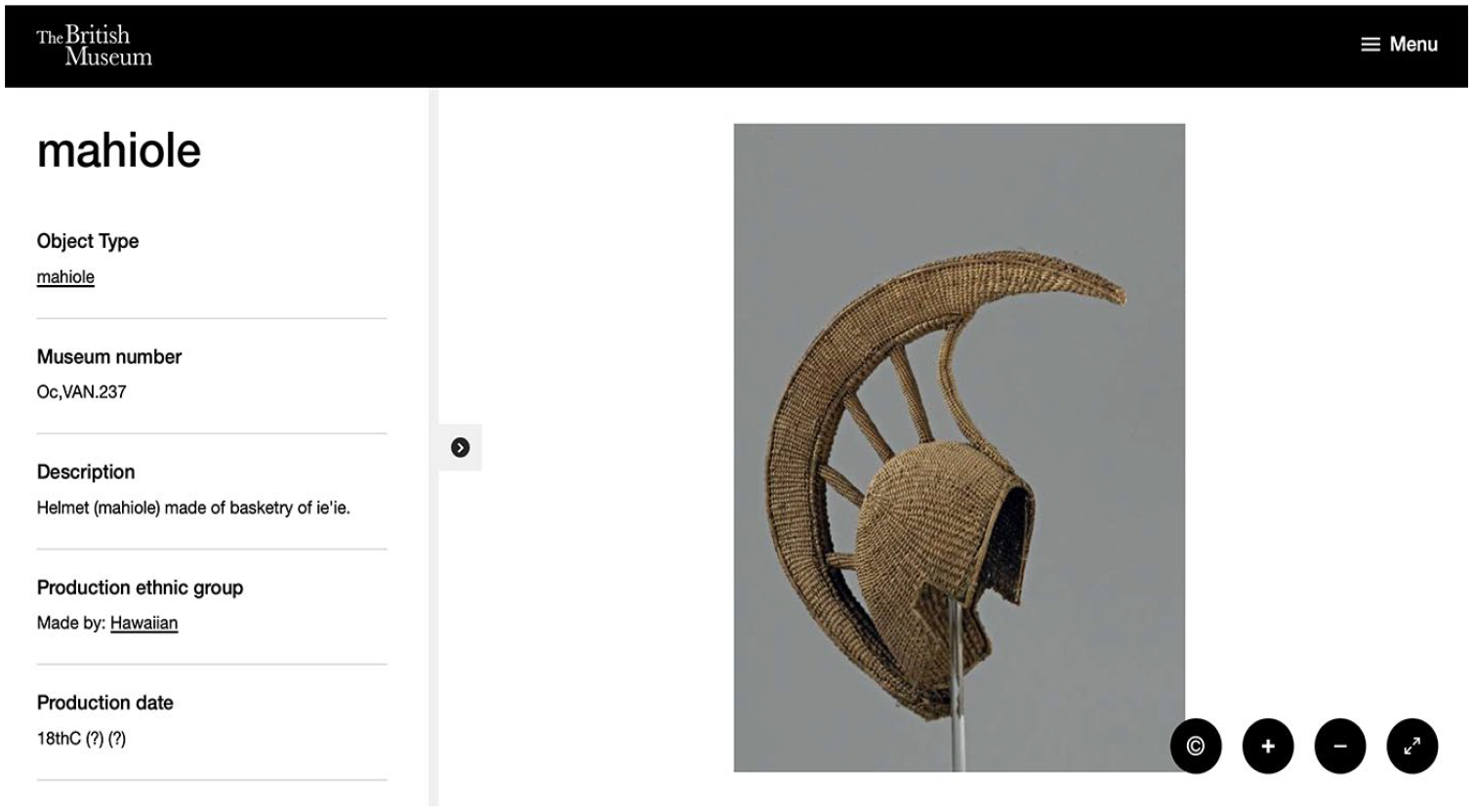
Record for mahiole (Oc,VAN.237) showing the inclusion of the describer in ‘ōlelo Hawaiʻi by Keaukānaʻi. Users clicking on the describer term in bold and underlined can access associated historical and linguistic research. Photograph: © The Trustees of the British Museum, 2023.
Launch of pilot terms in the authority database during the visit of members of Keaukānaʻi to the British Museum (left to right: Leah Caldeira, Victoria Donnellan, N. Haʻalilio Solomon). Photograph: Alice Christophe, © The Trustees of the British Museum, 2022.
Debate around the proper spelling of this term (mahiole vs. “mahiʻole”) has endured—likely sparked by the absence of diacritic markings in the 19th century print media since included in modern orthography—such as the ʻokina (glottal stop, [ʔ] in the International Phonetic Alphabet). If the term is indeed pronounced with the ʻokina, then mahiʻole would etymologically denote “one who does not farm,” including “mahi” (to farm) and “ʻole” (negative marker). Some have adopted this as the correct form for the term because it is assumed that aliʻi (chiefs) who wore mahiole (mahiʻole) as part of their regalia would not perform agricultural duties as commoners did due to the high social rank the chiefs occupied. This would be a valid analysis except for the fact that Hawaiʻi’s most illustrious 19th-century scholars, Hawaiians themselves who grew up in or adjacent to the royal courts, wrote detailed accounts of the highest chiefs participating in agriculture, from establishing their own farm plots to harvesting the fruits of their labor (ʻĪʻī 1869; Kamakau 2022, 359).
Aside from historical corroboration of farming practiced by high-ranking members of traditional Hawaiian society, another reason debunks the case for using the ʻokina when spelling this term. The negative marker, ʻole, is productive and attestable elsewhere in the language. For example, it follows other verbs besides mahi, such as “hele” (to go), and “ʻike” (to know, to see). Newspapers editors of the time espoused a generally consistent convention that separated the verb and the negative marker with an intervening space, as in “hele ʻole” (to not go) and “ʻike ʻole” (to not know/see). If the term mahiʻole etymologically labeled its wearer as “one who does not farm,” then we would expect the term to be spelled as two words, “mahi ʻole.” Because of these reasons, Keaukānaʻi uses the spelling mahiole for this term as a single lexical item that can be applied to the several mea kupuna of this nature in the British Museum’s collections. Mahiole is thus used as the preferred term for entry in the database and display on Collection online.
At the time of writing this paper [2023], mahiole is a Narrower Term for “head-ornament” and for “helmet” within the legacy term structure. Though mahiole is defined in the Pukui and Elbert (1977) dictionary as “helmet,” this database placement is not based on a definition, translation, or even hierarchical subordination. Instead, the ʻōlelo Hawaiʻi describer term indicates an increase in specificity that references a distinct form of mea kupuna (Hawaiian ancestral treasures). It becomes an independent type in the taxonomy and integrates through the poly-hierarchy. Mahiole can then connect with and function as a “Broader Term” for increasingly specific describer terms (“Narrower Terms”), like “mahiole hulu manu”—mahiole that are or were feathered through a wide range of techniques.
Conversely, helmet as a Broader Term situates mahiole as a more specific term for “armour” (a Broader Term for helmet), a relational link that is misleading and inaccurate since a mahiole does not generally function as armor or a protective helmet. A more appropriate Broader Term for mahiole would be “chiefly regalia,” an English language concept that does not currently [2023] exist within the database. “Regalia” is a distinct term in the thesaurus, however similar to helmet linked to armor, further linkages exist in the legacy structure that are problematic. One such linkage is from regalia to one of its Broader Terms, “costume.” In the context of Hawai’i—where past and present experiences are heavily marked and impacted by the commodification of its culture through the tourist industry for instance—this association raises issues regarding cultural appropriation through the idea of costuming. 17
Conclusion: Limitations and Learnings
The points brought forth through the pilot term “mahiole” alone demonstrate that significant challenges and limitations exist when attempting to establish and integrate an Indigenous language taxonomy into a legacy system such as the British Museum’s database. Not only does such a system heavily frame modalities of integration for new data, but Western and colonial ontologies are so embedded within it that it has become endogenous and self-replicating. As Bowker and Star’s (1999) analysis of classification systems demonstrated, “once a system is in place, the practical politics of these decisions are often forgotten, literally buried in archives (where records are kept at all) or built into software [. . .]” (p. 45). Unrecognized—and without knowledge of the exact circumstances that shaped this system—taxonomical violence is equally “buried in the archives,” even when hidden in plain sight, and thus harder to challenge.
The work of Keaukānaʻi and of the Benioff Oceania Programme has shed light on the problematic nature of this system. By injecting renewed energy and knowledge into one of the museum’s authority thesauri, and by disrupting its endogeneity, this work brought forth the museum’s structural inability to host situated knowledge, and proposed to reshape the very meaning of “authority.” For the museum, this process drew attention to some of those deep assumptions built into the system and raised questions regarding how we might aim to transform cataloguing practices. 18 For Keaukānaʻi, prioritizing and restoring ʻōlelo Hawaiʻi (Hawaiian language) describers is just one basic way in which those stewarding mea kupuna (Hawaiian ancestral treasures) can attend to the kuleana (responsibility) that comes with the privilege of their practice. Mea kupuna physically present at the British Museum are powerful, tangible links to Hawaiian ancestors and living examples of the great skill and ingenuity they possessed. Each of these mea kupuna have mana (inherent and accumulated energy) reflective of the time and energy their makers put into them and the Hawaiian community’s regard for them, past, present, and future. Their mana is respected when people refer to them in the language of their origin, ʻōlelo Hawaiʻi, a gesture that moves towards pilina (relationship) invoking and nourishing the flow called into the process through the name Keaukānaʻi. This work has supported language advocacy and revitalization, while also upholding cultural norms around relating to and handling mea kupuna. As such, it has broadened horizons towards further redefining stewardship in the future, as space is made for the languages and worldviews associated with ancestral treasures of many cultures physically present at the British Museum.
As Keaukānaʻi continues to navigate this process, we wish to make space for the readers of this article as well as for the users and makers of databases, present and future, to critically engage with this work. To avoid burying challenges into the archives, we further highlight key learnings, limitations, and continued questions below:
(Re)assembling a new taxonomy was experienced as positional and multivocal work that requires depth of research as well as a willingness to acknowledge the unknown, not-yet-found, and not-yet-known. Negotiating a shared framework and associated vocabulary, as well as establishing workflow and format for tracking sources and tracing authorship are key steps to meaningfully compile research data associated with terms in the BM authorities and thesauri.
Integrating this taxonomy requires anticipating and implementing linkages within a system. When such linkages are set within an existing legacy structure as it is the case for the work of Keaukānaʻi, the system itself operates as a framework for searchability and retrievability, charting experiences and preventing both database makers and users from fully addressing colonial legacies.
Working within legacy structures can become a powerful act of advocacy by (re)establishing a rightful place for both language and worldview, and by signifying agency, presence and context to Indigenous database makers and users. Yet, within legacy structures, relationships between the parts of the whole are dedicated through existing hierarchies, and mapping pluralistic and multilayered relationships remains a challenging task.
Scope notes and expanded definition fields can hold space for describing specific relationships between terms (when located) and for providing potential crucial narrative context. Yet, relationships highlighted in such non-linkable text fields will likely remain inaccessible to a general audience as searching for/through them requires a certain level of cultural fluency.
The act of tagging in an Indigenous language is also an act of recalling and reclaiming an ancestral treasure as being of a place and of a people. In contexts where transgenerational knowledge has been disrupted by colonial violence, understandings of specific material forms can be limited. When the describer of an important treasure is not known, what are the implications of not tagging it in the language of its people, when the rest of the collection has undergone this process? As this article is being written, Keaukānaʻi continues the search for describers for a handful of important mea kupuna. 19
As museum institutions face decreasing funding streams, how can this practice addressing ever evolving relationships with ancestral treasures be structurally sustained and capacity built towards further transformations?
Despite continued questioning, and with awareness of challenges, the authors of this article argue that actions and steps taken here and now can generate opportunities and open horizons for meaningfully and sustainably transforming robust and rigid structures in the future. The work realized through this project strongly emphasizes the need for the museum to improve its ability to positionally host situated knowledge, and to make meaningful space for multilingual and multicultural data, a challenging but vital imperative which libraries, archives, and museums have already been grappling with for many years (e.g., Boast, Bravo, and Srinivasan 2007; Glass 2015). It also suggests that a better understanding of existing legacy thesauri and the history of their development would help tremendously in making dominant knowledge structures more explicit and in highlighting and progressively reshaping potential implications for new data. 20 Lastly, this work stressed the need to consider the authority thesauri of the database as a unique space for historio-linguistic research, and as a set of key data that should be made more easily accessible and searchable by audiences, with features also allowing future transformations.
Footnotes
Declaration of Conflicting Interests
The author(s) declared no potential conflicts of interest with respect to the research, authorship, and/or publication of this article.
Funding
The author(s) disclosed receipt of the following financial support for the research, authorship, and/or publication of this article: The Benioff Oceania Programme (2020-2023) and the work of Keaukānaʻi was made possible through the generous support of Lynne and Marc Benioff, through the American Friends of the British Museum.
1.
2.
The Hawaiian collections (or collections associated with the locus “Hawaiian Islands”) are currently [2023] composed of approximately 1400 object records, covering a wide range of ancestral treasures from early voyages into the Pacific to the present, as well as drawings and photographs (Collection Online, consulted on 12/05/2023).
3.
The word ‘mea’ in this context is used as a noun that refers to a ‘thing,’ ‘person,’ or ‘object’. The term ‘kupuna’ as a noun refers to an ‘ancestor,’ spelt with a kahakō (macron) in its plural form, as in ‘kūpuna,’ meaning ‘ancestors’ (Pukui and Elbert, 1977). When used as an adjective, ‘ancestral,’ this term spells with no kahakō: ‘kupuna’. ‘Mea kupuna’ here thus refers to ‘ancestral thing(s)/person(s)/object(s)’. The term ‘treasure’ in English language, used here to translate ʻmeaʻ, is borrowed from the translation of the term ‘taonga’ in Te Reo Māori (Māori language) (McCarthy 2007;  ).
).
4.
On this topic, the Smithsonian Center for Folklife and Cultural Heritage (2023) has recently authored a policy document for “Shared Stewardship of Collections”, available online (consulted on 12/05/2023): .
5.
We acknowledge that even linguistic tokenisation imparts some form of communication, and therefore, by definition, is also communicative. Here, we define communicative language as language that imparts the meaning(s) intended by the community of speakers according to the linguistic norms, as well as cultural values and practices, to which they adhere.
7.
The fundamental importance of retrieval as a goal of museum documentation is enshrined in the SPECTRUM standard, as one of the minimum requirements for Cataloguing: “Your system can reliably retrieve relevant catalogue information to meet the needs of users”. The importance of consistency is recognised in the policy question “How will you record names, dates, places, and other keywords consistently?” (Collections Trust, 2022).
8.
9.
10.
This aim coincides with a wider impetus among museum documentation professionals to make cataloguing more inclusive and reduce institutional gatekeeping, as reflected in a recent revision of the SPECTRUM Cataloguing procedure (Collections Trust, 2022).
11.
12.
User statistics when searching via thesauri show that ʻAgent’ (i.e. people or organisations) is the most frequently used entry point, followed by, in order: ʻPlace,’ ʻTitle,’ ʻMaterial Cultureʻ (i.e. cultures, periods or dynasties), and ‘Object Names.’ (Pers. comm., Julia Stribblehill, Research Services Product Manager, British Museum, 12/5/2023).
14.
Available field names are as follows: ‘Discriminator’; ‘Broader Terms’; ‘Use For’; ‘Related Terms’; ‘Display Term’; and ‘Scope Note.’
16.
Introductory text for each Scope Note reads: “Linguistic and historical research compiled and integrated into this record by Keaukānaʻi. Keaukānaʻi is a research and advisory group formed through the Benioff Oceania Programme (2020–2023) at the British Museum. The group is composed of Hawaiian language speakers, linguists, and Hawaiian language resource specialists working together with museum staff.”
17.
In the process of co-authoring this paper, further discussions have been taking place about these relationships and legacy terms, with a view to seeking better solutions, highlighting the ever evolving nature of this work.
18.
19.
This is the case for the feathered piece numbered Oc,HAW.116, currently [2023] described as a ‘helmet,’ and sometimes referred to as a ‘helmet-band’. While it is possible that this mea kupuna is indeed associated with a helmet, we cannot at this point of our research confirm that it would have been described as a ‘mahiole,’ and thus tag it as such. Finding the most appropriate place and describer for this mea kupuna within the database is ongoing work for Keaukānaʻi.
20.
More in-depth analysis of the history of the British Museum’s documentation and cataloguing systems is needed, parallel to research on the Smithsonian by Turner (2016b, 2020) and .