




Abstract
As the national design collection of the United States, Cooper Hewitt, Smithsonian Design Museum in New York City is dedicated to historical and contemporary design with a collection of over 215,000 objects. Since its founding in 1897 as the Cooper Union Museum for the Arts of Decoration, its collection departments have been defined taxonomically by materials. In 2022, the museum created a new collecting department for the first time in its history, acknowledging that Digital collections represent a separate “material.” The introduction of a Digital department stakes a claim that digital design is itself a separate discipline with its own needs of collections management, curation, and conservation. Digital design as both process and product is now pervasive throughout design fields and the collection will continue to grow as the museum strives to represent contemporary design practice. While the museum’s early digital collecting came from a lineage of graphic design and typography, this article discusses the challenges inherent in developing new taxonomies, typologies, classifications, and collections management and preservation processes.
Keywords
Introduction: What Is Digital Design?
The formal establishment of a Digital 1 collecting department at Cooper Hewitt, Smithsonian Design Museum is a landmark event in the museum’s 125-year history that has taken over a decade’s worth of effort. As part of this process, we have worked to define what digital design is, distinguishing it from time-based media art, digital surrogates, and digital design tools. Like the digital landscapes we find ourselves in, the boundaries and meaning of digital design are impermanent, ambiguous, and always shifting beneath our fingertips. In this paper, we will describe not only how the museum’s nascent Digital collection is being cataloged and understood, but notably how these traditionally fixed museum practices are in flux. Perhaps most importantly, what are the implications of defining digital design from the perspective of users and user interaction, focusing attention on the affective and performative dimensions of works of design? How does this orientation change practices of description and stewardship alike?
Following work to develop post-colonial and post-custodial approaches in libraries, archives, and other collections, we see a need for the museum field to shift focus from practices that privilege internal uses to those that enable access and interaction for users outside the museum’s walls. Moreover, approaches to categorization and presentation, along with corresponding norms of stability established within museum practice since the Enlightenment are being destabilized and subverted by the digital. Reorienting our description, preservation, presentation, and stewardship goals to be more user-centered has revealed large gaps in the interface between collections management and audience within our institution. When collections work remains behind-the-scenes, it is easy to be biased toward legacy norms of control and authority. Moving forward, digital collections are forcing us to confront mismatches between these legacy practices and a future of transparent, cooperative, transformative stewardship and presentation we hope to achieve.
Originally the Cooper Union Museum for the Arts of Decoration founded by sisters Sarah, Eleanor, and Amy Hewitt, the granddaughters of industrialist Peter Cooper, the museum and its collection centered decorative arts and artist references—including sketches, models, drawings, and a wide range of material culture—as inspiration and teaching material for emerging artists studying at Cooper Union. 2
In 1968, the collection and library were transferred to the Smithsonian Institution at which point the museum was renamed, first as Cooper-Hewitt National Design Museum, Smithsonian Institution (1968–2014) and later to Cooper Hewitt, Smithsonian Design Museum (2014–present). The change in name—from an institution focused on the decorative and applied arts to one focused on design—also reflected a shift in priorities in terms of positioning the collection, exhibitions, and its audience. Today, Cooper Hewitt is the only museum in the United States dedicated exclusively to historical and contemporary design.
Since its founding in 1897, the museum’s collection had been historically organized in four collecting departments—Drawings, Prints, and Graphic Design (originally Drawings and Prints); Product Design and Decorative Arts (originally Decorative Arts); Wallcoverings; and Textiles—with a diverse collection that spanned thirty centuries. Despite refinements of the museum’s collecting scope over the years, the establishment of the Digital department marks the first time that the museum added a new collecting department in over 125 years. This critical step enables the museum’s collections to keep pace with contemporary design practice, which now encompasses digital in addition to traditional physical media.
Designers of all disciplines today use digital tools, software, technologies, and fabrication techniques in the creation and execution of work that is represented in the museum’s other collections—consumer products, 3D-printed objects, jewelry, electronics, typefaces, posters, prints, models, 3D-knit textiles, wearable technology, and more are the result of digital design processes. Yet it is the application of digital in design that not only originates but that exists digitally (aka born-digital media)—that is among the most rapidly expanding realms of design practice. Interaction design, data visualization, app design, web design, information architecture, game design, digital animation, virtual and augmented reality, born-digital typography, interface design, and more are central areas of design innovation. Establishing a Digital department that intellectually frames, builds, and stewards this new media is an essential milestone, demonstrating that the museum recognizes this accelerating area of design and materiality as critical to present and future design practice. As the nation’s design museum, we have identified digital design as a priority area for collection growth in order to remain responsive to, and at the forefront of, contemporary practice. 3 Formalizing the department acknowledges the unique skills and resources needed to effectively and responsibly collect and care for born-digital work, and it positions the museum to dedicate the needed resources to build its capacity to do so.
The formulation of the Digital curatorial department as a distinct entity is an opportunity to define this design discipline in the National Design Museum and to identify how it contrasts with similar materials in the collections of peer institutions. In the museum’s Collections Stewardship Plan
4
:
design is defined as an intentional process, tool, or practice that results in change. The term signifies both the thing created (design as a noun) and the act of creation (design as a verb). The design process includes both practical problem-solving and aesthetic form-making, giving shape to the function and meaning of the human environment. Design encompasses systems and services as well as everyday objects, images, and environments.
5
Digital design demonstrates that computer code is an essential modern material not just in the creation of work, but to our experience of it.
Time-based media art (TBMA) has become a distinct term within the fields of curation and conservation. 6 Peer institutions collect film, video, installations, kinetic, sound-based work, and performance as TBMA into departments such as Modern and Contemporary and Media and Performance. While our Digital design collection conceptually differs from these art-based collections, the protocols for collecting and stewarding digital media that these institutions developed have guided our own. Importantly, Rhizome, a leader in collecting Net Art, has developed strategies for the preservation of web-based works that have become increasingly important in enabling the collection and longevity of networked media. 7
The Digital design collection is informed by the museum’s existing collections in graphic design and product design, which demonstrate design’s impact on how we interact with the world. Within this context, we identify digital design as that which is enacted upon and given meaning by a user. To that end, the museum’s Digital collection is more aligned with digital collecting by the Architecture and Design departments at MoMA (New York) and SF MOMA (San Francisco), which situate design within the landscape of an art museum, as well as with the Design and Digital department at the V&A Museum (London), 8 the world’s largest museum of decorative arts and design.
The intersectionality of digital design is as critical to its place in museum practice as is its indeterminacy. When the museum staged the exhibition Design ≠ Art (2005), digital design was not yet part of the conversation. Since the museum began acquiring born-digital work in earnest in 2011, it has forced a clarification of the overlaps and non-overlaps between both digital and non-digital collections, as well as art and design collections and their resulting practices within the remit of an institution dedicated to design. While distinguishing our collecting scope from media and performance, we have learned much from contemporary conservation theory generated by peer institutions and share conservation concerns developed in those disciplines related to performativity and the openness or boundlessness of interactive works. 9 This parallels work by the Tate’s “Reshaping the Collectible” initiative, which “attends to this ‘broader state’ of liveness, exploring the museum’s capacity to respond to ‘changeability or instability’ in artworks as well as in museum and artistic practice,” 10 which likewise adapts concepts of performativity from performance studies toward the stewardship of digital interactivity.
The indistinctness of “digital” in the lexicon of museums has been a topic of intense scrutiny for the last three decades, and this paper will only cite a fraction of the deep scholarship on this topic. Not only is there confusion about the differences in preservation and access practices between digital surrogates (i.e., images of physical objects used as their stand-ins in collections management systems) and “primary digital collection objects” (aka PDCO, the term coined by Smithsonian to aid in this distinction) but there is also “productive confusion”
11
surrounding digital media products by museums and those represented in museums as artworks. Nearly twenty years ago, Beryl Graham observed: “The term digital media is problematic because it conflates the ‘idea of digital coding’ and the ‘idea of computation.’ Unlike ‘computer media’ or ‘programmable media’, digital media does not reflect the way in which digital media itself operates with computation.”
12
And in 2014, Walsh et al. reported that the term “digital” had been understood by museum practitioners they surveyed in four distinct models:
The digital as a
In attempting to clarify the collecting boundaries of the Digital department, we have deployed each of these models for understanding the digital. While we foreground the digital as a material or medium for the purposes of the Digital collection overall, some works are acquired as important representations for the digital tools and technologies used in their creation (i.e., data visualizations, websites) while other works are collected as exemplary of digital culture (i.e., emoji, software applications). Works of digital culture are also represented (perhaps more obliquely) in consumer electronics collected by the Product Design and Decorative Arts department in what we term “hybrid objects,” where digital interfaces may be buried inside (and are sometimes irrecoverable from) their hardware components.
Importantly, following this context of collecting design (rather than art), our definitions of digital design focus attention on the user experience and what Johanna Drucker calls performative materiality: “Performative materiality suggests that what something is has to be understood in terms of what it does, how it works within machinic, systemic, and cultural domains.” 14 Drucker’s framing is consistent with a turn among conservators of time-based media to theorize the conservation of installation, kinetic, and other forms of time-based media under paradigms of performance. 15 She elaborates, “In this framework, we chart the shift from a concept of things as entities to a concept of them as events, from a notion of what is to that which is always in flux, from a literal to a contingent materiality that is exposed by the performative dimension of use.” 16 As is demonstrated through the case studies described below, a focus on interactivity and performativity complicates the collecting of digital design and redraws the boundaries of both descriptive and stewardship practices.
Collecting Digital Design
Before the Digital collecting department was established, digital design had long been displayed at the museum. In consideration of not only the instability and indeterminacy but importance of many forms of digital design, the museum repeatedly featured cutting edge digital designers in its temporary exhibitions, which provided an opportunity to engage with contemporary design without the risks and additional planning involved in incorporating the works into the permanent collection. In Why Design Now?, the museum’s 2010 Triennial exhibition, for instance, the museum included a number of forward-leaning digital design works such as The New York Times visualization and interaction projects, the Twitter interface, and the Posterwall for the Twenty-first Century, a bespoke computer program that gathered internet content and formatted the data into digital posters (Figure 1). The museum further signaled its engagement with digital media by adding Interaction Design to its annual roster of National Design Awards in 2011.
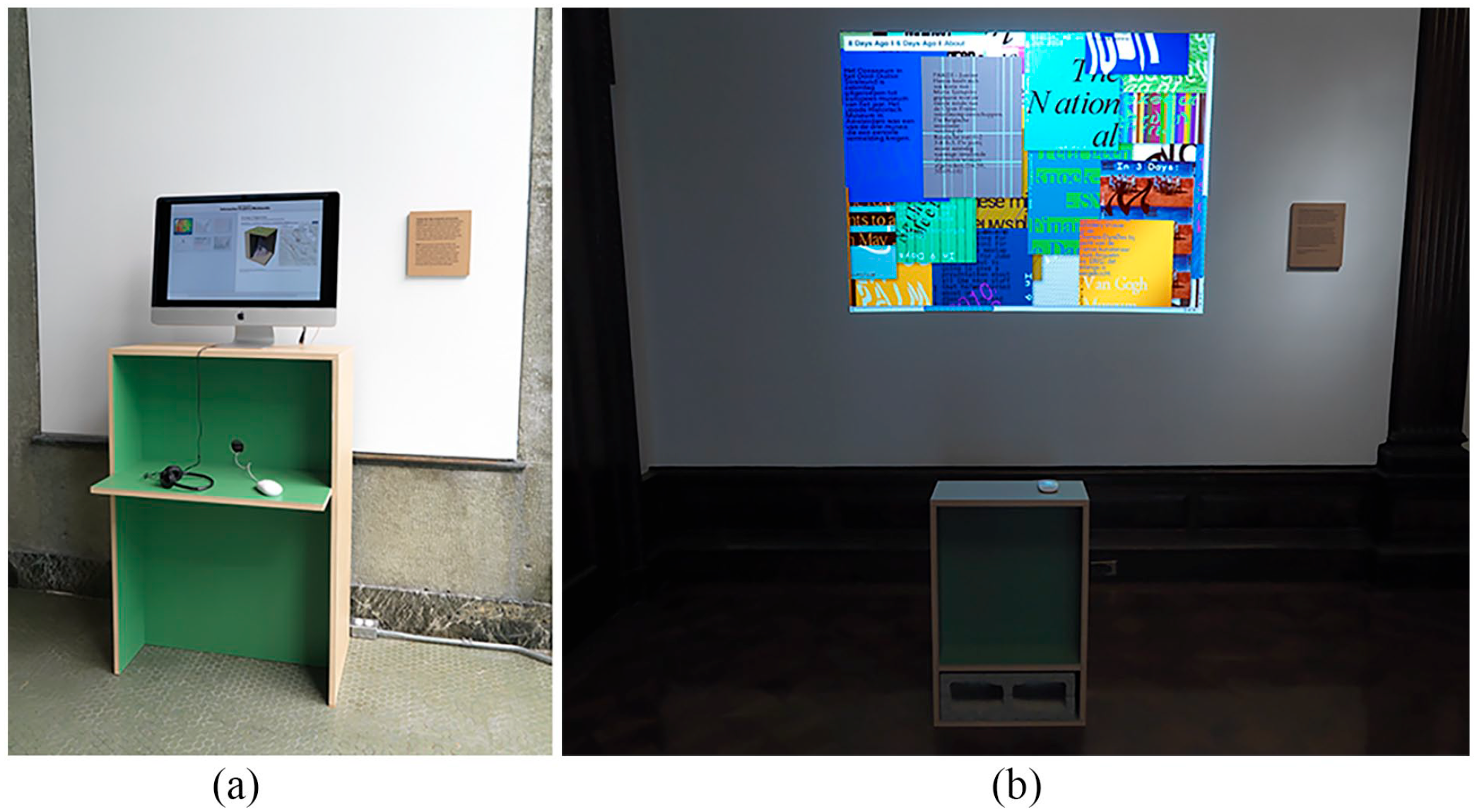
Two displays of digital design media from the Why Design Now? Triennial exhibition (May 14, 2010–January 9, 2011). (a) Display of The New York Times visualization and interaction projects as a contained, unnetworked interactive site. (b) Posterwall for the Twenty-First Century as a live, projected, and interactive installation.
The museum’s Collections Committee, which meets quarterly and advises on proposed museum acquisitions and collecting priorities, recognized that while the museum displayed digital media, it was unprepared and reluctant to collect it. As early as 2009, the Committee requested preliminary research on the technical issues of collecting and preserving digital media. 17 By 2011, the first born-digital acquisition entered the museum’s collection when the designer of the Clearview Highway typeface (which had been included in the Why Design Now? exhibition) gave the digital type files to the museum on a CD-ROM. (The Clearview typeface was also collected as a printed highway sign). That same year, the museum acquired the digital files, via CD-ROM, for the graphic identity developed by Stefan Sagmeister for the Casa Da Musica in Porto, Portugal. In 2013, the museum acquired two digital animations by graphic designer and typographer Phillipe Apeloig, and more ambitiously, its first piece of software—Planetary, a music visualization app designed for the newly released Apple iPad.
Well after its first digital acquisitions entered the collection, digital work was still considered difficult to contain and “metabolize” by the museum collecting management apparatus, reflective of common tensions throughout the museum field. 18 There is little documentation surrounding the museum’s first digital acquisitions of digital fonts and graphic identity on CDs. When presenting the type families to the museum’s Collections Committee, curatorial staff cited the requirement for new legal paperwork to address issues such as migration but did not discuss preservation concerns beyond this. In contrast, museum staff extensively described the acquisition of Planetary—the museum’s first attempt at collecting code—in a blog post 19 and professional paper. 20 Yet collections staff remained ill-equipped to handle the challenges of collecting, cataloguing, and caring for digital work.
In 2016, the museum received substantial funding from the National Collections Program to support the Digital Collections Materials Project (DCMP), its first large-scale analysis by conservation consultants Small Data Industries to assess the museum’s digital holdings. Simultaneously, collections staff and other internal stakeholders began meeting to build the expertise that would not only guide the museum’s efforts to collect and steward digital design, but implement and build on the findings from the DCMP to formulate policies and collecting strategies for future growth.
The DCMP’s major findings included the need to better integrate proposed display plans into the acquisitions process, given the high degree of interrelation between preservation and display; “garden the collection,” with increased attention to regular maintenance; and reconceptualize the way the museum thinks about risk and fragility to accommodate a totally different type of museum object. 21 While the initial approach was one couched in risk management as a framework, subsequent experience with the collection’s evolution has pushed back on the idea that the fragility of digital work is due to it being poorly understood or documented. In fact, the indeterminacy of some digital work has led to its flexible reuse and preservation, upending dominant norms of museum practice that see collections management best practices as reliant on detailed description and maintenance of fixity. 22
Describing Digital Design
Typologies and Formats
At present, the museum identifies digital design across many fields and typologies, though not all are yet represented in its collection. Digital typologies might include animations, augmented reality, data visualizations, digital typefaces, icons, illustrations, interfaces, instructions, posters, software and source code, videogames, virtual reality, visual journalism, and websites. In our collecting practices, we seek to consider not only what we acquire but how we acquire it, in order to most effectively reveal interaction (where relevant), designers’ process, and narrative in these complex acquisitions. The circulation and ubiquity of digital design also means that this work is non-exclusive, such that other institutions might collect the same works in completely different ways based on their priorities. For our purposes, we group works in our collection based on three overarching, format-driven types:
Hybrid objects: Embedded interfaces in electronic devices
Hybrid objects—the interfaces embedded in consumer electronics maintained in the Product Design and Decorative Arts department—are not formally being transitioned to the Digital department but represent a key area of legacy collecting that underlies our interests in interactivity and user experience design. Embedded design is the most challenging to describe and to maintain for a variety of reasons. First, most of the digital interface design was never documented at the time of acquisition, so often external resources like publicly available documentation are the only way to know how the interface design was intended to look. Second, turning on the museum’s devices to examine the embedded interface design requires multiple components often in precarious conditions, from aging plastics and electronics in the hardware devices to their power cords, which might be missing or damaged. Moreover, many network or software dependencies may no longer be available, limiting how the embedded design can be accessed and interacted with. Examination strategies explored by Small Data made use of surrogates (purchased on eBay or sourced through private collectors of historic computers, Figure 2) and envisioned presenting these works through surrogacy in future presentations. 23 Since 2018, we seek to make sharper distinctions during pre-acquisition discussions about our intentions to collect an object for its industrial design, interface, or both, in order to determine which element gets subordinated (if either) in our collecting process.
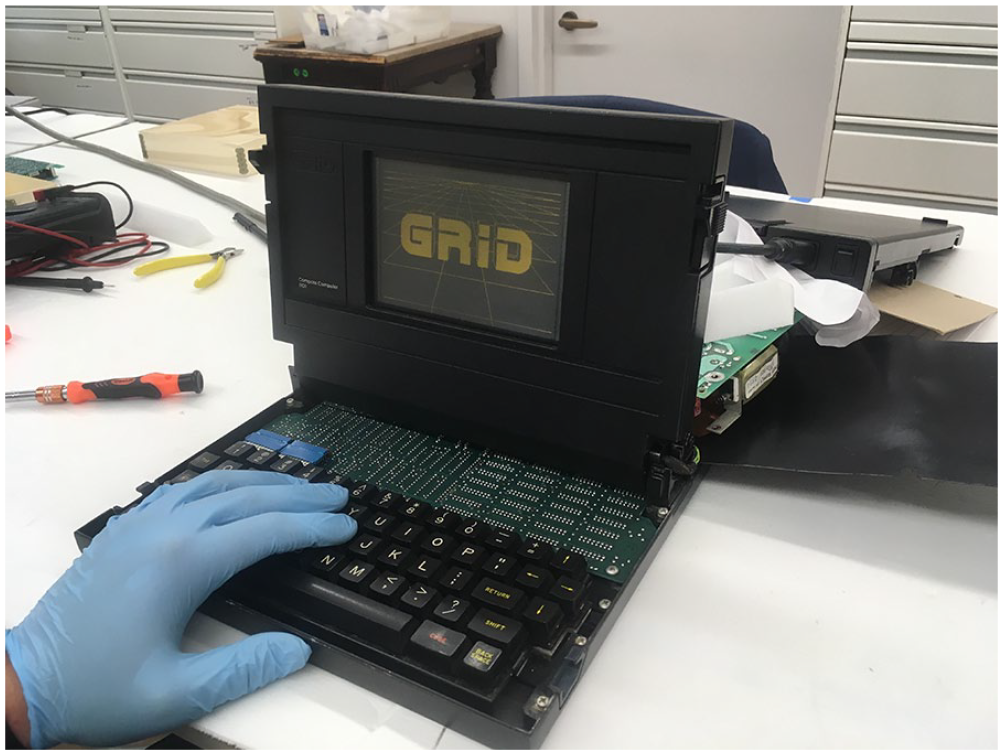
The GRiD interface was irrecoverable from one of the museum’s two GRiD laptops owing to hardware failure that prevents the computer from booting, but we were able to work with a private collector to document the embedded interface by swapping out a working hard drive.
File-based digital design
File-based works include static images and moving images, such as animations or digital videos, collected as file formats that are understood to be more stable. For preservation purposes, they are not anticipated to deprecate as quickly as other born-digital work, they conform to existing digital preservation standards, and they fit well within preservation norms (including fixity checking the files, providing file-level documentation and metadata, and auditing to ensure against damage in storage).
Icons, typefaces, digital posters, and animated visualizations are among the file-based works in Cooper Hewitt’s collection, as are the emoji which entered the collection in 2020—the Person With Headscarf and Inter-skintone Couple emoji. Both speak to communal advocacy and issues of representation on big tech platforms, which dominate emoji dissemination. In alignment with their significance narratives, the constituents associated with the emoji files include not only the designer, but the stakeholders involved in proposing and advocating for their inclusion within Unicode Consortium. Moreover, we collected the emoji files outside of the context of the devices on which they are used. By extracting them as elements of digital design rather than as components of interfaces, the possibilities to display the emoji are more open (Figure 3).
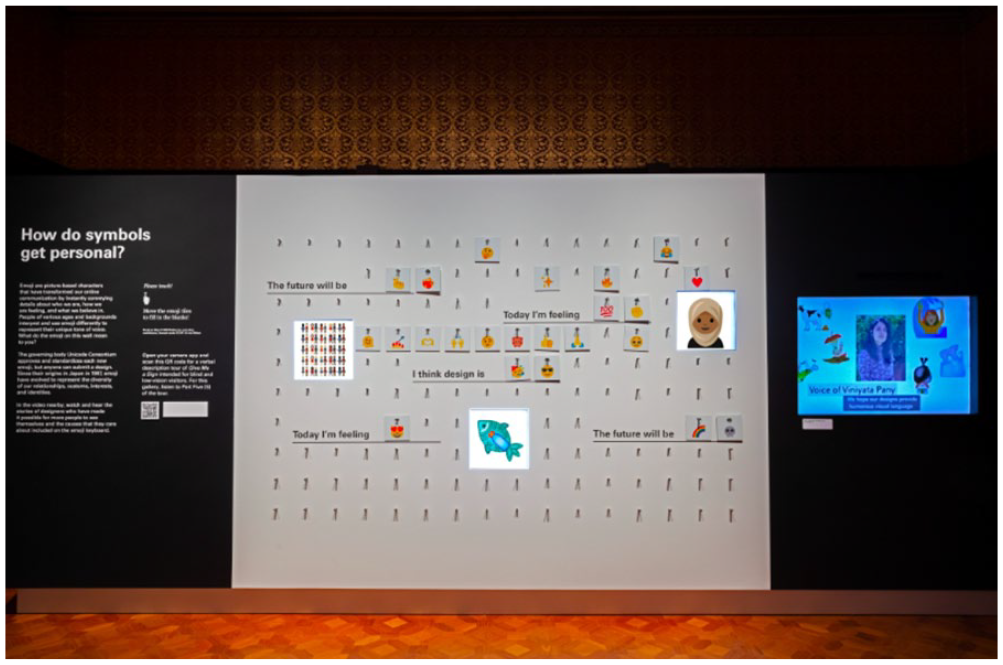
Person with Headscarf and Inter-skintone Couple emoji, as displayed in Give Me a Sign (May 13, 2023–September 24, 2024) with wall text with embedded monitors displaying digital emoji images.
File-based works in our collection often represent the output of digital design technologies—as product more than process—though associated collecting is a strategy we use to integrate other documentation into the acquisition, allowing more comprehensive stories to be told. As part of the Person With Headscarf emoji acquisition (four images), for instance, a copy of the Unicode Consortium proposal (the governing body that approves and standardizes emoji) was a supplement. The proposed interface layouts for the Inter-skintone Couple emoji (fifty-five images), revealing ideas about how users would select among the fifty-five variations of skintone and gender on an emoji keyboard, supplemented that acquisition.
Software: Interactive visualizations, websites, and other applications
The most ambitious area of collecting is software, in which works can be collected as both source code and compiled applications. To date, the collection includes interactive visualizations, websites, and applications. Software is more integrated into hardware dependencies, can be highly networked, and therefore usually represents a more unruly and nebulous type of collecting. Yet in our focus to privilege free access and interaction in our digital collecting strategies, we seek to prioritize user interaction with works outside of exhibition contexts whenever possible. Watercolor Maptiles, a web-based, open-source mapping tool acquired in 2021, is exemplary of this approach. The website displays OpenStreetMap’s data with the hand-hewn textures of watercolor paint through image processing algorithms and is zoomable, searchable, and free to embed in other projects. In keeping with the work’s ethos and design intent, we duplicated the live website as part of the acquisition, creating a parallel version now hosted by Smithsonian at watercolormaps.collection.cooperhewitt.org.
The acquisition of the work also included three components: the maptile assets (fifty-six million of them) required to build the functioning website; the code for the live website; and the image-processing code (Figure 4). The live-archive hybrid strategy means that we maintain the work even when it’s not on view in the museum’s galleries. In an in-gallery presentation, didactic documentation about the project (such as a video interview with lead designer Eric Rodenbeck) could likely be presented alongside the formal work, or perhaps in lieu of it.
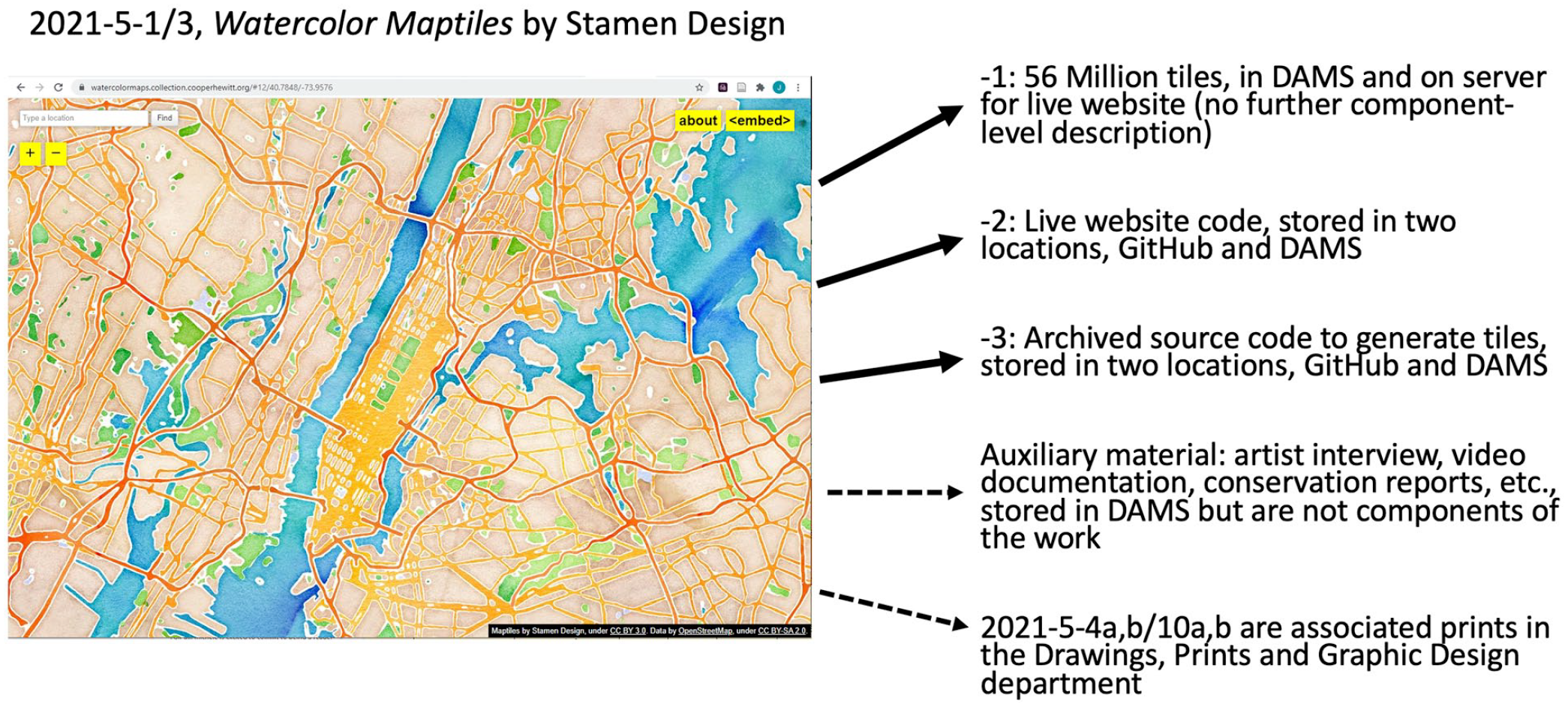
Diagram outlining the assets collected as part of the Watercolor Maptiles acquisition with associated accession numbers and descriptions, including: (2021-5-1) 56 million tiles; (-2) live website code; (-3) archived source code, which are all components of the artwork, along with auxilliary materials documenting the artwork that are not components, and associated prints collected by the Drawings, Prints and Graphic Design Department.
Components, Variants, and Versions
The museum has a well-established procedure for dealing with physical objects that have multiple parts, which we call components. Components are cataloged at the time of acquisition, registered in the museum’s collection records, and updated as changes arise (i.e., if an object is broken or removed from its original packaging). While these same principles apply in theory to digital works, in practice it is more challenging to define components and to decide which comprise “the work.” As our collecting has expanded, our understanding of digital collection objects has evolved—it was difficult to define component naming schema until we had a critical mass of examples. In addition, digital works tend to propagate, with copies being easily and often frequently made for exhibition, loan, research, conservation, and migration purposes.
In 2023, we undertook a deep dive into the Digital collection works to establish systems for assigning components. Conservation, curatorial, and registrar met for what we called “Component-a-thons.” For software, we generally seek to keep the description basic and often do not assign components at time of acquisition. Should copies be made, the copies are assigned component numbers per the procedure described in section D. However, the cataloguing process for file-based works is different: we review all material received from the designer at a file level to determine which components to assign.
Each file-based work gets its own accession number that consists of the main accession number (20XX-X-X) plus component designations, which can be extensive, complicated, and contested. First, the group must decide which files comprise “the work,” and which are supporting material (see section D). Designers often send extra files, so it is not simply a matter of which files they submitted for acquisition; instead, staff rely on collaboration and the designer interview to decide which file(s) are integral to the work. In general, each format becomes a component. However, there are additional rules for certain types of file-based works. This practical work reflects the more theoretical need to define the boundaries of works, process, and iterations.
For digital typefaces we decided, after consulting with graphic design archivists at the People’s Graphic Design Archive and Letterform Archive, that each family gets its own collection record, with components for weights and styles within that family. Styles receive a number, with families receiving a letter. The component numbers are generally assigned in the order in which the designer packaged the files. So, for example, ClearviewADA Font Family in Bold is 2011-24-5-1, while Clearview ClvText Font Family in Bold is 2011-24-6/8. For the Cooper Hewitt Solar typeface, there is only one font family, but with multiple styles and multiple formats. CooperHewitt-Bold in OTF is 2014-55-1-1a, while CooperHewitt-Bold in TTF is 2014-55-1-1-b; CooperHewitt-BoldItalic in OTF is 2014-55-1-2a, and in TTF 2014-55-1-2b.
For works in different colorways, like the Accessible Icon (Figure 5), we followed the rules established for the museum’s physical collections in the Textiles and Wallcoverings departments, which each contain many examples of objects with different colorways, that is, objects in the same pattern but different colors. To catalog these objects, each pattern receives its own object record, with components for each colorway.
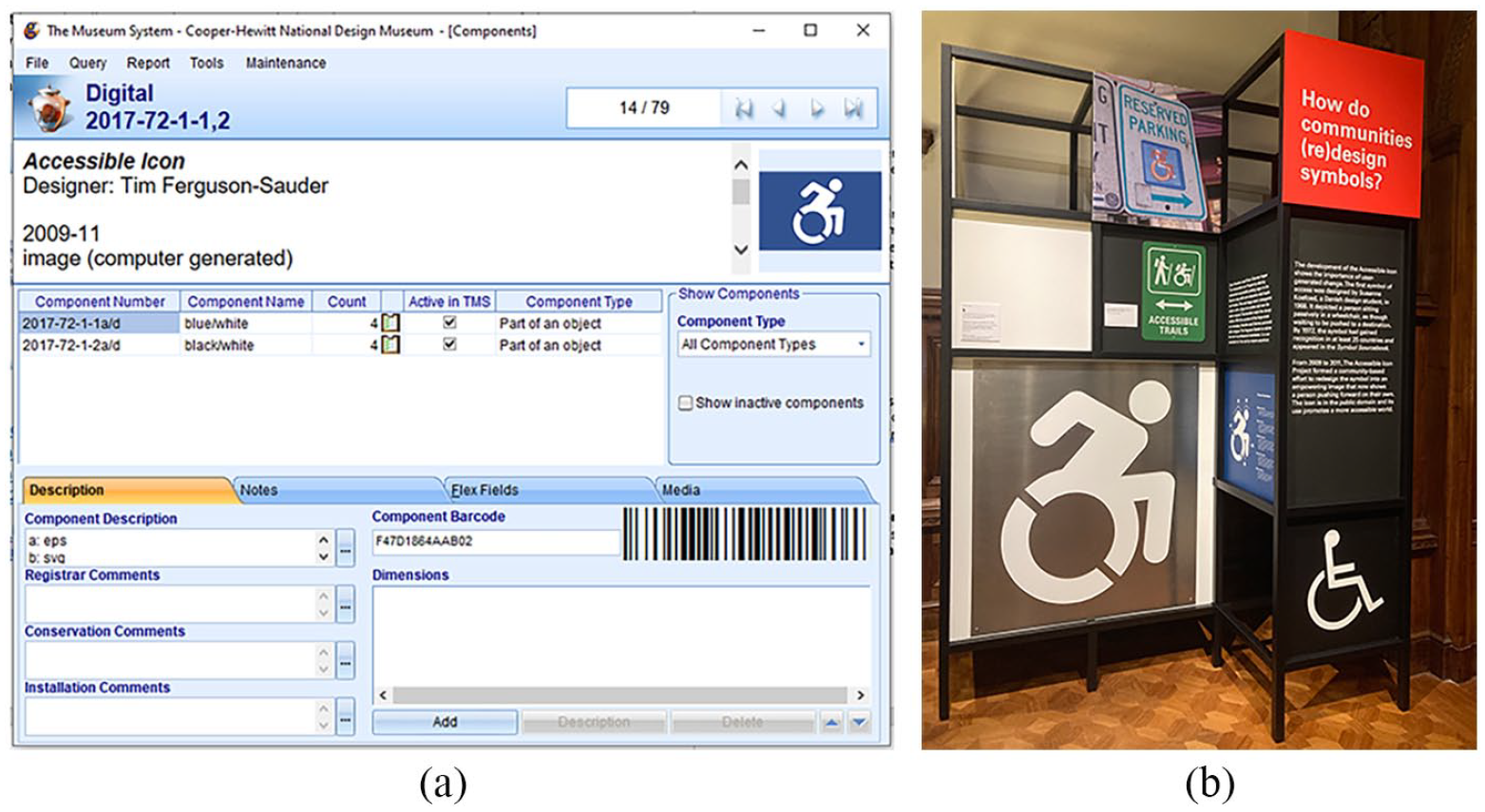
For the Accessible icon which was collected in blue/white and black/white colorways, we assigned a component for each colorway, then, as with typefaces, an additional component for each format. (a) Screenshot from the museum’s collections database showing the Accessible Icon in blue/white, eps format is 2017-72-1a, while the svg format is 2017-72-1b; black/white format in eps is 2017-72-2a, and svg 2017-72-2b. (b) An exhibition graphic printed in recessed metal to allow for a tactile, accessible experience for the gallery display in Give Me a Sign (May 12, 2023–September 2, 2024).
Medium: Fixity, Formats, and Fungibility
While at first “medium” was used to capture process and current file type, our re-cataloging of the Digital collection—informed by our experience conserving the collection—made us revisit that initial impulse. Though the museum has a data standards committee that discusses the applicability of the controlled vocabulary of Getty AAT, we have developed our hierarchical terminology by combining categories to better reflect our actual collection across the entire museum’s collections. This practice of generating local thesauri that incorporate needed terms and vocabulary is necessary for both internal and external audiences to understand and access our information. Rather than prescriptive practices of description, we advocate for institutions to work from their collections to understand the best descriptive practices that fit the types of work they actually collect.
This type of situated practice makes clear the limits of “best practices” and “preferred formats.” Unlike our peer institutions collecting TBMA, many of which collect substantial proportions of AV media that can be cataloged within preservation workflows that require clear definition of main (or master) files and derivatives, the relationships between the components of our works are often less clear (often more lateral and less hierarchical) and arguments to collect files in their original formats may push back on archival best practices for preferred formats. Images that circulate freely in digital networked culture may be adequately collected in lower resolution formats than are usually preferred in the collection of digital art. In addition, we at times collect multiple formats to capture both process and product and accommodate differing uses for these types of files in future presentations. This misfit between our collecting scope and existing practices also means that at times there are not yet any standards developed for the documentation of certain file types, for example, for digital typefaces. Overall, we have found this challenge to be an impetus for increasingly narrative and bespoke approaches to documentation and condition assessment, pushing back on the assumption that uniform workflows can be implemented across institutions.
File-based works
We now describe file-based works under the categories as follows:
Image (e.g., computer generated)
Moving image (e.g., digital video)
3D model
Typeface (i.e., digital typeface)
As noted in the above examples, works of graphic design have been collected at times in multiple formats. This reflects some uncertainty about the long-term preferences for formats in digital design collections. Within our unique and smaller-scale collecting remit we have already sensed that existing digital preservation standards (i.e., Library of Congress file format recommendations) 24 might not be fully applicable.
Graphic designers working in the Adobe creative suite may design something in Adobe Photoshop, move it into Adobe Illustrator, and work with it subsequently in animation software. This toggling back and forth between vector and raster image and moving image formats means that the same work could be represented equally well by a range of output file types (i.e., renders), or collected “in context” in process files bound to Adobe proprietary formats. If the museum’s collection eventually grows to form a “process archive” of working documents in addition to the “outputs” that are simpler to collect, we must embrace the difficulty of collecting these non-recommended formats, which are more difficult to ensure future access to.
Software as a medium
For software medium descriptions, “Software” is used as the broadest generic term, with more specificity added by defining the specific assets acquired as either source code, website, or compiled application, based on what we have collected so far. In the course of a work’s life it might transition from one format to another, but it will largely stay within the category of software. We might represent a work through documentation (i.e., as a video walkthrough or screen capture) rather than as interactive software, but this does not change the definition of the work itself, rather, it represents the explosion of display possibilities available when working with variable digital material.
For example: Ten Thousand Cents (2014-41-2) by Aaron Koblin and Takashi Kawashima was originally collected as a compiled application for Mac, to be displayed on Mac hardware in the museum. A web-based version was also hosted on Koblin’s website. While there are differences between the web and stand-alone presentations, the work can be represented by either of these two forms. Digital consultants at Small Data Industries are in the process of migrating the work from Flash to html 5 to enable a more stable web presentation consistent with today’s technologies. Though the new version will not remain Flash-based (older versions are able to be experienced through emulation) and the work is transforming, it remains a work of software. The new version will likely not be presented as a compiled application, as future presentations may take advantage of browser-based versions to be displayed more flexibly in in-gallery presentations.
Other Material: Defining Process Material, Conservation Documentation, Exhibition, and Access Copies
When copies are made of the work, additional components are added to the record, with letter prefixes indicating the purpose for which the copy was made:
EXH: Exhibition format created for an internally-produced exhibition
ASF: Access format, created for website or conservation
HRF: Outgoing loans
Sequence numbers are added to the prefixes, and components are marked inactive once their purpose has been fulfilled, such as when a work is returned from loan. This system allows us to track the location of the copies and to document the various ways in which the object has been utilized.
As mentioned above, some files received from the designer may not be defined as part of the work and will instead become supporting material, along with other documentation gathered during pre-acquisition including designer interviews, screen recordings and/or screen shots of the work, iteration reports, and designer-provided process material. This documentation is preserved in the museum’s DAMS (digital asset management system) but is not defined as components within the object record.
Due to the nature of its collection, the museum has not acquired a large amount of dedicated equipment. However, for those works that do have dedicated equipment—equipment that is integral to the display of a specific work—it is noted as a component as well. These components are numbered “DED-[sequence].[ObjectNumber],” such as the dedicated short-throw projector for installing The Substitute, a video installation by Alexandra Daisy Ginsberg.
While the museum has well-established practices for files on physical objects, the challenge with digital material is that it is often stored in the same kinds of digital systems and must be cataloged and tagged in a coherent way to differentiate digital artworks from other digital files. In addition, documentation for digital works is often integral to displaying the work in a way that is atypical of files for a physical object. The museum is still establishing these standards, but we hope to create a hierarchy that clearly labels what work(s) are associated with the documentation, whether the documentation is from the designer, from the museum, or from another outside source, alongside associated rights (especially the right to display) and keywords to assist in searchability.
Conclusions
Establishing a Digital collecting department in our nation’s design museum and actively collecting and stewarding this work has pushed us to reconsider all our museum practices. This work represents a significant change to the status quo and to the priorities of our future collecting and stewardship practices. Within this very contemporary realm of collecting, where we rely on many metaphors to make our points understood, these “living” collections 25 show that we have not yet calcified museum practice. New workflows and procedures that we put in place are in need of constant revision as we work through real-world examples. With each new digital work we encounter, we gain new insights and update our procedures.
While some of the language, taxonomy, and stewardship frameworks for digital collecting are unfamiliar to those working outside digital collections, we are working to document these new terms in the museum’s internal Collections Management Plan, updated biannually at Smithsonian, and theoretically a shared reference for all collections staff in curatorial, registrar, and conservation departments. Still these terms and frameworks need socialization within our staff, Board of Trustees, Collections Committee, colleagues at other institutions, and the outside world. In the context of negotiating outgoing loans and internal exhibitions alike, we have realized that the internal language we have developed to describe digital works and their many versions and variants does not always translate adequately to others. It may be seen as counter-cultural and disruptive to express deep skepticism of the applicability of data standards when working in such a variable field, but we prefer to see this language in flux as part of a move towards a “language of possibility,” 26 a broader shift needed throughout many different types of collections.
Within this space, we see important differences between “archiving,” “conservation,” and “stewardship.” As we seek to improve the collections management, access, and accessibility of the digital collection, it is no longer the narrow definitions of these terms that apply but a much broader sensibility of stewardship that allows for both individual works but also the entire collection to evolve and change. Within the field of Time-based media conservation, a useful way of framing variable media artworks (introduced by Pip Laurenson, following philosopher Nelson Goodman) conceives of these works as score-based, like a play or musical performance, rather than as unchangeable objects. 27 The “score” of the work is determined by the artist or designer and documented as the work-defining properties during the initial acquisition or conservation of the piece. The score documents an initial state but contains room for reinterpretation of the work in subsequent iterations, an approach that embraces (while it also limits) the variability or openness of these works. Often, conservation approaches for variable media and performance have used description as a tactic to enforce compliance with the original score, to greater or lesser degrees, 28 that is, to make sure that the subsequent iterations of a work meet the requirements to still reflect the work’s definition, even if some elements have changed. Our reconceived stewardship approaches conceptually modeled on gardening take a potentially looser approach to preserving works in that we are actively trying to shift to focus away from an original version to preserving access. By un-fixing software-based works from deprecated technologies, for example, we are enabling them to endure and be interacted with, inside or outside the museum.
The formation of a new collecting department may seem like a bureaucratic hurdle, but it is one that involves a lot of fixing, defining, and describing. These are core practices of museums and of the museum-ification of works of art and design as they are inscribed into the canon, particularly in national collections. The continued evolution of the works in the Digital collection—their resistance to fixity—pushes museum practice in the opposite direction, of encountering and learning to live with indeterminacy and fluctuation, variants and versions. 29 The concept of “Access copies” has also pressed us to reconsider whether the definition of Access is comprehensive enough. Many of these works are still very inaccessible to users with diverse disabilities, the topic of current collaboration by the Digital department and Digital and Emerging Media team, working together to design inclusive in-gallery and online experiences for the digital collection.
As outlined by choreographer Will Rawls, scores do not exclusively fix the parameters of a work, but rather, show where the work is open to (re) interpretation. 30 Thus, seeing scores as variable and open to reinterpretation, along with variations as generative rather than transgressive encourages many changes to museum practice, and likewise reflects how users interact with digital culture, from memes to devices. Describing new typologies requires openness in how we document and describe them. This is the most creative and challenging work we do, and the most transformative to museum practice because it shines a light on our underlying assumptions about museum practices and our prioritization of stasis and stability vs. access and interaction. Digital collections are transforming museum practice across many institutions, forcing us to reconsider practices and priorities of memory institutions. How and why do museum practices fix and encapsulate when they could instead be more open to change? Work with digital collections demands that we loosen our hold on best practices and be more open minded—reimagining how museums are not only record keepers and canon-generators, but also active participants in critical discussions in today’s design field.
Footnotes
Acknowledgements
We gratefully acknowledge the contributions of our close collaborators in the Digital Acquisitions Working Group: Cindy Trope, Janice Hussain, Sarah Barack, and Mary Fe Da Silva, as well as our colleagues across the museum and Smithsonian that enable this work, including Crystal Sanchez, Isabel Meyer, and Edward Monk at OCIO, and Bill Tompkins and Amelia Kile at the National Collections Program. Special thanks to the many students who have worked with us to build, describe, and steward the digital collection, including Angelina Medina, Nicolai Garcia, Wilder Seitz, Josephine Jenks, Katie Zwick, Caroline Carlsmith, Marguerite Montecinos-Deppe, and Chloe Friedenberg. A huge debt of gratitude is owed to Cass Fino-Radin at Small Data Industries for shaping our overall conceptualization of digital stewardship.
Declaration of Conflicting Interests
The author(s) declared no potential conflicts of interest with respect to the research, authorship, and/or publication of this article.
Funding
The author(s) received no financial support for the research, authorship, and/or publication of this article.
1.
Digital will be capitalized when referring to the museum’s Digital department, and uncapitalized otherwise.
3.
Cooper Hewitt’s latest Collections Stewardship Plan introduces new collecting priorities for the institution, including “broadening the scope of the collection to include digital design.” Cooper Hewitt, Smithsonian Design Museum, “Collections Stewardship Plan,” Unpublished internal document, Cooper Hewitt Smithsonian Design Museum (New York, NY), April 12,  , p. 23.
4.
A Collections Stewardship Plan serves to guide the shaping, refining, and growth of a museum’s collection.
5.
Cooper Hewitt, “Collections Stewardship Plan,” 6.
6.
7.
Rhizome’s use of variants to describe different iterations of net art works has been instrumental in establishing “variantology” as a discipline of inquiry and Dragan Espenschied’s articulation of the goals of preservation as between performance and documentation has strongly shaped Cooper Hewitt’s approach. Dragan Espenschied, “In Between Performance and Documentation,” in Documentation as Art: Expanded Digital Practices, eds. Annet Dekker and Gabriella Giannachi (London: Routledge, 2022), available at: .
8.
Gabi Arrigoni, Natalie Kane, Stephen McConnachie, and Joel McKim, Preserving and Sharing Born-Digital and Hybrid Objects from and across the National Collection (London: Victoria & Albert Museum, 2022), available at: .
9.
Cass Fino-Radin, Digital Preservation Practices and the Rhizome ArtBase (New York, NY: Rhizome, 2011), available at: http://media.rhizome.org/artbase/documents/Digital-Preservation-Practices-and-the-Rhizome-ArtBase.pdf and Dragan Espenschied and Klaus Rechert, “Fencing Apparently Infinite Objects,” in Proceedings of the 15th International Conference on Digital Preservation, September 24–27, (Boston, MA: iPRES, 2018).
10.
Lucy Bayley, “Curating and Collecting,” in Reshaping the Collectible: Research Approaches (London: Tate Research, 2019), available at: (accessed November 21, 2022).
11.
Beryl Graham, “Taxonomies of New Media Art – Real World Namings,” Museums and the Web 2005, available at: (accessed May 27, 2023).
12.
Graham, “Taxonomies,” 57.
13.
Victoria Walsh, Andrew Dewdney, and Emily Pringle, Cultural Value: Modelling Cultural Value within New Media Cultures and Networked Participation (London: Tate, 2014), 10, available at: (accessed May 27, 2023).
14.
Johanna Drucker, “Performative Materiality and Theoretical Approaches to Interface,” DHQ: Digital Humanities Quarterly, 7, no. 1 (2013): 4, available at: . Another component relevant not only to interpretation but also to the conservation of digital art is the recognition of digital design’s distributed materiality which, “though still focused on entities and their relations, edges towards an event-based model, with its roots in systems theory and suggestive connections to new materialisms.” (Blanchette paraphrased in Drucker, “Performative Materiality,” 7).
15.
16.
Drucker, “Performative Materiality,” 12 (italics in original).
17.
18.
19.
Seb Chan and Aaron Cope, “Planetary: Collecting and Preserving Code as a Living Object,” Cooper Hewitt Blog, August 26, 2013, available at: (Accessed January 3, 2024).
20.
Seb Chan, “Collecting the Present: Digital Code and Collections,” Museums and the Web 2014, March 19, 2014, available at: (Accessed January 3, 2024).
21.
Small Data Industries, “Designing the Future of Design: A Vision for Collecting Digital Design at the Cooper Hewitt, Smithsonian Design Museum,” 2018, available at: (Accessed January 3, 2024).
22.
23.
Small Data Industries, “Designing the Future” and Sarah Barack, Jessica Walthew, Cass Fino-Radin, and Andrea Lipps, “Planning for the Future Right Now: Riskscapes in Conserving Contemporary Design,” Journal of the American Institute for Conservation, 60, no. 2–3, (2021): 115–27, available at: .
24.
“Recommended Formats Statement,” Library of Congress, available at: https://www.loc.gov/preservation/resources/rfs/ (accessed May 27, ).
25.
Chan and Cope, “Planetary.”
26.
Jenny L. Davis and Krystiana L. Krupa, “Toward a Language of Possibility in Curation and Consultation Practices,” Collections: A Journal for Museum and Archives Professionals, 18, no. 1 (), 18–27. In Davis and Krupa’s article about their experience with NAGPRA repatriation work in Indigenous communities, they describe how the limited object-centered language of museum collections can be in conflict with Indigenous ontologies and terminology. Exploring the term “language of possibility” from Maori scholar Linda Tuhiwai Smith’s Decolonizing Methodologies (2012), they second Smith’s assertion that the language of research reflects our institutions’ deeply colonial underpinnings and needs to change.
27.
Pip Laurenson, “Authenticity, Change and Loss in the Conservation of Time-Based Media Installations,” Tate Papers, No. 6, 2006, available at: .
28.
29.
Jill Sterrett and Pip Laurenson, “For Art to Flourish and Leave its Trace,” VoCA Journal, November 12, 2015, available at: .