



Abstract
Archival records/resources in electronic and those that only existed in physical formats have been made available to a larger audience and received much more usage as a result of digitization and remote accessibility. Virtual archives can help to reduce the environmental impact of traditional archival practices by storing and sharing information digitally rather than physically. The aim of this paper is to assess and develop a framework for the delivery of a virtual archive system tailored to the needs of both users and archival institutions for the promotion of environmental sustainability especially in developing countries. The qualitative research explained user expectations and perspectives on the provision of a newly established electronic archival system for the provision of virtual archive services at an archival institution in the City of Cape Town. This paper anchored on the Expectation Confirmation Theory proposed the Virtual archival systems expectations and satisfaction (VASES) framework to identify electronic archival system users’ expectations, measure perceived performance of electronic archival systems, and assess confirmation and satisfaction.
Keywords
Introduction
The use of technology in archival practices has revolutionized the way that we access and interact with historical records. In recent years, both electronic and physical archival resources have become more widely available and more heavily used as a result of digitization and remote accessibility (Shillingsburg 2014). With the ability to access archives from anywhere and at any time, technology has opened up a world of possibilities for researchers, historians, and the general public (Pellerin, Mi, and Valk 2019) as well as applicable environmental sustainability measures. Virtual archives can help to reduce the environmental impact of traditional archival practices (van Bussel, Smit, and van de Pas 2015). By storing and sharing information digitally rather than physically, virtual archives can help to reduce the amount of energy and resources needed to store, preserve, and access historical and cultural materials. This can be particularly important in the case of large or frequently accessed collections, which can require significant resources to maintain and manage in a physical form (Singh and Sahu 2020).
The increasing reliance on computers, electronic mail, and other digital information systems is becoming the norm in business and society. Governments around the world are adopting information and communication technologies (ICTs) to improve the efficiency and delivery of public sector services (Alshehri, Drew, and Alhussain 2012). This adoption is resulting in the creation of large amounts of electronic records (e-records) that must be properly managed to enhance transparency and accountability in the management of public affairs and effective delivery of services (Wamukoya 2012). The government archives must also create and maintain electronic records that preserve their authenticity, reliability, completeness, and usability for as long as they are needed for the organization’s business needs and to meet legal or policy accountability requirements (Ngoepe and Saurombe 2016). Archives, as physical entities that hold primary sources of information such as original manuscripts, books, documents, maps, and photographs, are traditionally used to paper-based records. However, users of these archives must now adapt to the changing technological landscape and recognize the need for digital or virtual archive systems to improve and safeguard records, especially in the face of risks such as climate change, natural disasters, and poor handling practices (Pearce-Moses 2005; Sahoo 2004).
Virtual archives promote and safeguards the long-term accessibility of digital content which also ensures a number of environmental benefits. Singh and Sahu (2020) suggested that by reducing the need for physical storage and transport of materials, virtual archives can help to reduce energy and resource consumption and decrease waste. Chen (2019) noted that making valuable resources such as rare and unique materials available digitally, more people can access them without the need for physical copies to be produced, conserving resources in the process. These environmental benefits make digital preservation an important tool for promoting sustainability in the digital age.
Energy efficiency helps in ensuring environmental sustainability. Virtual archives can prove to reduce the energy and resource consumption associated with the production, distribution, and disposal of physical materials which can be beneficial in reducing greenhouse gas emissions and other environmental impacts (Pendergrass et al. 2019). Li, Su, and Du (2021) argued that virtual archives can also encourage the use of sustainable technologies, such as renewable energy sources and energy-efficient hardware and software, which can further contribute to a more sustainable future. In addition, digital storage and access requires less energy than maintaining a physical storage facility, as it does not require the use of physical space or the transportation of physical items (Chen 2019). With virtual archives also comes reduced wastes, as put forth by Paschalidou, Fafet, and Milios (2022) that the reduction in the need for physical storage and transport of materials, virtual archives can help to reduce the amount of waste generated from the production and disposal of physical materials. Similarly, this will guarantee long-term access of archival resources. Virtual archives help to ensure that digital content remains accessible over the long term, which can reduce the need for physical copies to be produced and distributed (Tallman 2021).
The virtual archival system at the archival institution serves several purposes, including meeting individual user information needs and demands, facilitating the sharing of archival information, showcasing archival collections through online exhibitions, supporting archival preservation management as well as supporting environmental sustainability. These functions are essential in fulfilling the role of the virtual archival system as a means of accessing and preserving archival materials (Hawkins 2022). However, the transition to digital archival systems is not without its challenges. In order to ensure that these systems meet the needs of both users and archival institutions as well as remain environmentally sustainable, it is important to carefully consider the design and implementation of these systems (Rhee 2022) in addition for users’ need and expectations (Oravec 2018). This is especially important in developing countries, where access to physical archival resources may be limited and the use of technology can have a significant impact on the availability and accessibility of historical records.
Travels and tourism for research and recreational purposes to archival sites and resources also impact on the environment through carbon emission through transportations. Wilczek (2021) stated that virtual archives have the capacity to reduce the environmental impacts of tourism by promoting virtual access to cultural heritage and other resources. By promoting remote access to information, virtual archives can help to reduce the environmental impacts of information management and access, and contribute to a more sustainable future (Faulkner, Lu, and Chen 2021). Efficient use of resources is better managed with virtual archives. Valuable resources, such as rare and unique materials, are used efficiently and effectively when such resources are available digitally (Tucker 2022). More archival users are provided access without the need for physical copies to be produced, which can help to conserve resources. The use of renewable energy sources and energy-efficient hardware and software, reduces the carbon footprint of information management and access. These are easily adoptable for virtual archives as sustainable practices in the design and operation of virtual archival systems (Pendergrass et al. 2019).
The aim of this paper is to assess and develop a framework for the delivery of virtual archive systems tailored to the needs of both users and archival institutions for environmental sustainability, with a particular focus on developing countries. Through this research, we hope to contribute to the development of more effective and user-friendly digital archival systems, particularly in developing countries where access to physical archival resources may be limited.
Methodology
The present study employed a qualitative case study method to investigate the delivery of a virtual archive system at an archival institution in South Africa. The purpose of which was to assess and develop a framework for the delivery of virtual archive systems tailored to the needs of both users and archival institutions for environmental sustainability. With a particular focus on developing countries, the developed framework is based on the Expectation Confirmation Theory (ECT).
The Expectation Confirmation Theory (ECT) proposed by Oliver (1980) suggests that satisfaction is determined by the extent to which an individual’s beliefs are confirmed/disconfirmed and their perception of the entity’s performance. This relationship is mediated by the construct of confirmation. The ECT (Figure 1) is a cognitive theory that aims to explain post-purchase or post-adoption satisfaction through the interaction of expectations, perceived performance, and confirmation of beliefs. The ECT was initially conceptualized for use in other disciplines including psychology and marketing (Oliver 1977, 1980). The ECT model includes four key constructs: expectations, perceived performance, confirmation of beliefs, and satisfaction.
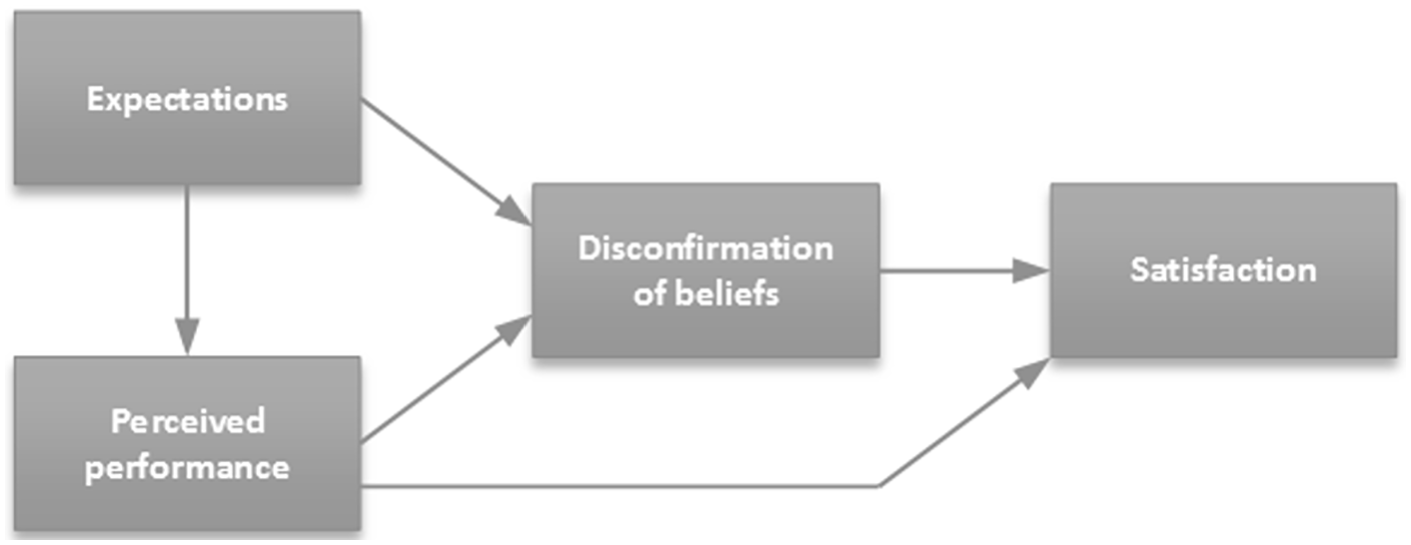
The ECT theory as proposed by Oliver (1980).
The theory proposes that satisfaction and repurchase intention are influenced by expectations, perceived performance, and the confirmation of beliefs (Fu, Zhang, and Chan 2018; Hossain and Quaddus 2012). The formation of repurchase intention can be understood within the ECT framework, which posits that customers’ repurchase intention is primarily driven by their satisfaction with the product or service. Satisfied customers are more likely to repurchase, while dissatisfaction can lead to discontinuation of use (Chou et al. 2012). According to Fu, Zhang, and Chan (2018) confirmation can be positive (perceived performance exceeds expectations), neutral (perceived performance matches expectations), or negative (perceived performance falls below expectations). Expectations provide a reference point for evaluating satisfaction, and the level of confirmation can influence satisfaction relative to this baseline. The expectations have a direct impact on perceptions of performance and the confirmation/disconfirmation of beliefs, and indirectly influence post-purchase or post-adoption satisfaction through the mediational role of confirmation (Lee and Kim 2020).
Expectations prior to purchasing or adopting a product, service, or technology can significantly impact an individual’s evaluation of the product’s performance and ultimately their satisfaction with it. This is because these pre-purchase or pre-adoption expectations provide a benchmark against which the product, service, or technology is judged. According to Gupta et al. (2021), the perceived performance of a product is directly influenced by these expectations. In turn, the perceived performance of the product can directly impact confirmation of beliefs and post-purchase or post-adoption satisfaction. Confirmation of beliefs refers to the process by which an individual evaluates a product, service, or technology in comparison to their original expectations (Oliver 1980; Wolverton et al. 2020). When a product performs better than the individual’s original expectations, this can lead to positive confirmation and increased satisfaction. On the other hand, when a product performs worse than expected, this can result in a disconfirmation and decreased satisfaction. In addition to directly impacting post-purchase or post-adoption satisfaction, perceived performance is also believed to indirectly affect satisfaction. However, if the confirmation is negative, this can lead to decreased satisfaction or increased dissatisfaction. Satisfaction is the positive emotional response an individual has towards a product, service, or technology. It can be described as a feeling of pleasure or contentment with the product. In summary, expectations prior to purchasing or adopting a product can significantly influence an individual’s evaluation of the product’s performance and ultimately their satisfaction with it.
The research was carried out at one of the oldest government archives in South Africa, with records dating back to the Dutch East India Company (VOC) and holds the oldest record with Jan van Riebeek’s signature, dated 1652. A qualitative research approach was adopted, involving the use of an open-ended questionnaire to gather data from a purposively selected group of archival users who had extensively interacted with the virtual system.
The group of archival users included archivists and research academics. Participants’ demographic details were not collected as this was not part of the approval from the ethics committee.
Questions were raised on the challenges experienced in accessing archival collections before the introduction of a new virtual archival system at their institution, the opportunities presented by the new archival system, level of satisfaction with the system as well as willingness to recommend the new system. Data was collected after the implementation of the new system.
A participation request was sent via email to these pre-selected users, who were drawn from a larger database of registered users at the archival institution. However, the total population of pre-selected registered users was not disclosed to the researchers. In total, six participants returned the questionnaire, and their responses were analyzed and presented thematically using ATLAS ti. During the thematic analysis, a review and familiarization of participants’ responses was done to gain a comprehensive understanding of the content. Initial codes were identified that represented important ideas or concepts present in the data. These initial codes were generated through a process of open coding. After generating a list of initial codes, grouping of similar codes together to form preliminary themes was done. The study adhered to the ethical principles of the University of the Western Cape Human Social Sciences Research Ethics Committee (HSSREC), including obtaining informed consent from all participants and permission from the archival institution to conduct research on site. The research was ethically cleared by the HSSREC with certificate number HS19/9/8.
Summary Findings
The study queried respondents on the challenges they experienced in accessing archival collections before the introduction of a new virtual archival system at their institution. All respondents identified various difficulties in making collections accessible to users. Five of the participants cited issues with damaged documents that required repair, leading to temporary inaccessibility. Two participants mentioned excessive backlogs of records retrieval requests, insufficient staff to maintain and retrieve records, and a lack of space for new archival requests from other departments. One respondent noted interest in doing research at the archival institution, however, archivists often seem to be overwhelmed by heavy workloads, further hindering access to collections for users. Three respondents revealed that they struggled to fulfill requests for records on time, as the records needed to be arranged and sorted on each floor according to the number of requests from researchers. This had obvious implications for service delivery. The opportunities presented by the new archival system were identified by participants. With respect to the major opportunities of having a virtual archives system, two respondents agreed that there will be benefits in terms of the access and retrieval of archival records. A participant noted that “the users can access as many collections as they wish wherever they are,” and they do not have to make copies which also further deteriorate the original copy. Three respondents agreed that the new archival system would reduce delays when using archival records. The opportunities identified by respondents also give rise to indication on perceived level of satisfaction of the virtual archival system. Participants were queried whether they would like to continue using the print records or recommend the use of virtual/digital archives system. Four participants identified that they liked the virtual archival system and all the respondents were ready to continue the use of the virtual system. All the participants were also very predisposed to recommend the virtual services to other archival users.
The summary of findings above served as the basis for the formulation and development of the virtual archival systems expectations and satisfaction (VASES) framework in Figure 2. The framework is proposed to explore the most effective ways to fully realize the potential of virtual archival systems in enhancing access and preservation of historical records.
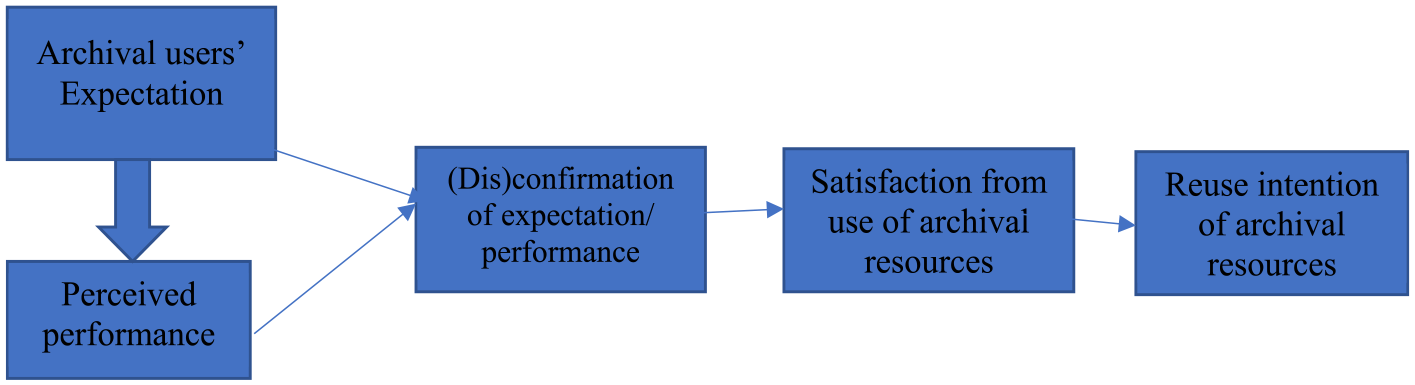
Virtual archival systems expectations and satisfaction (VASES) framework.
Discussion
The aim of this paper is to assess and develop a framework for the delivery of virtual archive systems tailored to the needs of both users and archival institutions for environmental sustainability, with a particular focus on developing countries. The provision of access as well as the demand and use of virtual archives especially in developing countries can help to reduce the environmental impact of traditional archival practices. By storing and sharing information digitally rather than physically, virtual archives can help to reduce the amount of energy and resources needed to store, preserve, and access historical and cultural materials. This can be particularly important in the case of large or frequently accessed collections, which can require significant resources to maintain and manage in a physical form.
Using the ECT as a framework it is easy to predict how individuals’ expectations about a product or service influence their perceptions of the product or service. In the context of virtual archives, the conceptual framework developed based on the research findings can be applied to understand how users’ expectations about how the virtual archive system influence their perceptions of the system and their satisfaction with it. In the case of virtual archives, users may have certain expectations about the functionality and usability of the system, the quality and relevance of the content, and the level of support and assistance available. If these expectations are met or exceeded, users will be more likely to have a positive perception of the system and feel satisfied with it. On the other hand, if the system falls short of users’ expectations, they may be less likely to have a positive perception of it and may feel less satisfied with it.
Users’ perceptions are influenced by their perspective, and what they see is determined by their viewpoint. User perspectives refer to the perception of actors on the demand side who are affected by a specific service or system.
Expectations are the attributes or characteristics that an individual anticipates or predicts will be associated with a product, service, or technology. These expectations are formed through speculation and can influence both perceptions of performance and confirmation of beliefs. In summary, expectations play a significant role in shaping an individual’s evaluation of a product’s performance and ultimately their satisfaction with it. This framework can be used to identify and measure users’ expectations about virtual archives, assess their perceived performance of the system, and evaluate their level of confirmation and satisfaction with the system. Virtual archival systems can be evaluated by, researchers and practitioners through:
The identify users’ expectations: practitioners can use a variety of methods to identify users’ expectations about virtual archives, including interviews, surveys, and focus groups. By gathering information about users’ prior experiences with similar systems, their expectations for the functionality and usability of the system, and their desired content and support, researchers and practitioners can gain a better understanding of users’ expectations.
Assess perceived performance: Once users’ expectations have been identified, practitioners can assess how well the virtual archive system meets these expectations. This can be done through user testing, which allows archivists to observe how users interact with the system and gather feedback about its performance. Alternatively, practitioners can use surveys or interviews to gather information about users’ perceptions of the system’s performance.
Evaluate confirmation and satisfaction: Based on the perceived performance of the system, archivists can evaluate the level of confirmation and satisfaction among users. If the system meets or exceeds users’ expectations, they will be more likely to feel confirmed in their expectations and satisfied with the system. If the system falls short of users’ expectations, they may feel less confirmed and less satisfied.
By applying VASES framework to the use of virtual archives, archivists can gain a better understanding of how users’ expectations influence their perceptions and satisfaction with the system. This information can be used to improve the design and implementation of virtual archive systems to better meet the needs of users.
In addition to using VASES framework to understand and improve the use of virtual archives, researchers and archivists can also consider other factors that may influence users’ expectations and perceptions of the system. For example, the design and usability of the system may affect users’ expectations and perceptions, as well as the relevance and quality of the content and the level of support and assistance available to users. By taking these factors into account, archival practitioners can create virtual archive systems that are more user-friendly and better meet the needs of users.
By examining user expectations and perceptions of performance, we were able to assess the level of confirmation and satisfaction among users, as well as identify factors that may influence their intention to reuse the system. The VASES framework provides a valuable starting place for understanding the delivery of virtual archival services tailored to the needs of both users and archival institutions. By taking into account the expectations and perspectives of users, we can ensure that digital archival systems are designed and implemented in a way that meets the needs of all archival stakeholders.
Conclusion
The provision of access to virtual archives, coupled with an understanding of users’ expectations and perceptions, offers significant potential for reducing the environmental impact of traditional archival practices, particularly in developing countries. Virtual archives, by storing and sharing information digitally, contribute to the conservation of energy and resources that would otherwise be expended in maintaining physical collections. Applying the VASES framework would enable archival institutions to gain a comprehensive understanding of the interplay between users’ expectations, perceptions, and satisfaction. This knowledge can inform the design and implementation of virtual archive systems, ensuring that they better cater to users’ needs and preferences. While the ECT framework provides a foundation for analyzing users’ expectations and perceptions, the VASES framework explicates variables in relation to archival institutions especially in developing countries. By incorporating these factors, archival practitioners can create user-friendly virtual archive systems that better serve the diverse needs of users. By examining user expectations, perceptions of performance, and confirmation and satisfaction levels, the VASES framework enables archivists to assess user intentions for future system reuse. This framework offers valuable insights for tailoring virtual archival services to meet the needs of users and archival institutions alike.
Study Limitations
While there have been several research studies on virtual archival systems, this study applied the ECT theory to develop a framework for Virtual archival systems expectations and satisfaction. With the development of the VASES framework, the conclusions should be inferred in the light of the following limitations. The findings of the research are based on a limited number of users through online surveys. The results were limited to the opinions of a small group of users. Therefore, conclusions cannot be generalized. However, the study will benefit from understanding user perspectives on the provision of virtual archives at archival institutions.
Footnotes
Declaration of Conflicting Interests
The author(s) declared no potential conflicts of interest with respect to the research, authorship, and/or publication of this article.
Funding
The author(s) received no financial support for the research, authorship, and/or publication of this article.
