




Abstract
Social outreach and engagement in UK-based audio-visual archives are under-researched areas worthy of further investigation, particularly considering the naturally immersive quality of audio-visual content and its potential to draw in, educate and engage audiences. This qualitative study explores three interconnected foci: challenges and opportunities currently faced by the National Library of Scotland’s Moving Image Archive with regards to preserving and making publicly accessible born-digital and analogue audio-visual materials; the impact of these challenges and opportunities upon the Moving Image Archive’s levels of social outreach and engagement; and ways to elevate the Moving Image Archive’s social outreach and engagement. Our findings indicate that, from a National Library of Scotland’s staff perspective, addressing issues related to copyright law and rights clearance processes, as well as supporting engagement in local areas and providing educational programmes on caring for materials, would be beneficial in increasing social outreach and engagement. The research findings informed recommendations, including increased staff resource and dedicated training in rights clearance processes, extending outreach and engagement beyond Scotland’s central belt, addressing the physical limitations of the archive’s public space and promoting the usability and creative re-use of archival material, as well as addressing gaps within the collection. Recommendations based on this study may contribute to further aligning the needs of the Moving Image Archive with the National Library of Scotland’s Reaching People: Library Strategy 2020–2025.
Keywords
Introduction
Established in 1925, the National Library of Scotland (NLS) 1 (2024) is a legal deposit reference library located in Edinburgh’s Old Town. The library hosts a collection of approximately 34 million print and digital items, including born-digital and analogue audio-visual material held in the Moving Image Archive (MIA). The MIA joined the NLS in 2007, and was previously an independent organisation known as the Scottish Screen Archive. The MIA does not hold the same legal deposit rights as bibliographic material in the NLS, and relies upon voluntary donations (Muir, 2004: 75) to make up its collection of approximately 46,000 analogue and born-digital items. The MIA is located in Kelvin Hall – a community centre in Glasgow’s West End, which provides services run by the charity Glasgow Life. Although the public can access the MIA in person, there are also 3,000 items available to view through its online catalogue. The collection dates to the 1890s, representing the ‘diverse record of Scottish life’ (Cameron, 2005: 142).
The aim of the MIA is to preserve and accurately reflect Scottish life and history through its rich audio-visual record, and make this accessible to the public, to enable a better understanding of and engagement with Scottish identity and cultural heritage (Figure 1).
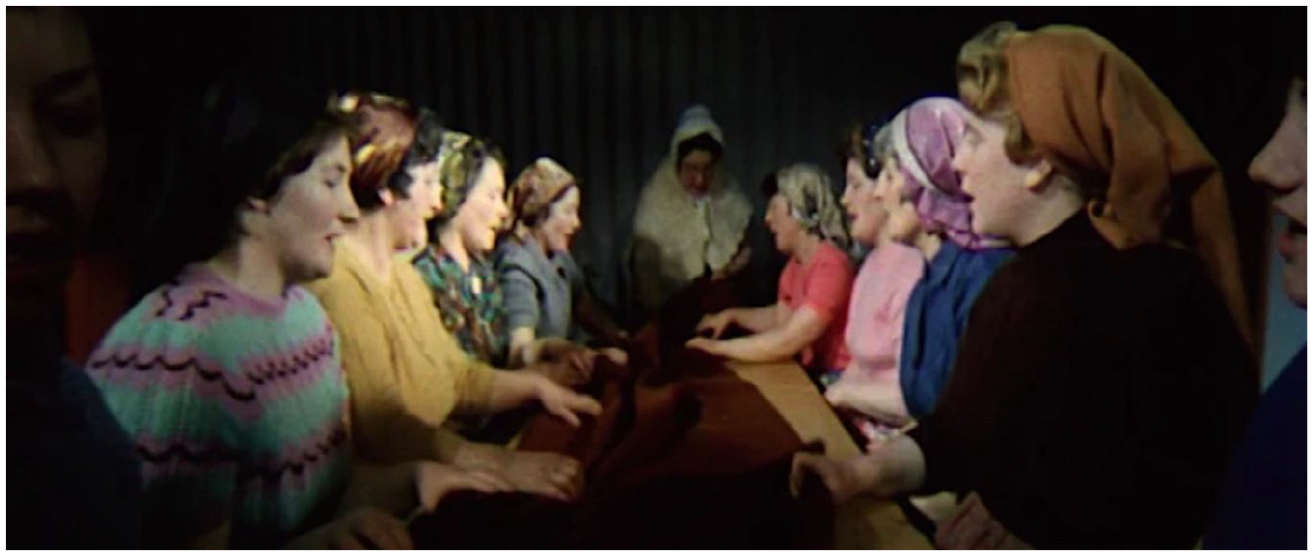
Screenshot of Outer Hebridean women singing while hand-finishing Harris tweed, from Island of the Big Cloth (1971). Published with permission of The National Library of Scotland.
There are currently several major challenges facing UK audio-visual archives, captured through the ongoing tension between continuing preservation work and enabling access to collections (Film Archive Forum, 2000; Gray and Jewitt, 2004; Kelly, 2007; McKernan, 2016). This research focusses on the NLS MIA (see Note 1), which is in the process of taking an audience-focused direction in its overall strategy, as outlined in its Reaching People: Library Strategy 2020-2025 (National Library of Scotland, 2020). For the MIA, this includes reconsidering its place as an audio-visual archive within an increasingly born-digital society, and how it might tailor its people-focused approach to include more creative, expansive, and inclusive social outreach and engagement opportunities.
This study was conducted as part of an Information and Library Science MSc final project at the University of Strathclyde in 2022, using a qualitative research approach. Following a scoping review, semi-structured interviews were carried out with selected NLS and MIA employees and interview transcripts were thematically analysed. Research results shed light on the alignment between the current overall Reaching People: Library Strategy 2020-2025 strategy and the needs of the MIA, and identifies gaps, from a staff perspective, to inform its future direction as it pertains to social outreach and engagement.
The following research questions were explored using a qualitative research approach:
What challenges and opportunities does the National Library of Scotland’s Moving Image Archive currently face with regards to preserving and making publicly accessible born-digital and analogue audio-visual materials?
What impact do these challenges and opportunities have upon the Moving Image Archive’s level of social outreach and engagement?
What recommendations can be provided for the Moving Image Archive to elevate its social outreach and engagement?
We hope this study and its recommendations may contribute towards enabling better access and deeper engagement with the MIA’s collection by serving it to the public, rather than relying on them to find it, and re-invigorating the public’s interest and agency in ensuring the MIA’s legacy.
Literature review
There are many hurdles national audio-visual archives must overcome in managing and fulfilling their responsibility to creators of works, donors and the public. The complexity and urgency of audio-visual preservation encompasses technological, organisational, legal and sociocultural challenges. Technological issues and approaches are largely well addressed in the literature (e.g. in manuals such as Blewer, 2020; Casey, 2022; IASA Technical Committee, 2017; Lacinak et al., 2022). Case studies such as Unlocking our Sound Heritage at the British Library, 2 the BBC Oral History Archives (Sichani and Hendy, 2022), the British Film Institute’s large scale videotape digitisation (Norman, 2022), dedicated journals and other general resources (Association of Moving Image Archivists (AMIA), no date; Library of Congress, no date) provide further pointers on these aspects. However, other non-technological aspects may heavily impact on the access to and engagement with audio-visual archives.
Arroyo-Ramírez et al. (2020) have listed ‘privacy and copyright’, ‘user interests’ and ‘donor and institutional expectations’ as some of the major ‘aspects of a collection’s profile that may influence decisions about access’ (p. 23). These are recurring themes in tackling barriers to access and social engagement in national audio-visual archives. A recent response by Screen Scotland to the UK Parliament Culture, Media and Sport Committee’s British Film and High-End Television Inquiry reiterated such aspects in the list of challenges faced by audio-visual heritage and archives in Scotland (UK Parliament Committees, 2023). In addition to analogue preservation and digitisation, digital preservation and technological obsolescence, the list mentions copyright and licencing, access and outreach, collaboration and partnerships and – as specifically raised by NLS colleagues – the need for ‘skills investment in heritage skills’ and ‘funding that balances investment in audiences with investment in infrastructure, technology and innovation’ (UK Parliament Committees, 2023: 20–21). Relevant studies on social outreach and engagement for national audio-visual archives are discussed below.
Privacy & copyright law: Re-evaluating the place of orphan works
Copyright law has been described as ‘probably the single biggest barrier to making available the existing cultural record’ (Joint Information Systems Committee (JISC, 2009: 21) and ‘a barrier to the digitisation and dissemination of library and archival holdings’ (Deazley and Stobo, 2013: 17). For national archives, copyright regulation can be a suppressive influence on the shape of its collections by potentially inhibiting representations of ideologies or identities that should be ‘made available to the public’ (Sarikakis et al., 2016: 42), often due to the problem presented by ‘orphan works’, whereby material ‘for which the right holder is not known or cannot be found [. . .] cannot be used freely, even though it may be impossible to get the right holder’s permission’ (Intellectual Property Office, 2020). Without identification of rights holders, ‘unclear provenance of collection materials can affect the provision of ethical access to materials’ (Smith et al., 2021). This complicates an archive’s purpose, and responsibility to its users, and donors, because if material is ‘potentially available but not publicly accessible, [the] possibilities to engage with the dynamics of history and to reach [the] potential for history making will be limited’ (Op Den Kamp, 2016: 40). What constitutes ‘authenticity’ also has implications for social outreach and engagement work, with calls to re-evaluate rights clearance processes so that the story of how material has come into being can be told (Ross, 2012: 54).
Privacy & copyright law: Takedown policy & the benefits of creative re-use
Although carefully navigating the grey area of orphan works is important to enable public access to material, audio-visual archives must also ensure robust policies are in place to protect individuals’ identities, particularly when non-consensual exposure ‘could be harmful to living subjects’ (de Klerk, 2018). An example of this is the National Library of Scotland (NLS, 2018) Takedown Policy, which acknowledges the potential for ‘material made available in good faith [which] may later be shown to be infringing copyright, displaying sensitive personal data, or contain[ing] obscene or defamatory content’ (NLS, 2018: 1). This includes information for the public on how to request material to be removed if they believe it breaches privacy or copyright law. This approach is supported by Aufderheide et al. (2014), who advise that ‘institutions should not simply promise takedowns in the event of receiving a complaint but should always engage in dialogue as a first step’ (p. 36). The Takedown Policy is an example of how national institutions ‘have become more sensitive to the consequences and harm that widespread online access can bring to personal lives’ (Manžuch, 2017: 8), and how ‘users can be valuable contributors and even help in providing additional information about collection materials’ (Aufderheide et al., 2014: 36).
Allowing for more creative re-use of material within the limitations of copyright law can also enable meaningful public engagement. This is supported by Aufderheide and Jaszi (2011) in their arguments for reclaiming fair use, and is reiterated by Aufderheide et al. (2014) who state that re-use of material is a ‘critically important part of facilitating research, promoting new discoveries, and enabling the creation of new creatives works’ (p. 16). However, issues presented by orphan works can still ‘frustrate entire reutilization projects’ (van Gompel and Hugenholtz, 2010: 62).
Social outreach & engagement: Building relationships with donors
Collaboration between national institutions and donors and users is important not only for takedown policies and navigating copyright law, but also for social outreach and engagement purposes. As the Digital Preservation Handbook (Digital Preservation Coalition (DPH), 2015) reminds us, ‘creators may often be unaware of their pivotal role’ in enabling access and improving engagement with their material. Although Kim et al. (2019) raise concerns in managing donations from the public, and Schüller (2020) highlights the importance of ‘well-organized metadata’ (p. 214) for identification purposes, such concerns point towards the value of educating donors and the public in best practice as, ultimately, ‘they know more about their works than anyone else’ (Gladney, 2007: 18). Building relationships with donors and sharing knowledge regarding best archival practices improves the possibility of audio-visual heritage being preserved for posterity. This is evidenced by Davidson and Reid (2022) in their digitisation project ‘Fraserburgh on Film’, which reflects the ‘democratisation of heritage’ (p. 390) as Fraserburgh’s history is told through the local vernacular of and by its people. Including input from local communities is also a way of potentially mitigating gaps within national collections, and promotes inclusivity and discoverability (Flinn, 2007), particularly as ‘there are many memories that are often conflicting and contradictory’ (Carter, 2006: 220).
Social outreach & engagement: Researching user needs & audience development
The DPH underlines the importance of engaging with communities which are less visible in national archives, whereby potential users and their needs are researched and identified rather than assumed. Researching user needs and developing an audience strategy can be managed through the Open Archival Information System’s (OAIS) ‘designated community’ approach (Mitcham, 2023: 2). The NLS is an OAIS archive, with its ‘mandate for preservation and access reflected in the Reaching People Library Strategy 2020-2025’ (NLS OAIS Archive: 2), which aims to ‘“save some of the most fragile [audio-visual] formats in the country from disintegration’ (National Library of Scotland, 2020: 2) and ‘collect, preserve and make available diverse materials that represent the lives and memories of Scotland’s people’ (p. 10). However, despite a designated community definition being an OAIS mandatory responsibility, Keitel and Mitcham (2023) highlight that the vast majority of attendees at a Digital Preservation Coalition event in 2022 ‘did not have a designated community definition’ (p. 3). Talboom and Underdown (2019) also point towards issues with defining a designated community, particularly for national institutions, as ‘we cannot meaningfully define “everybody” as our Designated Community’ (p. 5). Bettivia (2016) suggests that collaboration with communities allows for a more balanced relationship between users and their institutions (p. 8) and avoids national institutions employing audience development strategies which ‘privilege the institutions more so than the public and audiences they serve’ (p. 1). Owens (2018) underlines this, by explaining that including communities as part of social outreach strategies is not a box-ticking exercise, but one which should be continually re-evaluated as audio-visual archives should serve as ‘resources to communities [and] not harvesters or plunderers of resources from communities’ (p. 108).
The changing landscape: Managing expectations & prioritising born-digital material
Looking to the future, what is considered archival material for audio-visual collections is now changing in a largely born-digital environment, particularly with the prolific use of social media platforms to upload audio-visual material. This creates new challenges, including more demand for specialist input efforts as it pertains to maintaining useful and correct metadata, ‘to ensure trustworthy archives’ (Bushey, 2015: 279–280). It also contributes to confusion surrounding ‘expectations of preservation versus the realities of access’ (Smith et al., 2021), where ‘users have an ill-informed sense of entitlement to immediate access’ (Bamberger and Brylawski, 2010: 113). In a rapidly changing landscape, national institutions need to put strategies in place to prioritise contemporary born-digital material for preservation, as well as implementing social outreach and engagement strategies designed to educate donors on storing and maintaining born-digital material, to ensure the continued democratisation of our heritage. For example, a new digital scholarship service at the NLS ‘has given an initial priority to providing digitised collections as datasets, with future plans to publish metadata, maps-as-data, audiovisual material, web archive and organisational data’ (Ames and Lewis, 2020: 3), posing interesting conceptual and organisational questions for audio-visual materials.
The emerging theme from the literature is one of collaboration as an effective tool in tackling barriers to access and engagement, although heterogenous and at times inconsistent approaches are being used by a number of national institutions to address such barriers. Social outreach and engagement in UK-based audio-visual archives require further research to realise the potential of such materials to draw in, educate, and engage audiences.
Our study seeks to fill these gaps by investigating challenges and opportunities for social outreach and engagement in the NLS MIA, and connecting those to the NLS Reaching People Library Strategy 2020–2025 (NLS, 2020).
Methodology
A qualitative research method was chosen to address the research questions and explore professional perspectives. Semi-structured interviews were conducted remotely via Microsoft Teams, followed by a thematic analysis of the transcripts, and onsite visits were conducted to familiarise with the working environment of the NLS and MIA. This study required an understanding of the workings of an organisation. Due to the nature of the research project, we focused on selected internal MIA and NLS employees to inform the analysis and recommendations. In advance of conducting the study, ethics documentation was submitted to and approved by the University of Strathclyde’s Computer and Information Sciences Departmental Ethics Committee.
Interviewee selection
Interviewees selection was based on the research project’s specific time constraints, and on the recommendations provided by our main point of contact at the MIA, who made suggestions based upon the central themes of the research questions, areas of staff expertise and the general availability of staff members in June 2022. Interviewees were not selected based on their length of time at the MIA or NLS, but upon their perceived contribution and relevancy to the research questions. Selecting staff members who were both directly or indirectly involved with the MIA (such as those also working with bibliographic material at the NLS), allowed us to gain a vantage point from outwith the MIA.
Interview approach
As of 30th June 2022, there were twenty-four staff members working in the MIA, including full-time, part-time, and externally funded project staff. Ten in-depth semi-structured interviews of approximately 30 minutes–1 hour in duration were conducted via Microsoft Teams with members of staff from the MIA and NLS across several different expertise in June 2022, producing rich accounts on the topics explored in this study. The interviews were recorded, and transcripts were generated from Microsoft Teams. All participants signed a consent form in advance of the interview, confirming that all quotations used in the study would be anonymised. Due to the level of expertise and insider knowledge required for this study, using semi-structured qualitative interviews rather than a questionnaire or survey allowed for more nuanced, descriptive feedback, particularly as the ‘nature of the data is too complicated to be asked and answered easily’ (Pickard, 2013: 196).
Interviews design
In designing the interview questions, central themes from the research questions and literature review were considered as well as the individual expertise of the interviewees. Two specific uniform questions were also asked of every interviewee:
If you had an endless supply of funds and the authority to make whatever changes you wanted, how would you use that power within the MIA?
In your opinion, what is the central purpose and number one priority of the MIA?
These consistent styles of questioning, following Kvale’s (1996: 133–135) structure – introducing, follow-up/probing and specifying – were employed to provide a clear comparison point across all ten interviews, and to assist with informing the recommendations to ensure participants’ voices were heard. The specifying questions included for example:
‘With the MIA being situated within Kelvin Hall, a hub which includes Glasgow Life services for the public and educational resources for the University of Glasgow, how does the MIA play its role in terms of social outreach and within the community?’
This proved to be one of the most useful questions as it allowed participants to focus on the specifics of social outreach within the MIA, prompted by using buzz words such as ‘hub’, ‘educational’, ‘outreach’ and ‘community’. Although a long question, it positions the MIA as another community resource alongside Glasgow Life services (a charity connected to and largely funded by Glasgow City Council 3 ), rather than as a purely academic or curatorial institution.
In a pilot interview, questions surrounding legal and ethical frameworks proved complex for interviewees to answer, with interviewees either unable to answer, or to provide a meaningful answer. Instead, probing questions regarding the technicalities of copyright law and orphan works were revised to allow for more nuanced answers surrounding interviewees’ opinions on such processes, and how they feel it impacts levels of access and engagement with material.
Overall, the nature and style of the interview questions allowed for data which provided a broad perspective of activity and opinion within the MIA, which could then be broken down into codes and themes from which to inform meaningful recommendations from a staff perspective.
Thematic analysis and coding
Thematic analysis is the segmentation and coding of text to prescribe meaningful themes across a data set, to reveal patterns and distinctions within a research area (Braun and Clarke, 2006). Thematic analysis was an appropriate research method for this study because it is ‘useful for producing qualitative analyses suited to informing policy development’ (Braun and Clarke, 2006: 97). The analysis took an inductive approach in that the data from the interview transcripts was not coded to a ‘pre-existing coding frame’ (Braun and Clarke, 2006: 83) but was organically generated at an individual level before being arranged into sub-themes and macro-themes.
Coding
Using the NVivo software, 4 codes and themes were generated from the interview transcripts and iteratively reviewed and revised.
Codes were individually colour-coded according to a traffic-light system to highlight their level of relevance to the research questions. For example, red indicated a topic with little or no relevance to the research questions; yellow indicated the potential for a topic to be explored further, and green determined a definite area of interest and inclusion. ‘In vivo’ codes (Charmaz, 2008) were also a key aspect of the coding process, in that quotes from interviews informed the individual codes and higher-level themes. This was important for this study as it allowed the researcher to ‘prioritize and honour the participant’s voice’ (Saldaña, 2009: 74). Such an approach proved useful for the data analysis and discussion, which relies heavily upon direct quotes from interviewees and is based around the structure of the macro-themes employed during the thematic analysis.
NVivo presents a ‘temptation to quantify the data’ (Curtis and Curtis, 2011: 17), which is an issue that arose during this study. For example, the code ‘rights clearance’ had 17 references assigned to it, but the richness of the data did not necessarily equate to this figure.
Two macro-themes and related codes were identified:
- Social Outreach and Digital Engagement theme, including codes on Recommendations, Partnerships, Building relationships, Projects, Increasing Visibility, Creativity, COVID-19, Caring for collections, Training.
- Overall Purpose of Archive theme: including codes on Preservation, Access, Scottish identity, Sharing, Collecting.
Insights from interviewees and the emerging macro-themes from the thematic analysis to inform recommendations for elevating levels of social outreach and engagement in the MIA are discussed below. Interviewees’ responses have been anonymised and given alphanumeric labels.
Discussion
Addressing and managing the limitations of copyright law
NLS and MIA staff have a ‘duty to protect the interests’ of donors (P2; P7), however managing the risks related to copyright law, and the limitations it can have in enabling access and creating a representative picture of national institutions’ collections, can be a real dilemma, as expressed by one interviewee: By us not allowing access to [a] particular item, or not doing something with this item, is that going to benefit, or not harm, the person’s economic rights? Or actually, there’s no-one doing anything with this content, no-one has this content, [and] no-one probably knows that they own the rights? (P7)
Such queries echoes questions raised by Sarikakis et al. (2016), Op Den Kamp (2016) and van Gompel and Hugenholtz (2010) in their discussion of balancing public access to orphan works and the protection of donors’ identities. Despite this, and although copyright law has been described as a barrier by JISC (2009) and Deazley and Stobo (2013), interviewees viewed the relationship between preservation and access and copyright law to be a ‘hurdle rather than a barrier’ (P2; P3). This opposes JISC and Deazley and Stobo, as it presents copyright law as a challenge for enabling public access to collections, but certainly not a ‘barrier’. Interviewees explained this is because copyright law will always ‘legally end’ (P9) in the future, and they believe it is an archive’s responsibility to work towards ‘longevity’ (P2), with the opportunity to ‘do something [with material] at some point in the future’ (P2). One interviewee was even optimistic about such limitations, explaining that ‘just because you can’t use [material] in your career doesn’t mean you should deprive future generations of being able to use it and have it accessible’ (P9).
However, interviewees’ feedback on projects such as Unlocking Our Sound Heritage (UOSH) 5 reveal that the limitations of copyright regulations and rights clearance processes can have an influence on the shape of audio-visual collections. For example, one interviewee explained that the final material included in the UOSH project was not ‘necessarily a representative picture’ (P8) of the collection because it is entirely dependent on ‘what you’ve managed to clear through copyright’ (P8). Additionally, material from existing partners of the MIA was prioritised to be considered for inclusion in UOSH as resources were guaranteed in the long-term, which was described by one interviewee as a ‘limiting factor’ (P8) for the project. Therefore, public-facing projects, whose very purpose is to raise public awareness of national collections, would benefit from a more flexible approach in its rights clearance processes, as supported by Ross (2012) and Aufderheide and Jaszi (2011).
Lack of staff resource and training in handling rights clearance processes
Continuing with issues related to rights clearance processes, at least three interviewees commented that making material publicly accessible is contingent upon correctly supplied and complete paperwork, but current workloads, resources and differing levels of staff training prevent them from managing the scale and complexity of rights clearance and, subsequently, making that material publicly accessible. As of June 2022, there was only one permanent acquisitions officer handling all contracts, and one full-time post for outreach work and larger individual projects in the MIA, managing a ‘backlog which is 14 years’ long’ (P1). One interviewee described this level of staffing as ‘completely unrealistic’ (P6) in handling rights clearance and accessibility issues, particularly given the level of care and responsibility a national film archive demands. Additionally, despite the third-party exemptions the NLS receives, when interviewees were asked what they would do with increased funding and staff resources within the MIA, responses included: engaging more staff, to be trained and to be trusted to handle rights clearances’ (P3), ‘to have a dedicated rights person’ (P8), putting ‘funding towards a project to look at the legacy issues with rights’ (P5) ), and another commented that the ‘capacity problem could be dealt with if you had, like, two more members of staff, you’d better get through the backlog (P10).
Despite the suggestion there may be ‘more opportunity to gain [information] about the rights status of an item, and potentially rights ownership information’ (P7) due to the increasingly contemporary nature of donated audio-visual material, another interviewee commented that: If the rights were clearer and more tidy, then we could be putting more things online and more things on the website. And then it’s not solely limited to being in Glasgow or Edinburgh and one of our venues to see the on-site stuff. (P5)
Incomplete or incorrect paperwork can present an opportunity for the MIA to diversify its collection, not only beyond Glasgow and Edinburgh, but also in terms of donations, which one interviewee commented often come from ‘people that feel comfortable in the spaces that they’re in [. . .] and people that possibly aren’t less likely to give you’ (P4). With one interviewee suggesting that material they receive often, but not always, originates from a ‘white, middle-class point of view and predominantly male’ (P8), a case can be made to increase efforts to outsource material from, for example, historically suppressed voices. The NLS already has a Takedown Policy in place to mitigate risk to donors, and continuing dialogue with donors, and community archivists, supports Aufderheide et al. (2014), and suggests that conversations with donors can be a helpful learning exercise in providing ‘additional information about collection materials’ (p. 36).
Finally, in its collection the MIA typically holds low-budget material from individuals or companies who do not have the capacity or resources to provide completely up-to-date and correct rights documentation. As one interviewee explained, ‘small organisations, arts organisations or production companies are really short of time [and] there’s quite a lot expected of the donor to get [rights information] in order before it actually comes to the Moving Image Archive’ (P6). Therefore, improving dialogue and public awareness regarding rights processes is imperative to ensure future donors are ‘thinking about the long-term copyright implications when they create material’ (P7).
Physical limitations of Kelvin Hall
With ‘greater numbers visit[ing] to view the exhibitions, attend talks and take part in other educational activities’ (National Library of Scotland, 2020: 4), there is clearly a demand for in-person outreach activities at both the NLS and the MIA. However, multiple interviewees described the physical site of Kelvin Hall as ‘limited’ (P2), ‘not fit for purpose’ (P6), and ‘a static space’(P5). With the physical space available within Kelvin Hall, one interviewee highlighted the difficulties of arranging events, as ‘if we proactively encourage people too much but then we don’t actually have a facility to offer them, it can cause frustration and give a bad impression’(P5).
With the MIA being situated at the very back of Kelvin Hall, its presence is not visible from entering the building. This was commented on by one interviewee, who suggested that ‘you want it at the front of the building [and] in neighbourhoods’ (P7) and NLS sites, such as the MIA. This interviewee compares this with the presence of, for example, public libraries in local areas contrasted with NLS sites, such as the MIA, which are ‘physically present next to nowhere’ (P7). As another interviewee explains, ‘a lot of people stumble upon us in this building and are very unaware of the fact that we’re here, and who we are’ (P5).
Re-assessing the place of the MIA in an increasingly born-digital society
Improving educational efforts and public awareness is a continuing theme in interviewees’ responses which reveals some concerns in current public attitudes towards the collection, care and preservation of audio-visual material. For example, one interviewee expressed concern that there is a growing disparity between what the public understands to be an appropriate level of care for personal audio-visual material, and the level of care deemed acceptable by professionals and national institutions for material to be accessible and usable, now and in the future. Another interviewee explained that ‘people tend to think once something’s on YouTube, or it’s on iTunes or Apple, then it’s going to be on there forever, but it’s not’ (P4). The same interviewee summarises the dilemma with this phenomenon as the [. . .] effect of the democratisation of the ability to produce sound material, in that anyone can do it [. . .] but there’s a lot less skill amongst the population in their ability to archive, or protect, or back up the things they make (P4).
Although the ‘democratisation of heritage’ can be a positive thing, feedback from interviewees reveals an unease with what this might mean for the future of the MIA. Whilst best efforts can be made to educate the public in how to care for both analogue and born-digital material, and encouraged to ‘store, preserve and present things from their local area where it has the most meaning’ (P8), a few interviewees expressed concerns with the growing commercialisation and monetisation of audio-visual records. One interviewee gave an example of this by explaining that there is a tendency for donors to only consider the monetary value of their audio-visual material once they have been approached by a national archive, such as the MIA (P4). This complicates the relevancy and legitimacy of the MIA’s purpose, at least from a public perspective, as it raises questions as to why such an institution – despite it being the national film archive – is an appropriate repository for content which may be profitable elsewhere. And so, born-digital material is ‘less likely to be offered’ (P1) as, according to one interviewee, ‘people don’t need us to share stuff any more [because] the Internet does that’ (P2), and ‘don’t see what they’re making as “archival”’ (P9), despite such material being very fragile and ‘a lot more ethereal’ (P4) than analogue material.
These concerns can be uncomfortable for some to raise, as it puts their own work and the archive’s purpose into question. They are also not reflected in the literature review, and although this does not mean there are not audio-visual archives with the same concerns as the MIA, it is worth noting that this is an uneasy truth audio-visual archives will have to contend with. Addressing these public attitudes could help to elevate levels of social outreach and engagement with audio-visual archives, as explored further in our recommendations.
As suggested by several interviewees, setting up a free digital upload service for MIA and NLS users could be a possible way to support the donation of digital born materials, and address gaps within the collections. Such a service would allow the MIA to not only professionally preserve and care for material, but also address the issue of gaps within the collection, particularly ‘as a way of maybe bringing in more content digitally’ (P1), and to avoid the current cycle whereby people only donate items to the MIA ‘when something goes wrong at some point’ (P4).
In terms of adding to its collection, staff members also mentioned that the MIA was interested in proactively seeking podcasts to include in its collection, because podcasts ‘pick up quite a lot of the flavour of the current diversity and representation within our society’ (P2) and captures the work of a new and younger audience the MIA arguably needs to attract to remain relevant and meaningful. One interviewee further added that when planning training sessions for heritage professionals during the UOSH project, a workshop on how to create a podcast was ‘hugely oversubscribed’ (P8).
Supporting public engagement outside the MIA
Based on the discussion above, as a national institution the MIA must reach beyond its own four walls to not only serve its public, but also to ensure its own relevancy. The MIA is described by one interviewee as the ‘accessible [and] friendly’ (P3) face of the NLS, with collections which the public are ‘almost immediately caught and engaged with’ (P2). The limitations of the physical MIA site and the scale of digitisation required to make content available for public engagement, are two central concerns in developing an audience and making content available for public engagement purposes.
Taking collections outside of the MIA where possible has provided beneficial in gauging not only public interest but a deeper level of engagement with audio-visual heritage. For example, Her Century (2020) (Figure 2) followed a thematic and curated programming approach whereby pieces of footage were selected, thematically arranged, and provided with some interpretation from the lead curator. Her Century was streamed via YouTube and gained 5,000 views across its exhibition. The success of this paved the way for Living Proof: A Climate Story (2021) (Figure 3), which toured with Film Hub Scotland and was screened at the Take One Action! film festival. Despite lower viewing figures than Her Century, one interviewee argued that the level of engagement was deeper because of critical support from external organisations, ‘which really helped to kind of legitimise it as a way of getting the collections out to people’ (P6). Having this ‘expanded network approach’ (P8) allows for meaningful co-curation and collaboration outside of Glasgow and Edinburgh, and bridges the gap where ‘the thing historically that’s been missing from big institutions is that they tend to represent themselves’ (P4).
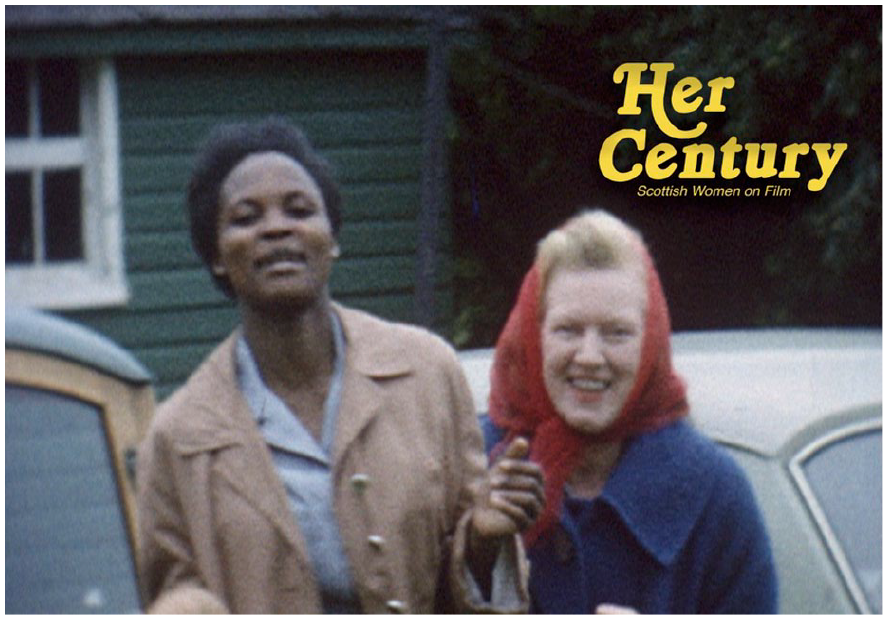
Screenshot of two women from Her Century. Published with the permission of the National Library of Scotland.
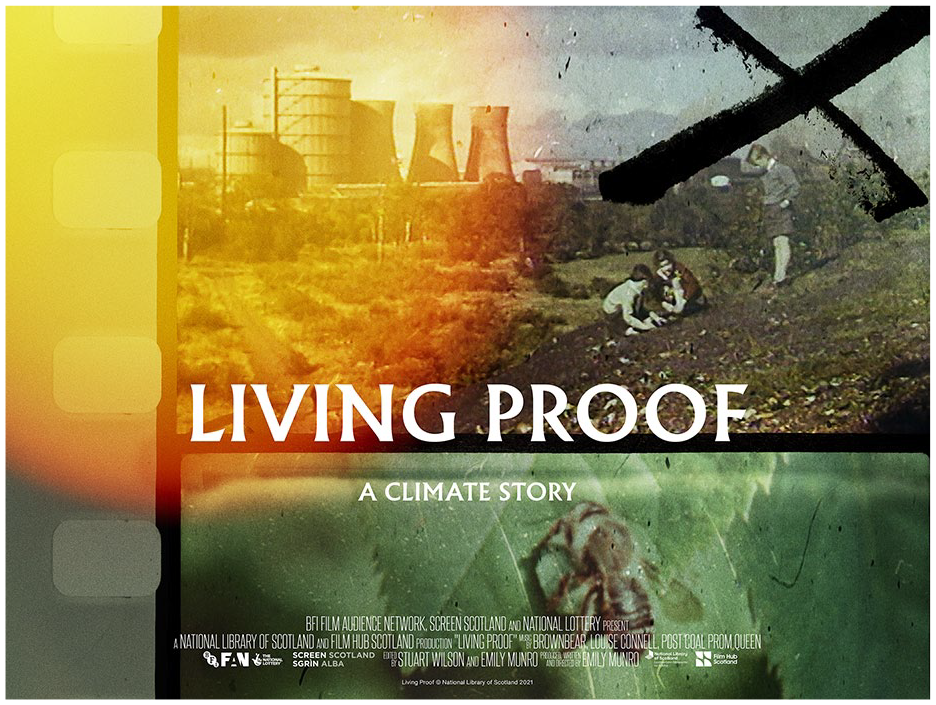
Image of promotional poster for Living Proof. Published with the permission of the National Library of Scotland.
Although ‘public funds go into the preservation’ (P7) of material held by the NLS, another interviewee was keen to express that governments tend to only ‘look around five years ahead’ (P1). This is potentially an issue for institutions, such as the MIA, whereby much of their value – at least from a funder’s perspective – lies within increasing preservation index rather than enabling access to material in the long-term. Thus, highlighting that a ‘service and collection is usable at the moment’ (P2) is extremely difficult to communicate to funders in an environment whose focus is primarily understood by funders to be preservation, despite one interviewee commenting that ‘the arguments for preservation are so much better made when you’re engaging people with the material’ (P6).
Additionally, educating users that enabling access in the long-term sometimes means that access cannot be provided in the present is a challenge for the MIA, reflected in enquirers being met with ‘shock’ (P5) when informed of 4-week turn-around times to provide digital copies of material as ‘there’s this misunderstanding that if there’s a digitised copy, why can’t I just have it now?’ (P5). This is concerning, as it points, again, to a disparity between the work of audio-visual archivists and public understanding. This is raised by both Smith et al. (2021) and Bamberger and Brylawski (2010), who describe the growing issue of a sense of entitlement from users in requesting access to material, which in turn is a symptom of an increasingly born-digital society and the speed of access we now expect in our daily lives.
Exploring audience development
Finally, the interviews reveal that although the MIA has an audience development ‘strategy of sorts’ (P3) (as of June 2022), this flexible approach is not necessarily a negative aspect for the MIA. Although concerns were raised that there has been more focus placed on exploring user needs and audience development at the NLS site in Edinburgh, by using a more piecemeal approach and capitalising on people using Kelvin Hall for other purposes, such as sport or childcare facilities (P5), the MIA does not limit itself to the constraints or limitations of, for example, the designated community approach. As Keitel and Mitcham (2023) and Underdown and Talboom (2019) have also highlighted, there are issues with such an approach which have a tendency to become more of a box-ticking exercise for national institutions. Having more flexibility in their approach to audience development allows the MIA to engage with individuals and communities outwith the generally more academic or research user base of the NLS, and identify user and audience needs rather than assuming them (DPH, 2015; Owens, 2018).
Recommendations
The overall strategy of the NLS has recently shifted ‘from being focused on digitisation and cataloguing to focusing more on outreach and digital engagement’ (P2). As part of this study, five recommendations were produced for the MIA to elevate its levels of social outreach and engagement, based on feedback from professionals within the MIA and NLS. These recommendations were compared against the aims of the NLS Reaching People: Library Strategy 2020-2025 (National Library of Scotland, 2020) to analyse how usefully its strategy serves the MIA, given its unique and contemporary challenges.
Improving rights clearance processes to increase access to collections
The NLS Reaching People: Library Strategy 2020-2025 suggests that, by 2025, the NLS will attract regular visitors, continue to support research, and foster a nurturing space that welcomes families and children, focusing upon accessibility and ease of use (NLS, 2020: 6). To achieve this, the NLS ‘will support, develop and train our staff and recruit new talent to enhance our existing skills and knowledge’ (NLS, 2020: 18). However, as addressed in the Discussion, the level of staffing in the MIA as of June 2022 was described as ‘completely unrealistic’ (P6) considering the level of care and responsibility a national film archive requires. As highlighted by several interviewees, increasing staff resource to manage the scale of rights clearance for the MIA’s collection is necessary to improve its levels of social outreach and engagement, as this will ultimately enable ‘greater access to collections in digital formats’ (NLS, 2020: 2), now and in the future. Secondly, the rights clearance issues could be alleviated by providing workshops for donors to educate them on the common issues which arise from rights clearance processes, and highlighting the repercussions of correctly and incorrectly supplied paperwork, as well as listening to and implementing feedback from donors on the process.
Addressing the physical limitations of Kelvin Hall
Although adapting the physical site at Kelvin Hall to allow for better and increased social engagement is a viable recommendation to improve the visibility of the NLS and MIA, having a physical presence outwith Kelvin Hall and the George IV site allows the MIA to be ‘less focused within the walls that [they] sit in’(P2). Based on feedback from the Reaching People: Library Strategy 2020-2025 that there are ‘greater numbers visit[ing] to view the exhibitions, attend talks and take part in other educational activities’ (National Library of Scotland, 2020: 4), this recommendation would be to put funding towards modernising and increasing the physical space available within the MIA to promote better outreach and engagement opportunities. Finally, although the Reaching People: Library Strategy 2020-2025 begins by stating that feedback from its recent audience and user surveys ‘told us clearly about the need to enhance the facilities in the George IV Bridge building in Edinburgh’ (NLS, 2020: 2), there is a clear omission relating to improvements which are required for the MIA’s facilities and physical presence based on staff feedback alone.
Extending outreach beyond Glasgow & Edinburgh
The NLS plans to ‘engage communities throughout Scotland with the collections – through touring exhibitions, targeted learning and outreach activities, and innovative online content’ (NLS, 2020: 14). Living Proof is an example of a touring exhibition which has increased the MIA’s level of social engagement, but areas which require more in-depth focus and progress are the ‘targeted learning and outreach activities, and innovative online content’ (NLS, 2020: 14). For example, despite the educational talks and activities provided for universities, colleges, and schools, one interviewee explained that the MIA is ‘certainly only hitting the central belt’ and ‘should be looking elsewhere’ (P8). This feedback is aligned with the Reaching People: Library Strategy 2020-2025’ aim to ‘continue to explore opportunities to reach people outside Scotland’s central belt’ (NLS, 2020: 2). Extending social outreach to areas outside of Glasgow and Edinburgh is imperative as the MIA must ensure its outreach extends to different areas across Scotland, and especially those in more remote areas who cannot benefit from what is offered on-site or even what might be available online, given copyright issues and a backlog in digitisation efforts.
Although the NLS has increased its ‘digital services over the last five years’ (NLS, 2020: 2), due to funding and time constraints it is still not possible to listen to sound collections on the MIA website. The lack of representation for sound collections means that those interested in hearing sound collections must attend either the Edinburgh or Glasgow site, which presents a gap not only in the collection but also in social outreach and engagement opportunities. This recommendation for the MIA is therefore to not only prioritise making its sound collections available online, but also to have its own equivalent of the NLS Reaching People: Library Strategy 2020-2025, as this would capture specific issues such as the above that are unique to its collection and bridge a gap between the aims of the MIA and NLS.
Addressing gaps within the collection
The MIA can also play a role in the democratisation of heritage that doesn’t necessarily require its direct intervention, through providing uploading services that donors can independently use. For example, multiple interviewees said they would like to see a free digital upload service for MIA and NLS users, whereby ‘the library actually creates this free storage environment where we can tap into what’s being put on there’ (P1).
Hosting open days for existing and potential donors to discuss caring for items, and introducing, for example, competitions focused on creating short films in specific subject areas or in formats the archive is currently lacking in would go some way towards achieving the Reaching People: Library Strategy 2020-2025 aim to ‘create new programmes and services to reach wider and more diverse audiences’ (NLS, 2020: 14). A recent example of democratising efforts is the donation of 200 films with animations from ethical media-production company co-op to the National Library of Scotland, including gender-based violence animations from the NHS Lanarkshire’s Gender-Based Violence (GBV) team (NHS Lanarkshire, 2024).
Visibility & usability of collections
What makes social outreach work truly engaging is reflected in the creative ‘usability’ of collections and implementing programmes which address gaps within public knowledge, as well as establishing relationships with communities to better reflect their experiences in the national landscape. As one interviewee explained, one of the central goals of the MIA is ‘just generally having the collections more visible, and people with a much better idea of what it is they can do with it’ (P2).
A good example of how we can re-mix and re-use archival footage to encourage social engagement with audio-visual heritage is Arcadia 6 (2017), which was recently screened at Kelvin Hall in November 2023 to coincide with the Samhain. With a runtime of just 78 minutes, this was described at the screening as one of the best and most interesting examples of creative re-use of archival material, which includes footage from the MIA. The film tells the story of Britain’s agricultural history, with an ethereal, synth soundtrack accompanying images of pagan rituals alongside illegal 90s’ raves, Cornish folk dancing and the tilling of fields, and asks the audience to consider how our audio-visual historical record can be reinterpreted to tell us something new about our past, and our present.
These types of screenings promote thoughtful ‘investigations of the collections from different angles, uncovering untold stories and giving fresh perspective on society and culture’ (2020: 17). And so, the final recommendation for the MIA is to continue to explore and promote the usability of collections, as it provides audiences with ‘a much deeper engagement with the original content when they’re beginning to think “well, what can I actually do with this?” (P2). As the camera is “attributed [with] the power to construct and transform identities through time”’ (Sieber, 2016: 32), one of the ways in which the MIA can harness this transformative power is by continuing to fund projects which involve re-working, re-mixing and re-using its archival material, such as the UOSH project, ‘helping people to use the collections in the most creative ways possible’ (National Library of Scotland, 2020: 13).
Conclusions and outlook
This research focuses on the staff perspective of what changes and improvements professionals would like to see within the MIA as it pertains to access, outreach, and engagement. The opinions and feedback upon which the findings are based come from a small pool of ten professionals, although findings may be transferable to similar contexts. Small samples in qualitative research are often criticised, however it has been noted that ‘data adequacy is best appraised with reference to features that are intrinsic to the study at hand’, beyond sample size (Vasileiou et al., 2018). Due to the time constraints of the research project, it was not possible to investigate what users might like to see or have access to in the MIA, as well as their understanding of its place within the NLS. Further studies are welcome to better understand the user perspective in this area.
The assessment of the NLS Reaching People: Library Strategy 2020-2025 will establish whether its vision has been achieved, and the extent to which issues specifically affecting the MIA have been addressed. However, our research is a reminder that ‘the survival of the past is constantly at the mercy of the present’ (Edmondson, 2004: 62). This is reflected through efforts to carefully balance audio-visual preservation with access, as well as the complications which copyright law bring to enabling access, and the paradoxical task of educating the public on how to care for their audio-visual material whilst also advocating for its inclusion within a national archive. Additionally, with the scale of born-digital material within the public domain increasing day by day, the MIA is ‘kind of heading towards this unknown where we don’t really know what’s coming up next’ (P6).
Although the fragility of analogue and born-digital audio-visual material is concerning in terms of its survival for posterity, this research aims to reframe the narrative of the existential threat facing audio-visual archives by considering how improving social outreach and engagement with collections may be the key to saving them. Preservation challenges arising from the fragility of born-digital materials are increasingly important as small and large archives become more digitally focused. By continuing research into the social aspect of the public’s relationship with audio-visual collections, we can better understand how moving image and sound can be instruments for change – whether that is on a societal, community or personal level. Continuing this research will also provide us with insight into what audio-visual archives need not only to survive but to thrive, and curate archives in which moving image and sound are not merely consumed but actively created and cared for by professionals and the public alike. Because, ultimately, audio-visual heritage is ‘not just for the archivists and the librarians – it’s for everybody’ (P3).
Footnotes
Acknowledgements
We are grateful to the National Library of Scotland and Moving Image Archive staff members for having contributed to this research by sharing their knowledge, experiences and insights which inform this research. We would like to thank the three anonymous reviewers, the Review Editor Prof Adrienne Muir and Editor in Chief Prof Ann Goulding for their insightful and constructive comments, and Dr William Kilbride from the Digital Preservation Coalition for providing useful feedback in revising the paper. Vhari wishes to dedicate this study to her beloved grandfather, Davey Shankland, who greatly enjoyed watching some of the Moving Image Archive footage and reminiscing with her about his childhood. Perla dedicates this research to all the formidable, dedicated librarians who painstakingly break barriers and build bridges for a better world.
Declaration of conflicting interests
The author(s) declared no potential conflicts of interest with respect to the research, authorship, and/or publication of this article.
Funding
The author(s) received no financial support for the research, authorship, and/or publication of this article.
Notes
Author biographies
 .
.