




Abstract
In March 2020, the COVID-19 Oral History Project, based at Indiana University Purdue University Indianapolis (IUPUI), teamed up with A Journal of the Plague Year: An Archive of COVID-19 (JOTPY), based at Arizona State University to create and curate a series of oral histories focused on the lived experience of the pandemic. Among the results of this collaboration has been a focus on research-based pedagogy and learning for undergraduate students, graduate students, and the public at large. This pedagogical emphasis has both shaped the archive and has been shaped by the process of developing the archive.
Keywords
In the weeks and months that followed the COVID-19 outbreak, scholars across the United States began organizing rapid response collecting initiatives. Most of this work focused on digital objects—in part, a consequence of social distancing. Among these initiatives were A Journal of the Plague Year: A COVID-19 Archive (JOTPY) and The COVID-19 Oral History Project (C19OH). JOTPY, established at Arizona State University, is a rapid response collecting project dedicated to archiving digital objects that reflect the day-to-day life of COVID-19 around the globe. Its approach has been to team up with other rapid response collecting teams to create a federated repository. Using Omeka-S as its platform, the project grew quickly through teaming up with higher education institutions and museums. Since March, JOTPY has collected more than 10,000 objects.
C19OH, based at the IUPUI Arts & Humanities Institute, was also established in March and had the narrower mission of recording oral histories that explored the experiences of living through COVID-19. It had a global focus, similar to JOTPY’s, and by early April, the directors of both projects decided to collaborate. At that point, JOTPY had relatively few oral histories, so they agreed that C19OH would lead the collecting and curatorial efforts related to oral history for JOTPY.
This collaboration has led to a substantial collection of oral histories in a relatively short period. It has also generated a framework of archival and project management best practices for research teams working at multiple institutions thousands of miles apart. This essay offers a summary of what the teams have learned and developed together so far in the context of both methodologies and practical considerations. The nature of the C19OH and JOTPY partnership has been, by necessity, iterative. By design, it forefronts formal and informal pedagogies in the development of the oral history archive. As a result, the project has resulted in important insights into collaborative and distributed research in the digital humanities.
C19OH and JOTPY have always intended to produce multiple types of oral histories. At the core of C19OH was an effort to work with trained oral historians and ethnographers to develop what we might call traditional oral histories—long form, semi-structured interviews with a diverse range of narrators who could speak to the ways in which their lives had changed over the pandemic. The plan was to begin by asking a broad set of questions, and, as the pandemic progressed, to respond to emerging themes by creating subsets of more focused inquiries. So, for example, the research team at IUPUI is currently developing a set of oral histories examining the intersection of COVID-19, racial justice, protest, and the Black Lives Matter movement. Working from the premise that the effects of the pandemic will continue for many years, C19OH plans to revisit with narrators multiple times during the next decade to generate longitudinal data on lives affected by the pandemic.
In addition to a traditional oral history approach, which works with oral history specialists, both JOTPY and C19OH place importance in the value of narratives generated by students and publics beyond the university. While recognizing that these narratives might not necessarily look the same as interviews created by professional oral historians, in the spirit of shared authority, team leaders recognized the value of engaging broader publics as citizen-archivists and citizen-historians (Filene 2012; Frisch 2011; Pandya 2014; Wingo, Heppler, and Schadewald 2020). For oral history, contributors would be able to upload their stories to the archive, regardless of any professional training.
The C19OH and JOTPY teams developed a number of resources for teachers, students, the public, and professional researchers alike. Victoria Cain and Claire A. Tratnyek at Northeastern University created an oral history teaching module for instructors who wished to work with their students to conduct oral histories as part of their curricula (Tratnyek and Cain 2020). The C19OH team created an in-depth, multi-part online module in Canvas for users of all levels (Kelly et al. 2020). The module introduces them to everything from the ethics and methods of oral history, through the importance of informed consent and deed of gift, to the process of transcription and uploading to the JOTPY archive. In addition to these online resources, C19OH has held online trainings as well as consultations with those who wish to participate in the collective endeavor.
Perhaps not unsurprisingly, the academic nature of the projects has meant that the majority of oral histories have been generated through universities—especially through instructors who include oral history as part of their coursework. Because conducting oral histories (and providing transcriptions) takes a significant amount of time, the capacity for rapid response collecting was given a boost by student involvement in schools across the country. Faculty and students participating in C19OH and JOTPY have had the opportunity not only to build this important historical archive, but, depending on the focus of their courses, they have been able to engage with the project to learn about oral history methods and theories, digital curation, and even technical skills associated with digital exhibition management. Integrating students into the developing the archive has a strong pedagogical benefit: as defined by George Kuh, the project is a “high impact educational practice” in that it is collaborative, research-based, and engaged with communities beyond the university (Kuh 2008). This commitment to pedagogy has been a strength of the project. C19OH and JOTPY gives students a voice in the research process, and it recognizes that everybody has the capacity to contribute something substantial to large, collaborative research endeavors. In the case of students, contributions might be previously unexamined insights into method or interpretation. At other times, they are key to reaching new narrators who wish to participate in the project. 1
At the heart of the archival work for C19OHand JOTPY are, consequently, two complementary goals. On the one hand is an archival project focused on observing and recording the rapidly shifting dynamics of the COVID-19 pandemic with the intent of ensuring that a wide range of voices are represented in the historical record. On the other hand is an educational project focused on formal and informal learning through applied research. As oral historians/digital humanists-in-training, the recordings that students submit to the archive can range from professional-level interviews to interviews by individuals still discovering their scholarly voices.
In addition to the professional and student-conducted oral histories, C19OH and JOTPY encouraged individuals outside the university to participate. For those who may have had some experience with oral history or social science interview techniques, C19OH offered refresher courses in interviewing techniques in spring 2020. This was supplemented by the online training module, content that interviewers could consult at their leisure. The training focused on the importance of informed consent and the ethics of interviewing and explained how to use the interview questions in order to address the goals of the project.
While the team encouraged potential narrators to sign up to be interviewed by a member of the C19OH team, the platform allowed individuals to record their own stories and upload them directly to the archive. While not oral histories in the traditional sense, our practice has been to include these first-person audio or audio-visual narratives in the oral history collection. The reasons are both practical and theoretical. On a practical level, JOTPY is divided into a series of sub-projects, one of which is oral history. While users can search through the entire collection, the purpose of the sub-projects is to offer curated sets to users. Including only traditional oral histories in the oral history set would have effectively divided contributors’ first-person narratives into two unrelated collections. On a theoretical level, the objects in JOTPY illustrate the dynamics of the pandemic—the working-out and processing of the historical moment. No matter what the mode—whether in the form of a first-person narrative, a student interview, or a professional oral history—these recordings demonstrate thoughtful individuals trying to work out the complexity of the moment by narrating personal experience. As such, they are closely related even if they do not conform to professional disciplinary categories.
Of course, the oral histories need to fit into the larger JOTPY archive—the key characteristic of which is its distributed and collaborative nature. By being distributed and collaborative, JOTPY must serve a variety of projects and research modes. One of the archival challenges has been to ensure that oral histories could be integrated into a collection in which objects tended to be images or short texts (e.g., diary entries). Because the C19OH began its work outside of the JOTPY environment, it began with a different metadata schema. Like the other oral history projects, based at the IUPUI Arts & Humanities Institute, C19OH used a modified version of PBCore (https://pbcore.org), an xml-based schema developed by and for the public broadcasting community. JOTPY, built in Omeka Classic and later Omeka-S, used a metadata schema (a “resource template” in the Omeka environment) premised on the idea that it should be “comprehensive but not encyclopedic, and very usable” (Tebeau 2020). In order to interface with JOTPY, C19OH developed a second oral history schema within the JOTPY environment that expanded the core metadata fields, addressing subjects such as gender, race/ethnicity, age, embargo dates, and more (see Tables 1 and 2). In effect, the oral history schema is an expanded version of the default schema, designed specifically for the needs of oral history. There are common fields in both schemas, which facilitate searches across the archive.
JOTPY Default Metadata Schema.

JOTPY Oral History Metadata Schema.
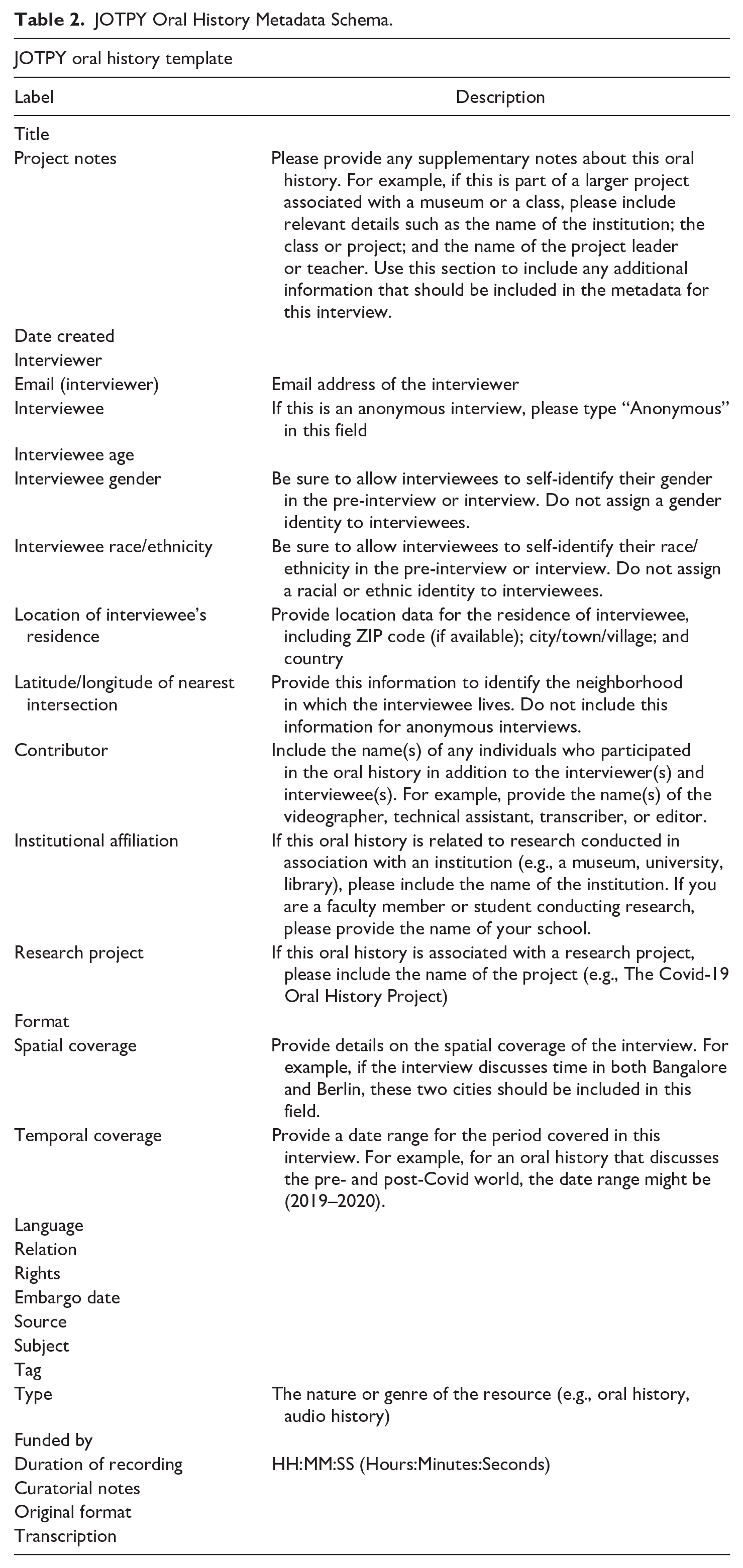
It is only from the research perspective that slight problems emerge in merging the two metadata schemes. As mentioned above, the default metadata template was created to make the system as user-friendly as possible. Because so many of the digital objects were crowdsourced from students and the public more broadly, the operating principle for JOTPY was to keep input fields to a minimum—to avoid errors, confusion over what to include in each field, and to ensure that the system doesn’t require excessive labor from users.
Because of the nature of oral history, which is enhanced by having rich demographic data, the C19OH team has encouraged researchers as well as teachers developing student oral history projects to upload their items using an online form specifically developed for oral histories. In addition to the expanded metadata, it asks individuals to upload transcripts and signed deed-of-gift forms, which include a license to use the oral histories. While the expanded schema requires more work on the part of the user, the consensus among the research team was that since oral histories were already labor intensive, the extra time was comparatively minimal.
While most teachers and organizations engage with C19OH and JOTPY before pursuing oral histories—and thus receive guidance on the preferred mode for uploading oral histories—there have been instances in which oral history data sets have been uploaded through the default template. Likewise, most audio and audiovisual narratives uploaded by the general public tend to be uploaded through the main JOTPY portal. Consequently, there are a number of narrative objects that lack the rich metadata found in the majority of oral histories. And, on occasion, oral histories submitted through the default template lack necessary information, such as a deed of gift, requiring the curatorial team to contact the individual who uploaded the recording. The consequences are minimal for most users, but for researchers who might wish to pursue broader comparative questions (e.g., research questions based in Historical GIS), the limited metadata means that some narratives will be left out of the analysis.
As the project has developed, the joint projects, C19OH and JOTPY, regularly respond to challenges and develop best practices protocols. This is only partly the consequence of a rapid response approach. Because participants are distributed across the country (the C19OH team is in Indiana, while the JOTPY team is in Arizona, and their partners are based from Hawai’i to Boston to Dublin to Hamburg), local conditions have sometimes generated new ways of thinking through and about the archive. For example, the ability to transcribe is dependent on financing and staff, so the project put in place workflows for AI transcription and coding. Interviews with undocumented workers led to workflows specifically developed for anonymous recordings while interviews with Costa Rican narrators led to the creation of Spanish-language informed consent and deed-of-gift documents. These documents are also being used for Spanish-language speakers in the United States. Oral history work with been limited, in part, because of different international IRB and privacy requirements. 2 The consequence of this has been an opportunity to teach students about such legislation as the European Union’s General Data Protection Regulation (GDPR). It has also encouraged project participants to think deeply about the relationship between legislation, research ethics, and research design.
What has defined the C19OH-JOTPY oral history collaboration—and the project more generally—has been a commitment to imagining the creation of the archive as a pedagogical process. As such, all of the iterations, all of the decisions, and all of the pivots that have emerged in the development of the archive have been through conversations of a collaborative team of students, faculty, archivists, and museum professionals dispersed across the United States. While the outcome of the project will appear to be an archive at first glance, there are a more extensive set of learning outcomes that emerge from training and research-based learning associated with the project which benefit hundreds of students and members of the public. In this sense, the project is an archive on COVID-19, but the archive is just as much a practice in pedagogy.
Footnotes
Declaration of Conflicting Interests
The author(s) declared no potential conflicts of interest with respect to the research, authorship, and/or publication of this article.
Funding
The author(s) received no financial support for the research, authorship, and/or publication of this article.
