




Abstract
In April 2020, the National Nordic Museum (NNM) in Seattle launched an oral history initiative titled “A Pandemic Preserved: The COVID-19 Crisis in the Nordic Countries and the Pacific Northwest.” Utilizing the video conferencing platform Zoom, the NNM has collected the stories of individuals impacted by the coronavirus in Denmark, Finland, Iceland, Norway, Sweden, and Washington state, the first reported epicenter in the United States. Augmenting an existing collection of more than 900 oral history interviews, “A Pandemic Preserved” privileges current perspectives of ongoing events over retrospection. With the consent of the participants, the recordings are made accessible to researchers through the Museum’s collection management system (CMS), as well as promoted periodically to a general audience through social media channels to foster online engagement during closure. This article will examine the project’s scope, execution, products, dissemination to academic and general audiences, and relation to the NNM’s existing oral history collection. It will also consider how a project that captures response to a global health crisis realizes the Museum’s collecting goals in comparative and area studies.
Keywords
Introduction
On January 21, 2020, the national spotlight shone on the state of Washington. Twelve days following the World Health Organization’s (WHO) announcement of the diagnosis of a coronavirus-related pneumonia in Wuhan, the Centers for Disease Control and Prevention (CDC) confirmed the first case of the 2019 novel coronavirus in the United States in a traveler who had visited the Chinese province. The virus took hold in the region with the first of many deaths occurring on February 29th. As the virus’s rate of transmission accelerated, so too did the implementation of state-wide measures to curb its spread. Concurrently, the WHO designated COVID-19 a pandemic, and many countries around the world issued movement control orders. Nearly concurrent with this timeline, the Nordic countries (Denmark, Finland, Iceland, Norway, and Sweden) began reporting the earliest confirmed cases within their borders. Norway was the first of the five countries with a patient testing positive for the virus on January 26th and Iceland the last on February 28th, and their containment and mitigation strategies commenced. 1 Journalistic reporting on this global health crisis was country-specific due to the manner in which data was submitted and disseminated. The infection and death rate informed public perception of the success or failure of each country’s initial response, with Iceland and Sweden portrayed as examples of each.
In the wake of these events, Seattle’s National Nordic Museum (NNM) conceived of a project to capture this local and global crisis. The Museum launched “Preserving a Pandemic with Zoom: The COVID-19 Crisis in the Nordic Countries and the Pacific Northwest” on April 14, 2020.
The NNM’s Oral History Programs
The NNM’s oral history program owes its genesis to a grant-funded project in 1999. The Museum (formerly the Nordic Heritage Museum) partnered with two local historical societies—the Ballard Historical Society and the Swedish-Finn Historical Society—to interview individuals who had lived and worked in Ballard, a Scandinavian-American enclave in northwestern Seattle. It is important to note, however, that the interviews represented all ethnicities residing in the neighborhood. Over a two-year span, more than forty volunteers collected 123 oral histories for the project, which they titled “Vanishing Generations.” They shared the stories of this vibrant immigrant community in two books and numerous online publications. 2
The “Vanishing Generations” project proved foundational for the oral history initiatives that followed, namely the Nordic American Voices (NAV) Oral History Project. In 2009, a group of museum volunteers, which included individuals involved in the Vanishing Generations project, launched NAV. NAV sought to collect, preserve, and share stories of Nordic immigrants and their descendants who have settled in the Pacific Northwest. The program remains entirely coordinated and executed by a dedicated group of volunteers, with oversight by the museum curatorial department. A sizeable volunteer corps provides support in many of the NNM’s functions, and the group’s significant contributions are not unique to the institution.
NAV volunteers have amassed over 750 interviews, nearly all of which include video and are transcribed. Approximately half of the interviews are accessible to researchers and the general public alike through the NNM’s collections portal, a gateway for searches utilizing the PastPerfect CMS. The group plans to digitize and upload the remaining interviews in the coming years. Drawing extensively from interviews, NAV has also produced two documentaries—Under the Clouds of War: Growing Up in Occupied Denmark and Norway (2011) and This is My Childhood: Finland At War (2016).
Shifting from volunteer- to staff-led oral history initiatives, the NNM’s collections team created in 2016 a concurrent oral history project—“Interwoven: The Blended Heritage of Nordics and Native Peoples”—to better represent the shared Nordic and Native American ancestry of Washingtonians. Due to the specificity of its scope, this project has taken a more curated approach to gathering narrators. “Interwoven” discussions have centered on the themes of identity and culture, rather than extensive life histories. “Interwoven” has been the subject of two symposia, one in 2018 at the NNM, and the second in 2019 at the Tulalip Tribes’ Hibulb Cultural Center in nearby Tulalip, Washington. Subsequent phases of “Interwoven” will include the stories of those of individuals with African, Asian, and Hispanic descent. To facilitate the expansion of this important program, the NNM hired its first-ever Archivist and Oral History Specialist in January 2020.
Procedure
Prior to conducting the interviews, the Archivist and Oral History Specialist prepared questions while providing opportunities to incorporate those that arose organically. She was mindful of how they could inspire answers both stimulating to audiences in the present and fertile ground for future research and exhibitions. In some cases, questions were modified based on the following: (a) the interviewer’s first-hand knowledge of a story or situation that merited inclusion, (b) the narrator’s response to a question positioned later in the prescribed order, and (c) the narrator’s responses yielded new information that required follow-up questions. The Archivist and Oral History Specialist determined the best course of action as the interview unfolded with regard to prompts, and preferred a natural flow of narration over the delivery of a rigid set of questions. Questions were emailed to narrators in advance the interview, along with a release form to secure the NNM’s publishing rights and permission to use video and transcripts, partially or in full.
Questions provided to narrators in advance:
We are especially interested in [information regarding their unique story].
In what ways has your life, the life of your family, and your community been altered by the COVID-19 health crisis? Examples may include work, family, schooling, finances, health issues, shortages, etc.
What were your initial reactions to the early news reports and information about the pandemic? Have your feelings changed or stayed the same as the situation has developed?
What are some things you may be doing to help keep yourself, your family, and your community safe?
What would you like future generations to know about life in your city/town during the pandemic?
What are your hopes for the future, both immediate and long-term, related to this health crisis?
Other comments?
To date, eighteen interviews of twenty-two participants have been conducted between May 1, 2020, and August 25, 2020. Four interviews included two co-narrators, and fourteen interviews focused on an individual narrator. Four interviews were conducted with respondents from a call for participants, which the museum shared in member emails and through social media platforms in April 2020. Following a response to the initial call, respondents were then emailed a list of supplementary questions prior to scheduling an interview, asking about access to software and basic information about the story they wished to tell. Fourteen interviews were conducted with narrators via referral by museum staff or volunteers, either because they had a contact in the Nordic countries or because the individual was known to have a story related to the pandemic.
Even within this relatively small set of participants, a wide array of job sectors are represented, the diversity of which lends itself well to providing richness and depth to the overall collection (Figure 1). Of the eighteen interviews, participants represented the Nordic countries and the Pacific Northwest evenly, with eight Seattle-based interviews, and ten Nordic-based interviews (Figure 2). Of the ten Nordic interviews, the countries represented are: Sweden (3), Norway (3), Iceland (2), Denmark (1), and Finland (1).
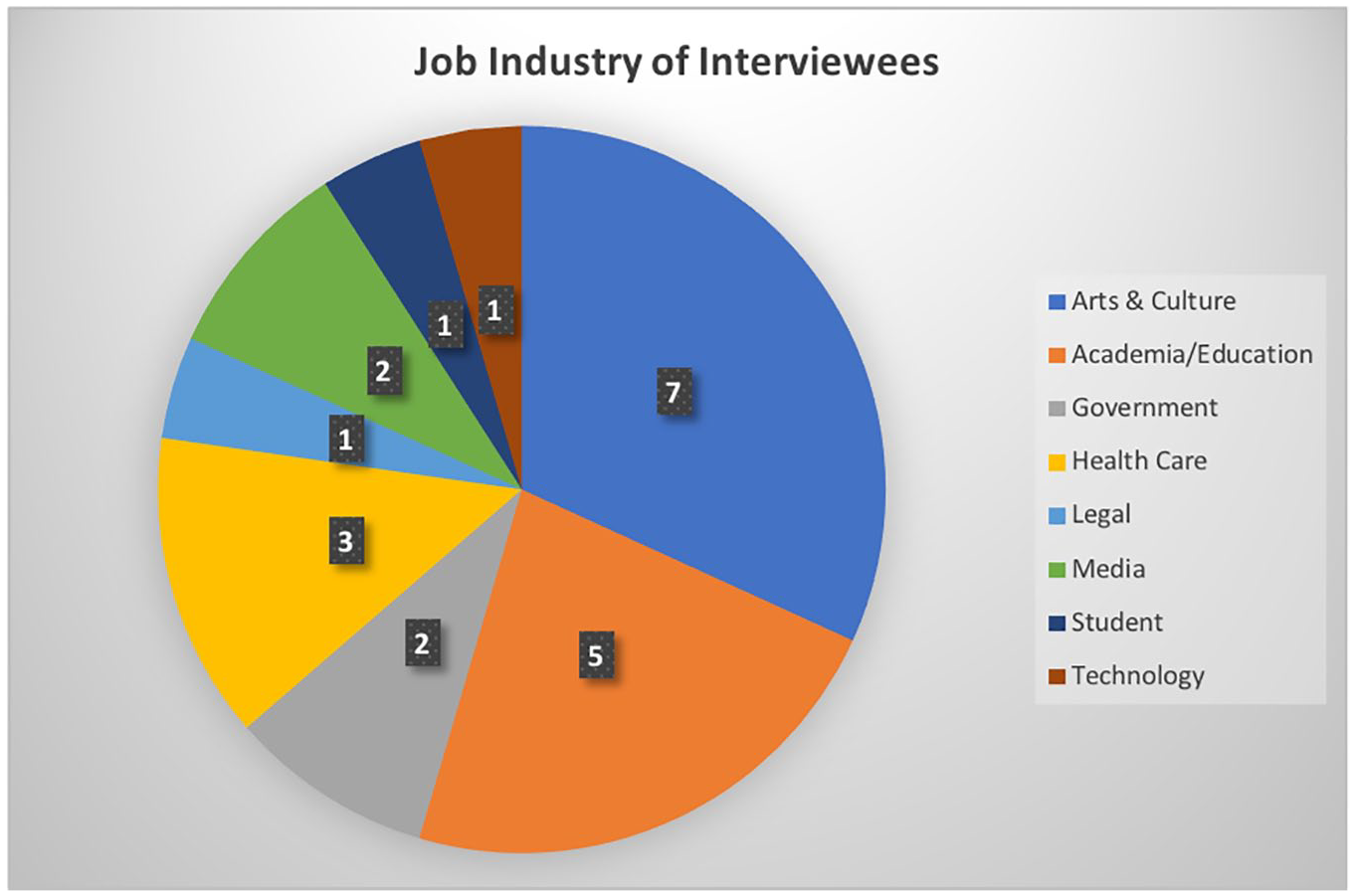
Job industries represented from twenty-two individuals interviewed between May 1, 2020 and August 25, 2020.
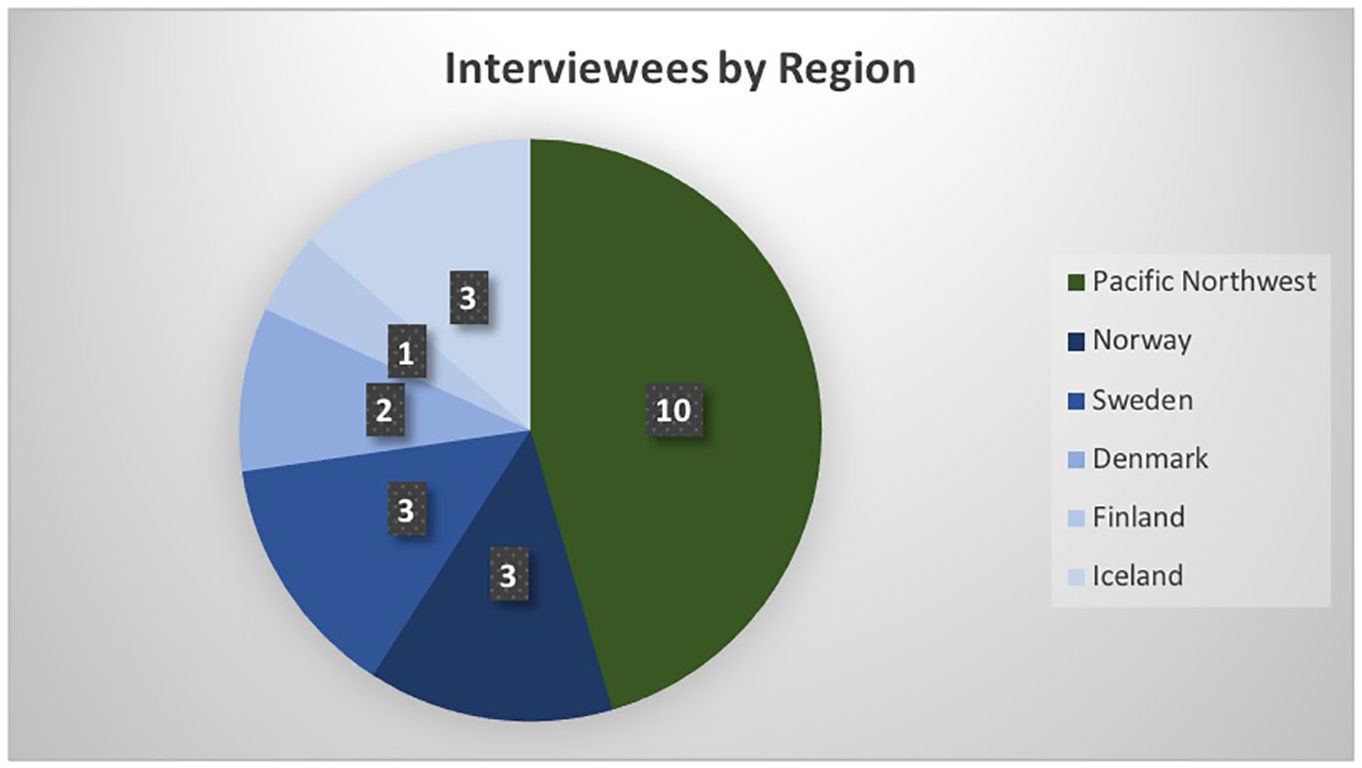
Regions represented by twenty-two individuals interviewed between May 1, 2020 and August 25, 2020.
Three early interviews were conducted via Skype, but Zoom was determined by the NNM’s Archivist and Oral History Specialist to work the best in terms of call quality and ease of use by both parties. Subsequently, Zoom became the preferred platform for conducting the interviews. Twelve interviews were conducted via Zoom, and two interviews were self-recorded smartphone videos that participants sent to the museum, answering the prescribed list of questions. One Zoom interview also doubled as live, virtual museum programming, with narrators discussing their photography of Copenhagen during the pandemic. Three interviews were conducted with the museum oral history specialist aided by volunteers, and the remaining interviews were conducted solely by the museum oral history specialist.
Most interviews fell within a twenty-five to forty-minute timeframe, some a bit shorter, but none over an hour. Videos were recorded using the application itself, and were archived on an external hard drive and the NNM’s server.
Limitations
In an ideal situation, an oral history interview would be conducted face-to-face, resulting in a sense of comfort and intimacy. Because this option was not available, the mode of collection is evidence in itself of the unusual time that this project aims to capture. Conducting oral histories using video conferencing software overall was a smooth process. Technical information about how to join the call was provided if participants enquired, but Zoom has proven to be a very user-friendly platform, and most participants already had strong technology skills. In subsequent phases, more participants in the Nordic countries will be interviewed to create a broader picture within each nation.
Regarding narrators, identifying local participants was easier and less time-consuming than candidates in the Nordic countries. A main limitation within the participant pool relates to capturing diversity. Those who responded to the initial call and those who were ultimately able to participate were in relatively good health, had access to internet and computers, and fell into socio-economic groups that are somewhat less affected by the pandemic. Museum collections staff
Next Steps
These interviews are currently being made available on the NNM’s online collection portal. Records include full transcripts and videos, alongside the NAV and “Interwoven” oral history collections. Due to political matters and potentially erroneous health information being discussed around an ever-evolving situation, a decision was made to include a disclaimer message in each video: “These oral histories are presented unedited. They are expressions of the views, memories, and opinions of the interviewee. They do not necessarily represent the views of the National Nordic Museum.”
These initial eighteen interviews, conducted between May 1st and August 25th represent a “first wave” in terms of collection in relation to the course of the pandemic itself. The NNM’s collections staff plan to begin another round of remote interviews scheduled for the fall and winter, as this health crisis appears to be ongoing. A phased approach may be of interest in the future. It is evident that in the earlier interviews, news about the pandemic was quite different than just months later as the situation unfolded. Another aspect that will likely be examined include similarities and differences between the Pacific Northwest and the Nordic countries in terms of handling of the pandemic—both governing bodies and individuals, as well as ways in which the Nordic countries vary from each other. These stories will help to create a microcosm of the pandemic viewed through the experiences of citizens in two distinct global regions as time moves forward.
Footnotes
Declaration of Conflicting Interests
The author(s) declared no potential conflicts of interest with respect to the research, authorship, and/or publication of this article.
Funding
The author(s) received no financial support for the research, authorship, and/or publication of this article.
