




Abstract
With the continuous development of fifth-generation technology, the number of mobile terminal Internet of Things devices has increased exponentially. How to effectively improve the throughput of fifth-generation systems has become a challenge. In the Internet of Things networks, ultra-dense networks and non-orthogonal multiple access technology have drawn extensive attention in recent years, because they can achieve multiplexing from the space domain and power domain. To improve the throughput of the system, this article combines non-orthogonal multiple access with ultra-dense networks technology and considers the orthogonal frequency division multiplexing non-orthogonal multiple access–based ultra-dense networks with multiple base stations and multiple Internet of Things devices. In particular, first, we build the network model and channel model. Second, we construct the downlink transmission rate maximizing problem subject to the total power. Then, to solve this problem, we divide it into three sub-problems: device grouping, inter-sub-band power allocation, and intra-sub-band power allocation problems. Solving these sub-problems, we obtain the optimal power allocation schemes by jointly employing channel-state sorting–pairing algorithm, water-filling algorithm, and convex optimization theory. Finally, numerical simulations are conducted to validate the performance of our proposed optimal downlink power allocation scheme. Experimental results show that the total throughput of the system has been significantly improved.
Introduction
With the development of the fifth-generation (5G) mobile networks, the increasing demand for mobile communications services has led to a rapid growth in mobile data.1–3 Recently, 5G has been deployed globally; it is predicted that by 2022, mobile data volumes are expected to increase 1000 times more than in 2012. Compared with the traditional second-generation (2G), third-generation (3G), and fourth-generation (4G) networks, 5G wireless communication networks have obvious characteristics such as high reliability, low latency, and large capacity.4–6 With the goal of “Internet of Things (IoT),” we are creating a new era of networking by integrating it with people’s lives. 7 Subsequently, non-orthogonal multiple access (NOMA) is proposed.
NOMA technology is considered as one of the most promising technologies for IoT to increase the total system capacity.8,9 As a new space interface technology, comparing with orthogonal multiple access (OMA), NOMA has the potential to significantly improve the radio spectrum efficiency, which leads to multiplexing of power domain users to further increase the total system throughput. In addition, NOMA provides better fairness to users than traditional OMA systems.10,11 The current research on NOMA technology is divided into two categories: power domain NOMA and code domain NOMA. 12 The power domain NOMA transmission technique allocates power for transmitters according to different channel states, that is, less power will be allocated to transmitters with better channel states and more power will be allocated to transmitters with worse channel states. At the receiver, we use successive interference cancellation (SIC) to decode user information. SIC technique is used at the receiver to decode the user information, thus, enabling multiple user transmission in the same sub-channel.13,14 Although the power domain NOMA transmission technique suffers from error code accumulation phenomenon, this phenomenon can be reduced by a suitable power allocation scheme. Thus, power domain NOMA is more widely used in IoT scenario.
NOMA technology, as one of the key technologies in the field of IoT, has been studied by a large number of scholars. 15 The literature 16 describes the impact of user pairing on the performance of NOMA systems. The results show that NOMA systems with fixed power allocation can provide greater throughput than OMA systems. In the study by Liu et al., 17 the authors investigate the fractional order power allocation algorithm in NOMA systems, where the power received by each user is determined by its channel state. In this literature, the authors introduce fairness as a system optimization objective to maximize the data count rate. In the literature, 18 to maximize the total system rate, the authors study the optimal channel assignment and power allocation, and solve the objective optimization problem by means of the proposed water-filling algorithm. However, this literature assumes that the number of subcarriers assigned to a single user is not limited. The literature 19 used a greedy user selection algorithm to schedule the best set of multiplexed users satisfying the maximum proportional fairness metric and used the Karush–Kuhn–Tucker (KKT) conditions to solve the objective optimization problem.
To obtain a better network performance, NOMA can be integrated with other key technologies. 20 For example, the combination of NOMA with ultra-dense networks (UDNs) technology can further increase the total transmission rate of the system from not only the power domain but also the space domain. The concentration of urban residential population has led to a gradual concentration of data traffic to hotspot areas, which puts higher demands on network capacity. UDNs with high-density spatial reuse of frequencies can effectively improve spatial reuse and meet the traffic demand of 5G, so it is considered as one of the key technologies to improve system capacity and spectrum efficiency in 5G mobile communications.21,22 UDN is specifically the deployment of a large number of small base stations in a certain area, and the number of small base stations is much larger than the number of users. By increasing the number of small base stations per unit area to form a super-dense wireless communication network, UDN expands the spectrum resources of the system and increases the transmission rate of the system capacity greatly. However, due to the dense deployment of base stations in UDN and the small coverage area, there is a high possibility of overlap, resulting in serious interference between base stations.23–26 The literature 27 uses inter-cell interference coefficients in UDNs to divide all base stations of the entire system under the constraint of maximum intra-cell interference and minimum inter-cell interference to divide the entire network into multiple cells, thus reducing the interference between cells. The literature 28 uses the coordinated multiple points (CoMP) technique to improve the data rate and total system throughput at edge terminals. CoMP technique can convert inter-cell interference signals into useful signals, thus mitigating inter-cell interference, and improving total system throughput. In the study by Zhang et al., 29 the authors investigate the optimization of energy-efficient resources for downlink transmission in user-centric UDNs supported by wireless access, non-orthogonal multiple access, and beamforming wireless backhaul. The literature maximizes the energy efficiency of the system by jointly optimizing the scheduling, sub-channel assignment, and power allocation of users or access points. Simulation results show that the algorithm greatly improves the energy utilization of the system compared with the benchmark scheme. In the study by Khodmi et al., 30 the authors propose joint access and backhaul resource allocation in 5G heterogeneous UDNs (H-UDNs) to maximize the overall throughput of the system. A decoupling approach is used to decompose the joint resource problem into two sub-problems. Most of these works only introduce techniques related to UDN or only improve the channel transmission rate in the spatial domain.
Motivated by the aforementioned problems, we consider the orthogonal frequency division multiplexing (OFDM)-NOMA–based UDN in IoT networks, and study the optimal downlink power allocation strategies optimal downlink. The specific works are as follows:
Considering the UDN scenario with multiple base stations and multiple IoT devices, we construct the problem to maximize system throughput;
To solve this problem, the original problem is equivalently converted into three sub-problems: device grouping algorithm, power allocation between sub-bands, and power allocation within sub-bands;
The simulations are conducted to validate the proposed power allocation scheme.
The remainder of this article is arranged as follows. The section “The system model” presents the downlink system model for OFDM-NOMA based UDN with multiple small base stations, and establishes the system throughput maximization problem. The section “Joint optimization strategies” divides the maximization problem into three sub-problems, and obtains the optimal downlink power allocation strategies by solving these sub-problems. The section “Performance evaluation” simulates our investigated optimal downlink power allocation scheme for OFDM-NOMA–based UDN. The section “Conclusion” concludes this article.
The system model
We consider a downlink NOMA-based UDN system with multiple small base stations and multiple IoT devices, as shown in Figure 1. We assume full knowledge of the channel-state information. There are

OFDM-NOMA–based UDN system model.
The channel gains from the
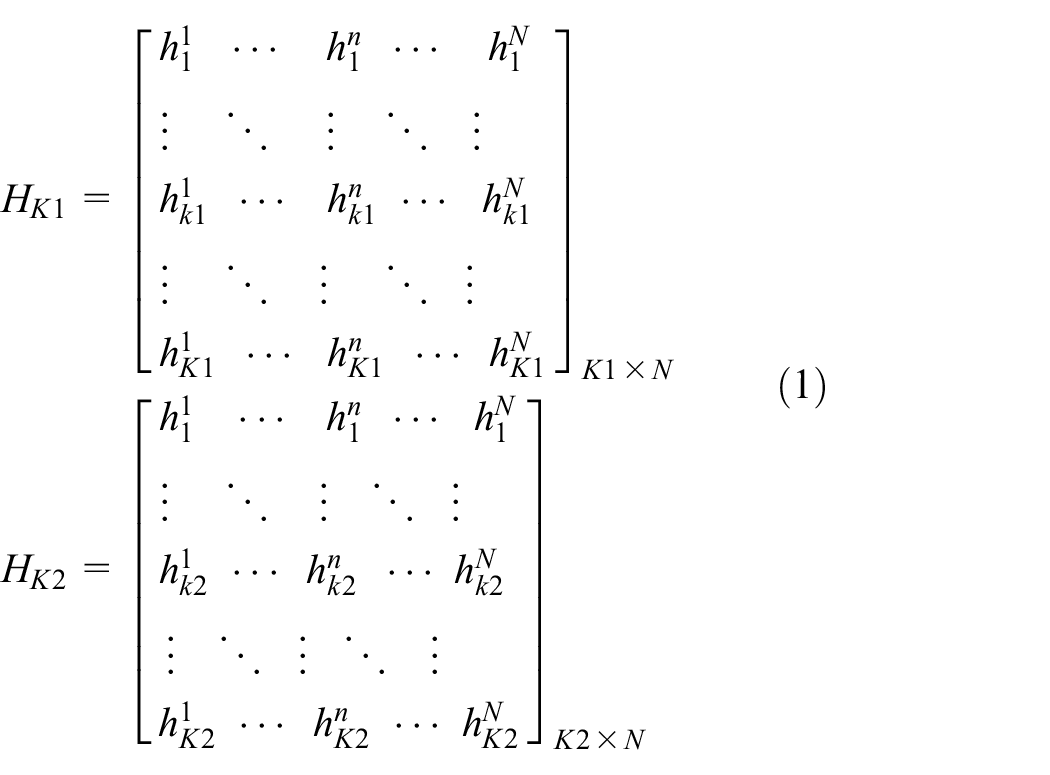
The signals received by the kth IoT group within the coverage of the nth small base station,
31
denoted by


In equations (2) and (3),

When devices transmit information on the channel, SIC technology is implemented for IoT device


Illustration of two IoT devices downlink NOMA with SIC.
The SINR (signal to interference and noise ratio) of IoT device

where
Based on the channel model, we can get the data rates of IoT device

The total throughput of the system is shown as follows

In summary, we construct the OFDM-NOMA–based UDN throughput maximization problem

In problem
To solve the above problems, we equivalently convert the total throughput maximization problem of the system into three sub-problems: device grouping algorithm, power allocation between sub-bands, and power allocation within sub-bands to design corresponding algorithms to solve them separately.
Joint optimization strategies
In this section, we employ the device grouping algorithm to group devices on each sub-band, allocate power to each sub-band, and then, obtain the power allocation coefficient of the IoT devices on the sub-band.
Device grouping algorithm
In the NOMA system, the greater the channel gain difference between IoT devices in the same group, the greater the sum rate of superimposed IoT devices and the better the grouping effect.
36
Thus, to group each sub-band, in channel-state sorting–pairing algorithm (CSS-PA), we sort IoT devices according to their channel states, and select the two IoT devices with larger channel gains difference as one IoT group. We denote the IoT device number by

Grouping diagram for different number of IoT devices.
Channel-state sorting–pairing algorithm.

Inter-sub-bands power allocation
On the grouped sub-band where the IoT devices have been grouped, we regard the two devices on the sub-band as an IoT group, and apply the water-filling algorithm to implement the power allocation for the inter-sub-bands. We first solve the sub-problem of problem
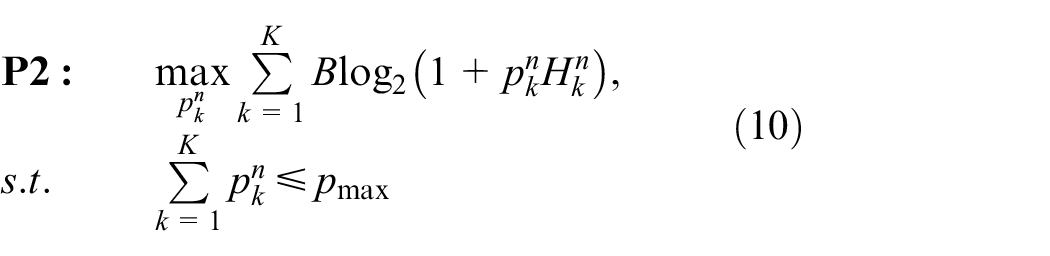
where
To solve the problem

where

Solving equation (12), the optimal transmission power


Substituting equation (14) into equation (13), we can obtain the initial optimal inter-sub-band power allocation scheme. Then, the iterative water-filling level is continuously updated with a certain step length until the water level converges. The iterative water-filling level is updated by the following equation

where
The water-filling level converges when the condition
Iterative water-filling algorithm.

Let us denote

According to the above-mentioned iterative algorithm, the power allocation between the sub-bands is completed, and then the power allocation among the IoT devices in each sub-band is our main consideration.
Intra-sub-band power allocation
We assume that in the kth IoT group, the power allocation coefficient for the allocated IoT device
In the previous section, we have obtained the optimal inter-sub-band power allocation scheme
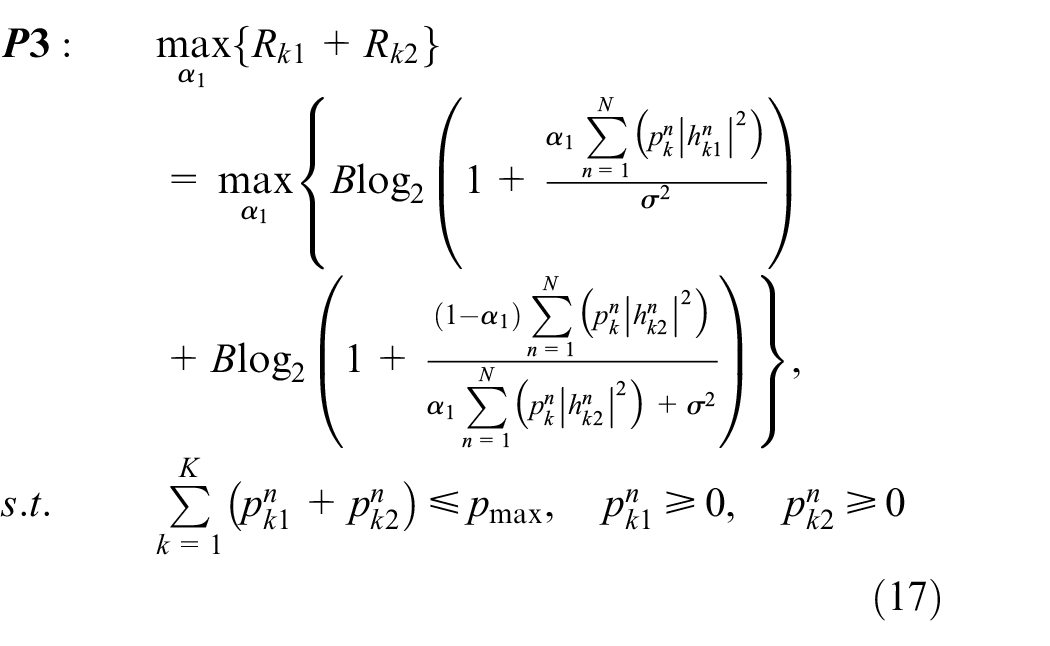
To guarantee the quality of service (QoS) for OFDM-NOMA–based UDNs, we set the IoT devices’ SINR not lower than the minimum SINR threshold. We reset the SINR thresholds of IoT devices

Simplifying equation (18), we can obtain the inequation as follows

where

We assume that
To further derive the optimal intra-sub-band power distribution coefficient
Lemma 1
Problem
Proof
Plugging equation (20) into the objective function of problem

First, we construct the first-order derivative of

Then, the second-order derivative of

Since
Thus, the objective function of problem
To solve problem

where



Solving the above KKT conditions, we give some remarks corresponding to the optimal intra-sub-band power allocation coefficient under different Lagrangian multiplier.
1. When
2. When

3. When

4. When
In this section, we employ the channel -state sorting and pairing algorithm, iterative water-filling algorithm, and Lagrangian multiplier method to allocate the power for IoT groups, inter-sub-bands, and intra-sub-bands to maximize the transmission rate of the system.
Complexity analysis: the complexities for the algorithms I is
Performance evaluation
In this section, the performance of our proposed scheme is evaluated through system-level simulation. In this simulation, we consider the downlink data transmission of the OFDM access (OFDMA)-NOMA system with multiple base stations. We assume that the maximum radius
Figure 4 shows a schematic diagram of the relationship between the total system throughput and the number of requested IoT devices. As shown in Figure 4, as the number of IoT devices increases, the total throughput of the NOMA system gradually increases, and is always higher than the total throughput of the OMA system. This is because compared with the traditional OMA system, NOMA systems can transmit information over the same time slots and frequency points with less resources, thus, greatly improving the utilization of spectrum resources. In addition, the gap between the curves of the NOMA system and the curves of the OMA system gradually increases as the number of IoT devices increases. When the number of IoT devices is 26, the total throughput of the NOMA system is 31.68% higher than that of the OMA system. This also further shows that the NOMA system has better spectrum utilization than the OMA system when the number of IoT devices is large.

Impact of the number of IoT devices on total transmission rate. IoT: Internet of things.
Figure 5 displays the relationship between the total throughput of the NOMA system and the OMA system and the number of small base stations. At this time, we set the number of IoT devices to 10. From Figure 5, we can see that the total throughputs of NOMA and OMA system increase as the number of base stations increases, and the throughput of NOMA in both cases is far greater than the OMA system throughput. At the same time, it can be seen from the figure that the throughput of Plan 2 is higher than the throughput of Plan 1, so the power distribution coefficient obtained in the second case is greater than the power distribution in the first case coefficient.

Impact of the number of SBS on total transmission rate.
Figure 6 plots the comparison between the NOMA system and the OMA system at different noise powers when the number of IoT devices is 2, 4, 6 and the total transmit power of the base station is

Impact of the noise on total transmission rate.
Figure 7 demonstrates the comparison between NOMA and OMA systems with different transmit powers when the number of IoT devices is 2, 4, 6 and the noise power is 0.35. From the figure we can see that as the power increases, the gap between Plan1, Plan2 and OMA systems becomes greater, and the total system throughput in Plan2 of this article is greater than Plan1 and both cases are greater than the total throughput of the OMA system for a certain number of IoT devices. At power

Impact of the power on total transmission rate.
Conclusion
This article mainly studied the problem of maximizing the total throughput for OFDM-NOMA system with multiple base stations and multiple IoT devices. This maximization problem was equivalently converted into three sub-problems, that is, device grouping, inter-sub-band power allocation, and intra-sub-band power allocation. To solve these problems, we employ the channel state sorting, water-filling algorithm, and Lagrangian function. Then, the optimal joint power allocation strategies are obtained. The simulation results showed that the proposed optimal power allocation strategies can improve the performance compared with the OMA system, which verified the effectiveness of the proposed algorithms.
Footnotes
Handling Editor: Miguel Acevedo
Declaration of conflicting interests
The author(s) declared no potential conflicts of interest with respect to the research, authorship, and/or publication of this article.
Funding
The author(s) disclosed receipt of the following financial support for the research, authorship, and/or publication of this article: This work was supported in part by the Natural Science Foundation of Henan (No. 202300410292), the Key Scientific Projects of Henan Higher Education Institutions (No. 19A510018, No. 20A510008, and No. 21A510008), the Key Scientific and Technological Projects (No. 202102210120 and No. 212102210553), the Foundation for Young Backbone Teachers in Higher Education Institutions (No. 2018GGJS126), and the Henan key Laboratory for Big Data Processing and Analytics of Electronic Commerce (2020-KF-6).
