




Abstract
Millimeter-wave massive multiple-input multiple-output is a key technology in 5G communication system. In particular, the hybrid precoding method has the advantages of being power efficient and less expensive than the full-digital precoding method, so it has attracted more and more attention. The effectiveness of this method in simple systems has been well verified, but its performance is still unknown due to many problems in real communication such as interference from other users and base stations, and users are constantly on the move. In this article, we propose a dynamic user clustering hybrid precoding method in the high-dimensional millimeter-wave multiple-input multiple-output system, which uses low-dimensional manifolds to avoid complicated calculations when there are many antennas. We model each user set as a novel Convolutional Restricted Boltzmann Machine manifold, and the problem is transformed into cluster-oriented multi-manifold learning. The novel Convolutional Restricted Boltzmann Machine manifold learning seeks to learn embedded low-dimensional manifolds through manifold learning in the face of user mobility in clusters. Through proper user clustering, the hybrid precoding is investigated for the sum-rate maximization problem by manifold quasi-conjugate gradient methods. This algorithm avoids the traditional method of processing high-dimensional channel parameters, achieves a high signal-to-noise ratio, and reduces computational complexity. The simulation result table shows that this method can get almost the best summation rate and higher spectral efficiency compared with the traditional method.
Keywords
Introduction
Millimeter-wave (mmWave) massive MIMO (multiple-input multiple-output) technology gradually becomes a key technology in 5G communication due to its rich spectrum resources.1–3 Due to the high carrier frequency, mmWave signal suffers from high propagation loss so that large-scale antenna arrays are leveraged for path compensation. 4 However, in massive MIMO system, the number of antennas at the transmitter and receiver is very large, 5 configuring a radio frequency (RF) chain for each antenna in the traditional all-digital solution requires a lot of hardware cost and causes the loss of power. In response to this problem, a hybrid scheme has emerged, considering the reduction of hardware requirements in spectrum efficiency (SE) and energy efficiency (EE).6–8 However, the hybrid precoding scheme in wideband channels is currently a difficult problem to solve.
How to obtain the optimal precoding matrix is the key issue of hybrid precoding. For the case of large-scale antennas in mmWave communication, large-scale matrix calculations are usually required. 8 The difficulty of hybrid precoding is to reduce the complexity of the above situation. 9 Some advanced beam-space-based hybrid precoding algorithms have been studied.10,11 Previous investigations12–16 make full use of the sparsity of the beam space channel according to the sparse signal processing scheme. In the literature,12,13 the problem is transformed into finding the optimal precoder with hybrid structure, and an algorithm based on the basis tracking method is proposed. A hybrid precoding scheme designed is proposed according to the Orthogonal Match Pursuit (OMP) algorithm in the literature,14,15 which can make full use of channel sparsity. In the multi-user scenario, the low-complexity multi-user hybrid precoding of the mmWave system is studied. 16 A Kronecker decomposition hybrid beamforming (KDHB) method for multi-cell multi-user massive MIMO system based on sparse propagation path is proposed. 17
However, the resolution of the beam space is not infinite. Due to the existence of power leakage, the sparse channel is non-ideal, and there are many possible non-zero terms. Some papers consider hybrid precoding of interfering mmWave channels.18,19 Dealing with interference is very challenging, because the number of antennas is large, and the high-complexity precoding matrix is difficult to implement. 20 To address the high interference problem, a closed-form broadband hybrid precoding scheme was proposed in the literature.21–24 An analytical framework of hybrid beamforming (AFHB) in multi-cell mmWave systems was proposed. 25 A combination of analog and digital beamforming is adopted. The former is based on a phase shifter, and the latter is based on a regularized zero-forcing method.
Recently, scholars have proposed the manifold learning in mmWave massive MIMO systems. Yu et al. 26 proposed a manifold optimization (MO)-based hybrid precoding algorithm with lower complexity. To replace the range of the constant envelope with a circular manifold, Chen 27 proposed a Riemannian conjugate gradient manifold algorithm. In Mai et al., 28 a Riemann vector perturbation manifold for a multi-user massive MIMO system was studied, in which the RF-baseband hybrid precoding was jointly arranged. A Riemannian trust-region Newton manifold (RTRNM) showed an improved method of beamforming in multi-cluster scenarios. 29 The optimization beamforming is utilized to mitigate inter-cell interference by dividing multi-users into multi-clusters with spatial correlation. However, multi-user high-dimensional channels are not mapped into low-dimensional subspaces to achieve dimensionality reduction. Learning a form of a double digital beamforming schemes optimizes the network resource allocation in massive MIMO networks. 30 Moe Thet et al. 31 analyze by greedy algorithm how fast-moving users in static and time-varying user clustering are executed according to the system sum-rate. The manifold learning algorithm is used to reduce the multi-user high-dimensional channels. It reduces the computational complexity while mitigating inter-cell interference-based fully digital beamforming. It focuses on the local linear spatial structure between user channels, and ignores the global spatial characteristics. And it is not possible to quickly analyze the global and local correlations between user channels in the case of moving users.
The traditional user precoding methods are not applicable to multiple users, although they optimize precoding using channel sparsity. In the multi-user scenario, the traditional method suffers from high precoding complexity, high channel dimensionality, and does not consider user mobility. Therefore, it is necessary to propose new algorithms that take into account these important problems in practical communication.
In this article, we propose a low-complexity hybrid precoding algorithm for dynamic user clustering in mmWave mass MIMO systems. Specifically, a large-scale number of antennas embedded in a low-dimensional subspace. The mmWave channel measurement results show that the mmWave has a diffuse scattering phenomenon on the surface of the rough scatterer, and the scattering range will increase as the wavelength decreases. 32 For scenarios where users are dense, when there is not enough space between users, diffuse scattering may cause adjacent users to receive signals of the same path. Therefore, it causes serious inter-user interference. Our goal is to design a mixed precoding matrix, so they manage intra-cell and inter-cell interference requires a lower channel knowledge, and can be used to achieve low-complexity mixed analog/digital architecture, that is, compared with a small number of RF chains, the number of antennas. In order to solve the set classification problem, a manifold discriminant analysis (MDA) 33 is proposed. Set by each user is modeled as a manifold, we will issue expressed as clustering for multi-manifold learning. The manifold discriminative learning seeks to learn the embedding low-dimensional manifolds, wherein manifolds with different user cluster label better separation of high-dimensional partial space of each flow channel in the shape of the correlation is enhanced. Learning by discriminant manifold, the majority of high-dimensional mapping of the channel to a low-dimensional manifold, it is possible to fully utilize the potential of the high-dimensional channel spatial correlation. By transforming the non-linear problems of high-dimensional channels into global non-linearities and local non-linearities, the purpose of dimensionality reduction is achieved. In low-dimensional manifolds, the intra-cluster channels become more clustered and the separability of embedded features is enhanced. Facing the situation that users will move in different clusters, we introduce the novel Convolutional Restricted Boltzmann Machine (NCRBM) framework into our stream shape learning. By continuously updating the stream shape discriminations in clusters, we get the best state of stream shape learning for users in clusters. Through proper user clustering, the hybrid precoding is investigated for the sum-rate maximization problem by manifold quasi-conjugate gradient methods. 34 To enhance the spectral efficiency of the system, the design of each cluster analog RF precoder should balance the optimizing self-transmission and the interference. The digital precoding matrix is obtained by Karush Kuhn Tucker (KKT).35–37 Compared with the traditional method, the proposed method does not require the solution of large-scale channel parameters, and can achieve a high signal-to-noise ratio (SNR) while reducing the computational complexity. The results show that the algorithm can obtain close to the optimal sum-rate and quite high spectral efficiency.
The rest of this article is as follows. Section “System model and channel model” introduces the system model and channel model. Section “User clustering hybrid precoding scheme” introduces the algorithm for dimensionality reduction and the hybrid precoding algorithm in multi-user high-dimensional channel scenarios. Section “Simulation results” presents the simulation results. Section “Conclusion” part summarizes this article.
Notations
Upper and lower-case boldface letters represent the matrices and the vectors, respectively.
System model and channel model
System model
We consider a hybrid mmWave massive MIMO system model consisting of B cells. We assume that a base station (BS) equipped with

Hybrid mmWave massive MIMO system model.
Let
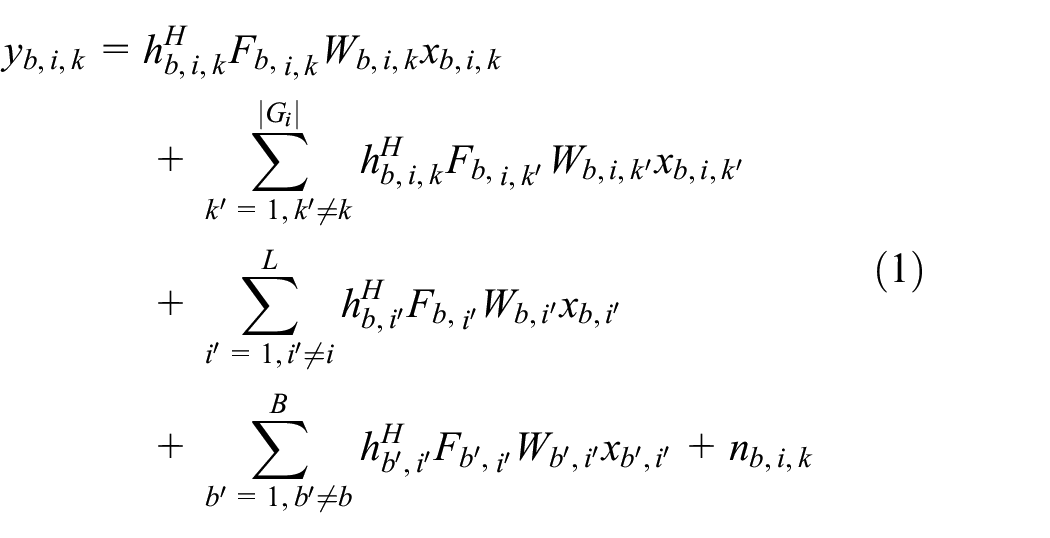
where
Channel model
In order to take advantage of the unique spatial selectivity or scattering characteristics of the mmWave massive MIMO channel, this article adopts the Saleh–Valenzuela (SV) model, 35 where the channel matrix of the user in cluster can be expressed as

where

where
User clustering hybrid precoding scheme
Our goal is to design a hybrid precoding matrix. Therefore, we must first deal with intra-cluster, inter-cluster, and inter-cell interference with less known channel knowledge, and second, we need to use little RF chains to complete the hybrid analog/digital architecture, avoiding the high complexity of traditional methods. Next, we propose a hybrid precoding method based on manifold learning to achieve the above goals.
NCRBM manifold learning for user clusters
With the increase of antennas and users in the mmWave massive MIMO system, inter-cell and intra-cell directional interference will occur during signal transmission. The high-dimensional channel matrix requires high-complexity hybrid analog/digital architectures. By modeling each user set as a manifold, we formulate the problem as clustering-oriented manifold discriminative learning.
The undirected similarity graph of multi-users is represented by the graph embedding method. To represent each user set as a manifold, the user channel characteristic graphs
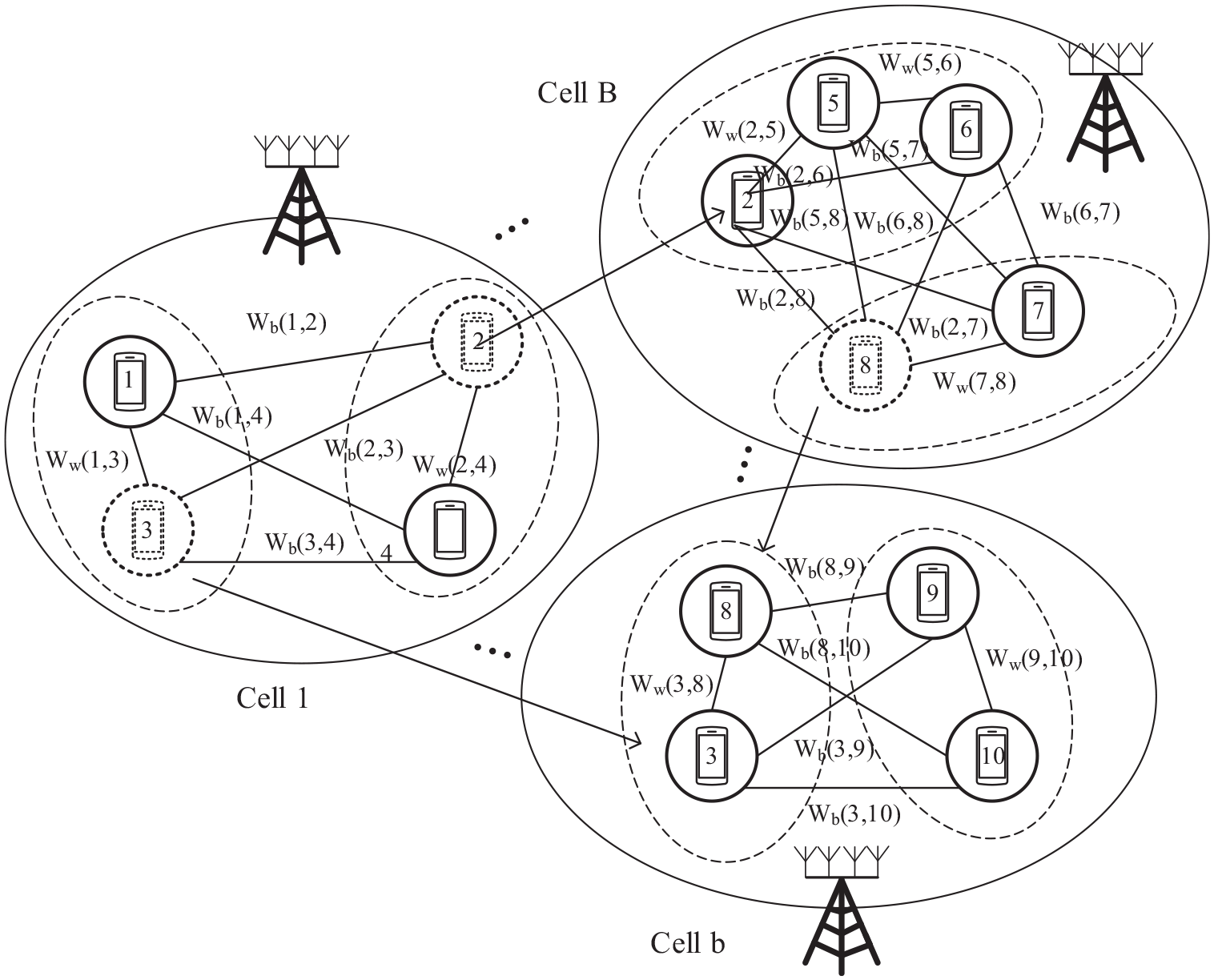
User cluster undirected characteristic graph.
The weight function

The weight function

The weight functions of the intra-cluster show that when users
We propose to perform the manifold discriminative learning for global dimensionality reduction. The high-dimensional channels are mapped in the low-dimensional manifolds, as shown in Figure 3. In order to reveal the potential non-linear manifold structure of high-dimensional channels, intra-cluster graph and inter-cluster graph are constructed using the label information of user characteristics. In addition, it can make the low-dimensional channels more clustered, and enhance the separability of embedded low-dimensional channels. The radio frequency eigen-beamformer is considered to be the best solution for user group transmission. The channel eigenvector learning corresponding to the maximum eigenvalue is taken as the spatial direction. In theory, the main direction learned is the beamforming. Multi-users of the same cluster have highly correlated transmission paths. We seek to learn a generic mapping

where


Schematic diagram of dimension reduction.
The projection can maximize the use of all users in the cluster of the intra-cluster as equation (8), where

According to the SV model,

where
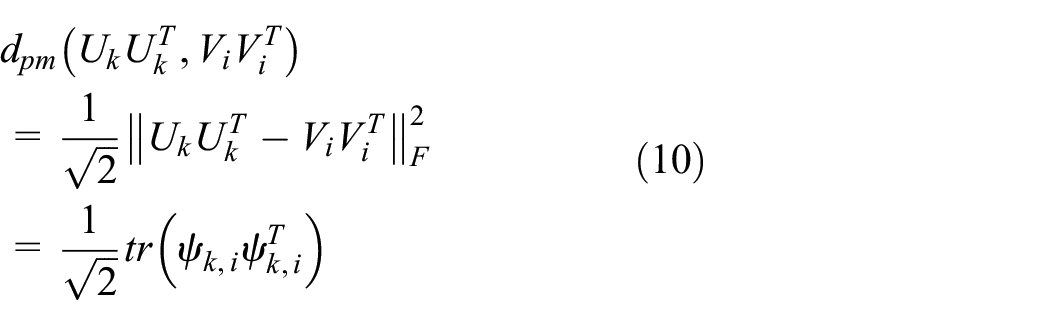
where

To effectively utilize the global characteristics and local manifold structure of intra-cluster channels, we can get the intra-cluster dispersion

where
The weight functions

where
In order to maintain the manifold structure of the inter-cluster user channels, the optimization problem is the projection direction of manifold, that is,

Therefore, the projection can maximize the use of all users of the inter-cluster, that is

where

To effectively utilize the global characteristics and local manifold structure of inter-cluster channels, we can get the inter-cluster dispersion

where ℘ is the constants.
The weight functions

where
After getting the intra-cluster dispersion

where * stands for the convolution;
The network assigns a probability to every possible pair of input and optimized unit through this energy function as follows

where Z is the partition function.
The optimization of the model parameters can be performed by minimizing the following objective function using the Contrastive Divergence

The second term in equation (21) is the sparsity regularization proposed to prevent the model from being overcomplete. For each intra-cluster dispersion,

where

NCRBM objective function is comprised of two main parts, for example, generative and optimized parts. Generative objective (the first two terms in equation (24)) is the same as sparsity regularized CRBM, while this way of optimization does not guarantee the best intra-cluster dispersion value. Optimization of the generative part is performed by minimizing Contrastive Divergence. The second two terms in equation (24) correspond to the optimized function, which can be optimized by following a gradient-based process. Minimizing the following objective function can get the optimal intra-cluster dispersion


where L is the number of clusters. In equation (24), the third term tries to move the features of each intra-cluster dispersion in cluster r to its manifold structure
The gradient of the optimized part can be computed exactly at each iteration. For each cluster, we summed the gradient contributions brought by the two components. Based on the definition in equation (23), update of intra-cluster dispersion in each cluster can be performed after optimizations. The limitation of this approach is that too long-time intervals can cause the obtained intra-cluster dispersion to be inaccurate. So, it needs to be run several times, which makes the overall computing time of the algorithm increase.
For inter-cluster dispersion, we use a similar approach to obtain the optimized inter-cluster values
The discriminative function

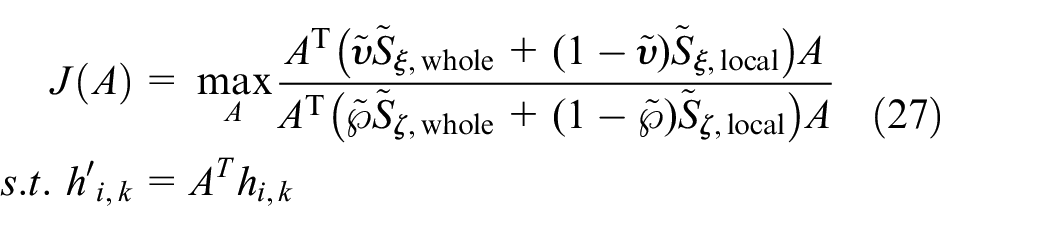
According to equation (27), the low-dimensional mapping of the
Then, according to the intra-cluster graph and inter-cluster graph constructed using the label information of user characteristics, the user clusters can be divided more accurately with lower complexity. Based on the maximum and minimum distances and the weighted likelihood similarity criterion, an optimized spatial fuzzy c-means clustering algorithm is proposed. The algorithm is an iterative optimization that minimizes the cost function defined as follows

where

and

where
Step 1: construct the user channel characteristic graphs
Step 2: find the two farthest distances
Step 3: from the Euclidean distance criterion
Step 4: among the
Step 5: calculate the spatial membership function and update the center point

Then, the maximum value among
Step 6: if
Step 7:
Step 8: output cluster result, and the number of users in each cluster.
Step 9: calculate the
Step 10: calculate the
Step 11: calculate the
Step 12: calculate the optimized
Step 13: optimize the discriminative function
Step 14: according to the obtained projection matrix, get the projection in low-dimensional subspace
Manifold discriminative learning for hybrid precoding
On the basis of manifold discriminative learning for global dimensionality reduction and user clustering, we investigate the sum-rate maximization problem for hybrid precoding. In order to design the precoding matrix
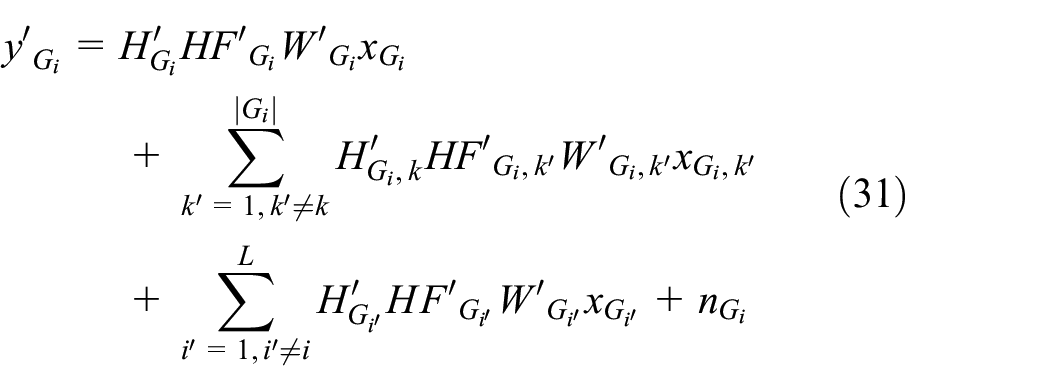
where
In PCP mode, the analog precoding matrix
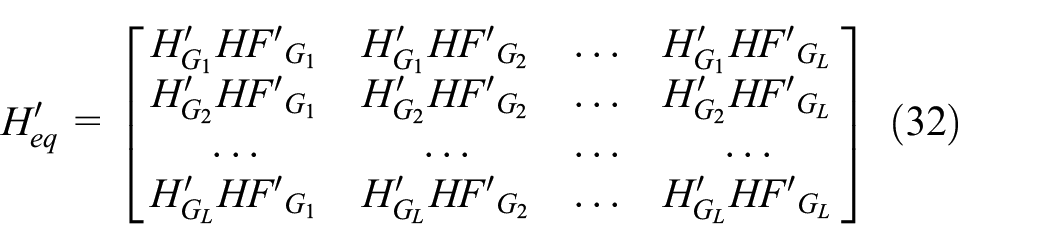
where
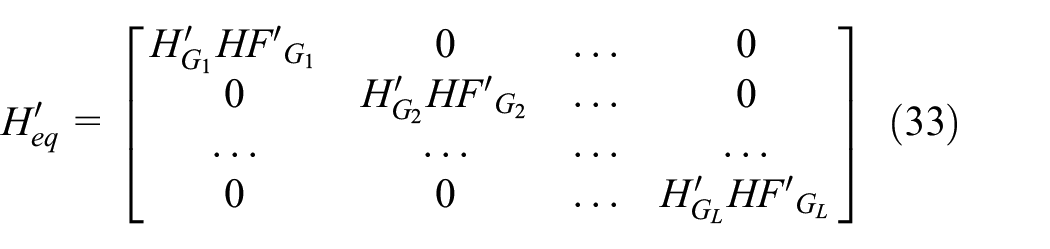
The digital precoding matrix

With scalar equalization

where

The conditional MSE in equation (31) is simplified as

where


Therefore, the hybrid precoding based on interference leakage is jointly optimized with

where

The optimal value given in Ayach et al.
12
is

Accordingly, equation (38) can be expressed as

After simple mathematical derivation, equation (39) can be expressed as

From the above analysis, it is essentially to find a radio frequency precoding matrix
To obtain a minimum value, we discover both geometrical and discriminant embedding space


For the Lth cluster,


where
Following some simple algebraic steps, equation (45) can be reduced to

where
Similarly, equation (46) can be simplified as

Thus, the discriminant embedding space

This is equivalent to find the largest

Let the largest
Once we have obtain the discriminant embedding space
Local discriminant matrix is defined as follows

where
In the general case, the distance in a Grassmann manifold (a particular class of manifolds) is the length of the shortest geodesic connecting two users in lineal subspaces

where
Having defined projection distance over Grassmann manifold, the distance from user

When the two distances are formalized as above, we arrive at the following form of user-to-user distance metric

In equation (55), the former describes how far away the origins of the two coordinate systems
The local discriminant matrix

where t is the parameter of the kernel function,
By minimizing the objective function below, we can find a suitable mapping on which the manifolds belonging to the same subspace can be closer and the manifolds in different subspaces can be further apart

The above formula can be simplified to

where


Therefore, the objective function with constraint is obtained as follows

Let

Finally, we can obtain the optimal
Therefore, solving the objective function can be transformed into a convex optimization problem. The optimal radio frequency precoding matrix
The manifold algorithm to find the optimal radio frequency precoding matrix
Step 1: initialize the analog precoding matrix
Step 2: the learning discriminant embedding space
Step 3: find the largest
Step 4: compute local discriminant matrix
Step 5: compute subspace-to-subspace distance according to equation (56).
Step 6: update
For the intra-cluster, there is correlation between the channels between users. Users in non-adjacent clusters are much smaller than users in adjacent clusters, but the interference is equal. So, the impact of remote user clusters on users in the cluster can be ignored. The SNR of a user cluster
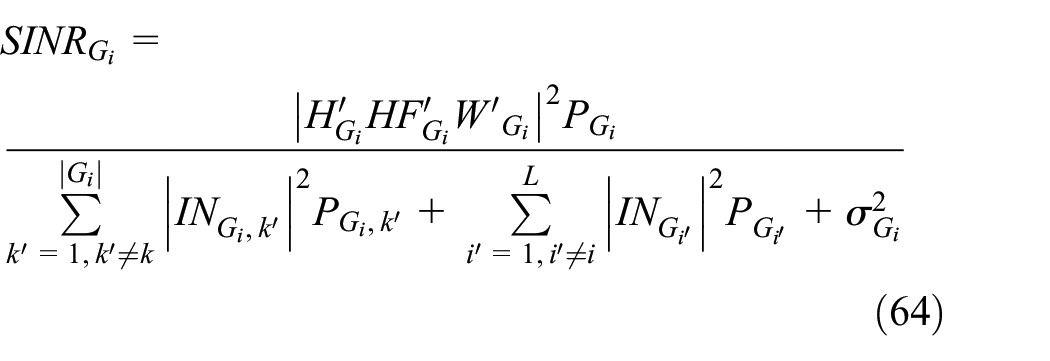
where
The capacity of mmWave massive MIMO system can be expressed as

Equation (65) can be written as

Simulation results
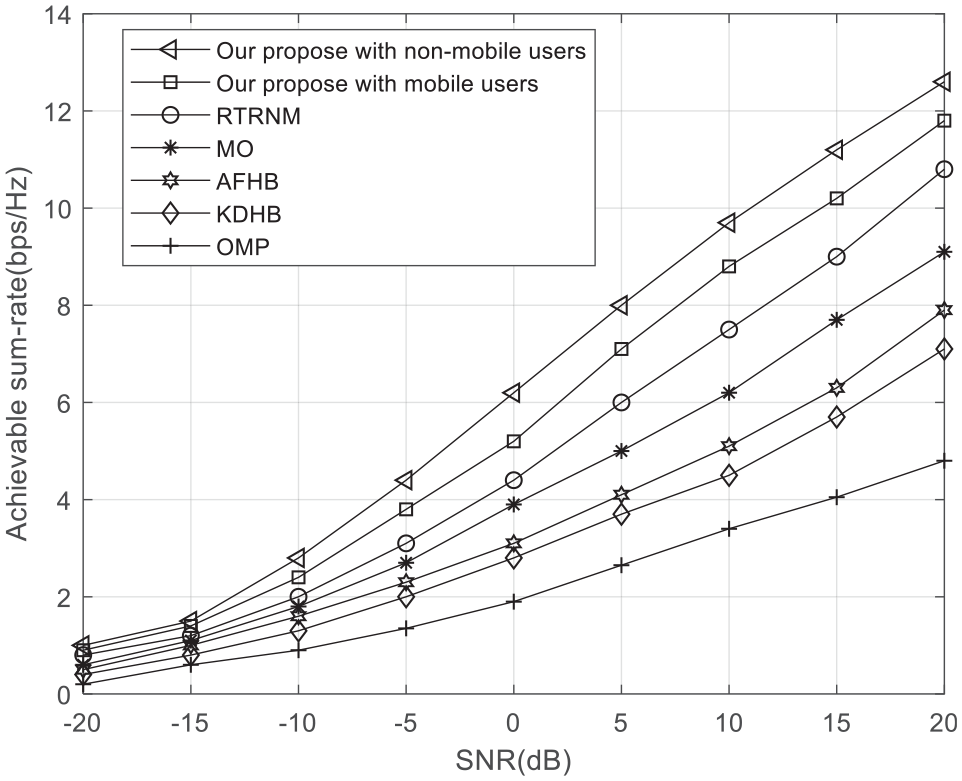
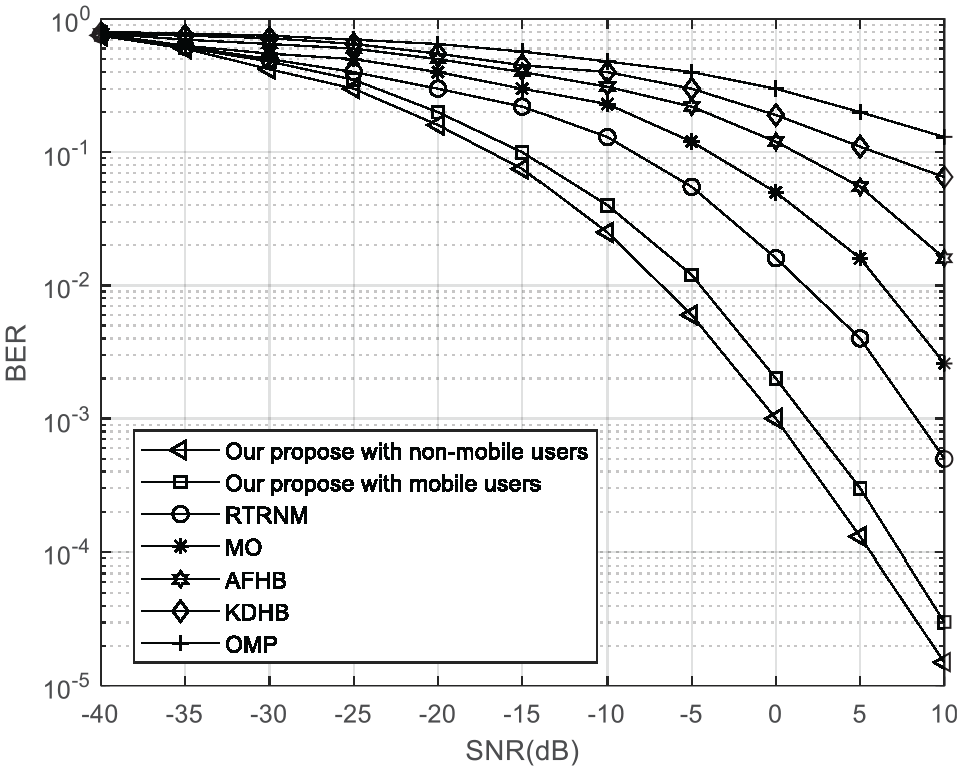
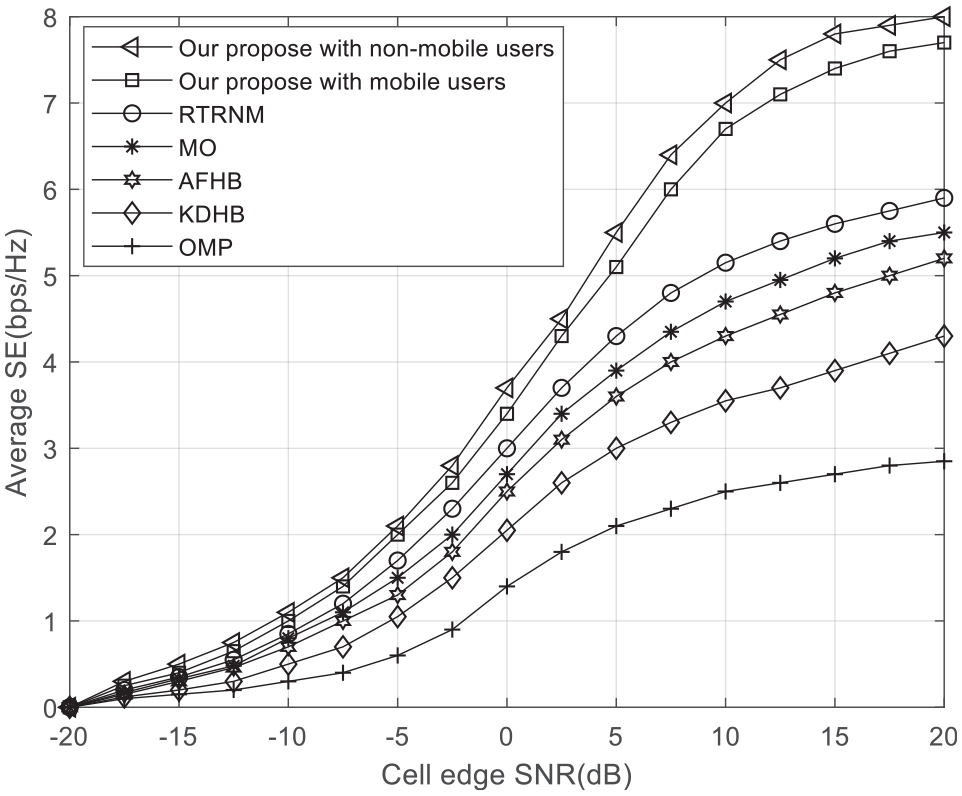
In this section, we will study the SE and bit error rate (BER) performance of the proposed hybrid precoder. We compare the method in this article with several traditional methods, that is, OMP, KDHB, AFHB, MO, and RTRNM. We also consider the performance of this method for non-mobile users and mobile users. The basic simulation parameters are as follows.
The carrier frequency is 60 GHz. The AoAs and AoDs are uniformly distributed in
Figure 4 shows the differences of sum-rate performance with traditional schemes in the mmWave massive MIMO system of hybrid precoding. Let
Sum-rate comparison of different schemes.
Figure 5 shows the differences of the BER performance of different hybrid precoding schemes, where the channel parameters in the single-cell scenario are the same as above. From Figure 5, in the case of different SNRs, a conclusion similar to Figure 4 can be drawn. We can also see that the proposed-based manifold discriminative learning scheme achieve a better BER performance than other schemes. The proposed scheme improves beamspace resolution and reduces the influence of power leakage on beamspace channel.
BER performance comparison of different schemes.
Figure 6 compares the average sum-rate of this article and the traditional scheme, and other existing precodings with different numbers of users. We set

Two-tier system average and rate comparison.
Figure 7 shows the change trend of the system average SNR as the SNR changes. Figure 8 shows the average SE when the BS antenna changes. We can learn from the figure that the proposed method achieves an average SE that is significantly higher than other traditional schemes. From Figure 7 that through the proposed manifold learning scheme, each user and its adjacent high-dimensional channels are in a global and local non-linear neighborhood. Aiming at the high-density hotspot scene of the community, the geometric model of clustering users is studied. The proposed scheme manages the multi-user and inter-cell interference and improves the data rate for cell-edge users. From Figure 8, the proposed method can effectively and extensively use antennas in multiple low-dimensional manifolds.
Average SE versus cell-edge SNR.

The average SE of the number of different BS antennas.
Conclusion
A hybrid precoding scheme for user clustering is proposed, which can solve the problem of large-scale mmWave MIMO in multiple low-dimensional manifolds, avoiding the high-dimensional complex operations of traditional schemes. For the BS, mmWave massive MIMO obtains a low-dimensional learning channel matrix by manifold. Then user clustering hybrid precoding is studied for the transmitted signal based on the low-dimensional channel matrix. The manifold discriminative learning seek to learn the embedding low-dimensional subspace, where manifolds with different user group labels are easier to distinguish, and the local spatial correlation of high-dimensional channels in each manifold is enhanced. Through proper user clustering, the hybrid precoding is investigated for the sum-rate maximization problem by manifold quasi-conjugate gradient methods. The simulation results show that the method has good robustness on the basis of reducing the computational complexity of the mmWave mass MIMO system.
More realistic precoding for MIMO is expected in the future research. In popular learning after user clustering we just use the traditional method, the choice of user clustering center is crucial, if the user is in high speed of movement will make our method inaccurate. So, more advanced research is needed. In addition, our current method is applied in hybrid precoding of full connections; precoding research is still needed for sub-connections as well as dynamic connections.
Footnotes
Handling Editor: Yanjiao Chen
Declaration of conflicting interests
The author(s) declared no potential conflicts of interest with respect to the research, authorship, and/or publication of this article.
Funding
The author(s) disclosed receipt of the following financial support for the research, authorship and/or publication of this article: This work was supported by the Shanghai Capacity Building Projects in Local Institutions under Grant 19070502900.
