




Abstract
The development of a modern electric power grid has triggered the need for large-scale monitoring and communication in smart grids for efficient grid automation. This has led to the development of smart grids, which utilize cognitive radio sensor networks, which are combinations of cognitive radios and wireless sensor networks. Cognitive radio sensor networks can overcome spectrum limitations and interference challenges. The implementation of dense cognitive radio sensor networks, based on the specific topology of smart grids, is one of the critical issues for guaranteed quality of service through a communication network. In this article, various topologies of ZigBee cognitive radio sensor networks are investigated. Suitable topologies with energy-efficient spectrum-aware algorithms of ZigBee cognitive radio sensor networks in smart grids are proposed. The performance of the proposed ZigBee cognitive radio sensor network model with its control algorithms is analyzed and compared with existing ZigBee sensor network topologies within the smart grid environment. The quality of service metrics used for evaluating the performance are the end-to-end delay, bit error rate, and energy consumption. The simulation results confirm that the proposed topology model is preferable for sensor network deployment in smart grids based on reduced bit error rate, end-to-end delay (latency), and energy consumption. Smart grid applications require prompt, reliable, and efficient communication with low latency. Hence, the proposed topology model supports heterogeneous cognitive radio sensor networks and guarantees network connectivity with spectrum-awareness. Hence, it is suitable for efficient grid automation in cognitive radio sensor network–based smart grids. The traditional model lacks these capability features.
Keywords
Introduction
Background
Cognitive radio sensor networks (CRSNs) have recently been proposed for smart grid (SG) applications. This will help to improve the monitoring, control, and overall communication network in an SG ecosystem. This leads to reliable and efficient electric power services.1,2 SG provides a bidirectional data exchange between utility and consumers. SG can greatly improve the utilization of some resources such as metre data management and available power, and avoid some failures caused by power resource scheduling. 3 The performance requirement such as delay for different types of data in the SG diverges greatly. This can pose a severe challenge in wireless communication; therefore, the integration of an improved quality of service (QoS) scheme for SG is very important. 4 For example, Fang et al. 5 proposed a QoS model that provides different QoS for different priority data in the communication system of wireless sensor network (WSN). However, real-time traffic applications such as SG applications can be effectively guaranteed in a CRSN with minimal packet transmission delay.2,6 This is because the interference challenge in the unlicensed wireless communication (Industrial, Scientific and Medical (ISM)) band is mitigated in the CRSN wireless environment. CRSNs are networks of cognitive radios (CRs) that are equipped with sensor nodes. They have cognitive capability and reconfigurability and can adjust their transceiver parameters with respect to interactions with the environmental circumstance in which they operate. 2 CRs can help to mitigate excessive collisions in the network. 7
Generally, CRSN topologies involve the deployment of a few to several hundred CR sensors within areas where monitoring activities are required. For example, deployment for monitoring activities can be carried out in specified areas of power generation, transmission, distribution, and consumer end points. The deployment can be carried out to cut across SG communication network hierarchical layers, as follows:
Premises area networks comprising of HANs (Home Area Networks), BANs (Building Area Networks), CANs (Commercial Area Networks), and IANs (Industrial Area Networks);
Neighborhood area networks (NANs);
Field area networks (FANs);
Wide area networks.
Each CR sensor node can connect to one or more CR sensor nodes in order to transmit data. 8 Obviously, CR sensor node deployment for full sensing coverage plays a vital role in allowing reliable transmission through an SG communication network. Basically sensor nodes including CR sensor nodes have energy and resource constraint issues.9,10 The limitation of the energy or the battery life can adversely affect the overall sensor network lifetime. Good design topology and modeling will address the energy consumption of a CRSN as well as providing minimal end-to-end delay and appreciable throughput of the CR sensor node. In addition, efficient MAC protocols that will enable the coexistence of CRSNs with existing wireless infrastructure are essential. 11
Mobile edge computing (MEC) can be used in a SG CRSN paradigm to address the issue of resource constraint sensor nodes – this is an emerging approach. For instance, a joint scheme of matrix completion technology and cache placement for dealing with the resource constraint edge nodes problem was proposed by Tan et al. 12 While conventional ZigBee WSNs make use of fixed channel access, CRSNs make use of multiple channel access from the available spectrum opportunistically through dynamic spectrum access (DSA). The fixed channel for conventional ZigBees can easily be choked during access allocation and as a result cause excess energy consumption, overhead and interference. Other features that illustrate the differences between ZigBee WSN and ZigBee CRSNs are given in Table 1. From Table 1, the topological differences between ZigBee WSNs and ZigBee CRSNs can be seen. The CRSN topologies are highlighted in the section on the overview of CRSN technologies.
Comparisons of ZigBee WSNs and ZigBee CRSNs.

DHC: distributed heterogeneous cluster.
The contribution of this article can be summarized as follows:
Investigation of the potential differences, with particular emphasis on the network topologies of ZigBee WSNs and ZigBee CRSNs for SG applications.
An energy-efficient CRSN model suitable for SGs, industrial networks, and Internet of Things (IoT) applications is developed.
An energy-efficient distributed heterogeneous clustered spectrum-aware (EDHC-SA) network connectivity formation is presented together with its coordination for CRSN deployment in SGs.
An EDHC-SA multichannel sensing coverage model based on the cross-layer algorithm is proposed.
Compliance requirements for communication infrastructure and CRSN integration in SG
CRSNs for other applications are different from the CRSNs for SG applications due to the following compliance requirements:
CRSN deployment in SGs should be supported by key immunity-compliance requirements set by the International Electrotechnical Commission (IEC). 13 CRSNs for other applications do not have these key SG immunity compliance requirements.
SG CRSNs must be able to overcome the electromagnetic interference (EMI) present in SGs. It has been established that EMI and environmental changes negatively impact SG wireless communication infrastructure.13,14
Appropriate electromagnetic comparability (EMC) must be considered for implementation of CRSNs in SGs. The International Special Committee on Radio Interference (CISPR) investigated radio noise originating from high-voltage (HV) power equipment and provided recommendations for reducing the radio noise generated in SGs. 15
Existing work on CRSNs for other applications suffers from the impact of SG EMI. This work reported here considers the key immunity-compliance requirements for CRSNs when deployed in SGs.
Overview of CRSN technologies
In a CRSN, there are two types of users: primary and secondary. Primary users (PUs) are the licensed (authorized) users, which have the license to operate in an allotted spectrum band in order to access the primary base station (BS). Secondary users (SUs) or the CR users are unlicensed users. CRs use the existing spectrum through opportunistic access without causing harmful interference to the primary or licensed users. CRs look for the available portion of the unused spectrum (called spectrum hole or white space (WS)). The optimal available channel (AC) is then used by the secondary or CR sensor nodes if there are no PUs operating in the licensed bands. 8 The WS geolocation database handles the control of the usage of the spectrum holes by the SUs in order to guarantee usage by the PUs when the PUs need the channels. Hence, a CRSN possesses unique characteristics.
Unique characteristics of CRSN
A CRSN has numerous unique characteristics that differentiate it from the conventional ZigBee WSN. Since it incorporates the cognitive capabilities of CR into WSN, it can differentiate itself from CRN and WSN. Hence, it has a unique feature wherein it possesses the dual characteristics of CRN and WSN. Other unique characteristics of CRSN include the following:
Capabilities for sensing the current radio frequency (RF) spectrum environment;
Policy with configuration repository—policies specify how the radio is to be operated, while the repository is usually formed from the sources used to constrain the operating process of the radio in order to remain within regulatory or physical limits;
DSA capabilities with multiple channels availability;
Spectrum handoff capabilities;
Adaptive algorithmic mechanism—during the radio process, the CR is sensing its environment, and following the constraints of the policy and configuration by exchanging with sensor nodes to best employ the radio spectrum and meet user demands;
Low traffic flow;
Reconfigurability and distributed cooperation capabilities;
Limited memory and power constraints.
Some of the unique characteristics stated above are based on the cognitive cycle functionalities which enable the SUs to have dynamic and opportunistic access to the unused channels. These functionalities are spectrum sensing, spectrum decision, spectrum sharing, and spectrum mobility. These four main DSA management functionalities of the CR are required to determine the accurate communication parameters of SG communication and adjust to the dynamic radio environments. Details of these DSA management functionalities are found in Akyildiz et al. 16
Due to the presence of the unique CRSN features, optimization of the protocol stacks to achieve improved QoS performance that is used for conventional ZigBee WSN cannot be directly applied to CRSNs. Also, the existing protocols of the conventional WSN cannot be applied to a CRSN because of the dynamic availability of multiple channels in the CRSN, and to dynamic spectrum access in the presence of PU activity. Hence, while designing resource allocation schemes for CRSNs, their unique features should be considered together with the PU activity consideration. Consequently, the work reported here considers these unique characteristics when designing the algorithms for QoS enhancement.
Structure of CRSN node hardware
A typical block diagram structure of a CRSN node is shown in Figure 1. It is composed of a sensor or the sensing unit which is used for sensing data and target signals. The processor processes and commands the activities of various units. The memory is used for storing data/information. The transceiver contains the cognitive engine and the RF component which enables the sensor node to dynamically adjust their communication network parameters and to transmit sensed data respectively. The battery or power unit supplies the necessary power to the rest of the units.

CRSN node structure.
The rest of this article is organized as follows: In section “CRSN topologies and communication protocols,” CRSN topologies and communication protocols are presented. Related works are highlighted in section “Related work.” Section “Distributed heterogeneous clustered topology of CRSNs in SG” presents a distributed heterogeneous cluster (DHC) for energy-efficient CRSNs, including a multichannel sensing coverage model in an SG. Section “Simulation, analysis, and results” presents simulation, analysis, and results of the EDHC-SA models. Finally, Section “Conclusion and future work” concludes the article.
CRSN topologies and communication protocols
CRSN topologies
A CRSN has different network topologies which are based on the application requirement. Hence each topology is suitable for a particular application. The following network topologies have been identified. Table 2 gives some of the characteristics of the different Zigbee CRSN topologies.
Different topologies of ZigBee CRSN with their characteristics.

Star topology
This is the simplest topology suitable for very small-scale sensor network. This topology has central BS infrastructure which handles spectrum sensing and resource allocation to the connected node, as shown in Figure 2(a).
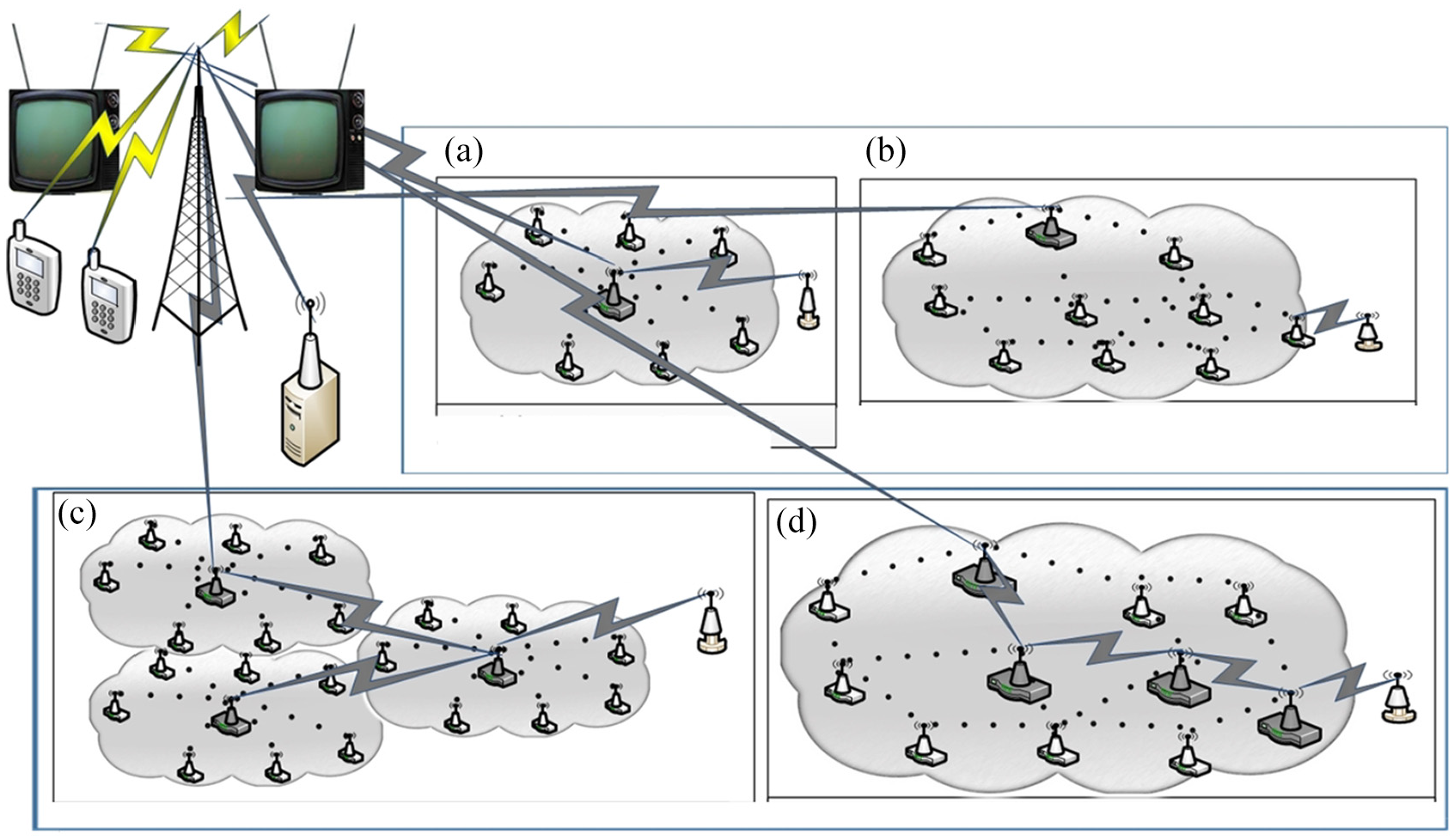
CRSN topologies: (a) star network topology, (b) peer-to-peer/mesh network topology, (c) cluster network topology, and (d) heterogeneous hierarchical network topology.
Peer-to-peer topology
In this topology, the CR sensor nodes communicate with each other in peer-to-peer as well as in multi-hop manner and directly to the sink node. This topology has no BS infrastructure. Hence, spectrum sensing, resource provisioning, and sharing are done by each node separately or by cooperative communication. Large-scale deployment of this topology can lead to a mesh network with several multi-hops, as shown in Figure 2(b). This topology has no high computational complexity and overheads. However, there will be high latency delay due to so many hop count in the mesh network.
Clustered-based topology
This is a form of star topology, however, with more sophisticated features suitable for large-scale sensor network deployment. The clustered-based topology involves selection of cluster heads or coordinator which will be apportioned to carry out critical tasks such as spectrum sensing for channel availability, and allocation of radio resources to other CR sensor nodes. This topology is illustrated in Figure 2(c). Consequently, cluster head (CH) selection and cluster network formation technique are essential in this topology for improved data communication network in SG application deployment.
Heterogeneous hierarchical topology
This involves the combination superior sensor nodes such as the actuator and multimedia CR sensor nodes, and the normal CR sensor nodes. The deployment of these mixed CR sensor nodes for various technologies is done in a hierarchical mesh network manner. Hence, this topology comprises heterogeneous CRSN nodes in a hierarchical mesh network, as shown in Figure 2(d).
DHC topology
This topology consists of heterogeneous CRSN nodes such as normal ZigBee CR nodes, actuator, and multimedia sensor nodes. Unlike heterogeneous hierarchical topology, the deployment here is done in a distributed clustered manner covering an extensive and long range area. The DHC topology is shown in Figure 3. This CRSN DHC topology is recommended for SG applications, because SGs require heterogeneous networks to support different QoS for the various applications. This topology has been adopted from the work of Ogbodo et al., 17 which has now been improved with an energy-efficient spectrum-aware model, and a multichannel sensing coverage model. It is regarded as distributed clustered because multiple inter-clustered network are linked with relay CRSN nodes for extensive range coverage. This will help in reducing the number of multi-hops with minimal latency delay, unlike the heterogeneous hierarchical topology that has several hops with high latency delay.

CRSN distributed heterogeneous cluster topology.
Mobile ad hoc topology
This topology is somewhat similar to the peer-to-peer topology, except that mobility is integrated in the CRSN node to cover the deployment area. Some of the CRSN nodes are made to be mobile. For example, mobile ad hoc CRSNs can be deployed with environmental, proximity, and light monitoring CR sensors.
Communication protocols in ZigBee CRSN
An investigation of the communication layer protocols in a ZigBee CRSN is presented in this section. Obviously, the communication layer protocols have direct relationships and cooperation with the DSA management functionalities highlighted in the previous section. The protocols and cooperation with the DSA functionalities, as shown in Figure 4, will jointly enhance the communication in ZigBee CRSN nodes. The communication layer protocols are as follows:
Physical (PHY) layer;
Media access control (MAC) layer;
Network layer;
Transport layer;
Application layer.

Interaction between the communication protocols and DSA functionalities. 16
Related work
The implementation of CRSNs for QoS improvement has been investigated by researchers from several perspectives. Gao et al. 18 presented a joint lifetime maximization and adaptive modulation framework for realizing high power efficiency in CRSNs. The framework to improve energy consumption of the sensor nodes is only on protocol optimization and not based on network topology. Naeem et al. 19 investigated energy-efficient power allocation including the maximization of ratio of throughput to power for CRSNs. Their work does not consider network topology for sensor nodes deployment and is not centered on SG. Aslam et al. 20 proposed a scheme that selects the optimal number of sensor nodes and efficient channel allocation mechanism, which improves the performance of clustered topology-based CRSNs. The work focuses on efficient channel allocation in CRSNs without considering integration in the SG environment. Zhang et al. 21 presented a centralized spectrum-aware clustering algorithm and a distributed spectrum-aware clustering (DSAC) protocol which maintained scalability and stability as well as low complexity with quick convergence of the dynamic spectrum variation. They did not consider bit error rate (BER) in their work. It is also not in the context of an SG.
Improvement of energy efficiency and end-to-end delay with a QoS guarantee for a CRSN when using in-network computation was investigated by Lin and Chen. 22 They also presented the maximization of throughput in the deployment of WSNs. However, their work is not in the perspective of an SG. Ren et al. 23 demonstrated how channel accessing schemes can significantly improve energy efficiency in CRSNs. Though again, the work is not in the context of an SG, Oto and Akan 24 investigated PU behavior and channel BER as the key critical parameters in determining the energy efficiency for CRSN, though this was still not in the context of an SG.
Other works addressed energy efficiency in sensor networks for monitoring applications using a hierarchical clustering topology approach. For instance, Heinzelman et. al. 25 proposed a low energy adaptive clustering hierarchy (LEACH) algorithm. This involves CHs which are randomly selected in order to increase the sensor network lifetime. Smaragdakis et al. 26 proposed a stable election protocol (SEP) for clustered heterogeneous WSN. SEP involves a heterogeneous-aware protocol to prolong the time interval before the death sensor node in order to conserve energy. Younis and Fahmy 27 proposed a hybrid energy-efficient distributed (HEED) clustering protocol. This periodically selects CHs based on the hybrid of the node residual energy and a node proximity to its neighbors. Saini and Sharma 28 proposed a threshold distributed energy-efficient clustering (TDEEC) protocol. This improves the energy use of the CHs by adjusting the threshold value of a node in a heterogeneous WSN. Arumugam and Ponnuchamy 29 proposed an energy-efficient LEACH (EE-LEACH) Protocol for data gathering in WSN. EE-LEACH helps to provide an optimal packet delivery ratio with lower energy consumption. Eletreby et al. 30 proposed Cognitive LEACH (CogLEACH), which is a spectrum-aware extension of the LEACH protocol. CogLEACH is a fast, decentralized, and spectrum-aware (including energy-efficient clustering) protocol for CRSNs.
The major drawback of the above-mentioned works, on energy-efficient hierarchical clustering topology approaches in sensor networks, is that they lack consideration of compliance requirements for sensor network integration in SGs. However, the energy-efficiency model reported in this article considers the compliance requirements for sensor network integration in SGs.
Studies involving energy-efficient clustering for data gathering in WSN, including underwater wireless sensor network (UWSN). have been conducted.31,32 Huang et al. 31 addressed an autonomous underwater vehicle (AUV)-assisted data gathering scheme using clustering, and matrix completion to improve the data gathering efficiency in the UWSN was proposed. Jiang et al. 32 proposed a trust-based energy-efficient data collection for an unmanned aerial vehicle (TEEDC-UAV) scheme to prolong sensor nodes lifetime with a trustworthy mechanism. Although these studies are not in the context of SG, one of their main focuses is energy-efficient clustering using an optimized approach for monitoring, control, and data collections in WSN and IoT applications.
Another area of research attention is the sensing coverage problem in sensor networks. Several researchers have addressed this using deterministic sensing models.33–35 Some researchers have investigated the sensing coverage problem using a probability coverage model.36–38 Other researchers explored the sensing coverage problem using environmental impacts such as path loss, multi-path, and shadowing fading.39–42 Most of these sensing coverage models ignore the consideration of compliance requirements for sensor network integration in SGs. They do consider multichannel sensing coverage of CRSNs or coverage probability with respect to BER and latency in their models. However, this article considers the multichannel sensing coverage of CRSNs, and coverage probability with respect to BER and latency for CRSN-based SG communication.
Implementation of CRSNs for enhanced QoS from an SG perspective is found in a few studies. For instance, Shah et al. 43 proposed a cross-layer design that ensures the QoS requirements for CRSN-based SGs. The authors handle the issues of heterogeneous traffic in a CRSN-based SG by defining different classes of traffic with different priority levels. This classification is significant in terms of separating the traffic with respect to the services and their network requirements, for example, latency, link reliability, and data rate. However, network topology for CRSN deployment, and BER and energy consumption, is not considered in their work.
Markov chain modeling of CRSNs in SGs was presented by Luo et al.; 44 the work aims at reducing transition delay during handoffs, though improvement using network topology is not considered in this work.
Aroua et al. 45 presented unselfish distributed channel allocation using a partially observable Markov decision process (POMDP) to improve spectrum utilization for smart microgrid-based CRSNs. Hassan et al. 46 proposed the use of unlicensed TVWS spectra for CR operators to guarantee QoS for SG applications.
However, even though there are few improvements for QoS through the implementation of CRSNs in SGs, as highlighted above, the implementation of CRSNs for guaranteed QoS in the context of network topology of the CR sensor nodes deployments in SG, including the evaluation of QoS metric in terms of BER, is rarely investigated. Hence, the focus here is performance improvement of CRSN-based SG which is achieve by utilizing a proposed CRSN topology for guaranteed QoS based on metric such as reduced BER, low end-to-end delay, and reduced energy consumption in SG. This will help for seamless delivery of sensed data in the SG ecosystem.
DHC topology of CRSNs in SG
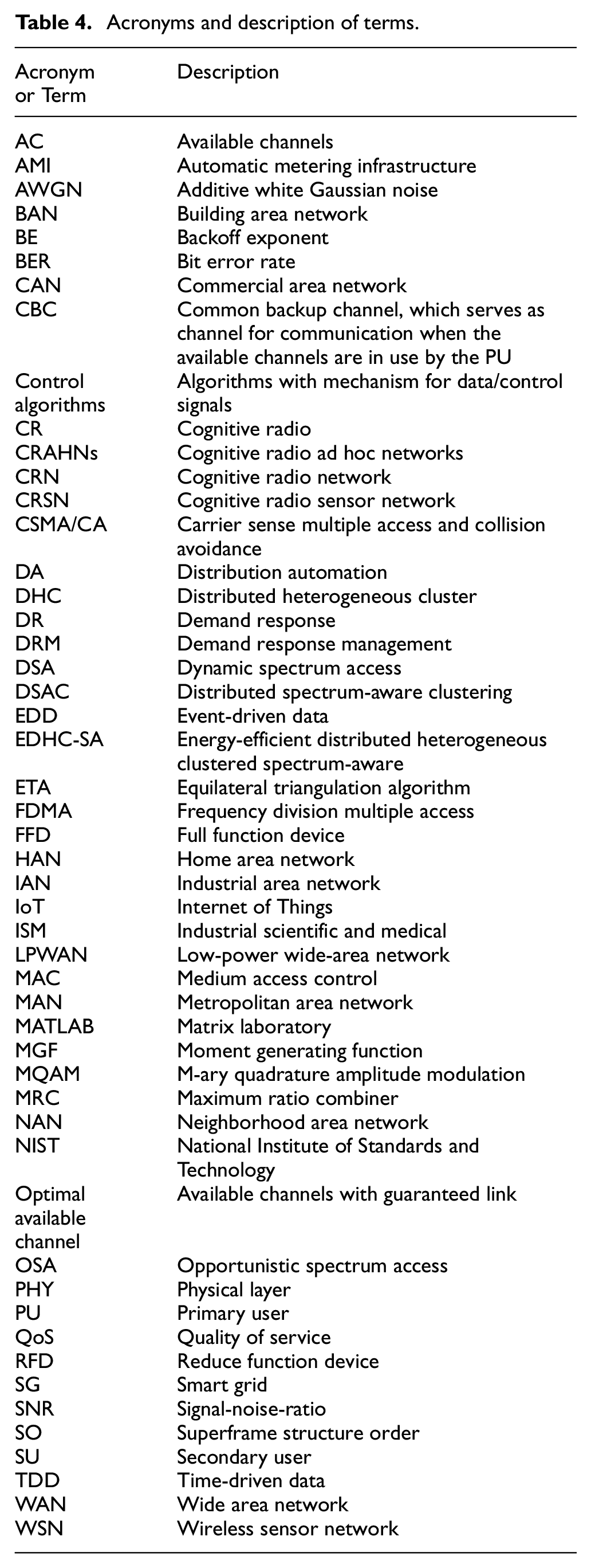
In this section, DHCs are presented. It begins with a description of the composition of the system as well as the topology. Also presented is the EDHC-SA network connectivity formation model. EDHC-SA multichannel sensing coverage model is proposed. For better understanding of the terminologies and symbols used in this article, Table 3 presents a description of the symbols and terms, and further acronyms are listed in Table 4.
Symbols.
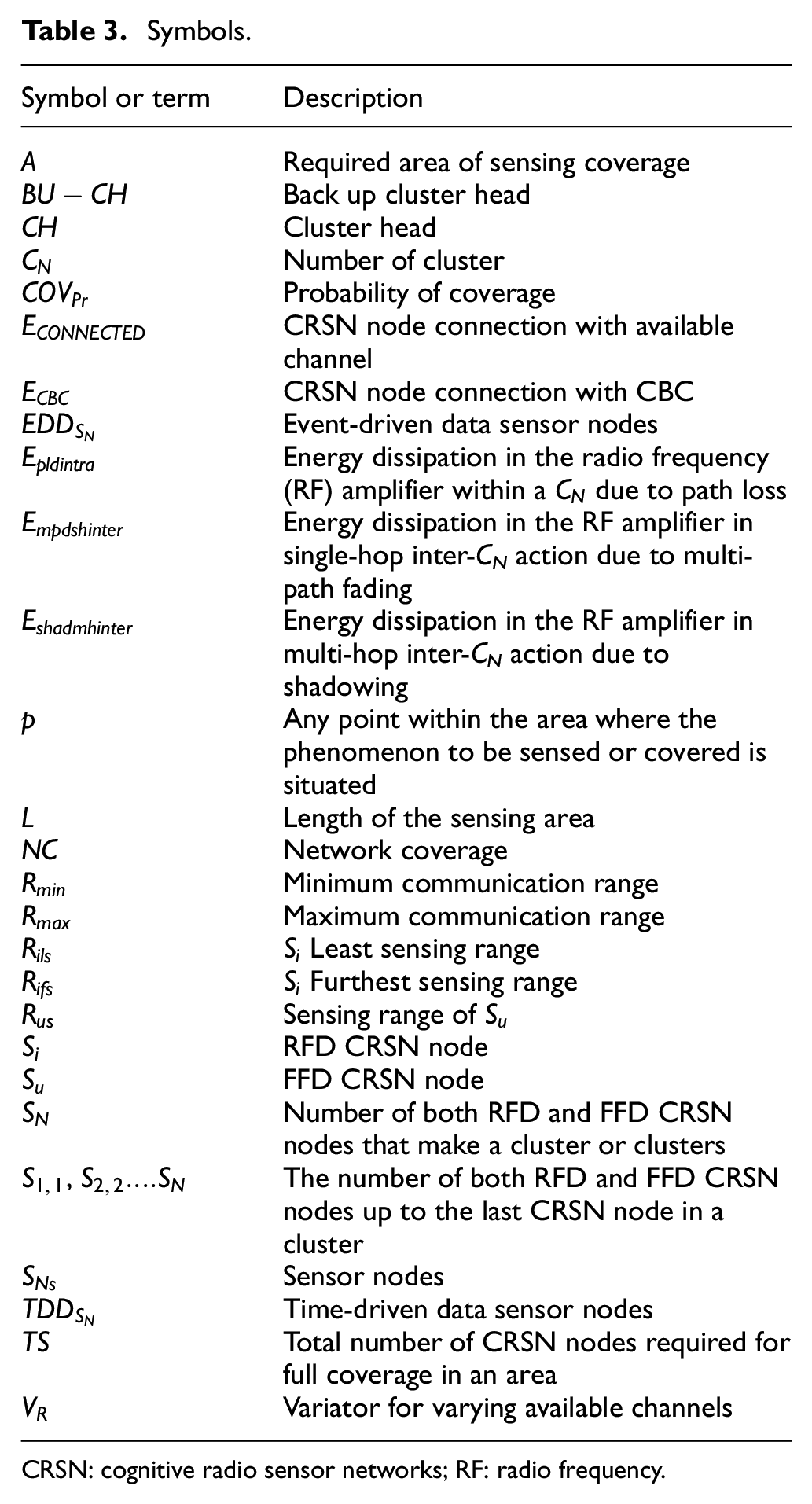
CRSN: cognitive radio sensor networks; RF: radio frequency.
Acronyms and description of terms.
DHC system model
A DHC ZigBee CRSN topology system model is composed of heterogeneous devices, which consist of fully function devices (FFDs) such as ZigBee Pro and multimedia sensors, and reduced function devices (RFDs) such as ZigBee and actuators. In this system model, different tasks are assigned to the different sensor devices; for example, ZigBee sensors and actuators are responsible for sensing activities within the expected coverage. ZigBee Pro acts as the CH, which is responsible for communication channel sensing and allocation to the RFDs. The ZigBee Pro also acts as the coordinator for the RFDs, including transmission of collected sensed data as well as a relay for the collected data to the BS or sink. The multimedia sensors are responsible for video signals and surveillance activities. Each sector is designed to have two FFDs, primary and redundant or backup coordinators, in order to alleviate energy consumption and increase network lifetime. A number of clusters are meant to cover a specific area. The clusters are extended via the ZigBee Pro in a distributed relay manner for long-range coverage area. The DHC topology is shown in Figure 3.
EDHC-SA network model
In order to guarantee network coverage and connectivity, the deployment scheme of the heterogeneous ZigBee CRSNs was first presented.
Deployment scheme for the EDHC-SA model
There are two main sensor deployment schemes: (1) structured or deterministic sensor deployment and (2) unstructured or random sensor deployment. The latter is suitable for applications in remote and inaccessible areas. In this work, deterministic sensor networks are used for SG applications because it provides sufficient sensing coverage and guaranteed connectivity. This is because SG applications are mission-critical applications 47 and require guaranteed transmission of sensed data in a real-time manner. For scheme (2), random deployment is susceptible to sensor coverage holes or possessing some areas that are not covered in the actual field; hence, it is not suitable for SG applications.
A square field area is considered. The phenomenon (target) to be sensed or covered is situated within the area. Hence the area is
Let the least distance from any point

where

Voronoi diagram with equilateral triangle shape in a square field.

Equilateral triangulation pattern deployment strategy in a square field.
EDHC-SA network connectivity model
Link interruption will cause the loss of communication between two adjacent nodes in the SG communication network. Therefore, a stronger network connectivity will be devoid of link interruption. For instance, Chen et al.
51
demonstrated network connectivity using the connectivity degree; that communication loss is related to the node connectivity degree. Hence the stronger the connectivity degree the better the connected link. However, the EDHC-SA network connectivity method, is modeled by a equilateral triangulation pattern, denoted as
An
If all vertices in a triangle are connected, then the triangle is covered by the associated sensor node; hence, the total triangles are covered, resulting to the full coverage and connectivity of the whole area.
Coverage and connectivity can be maintained if and only if the minimum Euclidean distance or minimum communication range,

where

The probability of coverage of the equilateral triangulation pattern field can be computed using the sensor node that constitutes a lattice which is denoted as

But the area of the equilateral triangle

Therefore,

The total number of CRSN nodes

where area of the square field
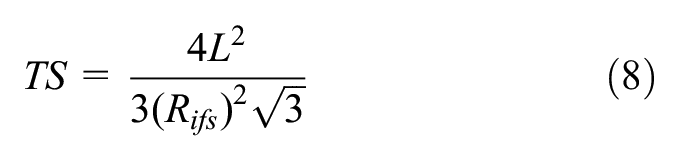
Since
Any point
The total number of clusters

so that

However, there are two
Algorithm 1: ETA Algorithm for guaranteed

AC: available channels; CBC: common backup channel.
Algorithm 1 in Table 5 shows the connectivity and coverage in the equilateral triangulation. Any point
EDHC-SA energy model
In this section, the energy consumption that is involved in the entire process of cluster network formation and the data communication or transmission phase is presented. The energy expended in the CRSN node during transmission and reception is


During transmission, a data frame of size
Some

where
The primary

where


where
Equations (15) and (16) are for the

where
Algorithm 2 in Table 6 uses CSMA/CA algorithms for the alternation of
Algorithm 2: CSMA/CA Algorithms for Alternation of

BP: beacon period; BE: backoff exponent; ACs: available channels; SO: superframe structure order.
EDHC-SA multichannel sensing coverage model
Signal model
CRSN-based SGs are examples of a situation where channel conditions fluctuate dynamically. Thus, ZigBee CRSN systems use an adaptive modulation schemes so as to take into account the difference in channel conditions. 53 The adaptive modulation varies transmission parameters such as power, data rate, and modulation technique. Hence, adaptive CR technologies will help to achieve interference-free networks as well as spectral efficiency54,55 during data frame transmission. The SG-sensed data is modulated using MQAM through a single fading channel from the available multiple fading channels distribution conditions via DSA. The received signal at the respective CRSN nodes can be modeled as

where

and has a zero mean with complex Gaussian variables denoted as (0,
However,

The higher the transmit power

where

Hence, the channel implementation is expressed as

where

and
Probability of sensing coverage signal
Various sensing models such as the circular disk sensing model, deterministic model and random deployment model cannot give absolute sensing coverage. This is due to the fact that they do not take into account the error probability mechanism. Hence, the error probability of the sensing coverage was introduced to the Voronoi equilateral triangulation model. Therefore, the probability density function (PDF) is employed; this uses the moment generating function (MGF). This utilizes the average bit error MQAM probability over a single Nakagami-q fading channel, which was derived in earlier work 53 and is given as

where

The MGF of the received SNR over the Nakagami-q channels is

In order to estimate the coverage probability of detection of the sensing signal, the sensing range RS of the CRSN node is taken into consideration. The RS depends on the transmit power of the sensing signal, the sensing received power (which is also the received signal strength (power), denoted as

where

where

Hence, integrating between limits

Simulation, analysis, and results
In this section, the EDHC-SA energy model and EDHC-SA multichannel sensing coverage model are implemented and evaluated using MATLAB. The EDHC-SA energy model algorithm is run and the results compared with the stable energy protocol (SEP), and the LEACH protocol. The performance efficiency of the proposed energy model is evaluated based on average residual or remaining energy for the sensor nodes. The efficiency of the EDHC-SA multichannel sensing coverage model is tested and the results compared with existing ZigBee sensor network models. The proposed multichannel sensing coverage model is evaluated using the following metrics Coverage error probability or BER, SNR, and latency. Table 7 presents simulations parameters for the models.
Simulation parameters.
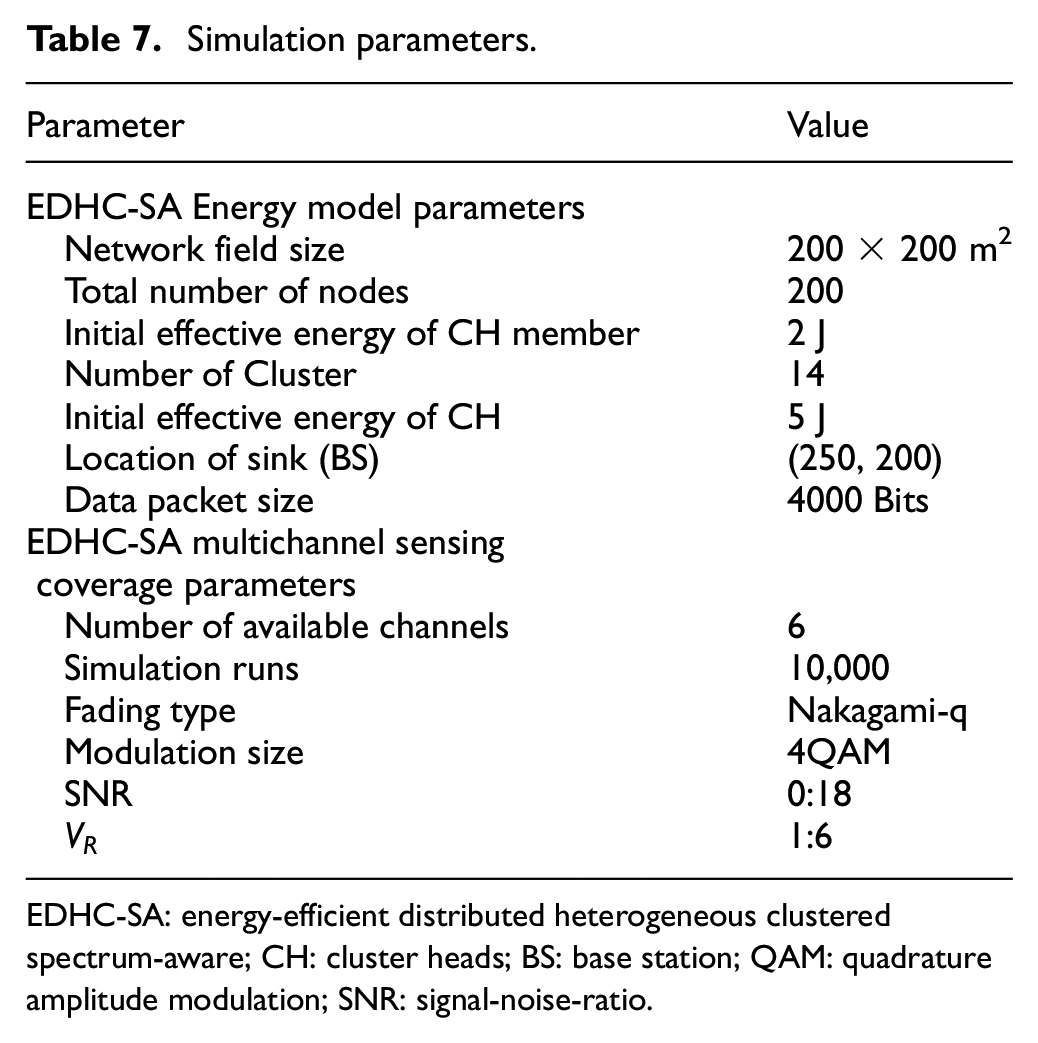
EDHC-SA: energy-efficient distributed heterogeneous clustered spectrum-aware; CH: cluster heads; BS: base station; QAM: quadrature amplitude modulation; SNR: signal-noise-ratio.
Figure 7 shows the energy consumption analysis based on average residual energy per round of the EDHC-SA energy model. This is compared with the existing SEP and LEACH Protocol. The results confirm that the EDHC-SA energy model can effectively do the data aggregation from the sensor node sources to the sink with minimal energy consumption. Figure 7 shows a higher average residual energy than the existing SEP and LEACH energy protocols.

Average residual energy per round for EDHC-SA compared with the existing SEP and LEACH protocol.
For the EDHC-SA multichannel sensing coverage model, the results in terms of BER with respect to SNR are obtained in two different scenarios. Scenario 1 is shown in Figure 8, and Scenario 2 in Figure 9. Scenario 1 is where all the six channels are available in the EDHC-SA CRSN model. It is compared with the conventional ZigBee WSN in order to obtain the BER and SNR. By inspection of Figure 8, it can be seen that the error rate at a given SNR in the EDHC-SA CRSN model is lower than the error rate in the conventional ZigBee WSN. For example, the EDHC-SA CRSN model exhibits a minimum error rate of approximately 10−4 at an SNR of 18 dB and maximum error rate of approximately 10−2 at an SNR of 0 dB. The conventional ZigBee WSN exhibit a minimum error rate of approximately 10−2 at an SNR of 18 dB and maximum error rate of approximately 10−1 at an SNR of 0 dB. This means that the conventional ZigBee WSN encounters more errors in excess of 100% at a given SNR than the EDHC-SA CRSN model.

Scenario 1: error probability comparisons of conventional ZigBee WSN and EDHC-SA CRSN.

Scenario 2: error probability comparisons of conventional ZigBee WSN and EDHC-SA CRSN with further channel changes.
At a given BER, the EDHC-SA CRSN model has a lower energy per bit-to-noise ratio (
The EDHC-SA CRSN model is further simulated with
From the simulation results in Figure 9, equation (17) was implemented at a given SNR in order to obtained a relationship of BER with respect to delay as illustrated in Figure 10 for the EDHC-SA CRSN model. From Figure 10, it is obvious that both the SNR and latency reduce as the BER reduces. For example, with SNRs of 18, 12, and 6 dB, it has a maximum latency of 0.44, 0.29, and 0.14 s, respectively. This means that at any given SNR, there is a corresponding decrease in the latency or delay as the BER reduces; and corresponding increase in the latency as the BER increases. Hence, an optimal data frame transmission can be made at a given SNR with minimal error rate and low latency. Therefore, the EDHC-SA CRSN model satisfies both energy efficiency and latency issues.

BER relationship with latency at three different SNR values for EDHC-SA CRSN model.
From Figure 11, the BER and the latency have the same trend as that of Figure 10, but with a higher error rate and latency at a given SNR. This means that the conventional ZigBee WSN exhibits high latency and is not energy-efficient when compared with the EDHC-SA CRSN model.

BER relationship with latency at three different SNR values for conventional ZigBee WSN.
Conclusion and future work
In this article, a DHC topology for ZigBee CRSN in an SG has been presented. The potential differences between conventional ZigBee WSN and ZigBee CRSN, when suitable for SG applications, was evaluated. Furthermore, an EDHC-SA model was proposed. The model was supported by providing a novel algorithm called the ETA for guaranteed network connectivity in CRSN-based SGs. A CSMA/CA MAC protocol algorithm for the alternation of data frame transmission of both event-driven and data-driven CRSN nodes was incorporated in order to save the network lifetime. This was the variator mechanism for varying the opportunistic multichannel access with single data frame transmission. The mechanism was implemented with a derived coverage probability for sensing coverage under multi-path fading conditions.
The simulation results confirm that the EDHC-SA CRSN model outperforms existing and conventional ZigBee WSN protocols in terms of BER, end-to-end delay (latency), and energy consumption. The SG applications are mission-critical applications that require low latency for real-time satisfactory sensed data delivery. Thus, the EDHC-SA CRSN model supports heterogeneous CRSNs and spectrum-aware guaranteed network connectivity. This is suitable for harsh SG environmental conditions. The traditional model lacks these capability features for SG applications.
The spectrum-aware cross-layer algorithm framework in the EDHC-SA is mainly based on lower layer communication protocols. Spectrum-aware cross-layer algorithms in the upper communication layer protocols (transport and application layer) of CRSNs in SGs will be an interesting future research area.
Footnotes
Handling Editor: Dr Miguel Acevedo
Declaration of conflicting interests
The author(s) declared no potential conflicts of interest with respect to the research, authorship, and/or publication of this article.
Funding
The author(s) disclosed receipt of the following financial support for the research, authorship and/or publication of this article: The work of E. U. Ogbodo was supported by the Council for Scientific and Industrial Research through the CSIR-DST Inter-University Programme Bursary Award.
