




Abstract
High-speed quality Internet provision for aircraft passengers is thought to be one of the major unresolved challenges for ubiquitous Internet provision. This article aims to resolve the problem of airborne Internet access with high quality of service for modern Internet of things devices. Large remote regions in the ocean along the busy air routes (e.g. Atlantic Ocean) require high-speed, reliable, and low-cost airborne Internet (i.e. Internet provision to the aircraft) to manage various delay- and throughput-sensitive applications. Conventional satellite-based solutions can be an alternate for Internet provision in such far-flung areas; but, such solutions are lacking quality of service (with longer delays and low bandwidth) and are significantly costly. Fortunately, the underwater optical fiber cables deployed across the oceans pass along the same busy air routes. This infrastructure of underwater optical fiber cables can be exploited for Internet backbone providing high quality of service for wireless Internet provision to the commercial aircraft. Dedicated stationary ships deployed along these underwater optical fiber cables can be utilized for Internet provision, navigation, and security to ships and aircraft. This article not only proposes the networking infrastructure of the submarine cable-based airborne Internet access architecture but also presents a novel routing scheme for airborne ad hoc networks. Also, we analyze quality of service provision as compared to other existing techniques. Our simulation results show that our proposed solution outperforms other existing schemes for airborne Internet service provision, in the presence of high mobility and dynamic topology changes.
Keywords
Introduction
Almost 4 billion passengers fly worldwide each year on commercial airlines, and most of them are carrying Internet-connected devices. 1 Apart from crew members, on average each flight has 100 passengers. 2 Whereas each passenger contains two to three Internet-connected devices onboard, that may include a smartphone, laptop/tablet, and other healthcare devices. 3 These devices require fast and reliable Internet connectivity not only to remain connected with the rest of the world but also for several other reasons including personal e-health monitoring through smart wearable, and so on.
Currently, in most cases, the Internet is provided to commercial flights through costly satellite links. However, the satellites are normally 36,000 km above the ground level which incurs huge end-to-end delay. Moreover, the cost is another important factor, as installing the equipment on a single aircraft costs almost $500,000. 4 Nevertheless, to enable the creation of complex services and fulfilling the needs of the aerial users, we first need stable Internet connectivity. Currently, the in-flight Internet does not suffice (due to factors such as low bandwidth, cost, and restrictions) to achieve the aforementioned goals. If access to a cloud is also required (e.g. for task offloading, to access data, or another cloud service), that would be possible only through satellite-based Internet. However, considering the huge distance between a flight and a satellite (i.e. almost 36,000 km), the average end-to-end delay is approximately 600 ms.5,6 Such delay only caters to delay-tolerant applications, such as web browsing, and constraints modern devices to perform any delay-sensitive and complex tasks. We use adaptive beamforming technology to provide aerial Internet. In conventional beamforming, focused signals are directed to the receiving device (airplane, in this case), enabling faster and reliable communication. 4 However, adaptive beamforming can flexibly steer a radio beam toward the desired user to exploit the array gain, increase signal quality, improve network coverage, and reduce inter-cell interference. 7 Hence, ground-to-air (G2A) communication would become much faster, through a much more reliable and high bandwidth Internet. Nonetheless, that would be applicable only until an airplane is above the ground. However, most of the flight time is above waters, requiring the computing and networking resources to be extended to vast waters. Therefore, a high-speed, reliable, and stable Internet is required. In our previous work, we proposed an airborne Internet service provision mechanism. However, in this article, we are going to optimize our previous work by introducing horizontal scalability and reliability. Our solution serves several purposes including the provision of required stable and faster Internet to the aerial users, regardless of where the plane is flying above the ocean.
Motivation
The Internet provision to the onboard passengers is considered to be one of the unresolved crucial challenges for ubiquitous Internet provision. Large remote regions in the ocean along the busy air routes (e.g. Atlantic Ocean) require high-speed, reliable, and low-cost airborne Internet (i.e. Internet provision to the aircraft) to manage various delay- and throughput-sensitive Internet of things (IoT) applications and services on modern smart devices. Conventional satellite-based solutions can be an alternate for Internet provision in such far-flung areas; but, such solutions are lacking quality of service (QoS) (with longer delays and low bandwidth) and are significantly costly. Fortunately, the underwater optical fiber cables (UOFC) deployed across the oceans pass along the same busy air routes. This infrastructure of UOFC can be exploited for Internet backbone providing high QoS for wireless Internet provision to the commercial aircraft. In our previous work, we have proposed special architecture in Nawaz et al. 4 that presents a beneficial use of these cables. Dedicated stationary ships called Oceanic Stations (OSs) or sea station (SS) are deployed along these UOFC that can be utilized for Internet provision, navigation, and security to OSs and aircraft. This article not only proposes the networking infrastructure of the submarine-based airborne Internet access architecture but also presents an innovative routing protocol for airborne ad hoc networks. We also analyze QoS provision as compared to other existing techniques. As opposed to the conventional land-based mobile radio cellular systems, high mobility of an aircraft leads to shortened handover-time margins which in turn pose grave challenges for maintaining QoS-based services. We thus also intend to propose an optimization solution for some of these challenges.
Our contribution
Our key contributions in this work are summarized as follows:
Cost efficient and reliable airborne ad hoc routing protocol for aerial users through underwater optical fiber.
QoS comparison with existing state-of-the-art airborne Internet providing schemes.
Remainder of the article
The rest of the article is organized as follows: section “Existing solutions of airborne Internet access” describes the existing state-of-the-art solution for airborne Internet provision. In section “Airborne Internet infrastructure and QoS parameters,” airborne Internet infrastructure along with QoS parameters is explained. Section “Results and discussion” elaborates comparative analysis and results. Finally, section “Conclusion and future work” concludes the article.
Existing solutions of airborne Internet access
To serve the purpose of providing Internet in the aircraft, some schemes have been presented in the existing literature, presenting different solutions for Internet provision and navigation services to aircraft either through satellite or from ground stations (GSs).8,9 However, a decade ago, satellite-based Internet provision was the only solution to provide airborne Internet services to the passengers traveling across oceans. Although satellite links have global coverage, such links are highly cost-inefficient and included intolerable delays. To provide Internet coverage to the aircraft traveling over the ocean, various approaches are presented in the literature. Most of these proposed techniques are still using satellite links as their backbone path. 10 However, some are completely satellite-free.4,11 Satellite-free solutions are mostly based on mobile ad hoc and mesh network topologies. We can thus categorize the major approaches that provide airborne Internet in the following three types:
Satellite-based approaches.
G2A link-based approaches.
Hybrid approaches.
We will briefly describe each of these approaches in the following lines.
Satellite-based approaches
In these types of solutions, the Internet is provided in aircraft by satellite link. The idea of the satellite-based solution is presented in Figure 1. Although satellite links have global coverage, such links are highly cost-inefficient and included intolerable delays. Normally, aircraft includes an internal aircraft’s network, direct-broadcast satellite receiver, and back-channel communications system equipment. This service allowed subscribers to access an Internet connection while onboard, normally through a wireless 802.11 Wi-Fi connection. Some other approaches for Internet provision in the aircraft that utilize satellite links can also be found in the literature.8,12 Nevertheless, almost all of the techniques inherently possess the problems of longer delay and higher cost, which may not be suitable for delay-sensitive applications like e-health, teleconference, online gaming, other IoT applications, and so on. Some of the modern applications along with their required data rates are mentioned in Table 1. This shows that QoS provision is extremely difficult in such approaches due to delay and data rate requirements as the aforementioned solutions incur long delays and high costs.

Airborne Internet provision through satellite only.
Application with the required data rate.

EEG: electroencephalogram; ECG: electrocardiogram.
G2A link-based approaches
In ground-to-air (G2A) approaches, mostly directional antennas are used to provide communication links to aircraft that further offer Internet to the passengers of the same aircraft and/or of nearby aircraft as shown in Figure 2. These techniques eradicate the necessity of satellite link, which results in comparatively cost-effective and delay-efficient solutions. Although, such approaches remain good when the aircraft is flying over the land. However, these solutions become a decent and economical solution as compare to satellite link-based solutions especially when the aircraft is flying over the oceans. Medina et al. 11 proposed a communication framework for Internet provision to aircraft flying across the oceans using an ad hoc network among a predefined number and location of GSs and a randomly dense aircraft deployment. The GSs deployed across the seashore provide onboard Internet access within their transmission range/vicinity through an air-to-ground (A2G) transmission link. The Internet provision is extended to the aircraft outside the transmission range of GS, through the air-to-air (A2A) communication link by establishing an airborne ad hoc network. In this technique, the traffic of all the airplanes in the oceanic region is routed through the A2G communication link of the coastal GS with the aircraft in its transmission proximity along the seashore. Due to the high speed of aircraft, such links have a very short life span; this results in a risk of QoS degradation. Medina et al. 9 present a routing algorithm for aircraft with geographic load-sharing. This routing mechanism is helpful in congestion avoidance by considering link-scheduling restrains through directional antennas. In Nawaz et al., 4 another solution of airborne Internet access is presented based on existing UOFC lines. This solution provides Internet to the aircraft flying over the ocean by G2A wireless links from the stationed OSs (along the route of UOFCs). These OSs are connected to the existing UOFC.

Airborne Internet provision through ground station only.
Hybrid approaches
In this approach, both the directional antenna and satellite are used to provide the Internet as shown in Figure 3. Normally, directional antennas and beamforming are used on GSs. Furthermore, G2A links are utilized when an aircraft is flying over the land, and satellite links are used for Internet connectivity when the plane is out of communication range from the land station, specifically when it is flying over the ocean. Multiple variants of the hybrid approaches have been exploited by a large number of authors so far.8,11 Sakhaee and Jamalipour 8 proposed a hybrid scheme for Internet provision which uses both satellite and G2A links. If an onboard passenger demands any Internet content, it will be checked in the local cache of the aircraft. If the requested content is found in the local cache, it will be forwarded to the requesting user. However, if the required content is not present in the local cache of the aircraft, then the only way to fetch the content from the main Internet source (on the ground) through a satellite link. This scheme performs well in the case of cached content but drastically degrades its cost and delay-efficiency, specifically, if the content is not cached and a satellite link is used.

Airborne Internet provision through both satellite and ground station.
Although there are some interesting solutions in the aforementioned schemes. However, there are several issues in certain existing approaches. For example, all satellite-based solutions inherent problems of delay and cost. Whereas, the ground-based solutions have their scalability issues and may have not suitable in most of the cases. For example, the solution proposed by Medina et al. 11 possesses the problem of limited bandwidth and low reliability. However, the above-discussed approaches have only focused on basic Internet connectivity for less bandwidth-hungry applications (e.g. web browsing) and are failed to provide sufficient Internet speed to maintain QoS for the modern web application. Therefore, there is a need to improve and optimize the airborne Internet provisioning techniques for aircraft flying over the ocean.
This article proposes an extended and improved version of Nawaz et al. 4 by introducing reliability. Also, we propose a scalable algorithm to provide high-speed Internet to aircraft flying outside the transmission range of OSs. This enables the onboard users of remote aircraft to use their smart devices to truly realize the true execution of IoT applications. This solution eliminates the need for a satellite link, that not only shortens the access delay but also makes it cost-efficient as compared to the other satellite-based solutions.
Airborne Internet infrastructure and QoS parameters
UOFC-based G2A architecture
In this section, we discuss the idea of airborne Internet through UOFC. Moreover, an airborne architecture for onboard users flying over the North Atlantic Ocean is introduced. In this architecture, stationary ships called OS or Base Station (BS) are deployed in the ocean right over the UOFC. These OSs are connected to the UOFC and are equipped with the power feeding, terminal, and other essential equipment as in UOFC landing stations. The envisioned onboard Internet service provision avoids costly satellite-based links and, as a result, enhances the capacity of Internet users significantly. The maintenance, operation, and servicing of the UOFCs are performed using service ships. The idea of standing ships can be extended and other ships can also be deployed in the sea which is connected to the Internet backbone through the UOFCs. Other than these proposed OSs, infrastructure can be installed on remote islands that can also be served as a Base Station or Island Station (BS/IS). These OSs can then be dedicated to serving as BSs for Internet provision not only to both aircraft and cargo ships but also providing other services (navigation). These dedicated OSs are stationed at equal distances from one another, along any of the UOFCs. The line-of-sight (LoS) communication channels (unobstructed) is used between OS and aircraft, as well as between OS and BS/IS. The spherical geometry of the surface of earth confines the line-of-sight communication range (LCR). The maximum LCR can be calculated using the average altitude of the aircraft (Ha) and radius of the earth (Re). All the aircraft are assumed to be flying at the same altitude level, taken as

Therefore, the maximum possible radius,



Handover process in airborne Internet.
The transmission power of 57.8 dBm is required to provide full coverage to

whereas
Smart antennas with high directional gains are used to reduce the power requirement for transmission. For this purpose, all aircraft and BS are equipped with planar smart antennas which must be able to compute the highly accurate direction of signal’s azimuth and arrival planes. Adaptive beamforming is done through these antennas that steer a narrow beam to a specific destination/receiver to enhance the transmission range. In our case, beams are steered from/to G2A and A2G with an optimum signal-to-noise ratio (SNR). It is also important that the power requirements on the BS/OSs can be generated through tidal-station, solar panels, and/or windmills installed on the OSs. Each BS transmits a pilot or beacon message. The aircraft flying within the transmission cell coverage area searches for the beacon message from the BSs. The aircraft establish a connection with the BS having the strongest beacon signal. The extractor/injectors are used for connecting the OSs to the UOFC as shown in Figure 5. These connections can be installed using maintenance and installation tools on cable OS. 4 The extractors/injectors maintain the capacity of the underwater optical fiber system without disturbing the existing traffic. 24 Multiple single-mode optical fiber signals can be inserted and extracted to/from the main UOFC. Handover is performed in the same manner as in most MANET/VANET systems, that is, when the power of the serving OS is decreased by a certain threshold as compared to the targeted/next OS, then the handover is performed. The handover process is shown in Figure 6. The handover decision and function are performed/controlled by aircraft. When an aircraft has to handover to the next OS, it sends a handover request to the targeted OS. Upon acceptance of handover request, resources are granted by targeted OS and then resources of serving OS are released.

Impact of radius of the Earth.

Injector/Extractor to/from optical fiber cables.
P2P-based airborne Internet infrastructure
The overall communication model of the proposed scheme is shown in Figure 7. In our solution, optical to electrical converters (on extractor) are used while extracting Internet content from the UOFC and electrical to optical converters (on injector) for sending data/query to the Internet. The beamforming technique is used in data transmission between aircraft and OS. This not only enhances the transmission range substantially but also increases the data rate. Wi-Fi is used within the aircraft to sending and receiving data to/from the onboard passengers. Any modern radio access technology (RAT) can be used along with orthogonal frequency-division multiplexing (OFDMA). The OS/BS is responsible to allocate the resources (e.g. time/frequency). Since the existing 4G RATs (e.g. LTE and WiMAX) are OFDMA-based. Therefore, OFDMA is a suitable candidate for being an RAT in the current architecture. The mentioned technologies can be tailored to be appropriately used in the proposed system because the existing RAT has certain constraints
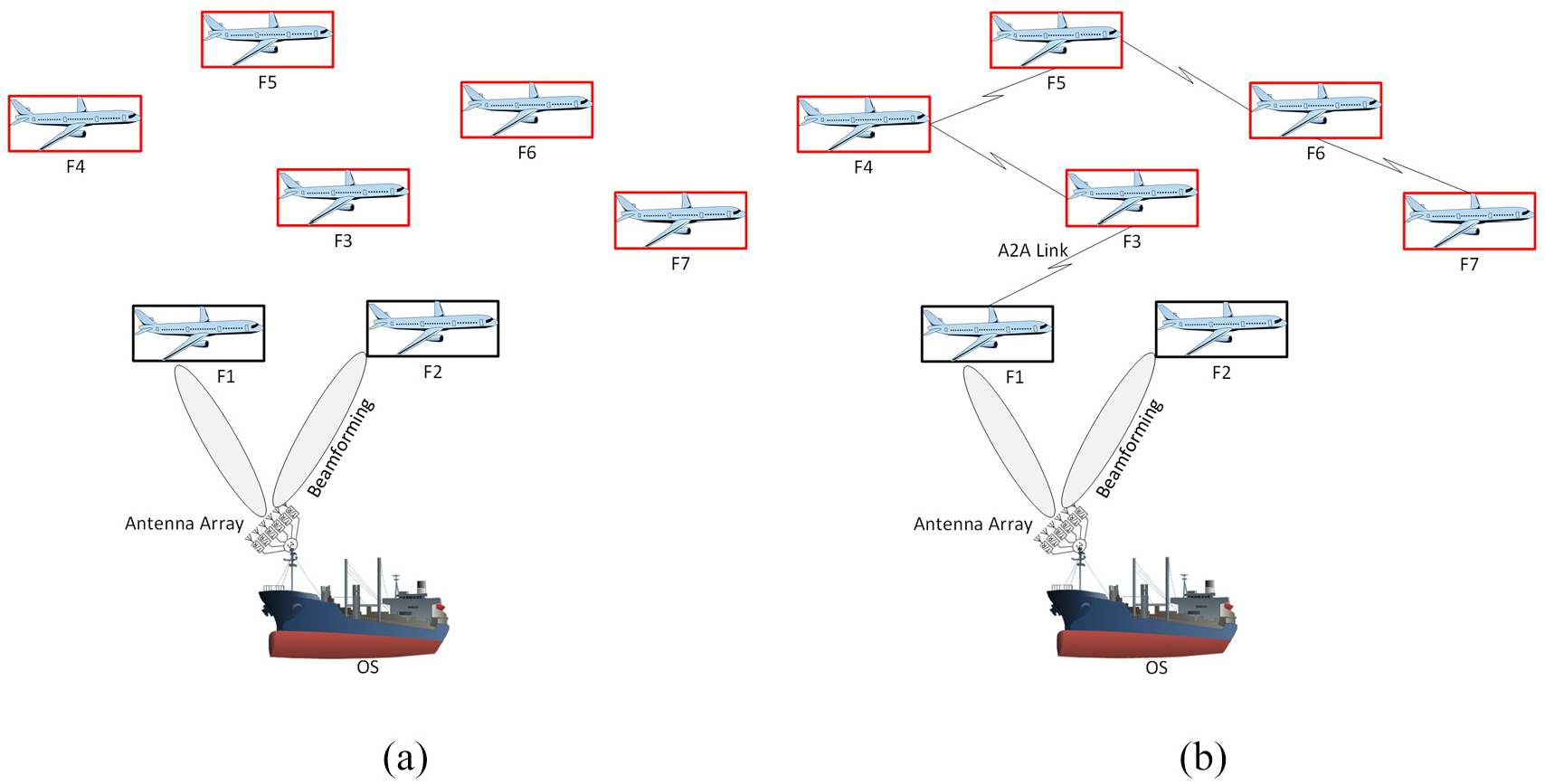
P2P and ad hoc-based models. (a) P2P-based airborne Internet approach and (b) aeronautical ad hoc-based approach.
Aeronautical ad hoc-based approach
In this approach, we are providing Internet to those aircraft that are outside the vicinity of the OS (i.e. ships). Figure 8 shows the scenario of aircraft topology in the air. The aircraft in the black rectangle is within the vicinity of at least one of the OSs. Whereas the aircraft in the red rectangle is outside the vicinity of any of the OSs. Therefore, it is not possible to provide Internet access directly from any of the OSs stationed in the sea.

Example scenario.
In the past, the only possible way to provide Internet connectivity was satellite-based Internet provision. However, we propose another novel scheme in which we take the benefit of an existing OS to provide high-speed Internet provision to those aircraft that are not in the direct range of OS. This not only reduces latency and improves the QoS but also a cost-effective way by avoiding expensive satellite link. Figure 9 shows the detailed architecture of the proposed methodology. We create the airborne ad hoc network. In the given example, aircraft F1 is directly connected to the OS. So, F1 acts as a gateway for the rest of the airborne ad hoc network. If a user from F5 requests for Internet content, then that request is sent to OS and in response, OS will forward the required content to the F5, by selecting the recent optimum route (conventionally the route with minimum path cost). In a simple scenario, the path cost is calculated through the number of hops. In the given example, the route is


Airborne Internet provision through UOFC.
In case there is the same number of hops from source to destination, then the proposed scheme will adopt the greedy approach and route the packets to the next hop having minimum physical distance. The distance is calculated by

where the first point is

where

where

In our proposed algorithm, the nodes are moving with great velocity; therefore, reliability is an issue. To increase the probability of successful packet delivery and avoiding packet loss due to unstable paths by high mobility, we proposed a reliable solution through efficient flooding. By efficient flooding, we mean that, instead of forwarding each packet to all neighboring nodes, our solution forwards the packet to one, two, or three neighboring nodes, that is, best, second-best and third-best neighbor. The decision of forwarding the packet redundantly is based upon the packet drop ratio


where
It is worth noting that the duplicate/redundant packet delivery is done only on the source node and not on intermediate nodes. This reduces the data traffic on the airborne ad hoc network while ensuring reliability. We suggest that efficient flooding can be made flexible by increasing the number of forwarding paths for redundant data transmission. The increase in the number of redundant paths is only suggested when the network stability is extremely low (i.e. the value of the packet drop ratio increased from some specific threshold). This procedure is explained in Algorithm 2.

We can explain the procedure of the proposed scheme through an example given in Figure 9. Let us suppose that a packet arrives at node m from the source j. Now proposed solution has to calculate the angular distance
We consider one GS located at the seashore, which acts as an Internet gateway. Also, we performed our evaluation on the areal route over the North Atlantic Corridor, along with UOFC deployment. We consider the angular distance along with the speed and trajectory of flying aircraft. We compare our work Airborne Ad-hoc Routing Algorithm (AARA) with the geographic forwarding approach (GLSR). To evaluate the performance of the AARA, detailed emulation experiments are conducted on our test-bed consisting of Universal Software Radio Peripheral (USRP). We use an approximation to get our evaluation results and verified those results through mathematical modeling and simulation and find resemblance in results that indicate the accuracy of the evaluation. We consider end-to-end delay and packet delivery ratio P dr as evaluation parameters.
Results and discussion
Figure 10(a) shows the behavior of the selected path from source to destination on the end-to-end delay. Due to different path selection through two different routing algorithms (i.e. AARA and GLSR), select two different paths from source (GS) to destination (D). In GLSR, destination D is selected on hop-by-hop basis. Whereas our proposed scheme involves an OS for data transmission from source to destination. Here, we selected D as destination where the path to reach D through GLSR is

whereas AARA selects the path

where FS denotes the flying station (flying aircraft). Due to more number of hopes, more delay incurs in GLSR. Whereas in AARA linked from GS to OS incurs fewer delay due to wired links in the beginning of route, and less number of hopes. Also, it is worth noted that wired link may be used for many OSs if an aircraft is flying far away from GS along the UOFC.

End-to-end delay comparison. (a) End-to-end delay for AARA and (b) end-to-end delay of GLSR.
Figure 10(b) shows that AARA has an end-to-end delay of less than 200 ms, whereas GLSR experiences more than 400 ms of delay. This indicates a significant improvement in terms of end-to-end delay.
We considered
As in aircraft networks, the node mobility is much higher than in any other scenario. Therefore, analyzing

Packet delivery ratio comparison. (a) Packet delivery ratio for AARA and (b) packet delivery ratio for GLSR.
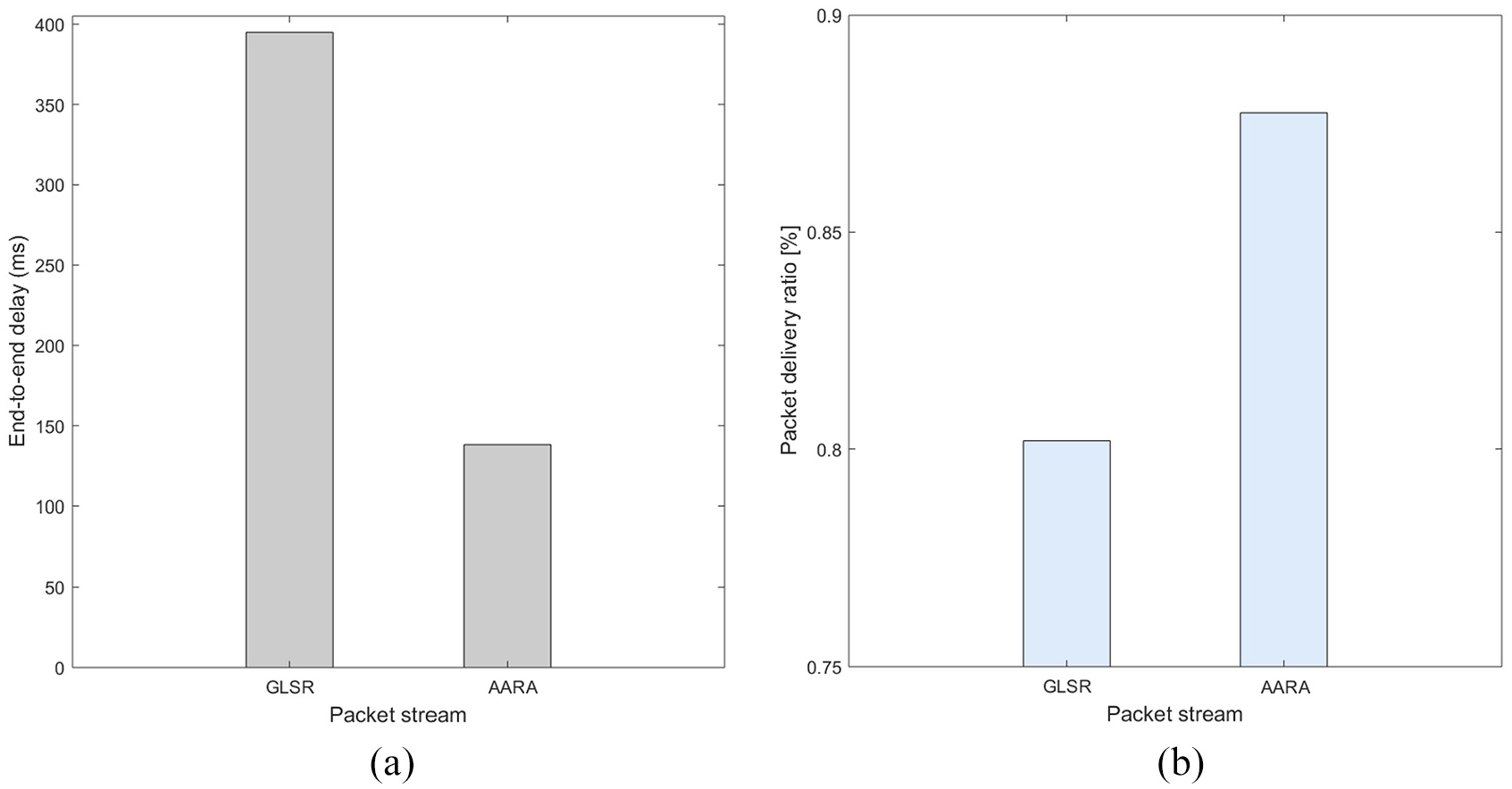
Overall E2E delay and packet delivery ratio. (a) End-to-end delay comparison and (b) Packet delivery ratio comparison.
Conclusion and future work
In this article, a synopsis of proposed research about the airborne Internet access infrastructure has been presented. The proposed infrastructure uses UOFCs for airborne Internet access. In the proposed approach, we intend to provide Internet to the aircraft flying across North Atlantic Ocean through G2A wireless links from the stationary OSs stationed along the UOFCs. A complete architecture has been proposed based on solid mathematical evidence. A survey on several solutions offering Internet services to the aircraft either through GSs or through satellites is also discussed in this article. This article has also discussed an analysis of the proposed networking infrastructure for its QoS provision and has presented a platform for its comparison with other existing airborne Internet access techniques. As shown in the results, our scheme has outperformed the existing solutions. However, this solution is presented for commercial aircraft, flying in a pre-specified direction. We recommend that further research should be undertaken for aircraft that are not flying in a specific trajectory. We hope our research will serve as a base for future studies on the Internet for flying things. Also, the proposed airborne Internet access strategy can be extended to include security of airplanes as well as remedial procedures in case of hijacking and terrorism.
Footnotes
Acknowledgements
The authors thank Mr Kazem Chamran, for assistance in experiments.
Handling Editor: Yanjiao Chen
Declaration of conflicting interests
The author(s) declared no potential conflicts of interest with respect to the research, authorship, and/or publication of this article.
Funding
The author(s) received no financial support for the research, authorship, and/or publication of this article.
