




Abstract
Due to the special characteristics of highway tunnels and vehicles, the interior of the tunnel is required to provide appropriate lighting to ensure the safety of driving vehicles, especially at the entrance section of the tunnel. At present, most of the tunnel entrance lighting control system only considers one single factor, the brightness outside the tunnel. However, in practice, the required lighting brightness in the tunnel is also related to traffic flow, speed, and other factors. Comprehensively utilizing these factors to improve the control strategy is urgently needed. To deal with this problem, this article has designed a multi-source information acquisition system for tunnel lighting based on the Internet of things technology, which combined with fuzzy control theory in order to develop an intelligent control system for LED lighting at the entrance section of the tunnel. The designed system was implemented and long-term tested in a real highway tunnel. The experimental results have shown that the system designed in this article can automatically control the brightness of the lighting inside the tunnel according to the real-time measurements of the brightness outside the tunnel, traffic flow, speed, and so on. Furthermore, the utilizations of the system can minimize the human and power consumption of tunnel lighting while ensuring the safety of tunnel traffic.
Introduction
With the rapid economic developments in recent years, China has become the world’s second largest economy in 2019. The rapid development of Chinese transportation industry is one of the key factors to promote the economy. In this context, the rapid development of economy and transportation has greatly promoted the rapid increments of highway construction in China. 1 According to the government reports, the total mileage of expressways in China has reached almost 142,600 km, ranking the first in the world. But at the same time, due to the complex terrains of China, a large number of mountainous and hilly expressways have appeared, which results in the necessity of constructing a large number of highway tunnels, especially in the western territory such as Chongqing, Sichuan, Shaanxi, and Gansu provinces.
Due to the particularity of highway tunnel and driving vehicles on highway, the tunnel interior must be able to provide appropriate lighting to ensure the traffic security and stability. According to the statistics, there is a high probability of traffic accidents in the expressway from the tunnel entrance section. 2 At the same time, the power and labor costs for the tunnel lighting also account for a large proportion of the highway management expense. 3 In many cases, these issues have resulted in the waste of transitional lighting and resources, as well as potential accidents. Therefore, in view of the above two problems, ensuring the lighting for driving safety and energy consumption reduction of tunnel lighting has become urgent problems.
The research on energy saving of tunnel lighting in developed countries started relatively early. At present, the energy-saving control technology of tunnel intelligent lighting in foreign countries has developed rapidly. The formulation of various criteria and specifications ensures the driving safety and energy saving, but it still needs to be developed further in the aspects of intelligent transportation and intelligent control.4,5 The main European and American developed countries have been far ahead in the field of the lighting control technology of highway tunnel as early as the 1960s. They have a large number of experts and scholars through long-term research studies and practices, and the technologies are relatively mature. Among these technologies, the most representative one is that the long tunnel lighting of Mont Blanc, which is between France and Italy, realizes the automatic dimming technology based on the brightness outside the tunnel. 6 In the late 1980s, in order to make the highway tunnel lighting more scientific, reasonable, and energy saving, countries around the world have developed their own national highway tunnel lighting design specifications and standards, such as the European tunnel lighting standards and tunnel lighting guide.7–9 After more than 10 years of development, the tunnel lighting control technology has a milestone turning point, transitioning from a simple artificial control mode to a fuzzy intelligent control network technology based on the factors of the tunnel environment, traffic flow, vehicle speed, and so on. 10 At present, some lighting enterprises and important research institutions in Europe begin to study communication protocol, network control, and intelligent lighting energy-saving products. At the same time, foreign countries have done a lot of research on improving lighting source and innovating lighting fixture. 11 For example, according to the driver’s visual characteristics and the visual environment in the tunnel, Germany has developed the calculation method of side wall, 12 Japan has proposed the maintenance coefficient of lamps and lanterns,13,14 and so on. Recently, the research group in Sapienza University of Rome has done a lot of work in this field. The researchers computed and compared the life cycle costs of two different road tunnel pavements and their corresponding lighting systems. 15 Also, they presented and validated a methodology to design transition structures.16,17 On the one hand, some western developed countries have made in-depth research on the appearance quality, optical characteristics, functional structure of lamps and lanterns, and have made breakthrough progress; on the other hand, some achievements have been made in the research of tunnel lighting, which is also a good reference for our study.
The research time of road tunnel lighting technology in China is relatively short. At present, lighting design criteria suitable for national conditions have been developed, but there is still a serious lack of fine and intelligent control of tunnel lighting, which is still to be developed in terms of low energy consumption and green traffic.18,19
Background
For the tunnel lighting equipment, most of the traditional domestic highway tunnel lighting uses high-pressure sodium lamp.20,21 Due to the technical limitations and long start-up time of sodium lamp, it is difficult to achieve stepless dimming of the tunnel. It mainly uses manual control or simple time sequence control mode. With the developments of electronic technology, LED lamps, as a new type of energy, have many advantages, such as long life, high luminous efficiency, low power consumption, short start-up time, and high color rendering index, low working temperature, low working voltage, and low ultraviolet radiation. They have already been applied in some lighting fields. 22 There is no doubt that LED lamps are the future direction of lighting development. At present, with the promotion and application of LED lights in the field of lighting, the automatic dimming control mode is also developed rapidly.23,24 This is a new control mode, which can realize the real-time dimming of LED lights. For example, according to the detected real-time environmental brightness value outside the tunnel, traffic flow, speed, and other factors, the LED lights can be continuously dimmed in a very short time, achieving the design requirements of highway tunnel lighting, and saving the power consumption of lighting. Therefore, it is necessary to study the corresponding automatic control technology and develop the corresponding automatic control equipment for LED lighting systems.
For LED lighting equipment, most of the current research studies and engineering realization only consider the influence of a single factor, and few of them design the equipment to collect the multi-source data such as vehicle speed, traffic flow and illumination, and control strategy and deploy them in the real tunnel, so as to realize the real energy saving. 25 Aiming at the urgent demands of intelligent lighting control in the entrance section of highway tunnel, this article integrates the latest research results of multi-sensor technology, electronic technology, and multi-source information fusion technology, and develops an automatic lighting control device for the entrance section of highway tunnel in Western China based on the fuzzy control theory. It should be noted that although the “detailed rules for lighting design of highway tunnels” regulate the reduction coefficient of tunnel brightness in entrance section, transition section, exit section, and tunnel, 1 there is still a lack of strict definition, which makes it difficult to strictly implement the current digital system and greatly weaken its strong control advantages. Therefore, the control system based on the Internet of things and fuzzy control theory designed in this article is very suitable.
System design and methods
Lighting design requirements of highway tunnel
According to “Guidelines for Design of Lighting of Highway Tunnels,” highway tunnels longer than 100 m can be divided into entrance section, transition section, middle section, exit section, and so on. 1 Different entrance sections have specific lighting requirements. Two entrance sections are shown in Figure 1, having the strictest lighting requirements.

Entrance sections 1 and 2.
In the tunnel lighting system segment shown in Figure 1, the lighting of the entrance segment is particularly important. The entrance section can be divided into two lighting sections denoted by th1 and th2 as design required. The corresponding lighting brightness in the tunnel can be calculated according to the following formula


where
The value of brightness reduction coefficient of entrance section.

If the traffic flow is in the middle, the value is determined by linear interpolation.
System design
According to the lighting requirements of the tunnel entrance section provided in the previous section, the system design in this article is mainly composed of two parts: the data acquisition and transmission system based on the Internet of things and the embedded control system based on fuzzy control theory. The specific descriptions are as follows.
First, according to the design requirements, multi-source data acquisition and transmission system based on the Internet of things is designed. The main factors, including the brightness outside the tunnel, traffic volume, and speed, are real-time monitored. For the brightness outside the tunnel, multiple light sensors are arranged averagely in the space outside the tunnel. For the traffic flow and speed, this article adopts the 77-GHz radar module produced by TI Company. The module is integrated with real-time digital signal processor (DSP), which can be used for on-chip fast processing. All the monitoring results are transmitted to the main device controller through the gateway node.
The second part is the embedded control system based on fuzzy control. The intelligent control system first processes the signals collected by each sensor node to get the estimated values of brightness, traffic flow, and vehicle speed outside the tunnel, and then the input data are fuzzed based on the basic principle of fuzzy control. Second, the fuzzy inference of fuzzy data is completed through rule table. Third, the brightness control signals of the entrance segments 1 and 2 are obtained by de fuzzing. Finally, combined with LED lighting device driver, the real-time dimming of LED light and energy saving are realized on the basis of meeting the luminance design requirements.
Method
The input of fuzzy control is the brightness of the environment outside the tunnel, the traffic flow, and the speed of the vehicle, and the fuzzy output is the brightness inside the tunnel. In this article, the input parameters are quantized at 256 levels, and the corresponding domain is obtained. In practical application, the relationship between the brightness of tunnel lighting and the brightness outside the tunnel can be calculated by equations (1) and (2), but the value of

where
According to Table 1, for both of one-way and two-way traffic, we fit the linear relationship between the two influencing factors of vehicle flow and speed through linear interpolation, and the fitting relationship is shown in Figure 2. It should be noted that there is a small part of

Linear relationship of
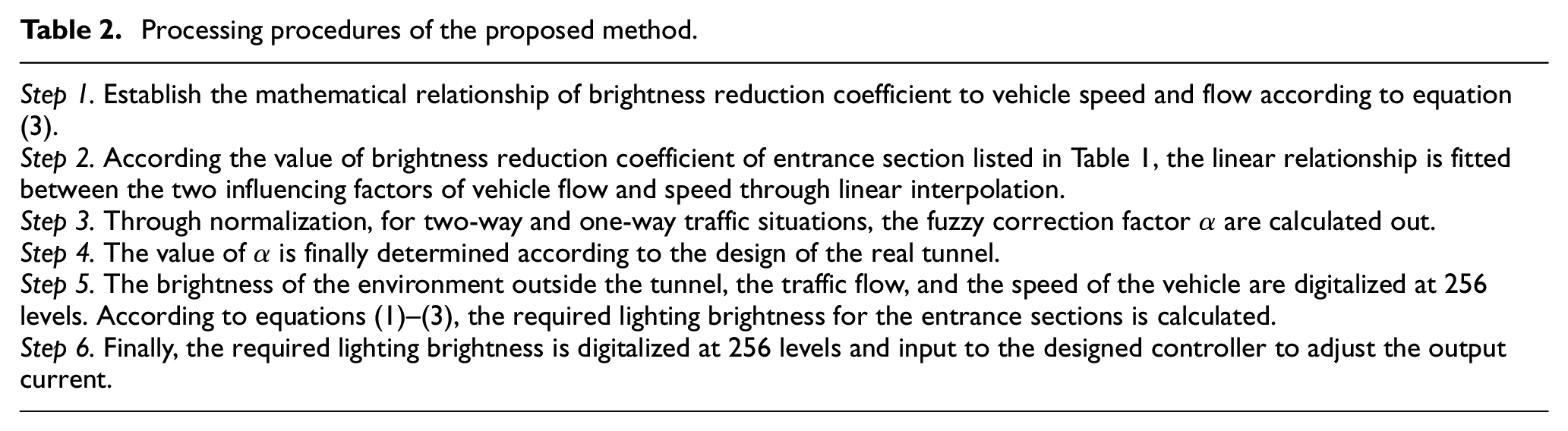
Finally, according equations (1)–(3), a fuzzy control rule table for brightness control with three variables (i.e. the ambient luminance outside the tunnel entrance, vehicle flow, and velocity) can be obtained. The fuzzy control table can be stored in the fuzzy control system in advance. After the control system receives the information collected by the external sensors, it can be quantified. Then, the table can be searched to obtain the required brightness level, thus generating the corresponding brightness control signals. The brightness signals control the intensity of the output current to achieve the purpose of controlling LED lighting brightness. The detailed processing procedures of the proposed method are listed in Table 2.
Processing procedures of the proposed method.
Experiments and results
Experimental site
The LED lighting intelligent control system designed in this article was arranged, tested, and implemented in Shigushan Tunnel of Weinan to Yushan expressway from October to December 2019. The starting point of Weinan–Yushan expressway is from Weinan to Pucheng expressway, and a hub interchange with Lianhuo expressway. The location of the experimental site with the terrain map is shown in Figure 3. The total length of the route is 39.5 km, and the designed speed is 100 km/h. The total length of Shigushan Tunnel is 2571 m. It adopts a two-way four-lane design. The tunnel crosses the low mountainous area on the northern foot of Qinling Mountains and Loess Hilly Region, and passes through three geological fault zones. The scene of Shigushan Tunnel is shown in Figure 4.

Location map of the experimental site.

Shigushan Tunnel: (a) darkest level, (b) intermediate level, and (c) brightest level.
Comparison and analysis of light intensity
In the experiment, the lighting conditions of the tunnel on 1 November and 5 December in 2019 are selected for comparison and analysis. The brightness curves outside the tunnel and the entrance section on 1 November and 5 December are shown in Figure 5. From the black lines in Figure 5, it can be seen that the changing time of light is about 7:00 and 19:00. The lighting luminance is nearly zero between 7:00 pm and 7:00 am. During the day, the intensity of the brightness outside the tunnel gradually increases and then decreases, and due to the influence of many factors such as weather conditions and clouds, the change appears random. Furthermore, comparing the brightness outside the tunnel and the entrance section in Figure 5 (i.e. red lines), respectively, it can be seen that as the brightness outside the tunnel increases, the brightness of the tunnel lighting at the entrance section gradually increases, vice versa. This result proves that the system can work well and meet the design requirements.

Brightness curves on 1 November and 5 December in 2019: (a) 1 November in 2019 and (b) 5 December in 2019.
At the same time, Figure 6 shows the changes in daytime traffic flow during the two test periods. It can be seen that the daytime traffic flow is more random, but the overall trend is gradually increasing in the morning and gradually decreasing in the afternoon and generally it is a smaller value at noon. These laws can be well found in the brightness of the tunnel entrance section shown in Figure 5. Obviously, due to the low traffic volume at noon, the lighting intensity of the entrance section is greatly reduced, which also meets the tunnel lighting specifications. It should be noted that in the preliminary testing stage of the equipment, the speed of the car is controlled through the tunnel. In this case, the brightness change is really affected by the speed. However, in the actual experiments, the traffic flow of the experimental tunnel is relatively small and all the vehicles are uncontrollable. Consequently, the range of vehicle speed change through the tunnel is not so large, and the effects of vehicle speed on brightness are not very significant.

Vehicle flow on the two experimental days: (a) 1 November in 2019 and (b) 5 December in 2019.
Comparison and analysis of electricity consumption costs
In order to test the long-term energy-saving performances, this article also built a remote power consumption monitoring system based on high-precision single-phase network meters (0.5% accuracy) and Data Terminal Unit (DTU) equipment. This system is equipped with dedicated data acquisition software and processing and analysis software, which is shown in Figure 7.

Schematic diagram of electrical energy test system.
For better comparison, two network electric meters are used to monitor the power consumption of a controlled LED lamp and a constantly lit LED lamp in the same power supply circuit. The RS485 bus is used to connect the meter and the DTU equipment. The type number of the meter is SDM640, with a range of 5 A, which supports the Modbus-RTU (remote terminal unit) protocol. It is fixed in the distribution box and mounted on the top of the tunnel using a rail mounted. After the DTU is waterproofed, it is fixed with the communication antenna outside the tunnel exit. The measure is transmitted to the background server through DTU and general packet radio service (GPRS) network. Figure 8 is the installation photo of Shigushan Tunnel.

Photo of electricity remote monitoring system.
For better comparison, the remote power monitoring equipment developed is used to monitor the power consumption of two LED lights at the same time, including the testing LED and baseline LED. Figure 9 shows the power consumption of the two LED lights for 70 consecutive days, where Figure 9(a) is the cumulative power consumption and Figure 9(b) provides the daily power consumption. It can be seen that for the baseline LED, its power consumption basically shows a linear increase trend, that is, the daily power consumption remains basically the same. Of course, the voltage instability will cause a small fluctuation. As a consequence, cumulative power consumption has been rising linearly. For testing LED, its cumulative power consumption has also been increasing, but its change is obviously non-linear, and it has greatly decreased compared to the baseline LED. Furthermore, Figure 9(b) shows that for the baseline LED, the daily electric energy usage is basically a constant value. Because of the daily weather conditions, traffic flow and vehicle speed are vary, the daily consumption of the testing LED has no obvious patterns, showing certain randomness. From the comparison of these two figures combined with the conclusion of the previous section, the experimental results show that the intelligent controller designed in this article can ensure that the power consumption is greatly reduced based on the safety lighting.

Power consumption of the two LED lights: (a) cumulative power consumption and (b) daily power consumption.
The equipment was installed and implemented from 3 October 2019 to 23 December 2019, and it can be concluded that the average daily power consumption of the controlled lamp is about 1.9 kW h, which is 53.0% less than that of the control lamp. After the real application in the entrance sections of the tunnel, the annual electricity cost can be saved about RMB 600 thousand. Meanwhile, according to the actual conditions of the experimental tunnel, the cost of the equipment installation is about RMB 600–800 thousand, that is, the cost for the equipment is about 1-year electricity cost saving, which has obvious energy-saving and emission reduction effects.
Conclusion and future work
In recent years, the rapid development of digital systems and LED lighting technology has provided a great technical foundation for the intelligent control of highway tunnel lighting, but most of the existing research studies and engineering implementations consider only one of the influencing factors. This article adopts the Internet of things technology to collect real-time tunnel information from multiple sources, and applies fuzzy control theory to the lighting control of the tunnel entrance section. An automatic control model of the tunnel entrance section is designed in accordance with the specifications, and deployed in Shigushan tunnel entrance section for long-term testing. The experimental results show that the system designed in this article can save electricity and human resources to a large extent, and reduce the accident rate and operating cost of tunnel management, meanwhile ensuring the safety of highway traffic. Further testing and wider application of this system is our future work.
Footnotes
Handling Editor: Rodolfo Meneguette
Declaration of conflicting interests
The author(s) declared no potential conflicts of interest with respect to the research, authorship, and/or publication of this article.
Funding
The author(s) disclosed receipt of the following financial support for the research, authorship, and/or publication of this article: This research was sponsored by the Industrial Fields Project of Science and Technology Department of Shaanxi Province (2019GY-105), National Innovation and Entrepreneurship Projects (201910702050), National-Local Joint Engineering Laboratory of Advanced Network and Monitoring Control (GSYSJ2020001).
