




Abstract
To support urban sustainable development, cities need innovative green logistics solutions to meet the needs of economic development. Crowdshipping is regarded as a promising sustainable freight solution. This article aims to assess the feasibility of implementing intercity express crowdshipping using private vehicle traveling. The crowdshipping carrier, who drives his or her private vehicle and travels on the intercity route, carries out the express delivery task between the regional cargo center and the dispatch center along the route. The feasibility assessment covers three parts. First, face-to-face interview and stated preference survey are used to investigate the willingness and preferences of express companies and car owners to participate in crowdshipping activities, respectively. Then, it calculates the environmental benefit and economic benefit brought by the crowdshipping mode in comparison with the traditional mode. The results show that the express companies are willing to pay 30 yuan for each car participating in the crowdshipping activities, and there are considerable numbers of car owners to support this crowdshipping activity, and this crowdshipping activity could bring positive impacts on environment as well as corporate economics. It is hoped that the research could enrich the knowledge of the development of green logistics.
Introduction
With the rapid development of urbanization and e-commerce, the volume of express delivery has grown significantly, and the express delivery industry has become one of the most dynamic emerging industries in the modern service sector. In 2018, the business volume of express delivery companies in China has accumulated to 50.71 billion pieces, up to 26.6% over 2017. The accumulated business revenue totaled 603.84 billion yuan, up to 21.8% year-on-year. Among them, the intracity business volume reached 11.41 billion pieces, up to 23.1% year-on-year, while the intercity business volume accumulated to 38.19 billion pieces, up to 27.5% year-on-year. Again in 2018, the proportion of express business in the eastern, central, and western regions possesses 79.9%, 12.3%, and 7.8%, respectively. 1
The rapid growth of express delivery business also brings more challenges to express solutions. In order to promote the healthy development of the express industry, the government has started to study and formulate relevant laws, regulations, policies, and plans. They encourage intensive service at the last mile of express delivery, encourage express delivery companies to cooperate in delivery services, and carry out joint collection and delivery. Companies are encouraged to comprehensively take advantage of such information as e-commerce transactions and logistics distribution to optimize scheduling and increase vehicle space utilization and reduce travel time. In the “13th five-year plan” for express delivery development in the Yangtze river delta region, the development of sharing economy is clearly promoted, and the idle transport equipment, storage resources, technical equipment, and other resources are encouraged to be integrated among express delivery companies to ensure efficient and orderly delivery services.2–4
At present, the research in the field of express delivery mainly focuses on the construction of express network, the last mile delivery of express delivery, the recycling and utilization of packaging materials, and other issues. However, in reality, considering the economy and timeliness of express delivery, there exist unreasonable phenomena of roundabout transportation and repetitive transportation during express delivery which causes serious inefficiency. Taking the express delivery between Huai’an city and Baoying county as an example. Baoying dispatch center (DC) is in charge of the parcels flowing into Baoying county. But as it belongs to the lower level node of Yangzhou regional cargo center (RCC), the parcels sent by Huai’an city to Baoying county must first be gathered in Huai’an RCC and then transported to Yangzhou RCC, and then returned to the Baoying DC from the Yangzhou RCC along the original route. And the total journey causes 259 km extra, which is 5.3 times longer than the shortest path directly from Huai’an RCC to Baoying DC. In addition, the express delivery in the Yangzhou RCC carries out again loading/unloading and sorting activities. These inefficient practices have become one of the difficulties in optimizing the operation of express companies.
Crowdshipping (or crowdsourcing) is viewed as one of the most promising solutions to the roundabout transportation and repetitive transportation of express delivery; it combines social idle capacity with express delivery needs. 5 This kind of business mode adapts to the sharing economy and conforms to the national development policy and planning requirements. It indicates that the utilization of social idle capacity can be maximized with the help of modern information and communication technology.
The crowdshipping activities to be studied in this article are based on carriers with extra capacity, crowdshipping platforms, and shippers. To be specific, the shipper posts its delivery demand through the crowdshipping platform, and the carrier detects and completes the transportation task that matches its original planned travel route through the crowdshipping platform. In this case, the shipper refers to the express delivery company, the crowdshipping platform is the market platform based on information technology, and the carrier refers to individual travelers who use the intercity highway network for other motives, and/or their private vehicles which have some spare space to accommodate the cargo.
In fact, the express transfer activity with the help of the carrier’s traveling motivation (such as relative and/or friend visit) completes the express transfer, almost without any additional transportation. Hence, it can reduce the transportation activities of the express delivery company; it is also one of the ways to reduce environmental pollution. The express transfer activity also indicates that the number and distance of express delivery through logistics nodes are reduced and the delivery cycle is shortened. Social transportation resources could be better utilized, and the social logistics costs will decrease. In fact, planning urban freight activities along highways can stimulate the development of sustainable logistics. 6
We assume that (1) the crowdshipping activities are first supported by the shipper and the carrier, that is, the express company and the car owner; (2) the express company is willing to give up the use of the company’s vehicles to complete the transportation of parcels between the RCC and the DC; and (3) there are enough cars to undertake the transportation tasks of these parcels. Under such circumstances, the crowdshipping activities could be carried out and then bring impacts on the economy and the environment.
Therefore, this article first discusses the willingness of shippers and carriers to participate in the crowdshipping activities in order to ensure that the conditions of implementing crowdshipping transfer are in place and then evaluates the potential impacts of the crowdshipping activities on environment and corporate economy so as to strengthen the feasibility of carrying out crowdshipping activities. The major research objectives of the article include the following: (1) to investigate the willingness of express companies and potential crowdshipping carriers to participate in crowdshipping activities, by surveying the transportation needs of express companies and the transportation capacity of potential crowdshipping carriers, and to determine the basics of implementation of this crowdshipping activity; (2) to evaluate the potential environmental impact of crowdshipping activities by comparing with traditional express delivery activities; and (3) to evaluate the potential economic benefits of using crowdshipping activities by comparing with traditional express delivery activities.
The contributions of the study are twofold. First, it enriches the researches on the intercity express crowdshipping mode based on Chinese logistics practice; second, it also provides reference for the development of the express transfer crowdshipping activity.
Literature review
In reality, crowdshipping has been in the process of continuous development and change. Some schemes of crowdshipping are still in the experimental stage and lack of unified operation norms and operation data, which is challenging for its research. 7 Most of the research on crowdshipping focuses on the downstream “last mile” service,5–19 and there are few studies on the intermediate links of express delivery.
The concept of crowd logistics
Arvidsson proposed a “co-transportation” mode that shared passenger and freight resources and attempted to solve the delivery problem of the last mile in this way, which was generally realized by crowd logistics. 8 In the studies of some scholars, crowd logistics is also known as collaborative logistics, 9 crowdshipping, 10 cargo hitching, 11 and crowdsourced delivery. 12 Carbone et al. 7 pointed out that crowd logistics was taking different forms to participate in logistics activities, which has become a global phenomenon.
Buldeo et al.
13
made a specific definition of crowd logistics. He proposed the crowd logistics as an information connectivity enabled marketplace concept, that matches supply and demand for logistics services with an undefined and external crowd that has free capacity with regards to time and/or space, participates on a voluntary basis and is compensated accordingly.
Some scholars believe that most crowdshipping projects that started from the United States, 12 mainly cover warehousing, local delivery, freight shipping, and shipping agencies in logistics activities. 7
Willingness and stated preference of potential carriers and shippers in crowdshipping
Some researchers studied the willingness and preferences of potential crowdshipping carriers. Marcucci et al. 16 conducted a survey in Rome (Italy), and the results showed that 87% of students said that they would be willing to act as crowdshipping carriers if they got a proper payment. Devari et al. 17 surveyed in Alexandria (USA) and found that 72% of respondents agreed to implement the shipment. It can be seen from the above surveys that there exists considerable willingness of crowdshipping participation especially when reasonable payment is provided.
Moreover, some researchers studied the shippers’ wishes and preferences. Mladenow et al. 20 found that for retail enterprises, they were willing to combine offline consumers’ travel with the enterprise’s plan to deliver goods in this way, so as to reduce the transportation tasks for special delivery. Some researchers believed that well-planned crowdshipping could deliver goods faster and cheaper than commercial express companies when the traveler could transport goods in a timely manner and the traveler’s travel plan was consistent with the cargo transport plan. 21 However, some researchers also found that unplanned crowdshipping activities would lead to more pollution and higher costs, and the uncertainty of the delivery time of parcel would easily cause customer dissatisfaction. 16 Therefore, it indicates that to effectively implement crowdshipping activities, planning shall be well performed in advance.
Vehicle emission
Logistics depends on transportation which generates air pollution. In order to facilitate the acquisition of vehicle emission factors, some researchers have made some attempts. Previous studies have shown that factors such as fuel, traffic conditions, road gradients, and engine performance have an impact on vehicle fuel consumption and emissions.22–26 Zhang et al. 27 established a multiple regression model that calculated CO2 emissions considering initial vehicle speed, circular curve length, and roadway segment radius, and they used the field experiment to verify that the Motor Vehicle Emission Simulator (MOVES) model is valid. In addition to the MOVES model, various models have been currently used to estimate vehicle emission factors such as Comprehensive Modal Emissions Model (CMEM), Mobile Source Emission Factor Model (MOBILE), Emission Factor (EMFAC), International Vehicle Emission Model (IVE), and Computer Programme to Calculate Emissions from Road Transport (COPERT) models.28–30 The COPERT model developed by the European Environment Agency (EEA) also takes into account the above factors; it is widely used in Europe. The calculated emissions include CO, NOX, PM2.5, and CO2. Alam et al. 29 used the COPERT model to assess the impact of Irish emission reduction policies on greenhouse gas emissions. Quaassdorff et al. 31 used the COPERT model to predict Madrid’s emission.
China also uses COPERT’s European road transport emission inventory to estimate vehicle emissions, which is because China uses technology from Europe to make cars and the emission regulations are consistent with Europe. 32 Previous studies have also shown that the COPERT model can be used to estimate emissions from Chinese vehicles, and the COPERT is also favored by Chinese researchers and institutions.33,34 In addition, Buldeo et al. 13 compared the impact of crowdshipping and professional delivery (using vehicles of express companies) on the society and found that uncontrollable crowdshipping activities would lead to the phenomenon of higher emissions from special vehicle delivery. Therefore, the above-mentioned COPERT model will also be used to test the emission characteristics of the crowdsourcing scheme proposed in this article.
Cost analysis
In the field of capital budgeting, there are many ways to evaluate the economic efficiency of projects. Gdowska et al. 18 introduced an agent-oriented approach to simplify the problems in studying the carrier to complete the delivery task of the last mile. They provided a way to calculate the total cost of delivery in crowdshipping mode, as well as the cost of delivery by vehicles of express companies.
Wu et al. 35 used the net present value (NPV) to analyze the economic benefits of mainstream solutions and alternatives and provided a basis for decision-making. Naveen et al. first estimated input costs, crop yields, and crop prices and then performed financial analysis of irrigation using surge valves by calculating annual cash flows and NPV. The positive estimates for NPV promoted implementation of irrigation efficiency improvement work. 36
Magni37,38 analyzed the capital-weighted mean of holding period rates and based on this proposed a more general concept of rate of return, which is called the average internal rate of return (AIRR). The AIRR method uses the means of a weighted arithmetic mean to associate the returns in each period with the corresponding period capital amounts invested. Magni’s37,38 research indicated that the effects of using AIRR and NPV were the same, that is, any decision made by an investor using NPV was the same as a decision made by an investor using AIRR. As NPV is considered to be the most reliable tool in theory,39–41 this study will also use NPV as an indicator to predict the potential economic benefits of carrying out crowdshipping program.
Methods
To achieve the above-mentioned research objectives, the study first employs the face-to-face interview method and stated preference (SP) method for investigating the willingness of express companies and car owners to participate in crowdshipping activities. Then, it applies the COPERT model for calculating vehicle emissions. And finally, the NPV method for calculating the economic benefits of companies is explained in details.
To facilitate a better understanding of the proposed crowdshipping mode, Figure 1 depicts the traditional parcel delivery route and the intercity car travel route between City A and City B; and the original planned travel route of the car traveler passes near points A and B1.
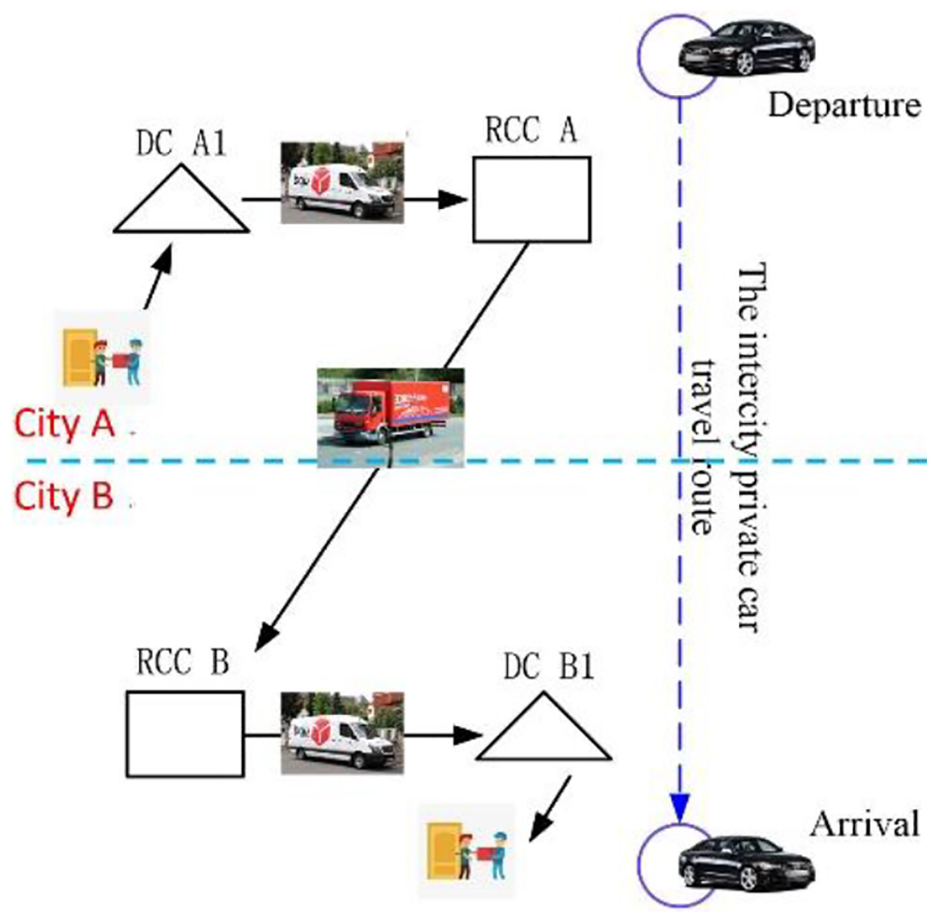
Traditional parcel delivery route of express company and the intercity private car travel route.
As can be seen in Figure 1, the courier in City A receives the parcel from the sender and brings it to the DC A1, which then uses light commercial vehicles (LCVs) to transport parcels to the RCC A. Then, the RCC A uses heavy-duty trucks (HDTs) to deliver parcels to the RCC B where the recipient in City B is located, and then the RCC B delivers parcels to the DC B1 near the recipient, and finally the courier brings the parcel to the recipient. To note: RCC collects the parcels of all DCs within its service area and also receives parcels from other RCCs. Parcels in RCC need to be sorted before being sent to other RCCs or DCs.42–47
This traditional process, although guarantees the timeliness and economy of express delivery, generates serious inefficiencies through repeated transportation, repeated loading and unloading, and repeated sorting activities in delivering parcels between the RCC and the dispatch points in neighboring cities. Hence, the study proposes a crowdshipping scheme to efficiently complete the parcel transportation task between the RCC and the delivery point in the neighboring city.
The parcel delivery route with crowdshipping activity is shown in Figure 2. The car travelers participating in the crowdshipping activity only complete the task of transporting the parcels from the RCC A to the DC B1. The RCC has sorting equipment that can sort parcels by destination DC. The parcel delivery activities in other links are still completed by the express company’s courier and vehicle.

Parcel delivery route with crowdshipping activity.
Survey methods
There are two types of survey objects: the senior manager of the express company, and the private car owner. As currently the crowdshipping activity based on intercity car travel has not been practiced, we introduced and explained the crowdshipping activities as described above to the respondents before the formal survey. Face-to-face interviews were conducted with senior managers of express delivery companies to understand their attitudes of participating in crowdshipping activities.
In January, 2019, the researchers visited six express companies in Huai’an city, Jiangsu province, China, inclusive of Shen Tong (ST), Yuan Tong (YT), Zhong Tong (ZT), Yun Da (YD), Shun Feng (SF), and Express Mail Service (EMS),42–47 whose business volumes together accounted for 80% of the business volume in the region in 2018. 48 We interviewed their senior managers, introduced the idea of crowdshipping activities, and investigated their willingness of transforming the intercity express transportation activities that were completed by their own vehicles into crowdshipping activities. During the interview, we also learned about the company’s vehicle information and operating costs. The profile of the interviewees is shown in Table 1.
Profile of interviewees.

ST: Shen Tong; YT: Yuan Tong; ZT: Zhong Tong; YD: Yun Da; SF: Shun Feng; EMS: Express Mail Service.
The SP methods were employed to understand the attitudes of car owners toward crowdshipping activities. SP surveys are widely used in the field of transportation, assessing the impact of shippers’ and carriers’ behavioral preferences when introducing new cargo systems, 49 travelers’ acceptance of car-sharing systems, 50 and the impact of observable variables and unobservable potential variables on the acceptance of new policies. 19
From January to May 2019, we assessed the attitudes of car owners to participate in this crowdshipping activity through SP survey. SP survey was chosen since it is perfectly suitable for investigating individuals’ perceptions, acceptance, and reactions toward hypothetical conditions not present in the market. 5 The drafted SP questionnaire were first pilot tested with 20 select car owners, which generated certain suggestions for revision after initial test. The revised questionnaire was constructed through www.wjx.cn which creates a link for questionnaire answering. The link was forwarded through various community social networks (i.e. QQ/WeChat, etc.) to 1000 targeted respondents for formal survey and 356 were returned, out of which 289 valid questionnaires were utilized. And this generated the response rate of 35.6%, which is higher than the acceptable minimum level of 18.9% in most social research. 51
The profile of respondents is displayed in Table 2, where women accounted for 61.6%. The proportion of young people participating in the questionnaire is relatively high; the company’s staff accounted for 34.6%; the proportion of respondents with junior college or bachelor’s degree was 72.3%; and households with an annual income of 110,000–200,000 yuan accounted for 48.8% of the total sample.
Profile of respondents.

Emission calculation method
COPERT, recommended by the United Nations Framework Convention on Climate Change (UNFCCC), 52 is the EU standard vehicle emissions calculator. It is applicable to all relevant research, scientific, and academic applications. The development of COPERT is coordinated by the EEA in the framework of the activities of the European Topic Centre on Air Pollution and Climate Change Mitigation. It uses vehicle population, mileage, speed, and other data such as ambient temperature and calculates emissions and energy consumption for a specific country or region. 53
In this article, the European road transport emission inventory model 54 of COPERT 5.2.2 was used to estimate the air pollutants emitted by freight vehicles of express companies and crowdshipping cars and to compare the environmental impacts of express transport between them. Vehicle emissions include CO, NOX, PM2.5, and CO2. In COPERT, vehicle i’s emissions are calculated as the sum of the three contributors.

where Ehot,i denotes hot emissions, generated by the engine at operating temperature; Ecold,i refers to cold emissions, generated during the engine warm-up phase; and Evap,i denotes evaporative emissions, composed exclusively by non-methane volatile organic compound (NMVOC). Most evaporative emissions of VOCs emanate from the fuel systems (tanks, injection systems, and fuel lines) of petrol vehicles. Evaporative emissions from diesel vehicles are considered to be negligible due to the presence of heavier hydrocarbons and the relatively low vapor pressure of diesel fuel and can be neglected in calculations. For gasoline vehicles with fuel injection and returnless fuel systems, the fuel temperature in the tank is not affected by engine operation, and thus no additional fuel vapor is generated in the tank. 55 Therefore, the evaporative emissions of these gasoline vehicles in operation are also negligible. In this article, Ehot,i and Ecold,i are used to compare the amount of air pollution emissions from freight vehicles of express companies and crowdshipping cars.
The following parameters are required for COPERT method to calculate vehicle emissions: vehicle fleet composition, vehicle categories and emission standards, vehicle speed, kilometers traveled for each year and the cumulative value of the kilometers traveled during the lifetime, the ambient temperature ta (for practical reasons, the average monthly temperature can be used), and the average trip length ltrip, where ltrip is the mean trip distance in km, for example, traveling between office and home with an intermediate stop to buy grocery. The first trip is between office (key-on) and the grocery store (key-off). The second trip is between the store (second key-on) and home (second key-off).56,57
First, one needs to check whether the mileage fraction driven under thermally non-stabilized engine conditions (β-parameter) exceeds the mileage share attributed to urban conditions (SURBAN). For each vehicle category j and pollutant i, the calculation takes the form. 54 This article studies the express crowdshipping activities based on intercity car travel. In these activities, the extra distance driven by the car is between the planned road and the RCC in the urban area or the urban express DC. So the mileage share attributed to urban conditions (SURBAN) has a value of 1.
Then


where βi,k is the fraction of mileage driven with a cold engine or the catalyst operated below the light-off temperature for pollutant i and vehicle technology k, Nk is the number of vehicles (veh) of technology k in circulation, Mk is the total mileage per vehicle (km/veh) in vehicle technology k, SURBAN;k is the mileage share attributed to urban conditions for vehicle technology k, and eHOT URBAN;i,k is the urban hot emission factor for pollutant i by vehicle technology k.
The calculation method of β-parameter is shown in the following formula, where ta is the monthly average temperature of the city

The value of eHOT URBAN;i,k refers to the emission calculation method published by the EEA. 54 The method of calculating e COLD /e HOT is shown in Table 3.
Over-emission ratios e COLD /e HOT for Euro 1 and later petrol vehicles (V: speed in km/h, ta: temperature in °C).

According to the above formula, the CO, NOX, and PM2.5 emissions of passenger cars, LCVs, and HDTs can be calculated. CO2 emission is based on the total annual fuel consumption of the vehicle category. Emissions of ultimate CO2 originate from three sources: combustion of fuel, combustion of lubricant oil, and addition of carbon-containing additives in the exhaust. 54
Economic benefit analysis
Finally, we analyze the cost and benefit of the traditional parcel delivery and the proposed crowdshipping mode. Cost–benefit analysis (CBA) is a method to evaluate the project value by comparing the total cost and benefit of the project. This article uses the NPV method of Ricardo-AEA 58 and Litman 59 to accomplish this task.
NPV is a comprehensive index reflecting CBA results. The NPV method uses the difference between the total present value of the net cash benefit amount and the net cash investment amount to calculate the net income and then evaluates the investment plan according to the size of the net income. If the NPV is positive, the investment plan is acceptable. If the NPV is negative, the investment option is unacceptable. The higher the NPV, the better the investment plan.

where NPVi is the total net income generated by project i, t is the t-year after the project is put into use, bi(t) is the income generated by project i in year t, ci(t) is the cost of project i in year t; 1/(1 + r) represents the discount factor when the discount rate is r, n is the life cycle of the project i, and ki is the initial input capital for project i. In this study, the discount rate is 4.5%, referring to the Bank of China’s lending rate. 60
Data and results
Willingness and preferences for crowdshipping participation
The findings from the face-to-face interview with the six express companies show that (1) the crowdshipping activity might be an innovative green logistics solution; (2) if the cost of express delivery completed by crowdshipping is lower than the current cost of the corresponding link, and if there are enough cars to ensure the task to be completed, they are willing to participate in these crowdshipping activities; and (3) based on their calculation, when the crowdshipping carrier helps the express company to complete the transportation of 0.4 m3 of goods between adjacent cities, the express company is willing to pay the carrier 30 yuan.
Correspondingly, from the survey questionnaire responded by car owners, it shows that under the conditions of (1) carrying 0.4 m3 of goods per vehicle, (2) the crowdshipping carrier earns 30 yuan per trip, and (3) the activity is beneficial to environmental protection, 83.7% of the respondents are willing to participate in this crowdshipping activity (see Figure 3). It is also found that about 85.1% respondents (see Figure 4) are concerned about environmental protection, which may be resulted from the fact that environmental protection has become a hot topic in current life.
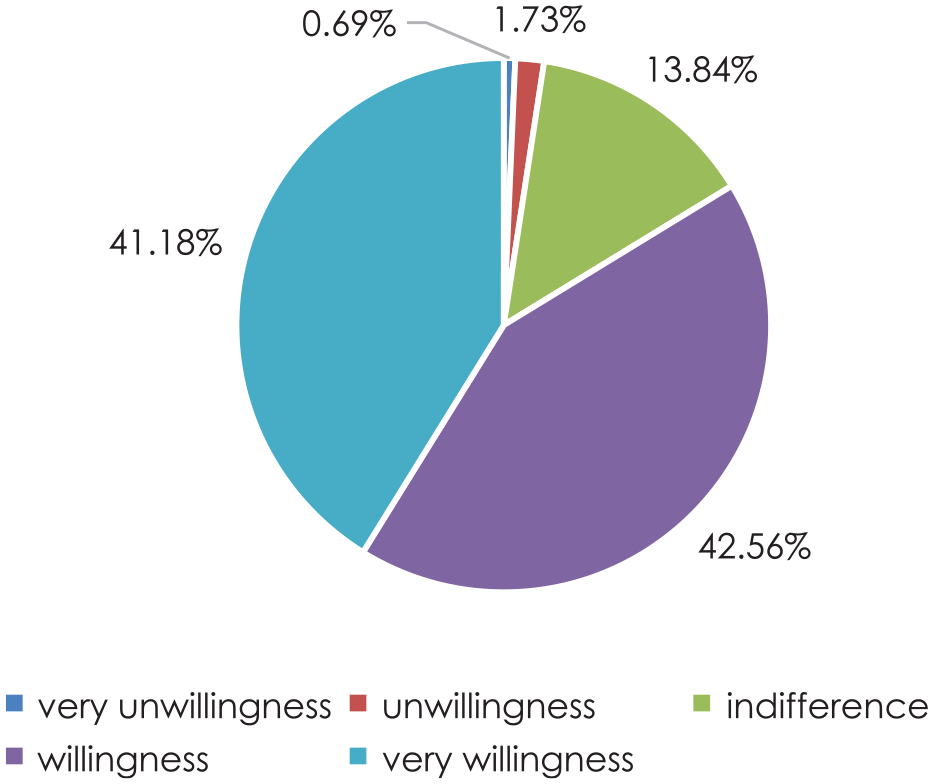
Crowdshipping participation intention.

Proportion of environmental protection attitude.
Take SF, one of China’s leading comprehensive service providers of express logistics, as an example. As can be seen from Table 7, if the crowdshipping mode is adopted, 36,443 (5751 + 5383 + 5096 + 5593 + 4989 + 4938 + 4693) cars are required to undertake the express service between the RCC of SF in Huai’an city and the DC in surrounding counties, that is, at least 100 (36,443 ÷ 365) cars are needed every day. SF express business accounts for 16% of the city’s total business volume, 48 so no less than 625 (100 ÷ 16%) cars should participate in the crowdshipping activity every day, in order to complete the task of Huai’an city to the surrounding DCs. According to the data of Jiangsu Expressway Network Operation & Management Center, 61 about 25,000 cars are out of town every day in Huai’an city. According to the survey results shown in Figure 4, 83.7% of the respondents are willing to participate in this crowdshipping activity, in other words, the 20,925 (25,000 × 83.7%) car owners are willing to act as crowdshipping carriers, so we believe that there will be sufficient capacity to meet the parcel transportation needs of express companies. Hence, from the perspective of the parties to be involved, the proposed crowdshipping mode is socially supportive.
Vehicle emission comparison
Take SF as an example. Transportation vehicle information was collected from its fleet documents during the face-to-face interview at SF. As shown in Table 4, HDTs are used between RCCs, and LCVs are used between RCCs and DCs.
SF express vehicle configuration.

HDV: heavy-duty vehicle; LCV: light commercial vehicle.
Through the questionnaire survey, we also collected relevant information of car owners’ vehicle emission standards, vehicle fuel types, vehicle sizes, and so on. Such information category is in accordance with the requirements of the COPERT software. Among the respondents who are willing to participate in crowdshipping activities, 70% of their vehicles have emission standards of “China 5,” 21% have emission standard of “China 4,” 7.8% have emission standard of “China 3,” and the rest are using electric vehicles. Currently, the emission standards of China 3, China 4, and China 5 are in line with Euro III, Euro IV, and Euro V, respectively. 62 The passenger cars used in the crowdshipping activities have a capacity of about 440–550 L. Considering the convenience of loading, we estimated the demand for cars with a volume of 400 L (0.4 m3).
The parameters to key into the COPERT software include ta, energy consumption, ltrip and its travel time, entering the value of Nk and Mk in stock and activity date, and entering the value of SURBAN;k in circulation activity. If the traditional mode and the crowdshipping mode are used to transport the parcels between Huai’an RCC and Baoying DC in 2018, respectively, according to the actual space used by the company’s vehicles in Table 4 and the space used by the cars mentioned above, the number of required vehicles (Nk) is shown in Table 5.
Demand for various types of vehicles.

LCV: light commercial vehicle; HDV: heavy-duty vehicle, PC: passenger car.
The ta value is the monthly average temperature of Huai’an city. 63 The energy consumption of the vehicles is calculated according to the fuel consumption in Table 4. According to the distance between the logistics node and the main road, the detour distance of the car is about 5.8 km, which can be divided into two trips. So ltrip is equal to 2.9 km. According to the field test, it takes 5 min between Huai’an RCC and the adjacent main road. Mk is the distance traveled for each vehicle to complete a delivery mission. For example, to complete the delivery task between Huai’an RCC and Baoying DC, each heavy-duty vehicle (HDV) travels 182 km and each LCV travels 137 km. As described in section “Emission calculation method,” the SURBAN;k value is 1.
As the number of transportation vehicles required each month and the distance traveled by the vehicles are different, we use the COPERT software to calculate the vehicle emissions under different modes on a monthly basis. The results are shown in Table 6.
Vehicle emissions from transportation tasks between Huai’an RCC and Baoying DC in different modes in 2018.

RCC: regional cargo center; DC: dispatch center; LCV: light commercial vehicle, PC: passenger car.
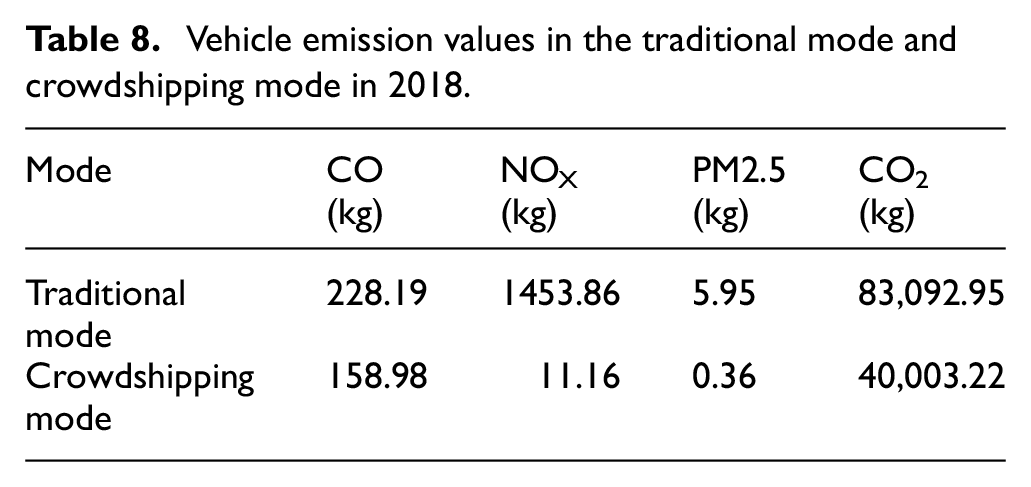
Table 7 shows the distance and parcel volume data between the Huai’an RCC and the DCs in surrounding counties. Using the same method as above, the vehicle emission data of transportation tasks from Huai’an RCC to these DCs are shown in Table 8. If crowdshipping mode is adopted, in 2018, SF could reduce CO emissions by about 69 kg (i.e. 228.19–158.98 kg), NOX emissions by about 1.3 t, particulate emissions by about 5.6 kg, and CO2 emissions by about 43 t. Hence, from the perspective of environmental protection, the proposed crowdshipping mode is feasible.
Distance and business volume between the Huai’an RCC and the DC in surrounding counties in 2018. 42

RCC: regional cargo center; DC: dispatch center, PC: passenger car.
Vehicle emission values in the traditional mode and crowdshipping mode in 2018.
Economic benefit analysis
Through the interview at SF, we learned about their existing Shun Lu (SL) software and obtained their operating cost data for each link from relevant documents. The total cost of completing these services in Table 7 was 7,214,481 yuan, and the income was 9,870,182 yuan.
The investment cost mainly refers to the cost of upgrading the current “Shun Lu” (SL) APP, which does not offer private car-based crowdshipping service. According to purchasing department of SF, the cost of upgrading the SL APP is about 40,000 yuan. 42 According to the current situation of the Chinese software market, assume that the annual service fee for the next 4 years is 5000 yuan. The calculation period of the project is from 2020 to 2023.
In 2018, the business volume of the Huai’an RCC to the surrounding DCs was 759,249, which is the sum of the column “Quantity” in Table 7. As shown in Table 9, the freight between RCCs is 569,473 (0.75 × 759,249). Combining the data in Table 7, the sorting fee in RCC is 295,257 (1.4 × (182 × 231 + 182 × 216 + 96 × 205 + 120 × 225 + 185 × 200 + 140 × 198 + 96 × 189)). The freight between RCC and DC is 759,249 (1 × 759,249). The intermediate link cost is 1,623,943 yuan, accounting for 22.5% (1,623,943 ÷ 7,214,481) of the total cost. These data were obtained in interviews with SF.
Intermediate link costs of SF express service in 2018.

RCC: regional cargo center; DC: dispatch center; SF: Shun Feng.
If crowdshipping mode is adopted, SF pays 30 yuan for each car (under this level, about 83.7% of respondents are willing to participate in crowdshipping activities), and then a total of 1,093,290 (30 × 36,443) yuan will be paid to the car owners. According to Huai’an Municipal Postal Administration, 48 the study assumes that the growth rate of express business in Huai’an city is 10%. The estimated NPV of SF express business within the project calculation period of 2020–2023 is shown in Table 10. The crowdshipping compensation is about 1,203,000 yuan (1093.290 × (1 + 10%)), the income is 10,875 (9870.182 × (1 + 10%)), and the other link cost is 6150 ((7214.481 – 1623.943) × (1 + 10%)). The results suggest that using crowdshipping mode, NPV will increase 19% ((14,454 – 12,095) ÷ 12,095) compared with the traditional mode. Hence, from the perspective of economic efficiency, the crowdshipping mode is financially feasible.
Comparison of NPV under two models.

NPV: net present value.
Conclusion
Considering urban sustainable development, cities need innovative green logistics solutions to meet the needs of economic development. Crowdshipping is a promising sustainable freight solution. This article proposed a crowdshipping solution for parcels transportation between express company’s RCCs and DCs in neighboring cities, that is, a crowdshipping transportation solution based on intercity private car traveling.
The research started from face-to-face interviews and SP questionnaires to understand the attitudes of senior executives and car owners in participating in this crowdshipping activity, respectively. The survey results show that considerable number of car owners would participate in this crowdshipping activity and complete the parcel transportation tasks demanded by express companies.
Next, we used COPERT 5.2.2 calculation model to compare the environmental impact of the traditional mode of parcel transportation and the crowdshipping mode. The results show that using the crowdshipping mode to complete the parcel transportation task between the RCC and the DCs could greatly reduce pollutant emissions. Finally, we used the NPV method to compare the economic benefits brought by the two modes. The results indicate that crowdshipping would increase the NPV of the company by 19%.
The generalization of the conclusion is limited as the data were collected merely from Huai’an, one city in Jiangsu Province, China; data were analyzed at an initial stage and the results were derived mainly from SF practices. Hence, future research work would explore further on (1) more detailed environmental assessment, (2) more in-depth analysis of preferred demand of crowdsourced shipper and crowdsourced carrier, (3) the operation of crowdshipping activities, (4) investigate key factors affecting the implementation of crowdshipping activities, and so on.
Footnotes
Handling Editor: Stephan Reiff-Marganiec
Declaration of conflicting interests
The author(s) declared no potential conflicts of interest with respect to the research, authorship, and/or publication of this article.
Funding
The author(s) disclosed receipt of the following financial support for the research, authorship, and/or publication of this article: This research was funded by the open fund for Jiangsu Smart Factory Engineering Research Center (Huaiyin Institute of Technology).
