




Abstract
In digital steganography, due to difficulties estimating the JPEG cover image, it is still very hard to accurately locate the hidden message embedded in a JPEG image. Therefore, this study proposes a payload location method for a category of pseudo-random scrambled JPEG image steganography. In order to estimate the quantized discrete cosine transform coefficients in the cover JPEG image, a cover JPEG image estimation method is proposed based on co-frequency sub-image filtering. The proposed payload location method defines a general residual, uses the estimated cover JPEG image to compute the residuals, and then employs the mean residuals of multiple stego images embedded along the same path to distinguish the stego positions. The proposed cover JPEG image estimation method constructs 64 co-frequency sub-images, and then filters the sub-image to estimate the cover JPEG image. Finally, using these methods, payload location algorithms are designed for two common JPEG image steganography algorithms: JSteg and F5. Experimental results show that the proposed location algorithms can effectively locate the stego positions in both JSteg and F5 steganography when the investigator possesses multiple stego images embedded along the same path. In addition, the location results can also be used to recover the steganography key to extract the embedded secret messages.
Keywords
Introduction
Digital steganography is a technique that embeds hidden information, known as the payload, in redundant parts of multimedia data such as digital images, video, audio, and text, termed the cover, in order to conceal secret communications. In the past 30 years, many steganography algorithms have been proposed for different applications.1,2 These algorithms can be used not only to ensure communication security but also to steal private data such as trade secrets. For example, in September 2011, the Laboratory of Cryptography and Systems Security at Budapest University discovered the worm Duqu, which was closely related to Stuxnet but designed to gather information on the infected system, hide the information in seemingly innocent images, termed stego images, and then transfer the obtained data to command and control centers. 3
At present, a series of steganalysis algorithms exhibiting excellent performance have been proposed for image steganography. These steganalysis algorithms can not only accurately detect the stego images of traditional steganography 4 but can also effectively distinguish the stego images of new adaptive steganography5–7 and even estimate the ratio of the payload.8,9 In addition, some steganalysis algorithms can also estimate the capacity of hidden information in the cover.10,11 However, investigators are typically more focused on correctly extracting the hidden message. Compared with the detection of stego objects, extraction of the payload is much more difficult. Previous research has demonstrated that, when the mechanism of stego position selection is known, if the probability of the investigator locating the stego positions is higher than that achieved by random guessing, the stego key will likely be recovered by collision attack and the secret message will be extracted. 12
Early payload location algorithms predominantly located the stego positions in sequential steganography, such as sequential spatial least significant bit (LSB) replacement steganography, sequential spread spectrum steganography, and sequential JSteg steganography.13–19 This is because the message is embedded sequentially in a partial region of the cover, resulting in the statistical properties of the stego region differing significantly from those of the other regions. In contrast, random steganography randomly distributes hidden message over the entire cover and does not generate a partial area with clearly abnormal statistical characteristics. Thus, it is difficult to locate the payload and early payload location methods, which typically perform poorly against random steganography. For example, Davidson and Paul 20 analyzed the payload location as an energy-based image anomaly detection problem and proposed a spatial payload location algorithm based on outlier detection. Ambalavanan and Chandramouli 21 used a Markov random field to model the image and proposed a spatial payload location algorithm based on a Bayesian method. These algorithms, such as LSB replacement and LSB matching, can locate stego positions in a smooth area or where pixels exhibit large amplitude changes; however, they cannot correctly locate stego positions in complex texture areas nor distinguish pixels that only exhibit small changes.
To locate stego positions in spatial LSB replacement steganography, Ker 22 proposed a payload location algorithm based on weighted stego residuals under the condition that the investigator possesses a number of stego images, each containing the payload at the same position. Under this condition, a variety of more accurate payload location algorithms were proposed. For example, Chiew and Pieprzyk 23 improved Ker’s method 22 by adding the local entropy of a pixel block for binary image replacement steganography. Ker and Lubenko 24 proposed a payload location algorithm for spatial LSB matching based on a wavelet filtering residual, which filters the stego image by a high-pass wavelet filter and inversely transforms the obtained wavelet residual into a spatial residual. Quach25,26 proposed several payload location algorithms for LSB replacement and LSB matching, which use a hidden Markov model or Markov random field model to model the cover image, then employ the Viterbi decoding algorithm or Quadratic Pseudo-Binary Optimization (QPBO) algorithm to find the optimal estimate of the cover image. Gui et al. 27 proposed a payload location algorithm based on a combination of multiple cover estimates for LSB matching steganography; the algorithm estimates nine cover images for each stego image in order to calculate the residuals and then combines them to improve the accuracy of payload location. Liu et al. 28 proposed a payload location method for spatial LSB replacement and LSB matching based on JPEG re-compression, which more accurately estimates JPEG-compressed spatial cover images by compressing and decompressing the stego image, and locates stego pixels with high accuracy. Yang et al. 29 proposed a payload location algorithm based on an optimal stego subset for multiple least significant bits (MLSBs) replacement steganography, which uses the wavelet filter to estimate the cover image.
The above algorithms have greatly improved the location accuracy of random steganography. Under certain specific conditions, these algorithms have been used to estimate groups in group parity steganography, 30 determine the stego pixel order in random steganography, 31 and even restore the stego key and extract the hidden message.12,29 However, these algorithms are only suitable for spatial LSB replacement, LSB matching, and MLSB replacement steganography.
In practice, JPEG images are more widely used on the Internet. Steganography and steganalysis of JPEG images have therefore become a hotspot in the field of information hiding. A number of effective JPEG image steganalysis algorithms have been designed for various steganography algorithms using JPEG images as the cover. However, due to the weak correlation between adjacent discrete cosine transform (DCT) coefficients in JPEG images, it is difficult to accurately estimate the cover image. As a result, no payload location algorithm currently exists for JPEG steganography. Therefore, this study analyzes the payload location for JPEG image steganography. The main contributions of this article are as follows:
A general payload location method is proposed for a category of pseudo-random scrambled JPEG image steganography. This method defines a general residual, and then uses the cover JPEG image estimation method to estimate the cover coefficients and calculate the mean residual of each position in multiple stego images embedded along the same path, thereby locating the stego positions.
A method based on co-frequency sub-image filtering is proposed to estimate the cover JPEG image. This method combines the coefficients at the same positions of all 8 × 8 blocks in a JPEG image to obtain 64 co-frequency sub-images, and then filters each sub-image using a low-pass filter to estimate the cover JPEG image.
The specific payload location algorithms are designed for two common JPEG image steganography algorithms: JSteg and F5. Experimental results show that the proposed algorithms can effectively locate the stego positions, and the location results can also be used to recover the stego key to extract the embedded message, even if the investigator only possesses 10 stego images embedded along the same path.
The structure of this article is as follows. The “Random JPEG image steganography” section briefly introduces the random JPEG steganography algorithm analyzed in this study. The “Payload location method for random JPEG image steganography” section describes the proposed payload location method for JPEG image steganography. The “Cover JPEG image estimation based on co-frequency sub-image filtering” section proposes a cover JPEG image estimation method based on co-frequency sub-image filtering. The “Payload location algorithm for JPEG image steganography based on co-frequency sub-image filtering” section presents specific payload location algorithms for JSteg and F5 steganography. The “Experimental results and analysis” section provides the experimental results and analysis, and the “Conclusion” section presents the conclusions of the study.
Random JPEG image steganography
JPEG is the first and most widely used digital image compression standard in the world. The main process of JPEG compression is shown in Figure 1. First, the spatial image is converted to YCbCr color space. Second, the Cb and Cr components are down-sampled according to the sampling mode. If the sampling mode is YCbCr 411 or YCbCr 422, the ratio of Y, Cb, and Cr pixels is 4:1:1 or 4:2:2. Then, each component is divided into non-overlapping blocks with a size of 8 × 8 after sampling. Third, the pixels in each block are subtracted by 128 and transformed by DCT. Then, the obtained DCT coefficients are quantized using quantization tables. Finally, the quantized DCT coefficients are encoded by Huffman encoding to obtain the JPEG image. JPEG decompression is the inverse process of JPEG compression.

Key processes of JPEG image compression.
Random JPEG image steganography randomly selects quantized DCT coefficients from a JPEG image, and then embeds message bits into the coefficients. The coefficient selection procedure involves pseudo-random scrambling of the quantized DCT coefficients in the cover JPEG image according to a given stego key, and then selecting a certain number of coefficients from the scrambled sequence of coefficients to embed message bits sequentially. Because some JPEG image steganography algorithms cannot embed message bits into coefficients in certain specific positions or into coefficients with specific values, they may only scramble the available coefficients. Therefore, according to whether the unavailable coefficients are eliminated during pseudo-random scrambling, the stego coefficient selection methods in random JPEG image steganography can be classified into two main categories (Figure 2): pseudo-random scrambling of available coefficients and pseudo-random scrambling of all coefficients.

Comparison of two major stego coefficient selection methods in random JPEG image steganography: (a) original coefficients, (b) coefficients after pseudo-random scrambling of available coefficients, and (c) coefficients after pseudo-random scrambling of all coefficients.
This study employs a JPEG image steganography algorithm that pseudo-randomly scrambles all coefficients to select the embedding positions. The corresponding embedding process is as follows:
Obtain the quantized DCT coefficients by Huffman decoding of the given JPEG image or JPEG compression of the given spatial image.
Scramble all quantized DCT coefficients in the entire JPEG image according to the given stego key to generate the scrambled DCT coefficient matrix.
Sequentially select the coefficients from the scrambled DCT coefficient matrix and embed the secret message bits into the selected coefficients in sequence.
Inversely scramble the coefficient matrix containing the stego coefficients.
Encode the inversely scrambled coefficient matrix by Huffman encoding to generate the stego JPEG image.
Payload location method for random JPEG image steganography
When the embedding positions are selected by pseudo-randomly scrambling all coefficients as described in the “Random JPEG image steganography” section, if the investigator possesses T stego images
If the position
If the position

T stego images embedded along the same path. Black squares represent unavailable coefficients, white squares represent available coefficients not containing the message, and the grid squares represent available coefficients containing the message. Numbers in circles indicate the positions of the coefficients before scrambling.
Let

where
Let

If the position

According to formulae (2) and (3), the means of the residuals in the stego position and non-stego position differ significantly; therefore, it is theoretically possible to distinguish them.
In practice, however, the investigator often does not possess a cover image; only an estimated version of the cover image can be obtained. Therefore, one can simply obtain the mean of the estimated residuals as follows

Let
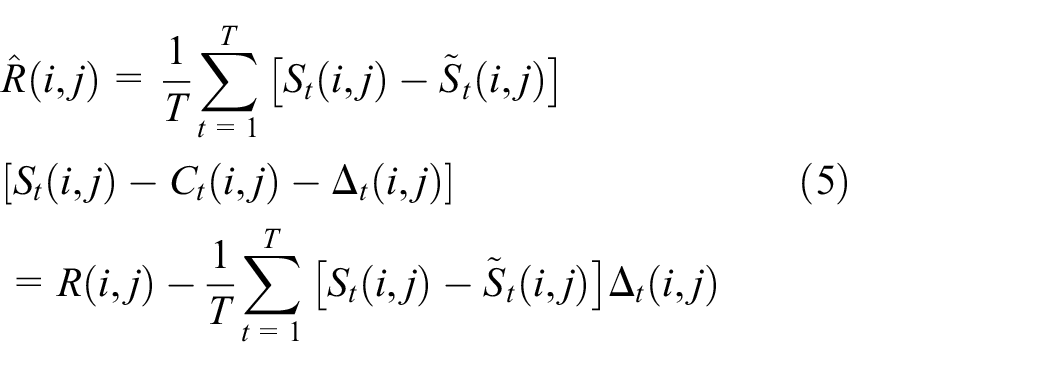
Thus, when position

When position

When the mean of the estimation error

and the expected mean of the estimated residuals in the non-stego position is

Therefore, even when the cover image is not possessed, as long as the mean of the estimation errors of the cover coefficients of T stego images is 0, and there are sufficient stego images embedded along the same path, it is also possible to distinguish the stego positions and non-stego positions.
Based on the mean of the estimated residuals in formula (4), a payload location method is proposed for JPEG image steganography, which selects the embedding positions by pseudo-randomly scrambling all coefficients. The main procedure is shown in Figure 4 and is described as follows:
For the T given stego images,
Calculate the estimated residual

Compute the mean of the estimated residuals in the same position of different stego images using formula (4).
Sort all positions in descending order according to the mean of the estimated residuals in each position.
Select the first positions as the estimated stego positions, where M can be obtained by quantitative steganalysis.
In a possessed stego image, if the coefficient in an estimated stego position is available for steganography, then it is judged that this coefficient contains a secret message bit.

Procedure for the payload location method for JPEG image steganography.
Cover JPEG image estimation based on co-frequency sub-image filtering
According to the “Payload location method for random JPEG image steganography” section, accurate estimation of the cover image is directly related to the accuracy of payload location. However, existing cover image estimation algorithms are predominantly designed to estimate the spatial cover image. Thus, it is difficult to accurately estimate the quantized DCT coefficients in the cover JPEG image. JPEG image calibration in existing JPEG image steganalysis methods can only estimate the statistical characteristics of the cover JPEG image and cannot estimate the coefficients in cover JPEG image. Therefore, it is necessary to design a cover JPEG image estimation algorithm to accurately estimate the cover coefficients.
This section proposes a cover JPEG image estimation method based on co-frequency sub-image filtering. According to the JPEG image compression process described in the “Random JPEG image steganography” section, the JPEG image is stored in the form of some non-overlapping quantized DCT coefficient blocks with a size of 8 × 8. The different positions in the coefficient block represent different frequency spectra, and the coefficient in each position represents the energy in the corresponding frequency spectrum. Therefore, if the pixels over two blocks are similar or have a strong positive correlation, the DCT coefficients in the same position of these two blocks (i.e. the energy in the same spectrum) should also be similar or have a strong positive correlation. Because the content of adjacent blocks in a JPEG image is typically similar and has a strong correlation, quantized DCT coefficients in the same position in these blocks may also have a strong correlation. Thus, it should be feasible to combine the quantized DCT coefficients in the same position of all blocks to obtain 64 co-frequency sub-images, and then estimate the cover JPEG image by low-pass filtering of each co-frequency sub-image.
The main procedure of the proposed cover JPEG image estimation method is shown in Figures 5 and described as follows:
1. Decode the input stego JPEG image by Huffman decoding to obtain the quantized DCT coefficient matrix

where M and N represent the height and width of the input image, respectively, and both are integral multiples of 8.
2. Combine coefficients in the same position

where
3. Low-pass filter each stego co-frequency sub-image
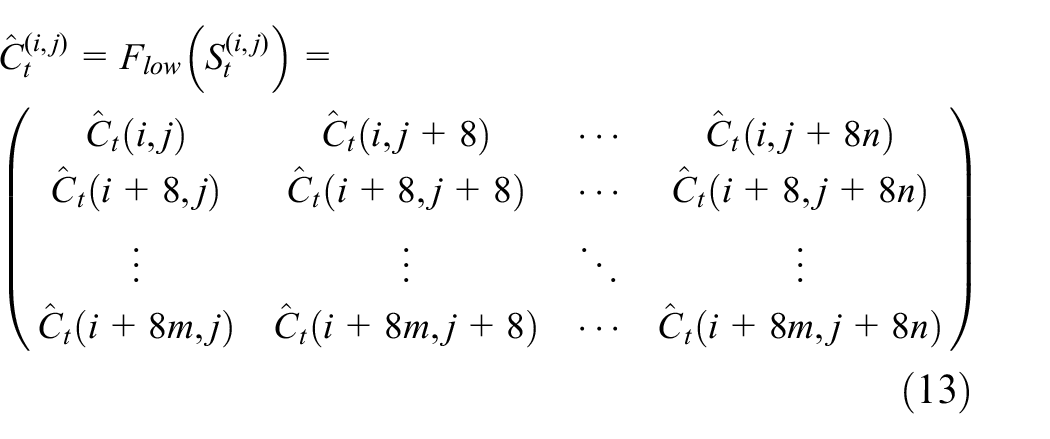
4. Combine 64 estimated cover co-frequency sub-images to form the cover JPEG image


Cover JPEG image estimation method based on co-frequency sub-image filtering.

Co-frequency sub-image division of the JPEG image.
When embedding the message into an image, any changes to the cover are reduced as much as possible, resulting in only slight noise. Among existing low-pass filters, the wavelet filter has good multi-directional and multi-resolution analysis capabilities and can capture subtle details in the image. Thus, the wavelet filter is very suitable for capturing stego noise and has exhibited excellent performance in JPEG image steganalysis. 5 Correspondingly, the low-pass wavelet filter can also effectively remove stego noise in the stego image. In view of this, the low-pass wavelet filter is applied to filter the stego co-frequency sub-images and the following cover JPEG image estimation algorithm is proposed based on co-frequency sub-image wavelet filtering as follows.
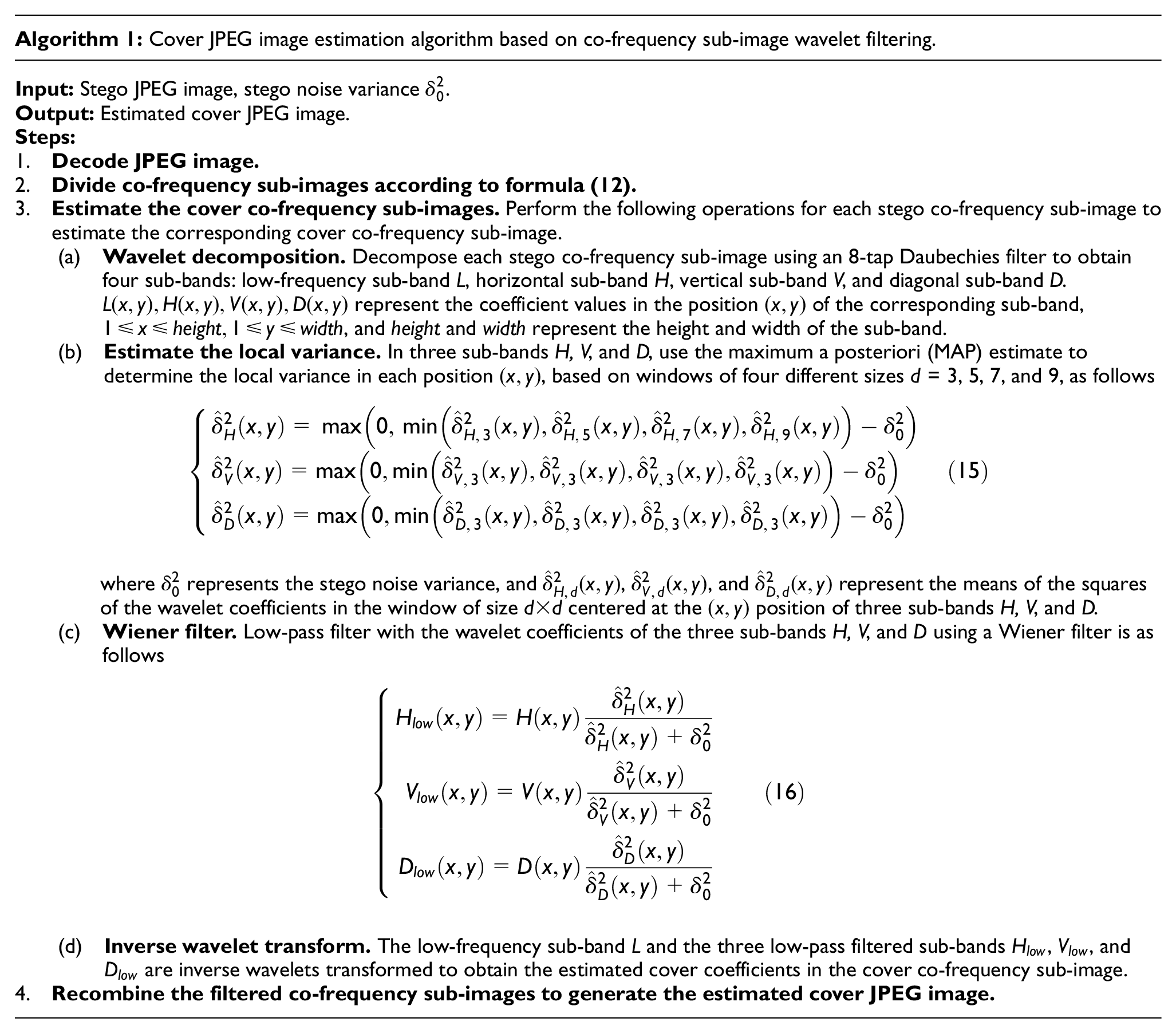
Similarly, the 4-neighborhood average filtering method commonly used in steganalysis can also be used to low-pass filter each stego co-frequency sub-image. Then, the cover JPEG image estimation algorithm based on co-frequency sub-image 4-neighborhood filtering is derived.
Payload location algorithm for JPEG image steganography based on co-frequency sub-image filtering
To date, multiple JPEG image steganography algorithms have been proposed. However, JSteg and F5 remain popular with steganalysts because of their simplicity and excellent visual invisibility. Therefore, in this section, the proposed methods are applied to payload location for these two common JPEG image steganography algorithms.
Payload location algorithm for JSteg steganography
The JSteg steganography applies the spatial LSB replacement to the JPEG image and processes each selected coefficient as follows:
If the selected coefficient is a direct current (DC) coefficient or alternating current (AC) coefficient with a value of 0 or 1, it is considered that the selected coefficient is not available for JSteg steganography and is skipped to select the next coefficient.
If the selected coefficient is available for JSteg steganography, replace the LSB of the selected coefficient with the current bit in the secret message, then select the next coefficient along the embedding path, and read the next bit from the secret message.
When the last bit in the secret message has been embedded or the ratio of selected coefficients to all coefficients exceeds a certain threshold, finish the embedding.
DC coefficients and AC coefficients with values of 0 and 1 have certainly not been changed. Therefore, when estimating the residuals, we can obtain their extract residual values as 0 instead of the estimated value. Thus, the residual estimation formula can be improved as follows

where
The cover JPEG image estimation algorithm used in Algorithm 2 can also be replaced with the cover JPEG image estimation algorithm based on co-frequency sub-image 4-neighborhood average filtering. Then, the payload location algorithm for JSteg steganography based on co-frequency sub-image 4-neighborhood average filtering (CS4-JSteg) can be obtained.

Payload location algorithm for F5 steganography
F5 steganography introduces matrix encoding and uses almost all available coefficients to carry the message when the embedding ratio is no larger than 2/3. Therefore, in this case, it is meaningless to locate the stego positions. However, when the embedding ratio is larger than 2/3, the matrix encoding will degenerate to ordinary random embedding. Therefore, this section proposes a payload location algorithm for F5 steganography without matrix encoding.
F5 steganography uses the quantized DCT coefficient whose value is either a positive odd number or negative even number to represent 1, and then uses the quantized DCT coefficient whose value is either a positive even number and negative odd number to represent 0 and does not use DCT coefficients with a value of 0 to carry message bits. It processes each selected coefficient as follows:
When the selected coefficient is a DC coefficient or AC coefficient with a value of 0, it is considered that the selected coefficient is not available for F5 steganography and is skipped to select the next coefficient.
When the selected coefficient is available for F5 steganography, if the bit represented by the selected coefficient is the same as the message bit to be embedded, the selected coefficient is not changed; if the bit represented by the selected coefficient is different from the message bit to be embedded, the absolute value of the selected coefficient is subtracted by 1. If the available coefficient is changed to 0, the embedding is regarded as invalid embedding and the message bit should be re-embedded into the next coefficient. The next coefficient along the embedding path is then selected.
When the last bit in the secret message has been embedded or the ratio of selected coefficients to all coefficients exceeds a certain threshold, the embedding is finished.
According to the embedding rules of F5 steganography, the specific residual estimation for F5 steganography is

where

and Rand is a random number between 0 and 1. This section applies the improved residual estimation formula (18) and the cover JPEG image estimation algorithm in the “Cover JPEG image estimation based on co-frequency sub-image filtering” section to the payload location method proposed in the “Payload location method for random JPEG image steganography” section, and then derives the payload location algorithm for F5 steganography based on co-frequency sub-image wavelet filtering, as follows.
The cover JPEG image estimation algorithm in Algorithm 3 can also be replaced with the cover JPEG image estimation algorithm based on co-frequency sub-image 4-neighborhood average filtering. Then, the payload location algorithm for F5 steganography based on co-frequency sub-image 4-neighborhood average filtering (CS4-F5) can be obtained.

Experimental results and analysis
Experimental setup
In total, 10,000 PGM images with a size of 512 × 512 were downloaded from the BOSSbase1.01 and converted to cover JPEG images with a quality factor of 75. Then, 1000 cover images each containing 30,000 to 50,000 non-zero quantized DCT coefficients were randomly selected from 10,000 cover JPEG images. Next, a pseudo-random path was generated by using the MATLAB function “randperm” to scramble the integer sequence in the range between 1 and 512 × 512. Finally, 20 test stego image sets were generated by selecting the coefficients with a ratio of
Currently, there is still no payload location algorithms for JPEG image steganography because it is difficult to precisely estimate the cover JPEG image. All of the existing payload location algorithms were designed for spatial image steganography. The intuitive idea is to adapt the payload location algorithms to locate the payload of JPEG image steganography. Therefore, the payload location algorithms in Ker and Lubenko 24 and Gui et al. 27 are adapted for JPEG image steganography as follows:
CSW-JSteg: This payload location algorithm performs wavelet filtering on co-frequency sub-image to estimate the cover JPEG image, and then calculates the JSteg residuals between the given image and the estimated cover image of it to locate the payload of JSteg steganography.
CS4-JSteg: This payload location algorithm performs 4-neighborhood average filtering on co-frequency sub-image to estimate the cover JPEG image, and then calculates the JSteg residuals between the given image and the estimated cover image of it to locate the payload of JSteg steganography.
WIW-JSteg: This payload location algorithm performs wavelet filtering on all pixels in the whole image to estimate the cover JPEG image, and then calculates the JSteg residuals between the given image and the estimated cover image of it to locate the payload of JSteg steganography.
CSW-F5: This payload location algorithm performs wavelet filtering on co-frequency sub-image to estimate the cover JPEG image, and then calculates the F5 residuals between the given image and the estimated cover image of it to locate the payload of F5 steganography.
CS4-F5: This payload location algorithm performs 4-neighborhood average filtering on co-frequency sub-image to estimate the cover JPEG image, and then calculates the F5 residuals between the given image and the estimated cover image of it to locate the payload of F5 steganography.
WIW-F5: This payload location algorithm performs wavelet filtering on all pixels in the whole image to estimate the cover JPEG image, and then calculates the F5 residuals between the given image and the estimated cover image of it to locate the payload of F5 steganography.
The filter used in the above algorithms can be seen from Table 1. Then the algorithm proposed in this article is compared with above payload location algorithms originated from Ker and Lubenko 24 and Gui et al. 27
Filters and applicable steganography algorithms used by these payload location algorithms.

Validity of payload location algorithms
Figure 7 shows the histogram of the estimated residual means computed by the CSW-JSteg algorithm (CSW-JSteg residual means) for 1000 stego images of JSteg steganography with an embedding ratio of
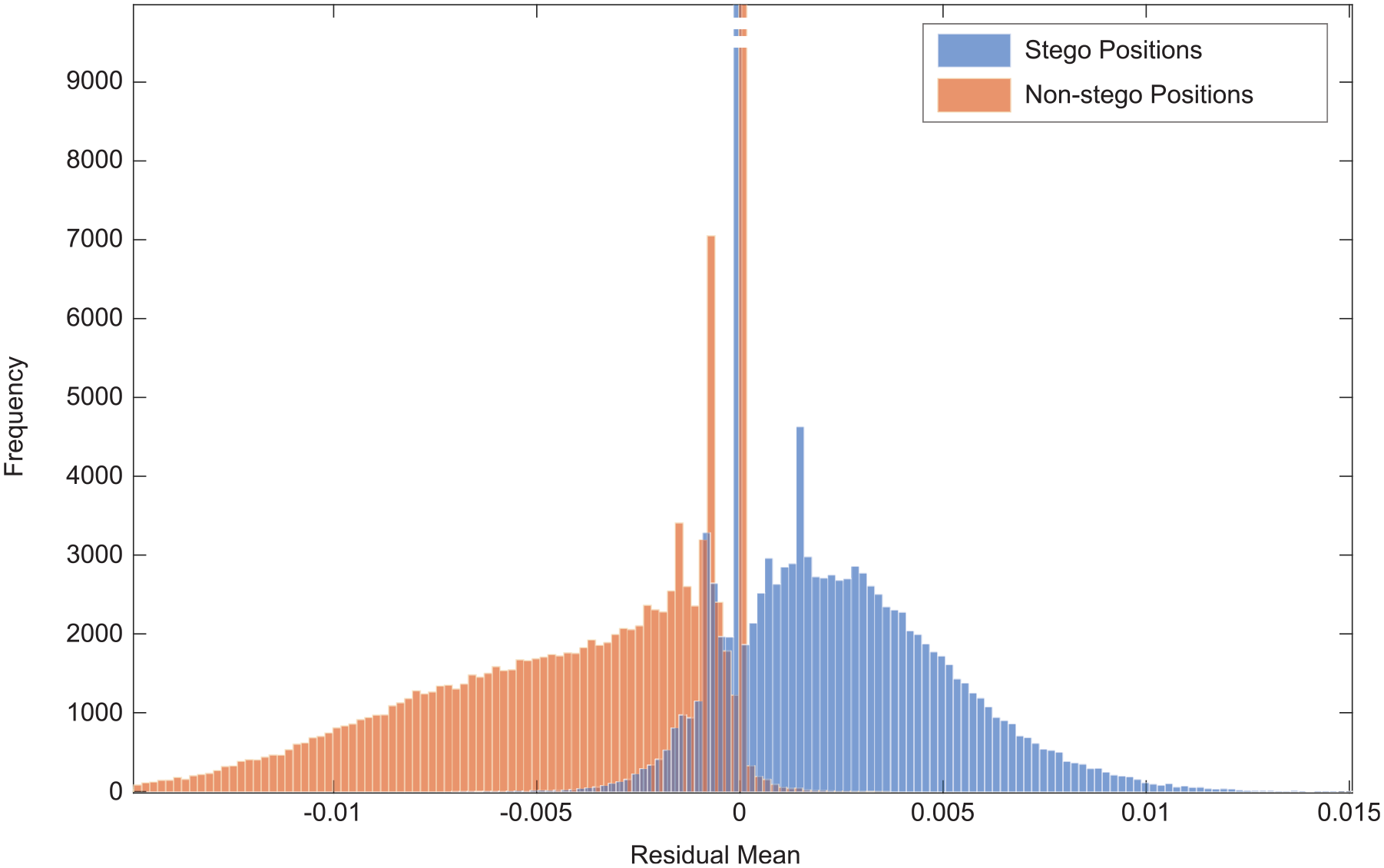
Histogram of the CSW-JSteg residual means for 1000 stego images embedded by JSteg steganography along the same path with an embedding ratio of 0.5.
Figure 8 shows a histogram of the estimated residual means computed by the CSW-F5 algorithm (CSW-F5 residual means) for 1000 stego images of F5 steganography with an embedding ratio of
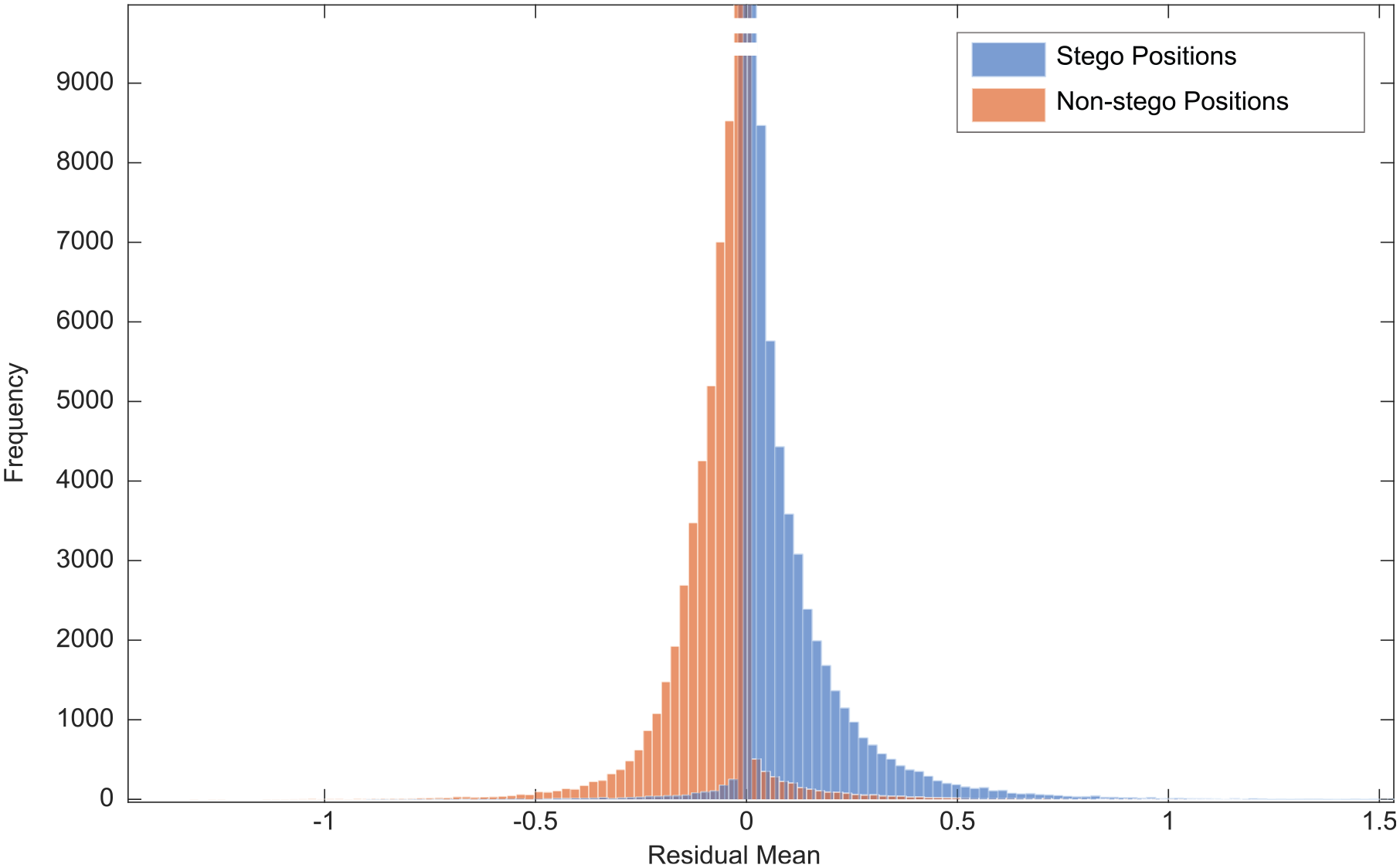
Histogram of the CSW-F5 residual means for 1000 stego images embedded by F5 steganography along the same path with an embedding ratio of 0.5.
Performance of payload location algorithms
In order to test the performance of the proposed JSteg steganography payload location algorithm CSW-JSteg, the cover JPEG image estimation algorithm in CSW-JSteg was replaced by the estimation algorithms based on co-frequency sub-image 4-neighborhood average filtering and whole-image coefficient wavelet filtering, respectively, resulting in corresponding payload location algorithms termed CS4-JSteg and WIW-JSteg.
Table 2 shows the location accuracy of the payload location algorithms CSW-F5, CS4-F5, and WIW-F5 with possession of different numbers of stego images embedded by JSteg with an embedding ratio of 0.5. Table 3 shows the payload location accuracy of the three payload location algorithms for 1000 stego images embedded by JSteg along the same path with an embedding ratio of 0.1, 0.2, 0.3, 0.4, 0.5, 0.6, 0.7, 0.8, and 0.9. According to Tables 2 and 3, all three payload location algorithms can locate the stego positions more accurately than random guessing (a correct rate equal to 50% is equivalent to a random guess). Furthermore, with an increase in the number of stego images and embedding ratio, the location accuracy of the stego positions increases significantly. The two payload location algorithms based on co-frequency sub-image filtering have significantly higher accuracy than the payload location algorithm based on whole-image coefficient wavelet filtering. The payload location algorithm CSW-JSteg exhibits the best performance. This is because the weak correlation between adjacent coefficients in JPEG images causes poor estimation accuracy of the cover image coefficients by wavelet filtering of coefficients in the entire image.
Payload location accuracy of three payload location algorithms for JSteg steganography for different numbers of stego images.
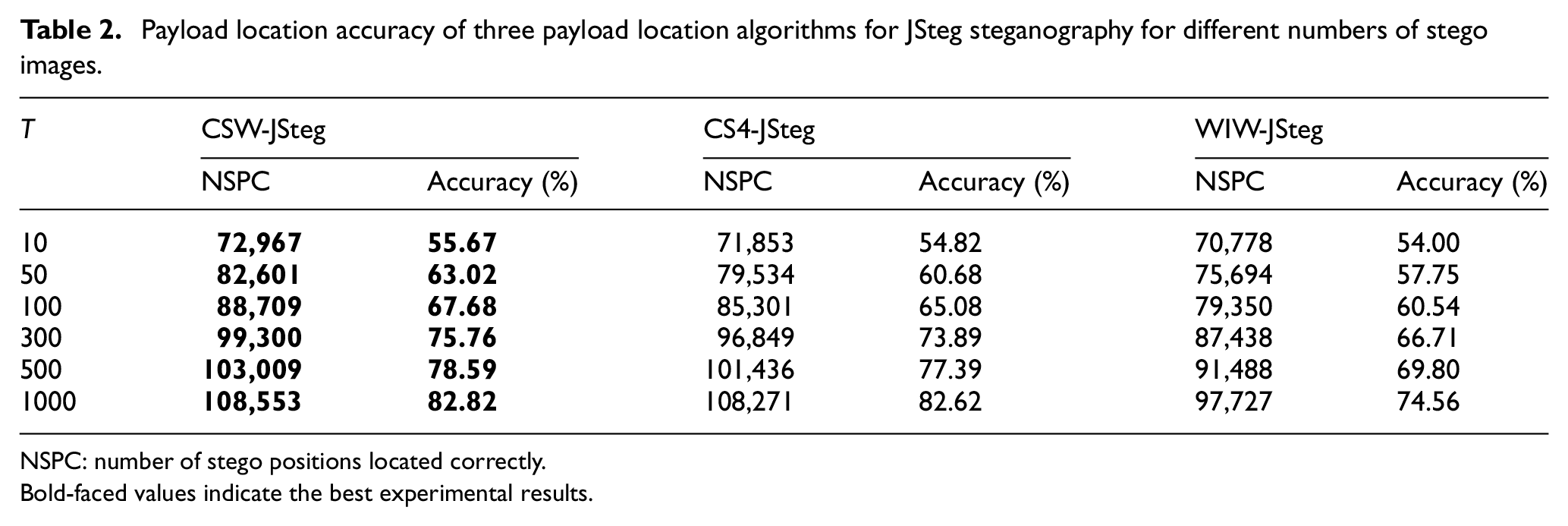
NSPC: number of stego positions located correctly.
Bold-faced values indicate the best experimental results.
Payload location accuracy of three payload location algorithms with 1000 stego images of JSteg and an embedding ratio of
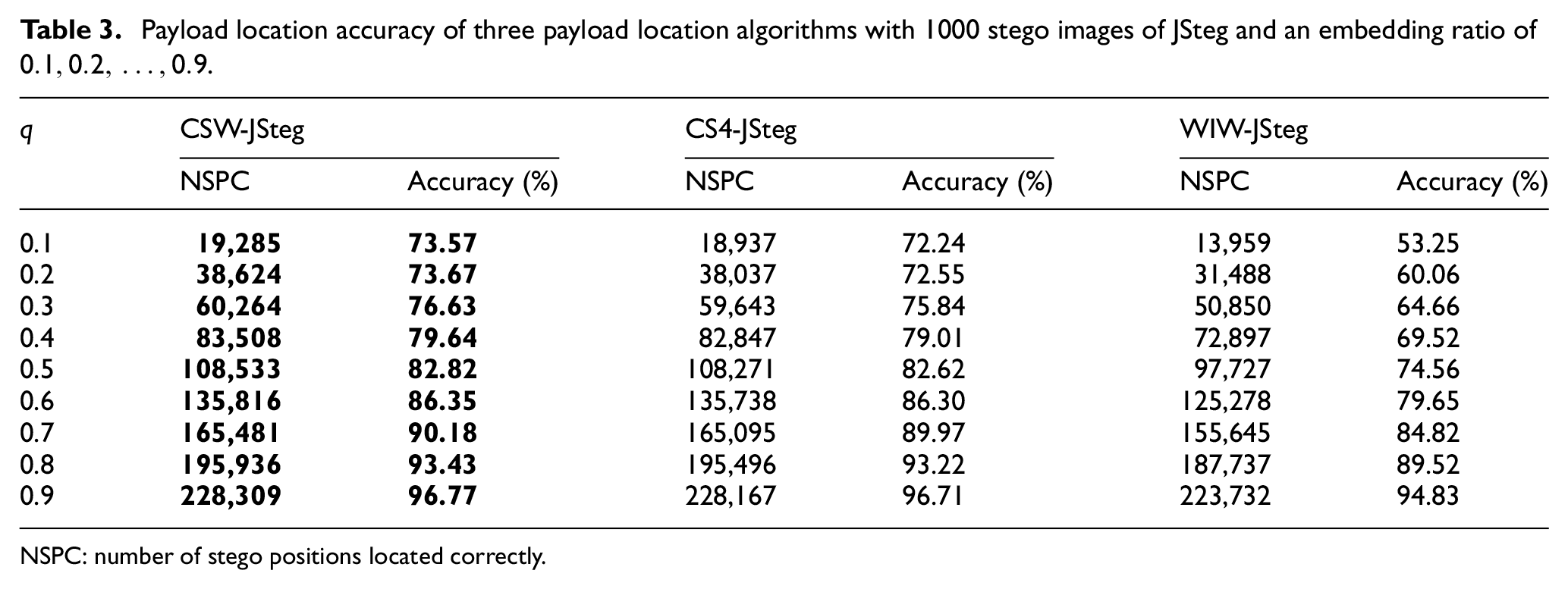
NSPC: number of stego positions located correctly.
In order to test the performance of the proposed F5 steganography payload location algorithm CSW-F5, the cover JPEG image estimation algorithm in CSW-F5 was replaced by the estimation algorithms based on co-frequency sub-image 4-neighborhood average filtering and whole-image coefficient wavelet filtering, respectively, resulting in corresponding payload location algorithms termed CS4-F5 and WIW-F5.
Table 4 shows the payload location accuracy of the payload location algorithms CSW-F5, CS4-F5, and WIW-F5 for the 1000 stego images embedded by F5 along the same path with an embedding ratio of 0.1, 0.2, 0.3, 0.4, 0.5, 0.6, 0.7, 0.8, and 0.9. When the embedding ratio is greater than or equal to 0.2, the payload location algorithm CSW-F5 can locate the stego positions with a higher probability of success than achieved by random guessing. Moreover, the location accuracy is significantly higher than the other two algorithms. However, when the embedding ratio is equal to 0.1, all three location algorithms fail. A comparison with Table 3 indicates that, under various embedding ratios, the payload location accuracies for F5 steganography are always lower than those for JSteg steganography. This could be due to the following two reasons:
F5 steganography may change the coefficients of values 1 and −1 to 0; thus, the estimation errors of the residuals of many unchanged zero-valued coefficients cannot be eliminated.
F5 steganography subtracts the absolute value of the changed coefficient by 1, causing a large number of coefficients with values of 1 and −1 to become 0. This can be viewed as the denoising process. However, JSteg steganography is equivalent to adding noise to the image, and the cover JPEG image estimation process in the above location algorithm is essentially a denoising filter. Therefore, this process is more suitable for estimating the cover JPEG image from the stego images of JSteg steganography.
Payload location accuracy of three payload location algorithms possessing 1000 stego images of F5 with an embedding ratio of

NSPC: number of stego positions located correctly.
Applicability of payload location results
According to Table 3, when there are few stego images embedded along the same path, the payload location accuracy is low. For example, when there are only 10 stego images embedded by JSteg along the same path, the best CSW-JSteg algorithm can only locate the stego position with an accuracy of 55.67%, which is close to that of random guessing. In order to test the applicability of the location results, this section applied the location result to the collision attack algorithm proposed in formula, 12 as follows:
Randomly select 10 cover images from the 1000 cover images.
Randomly select a number from 1 to 65,535 as a stego key, use the “randperm” function in MATLAB to generate an embedding path, and embed a pseudo-random message by JSteg with a ratio of 0.5 in the selected 10 cover images along the embedding path.
Estimate the stego positions in the 10 stego images using the CSW-JSteg algorithm.
Respectively feed
Count the number of estimated stego positions in the first 50% of positions along each test path.
Take the seed corresponding to the larger number of estimated stego positions as the recovered stego key.
Figure 9 shows the number of estimated stego positions in the first 50% of positions along each path. The number of estimated stego positions corresponding to the correct stego key is clearly larger than that corresponding to the pseudo-stego keys. That is, even when there are only 10 stego images embedded by JSteg along the same path, the payload location result of the proposed CSW-JSteg algorithm can still be used to effectively recover the stego key. A previous study 31 also reported that a higher payload location accuracy will enable the stego key to be recovered with higher accuracy and efficiency, and allow the stego key recover algorithm to be used for smaller and larger embedding ratios. Therefore, it is still necessary to improve the payload location accuracy as much as possible.

Number of estimated stego positions in the first 50% of positions along each test path, when 10 stego images embedded by JSteg along the same path are possessed (the correct stego key is “12340”).
Conclusion
Because the quantized DCT coefficients in the cover JPEG image are difficult to accurately estimate, there is still no effective payload location algorithm for JPEG image steganography. Thus, this study proposed a payload location method for pseudo-random scrambled JPEG image steganography and a cover JPEG image estimation method based on the co-frequency sub-image filtering. Then, specific payload location algorithms were designed for the common JSteg and F5 steganography algorithms. The experimental results showed that, when possessing multiple stego images embedded by JSteg or F5 along the same path, the proposed payload location algorithms can effectively locate the stego positions, and the location result can be used to effectively recover the stego key.
However, if the steganography algorithm embeds the message using certain encoding algorithms, such as matrix code or Syndrome-Trellis Codes, the above method will fail because it is difficult to obtain multiple stego images embedded along the same path. Moreover, because audio, video, and other media have different characteristics from JPEG images, it is necessary to explore the payload location for steganography with audio, video, and other media types as covers. 32 It may be a potential idea to search similar cover media 33 and apply the data learning 34 to recognize the stego positions.
In future work, we will try to use the existing quantitative steganalysis methods10,11 to estimate the embedding ratio when the embedding ratio is unknown, and then use the method proposed in this article to perform payload location.
Footnotes
Acknowledgements
The authors would like to thank Dr. Zhenyu Li for his help improving the English of the article.
Handling Editor: Yee Wei Law
Declaration of conflicting interests
The author(s) declared no potential conflicts of interest with respect to the research, authorship, and/or publication of this article.
Funding
The author(s) disclosed receipt of the following financial support for the research, authorship, and/or publication of this article: This work was supported by the National Natural Science Foundation of China (Grant Nos 61872448, U1804263, 61772549, U1736214, 61602508, and 61601517) and the Science and Technology Research Project of Henan Province, China (Grant No. 152102210005).
