




Abstract
It is one of the potential threats to the Internet of Things to reveal confidential messages by color image steganography. The existing color image steganalysis algorithm based on channel geometric transformation measures owns higher accuracy than the others, but it fails to utilize the correlation between the gradient amplitudes of different color channels. Therefore, this article points out that the color image steganography weakens the correlation between the gradient amplitudes of different color channels and proposes a color image steganalysis algorithm based on channel gradient correlation. The proposed algorithm extracts the co-occurrence matrix feature from the gradient amplitude residuals among different color channels and then combines it with the existing color image steganalysis features to train the ensemble classifier for color image steganalysis. The experimental results show that, for WOW and S-UNIWARD steganography, compared with the existing algorithms, the proposed algorithm outperforms the existing algorithms.
Introduction
With the development and popularization of network technology, various image acquisition networks have been widely deployed in many fields, which have become one of the important forms of Internet of Things. Because the digital image is the body of the data in image acquisition networks, the transmitted image data will not be intercepted by the security protection systems. Therefore, it is possible to maliciously use the steganography to hide sensitive messages into digital images and transmit the images over the Internet, which results in information leakage. As the counterpart of steganography, steganalysis aims to judge if a digital image carries secret messages, further locates the payload, and finally extracts the secret messages. At present, the research of digital image steganalysis mainly focuses on steganography detection of a single-color channel. Either for the traditional steganography algorithms,1–4 or for the content-adaptive image steganography algorithms developing in recent years,5–8 researchers have proposed a series of effective steganalysis algorithms for the single-color channel,9–12 and some can even locate or extract the secret messages in the special cases. 13
In reality, color images are widely used, which consist of multiple color channels. When the steganographer embeds messages into multiple color channels, often the single-channel steganalysis algorithm is applied to detect each color channel and then to determine if the color image contains secret messages according to the detection results of each channel. However, compared with embedding the same length of message in a single-color channel, the length of messages embedded in each color channel is much shorter, and thus it is more difficult to implement effective detection.14,15 Therefore, reliable steganalysis of color image steganography is important for practical applications of steganalysis technology. For steganography with color images, based on the characteristic that steganography will increase the number of color or similar color pairs, Fridrich et al.
16
used the ratio of similar color pairs in the color pairs as steganalysis features. To detect the color stego image of least significant bit (LSB) steganography, Su et al.
17
embedded fixed ratio of random information into the investigated image and then extracted the increased numbers of different colors and similar color pairs as features. Abdulrahman et al.
18
calculated the co-occurrence matrices from gradient amplitudes of each channel and their derivatives and then combined them as features to realize color image steganalysis. Goljan et al.
19
extracted the co-occurrence matrices between the residuals of three channels and the Rich Model features of each channel, respectively, and then merged them into the color image steganography detection features—SCRMQ1 (Spatio-Color Rich Model with quantization step
Compared with the separate detection of each color channel, the above steganalysis algorithms effectively decrease the steganalysis error. Particularly, the detection error rates of the algorithm in Abdulrahman et al. 15 for S-UNIWARD (Spatial UNIversal WAvelet Relative Distortion) and WOW (Wavelet Obtained Weights) steganography are lower than those of the algorithm based on gradient amplitude and derivative, 18 the algorithm based on the co-occurrence matrix between channel residuals, 19 and the detection algorithm based on CFA sensitivity. 20 However, the steganalysis algorithm in Abdulrahman et al. 15 only considers that steganography will reduce the texture direction consistency of different color channels, while steganography will also reduce the consistency of their texture variation intensity. Therefore, we try to further improve the steganalysis performance by exploiting the two types of consistencies simultaneously. The main contributions of this article are as follows:
It points out that steganography will weaken the correlations between gradient amplitudes of different color channels.
A steganalysis feature extraction method based on channel gradient amplitude correlation is then proposed.
A steganalysis algorithm based on channel gradient correlation is proposed by combining the proposed features with existing color image steganalysis features in Abdulrahman et al. 15 and Goljan et al. 19 The experimental results show that when the information is embedded into each channel by WOW and S-UNIWARD algorithms, the proposed algorithm reduces the average detection error rate.
Related works
Color image steganography
When embedding messages into a spatial color image composed of three color channels: red (R), green (G), and blue (B), the messages to be embedded will be divided into three components, which can be embedded into three channels correspondingly by steganography algorithms such as HUGO (Highly Undetectable steGO), 5 WOW, 6 S-UNIWARD, 7 and HILL (High-pass, Low-pass, and Low-pass). 8 And then the three stego channels will be merged to compose the stego color image, as shown in Figure 1.

Procedure of color image steganography.
This steganography method seems to have great ability to resist detection. First, the secret messages to be embedded are split into three components and embedded into each color channel separately. Compared with embedding the whole message into a grayscale image, the payload of each color channel is obviously reduced. Furthermore, when detecting the color image steganography, if the detection is implemented separately in each color channel, the detection result of different channels will interfere with each other, which decreases the detection performance.
It is worth noting that the three color channels are not independent of each other. The correlation among the channels should not be ignored.
25
As shown in Figure 2(b) and (c), the content and texture of each color channel are very similar. Sangwine and Horne
26
calculated the correlation coefficients between three color channels of natural color images:

Influence of steganography on correlations between different color channels: (a) color image, (b) channel R (shown in grayscale), (c) channel G (shown in grayscale), (d) difference of channel R and channel G before steganography (shown in grayscale), and (e) difference of channel R and channel G after steganography (shown in grayscale).
Gradient vector in digital images
The gradient is a vector, the direction of which is the gradient direction. In mathematics, the function changes fastest and achieves the maximum rate of variation along the gradient direction. This maximum value is the amplitude of the gradient vector. If this theory is applied to digital images, the texture characteristics of images can be expressed by gradient vectors. The gradient direction of a point in the image represents the texture direction of the point, and the gradient amplitude of the point indicates the intensity of the texture variation at that point.
Represent the digital image as a function

For digital images, differentiation can be replaced by difference. That is, the horizontal and vertical components of the gradient vector at the position

As shown in Figure 3, a point in the image is taken as an example (“86” in Figure 3). Similar to equation (2), the horizontal component of the gradient vector at this point can be calculated as “86 – 125 = –39,” and its direction is horizontal to the right, as shown by the arrow. Similarly, the vertical component of the gradient vector at this point can be calculated as “86 – 171 = –85,” and its direction is straight up. And the direction of the gradient vector is determined by these two arrows.

Gradient vector in digital images.
It is worth noting that the difference between adjacent pixels can enhance the signal-to-noise ratio of steganographic signals and suppress the interference of the image content to outstand steganographic noises. Therefore, while depicting the image texture features, the gradient vector of the image highlights the horizontal and vertical steganographic signals.
Color image steganalysis based on channel gradient direction consistency
According to the above section, there is a strong correlation between the color image channels, the texture direction of which also has strong consistency. For example, in each channel, the edge regions of the color image are also the edge regions along the same or the similar direction, and the smooth regions of the color image are also the smooth regions of each channel. In cover images, the angle between different channel gradient vectors is relatively small due to the consistency of texture directions between color channels. But in stego images, the angle between the gradient vectors is likely to increase by embedding changes. In order to capture the influence of steganography on the consistency of texture direction between channels, the cosine and sine values of the angle between channel gradients are calculated to depict the consistency of different channel texture directions. Abdulrahman et al. 15 extracted steganalysis features based on channel gradient direction consistency and proposed a color image steganalysis algorithm based on channel geometric transformation meatures called RGB-CGTM.
The steganalysis algorithm has 24,157-dimensional features, which consists of 6000-dimensional steganalysis feature based on channel gradient direction consistency and 18,157-dimensional SCRMQ1 feature. The extraction process of 6000-dimensional steganalysis feature based on channel gradient direction consistency is as follows:
1. Calculate the gradient vector of three color channels red, green, and blue by equation (2), which is recorded as
2. The cosine values of the angle between gradients of R and G channels and the cosine values of the angle between gradients of R and B channels are obtained as follows
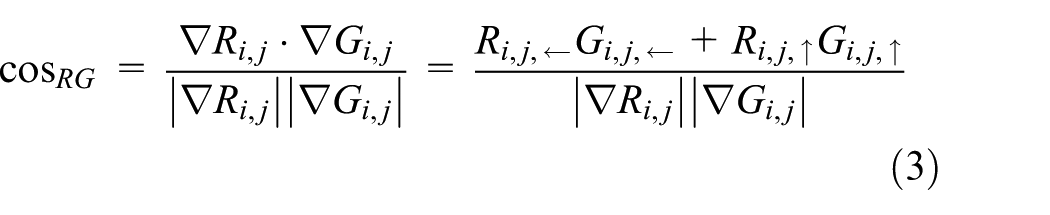
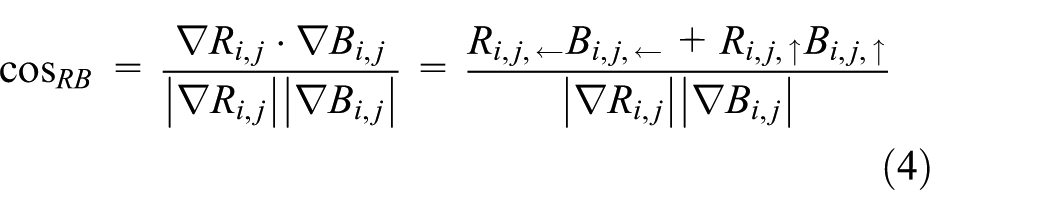
where the dot product of two vectors is a scalar, which reflects the projection of one gradient vector in the direction of another gradient vector. Therefore, the dot product of two unit gradient vectors can be used to calculate the cosine of the angle between them. The smaller the cosine value is, the larger the angle between them is. If the cosine value is equal to 1, their directions are completely consistent, and the cosine value equal to −1 indicates that they are in the opposite direction.
3. Since the cosine value only reflects the absolute value of the angle between the two vectors, it fails to reflect the direction of deviation between them. Because the sine function is an odd function, it is more sensitive to the positive and negative of the angle than the cosine function (even function). Therefore, the author introduces the sine value of the angle between the two gradients to express the directional characteristic of the angle between them
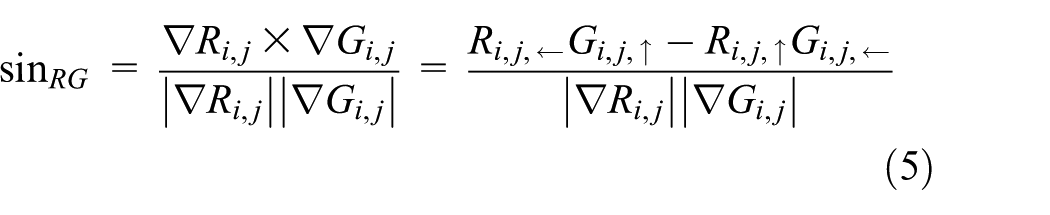

where the cross product of two vectors is a vector, whose norm reflects the area of the parallelogram formed by the two vectors at the same starting point, and the direction satisfies the right-hand grip rule. Therefore, the cross product of two unit gradient vectors can be used to calculate the sine value of the angle between them.
4. Calculate residuals and extract co-occurrence matrices from four images
Finally, the 6000-dimensional steganalysis feature based on channel gradient direction consistency is combined with the 18,157-dimensional SCRMQ1 features in Goljan et al., 19 and the ensemble classifier is trained to detect color images.
Color image steganalysis feature based on channel gradient amplitude correlation
Abdulrahman et al. 15 used the sine and cosine of angle to measure the value and direction of gradient angle between two color channels. These two measurements describe the consistency of the texture direction and reflect the correlation between channels, which improves the performance of color image steganalysis. However, the algorithm in Abdulrahman et al. 15 only utilizes the effect of color image steganography on the consistency of the texture direction between channels, but does not consider the influence of color image steganography on the correlation between texture amplitudes of different color channels. The application of the gradient vector in digital images shows that the gradient direction is the direction along which pixel values change fastest, and the gradient amplitude expresses the intensity of texture variation. The following section will point out that there are also correlations between the gradient amplitudes of different color channels, which will be decreased by steganography. According to this characteristic, this section extracts the steganalysis features based on channel gradient amplitude correlation.
Influence of steganography on correlations between gradient amplitudes of different color channels
Because of the strong correlation between the textures of different color channels, the intensities of texture variation at the same location in different channels should be close. Therefore, the gradient amplitudes of each color channel should also be correlated. As shown in Figure 4, the gradient amplitudes of each color channel of the color image shown in Figure 4(a) are given in the form of a grayscale image. It can be seen that the textures of the gradient amplitude image of each color channel are very similar, which indicates that they are correlated. Besides, this section scaled 10,000 color BOSSbase images downloaded from http://agents.fel.cvut.cz/stegodata/RAWs/ to color images in “tiff” format with a size of

Color image and gradient amplitude images of each channel: (a) color image, (b) gradient amplitude image of channel R, (c) gradient amplitude image of channel G, and (d) gradient amplitude image of channel B.

Correlation coefficient of gradient amplitude image of different channels.
When embedding messages in each color channel, the correlation between the gradient amplitudes of different color channels is likely to be weakened due to the randomness of embedding messages, changing pixels, or the change value. Taking WOW steganography algorithm as an example, when the pseudo-random secret information is embedded into a color image, although the changed pixels will be concentrated with a large probability on positions where the distortion values are small, the change values to these pixels will be pseudo-random +1 or −1. As a result, it is very possible that the WOW steganography algorithm will weaken the correlation between the gradient amplitudes of different color channels. In this section, pseudo-random messages with a payload of 0.4 bpc were embedded, respectively, in the three color channels of above 10,000 color cover images to generate the corresponding 10,000 stego images. Then the correlation coefficient between gradient amplitudes of different color channels of each stego image is subtracted from that of the corresponding cover image as shown in equations (7) and (8)


where

Correlation coefficient difference of different channel gradient amplitude images: (a)
The above statistical results show that in most color images there are strong positive correlations between the gradient amplitudes of different channels, which will be weakened by steganography. If the statistical features which can capture such changes are extracted and used for steganalysis, the detection performance of color image steganography should be improved.
Extraction of steganalysis feature based on channel gradient amplitude correlation
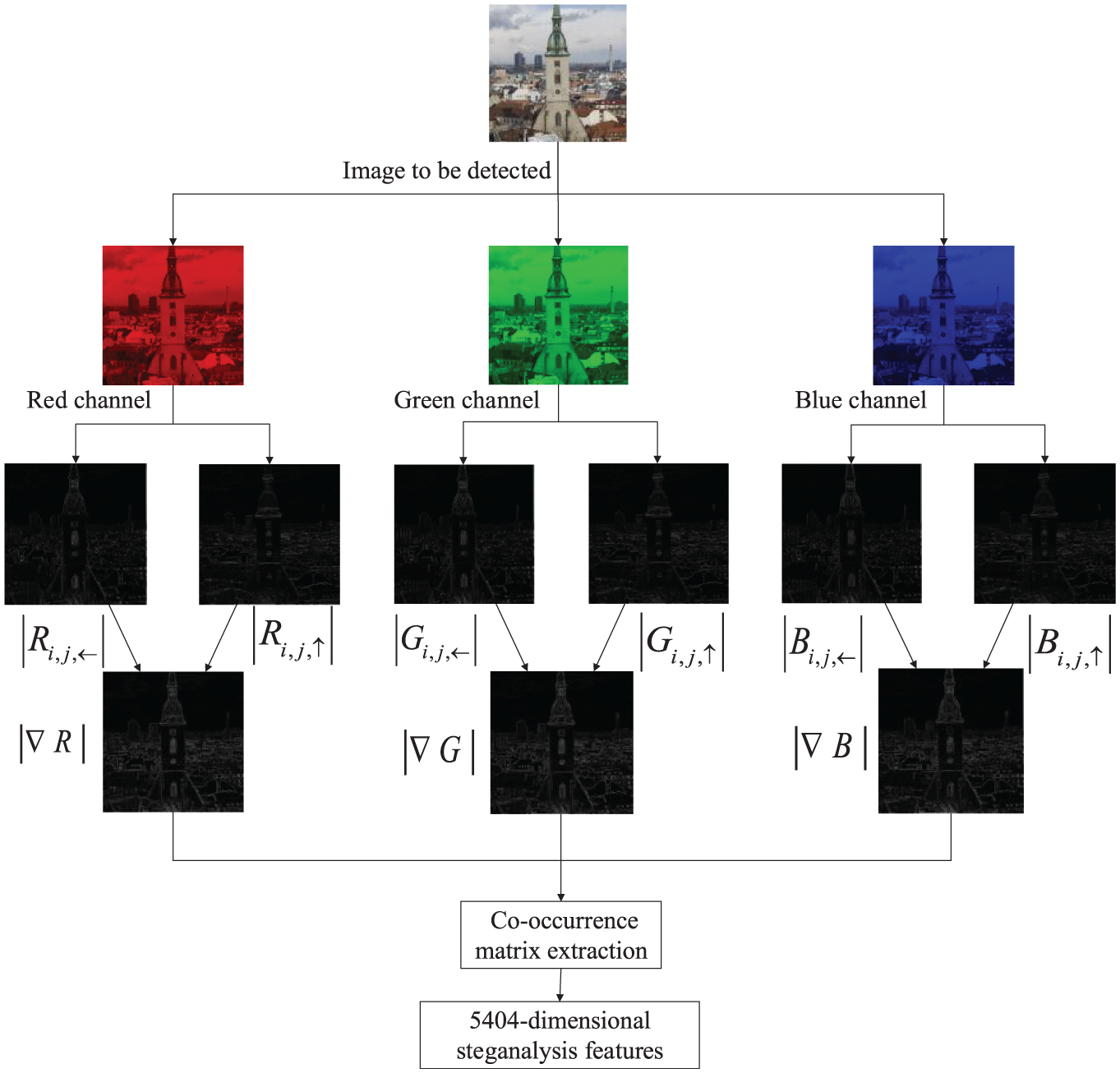
It can be seen from Figure 4(b)–(d) that not only the gradient amplitudes in the same position of different color channels are correlated, but also the gradient amplitudes inside each color channel are strongly correlated. Therefore, this section first calculates the gradient amplitude images of three color channels to describe the intensity of texture variation. Second, 7 spam high-pass filters and 24 min–max high-pass filters are used to calculate the residuals of gradient amplitudes of each channel. The correlations between the gradient amplitudes inside each channel are used to suppress the information of image content. Then the co-occurrence matrices over the gradient amplitude residuals of different channels are calculated. The differences between the co-occurrence matrices before and after steganography reflect the influence of steganography on the correlations between gradient amplitudes of different channels. The specific calculation process is as follows (shown in Figure 7):
For a color image with a size of

For every gradient vector in each channel, calculate the gradient amplitudes in each position of the three color channels as follows
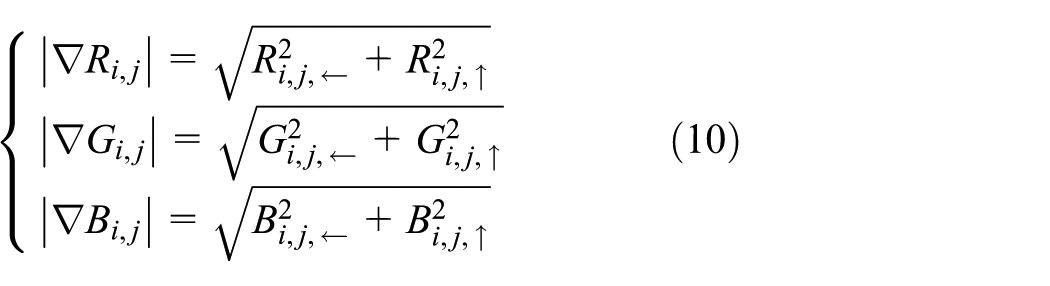
where
In total, 7 spam high-pass filters and 24 min–max high-pass filters used in the CRMQ1 algorithm are applied to three gradient amplitude images
Round and quantize each residual, and truncate the residuals greater than the truncation threshold T to T, the residuals less than

For three gradient amplitude residual images of each filter

where
The rules of symbolic symmetry and direction symmetry given in Goljan et al. 19 are applied to merge the co-occurrence matrices of 7 spam residual images and 24 min–max residual images to obtain 7 × 100-dimensional spam residual image co-occurrence matrix feature and 24 × 196-dimensional min–max residual image co-occurrence matrix feature, which constitute 5404-dimensional steganalysis feature based on channel gradient amplitude correlation.
Correlation coefficient of gradient amplitude image of different channels.
Steganalysis algorithm based on channel gradient correlation
This section presents a color image steganalysis algorithm based on channel gradient correlation which combines the steganalysis feature based on channel gradient amplitude correlation with the steganalysis feature based on channel gradient direction consistency and the SCRMQ1 feature. Because the supervised learning technique usually outperforms the unsupervised learning technique in both accuracy and efficiency, 27 the supervised learning technique is more commonly used in steganalysis. With the increase of dimension of steganalysis feature, ensemble classifier has become a popular learning tool for steganalysis. Therefore, it is also used in the proposed color image steganalysis algorithm. The algorithm is composed of steganalyzer training and stego image detection, the detailed procedures of which are described in Algorithms 1 and 2.


Experimental results and analysis
Experimental settings
In this section, 10,000 color images in “tiff” format generated in the above section are used to test the performance of the proposed algorithm and existing color image steganalysis algorithms. Two typical adaptive steganography algorithms WOW 6 and S-UNIWARD 7 with the payloads of 0.05, 0.1, 0.2, 0.3, and 0.4 bpc are used. In total, 100,000 color stego images were obtained.
In the experiment, 5000 images in 10,000 cover images are randomly selected as training cover images, and the corresponding 5000 stego images are used as training stego images. The remaining 5000 cover images and 5000 stego images are used as the test cover and stego images, respectively. As a result, there are 10 groups of training image set and test image set, each group containing 5000 cover images and 5000 stego images. Ensemble classifier 28 is used as the steganalyzer, and the average testing errors under equal priors are taken to evaluate the steganalysis performance that

where
Performance of steganalysis features based on channel gradient amplitude correlation
For contrast experiment, the algorithms proposed in Abdulrahman et al.15,18 are tested. Tables 1 and 2 show the average testing errors of three steganalysis algorithms for the detection of WOW and S-UNIWARD steganography with different payloads. Figures 8 and 9 show the receiver operating characteristic (ROC) curves of three steganalysis algorithms for WOW and S-UNIWARD with the payloads of 0.05, 0.1, and 0.3 bpc, respectively. It can be seen that, for the detection of both WOW and S-UNIWARD steganography, the proposed steganalysis algorithm outperforms the steganalysis algorithms in Abdulrahman et al.15,18 And with the increasing payload, the difficulty of detection will decrease, which makes the improvement more difficult and the crossings of curves move forward. In addition, the steganalysis reliability measurements 29 have been calculated and are shown in Figures 8 and 9, which can describe the area under the curve. The bigger the value, the better the steganalysis performance. For WOW steganography, the maximum decreasing amplitude of average test errors reaches 1.02% at the payload of 0.05 bpc compared to the method of Abdulrahman et al. 18 and 0.85% at the payload of 0.1 bpc compared to the method of Abdulrahman et al. 15 Regardless of the payload, the steganalysis reliability measurement of the proposed algorithm is the maximum of the three. For S-UNIWARD steganography, the maximum decreasing amplitudes of average test errors reaches 0.95% at the payload of 0.05 bpc compared to the method of Abdulrahman et al. 18 and 0.67% at the payload of 0.1 bpc compared to the method of Abdulrahman et al. 15 The steganalysis reliability measurement of the proposed algorithm is also the largest of the three.
Average test errors of different steganalysis algorithms for WOW.
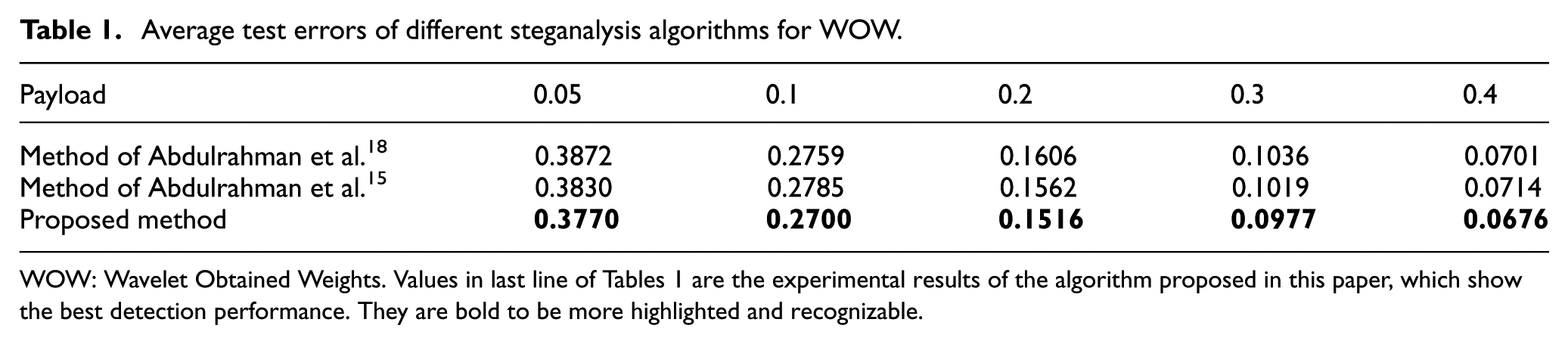
WOW: Wavelet Obtained Weights. Values in last line of Tables 1 are the experimental results of the algorithm proposed in this paper, which show the best detection performance. They are bold to be more highlighted and recognizable.
Average test errors of different steganalysis algorithms for S-UNIWARD.
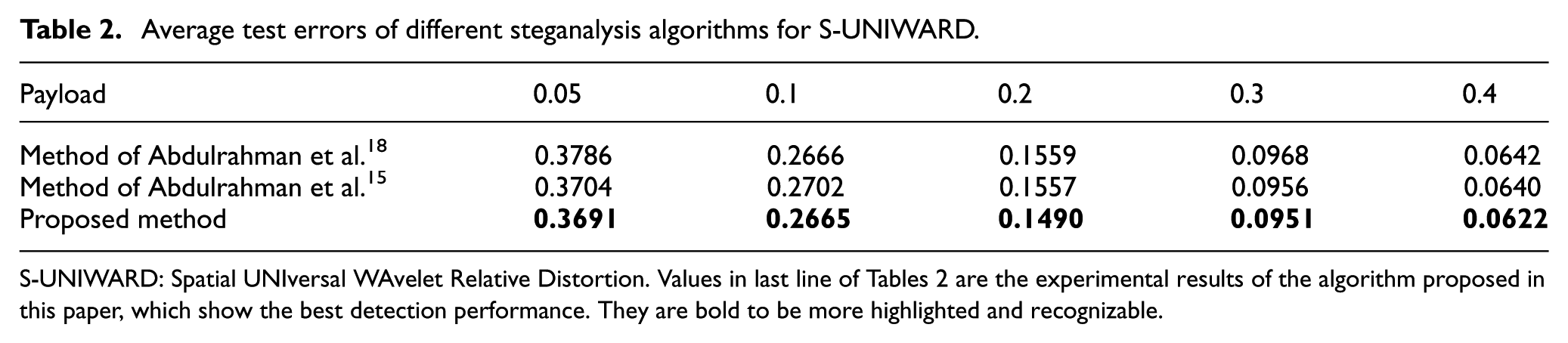
S-UNIWARD: Spatial UNIversal WAvelet Relative Distortion. Values in last line of Tables 2 are the experimental results of the algorithm proposed in this paper, which show the best detection performance. They are bold to be more highlighted and recognizable.

ROC curves of different steganalysis algorithms for WOW at the payloads of (a) 0.05 bpc, (b) 0.1 bpc, and (c) 0.3 bpc.

ROC curves of different steganalysis algorithms for S-UNIWARD at the payloads of (a) 0.05 bpc, (b) 0.1 bpc, and (c) 0.3 bpc.
In Abdulrahman et al., 18 the co-occurrence matrix features are extracted from the three color channels and then combined to detect steganography without considering the integrity of the color image. In Abdulrahman et al., 15 the gradient vector directions of each channel are used to describe the direction of texture change in each channel, and the angle between channels is represented by the angle between their gradient vectors. Compared with Abdulrahman et al., 18 the correlation between channels is used in Abdulrahman et al. 15 However, it only considers the consistency of the texture direction of each channel. This article depicts the consistency of the texture variation intensity between channels by the distribution of gradient amplitudes of each channel. It captures the changes of correlation between different channels from direction and intensity, which could further improve the steganalysis performance.
Conclusion
The current research on digital image steganalysis mainly focuses on the single-color channel. Among the existing color image steganalysis algorithms, the detection algorithm based on channel geometric transformation measures has higher detection accuracy than the other detection algorithms. But it fails to utilize the correlation between the gradient amplitudes of different color channels and still has a large detection error rate. Thus, this article points out that color image steganography will weaken the correlation between the gradient amplitudes of different color channels and proposes a color image steganalysis algorithm based on channel gradient correlation. The experimental results show that, compared with the existing algorithms, the proposed algorithm reduces the average detection error rate of the existing algorithms for WOW and S-UNIWARD steganography, and the maximum decreasing amplitudes reach 1.02% and 0.95%.
The main work of this article focuses on extracting the features that can describe the correlation of the different channels, but the dimensionality of features is always high, which will take up lots of time and space when being extracted and saved. If the feature dimensionality can be reduced 30 and the algorithm in classification stage can be improved, 31 the performance of detection can be more effective. In addition, the image is just one of the types of cover which may be maliciously used, while text, voice, protocol packets, and other types of data may also be utilized to transit secret confidential information.32–34 Therefore, how to reliably detect the hidden secret information of various multimedia data transmitted in the Internet of Things should be solved for ensuring the security of the Internet of Things.
Footnotes
Handling Editor: Giancarlo Fortino
Declaration of conflicting interests
The author(s) declared no potential conflicts of interest with respect to the research, authorship, and/or publication of this article.
Funding
The author(s) disclosed receipt of the following financial support for the research, authorship, and/or publication of this article: This work was supported by the National Natural Science Foundation of China (Nos 61772549, 61872448, U1736214, 61602508, and 61601517).
