




Abstract
With the development of Internet of things, a large number of embedded devices are interconnected by ad hoc and wireless network. The embedded devices can work correctly, only by ensuring correct communication between them. Identifying modulation scheme is the precondition to ensure the correct communication between embedded devices. However, in the multipath channel, ensuring the correct communication between embedded devices is a great challenge. Multipath channel always exists in the wireless network. However, most of the available modulation classification algorithms are based on ideal channel. It leads to the low-modulation classification probability in multipath channel. To resolve this problem, we propose a novel modulation classification algorithm. The proposed algorithm can classify signal without prior information about multipath channel. We calculate feature by high-order cyclic cumulant and wavelet transform. The feature is robust to multipath channel. The simulation results show that the proposed algorithm can achieve the much better classification accuracy than the available method in multipath channel.
Introduction
With the development of Internet of things (IoT), a large number of embedded devices are interconnected by ad hoc and wireless networks.1,2 Every connected embedded device can communicate with each other. There will be explosive data and massive interconnections in the wireless network.3,4 In this situation of explosive and massive interconnections, how to ensure the correct communication between embedded devices is a great challenge. Only by ensuring the correct communication, the right information can be received and the cooperation between embedded devices becomes possible.5,6 Wireless network is most susceptible to multipath fading, and effects of multipath fading always exists in the wireless network.7,8 In multipath fading channel, it is difficult to identify modulation schemes correctly and we cannot receive the right information. 9 Therefore, modulation classification in multipath channel is the key technology of signal processing in wireless network.
Modulation classification is widely used in civil and military fields. 10 In the military field, modulation classification is the precondition to interfere and intercept the communication of enemies. 11 Modulation classification also is the key to communication intelligence system. 12 Only by correctly identifying the modulation schemes, we can formulate effective reconnaissance and jamming strategies. 13 In the civil field, modulation classification is mainly applied to wireless spectrum management for signal identity and interference confirmation. 14 The wireless communication department needs to monitor and manage the communication frequency spectrum to prevent illegal user and interference of wireless spectrum. In this way, we can protect legal communication from being affected.15,16 The use of modulation classification in spectrum monitoring equipment helps us to improve the ability of distinguishing different users, determine the properties of unknown interference signal, and can help manager to solve problems. 17
Modulation classification methods are mainly divided into two categories: maximum likelihood–based method and feature-based method.18,19 The maximum likelihood–based method is a modulation classification method based on probability theory and hypothesis testing.20,21 First, we need to know the signal statistical characteristics. Then by theoretical analysis and derivation of the signal statistical characteristics, we can obtain one or more statistical tests. Finally, we can classify modulation schemes based on appropriate threshold.22,23 Xu et al. 24 proposed an automatic modulation classification method based on likelihood function. In their work, they studied the various classification solutions obtained by likelihood ratio test and discussed the detailed features related to all major algorithms. Chavali and Da Silva 25 used the expectation maximization (EM) algorithm to solve the maximum likelihood estimation of signal fading factor and Gaussian mixture model parameters. The hybrid likelihood ratio test (HLRT) was used to classify amplitude phase modulation schemes. Headley and Da Silva 26 used the quasi HLRT based on moment estimation to classify amplitude phase modulation schemes in non-synchronous fading channel. By oversampling the baseband received signal, Headley derived the moment estimation closed-form solution of received signal amplitude, noise variance, timing deviation, and phase offset. Using the Gibbs sampling, Liu et al. 27 estimated the posterior probability distribution of modulation schemes. Then they used posterior probability distribution as test statistic and used test statistic to classify the linear digital modulation schemes. The advantage of this method is that parameter estimation is not needed. But the computational complexity of this method is high.28,29 The maximum likelihood–based method is optimal in the Bayesian criterion, but its computational complexity is high and is easy to have the problem of model mismatch.30,31
The feature-based method accomplishes the modulation classification by extracting features from the received signal.32,33 The key to implement this method is how to find the features that can effectively classify different modulation schemes, that is, selection of feature space.34,35 Ozdemir et al. 36 proposed a modulation classification method based on high-order cumulants. The idea was first to use the independent component analysis to estimate the multiple-input multiple-output (MIMO) channel matrix, second to calculate the estimate of the transmitted signal vector, finally to calculate the fourth-order cumulants of transmitted symbol and fourth-order cumulants formed the feature vector. This article assumed that the feature vector obeyed the joint Gaussian distribution. This article also derived the mean and covariance matrix of the feature vector and used the maximum likelihood criterion to construct the likelihood ratio classifier to classify the modulation schemes. Dan et al. 37 proposed a new automatic modulation classification algorithm using wavelet analysis and wavelet support vector machine. The classifier can identify ten modulation schemes, and rate of correct classification is over 96.5% when signal-to-noise ratio (SNR) is not lower than 3 dB. Wang and Wang 38 proposed a modulation classification method based on cyclic cumulants. First, the author derived the cyclic cumulant of the first, second, and fourth orders. Second, the author found out the differences between the spectral peaks of different signals under specific cyclic cumulant. Finally, the author used the constant false-alarm rate (CFAR) detection algorithm to complete modulation classification. Zhang et al. 39 proposed an algorithm combining high-order cumulants and convolutional self-encoders to achieve modulation classification. The classification performance of feature-based method is suboptimal, but its computational complexity is low and it is more robust to signal model mismatch than maximum likelihood–based method. 40
All the methods mentioned above are efficient to classify signal in Gaussian channel. However, modulation classification of binary frequency shift keying (2FSK), binary phase shift keying (BPSK), and 16-quadrature amplitude modulation (16QAM) in multipath channel have not been studied. In this article, we propose a novel modulation classification algorithm in multipath channel. The proposed algorithm can avoid the multipath channel effect by combining wavelet transform and higher order cyclic cumulants. The proposed algorithm only need to know the signal carrier frequency and does not require more prior information such as the path number and noise variance.
The remaining parts of this article are organized as follows. In section “Mathematical model and classification algorithm,” we introduce mathematical model and modulation classification algorithm. The results and analysis are presented in section “Simulation results and analysis.” Conclusions are drawn in section “Conclusion.”
Mathematical model and classification algorithm
When the time delay

where

where
Wavelet transform is a time–frequency analysis method. Compared with Fourier transform and short-time Fourier transform, wavelet transform is based on the localization analysis of time and frequency. 44 Wavelet transform can multi-scale refine the signal by calculating flex and transition. It can extract feature information of the signal effectively, and it can find the location and the amplitude of outliers. 45 Therefore, wavelet transform is known as “mathematical microscope” for analyzing signals. Wavelet transform has the ability to extract the local feature of signals in both time domain and frequency domain. Wavelet transform can detect transient anomalies in normal signals easily. Wavelet transform is more and more widely used in the fields of communication, signal analysis and processing, speech synthesis, pattern recognition, military electronic countermeasures and weapon intelligence, and computer classification and recognition. 46
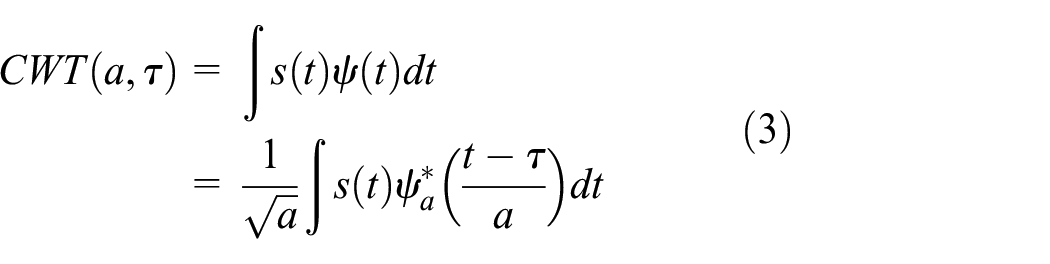
The continuous wavelet transform (CWT) of
where

where
The properties of CWT are as follows 49
If CWT of
If CWT of
If CWT of
The wavelet transform with different scale factors
It is not unique to reconstruct the original signal using CWT. Because of its redundancy, CWT can be discretized, and the discretization results are satisfactory.
Generally, wavelet functions have two characteristics: first, the definition domain of wavelet function is limited, and it has compact support or approximate compact support in the time domain. In principle, any function satisfying the admissibility condition can be wavelet function. But to make the wavelet generating function have better local characteristics in the time–frequency domain, we often choose the real or complex function with compact support or approximate compact support (local in time domain) and regular type (local in frequency domain) as the wavelet function. Second, the wavelet function has a positive and negative undulatory property because its direct current (DC) component must be zero. Because Haar wavelet has good selectivity in time domain and frequency domain and is easy to calculate, we choose Haar wavelet as mother wavelet in this article. 50
According to the above properties of wavelet transform, we know that in multipath channel, the wavelet transform of received signal equals the sum of wavelet transform on each path signal. The wavelet transform of Gaussian noise approximates to zero. Therefore, without considering Gaussian noise, the wavelet transform of received signal in multipath channel is given by

where
The properties of cyclic cumulants are as follows 51
The cyclic cumulants of stationary Gauss white noise more than second-order are always zero.
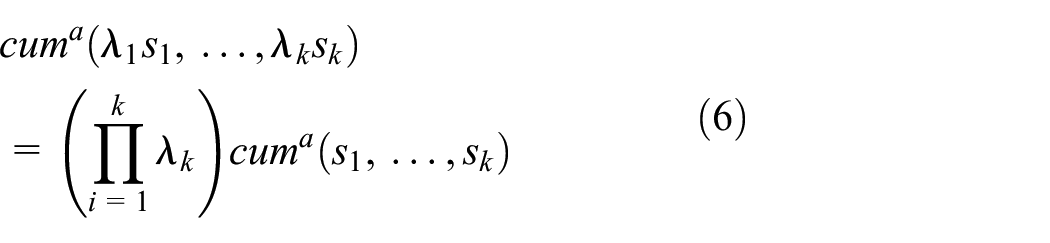
If
If the random variables

Cyclic cumulants have symmetry on variables, and we can get the following equation

where
In the modulation classification algorithm, cyclic cumulants are computed by cyclic moments. According to the definition of cyclic moments, the kth-order cyclic moments of cyclostationary signal s(i), can be estimated by the sample cyclic moments

If

then we can get the following equations


where


The fourth-order cyclic cumulant of signal

where
The fourth-order cyclic cumulant of noise


When the cyclic frequency satisfies

Therefore, when the cyclic frequency satisfies

where
Wavelet transform belongs to linear transformation, satisfies the principle of linear superposition, and has translation invariance. So in multipath channel, the wavelet transform of received signal equals the sum of wavelet transform on each path signal. The signal with time delay for more than one symbol period is independent from the original signal, so each path signal is still independent after wavelet transform. To simplify the mathematical derivation, we make

We define the feature

where
By the above analysis, the flow chart of the proposed algorithm is shown in Figure 1.
Calculating the wavelet transform of the received signal
Calculating the fourth-order cyclic cumulants of
Calculating the fourth-order cyclic cumulants of
Calculating the eigenvalue

Algorithm flow chart.
Simulation results and analysis
In this section, we make a lot of experiments to verify the effectiveness and performance of the proposed algorithm. In multipath channel, we test a variety of modulation schemes, including 2FSK, BPSK, minimum-shift keying (MSK), and 16QAM. Sampling frequency is 320 MHz. Carrier frequency is 40 MHz. Symbol transmission rate is 2 Mbps. Number of symbol is 2000. Phase offset is distributed randomly between 0 and
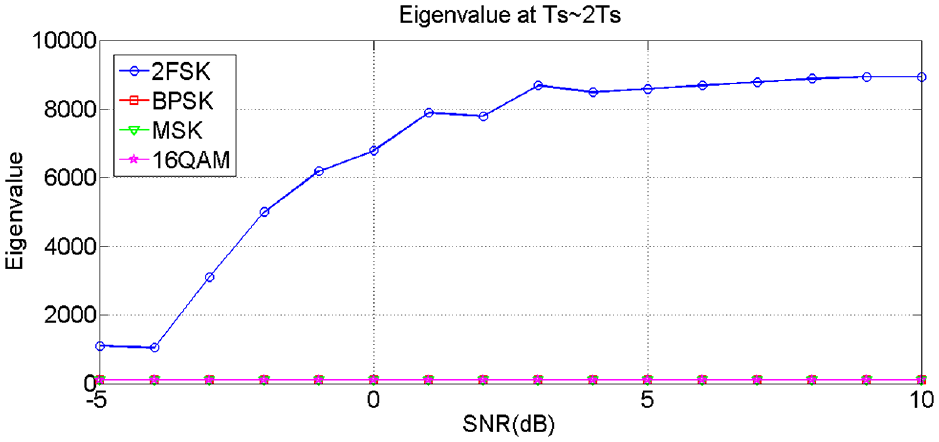
Figure 2 is the eigenvalue curve of signal with SNR when the path number is 3, time delay is distributed randomly between
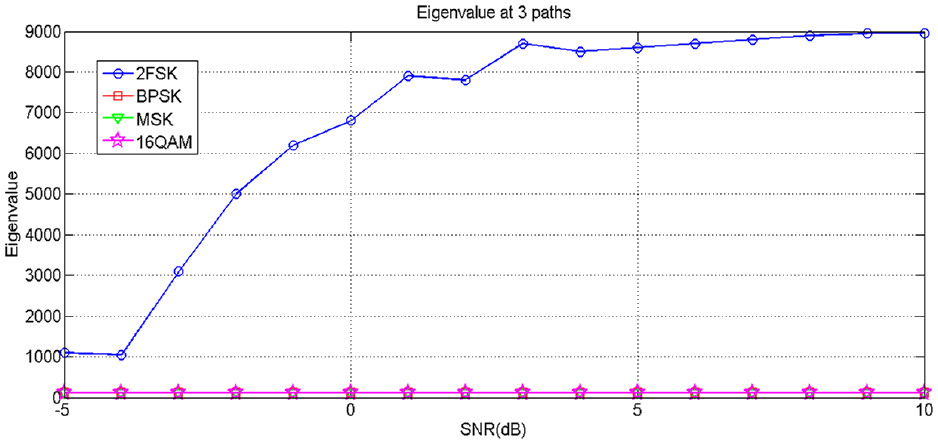
Eigenvalue curve with SNR when path number is 3.
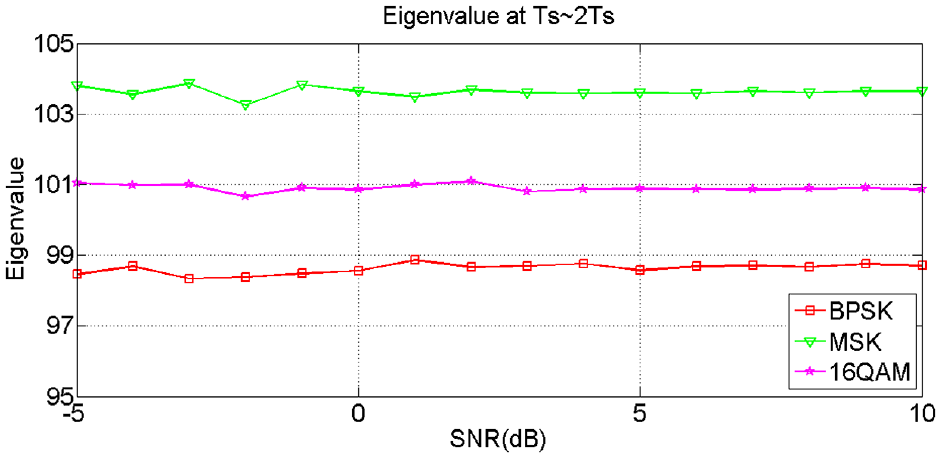
Because the eigenvalue of 2FSK is much larger than the other signals, to observe conveniently, Figure 3 is the result of removing 2FSK. From Figures 2 and 3, we can see that eigenvalues of different signals have significant distinction and eigenvalues do not change obviously with SNR. It is shown that eigenvalue is less affected by SNR.

Eigenvalue curve with SNR when path number is 3 without 2FSK.
To verify the objectivity of the results, the path number is changed to 5 and 8 under the same conditions. The results are shown in Figures 4–7.

Eigenvalue curve with SNR when path number is 5.

Eigenvalue curve with SNR when path number is 5 without 2FSK.

Eigenvalue curve with SNR when path number is 8.
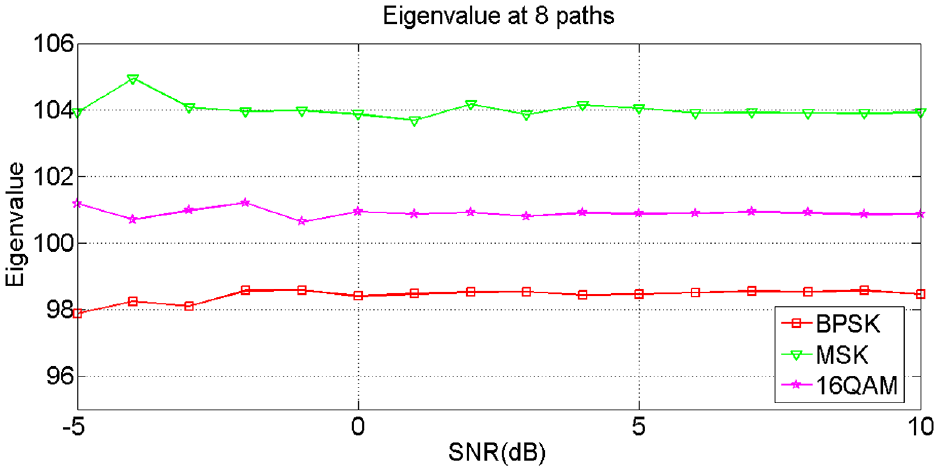
Eigenvalue curve with SNR when path number is 8 without 2FSK.
It can be seen from Figures 2 to 7 that the eigenvalues do not change greatly with the path number when SNR is more than −5 dB. It is shown that eigenvalue proposed in this article is less affected by the path number.
Figures 8–13 are the eigenvalue curve with SNR when the path number is 3, the time delays are
Eigenvalue curve with SNR when time delay is
Eigenvalue curve with SNR when time delay is

Eigenvalue curve with SNR when time delay is

Eigenvalue curve with SNR when time delay is

Eigenvalue curve with SNR when time delay is

Eigenvalue curve with SNR when time delay is
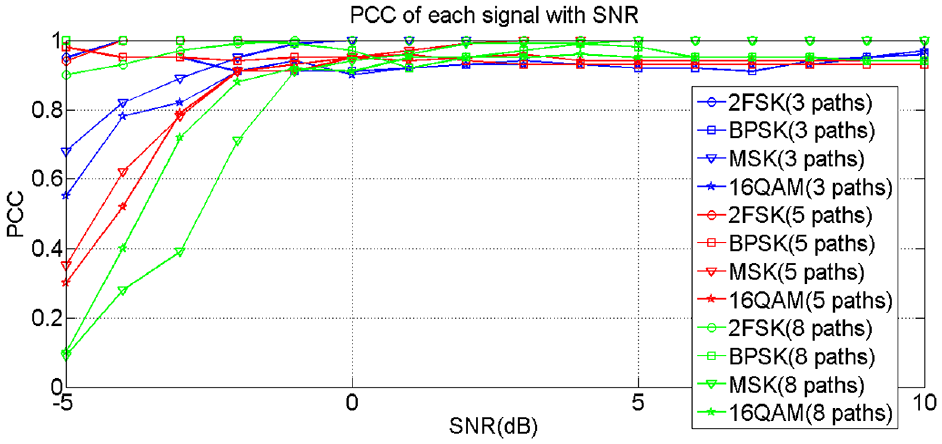
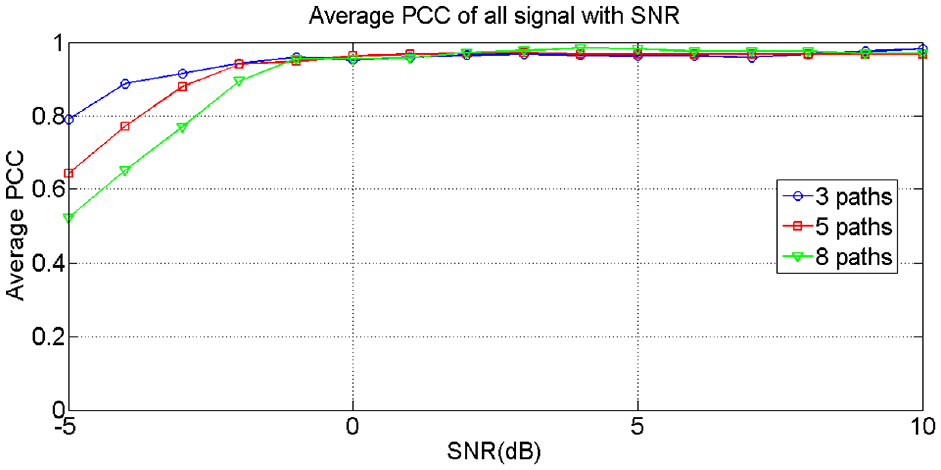
Figure 14 shows the probability of correct classification (PCC) of each signal with SNR when the path numbers are 3, 5, and 8. Figure 15 shows the average PCC of all signal with SNR when the path numbers are 3, 5, and 8. From Figure 14, we can see that PCC of each signal are all above 90% at SNR −1 dB. From Figure 15, when SNR is more than −1 dB, we can see that average PCC do not have obvious change even when the path number is different. It is shown that the average PCC is less affected by the path number.
Different paths numbers, PCC of each signal with SNR.
Different paths numbers, average PCC of all signal with SNR.
Figure 16 shows the PCC of each signal with SNR when the time delays are

Different time delays, PCC of each signal with SNR.
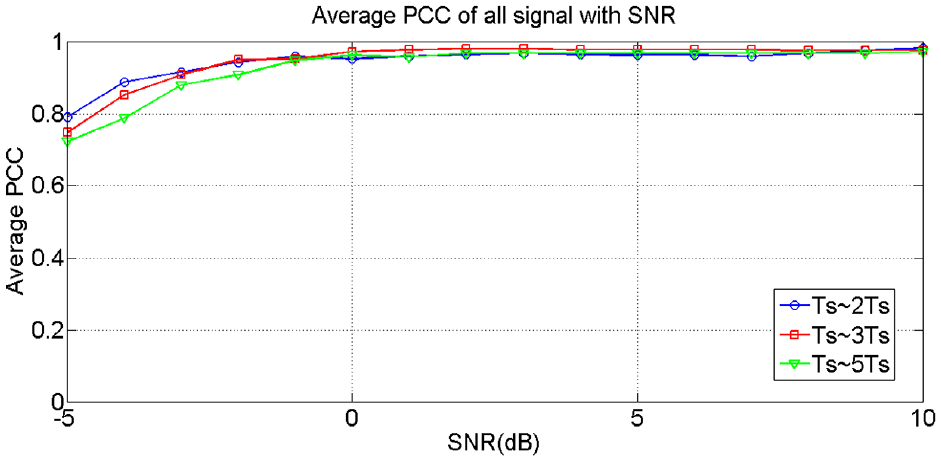
Different time delays, average PCC of each signal with SNR.
We compare the performance of the proposed algorithm in this article with the proposed algorithm by Xi and Wu.
53
The results are shown in Figures 18 and 19. The dotted line is the algorithm performance curve proposed in this article. The solid line is the algorithm performance curve proposed by Xi. Figure 18 shows the average PCC comparison with SNR when the path numbers are 3, 5, and 8. Figure 19 shows the average PCC comparison with SNR when the time delays are

Different paths numbers, average PCC in comparison with SNR.

Different time delays, average PCC in comparison with SNR.
Average PCC comparison at SNR = 0 dB.

PCC: probability of correct classification.
All the above simulation experiments can be run in MATLAB. Length of the proposed algorithm code is less than 3000. For running 100 Monte Carlo experiments, the total time taken is not more than 3 min. When the proposed algorithm is running, not more than 20% of the computational resources are occupied. It shows that the computational complexity of the proposed algorithm is low. It is very suitable for system with high real-time requirement.
Conclusion
In this article, we studied the modulation classification in multipath fading channel and proposed a novel algorithm. Theoretical deduction proves that the proposed algorithm can effectively suppress the effects of multipath channel. We conduct a large number of experiments under different simulation conditions in this article. The results shows, even at low SNR, the proposed algorithm still has high correct classification rate. When SNR is not lower than −1 dB, correct classification rate of 2FSK, BPSK, MSK, and 16QAM are all above 90%. And correct classification rate is less affected by the number of multipath and time delay. Moreover, the computational complexity of the proposed algorithm is low. The proposed algorithm can be used in system with high real-time requirement.
Footnotes
Handling Editor: Daniel Gutierrez-Reina
Declaration of Conflicting Interests
The author(s) declared no potential conflicts of interest with respect to the research, authorship, and/or publication of this article.
Funding
The author(s) disclosed receipt of the following financial support for the research, authorship, and/or publication of this article: This paper is supported by the National Natural Science Foundation of China (No. 61671167) and the paper is funded by the International Exchange Program of Harbin Engineering University for Innovation-oriented Talents Cultivation.
