




Abstract
In this article, we study secure multipath routing with energy efficiency for a wireless sensor network in the presence of eavesdroppers. We consider two objectives: (1) the multipath routing scheme for maximising the energy efficiency with security constraints and (2) the multipath routing scheme for maximising the secrecy capacity. The binary erasure channel model is adopted to describe the wireless channel states among neighbouring nodes. Based on the binary erasure channel model, the problem of multipath routing degrades to a problem of bit allocation for each path. We formulate the problems and find that the problems are both quasi-convex. For the first one, it is a linear fractional optimisation problem. The optimal solution is obtained by the Charnes–Cooper transformation. For the second one, we propose an iterative algorithm to obtain the
Introduction
Background
Multipath routing in multihop networks has been extensively studied for distributed sensor networks. 1 There are various advantages of multipath routing in wireless sensor networks (WSNs), such as load-balancing, reliability enhancement, and quality of service (QoS) improvement. 2 In order to reduce the end-to-end delay and routing overheads, Marina and Das 3 proposed the ad hoc on-demand multipath distance routing protocol (AOMDV), which is a multipath extension to the ad hoc on-demand distance routing protocol (AODV). Split multipath routing (SMR) was proposed to utilise available network resources efficiently and prevent nodes of the route from being congested in heavily loaded traffic situation. 4 Multipath routing together with diversity coding has been adopted to guarantee the probability of reconstructing the original information received at the destination. 5 In spite of these benefits, multipath routing is less energy efficient than single-path routing, since more intermediate nodes participate into transmissions.
Moreover, energy efficiency (EE) is one of the most pivotal metrics to evaluate the performance of WSNs, for the reason that devices usually work with limited power supply. Chen et al. 6 formulated the energy consumption minimisation problem as an optimisation problem in a multiple input multiple output (MIMO) multihop network and investigated the trade-off between the EE and the bandwidth efficiency. Vahid Nazari Talooki et al. 7 proposed a new routing protocol (E2AODVv2) to provide a weighted and flexible trade-off between energy consumption and the load dispersion.
Since devices are often deployed in open areas, WSNs could be eavesdropped easily. Jawandhiya et al. 8 summarised different attacks in multihop networks, which were active or passive to interrupt or wiretap information transmission. The information-theoretic security (ITS) has become a great issue9,10,11 since Wyner’s 12 work in 1975. It also lead Choi to investigate the optimal multipath routing scheme for the throughput maximisation under ITS constraints. 11
Related work
In WSNs, sensor nodes can play different roles: the helpers which help to relay signals, the jammers which send jamming signals to interfere the transmitting, and the potential eavesdroppers which might wiretap signals. If some sensor nodes are captured by eavesdroppers, they are thought to be untrusted. The beamforming technique for physical layer security and its performance is discussed with untrusted relays in Mo et al., 13 Wang et al., 14 and Aggarwal and Trivedi, 15 where the relays played as both helpers and potential eavesdroppers.
Choi 11 proposed a novel scene of eavesdroppers wiretapping the WSN in which there are four types of nodes: a source node (SN) transmits packets to a destination node (DN) through relay nodes (RNs). Some of RNs are captured and become eavesdroppers (ENs). The SN cannot check out the ENs since they participate in the transmission from the SN to the DN as normal RNs. In order to prevent the ENs from decoding the transmitted packets, the SN takes multipath routing to ensure the transmission security. In this condition, the binary erasure channel (BEC) model was adopted to describe channels between neighbouring nodes in Choi, 11 which is also adopted in Tsirigos and Haas.5,16
In this article, we use the same system model and the channel model as in Choi. 11 Instead of aiming at the throughput maximisation, we focus on the EE maximisation of the network with the ITS constraint and the secrecy channel capacity. The contributions of this article can be summarised as follows:
We allocate each path with a certain probability that the SN may send information through this path. We derive the achievable channel capacity of the network based on the BEC model with respect to the allocated probabilities of all the paths. Then, we formulate the optimisation problem of the EE maximisation with the ITS constraint and find the optimal multipath routing scheme with the Charnes–Cooper transformation.
As the ITS constraint depends on the secrecy channel capacity of the network, the optimisation problem of the secrecy channel capacity of the network is derived. An iterative algorithm is proposed to solve the optimisation problem and find out the maximal required secrecy channel capacity.
Performance analysis of the ITS routing is carried out under two conditions: (1) the erasure probabilities of all the links are equivalent and (2) the erasure probabilities are independent and identically distributed (IID). Constraint conditions are derived for the ITS routing.
The organisation of this article is presented as follows. The system model and related concepts are described in section ‘System model’. In sections ‘Bit allocation scheme for maximising the EE with security constraints’ and ‘Bit allocation scheme for maximising the secrecy channel capacity’, two optimisation problems corresponding to the above two objectives are derived, and the algorithms are also proposed to find solutions. Performance analysis is studied in section ‘Performance analysis’. Section ‘Simulation results’ presents the simulation results and validates the efficiency of our proposed algorithms. Finally, we conclude the article in section ‘Conclusion’.
System model
For multipath routing in multihop WSNs, it is difficult to derive the capacity of the network from the perspective of physical layer, since the signals are transmitted through a number of intermediate nodes before they reach the destination. Thus, in this article, we use the BEC model to simplify the channels between nodes based on the following known results.
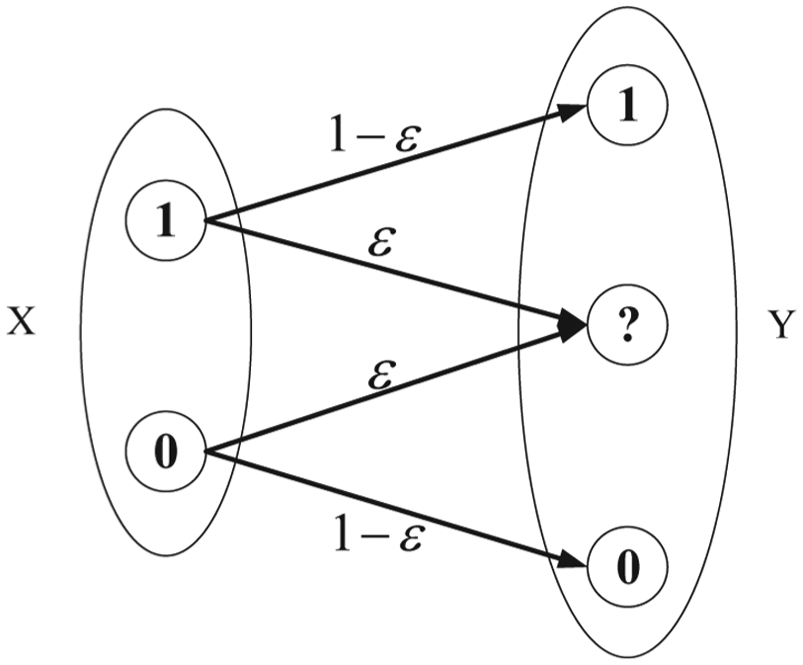
Binary erasure channel model.
Properties 1 and 2 can be intuitively obtained according to Axiom 1. Hence, the definite procedures of the proof are omitted for simplicity and clarity.
Multihop parallel network
In this article, we consider a multihop WSN with multipaths as is illustrated in Figure 2. Each link between neighbouring nodes is modelled as a BEC, the S node (SN) is the transmit node and the D node (DN) is the receive node. In the network, the SN sends the information to the DN through K disjoint multipaths between them. Erasure probabilities of all the links are available to the SN. There is one or more smart eavesdropping nodes (ENs) which the SN cannot recognise. They behave like normal nodes and cooperate to eavesdrop the information. The SN is to distribute a message sequence along multipaths according to a certain probability distribution. The probability distribution can be modified to realise different routing schemes. Key parameters of the network are described in Table 1.
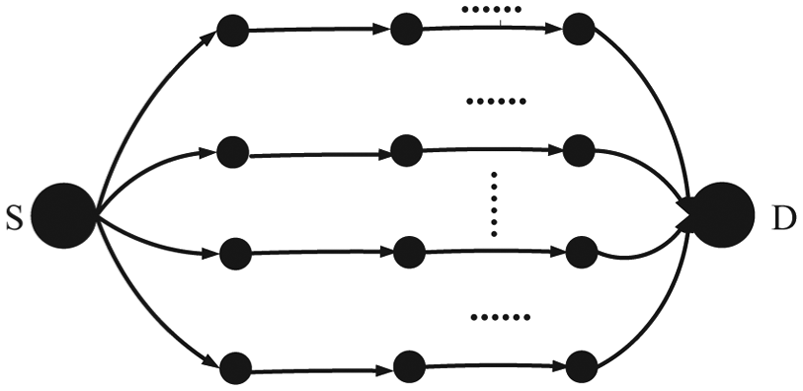
Multihop parallel network with BEC channel model.
Parameter definition table of the multihop parallel network.

SN: source node; DN: destination node.
For the network in Figure 2, the capacity of the channel connecting the SN to the lth intermediate node along the kth path is
Energy consumption model
As is mentioned in Chen et al. 6 and Talooki et al., 7 energy consumption is a critical issue in multihop WSNs. Measured results on devices show that consumed energy grows linearly with the number of bits transmitted. 17 In El-Moukaddem et al. 17 and Heinzelman et al., 18 the following energy consumption model was considered

where
In this article, we also adopt this energy-consuming model in equation (1) to take the EE into account in secure multipath routing.
Bit allocation scheme for maximising the EE with security constraints
In this section, we study ITS routing with EE maximisation. The network’s EE metric can be defined as information bits transmitted per Joule, which is given by

where E and C denote the energy consumed by the source sending one symbol and the channel capacity of the network, respectively.
Channel capacity
According to Property 1, for the kth path in the network, the achievable channel capacity of the channel connecting SN to the lth intermediate node is denoted as

and the sum channel capacity becomes

where

Energy consumption
Using equation (1), the energy consumed by the kth path per unit time can be expressed as

where
The energy consumed by the whole network is

Let

The ITS constraint
According to Bloch et al., 9 the secrecy channel capacity is defined as

where
In this article, the ITS constraint is defined as

where
The SN has no knowledge of how many ENs there are and where they are deployed. Since bit allocation by the SN depends on the number of ENs, the SN has to consider the worst condition. Assuming that there are m ENs (
As derived in Choi,
11
let

Let
If the SN knows the index set

In this article, we assume that the SN has no information about eavesdroppers’ deployment. Considering the worst condition, the eavesdropping channel capacity becomes

After substituting equations (4), (9) and (11) into equation (10), the ITS constraint can be rewritten as

For

After substituting equation (13) into equation (12), we can obtain that for

In order to simplify equation (14), we define a series of


Then, (14) can be expressed as follows

where
Problem formulation and the optimal bit allocation scheme
By substituting equations (5) and (8) into equation (2), the EE of the multihop network can be formulated as

We define the EE of transmission along the kth path as

Without loss of generality, we assume that the EE of transmission along the first path is the largest, that is,

Clearly, the optimal EE of the network is obtained when transmitting all the information sequences along the most energy-efficient path. However, such a scheme may not satisfy the ITS constraint. Thus, the problem of maximising EE of the multihop network with the ITS constraint can be formulated as follows.

where
Problem (19) is a quasi-concave problem due to the linear fractional structure of its objective function. These kinds of problems can always be solved by a bisection methodology,
19
where the globally optimal solution is sequentially searched by solving a sequence of feasibility problems. However, in this article, we propose a more efficient method to solve it. We use the Charnes–Cooper transformation to reformulate (19) into a convex problem. Let
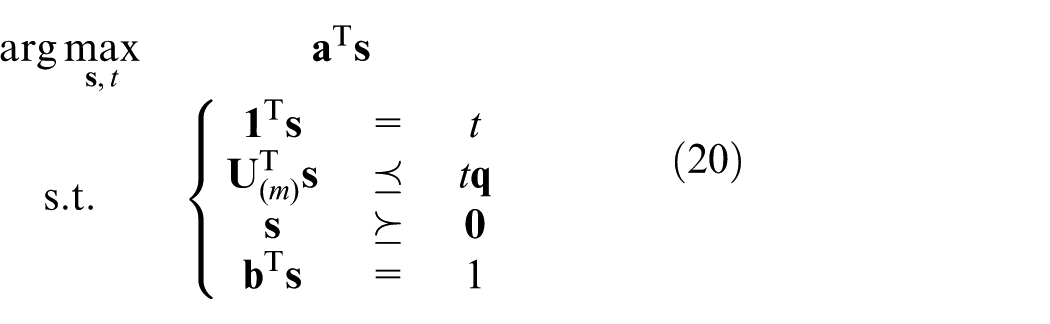
Since equation (20) is a linear problem, we can solve it by linear programming and get the optimal solution, which is denoted by
Bit allocation scheme for maximising the secrecy channel capacity
In this section, we turn our attention to the second target, that is, the bit allocation scheme for maximising the secrecy channel capacity.
According to equations (4), (9), (10) and (11), we can formulate the problem as follows.

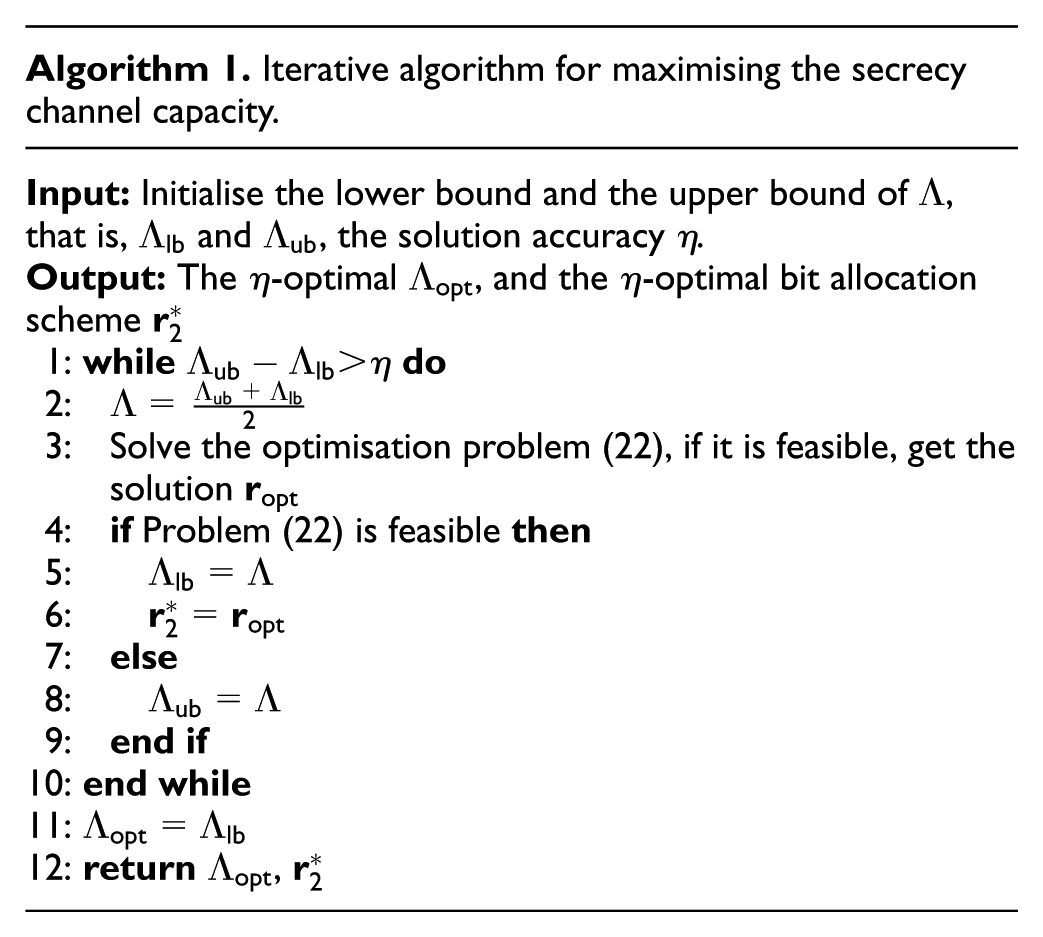
It is obvious that the problem in equation (21) is a quasi-convex problem. According to Boyd and Vandenberghe,
19
we could use the bisection search algorithm to solve the problem. Using the bisection method, we can formulate a sub-optimisation problem with a variable parameter

Clearly, if
For a given
Performance analysis
Since the solution to Formulation 1 does not always exist, it is important to know the probability that there exists a feasible bit allocation scheme according to Formulation 1. In this section, we analyse the impact of different parameters on this probability. It is noteworthy that analytical results in this section are generalised ones of those in Choi.
11
In particular, since the ITS constraints are
Unfortunately, there are too many parameters to obtain simple and intuitive analysis for the above problem. Thus, we consider the following symmetric assumptions for tractable analysis:
Under

As a result, the ITS constraint for one EN (i.e.

Formulation 1 can be reformulated as


The proof procedure is shown in Appendix 1.
This result can be directly generalised to the situation with multiple ENs.

The proof is omitted here for simplicity.
When

This implies that in order to guarantee the ITS constraint, the number of multipaths, K, should grow linearly with m increasing when
Until now, we have discussed the bit allocation schemes for multipath routing when the erasure probabilities are known to the SN. However, we cannot find the optimal bit allocation scheme as shown in Conclusion 1 if the erasure probabilities are unknown. In this case, with a suboptimal bit allocation scheme, the equal bit allocation scheme, we are interested in finding the probability that the equal bit allocation scheme satisfies the ITS constraint. We have the following assumption.
We consider the situation that there is one EN (i.e.
With a single EN, it is observed that

After giving the definition that

we have the following upper bound on


The proof procedure is provided in Appendix 1.
Simulation results
In this section, we present some simulation results. We assume that the number of links per path is the same, denoted by L, and the distance of any neighbouring nodes is equal to 100 m. In the energy consumption model, we let

For comparison, we also consider three different schemes: the optimal energy-efficient single-path routing, the ITS routing and multipath routing with the equal bit allocation scheme. Formulation 1 shows that the ITS constraint is not always feasible. In our simulation, when there is no ITS bit allocation scheme for Formulation 1, the equal bit allocation scheme is adopted. According to the randomness of the erasure probabilities, 1000 times of simulations for each situation are carried out to find the performance of different schemes.
In general, when the number of multipaths increases, the EE of the network using the first scheme could increase and this gain is called multiroute path selection (MRPS) diversity gain. 20 The first scheme is also called the MRPS routing. Although the ITS routing cannot reach the optimal EE of the network with the MRPS routing, it is more secure in the presence of eavesdroppers.
Figure 3 shows the EE of the network and the secrecy channel capacity for the number of multipaths, when

Energy efficiency and secrecy channel capacity of various schemes (
Figure 4 shows the impact of L on the EE and the secrecy channel capacity, when
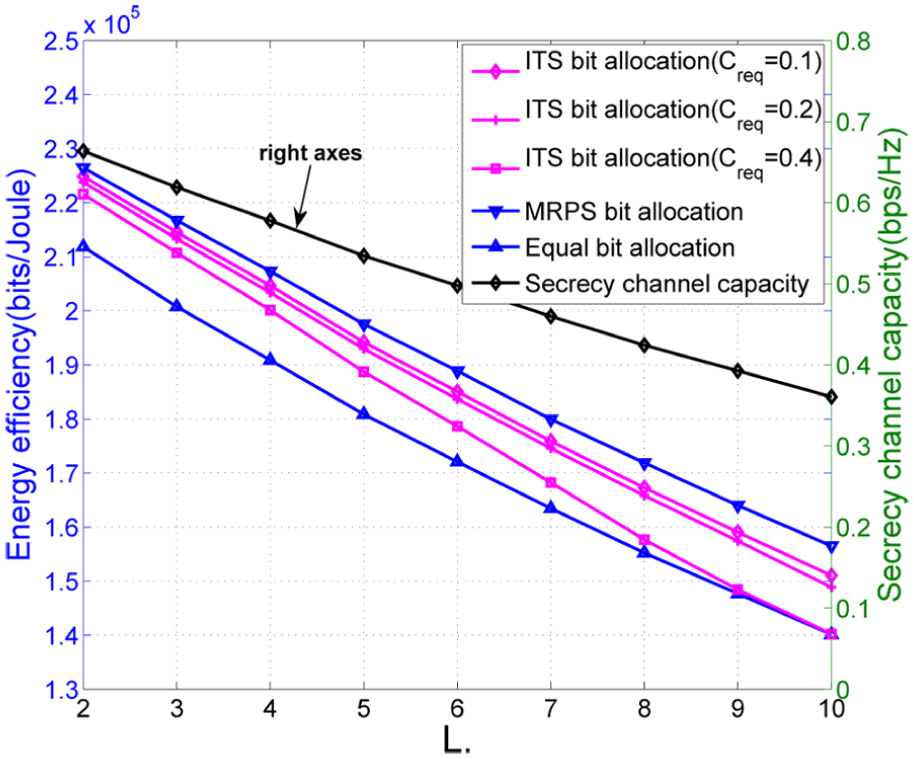
Energy efficiency and secrecy channel capacity of various schemes (
Figure 5 shows the EE and the secrecy channel capacity for various numbers of cooperative ENs, m, when
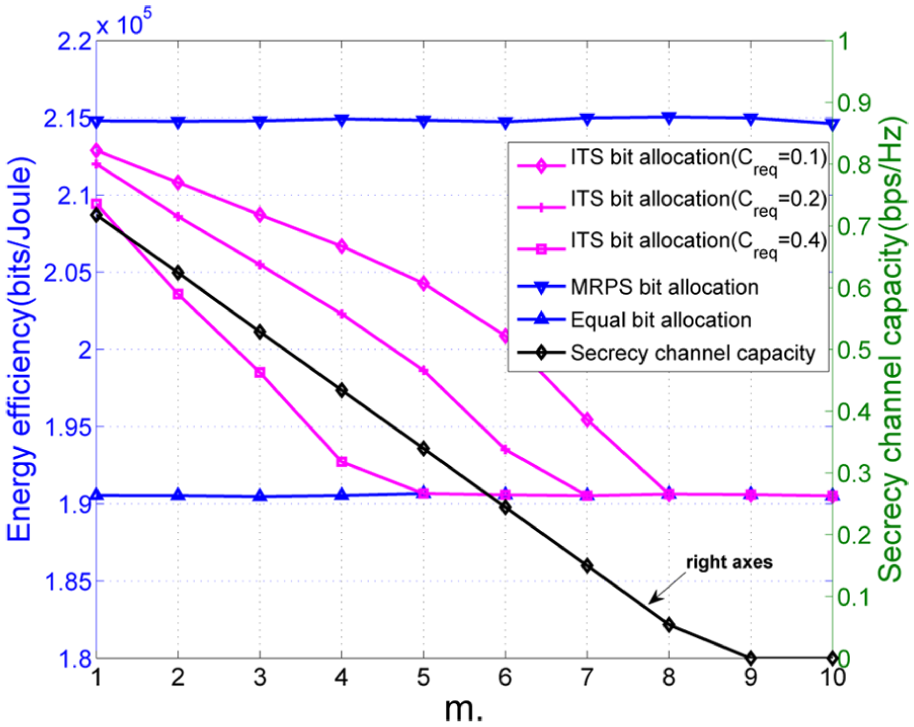
Energy efficiency and secrecy channel capacity of various schemes (
It is clear that the probability of existing ITS routing increases when K increases for a fixed L and
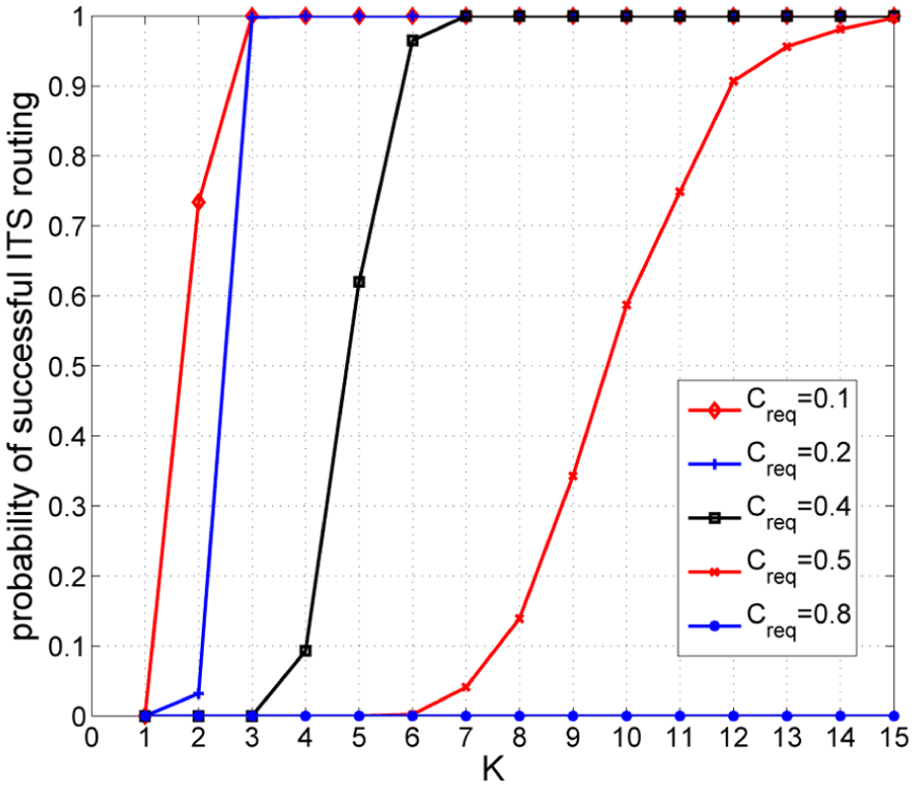
Probability of successful ITS bit allocation (
Conclusion
In this article, we focus on multipath routing for the EE and secrecy channel capacity of WSNs. Based on the BEC model, we transform the problem of designing routing with the ITS constraint into that of bit allocation to multipaths. The problem of maximising the EE of the network with the ITS constraint is formulated and solved with the Charnes–Cooper transformation. The problem of maximising the secrecy channel capacity has been formulated and an iterative algorithm is proposed. The performance analysis is carried out with the constraint of multiple parameters (the number of multipaths, the number of links per path and so on) to the ITS routing. It is shown that as there are more multipaths participating into the transmission, the probability of the ITS routing increases and the transmission becomes more secure. Simulations also verify the results that the ITS routing is more secure, while the EE of the network with ITS routing is lower than that with MRPS routing.
Footnotes
Appendix 1
Academic Editor: Alessandro Nordio
Declaration of conflicting interests
The author(s) declared no potential conflicts of interest with respect to the research, authorship, and/or publication of this article.
Funding
The author(s) disclosed receipt of the following financial support for the research, authorship, and/or publication of this article: This work is supported in part by the National Science Foundation of China (NSFC, Grant No. 61471008).