




Abstract
The authentication scheme for vehicular ad hoc networks aims to improve the security and integrity of message delivery. The base station manages a large number of vehicular nodes, so the security communications are non-trivial. In this article, we propose an amplify-and-forward strategy for a dual-hop cooperative network in order to improve secure communications for vehicular ad hoc networks. We assume that each vehicular node equipped with a single antenna and derive closed-form expressions for the secure communication rate calculation. Moreover, we propose a cooperative strategy by jointly considering average power scaling and instantaneous power scaling, which are proved to be able to achieve information security. The simulation result shows that the proposed scheme can achieve better performance in scenarios with different signal-to-noise ratio.
Introduction
Due to the nature of the broadcasting communication, wireless communications are susceptible to eavesdropping. The traditional security mechanisms mainly rely on cryptographic protocols. The strategies of the physical layer security exploit the randomness of wireless channels to significantly strengthen the security of wireless communications.1–4 Several potential benefits of studying secure information from physical layers have been reported by Maurer. 1 The basic principle of information-theoretic security has been widely used in the strictest secure communication because it guarantees that the messages cannot be easily decoded by a malicious eavesdropper.1,3–5 Wyner 6 introduced a wiretap channel model to evaluate secure transmissions for the physical layer, where Alice transmits confidential data to Bob and Eve eavesdrops on the transmission. Csiszár and Körner 7 and Leung-Yan-Cheong and Hellman 8 generalized this model to the broadcasting and the Gaussian channels, respectively. Kang and Liu 9 studied secure communications over two-user semi-deterministic broadcasting channels. The secrecy capacity is defined as the difference between the main channel capacity (Alice to Bob) and the eavesdroppers channel capacity (Alice to Eve). 8 Barros et al.5,10 generalized the Gaussian wiretap channel model to wireless quasi-static fading channels, while other authors studied secure properties in multiple-input multiple-output (MIMO) systems.11,12
Motivated by emerging wireless applications, there is a growing interest in exploiting the benefits of relay and cooperative strategies to guarantee secure transmissions.13,14 Lai et al. 13 presented that the secure communication can occur via an untrusted relay node by jamming an eavesdropper. Recently, the physical layer secures protocols based on decode-and-forward (DF) and amplify-and-forward (AF) strategies proposed in previous works14,15 to employ trusty relay nodes. To maximize the secrecy capacity, several power allocation schemes among the source node and relay nodes were investigated in studies by Dong et al.2,15 On the other side, in vehicular ad hoc networks (VANETs), vehicular nodes require to transmit data to base station (BS) via relays. In this scenario, we should ensure the security and privacy of dual-hop communication to guarantee the related services for users.14,16 By leveraging the broadcasting security in VANETs, the on-board units (OBUs) communicate with each other and between the infrastructure points. There are three main communication modes: (1) in vehicle and vehicle (V2V) communication mode, vehicles use OBUs to exchange information within the line free communication range; (2) in vehicle and infrastructure (V2I) communication mode, the RSU (road side unit) in VANET communicates with the vehicle to exchange information; and (3) in the hybrid communication mode (V2V + V2I), the vehicle can communicate with other vehicles and infrastructure points. In wireless communication, security and privacy are important issues in avoiding network threats. Consequently, secure communication can be used in many application scenarios, including not only the self-security of terminals and platforms17,18 but also the wireless communication security in networked communication. There are many studies by jointly considering the dual-hop secure communication and the technology of VANETs to achieve a secure vehicular network. Waghmode et al. 19 put forward a group-based V2V communication scheme, using the intra-group symmetric key to complete the V2V communication. By using the encryption operation, it can resist the attack, prevent the vehicle from being threatened and achieve the goals of security and privacy. Horng et al. 20 proposed an identity-based batch verification scheme to ensure anonymity authentication, integrity, privacy and traceability of the message in the communication between V2V and V2I. The effectiveness and practicability of the proposed scheme was proved theoretically. Remyakrishnan and Tripti 21 proposed a user authentication security method based on biometrics. Based on the concept of biometric encryption, this security method can ensure the convenience of authentication and the security of the biometric template. This method was committed to improving the security of V2I in VANETs.
In this article, inspired by the previous work in the AF dual-hop relay for secure communications within Wyner’s wire-tap channel, such as Hasna and Alouini 22 and Suraweera et al., 23 we investigate the secure communications in VANETs in terms of the bit error rate and the outage probability. Specifically, unlike using the fixed channel conditions,2,15 we consider the impact of time-varying channel fading on the secrecy capacity of an AF relay network with two power constraints, that is, average power scaling (APS) and instantaneous power scaling (IPS).22,24 These two constraints are employed to scale the output power of the relayed signals in two different ways. 24 Based on an information-theoretic formulation of secure communications over wireless channels, 25 we characterize the secrecy of an AF relay network in terms of the average secrecy rate and the outage probability. The closed-form expression of the secrecy rate is derived for IPS when source-relay channels experience Rayleigh fading without a source-to-eavesdropper (S-E) link. The approximate expressions also are derived both for APS and IPS. Our main contributions in this article are shown as follows.
A close-form expression of the secrecy rate is derived for IPS with Rayleigh fading without an S-E link. The approximate expressions of average secrecy rate are derived both for APS and IPS.
The cooperative strategies by combined APS and IPS are proved to achieve better performance via simulations.
We organize the remainder of this article as follows. The system model is described in section ‘System model.’ The ‘Secure communications without S-E link’ section investigates the performance of a dual-hop relay wiretap channel without an S-E link. A dual-hop relay wiretap channel with an S-E link is discussed in the ‘Secure communications with S-E link’ section. The security analysis and performance evaluation are presented in the ‘Simulation results’ section. This article is concluded in the ‘Conclusion’ section.
System model
Figure 1 shows a typical architecture of VANETs that consists of vehicular nodes, roadside installed infrastructure (including RSU) and BSs. The vehicle is equipped with a wireless communication terminal, that is, OBU. The OBU realizes communications through 802.11p controller and exchanges information with vehicles and roadside infrastructures. As a typical roadside installed infrastructure, RSU is usually installed on the roadside, which can communicate with OBU in the communication area.

A fundamental architecture of VANETs.
According to the aforementioned architecture of VANETs, a simple dual-hop relay system with wire-tap channel model is presented in Figure 2. The source

A simple dual-hop relay communication system.
In the first transmission phase,

During the next phase,

During the transmission phase, Eve observes the output of an independent discrete-time fading channel (the eavesdropper’s channel) from

In equations (1)–(3),
We utilize maximum ratio combining (MRC) at the receiving sides. Then, for APS, the instantaneous signal to noise ratio (SNR) is


For IPS, the instantaneous SNR is


where


In this article, the source
We summarize all the symbols used in this article in Table 1.
Symbols and notations.

BS: base station; RSU; road side unit; OBU: on-board units; SNR; signal to noise ratio; AF: amplify-and-forward; APS: average power scaling; IPS: instantaneous power scaling.
Secure communications without S-E link
This section characterizes the secrecy rate of a dual-hop relay wiretap channel without S-E link in terms of average secure communication rates. For example, Eve and
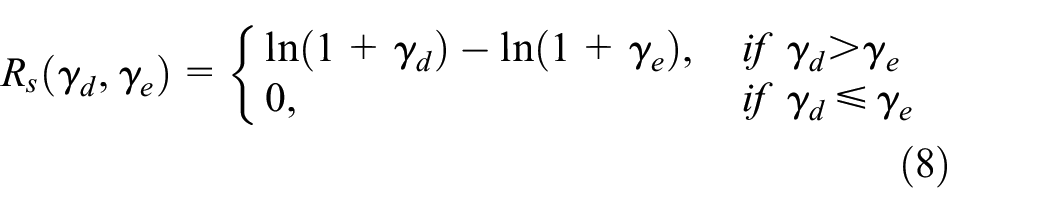
Start by deriving the secrecy rate for one realization of fading. Recalling the results in Bloch et al. 5 for the Rayleigh fading wiretap channel, the secrecy rate for one realization can be written as
where
In order to compute average secrecy rates, we need the following two integrals given in Gradshteyn and Ryzhik 26


where
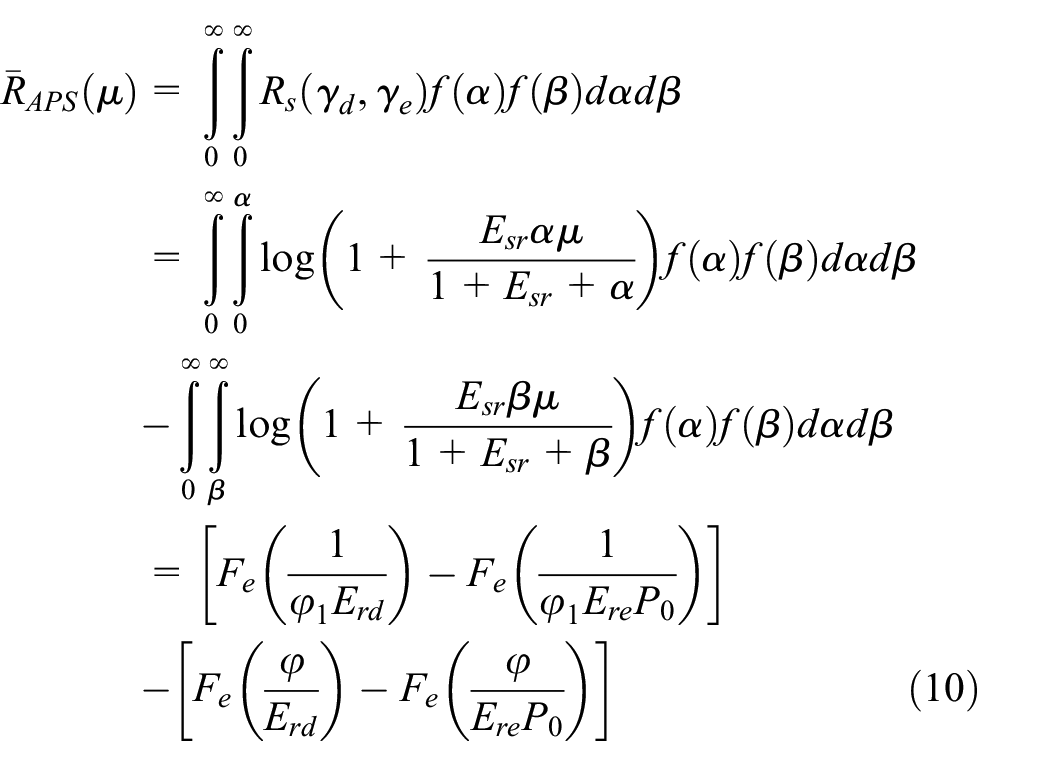
First, we derive the secrecy rate for the fixed realization of
where

Subsequently, by using equations (10) and (11), we can obtain the final average rate by taking expectations with respect to the S-R channel


The closed-form solution of IPS can be expressed as

when
However, we are unaware of closed-form analytical solutions to the integrals (equation (12b)), unless some assumptions are imposed on the SNRs. Relatively high SNR for the S-R links, that is,


For APS, we express the instantaneous SNR as [14][15]


Proof of equation (13): we rewrite

Therefore,

Using the the integrals given in equation (17), equation (17) is given by

The integral can be evaluated by using equation [17]

After some manipulations, equation (18) can be reexpressed as

where
By taking expectation with respect to

If

The average secrecy rate under high S-R SNRs for AF relay can be approximately given by


where
For IPS, we can prove that the secrecy rate improves when the value of
Proof of equation (14) is the maximum: for the fixed realization of

where


So, function
We define

Since

Then
Secure communications with S-E link
This section characterizes the secrecy rate of a dual-hop relay wiretap channel with S-E link in terms of average secure communication rates. Apparently, the S-E link deteriorate the performance of the dual-hop relay system. Because the closed-form analytical results for AF relay with S-E link is difficult, we also assume relatively high SNR for the S-R links, that is,
Under this assumption, for IPS, the instantaneous SNR is


For APS, the instantaneous SNR is


where

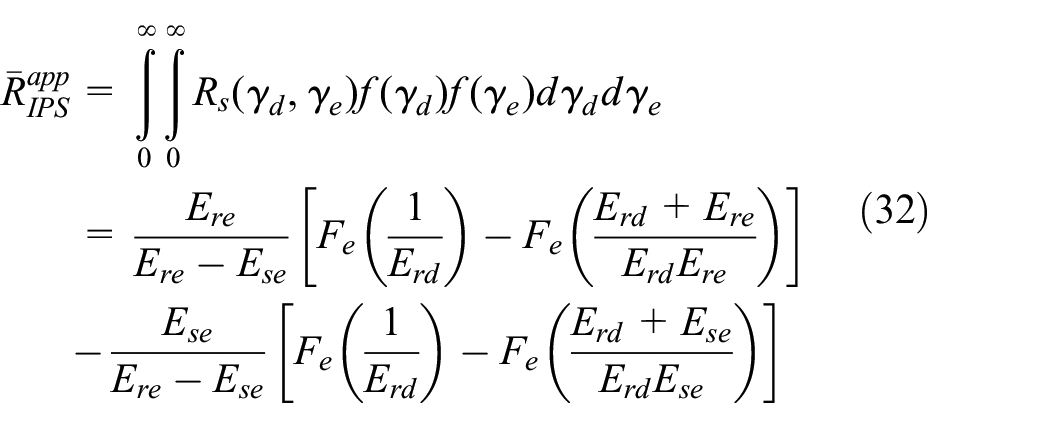
Similar to section of Secure communications without S-E link,
when

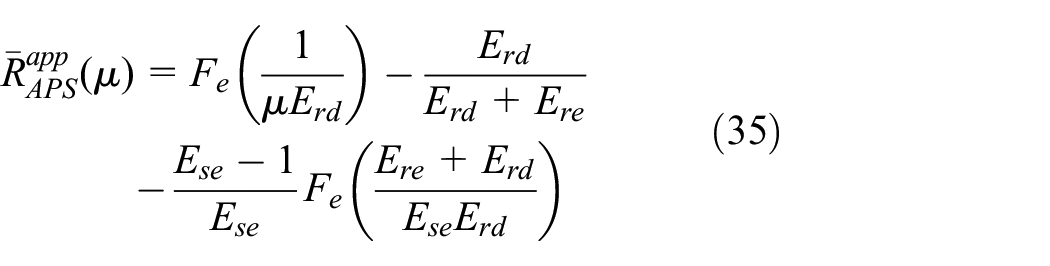
In order to obtain the average secrecy rate of APS, we first take integrations over (equation (35)) fixed channel realization

when
The average secrecy rate of APS can be expressed as
Simulation results
In this section, we evaluate the average secure communication rates of dual-hop AF relay under APS and IPS constraints.
Performance of a dual-hop relay wiretap channel without an S-E link
Figure 3 shows the average secrecy rate versus

The average secrecy rate versus
Figure 4 describes the average secrecy rate versus

The approximate average secrecy rate versus
Performance of a dual-hop relay wiretap channel with an S-E link
We show the approximate average secure communication rates when Eve can observe the output from
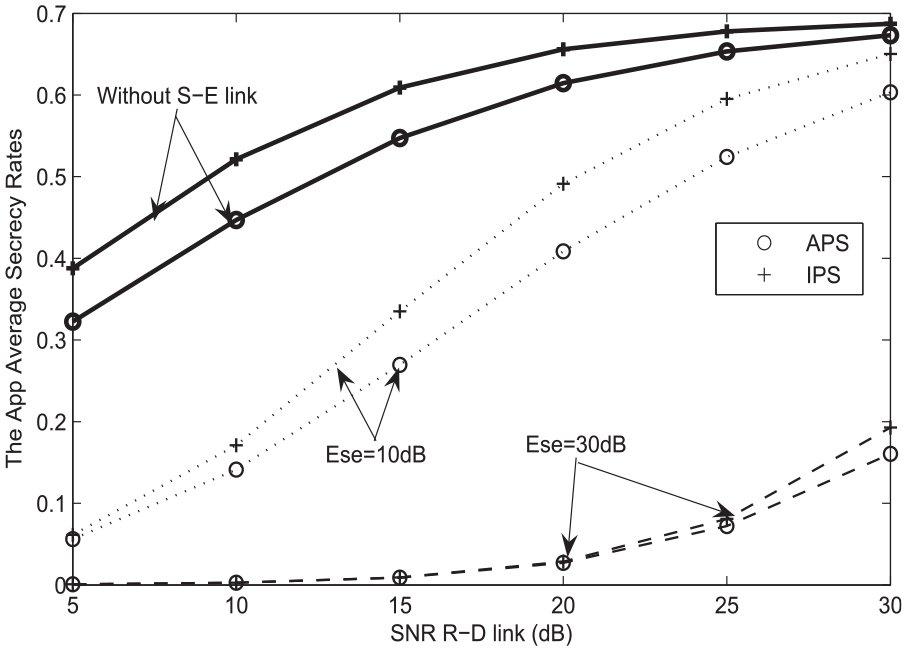
The approximate average secrecy rate with S-E link versus
Conclusion
In order to solve the key issue of authentication schemes for dual-hop communications, an AF relay for secure communication scheme is proposed in this article. The closed-formed expression of the secrecy rate is derived for IPS when wireless channels experience Rayleigh fading without an S-E link. The approximate expressions of average secrecy rate are also shown for APS and IPS. The cooperative strategies combined APS with IPS are proved to achieve information security. Due to the S-E link, the performance of the AF dual-hop relay becomes worse. Simulation results show that the performance of IPS is better than that of APS if the SNR of the S-R link is higher than that of R-D/E links. However, APS outperforms IPS in the moderate SNR regime for the S-R link.
Footnotes
Handling Editor: Michel Kadoch
Declaration of conflicting interests
The author(s) declared no potential conflicts of interest with respect to the research, authorship, and/or publication of this article.
Funding
The author(s) disclosed receipt of the following financial support for the research, authorship, and/or publication of this article: This work is partially supported by the National Natural Science Foundation of China (Nos. 61427801 and 61872423); the Ministry of Education–China Mobile Research Foundation, China (No. MCM20170205); the Scientific Research Foundation of the Higher Education Institutions of Jiangsu Province, China (No. 17KJB510043); the Six Talent Peaks Project of Jiangsu Province, China (No. DZXX-008); the Postdoctoral Science Foundation of Jiangsu Province, China (2019K026); the Open Research Fund of National Mobile Communications Research Laboratory, Southeast University (No. 2018D16); and the Research Foundation for Advanced Talents of Nanjing University of Posts and Telecommunications (No. NY217146).
