




Abstract
The biosensor based on surface acoustic wave is of great significance for the application of biological clinical detection, but the sensitivity and specificity of surface acoustic wave biosensor still need to be improved. In this article, the structure of surface acoustic wave biosensor and interdigital transducer is designed by studying the theoretical model of surface acoustic wave biosensor. Then the amplitude–frequency response of the device is studied. Later, the simulation model of surface acoustic wave biosensor structure is established, and the performance of surface acoustic wave device is numerically calculated. Meanwhile, the relationship between the applied excitation signal and the resonant frequency is considered, and the performance of the surface wave propagation and attenuation characteristics are analyzed. In addition, the influence of the material of the piezoelectric substrate and the structure of the interdigitated electrode on the surface acoustic wave propagation are studied. The response potential curve and the total displacement of the particle vibration are analyzed, and the structure of the surface acoustic wave device is optimized.
Introduction
With the rapid development of modern sensor technology,1–3 surface acoustic wave (SAW) biosensor has attracted great attention in the field of biomedicine because of its easy integration, miniaturization, high accuracy as well as sensitivity to trace information. 4 The research of acoustic wave promotes the development of sensor technology.5,6 The SAW is an elastic mechanical wave, which travels along the surface of the object. SAW devices are very sensitive to the changes of surface mass load, viscosity, and conductivity, which will lead to the changes of the velocity, phase, and amplitude of SAW. Therefore, this characteristic can be used to study the related biosensors and realize the detection of micro-sensitive information, including immunoassay, odor substance detection, pathogenic microorganism detection, environmental pollution detection, DNA detection, and other directions.7–9 SAW biosensors still need to be developed and improved in order to detect micro-level information required by biomedicine. 8
Drobe et al. 10 and Leidl et al. 11 adopted delayed horizontally polarized shear wave devices in the early development of biosensors, which were successfully applied in oils and non-polarized liquids, but could not be achieved in other solutions and the signal attenuation was very large. Smith et al. 12 designed a piezoelectric transducer model based on one-dimensional for series inductance–tuned transducers, and then several piezoelectric materials with the best aperture and the best number of digital cycles were listed to minimize the insertion loss and phase dispersion and maximize the bandwidth. Xu et al. 13 analyzed the electromechanical phenomena in SAW devices by establishing a finite element model, and explained the performance of the model by analyzing the frequency response of Y-Z lithium niobate filter with two uniform ports and focusing on the influence of the number of electrodes on the frequency response of the filter. Kabir et al. 14 simulated the current density of the electrode by two-dimensional finite element simulation and successfully obtained the frequency response characteristics of two different structures of SAW devices; based on the simulation model, SAW devices were designed, and the measured frequency response was in good agreement with the simulation results. El Gowini and Moussa 15 established the finite element model of SAW sensor and carried out the hydrogen detection. The sensor consists of lithium yttrium niobate substrates with digital interelectrode patterns on the surface, and the model used elastic modulus and density values of different hydrogen concentrations in palladium to determine the response of the SAW sensor. Based on the finite element analysis, Hofer et al. 16 proposed two methods for calculating the phase and attenuation constants of waves on periodic structures, and compared the propagation behaviors of waves measured and simulated on two different piezoelectric substrates. Wang 17 analyzed the research potential of piezoelectric materials and SAWs as actuators and sensors in the field of mechanical pumps and biosensors. Chen and Liu 18 used numerical analysis to demonstrate the mass sensitivity and electromechanical coupling coefficient, temperature delay coefficient, and piezoelectric waveguide layer of SAW biosensor based on ZnO/SiO2/Si structure, and then the relationship between the thicknesses and the structural parameters of the optimized nano-ZnO thin-film SAW biosensor was obtained, which laid a foundation for further research on the fabrication and application of ZnO/SiO2/Si structure SAW biosensors.
The stability and sensitivity of the sensor are the key indicators to determine their performance.19,20 At present, the main factors restricting the development of SAW biosensors are sensor sensitivity, insertion loss as well as non-specific binding interference. Further improving the sensitivity of the sensor and its insertion loss and reducing the interference of non-specific binding in the detection signal has a significant effect on micro-detection and accuracy improvement. It is the focus of SAW biosensor research at present.21,22 In order to analyze the current research situation in the world, the sensitivity and specificity of SAW biosensors still need to be improved to meet bio-detection applications. Based on structural design and material analysis, the propagation characteristics and attenuation characteristics of SAW in piezoelectric materials are emphatically analyzed, the piezoelectric substrates materials of SAW devices are optimized, the structure design of interdigital electrodes is improved, and the sensitivity of biosensors is further improved.
SAW biosensor theoretical model
SAW biosensor is a biosensitive layer modified on the surface, which converts trace biosensitive information into electrical signals easily detected by instruments through a pair of interdigital transducers (IDTs),23,24 so as to realize the detection of biological signals. Figure 1 is the schematic diagram of SAW biosensor designed in this article.

SAW biosensor schematic diagram.
SAW devices of SAW biosensor are made of piezoelectric materials, and their positive and negative piezoelectric effects are used to realize signal conversion. 25 When SAW propagates in piezoelectric materials, there will be electromagnetic waves generated by induced charge. Therefore, when describing SAW propagating on piezoelectric materials, it is usually necessary to consider the motion equation and Maxwell equation and couple them through piezoelectric equation. The equation of motion of a particle in an elastic medium is

where

where

In addition, the relationship between strain and particle displacement in the blank holder material is as follows

From equations (1), (2), (3), and (4), it can be obtained that

Since the medium is an insulator and there is no free charge, the divergence of the electrical displacement vector D must be equal to zero, that is

According to the piezoelectric equation of the medium

where

Equations (5) and (8) are the coupling equations in piezoelectric materials. By solving the equations, the properties of elastic waves in piezoelectric materials can be understood. By analyzing the properties of SAWs, the propagation characteristics can be better analyzed as a theoretical support for SAW biosensor design.
Structural design of SAW biosensor
The core device of SAW biosensor is the SAW device, which is mainly composed of IDT and substrate. Based on the IDT at the input end of the substrate, it converts the alternating electrical signal into acoustic signal through the inverse piezoelectric effect and propagates along the surface of the substrate, and then converts the acoustic signal into electrical signal through the piezoelectric effect by the IDT at the output end. Figure 2 shows the structure diagram of the acoustic surface wave device of the sensor.

SAW device.
Piezoelectric materials are used in the substrate of SAW devices, and the properties of the piezoelectric material have an important influence on the performance of SAW devices. The IDT is the key structure of biosensors, and the design of its structure is crucial for its characterization. Figure 3 shows the structure diagram of single-finger IDT designed in this article, where a denotes the fork-finger width, b represents the spacing, and ω refers to the sound aperture. The width of the single-finger transducer electrode is a quarter of the SAW length. When the finger spacing satisfies
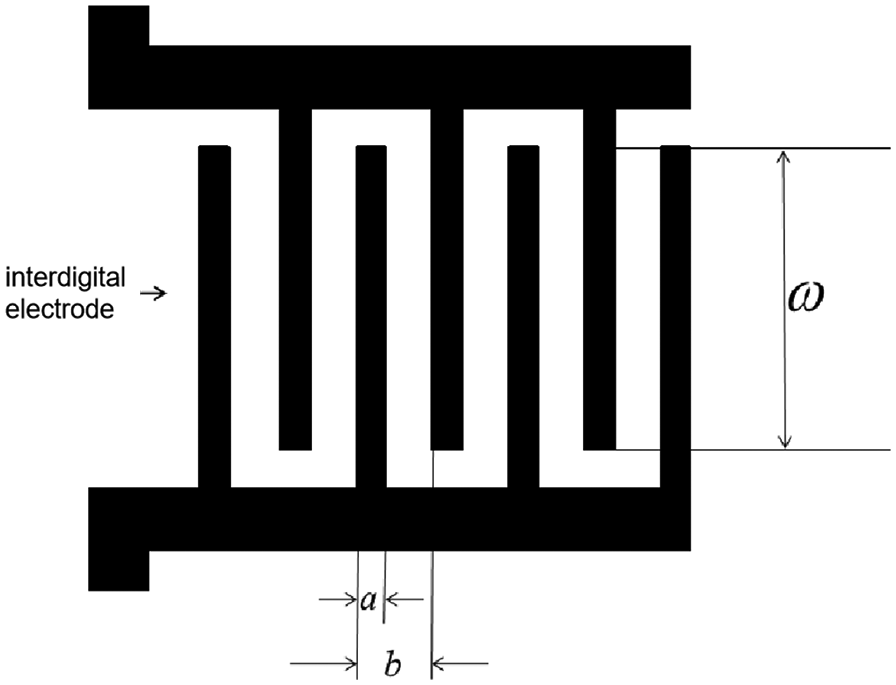
single-finger IDT.
Because aluminum film is characterized by good conductivity, low density, low acoustic impedance, and easy deposition, this article uses aluminum as the research object of the interdigital electrode to design a SAW biosensor based on single-finger IDT. The performance of SAW devices was optimized by studying its amplitude–frequency response 26 as shown in Figure 4.

Amplitude–frequency response of surface acoustic wave devices.
It can be seen from the comparison of the figures that there are some differences in the amplitude–frequency response between the ideal and actual SAW devices. This is because, during the design process, the actual response is to consider the influence of mechanical indicators on the device, and its performance is lower than the ideal device. By means of the analysis of the amplitude–frequency response, the mechanical properties of the SAW devices can be optimized to obtain the optimal fitting device between them, which is of great significance for the sensor’s optimal design.
SAW device modeling and analysis
The SAW device model of SAW biosensor was established by COMSOL finite element simulation.27,28 The IDT used in SAW devices may contain hundreds of identical electrodes, each of which is much longer than its width. Figure 5 shows a three-dimensional model of SAW devices, in which the black part is the interdigital electrode and the gray part is the piezoelectric substrate. Since the IDT is a periodic metal electrode, the edge effect is negligible, and its model geometry is simplified to a periodic basic unit as shown in Figure 6. Since the SAW tends to weaken at the bottom of the substrate until it disappears, the model height does not need to extend to the bottom of the substrate, and only a few wavelengths need to be extended downward. The model is based on the geometric structure of the basic unit of SAW, and it consists of a 12-µm high substrate and two electrodes with a width of
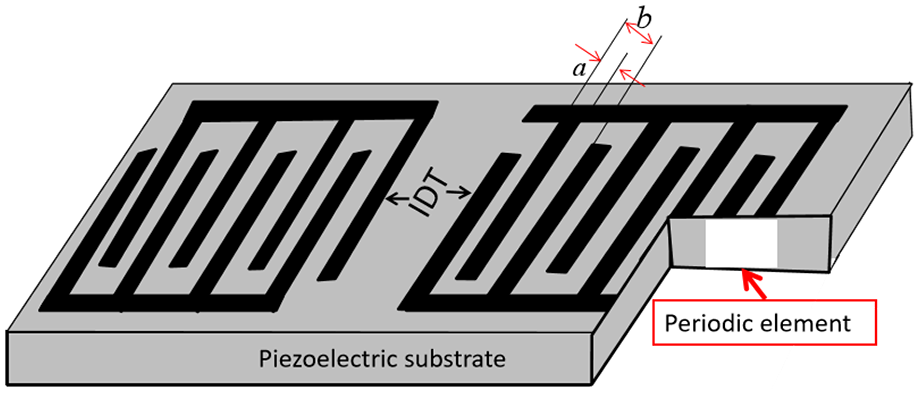
Schematic diagram of SAW device structure design.

Periodic basic elements and mesh generation model.
In order to fully consider the accuracy of the solution, the simulation model uses the unstructured mesh sub-regional division, and the mesh is refined between the surface of the piezoelectric substrate and the electrode. 29 The refinement of grids will lead to increased computing costs, so the pursuit of fine grids requires the selection of grids that meet the computational accuracy, thus minimizing the waste of computing resources. In this article, the relationship between the accuracy of solution and the availability of computing resources is fully considered, and the meshing is shown in Figure 6.
The setting of boundary conditions is particularly important to the simulation results. In this article, the structural boundary conditions and electrical boundary conditions are applied to the definition of the model boundary, and the boundary partition of the model is shown in Figure 7. The corresponding conditions of the model boundary are shown in Table 1.

Model boundaries.
Model boundary conditions.

Influence of substrate materials on SAW propagation
The use of periodic boundary conditions means that the wavelength of the lowest characteristic mode of the SAW is equal to the width of the geometric model, that is, 4 μm. Using this data in conjunction with the Rayleigh wave velocity for a given piezoelectric substrate material, an estimate of the associated resonant frequency can be obtained. Using the characteristic frequency solver in COMSOL helps to obtain a resonant frequency close to this estimate. The model studied in this article uses YZ-cut piezoelectric material substrate,
30
and at the same time, lithium niobate (LiNbO3) is used as the substrate material to carry out the modeling and simulation and analyze the propagation characteristics of SAW. The density of LiNbO3 is
Figure 8 shows the symmetrical mode isotope of the characteristic frequency and total displacement of the LiNbO3 piezoelectric substrate, which shows the amplitude of the SAW and its vibration intensity of the particle. The larger the red part is, the darker the color will be, indicating that the larger the amplitude of the SAW is, the stronger the vibration of the particle will be and the higher the energy will be. The high energy is mainly concentrated in the vicinity of 1–2 wavelength on the surface of the piezoelectric substrate. As the transmission depth increases, the amplitude of the SAW gradually decreases, indicating that most of the energy of SAW is concentrated near the surface, which is consistent with theoretical research. By analyzing the propagation characteristics and attenuation characteristics of SAW, it is of great significance for the subsequent research of SAW devices.

IDT different characteristic frequency symmetry mode equipotential map: (a) 854 MHz and (b) 864 MHz.
By increasing the characteristic frequency, the surface particle vibration intensity increases, and the distance that the wave propagates downward also increases accordingly. Studying the relationship between the frequency of the applied excitation signal and the frequency of the acoustic wave determined by the IDT structure helps to find the strongest frequency at which the IDT emits sound waves, which has a direct relationship with the sensitivity of the sensor. Through the displacement field diagram of Figure 9, the vibration tendency of the particle at different characteristic frequencies can be clearly seen.

IDT different modal frequency displacement field: (a) 854 MHz and (b) 864 MHz.
Since the model uses YZ-cut LiNbO3 as the base material, its Rayleigh wave velocity is about 3488 m/s. When the frequency of the external excitation signal is equal to that of the acoustic wave determined by the IDT structure, the acoustic wave emitted by IDT is the strongest. The optimal acoustic frequency of the SAW device can be expressed by the following equation

where

Relationship between characteristic frequency and total power of acoustic waves.
This article further changes the piezoelectric substrate material to study the effects of different materials on the propagation of SAW, and then the substrate material of the sensor is optimized. Later, the modeling and simulation are carried out by using ZnO, piezoelectric ceramics (PZT-5H), ST quartz, and aluminum nitride (AlN) respectively, and the potential changes of SAW propagation are compared and analyzed. The density of ZnO, PZT-5H, ST quartz, and AlN are
As shown in Figure 11, the red, black, blue, pink, and green curves represent five different piezoelectric materials of ZnO, PZT-5H, LiNbO3, ST quartz, and AlN, respectively.

Transverse potential variation of SAW.
The simulation results show that the potential of SAW propagates along the surface of piezoelectric materials periodically, and the potential fluctuations of different materials are obviously different. It can be seen from the figure that the potential of PZT-5H, which is a piezoelectric ceramic material, is almost zero, indicating that it is not suitable to be used as a piezoelectric substrate. In contrast, ZnO, LiNbO3, and AlN have obvious potential fluctuation, which indicates that they are suitable for piezoelectric materials for SAW propagation, and ZnO exhibits superior characteristics. With the help of finite element simulation, it is helpful to optimize the material selection of SAW biosensor.
Influence of electrode thickness on SAW propagation
In order to further optimize the performance of sensor devices, the relationship between the propagation characteristics of SAW and the thickness of interdigital electrodes is considered. In this article, the thickness of interdigital electrode is optimized by using the parametric scanning function provided by COMSOL. Using parametric scanning, the model attribute values need not be changed every time to solve repeatedly. The influence of electrode thickness from 0.2 to 1 μm on SAW propagation is studied, with a step size set to 0.1 μm. Figure 12 shows the potential response curve of SAW propagating in different interdigital thickness.

Potential response curves with different electrode thicknesses.
According to the analysis of the electric potential response curve, it can be seen that when the thickness of the interdigital electrode is 0.2 and 0.3 μm, the particle vibration of SAW is more prominent. In contrast, when the thickness of the interdigital electrode is 0.3 μm, the potential intensity is better and the change of the potential is relatively more uniform. And it can be clearly seen from the curve in the figure that as the thickness increases, the potential response curve of the SAW gradually decreases, especially when the electrode thickness reaches 0.7 μm, the potential tends to be zero. When continuing to increase the thickness of the electrode, the potential remains unchanged at zero potential. In addition, the same rule can be found by observing the total displacement map of particle vibration under different electrode thickness. The total displacement of particle vibration under different thickness of interdigital electrodes is shown in Figure 13. Meanwhile, the total displacement of particle vibration gradually decreases with the increase of electrode thickness. After reaching 0.7 μm, the total displacement basically maintains at the minimum value (0). The simulation results show that the thickness of the 0.3-μm interdigital electrode designed in this article meets the requirements of the device. Based on the numerical analysis method, the researcher can study the parameters and characteristic response of the sensor structure in combination with the actual situation, and then realize the optimal design of the sensor.

Total displacement under different electrode thicknesses.
Conclusion
In this article, the numerical method was adopted to analyze the relationship between the amplitude–frequency response of the SAW device under ideal conditions and the actual situation, and then the guiding suggestions for the optimal design of the sensor were put forward. The SAW device model was established by the finite element method. The characteristic frequency of LiNbO3 piezoelectric substrate was analyzed, and the relationship between the excitation signal and the resonant frequency of the device was explained. By changing the materials of piezoelectric substrates, the potential changes of SAW propagating on ZnO, PZT-5H, LiNbO3, ST quartz, and AlN substrates were compared and analyzed, and the transverse propagation law of SAW was also analyzed. Based on the above analysis, the propagation and attenuation characteristics of SAW on piezoelectric substrates could be found. When ZnO is used in the substrates, the acoustic characteristics were the best, and the selection of piezoelectric materials was optimized. The thickness change of interdigital electrode was simulated by parametric scanning; the relationship between the propagation characteristics of SAW and the thickness of interdigital electrodes was analyzed by means of the electric potential response curve as well as the total displacement diagram of particle vibration. It was pointed out that when the thickness of interdigital electrodes was 0.3 μm, the device has the best response characteristics. Therefore, it is of great significance to promote the application of SAW biosensors.
Footnotes
Appendix 1
Handling Editor: Yuedong Xie
Declaration of conflicting interests
The author(s) declared no potential conflicts of interest with respect to the research, authorship, and/or publication of this article.
Funding
The author(s) disclosed receipt of the following financial support for the research, authorship, and/or publication of this article: This work is supported by the scientific research starting project of Southwest Petroleum University (SWPU; No. 2018QHZ014) and the National Natural Science Foundation of China (No. 51504207).
