




Abstract
In Internet of Vehicles, establishing swap zones in which vehicles can exchange pseudonyms is an effective method to enhance vehicles’ location privacy. In this article, we propose a new scheme based on dynamic pseudonym swap zone, to protect location privacy of vehicles. For each vehicle, dynamic pseudonym swap zone allows it dynamically to establish a temporary pseudonym swap zone on demand to exchange the pseudonym with another random vehicle in the just formed zone. This randomness of choosing the pseudonym exchanging vehicles prevents dynamic pseudonym swap zone from the secure risk that the information of exchanging participants exposes to their group manager in some existing works in which each pair of pseudonym exchanging participants is assigned by the manager. To avoid the high communication and computation overhead of frequently swapping pseudonyms, dynamic pseudonym swap zone adopts a combination of swap and update to achieve the unlinkability between new and previous pseudonyms. Moreover, dynamic pseudonym swap zone can self-adapt to the varying surroundings to reduce the communication cost of forming pseudonym swap zones in high vehicle density areas. The analysis and simulation results show that our proposed dynamic pseudonym swap zone is a high location privacy preserving, secure, auditable scheme.
Introduction
As a typical application of Internet of Things technology in intelligent transportation system, Internet of Vehicle (IoV)1–3 can support intelligent traffic management, intelligent dynamic information service, and vehicle intelligent control. To achieve these services, it is essential for vehicles to periodically broadcast safety beacon that contains information such as vehicle identity, location, and driving status transmitted by the Dedicated Short-Range Communication (DSRC). However, such information is vulnerable to exploitation and brings with location privacy and security risks. For example, eavesdroppers can utilize the information to track specific vehicles through reconstructing these vehicles’ trajectory to a certain extent with multi-target tracking technology. 4
Wireless communications between vehicles are provided by the DSRC, referred to as IEEE Standard 802.11. 5 DSRC is an efficient wireless communication technology that enables the identification and two-way communication of mobile targets in specific small areas. Two types of DSRC are used in this paper, including vehicle-to-vehicle (V2V) and vehicle-to-infrastructure (V2I). The safety of passengers is increased by exchanging safety relevant information via inter-vehicle communication (IVC). The safety messages could be categorized in two types: periodic beacon safety messages and event announcing safety messages. 6 The former is some warning messages and has some sort of preventive role against possible incident. The latter is some of the messages which the vehicles issue when it detects an unsafe condition, for example, a car crash, icy surface. In summary, event announcing messages are sent in an unsafe situation, but the preventive messages are issued periodically by all the vehicles. In this article, the location information of neighboring vehicles is obtained through periodic beacon safety messages.
In order to enhance the location privacy of vehicles, many fruitful approaches have been proposed in recent years. Among them, it is a feasible and effective strategy to use pseudonyms to conceal vehicles’ real identities and provide unlinkability of new and previous pseudonyms. In some schemes,7–9 each vehicle needs to store a large number of anonymous certificates in advance and changes its pseudonym in fixed mix-zones which are carefully selected and are generally road intersections. These methods have to deal with storing and managing too many anonymous certificates, and the limitation that vehicles are allowed only to change pseudonyms in fixed zones make these schemes lack of necessary flexibility. To increase the flexibility of changing pseudonyms, several schemes such as dynamic mix-zone for location privacy (DMLP), 10 pseudonym changes based on candidate-location-list (PCC), 11 and cooperative pseudonym change based on neighbors (CPN) 12 have been proposed to form dynamic mix-zones to enhance the location privacy of vehicles. The schemes, however, are still based on pseudonym change approach that cannot provide high location privacy protection, especially where the vehicle density is low.
To further improve the location privacy of vehicles, the SlotSwap scheme proposes the idea of pseudonym exchange that allows a vehicle to select one of its appropriate one-hop neighbor vehicles to exchange pseudonyms in hot spots with high vehicle density. 13 SlotSwap only supports one-to-one pseudonym exchange rather than exchanging in groups formed by vehicles, which limits its privacy preserving performance to certain extent. In pseudonym swapping scheme based on neighboring vehicles (PSNV), 14 vehicles are allowed to dynamically form groups in which group members can exchange pseudonyms. However, since every pair of vehicles that exchange their pseudonyms with each other is assigned by the group manager, PSNV may expose a vulnerability to the location privacy of group members when a malicious vehicle becomes group manager. Memon 15 proposed that distance and cluster-based energy pseudonyms would change method for road network. It proposed scheme would reduce consumption, but the existence of cluster heads remains a security risk for cluster group members.
To avoid the mentioned weaknesses in the existing pseudonym exchange schemes, we propose the location privacy-preserving scheme based on dynamic pseudonym swap zone (DPSZ), in this article. DPSZ allows each vehicle dynamically to establish a temporary pseudonym swap zone on demand to swap pseudonyms with another random vehicle in the zone. When a vehicle has pseudonym update demand, it will check whether the number of such vehicles, which are among its neighbors and can guarantee the continuous communication with it until to complete the whole procedure of pseudonym swap, is more than the preset threshold. If so, the vehicle will establish a pseudonym swap zone, and respectively perform a pseudonym swap procedure with every other vehicle in the zone. Among all the above pseudonym swaps, there is one and only one that is real swap, and the other swaps are all fictitious. That ensures that the attacker cannot conclude whether the current vehicle swapped its pseudonym and which vehicle in the zone swapped the pseudonym with the current vehicle no matter using the time sequence or the number of the pseudonym swap messages. Moreover, DPSZ can self-adapt to the varying surrounding vehicle density to reduce the communication overhead of establishing pseudonym swap zone.
The main contributions of this article are summarized as follows:
We have proposed a new scheme DPSZ that can achieve high location privacy protection performance through exchanging pseudonyms in swap zones formed dynamically.
Our proposed DPSZ can avoid the secure risk that is brought about by the group manager in the existing works when assigning the exchanging participants. Moreover, DPSZ can also achieve the auditability.
We have introduced the combination of pseudonym swap and update, as well as the method of self-adaptive surroundings to reduce the communication and computation overheads.
In order to ensure the security of data transmission, we have adopted a scheme for generating dynamic encryption keys. The secret key is dynamically formed using the Diffie–Hellman key exchange protocol and used for encryption of private data.
We have evaluated the performance of DPSZ scheme through simulation experiments and compared it with some existing methods. Our analysis also shows that the proposed method is superior to the existing methods in different experimental environments.
The remainder of this article is organized as follows. Section “Related work” reviews the important and typical location privacy preserving works. Section “System model” introduces the system architecture, giving the details of the security model. In section “Pseudonym swapping scheme based on dynamic swap zone,” we present our proposed DPSZ scheme along with detailed dynamic swap zone forming, and pseudonym exchanging algorithms. The evaluation of our proposed system using simulation is presented in section Performance evaluation. Section “Conclusion” concludes the article.
Related work
In recent years, many meaningful research works have already been reported to enhance location privacy of IoV. We survey the existing schemes of location privacy protection for IoV in this section. These existing schemes are reviewed in six parts: mix-zones schemes, silent period approaches, group signature approaches, third-party agent, obfuscation-based schemes, and pseudonym swapping schemes:
Mix-zones schemes: The location privacy of vehicles is protected by anonymous communication zones, that is, mix-zones. 10 The mix-zones are mainly traffic intersections where vehicles’ speed and directions are highly possible to change. During vehicles drive in mix-zones, they update their pseudonyms and are not allowed to send messages. Therefore, it is difficult for attackers to track the target vehicles from the vehicles that are in the same mix-zone, especially when the zone has high vehicle density.
Ying et al. 11 proposed PCC scheme that allows vehicles to form mix-zones dynamically and change their pseudonyms through candidate location list. Memon et al. 16 and Arain et al. 17 introduced strategies for multi-mixing regions based on dynamic pseudonyms. One scheme is to encourage each vehicle to change pseudonym dynamically inside as well as outside a mix-zone over the road network. 16 Another scheme requires mobile vehicles to communicate with reported server for registration and dynamically pseudonym change. 17 Arain et al. 18 presented a protocol named as clustering-based energy-efficient and communication protocol (CEECP) for multiple mix-zones over road networks, which is proposed to reduce the loop holes of prevailing clustering protocols. Lu et al.19,20 proposed a pseudonym change method based on social point to enhance location privacy of vehicles. Here, a social point refers to an area where vehicles gather temporarily, for example, a traffic intersection or a parking. If each vehicle changed its pseudonym before it drives out of a social point, then the social point can be regarded as a mix-zone. When the density of vehicles is high at a social point, it is difficult for attackers to track specific vehicles if all vehicles in the social point change their pseudonyms simultaneously. When the vehicle density of a social point is low, however, the two schemes cannot achieve satisfied location privacy protection performance. Due to that the performance of location privacy protection in mix-zones schemes depends on the number of vehicles in a same zone, it is a main challenge to form secure mix zones in environment of low vehicle density.
Silent period approaches: In view of the limitations of mix-zone scheme, some researchers used silent period approach in which vehicles choose a certain silent period and change their pseudonyms without the help of specialized traffic infrastructures. Sampigethaya et al. 21 proposed AMOEBA scheme to achieve unlinkability between the new and old pseudonyms of vehicles by keeping the vehicles to remain a random silent period. In SLOW, 22 vehicles are not allowed to broadcast messages once their speeds are less than a threshold (e.g. 30 km/h), and the vehicles can change their pseudonyms in the situation of low driving speeds. Generally, the random silent period scheme is efficient in protecting location privacy. However, the maximum silent period is limited by the safety beacon broadcast period and it is possible to track vehicles by inferring the temporal and spatial relationship of vehicles. 14
Group signature approaches: In group signature scheme,23–25 some vehicles form a group in which the members of the group are able to anonymously sign messages on behalf of the entire group. The group signatures can be verified conveniently by the group public key, and nobody except the group manager can track the signer through the corresponding group signatures. For example, the authors proposed a MixGroup approach to enhance vehicles’ location privacy. 23 Through utilizing group signature mechanism, MixGroup approach allows vehicles to establish extended pseudonym-changing regions to exchange the pseudonyms. The continuous exchange of pseudonyms can increase the uncertainty of pseudonym mixing. However, for the group manager knows all the memberships and the identity of every group member, it will lead to huge security risk once the group manager is compromised or held by a malicious node. Moreover, it is a challenging task to manage all the group members efficiently when the size of a group is too large. Perera et al., proposed a new group signature scheme, 24 which combines the member revocation mechanism with member registration and construct a fully dynamic group signature that supports manipulation of member revocation through verifier-local revocation (VLR). Group signatures require controllable linkability, so a new group signature scheme that supports controllable linkability is proposed. 25 The scheme generates a short signature by constructing a dynamic privacy-protecting signature scheme with both opening and linking capabilities. The short signature generated by the construct is even shorter than this in the best-known group signature scheme.
Third-party agent approaches: In order to reduce the high computation cost brought by too encryption operations in many location privacy protection schemes, some researchers proposed third-party agent approaches.26,27 These approaches allow vehicles to send messages through a trusted third-party proxy. The approaches achieved the goal of location privacy protection by hiding the identities of individuals within the groups established by the trusted proxies. Although the type of agent pattern ensures sending messages disguisedly, the trusted proxies are prone to become the performance bottleneck of the whole location privacy preserving system when taking their heavy work burden into consideration.
Static and dynamic pseudonyms: The static and dynamic pseudonyms here refer to the way how to obtain pseudonyms. The static pseudonyms are created by a pseudonym issuing authority and stored inside the vehicles. Dynamic pseudonyms refer to that the pseudonyms are dynamically generated by the vehicles themselves. Eckhoff et al. 13 and Petit et al. 28 used static pseudonyms. When all the pseudonyms stored in the vehicles expired, the vehicles need to obtain the new pseudonyms from the pseudonym issuing authority. 28 Another strategy is to set up a pseudonym pool and update it by pseudonym exchange. 13 The pseudonyms in the pseudonym pool can be reused. Vehicles obtain the self-issuance’s authority from the trusted authority, so that the pseudonym can be dynamically generated.29,30 They generate dynamic pseudonyms using the dynamic pseudonym trust management method and the method of sending authorized anonymous keys to the vehicles. In contrast to static pseudonyms, dynamic pseudonyms have the advantage that once the vehicles complete the corresponding initialization operation, the vehicles can autonomously perform the generation of the pseudonyms. However, in the methods of dynamic pseudonyms, many pseudonyms are generated by the same key obtained from CA. Once the key is compromised, all its derived pseudonyms are likely to be revealed. Moreover, it will bring additional computational overhead for the vehicles to generate pseudonyms.
Pseudonym swapping schemes: To enhance the location privacy of vehicles, the authors proposed the idea of pseudonym exchange that allows a vehicle to select one of its appropriate one-hop neighbor vehicles to exchange pseudonyms in hot spots with high vehicle density. 13 However, SlotSwap scheme only supports one-to-one pseudonym exchange rather than exchanging in groups formed by vehicles, which limits its privacy preserving performance to certain extent. Li et al. 31 proposed swing and swap schemes to enhance location privacy of vehicles. The main idea of the scheme is that vehicles exchange their identifiers with each other and then keep a silent time with random length. Memon et al. 32 presented an efficient pseudonym change strategy with multiple mix-zones scheme. This strategy builds extended pseudonym-changing regions, namely mixed zones, in which vehicles are allowed to use their identities instead of pseudonyms, and to accumulatively swap their pseudonyms with each other. However, the use of identity communication directly in the mix-zones poses a risk of disclosure of the identity information of the vehicles. Zhang et al. 14 proposed PSNV scheme in which vehicles are allowed to dynamically form groups in which group members can exchange pseudonyms. The conditions for vehicles to construct a pseudonym swap group are that their driving directions are the same, and their speeds and positions are close. Since every pair of vehicles that exchange their pseudonyms with each other is assigned by the group manager, PSNV may pose threat to the location privacy of group members when a malicious vehicle becomes group manager.
System model
System architecture
The system consists of two parts: vehicle subnet and service infrastructure. The vehicle subnet is an ad hoc network that is connected by on-board units (OBUs) installed in vehicles. The service infrastructure consists of a certificate authority (CA) and many road-side units (RSUs). For vehicles, the heterogeneous network architecture includes two types of communication: V2V, V2I, as shown in Figure 1. For simplicity, we regard the wireless channel in this study as the ideal one without packet loss.

System architecture.
CA is responsible for managing the identities and credentials of RSUs and OBUs in the region. It also manages the generation and cancelation of vehicles’ pseudonyms and certificates. RSUs are responsible for receiving requests from OBUs, relaying the requests to CA, and transmitting the replies of CA to OBUs. The symbols used in this article are listed in Table 1.
Notations.

CA: certificate authority.
Threat and trust models
The assessment criterion for location privacy is always related to the ability of attackers to track a target vehicle in the network. We assume that there is a global passive attacker who can eavesdrop on every message sent across the network. Nevertheless, the attacker does not know the details of the message if the message is encrypted. We also assume that the attacker knows all the maps between each vehicle and its true identification completely.
We use the probabilistic attacker model:
13
Assume that the probability of an attacker to track a pseudonym exchange between two nodes is

According to equation (1), when the swap zone of the target vehicle is composed of six vehicles and the attacker’s ability is weak, for example,
In this article, we assume that CA is honest, and the RSUs are semi-honest, and the OBUs are dishonest. Moreover, we assumed that CA and every RSU has strong physical security and cannot be breached easily. Honest members are protected by abundant security mechanism and not controlled by attackers. Moreover, honest members do not attack other members and not collect or disseminate the privacy of other members. Semi-honest members are roughly the same as honest members. However, unlike honest members, semi-honest members may collect user privacy. 33 The RSUs are the communication medium between OBUs and CA, so we believe that RSUs are semi-honest. The CA has the registration information of all members. If the CA becomes an attacker, the threat it poses will be much greater than other roles, so the CA must be handled by the official trusted authority, and we believe that it is honest.
Pseudonym swapping scheme based on dynamic swap zone
In this section, we will detail the proposed DPSZ scheme that includes four phases: registration, pseudonym update, pseudonym swapping, and pseudonym swap log uploading.
Registration
When joining the network for the first time, each vehicle, for example,
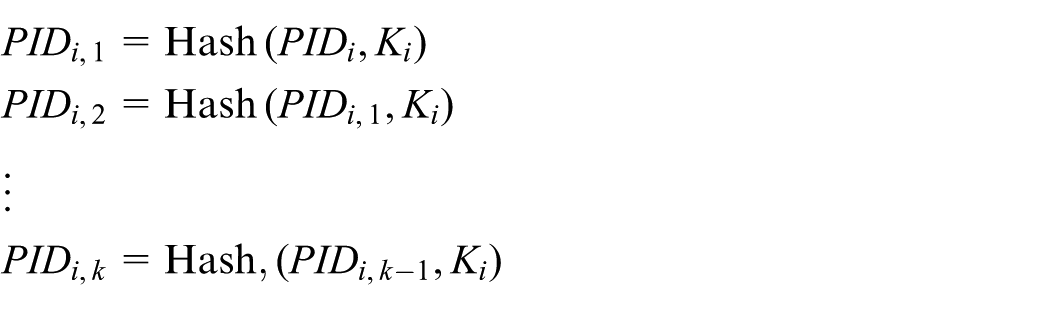
Without the secret key
Pseudonym update
In IoV, vehicles need to broadcast safety beacons periodically, which is the base of many applications. To protect the location privacy, vehicles can use pseudonyms in their safety beacons and even in communication with other vehicles and RSUs. In the proposed DPSZ, each vehicle, for example,
Pseudonym swapping
To complete pseudonym swap, there are four steps need to be done as shown in Figure 2. Among them, Steps 1 and 2 are utilized to establish a swap zone, and meanwhile to generate a session key by the embedded improved Diffie-Hellman key exchange protocol. 34 The session key is used to protect the following procedure of pseudonym swapping. Steps 3 and 4 are the procedure of pseudonym swapping. Algorithm 1 describes the overall process of the pseudonym swap algorithm and marks the parts of each step.

Pseudonym swapping based on dynamic swap zone.

To ensure the security of swapping pseudonym, before initializing a request to establish a swap zone, vehicles first judge whether their surroundings satisfies the two conditions as follows:
Condition 1: link continuous connected time
In IoV, vehicles have high mobility, and thus, the links between vehicles are dynamic, volatile, and intermittent. It is necessary to compute the continuous connected time of every pair of vehicles that prepare to swap their pseudonyms. For a vehicle

where the meanings of a, b, c, and d are respectively showed as below:
To complete the procedure of forming a swapping zone and exchanging pseudonyms, we need a threshold to judge whether there is enough continuous connected time between the vehicles that will take part in the swapping zone. For the whole procedure of forming swapping zone and exchange pseudonyms consists of four steps: establishing request broadcast, join reply, pseudonym swapping broadcast, and pseudonym swapping reply. Therefore, the threshold time, indicated as

where
In order to judge whether there will be a link between the vehicles
Condition 2: size of pseudonym swap zone
The size of DPSZ, that is, the number of vehicles that participate and form the swap zone, has an important influence on the strength of unlinkibility of the exchanged pseudonyms. It is obvious that the larger the size of the pseudonym swap zone is, the lower the probability for vehicles to be tracked is. However, due to the dynamic distribution of vehicles in IoV, when a vehicle has the requirement of swapping pseudonym, there are not always enough neighbor vehicles for it to form a swap zone. Therefore, we need to determine the threshold of swap zone size, indicated as

Threshold
When a vehicle

If
Step 1: request of forming pseudonym swap zone
The initiating vehicle

Use the current pseudonym
Step 2: reply to form pseudonym swap zone
After receiving the broadcast message of the initiating vehicle, the neighboring vehicle

The neighbor vehicle
Step 3: broadcast of pseudonym swap data
After the initiating vehicle receives the reply messages, the initiating vehicle needs to count the return information of the vehicles in the pseudonym swap zone and establish a separate secret key
Step 4: reply of pseudonym swap data
After receiving the encrypted swap data message broadcasted by

Obviously, only vehicle
Pseudonym swap log uploading
After the vehicles swap their pseudonyms successfully, CA can no longer associate the pseudonyms with the real identity of the vehicles, which conflicts with the secure demand of detecting and handling vehicles with misbehaviors. Therefore, it is obligatory for the initiating vehicle to upload the pseudonym swap log to CA each time after exchanging the pseudonyms. Utilizing the logs, CA can rebuild the map between the real identities and the swapped pseudonyms of the vehicles. In DPSZ, once the procedure of swapping pseudonym is completed, the pseudonym swap log of the initiating vehicle will be transmitted to the CA. The log includes that the pseudonym identities of both parties involved, that is,

Pseudonym swap log uploading.
For the openness of wireless channel,
Self-adaptive communication surroundings
In DPSZ, all neighbor vehicles, which have eligible link continuous connected time with the initiating vehicle, are required to reply to the requirement message and to participate in the swap zone. When the initiating vehicle is in some areas, for example, intersections, where the density of vehicles is high, the vehicle number of participating the swap zone could be large, which will result in too high communication and computation costs. To solve the problem, we improve Steps 1 and 2 of pseudonym swapping protocol of DPSZ and make DPSZ implement self-adaptive communication surroundings.
In Step 1, the initiating vehicle adds the number of its eligible neighbor vehicles, that is,

Equation (8) can ensure the eligible neighbor vehicles reply with high probability when
Security analysis
In this section, we analyze the main secure goals that our proposed DPSZ can satisfy as follows:
Conditional anonymity. In all communication processes except loginning to CA each time when a vehicle, for example,
Unlinkability. In order to maintain the location privacy of vehicles, it is necessary for each vehicle, for example,
Auditability. In DPSZ, the initializing vehicle in pseudonym swapping zone is obliged to upload the swap log by which CA can always the map between the real identities and the pseudonyms of vehicles. Meanwhile, the other participant of the just completed swap can judge the correctness and timeliness of the log message uploaded by the initializing vehicle and has the right to send accusing message to CA when meeting with misbehaviors. By utilizing accusing messages and log messages, CA can exactly find out those vehicles with malicious behaviors and exclude them from the system.
Performance evaluation
This section evaluates the performance of DPSZ scheme through simulation experiments. We compare the performance of DPSZ and the existing schemes PSNV, SlotSwap, and DMLP. Among them, PSNV is a location privacy protection scheme based on dynamically generated groups. SlotSwap refers to the scheme that vehicles select the appropriate one-hop neighbor nodes in the social spots with high vehicle density environment to exchange pseudonyms. DMLP is a location privacy protection scheme based on dynamic mixed areas. We compare the four schemes by analyzing their average anonymous entropy and probability of being tracked.
Performance metrics
We use entropy to measure the strength of location privacy protection for vehicles. Consider a pseudonym swap zone where a collection of vehicles, denoted by

Assuming that there are four vehicles in the pseudonym exchange area, the set of probability that four vehicles are tracked is Pi = {0.25, 0.25, 0.25, 0.25}, then the entropy of the anonymous set is
Let N represent the number of vehicles in the entire network. After there have been n zones swapped pseudonyms, the entropy of the average anonymous set of the entire network is

Simulation setting
We selected a 3500 m×3000 m city area, including 37 intersections and 62 two-way road sections. We use C++ to develop a simulation platform to simulate an IoV running in urban area. The speeds of vehicles are randomly selected from 10 to 90km/h which are related to the speed limit of the road segments. The movement of vehicles uses the Manhattan mobile model. 37 Detailed simulation parameters are shown in Table 2.
Simulation parameters.

RSU: road-side units.
Impact of self-adaptive communication surroundings
The self-adaptive communication surroundings are designed to reduce the communication cost of the areas where the density of vehicles is high. We use the size of the packets generated by the initiating vehicles communication as the communication cost. Figure 5 compares the communication cost of the vehicles in the two cases of with and without the self-adaptive communication surroundings strategy. It can be seen from the figure that the communication cost of the two cases is not much different in the environments with low vehicle density. With the increasing number of vehicles, we can see a significant difference between them. As the number reaches 500, the communication cost of vehicles in the self-adaptive scheme begins to stabilize, and the communication cost of vehicles in the non-self-adaptive scheme still shows a trend of continuous growth. It can be seen from the experimental results in the figure that the self-adaptive scheme can effectively control the communication cost of the vehicles in the environments with high vehicle density. As it requires lots of computing to generate, transmit, receive, and process a large amount of communication data, this means that our scheme can effectively reduce communication burden, and meanwhile can also lower computation overhead in high vehicle density case.

The effect of the self-adaptive communication surroundings.
Impact of swap zone size threshold
The effect of different

The effect of the threshold of participant vehicles on the average anonymous entropy.
Impact of vehicle density
Figure 7 shows comparisons of average anonymous entropy and the probability of the vehicles being tracked under different vehicle densities by the number of different vehicles in the simulation area. Figure 7(a) shows the average anonymous density conditions. In this simulation, we represent different entropy at different vehicle densities. From this graph, we can observe that as the number of vehicles increases, the average anonymity of the four schemes shows an upward trend. The average anonymous entropy indicates the degree of privacy of the vehicles, so the probability of the vehicles being tracked decreases as the vehicle density increases (as shown in Figure 7(b)). It can be seen from Figure 7(a) that when the number of vehicles is less than 600, the average anonymous entropy of the vehicles increases as the number of vehicles increases, and the probability of being tracked decreases as the number of vehicles increases. As the density of vehicles increases, the number of vehicles that meet the exchange conditions will also increase, so the anonymity of the vehicles increases and the probability of being tracked decreases. When the number of vehicles is greater than 600, the average anonymous entropy of the vehicles shows a stable trend. Our algorithm introduces the self-adaptive communication surrounding for controlling the number of vehicles in the zone when the vehicle density is too high. Therefore, after the vehicle density exceeds a certain value, the average anonymous entropy of the vehicles will no longer change with the vehicle density changes. Therefore, in Figure 7(b), when the number of vehicles is greater than 600, the probability being tracked no longer fluctuates with the density of the vehicles. It can be seen from the experimental results that when the number of vehicles is greater than 600, the privacy of the vehicles is optimal, which is based on the initial parameters defined in Table 2.

Different vehicle density: (a) average anonymous entropy and (b) being tracked probability.
The pseudonym swap of the SlotSwap scheme is only for two vehicles. Therefore, the SlotSwap scheme has a low swap efficiency, in turn, the average anonymity entropy of the scheme is low. The experimental results show that the PSNV scheme is closer to the experimental results of this paper’s scheme. Since DPSZ scheme rationally divides the swap zone to make full use of the swap opportunity, the effect of this scheme is still slightly better than the scheme PSNV. However, the difference in entropy in CAse where the vehicle-intensive scene is sparse relative to the vehicle density is still relatively large. The number of vehicles satisfying the swap condition is increased in CAse of a dense vehicle, and thus, the average anonymous entropy of the vehicles also increased. Experiments show that our algorithm performs better than the other three schemes at any vehicle density. This is because our solution is able to use the pseudonym swap opportunity as much as possible to achieve location privacy protection, even in the scenario where the vehicles are sparse.
Impact of vehicle speeds
Figure 8(a) shows comparisons of the average anonymous entropy of the four schemes at different running speeds. It can be seen from Figure 8(a) that the average anonymous entropy of the four schemes is in the form of rising first and then decreasing. As the speed of the vehicles accelerate during the running, the changes of the surrounding vehicles are accelerated; the number of neighboring vehicles that can participate in the pseudonym swap will also increase. When the speed is too fast, the effective communication time between vehicles will also be reduced; what’s more, the vehicles selection for pseudonym swap will also be reduced. The probability of the vehicles being tracked is inversely proportional to the average anonymous entropy, so the probability of the vehicles being tracked first drops and then rises (as shown in Figure 8(b)). From the simulation results in Figure 8(a), the speed for the four schemes to achieve optimal anonymity is 50 km/h for DPSZ, 60 km/h for PSNV, 30 km/h for DMLP, and 40 km/h for SlotSwap.

Different running speeds: (a) average anonymous entropy and (b) being tracked probability.
At different operating speeds, DPSZ’s average anonymous entropy and probability of being tracked are less volatile than the other three schemes. Therefore, it can be concluded that the running speed has less influence on the vehicle anonymity of the other three schemes. The conditional restrictions on the swap members in the scheme PSNV are relatively simple and neglect the condition that the vehicles are running at high speed. Both the DMLP scheme and the SlotSwap scheme are aimed at the pseudonym swap between two vehicles, so the speed of the vehicles has little effect on the two schemes. In our scheme, we reasonably increased the number and range of candidate vehicles to minimize the impact of running speed on the pseudonym swap. From the simulation results in Figure 8(a), we can see that the average anonymous entropy of our proposed DPSZ increases at first and reaches the highest value at 50 km/h, then decreases with the speed varying from 10 to 90 km/h. The reason is that if a vehicle needs to establish a DPSZ, it has to satisfy the two conditions: (1) there are some neighbor vehicles, and the link continuous connected time between each of them and the vehicle is not less than the threshold
According to Wikipedia contributors, 38 the speed limit of urban roads is basically between 20 and 60 km/h in many countries, and our DPSZ scheme shows better anonymous performance in the speed range compared with the other three schemes. This means that DPSZ is suitable for urban area.
Impact of simulation time
Under the different running time, Figure 9 compares the average anonymous entropy of the vehicles and the probability of being tracked. We assume that the probability of the vehicles being tracked at startup is 100%. As shown in Figure 9(a), the average anonymous entropy of the vehicles increases with increasing runtime. The higher the degree of anonymity of the vehicles, the lower the probability of being tracked. It can be seen from Figure 9(b) that as the running time increases, the probability of the vehicles being tracked is gradually reduced, and the probability of our scheme being tracked is significantly lower than that of the other three schemes. At the beginning of the simulation run, there are more vehicles that need to perform pseudonym swap, so the average anonymous entropy growth rate is larger. The growth rate of the average anonymous entropy of the vehicles after the simulation run for 400 s tends to be stable. Correspondingly, the probability of the vehicles being tracked drops steadily after the simulation runs for 400 s. When the running time is different, we can see from the experimental results that our scheme is superior to the other three schemes in terms of the average anonymous entropy and the probability of the vehicles being tracked. Therefore, our scheme has better anonymity than the other three schemes.

Different simulation time: (a) average anonymous entropy and (b) being tracked probability.
Impact of attack capability
Depending on the ability of attackers, the effect of different schemes will differ. Figure 10(a) shows the average anonymous entropy of the four schemes under different attack capabilities. It can be seen from the figure that within the range of effective anonymous value fluctuate, the average anonymous entropy decreases as the attack ability increases. The stronger the attack ability, the higher
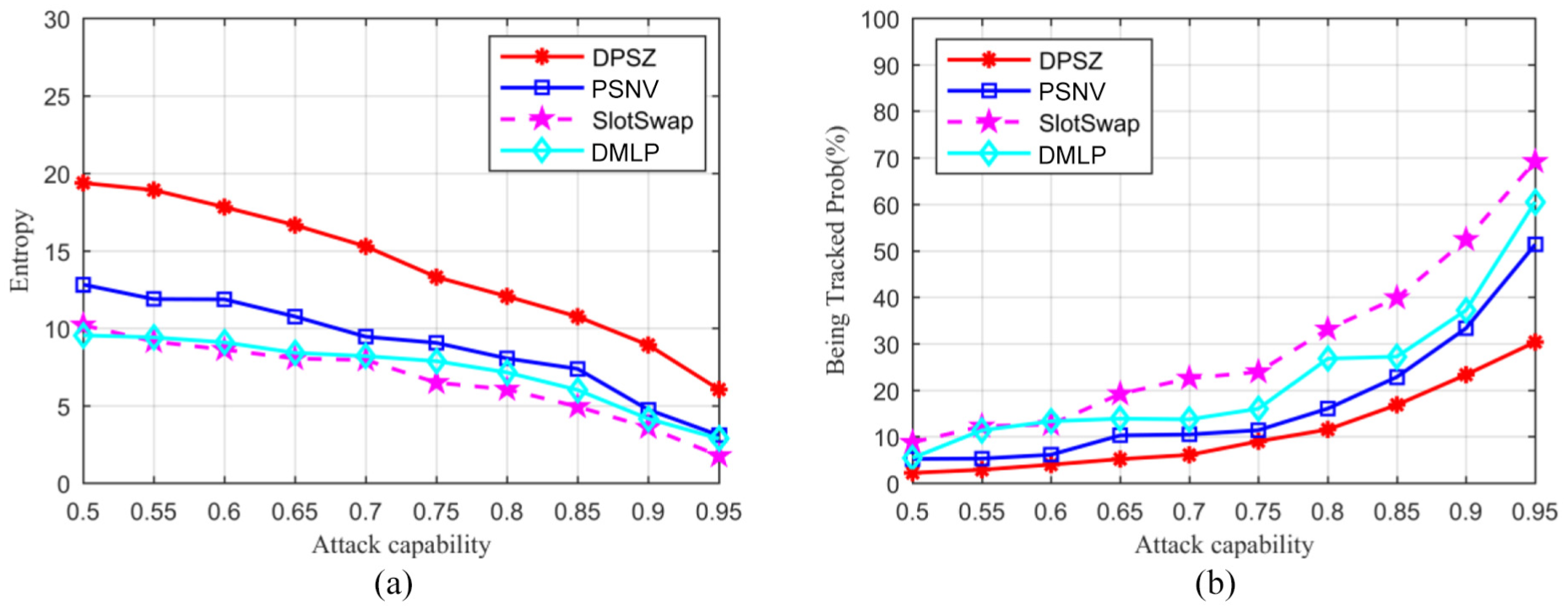
Different attack capabilities: (a) average anonymous entropy and (b) being tracked probability.
Regardless of the attack capability, both the DMLP scheme and the SlotSwap scheme are directed to the pseudonym swap between two vehicles, so the average anonymous entropy values of the two schemes are close. When the scheme DPSZ performs a pseudonym swap, all participating vehicles respond with messages of the same type and length. The attackers cannot determine the vehicle which performed the pseudonym swap with the initiating vehicle by the number and type of communication between the vehicles, thereby achieving good privacy. Under different attack capabilities, the experimental results also show that the scheme DPSZ is superior to the other three schemes in terms of the average anonymous entropy and the probability of the vehicles being tracked, thus reflecting good privacy protection performance.
Conclusion
We have presented a new location privacy protection scheme DPSZ. We first defined the two conditions for vehicles to establish a pseudonym swap zone: link continuous connected time and available vehicle number. When a vehicle has pseudonym swap need and its surrounding satisfies the above two conditions, it is allowed to form a dynamic zone to swap the pseudonym with another vehicle randomly selected in the zone. That makes DPSZ eliminate the secure risk of assigning the exchanging participants which is brought about by the group manager in the existing works. To avoid the high communication and computation costs of frequent pseudonym swap, we introduced the combination of pseudonym update and pseudonym swap. We also used a self-adaptive surrounding method to reduce the communication cost in areas with dense vehicles. We analyzed the security of the proposed DPSZ scheme in terms of conditional anonymity, unlinkability, and auditability. Moreover, we executed simulation to evaluate the location privacy protection performance of DPSZ and several existing typical schemes. The simulation results show that DPSZ achieve higher performance compared with the other schemes.
Footnotes
Handling Editor: Weizhi Meng
Declaration of conflicting interests
The author(s) declared no potential conflicts of interest with respect to the research, authorship, and/or publication of this article.
Funding
The author(s) disclosed receipt of the following financial support for the research, authorship, and/or publication of this article: This work is supported by the National Natural Science Foundation of China under grants nos 61662042, 61262081, and 61462056; the Yunnan Provincial Key Project of Applied Basic Research Plan under grants no. 2014FA028.
