




Abstract
In the past decades, compressed sensing emerges as a promising technique for signal acquisition in low-cost sensor networks. For prolonging the monitoring duration of biosignals, compressed sensing is also exploited for simultaneous sampling and compression of electrocardiogram signals in the wireless body sensor network. This article presents a comprehensive analysis of compressed sensing for electrocardiogram acquisition. The performances of involved important factors, such as wavelet basis, overcomplete dictionaries, and the reconstruction algorithms, are comparatively illustrated, with the purpose to give data reference for practical applications. Drawn from a bulk of comparative experiments, the potential of compressed sensing in electrocardiogram acquisition is evaluated in different compression levels, while preferred sparsifying basis and reconstruction algorithm are also suggested. Relative perspectives and discussions are also given.
Introduction
Benefiting from the significant developments of wearable device and information technology, recent years have witnessed a dramatic progress of wireless body sensor network (WBSN).1,2 As illustrated in Figure 1, WBSN adopts various wearable or implantable sensors to acquire real-time biomedical information, which is then transmitted to a fusion center using wireless communication technology. Subsequently, a powerful and wide-band network may be employed for transmitting the massive fusion data to a remote server where deep learning or other computer-aided technologies3,4 have been developed for diverse medical or health-care applications. Currently, almost all of the countries worldwide suffer from dramatic social and economic pressures derived from citizen’s medical services, and WBSN is expected to be an effective solution for low-cost health-care and medical treatments.
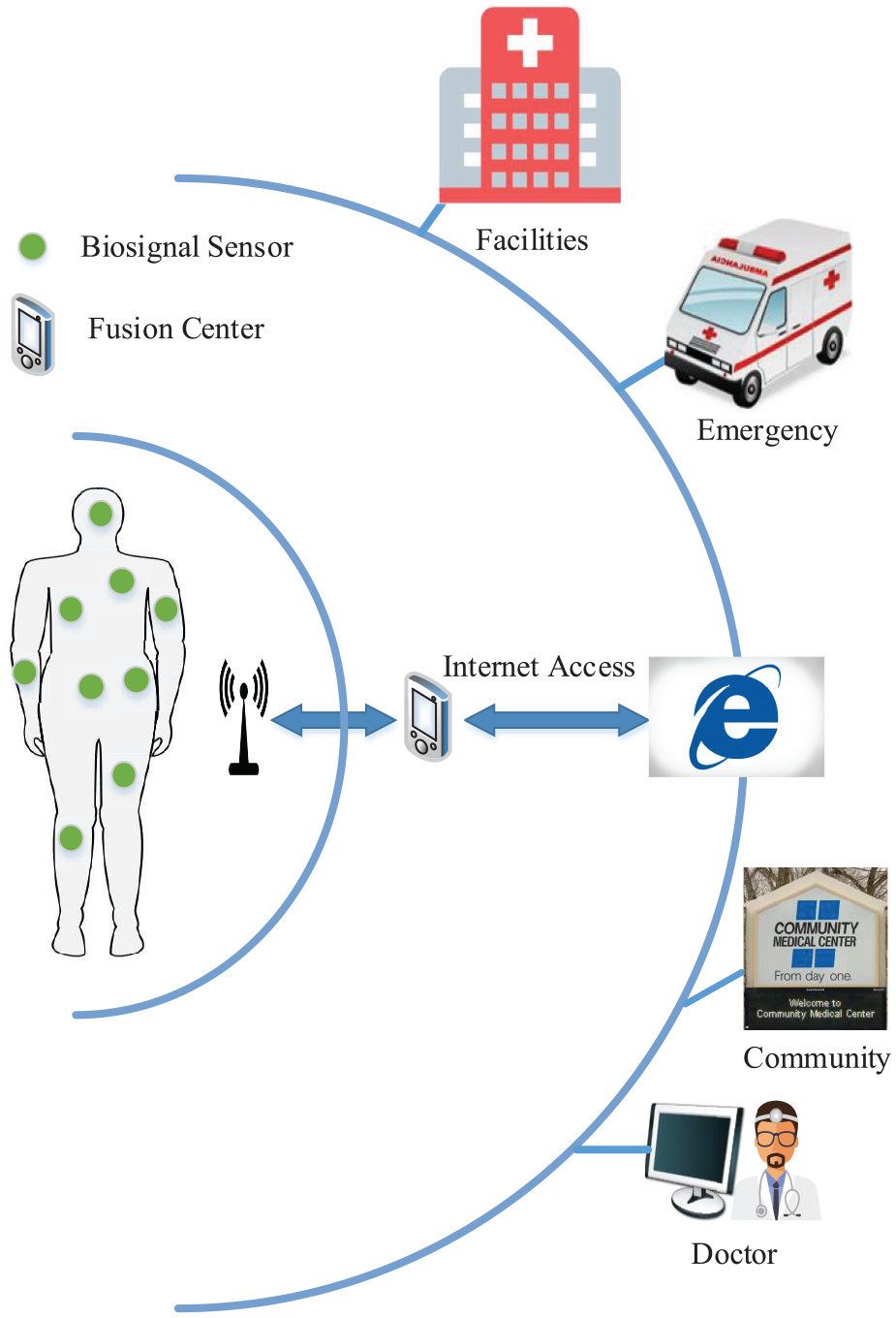
The wireless body sensor network.
Energy efficiency is the most important metric of the WBSN, 5 as it plays a critical role for the lifespan of biomedical sensors and further affects continuous monitoring of physical condition. Through comprehensive analysis, wireless transmission is found to be the most energy-consuming procedure in a WBSN node; 2 therefore, signal acquisition and data processing also play critical roles for the energy consumption. That is because if amounts of samples are collected or the data compression method is not satisfactory, it will consequently bring overloads to the wireless communication module, which is the most energy-consuming procedure as mentioned above. To be concluded, low-cost signal acquisition and data compression methods are highly demanding in WBSN applications.
In recent years, compressed sensing (CS)6–8 emerges as a promising solution for low-cost signal acquisition and compression. By exploiting sparsity feature of involved signals, CS simultaneously implements signal acquisition and compression using a simple linear projection of plain signals. In this scenario, the high-frequency Nyquist sampling is not required and the elaborate data compression module can be saved at the same time. On the contrary, relative complex optimization algorithms are usually required for signal reconstruction in the decoding end. However, this asymmetry of complexity, fortunately, matches practical applications where signal acquisition devices are generally resource constrained but the reconstruction operations are usually implemented on powerful servers. 9 The WBSN is indeed a typical case. The biosensors have limited energy, computation, memory, and storage; meanwhile, they are required to perform long-term signal acquisition and wireless communication. Conversely, the subsequent reconstruction and analysis of these signals are usually implemented in a remote data center, which can be actually regarded as ultimate powerful.
The application of CS in WBSN is therefore a matter of course. Using CS for biosignal acquisition started with the electroencephalography (EEG),10–12 where primary attention is paid to the sparsity modeling of EEG. Specifically, Aviyente 10 found that EEG is sparse in Gabor frame basis and the orthogonal matching pursuit (OMP) algorithm is demonstrated to be effective for reconstructing multi-channel EEG signals. Then, EEG recovery in Slepian basis is also validated. 11 The first time considering CS for biosignal acquisition from the WBSN perspective is given by Mamaghanian et al. 13 Taking electrocardiogram (ECG) acquisition as an example, Mamaghanian et al. 13 quantified the potentials of CS for low-cost signal acquisition in a resource-limited WBSN node. The experiments are implemented in real hardware platforms, and it is found that the CS-based ECG sampling algorithm can prolong 37.1% of the node’s lifespan in comparison with the wavelet-based counterparts. This groundbreaking achievement brings the booming research on CS applications in WBSN, which can be classified into two aspects. The former tried to evacuate the potential of CS from a network point of view, such as Mamaghanian’s work and the achievement of Li et al. 14 who investigate the energy-saving potential of CS for the Internet of things (IoT) in terms of sensing, transmission, and reconstruction. The latter emphasized on the promotion of reconstruction quality for various biosignals when they are sampled via CS technique, such as the works that investigate the sparsifying basis for EEG.10,11 Related works regarding the applications of CS in WBSN will be reviewed in the following section.
Essentially, this work belongs to the latter category. In specific, we focus on applying CS for the acquisition and reconstruction of ECG signals, motivated by the fact that ECG monitoring is critically important for cardiovascular diseases that are the most fatal life murderers worldwide. This article is different from a related work of Mishra et al.,
15
who conclude that the reverse biorthogonal wavelet family is more satisfactory for ECG recovery. The conclusion is drawn from a set of experiments, where 10 ECG samples and three compression ratios (CRs) are adopted. However, only a single reconstruction algorithm (
In this article, diverse reconstruction algorithms, wavelet sparsifying basis, some overcomplete dictionaries are compared in terms of various CRs, reconstruction quality, and the execution time.
Our contributions are summarized as follows.
The signal reconstruction performances of various wavelet family bases are comprehensively analyzed and separately illustrated, and the preferred wavelet basis is consequently obtained.
The superiorities of overcomplete dictionaries are experimentally verified, and these advantages further reveal the research focus in the future.
Comparisons of widely adopted reconstruction algorithms are conducted, and preferable ones in different CRs are concluded.
Perspectives are discussed, and the potentials of CS for biosignal acquisition are theoretically illustrated.
This article takes the following structure. The next section introduces the basic theory of CS and reviews its applications in WBSN. CS of ECG is comprehensively and comparatively analyzed in the “Comparative analysis” section, while relative discussions are given in the “Discussion and perspective” section. Finally, conclusions will be drawn in the last section.
CS with applications in WBSN
CS
CS emerges as a revolutionary framework for signal acquisition by exploiting the concept of sparsity.6–8 Instead of the traditional sampling-then-compression data collection mechanism, CS illustrates that the required measurements can be dramatically reduced given that the signal is sparse or compressible in certain basis. In this scenario, CS directly acquires the data in a compressed fashion at a lower rate. The sampling process is illustrated in Figure 2 and described as follows.

Sampling process of the CS.
Denote the signal to be sampled as a column vector

where

in which the measurement matrix
Signal recovery is implemented by linear sinc interpolation in Nyquist sampling theorem and this does not fit the CS framework which is characterized by an underdetermined linear system. Leveraging the sparsity assumption, innate nonlinear method resolves to the following optimization problem

and then the original signal

To guarantee unique and stable solution of this optimization problem, it is necessary that the sensing matrix

holds for all

where
Typical examples satisfying RIP with overwhelming probability are random matrices, entries of which are independent realizations of Gaussian random variables, Bernoulli random variables, 18 or the structurally random matrices. 19 Besides, advances reveal that such matrices are also incoherent with the commonly used sparsifying basis, which means the products of these matrices multiplying with traditional sparsifying basis also own RIP with overwhelming probability. Therefore, we can conclude that such matrices are valid measurement matrices for CS. In other words, the sampling process of CS can be realized by randomly projecting the incoming signal into these noisy-like functions, as described in equation (2).
The signal reconstruction of CS refers to the optimization problem as demonstrated in equation (4). In literature, relative research strives for better signal reconstruction and lower computation complexity at the same time. The popular reconstruction algorithms can be identified into three categories,
20
the so-called convex optimization, greedy pursuit, and iterative thresholding. The basis pursuit (BP) is a typical convex optimization approach, which is based on optimizing the
Application of CS in WBSN
The research of CS for WBSN applications can be primary categorized into the following twofolds.
On one hand, there are some works studying the applicability and suitable architecture of CS when it is used for signal acquisition in WBSN. For a “good” reconstruction quality, Mamaghanian et al. 13 first experimentally found that CS can achieve 37.1% extension of node’s lifetime in comparison with the wavelet-based compression counterparts. The energy-consumption problem of both digital and analog CS was studied by Brunelli and Caione, 21 who have conducted fair comparison using a real resource-constrained hardware platform for investigating the effect of CS parameter on the signal recovery performance and sensor’s lifespan. Mangia et al. 22 discussed the tradeoffs between data compression and signal reconstruction in the rakeness-based CS architecture together with a zeroing technique. By developing a novel cluster-sparse signal reconstruction means, 14 potential of CS for signal acquisition in IoT has been extensively exploited in terms of sensing, transmission, and reconstruction to relax the energy consumption and prolong the network capacity. State-of-the-art blind CS and low-rank techniques are combined by Majumdar and Ward, 23 and then a Split Bregman approach is derived to solve the reconstruction problem of EEG signals in WBSN. Furthermore, secure transmission of the acquired signals in WBSN is considered by Peng et al., 24 in addition to the consumption-efficient signal sampling procedure. Specifically, chaos theory was introduced into the CS network to generate a secret measurement matrix, so that a joint signal acquisition, compression, and encryption system is developed. Such a design indicates the dramatic potential of chaos-based CS,9,25–27 for secure CS in WBSN and other IoT applications. For dramatic progress of signal recovery while reducing communication requirements at the same time, sliding window processing technique was also evacuated. 28 Wang et al. 20 found that the quantization module is an overlooked but important factor for energy consumption of the whole CS sampling process, and further proposed two illuminative configurable quantized CS architectures for body sensor networks. Besides, Li et al. 29 paid more attention to group sparse signals recovery algorithm by capitalizing on biosignals’ sparsity feature, based on which a weighted group sparse reconstruction method has been developed for signal recovery at the fusion center. Systematic design and implementation of CS in ECG and electromyography (EMG) sensors are evaluated by Dixon et al. 30
On the contrary, some researchers focus on the reconstruction of a specialized biosignal in CS acquisition applications. As aforementioned, Mamaghanian et al. 13 comprehensively quantified the performance of CS for ECG acquisition. The energy reduction was improved to 52.04% finally. 29 Researchers at University of Bologna conducted compressive ECG sampling in a real hardware platform, which is a 180 nm complementary metal–oxide–semiconductor (CMOS) circuit that allows acquisition of biosignals up to 100 kHz. 31 The proposed system can fully exploit the rakeness architecture 32 and maximize the output from the measurements. Researchers also paid their attention to the CS acquisition of noninvasive fetal ECG, which is an important branch in health-care applications and can be used for the discovery of fetal development and disease.33,34 The negative factors of fetal ECG, including strong noise and nonsparsity which are not suitable for standard CS framework, have been well solved by sparse Bayesian learning; the raw fetal ECG recordings are reconstructed with satisfactory quality while reserving interdependence relations of multi-channel signals simultaneously. Different from aforementioned pre-defined sparsifying basis, dictionary learning (DL) emerged as a promising technique for constructing better sparsifying basis. An overcomplete dictionary was constructed by Wang et al. using k-means singular value decomposition (K-SVD) 35 and is proved valid for ECG reconstruction from the CS measurements. 36 Besides, Engan et al. 37 adopted a series of iterative least square–based DL algorithms while multi-scale DL is exploited by Polania and Barner 38 to evacuate the correlation within each wavelet sub-band. Multiple overcomplete dictionaries are used by Craven et al., 39 and furthermore, two-stage reconstruction was creatively developed at the same time. The ECG signal was first recovered using the standard K-SVD dictionary, and then QRS detection was performed to decide whether there is a QRS complex and location of the QRS in this reconstructed signal piece. Then, a most appropriate one of the overcomplete dictionaries was selected and the reconstruction was implemented again to promote the signal quality. Experimental results revealed the superiority of the proposed approach. 39 Besides the application in ECG acquisition which is the primary concern of this article, CS is also applicable for compressed and low-cost acquisition of EEG,40,41 EMG,30,42 and PPG (photoplethysmogram) 43 in WBSN. For example, Baheti and Garudadri 43 developed a CS-based hardware system for noninvasive monitoring of pulse oximeter. It is shown that only 1/20 data of Nyquist sampling is sufficient for CS acquisition of PPG; thus, the lighting time of LED can be reduced and sensor’s lifespan is dramatically prolonged.
With the increasing requirements of real-time and large-volume tele-monitoring in modern health-care systems, CS is expected to be one of the most promising solutions and will definitely have much more applications in health-care field.
Comparative analysis
Illustration of comparison
Amounts of experiments have been conducted, with the purpose to give precise and exhaustive comparisons of the ECG acquisition using CS. The source codes are open accessible for reproduction and extension. (The codes can be obtained via https://github.com/lurenjia212/Copmare_ECG_CS. As there is randomness in the projection and reconstruction processes, the numerical results may be slightly different, yet the conclusions are stable relatively.) Relative issues of the experiments are given in advance.
Samples of ECG. The ECG samples in our experiments are obtained from MIT-BIH Arrhythmia Database (the MIT-BIH Arrhythmia Database is open accessible via http://www.physionet.org/physiobank/database/mitdb/). 44 The modified limb lead II (MLII) is used and all of introduced records are sampled at 360 Hz. A total of 100 ECG recordings are employed for the experiments; they are produced from 10 original recordings, each of which contributes 10 independent recordings with length of 1024. There are other 30 original ECG recordings introduced for training of standard K-SVD,35,36 and relative overcomplete dictionaries of a state-of-the-art algorithm. 39
Performance indicators. The comparisons are mainly conducted in terms of the CR and reconstruction quality. There are many different indicators for evaluating these two metrics, whereas the following definitions are used in this article. Following popular definitions, the adopted CR is

It is obvious that CR is a floating number less than 1, while larger CR means that less CS measurements are acquired and thus more plaintext information has been compressed. Percentage root-mean-squared difference (PRD) is employed to numerically measure the distortion between the reconstruction signal

Besides, the reconstruction algorithms’ efficiency is evaluated by execution time.
Sparse basis. Two overcomplete dictionaries, six kinds including 52 specified wavelet basis, are employed for comparison. The first overcomplete dictionary is constructed by standard K-SVD approach,35,36 whereas another one refers to the adaptive dictionary by Craven et al. 39 (abbreviated as JBHI in the following analysis). Six kinds of wavelet basis, including haar, daubechies, symlet, coiflet, biorthogonal, and reversebior, are employed. Taking the control parameters of these wavelet categories into consideration, a total of 52 specified wavelet basis are adopted: they are haar, dbn (n = 2–10), symn (n = 2–8), coifn (n = 1–5), biornr.nd (nr = 1, nd = 1, 3, 5; nr = 2, nd = 2, 4, 6, 8; nr = 3, nd = 1, 3, 5, 7, 9; nr = 4, nd = 4; nr = 5, nd = 5; nr = 6, nd = 8), and rbionr.nd (nr = 1, nd = 1, 3, 5; nr = 2, nd = 2, 4, 6, 8; nr = 3, nd = 1, 3, 5, 7, 9; nr = 4, nd = 4, nr = 5, nd = 5; nr = 6, nd = 8).
Reconstruction algorithms and hardware platform. As aforementioned, there are three categories of reconstruction algorithms, that is, convex optimization, greedy pursuit, and iterative thresholding. In specific, five kinds of the widely used signal reconstruction algorithms are employed. They are OMP, BP, CoSaMP, iteratively reweighted least squares (Irls), and subspace pursuit (SP). It will be shown that these algorithms vary significantly in terms of the quality and efficiency of the signal reconstruction process. The experiments are implemented on a personal computer with Intel Core i7-7700HQ 2.80 GHz, 8 GB Memory, and 256 GB hard disk. The coding platform is Matlab 2014a. The measurement matrix is a fixed Bernoulli random one, while the experimental CRs range from 10% to 90%.
Results versus wavelet basis
The experiments are first conducted by performing signal reconstruction in various wavelet bases, and BP is fixed as the reconstruction algorithm for fair comparison. The results are presented in Table 1 and Figure 3. Obviously, PRD decreases with the increasing of CR, that is, the more the measurements, the better the reconstruction. As indicated from the results, rbio5.5 is a good wavelet basis on almost each CR region. Besides, bior2.8 and rbio4.4 also own satisfactory PRD when CR is less than 20%, whereas rbio4.4, rbio6.8 and bior1.3 are better alternatives when CR is within the range (30%–80%). In the case that CR is larger than 80%, one can use bior1.3, bior1.5, and rbio4.4 as replacements. It is frustrated to say that bior3.1, bior3.3, rbio3.1, rbio3.3, rbio3.5, rbio3.7, and rbio3.9 are always not good choices; the PRDs reconstructed with these wavelet basis are severely higher than their counterparts. To be concluded, they indeed cannot be used as sparsifying basis for ECG reconstruction in CS applications.
PRD of the reconstructed signals in various wavelet bases.

PRD: percentage root-mean-squared difference.
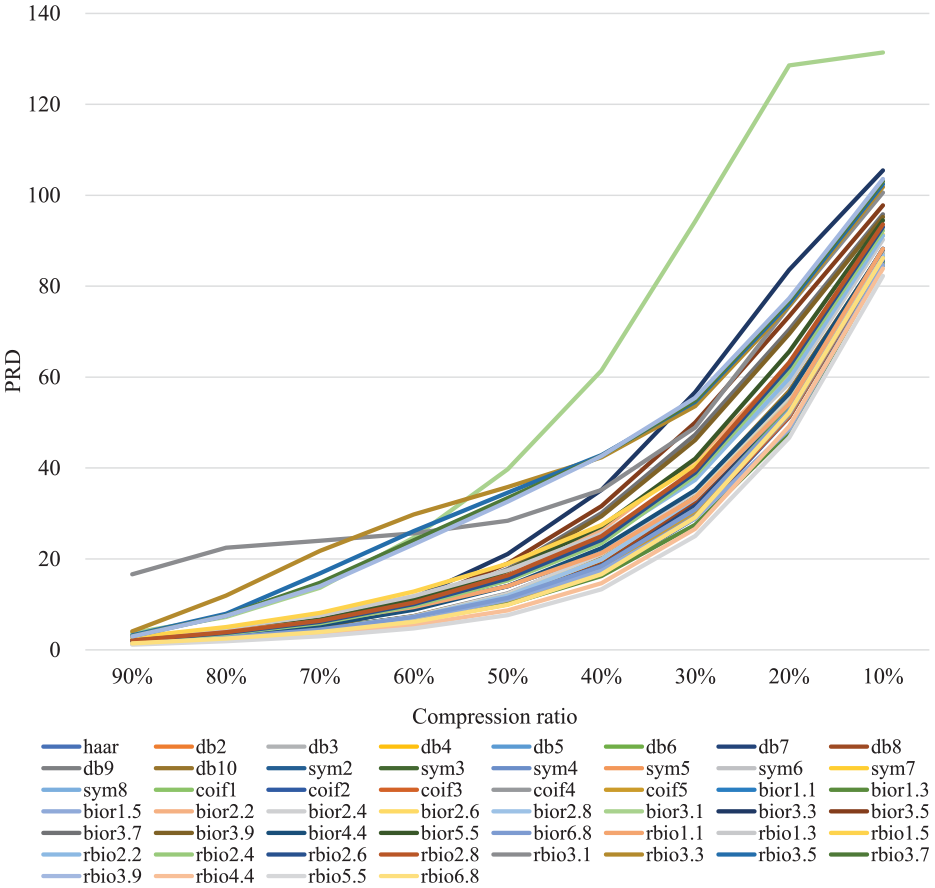
PRD versus different wavelet basis.
Results using overcomplete dictionaries
In recent years, DL has drawn much attention for signal reconstruction in the CS applications. The standard K-SVD approach and state-of-the-art adaptive dictionary technique 39 (i.e. the JBHI) are employed for comparison. (The PRD is defied in a different way in the original paper; 39 thus, there may be certain performance difference in appearance.) The involved dictionaries are with size 192 × 500; in other words, there are 500 atoms each of which has a length of 192. The results are listed in Table 2 and also illustrated in Figure 4, where the performance records of some wavelet basis that are relatively better in corresponding families are also introduced. Apparently, signal reconstruction using overcomplete dictionaries owns prominent superiorities in comparison with the wavelet counterparts. This advantage is more obvious when CR is lower, that is, fewer measurements are accessible. For example, when CR is 90% (data volume is only 10% of its origin), the PRD is over 80 if reconstructed with wavelet basis, yet it is only about 20 if using overcomplete dictionaries. The results completely match the current mainstream viewpoint, which places more emphasis on DL and its applications for signal acquisition in the CS scenario.
PRD of the reconstructed signals in wavelet basis and overcomplete dictionaries.
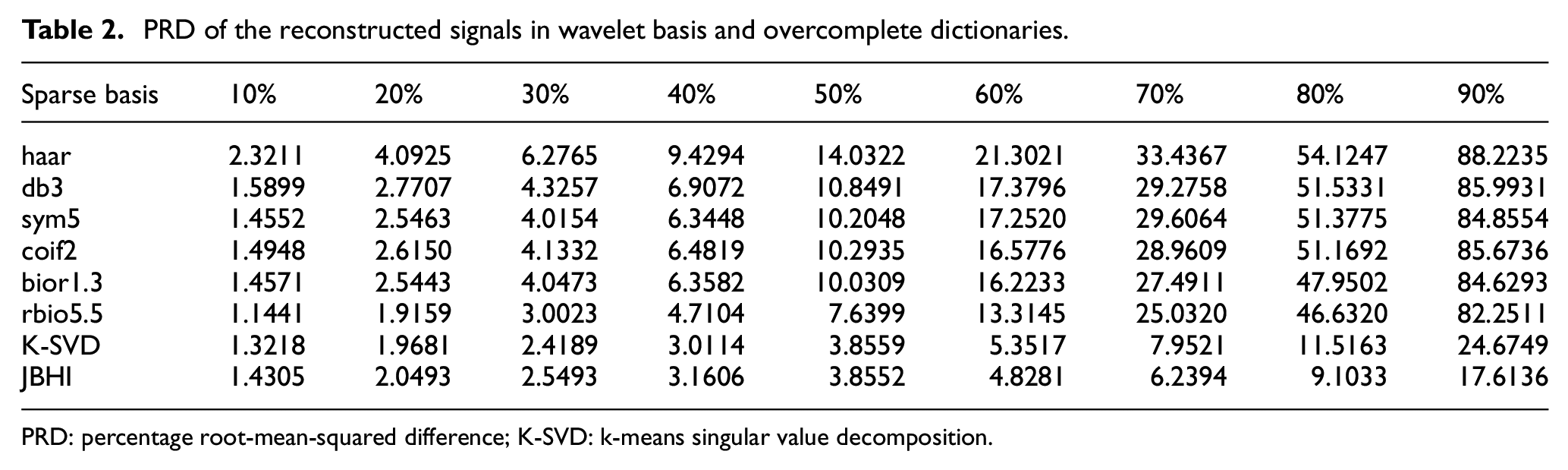
PRD: percentage root-mean-squared difference; K-SVD: k-means singular value decomposition.

PRD of the reconstruction signals in wavelet basis and overcomplete dictionaries.
Results versus reconstruction algorithms
Regarding the comparison of signal reconstruction algorithms, both the PRD and execution time are considered.
Table 3 and Figure 5 demonstrate the PRDs of various reconstruction algorithms; db2 is employed as the sparsifying basis for reconstruction. As illustrated, apparent performance gaps exist among the comparative reconstruction techniques. The Irls approach owns relatively better PRD performance when CR is less than 50%, while a comparable PRD can be achieved by OMP, CoSaMP, and SP when CR is within the range (60%–70%) and is relatively better than that obtained with BP and Irls. In the case that CR is larger than 80%, BP and Irls appear to be better than their counterparts.
PRD of the reconstructed signals using various algorithms.

PRD: percentage root-mean-squared difference; OMP: orthogonal matching pursuit; BP: basis pursuit; CoSaMP: compressive sampling matching pursuit; Irls: iteratively reweighted least squares; SP: subspace pursuit.
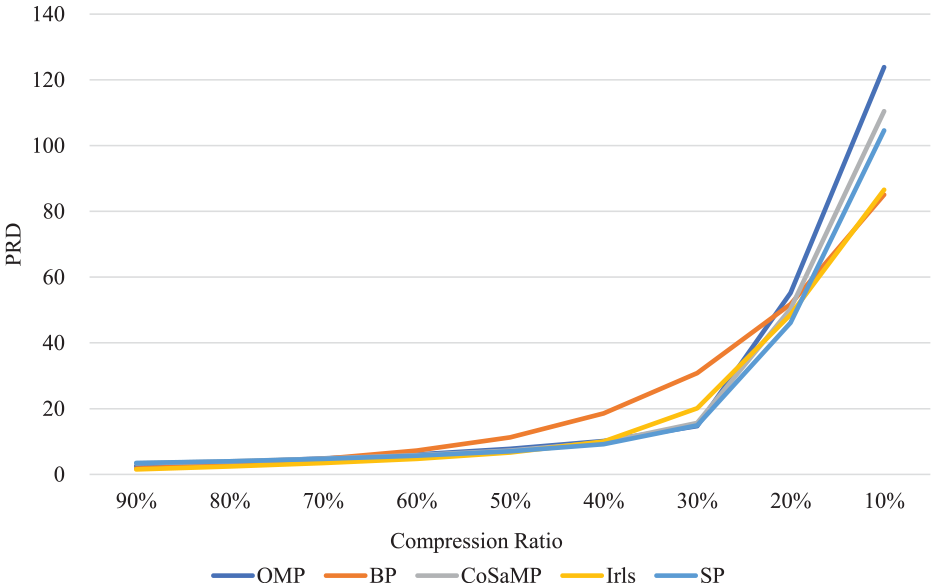
PRD of the reconstruction signals using various algorithms.
However, there are more distinct differences regarding the implementation time of these signal reconstruction algorithms, as revealed in Table 4 and Figure 6. The longest execution time is always required by Irls, the operation time of which even increases more than 100 times when CR changes from 10% to 90%. On the contrary, the implementation duration of BP is relatively more satisfactory and only increases less than 10 times when CR varies from 10% to 90%. The execution duration of SP is comparable with BP when CR is larger than 80%; however, they increase dramatically when CR is less than 70%.
Reconstruction time of various algorithms.

OMP: orthogonal matching pursuit; BP: basis pursuit; CoSaMP: compressive sampling matching pursuit; Irls: iteratively reweighted least squares; SP: subspace pursuit.
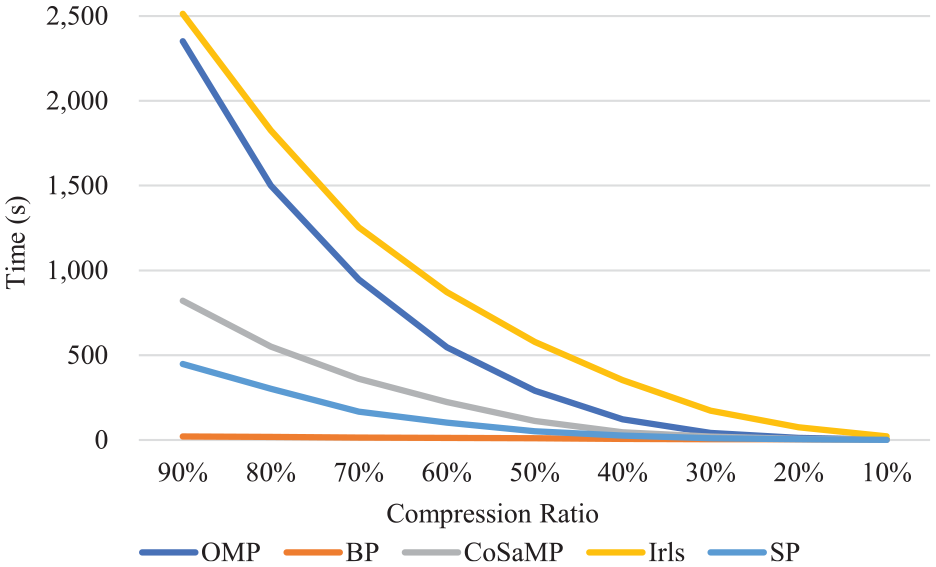
Execution time of various reconstruction algorithms.
Taking overall consideration of Tables 3 and 4, Figures 5 and 6, we can come to the preferred reconstruction algorithm in different compression requirements. When CR is larger than 80%, the BP algorithm gets “acceptable” reconstruction quality and computation time. Such a conclusion is also available when CR is less than 20%. When CR ranges from 20% to 70%, tradeoff should be compromised between execution time and reconstruction quality. Typically, Irls has satisfactory PRD, yet much more time is also required; on the contrary, BP owns relatively a bit bad reconstruction quality but it is the most efficient one. The preferred algorithm depends on the specified requirements of practical applications.
Discussion and perspective
With the booming requirements of modern health-care applications, real-time and continuous biosignal monitoring will definitely play more important roles in our daily life. Large-volume and long-time biosignal acquisition and wireless communication are basic requirements, which accordingly yield growing demands of the node’s resources. The computation, memory, and storage constraints are expected to be solved with Moore’s law, whereas the energy science may not make comparable progress to meet the increasing requirement of WBSN. Thus, achieving better reconstruction with less sampling rate becomes the first choice. The CS is a promising solution, as it can simultaneously acquire and compress biosignals with a low-rate energy-efficient linear projection. The energy-consumption in both the sampling and compression processes can be thus reduced. Advanced signal-processing techniques including CS will definitely have increasing contribution in this field.
From the experimental results, applicability of CS for ECG acquisition has been comprehensively verified. The preferred sparsifying basis and signal reconstruction algorithms in distinct CRs are also achieved. In short summation, rbio5.5 is the most preferred wavelet basis, yet it is still much worse than the overcomplete dictionaries. Therefore, future works should pay more attention to DL method and then construct individual dictionaries for specified biosignals in WBSN. Regarding the reconstruction algorithms, there are much apparent performance differences. In different ratio regions, users can prefer appropriate algorithm or make compromise between signal recovery quality and execution complexity. Data records presented in this article are expected serving as the referenced support for practical applications.
Besides, state-of-the-art achievement reveals that CS also has certain cryptographic properties;9,27 thus, it can further be exploited as a encryption scheme for the acquired data stream and indicates possible saving of the Advanced Encryption Standard (AES) encryption in WBSN protocols (generally in the Mac layer of IEEE 802.15.4/802.15.6/Bluetooth). In literatures, achievements in this kind have drawn increasing attention.45,46 However, standard CS framework has been found vulnerable against plaintext attack from the cryptographic viewpoint. Therefore, revolutionary progress of confidential CS technique is required and will be definitely beneficial in WBSN and other IoT applications.
Conclusions
This article presents a comparative analysis of CS for ECG acquisition. An introduction of CS theory was given, and its usage in WBSN was reviewed in two aspects: the first kind exploits its applicability from a network point of view while the second strives for better reconstruction of a specified biosignal. Subsequently, amounts of experimental results are presented. The rbio5.5 is indicated to be the best wavelet basis for ECG reconstruction, yet overcomplete dictionaries have much more satisfactory performance. Assessments of reconstruction algorithms are conducted in terms of signal recovery quality and execution time as well. The BP owns relatively better efficiency, yet Irls is demonstrated doing better for signal reconstruction. It is also observed that other counterparts have their own advantageous in certain compression level generally; compromise between PRD and computation complexity is suggested. The presented experimental data are expected being referenced records for practical applications.
Footnotes
Handling Editor: Behrouz Jedari
Declaration of conflicting interests
The author(s) declared no potential conflicts of interest with respect to the research, authorship, and/or publication of this article.
Funding
The author(s) disclosed receipt of the following financial support for the research, authorship, and/or publication of this article: This work is funded by the National Natural Science Foundation of China (Nos. 61802055, 61702221, 61771121), Fundamental Research Funds for the Central Universities (Nos. N171903003), the Natural Science Foundation of LiaoNing Province (Key Program) (No. 20170520180), Postdoctoral Science Foundation of Northeastern University (No. 20180101), China Postdoctoral Science Foundation (No. 2018M630301).
