




Abstract
Hybrid wireless mesh networks are suitable to construct emergency communication networks after disasters in underground mines. The routing decision in emergency scene is more difficult to give an accurate mathematical description due to the constraints of various data types, different data transmission requirements, and multi-parameters. Based on the fuzzy decision theory, this article has proposed a fuzzy-logic-based data-differentiated service supported routing protocol. Through the use of the adaptive fuzzy decision system, fuzzy-logic-based data-differentiated service supported routing protocol can provide data-differentiated services and make optimized routing decisions to satisfy the transmission requirements of different data types. In addition, a path soft handoff strategy has been proposed to maintain continuous data transmission when the path quality deteriorates. Based on NS2, we set three transmission scenarios (transmitting emergency data, regular data, or mixed data) to test the performances of fuzzy-logic-based data-differentiated service supported routing protocol, ad hoc on-demand distance vector, FUZZY-ad hoc on-demand distance vector, and multi-criteria routing metric. The results show that the fuzzy-logic-based data-differentiated service supported routing protocol has a higher delivery ratio and lower end-to-end delay when transmitting emergency data. When transmitting regular data, fuzzy-logic-based data-differentiated service supported routing protocol has achieved higher throughput and longer network lifetime than that of similar algorithms.
Keywords
Introduction
Coal mining environment is complex and accompanied by many risk factors such as high dust content, loud noises, and toxic gases. Therefore, in order to predict accidents and disasters, it is necessary to construct a communication network to monitor the status of miners, equipment, and the environment. 1 The traditional network in an underground mine is composed of network equipment (communication cables, Ethernet switches, routers, etc.) and communication clients (sensor nodes, personnel location nodes, mobile intelligent clients, etc.). However, clients and equipment in the network may be damaged once a disaster occurs. As a result, the data transmission capacity of the network will be seriously degenerated and emergency rescue communications cannot be supported after a disaster. Therefore, it is necessary to build an emergency communication network in an underground mine (ECNUM) through the remaining network equipment and communication clients.
The construction scene of the ECNUM after tunnel obstruction is shown in Figure 1. The tunnel blockage cannot be quickly opened up as usual, and rescue workers are unable to enter the affected area in a short time. To obtain the status of the affected area, the commonly used method is to drill in the blocking area and install a wireless access point (AP) or gateway through the hole to connect the ground backbone network with the ECNUM. 2

Construction of the ECNUM.
Wireless mesh networks (WMNs), as a new type of wireless network, have broad application prospects. They can be classified into three types: backbone WMNs, terminal WMNs, and hybrid WMNs (HWMNs). 3 HWMNs consist of mesh routers (MRs) and mesh clients (MCs). MCs can perform routing functionalities and provide end-user applications to customers. HWMNs in long and narrow tunnels mostly have long-chain structures. 4 The network topology after a disaster is shown in Figure 2, where GW is a gateway node installed in the hole at the blocking area. HWMNs have strong self-organizing and self-repairing abilities. When MRs are partly or totally unavailable, the network can be reconstructed through MCs to continue the transmission of data as shown in Figure 2. Therefore, HWMNs can be used to build an ECNUM in a complex disaster environment because of their high robustness. 5

Topology of the ECNUM after a disaster.
However, there have been few efficient dedicated routing protocols for ECNUM. The existing routing protocols did not consider the characteristics of post-disaster underground mines. For example, there are two kinds of data (regular data and emergency data) transmitted in the ECNUM. The network quality of service (QoS) requirements for emergency data and regular data are different. Emergency data are small and have strong burstiness, which demands real-time and reliable transmissions. The data stream of regular data is large and continuous, which will consume more energy of the network equipment. Therefore, it is necessary to provide differentiated services for different types of data when designing the ECNUM routing protocol. In addition, disasters may damage the underground power supply system, and energy constraints will be more prominent. Therefore, when regular data are transmitted in the ECNUM, energy balance and load balance should be achieved to maximize the network lifetime through data routing.
QoS is usually used to evaluate a transmission path. The QoS of ECNUM involves many aspects, including delay, delivery ratio, throughput, and lifetime. However, the relationship of these parameters is often complex, and the description of path quality is fuzzy. Besides, designing a routing algorithm in the ECNUM needs to consider multiple network parameters to satisfy various QoS requirements, which is a multiple input single output (MISO) problem. It is difficult to define an accurate mathematical expression under the multiple constraints. Fuzzy decision theory (FDT) has potential for dealing with the MISO problem, which can calculate the results through heuristic reasoning instead of establishing complex and accurate mathematical models. 6 Therefore, FDT is suitable to solve routing decision problems with multiple QoS constraints.
The focus of this study is to design routing protocols for emergency communication networks in underground mines. We have analyzed transmission characteristics of emergency data and regular data and chosen appropriate network parameters according to the data type to implement our work. Based on FDT, this article has proposed the fuzzy-logic-based data-differentiated service supported routing protocol (FDDSP) to satisfy different data transmission requirements in the ECNUM and optimize network performance. In addition, the path soft handoff strategy is proposed to maintain the continuity of the data transmission and improve the QoS when the path performance is degenerated.
The remainder of this article is organized as follows. Section “Related work” reviews the related work. Section “Preliminaries” introduces the applicability of FDT in the WMNs routing decision. Section “FDDSP” proposes FDDSP and describes it in detail. Section “Simulation experiment” presents the results of the simulation experiments. Finally, the conclusion of the study is presented in section “Conclusion.”
Related work
China is a major producer and consumer of coal. Coal consumption accounts for 70% of the non-renewable energy consumption at the present stage. 7 In recent years, the safety of coal mining has been paid more attention with the increase in depth and intensity in production processes. The terrain of an underground mine is complex, and the environment of mining production is terrible. Traditional wired networks cannot provide reliable communication services. 8 To improve the robustness of the communication networks in underground mines, a wired network generally forms the backbone network, and the wireless networks work as a complement. There are some wireless technologies used in mine communications, as shown in Table 1.
Mine wireless communication system.

The communication systems listed in Table 1 are strongly dependent on the network infrastructures. When a disaster occurs, the damage to infrastructures may lead to the paralysis of communications in the underground mine. HWMNs are different from traditional wireless networks due to their abilities of self-organization, self-healing, and extensibility. Besides, HWMNs can support the high capacity of network transmissions, efficient broadband access, and reliable multimedia support. Therefore, the HWMN can be used to build the ECNUM.9–12
With the process of coal mining and tunnel excavation, the tunnels extend gradually and form a hundreds of, or even a thousands of, meters long strip structure. Therefore, HWMNs with long-chain topologies in underground mines can only transfer information through multiple hops. For multi-hop networks, the hop count of a path directly affects the transmission delay and data delivery ratio. The hop count should be reduced as much as possible since an overlong path will lead to unstable data transmissions.
The MCs are powered by limited capacity batteries, which directly affect the lifetime of MCs and the ECNUM.13,14 In emergency communications, the energy supply in the affected area is interrupted. The energy of nodes cannot be supplemented, which will make the problem of energy limitations more prominent. 15 The network infrastructure, such as the MRs in the disaster area, may be partially or totally damaged. As a result, most of the network load is transmitted by MCs. Therefore, the energy balance should be achieved to prolong the network lifetime. In addition, the computing power and storage capacity of nodes are limited. An unbalanced load allocation can cause an overflow of the buffer queue and an acceleration of energy consumption. Therefore, the load balance should also be considered in the design of the routing algorithm for the ECNUM.
The necessity of using multiple criteria in network routing decisions is proposed in the study by Zhang and Long. 16 Basarkod and Manvi 17 implemented a routing protocol that can avoid congestion and adapt to frequent topological changes by using node mobility (measured by the node stability model) and network congestion (determined by the channel load and buffer occupancy) as routing metrics. A method of measuring link quality is proposed in the study by Jabbar et al. 18 using the idle time, residual energy, and buffer space of nodes. Ma and Denko 19 used two parameters, the cumulative expected transmission time and residual buffer, to choose the best path to achieve load balance. Lu et al. 20 proposed a multi-criteria routing metric (MRM) based on the network delay, hop count, and link load. MRM divided data into two types: urgent and non-urgent. End-to-end delay was calculated when transmitting urgent data, and hop count and link load were measured when transmitting non-urgent data. The aforementioned studies implemented multi-metric routing decisions by introducing proportional adjustment factors to build a multi-parameter adjustment model (MPAM). However, there is no direct quantitative relationship between these parameters. The evaluation of the path is the fuzzy process. It is difficult to give an accurate mathematical description of the MPAM.
FDT, which was proposed by Zadeh in 1965, is widely used in engineering research and industrial controls.21–23 FDT provides a new solution for the MPAM control system as well as routing decisions constrained by the multiple parameters of the network. 24 Marimuthu and Kannammal 25 discussed the selection of network parameters when applying FDT to the routing decision of ad hoc networks. Different fuzzy routing decision methods were proposed according to the type of protocol (proactive or reactive) in the study by Ghazisaidi et al. 26 The proactive routing protocol considered the hop count, expected transmission count (ETX), and congestion, while the reactive routing protocol considered the delay, hop count, signal strength, and congestion. Chelliah et al. 27 focused their efforts on trying to determine a fuzzy multi-constraint ad hoc on-demand distance vector (AODV) routing. The method made routing decisions based on more than one constraint such as buffer occupancy, node energy, and hop count. Torshiz et al. 28 proposed fuzzy energy-based AODV (FE-AODV). FE-AODV chose three parameters, the min-bandwidth, hop count and battery life, as inputs of the fuzzy decision system (FDS). However, FE-AODV needs to collect multiple path information and will cause additional overhead.
Abbas et al. 29 proposed a new method called FUZZY-AODV to optimize the AODV protocol. FUZZY-AODV had three inputs, including the residual energy, movement speed, and hop count. FUZZY-AODV reduced the possibility of a link break and improved the stability and lifetime of the network by selecting the next hop node with a higher trust value (low mobility, small hop count, and sufficient energy). However, FUZZY-AODV did not consider the link load and may cause congestion. Some clustering routing protocols were proposed in previous studies.30–32 These protocols used FDT to select the cluster head and improved the performance of the network. The aforementioned study shows that FDT is very suited for implementing multi-parameter routing.
However, the data types and transmitting requirements are more complex in ECNUM than general applications. In this article, based on the analysis of the transmission characteristics of emergency data and regular data, the multi-parameter routing model is constructed. FDDSP is proposed to satisfy different data transmission requirements in the ECNUM and optimize the network performance.
Preliminaries
Data description
Data transmitted in ECNUM can be divided into regular data and emergency data according to their sources, amounts, and transmission priorities. 33 Regular data include underground environmental information (such as gas concentrations, wind speed, temperature, and other monitoring data), personnel locations, and video streams. Emergency data are produced by the unstable environmental factors or unexpected situations after a disaster and mainly come from the early warning or alarm, such as gas leakage, rock permeability, and abnormal vital signs. The comparison of emergency data and regular data is shown in Table 2.
Comparison of emergency data and regular data.
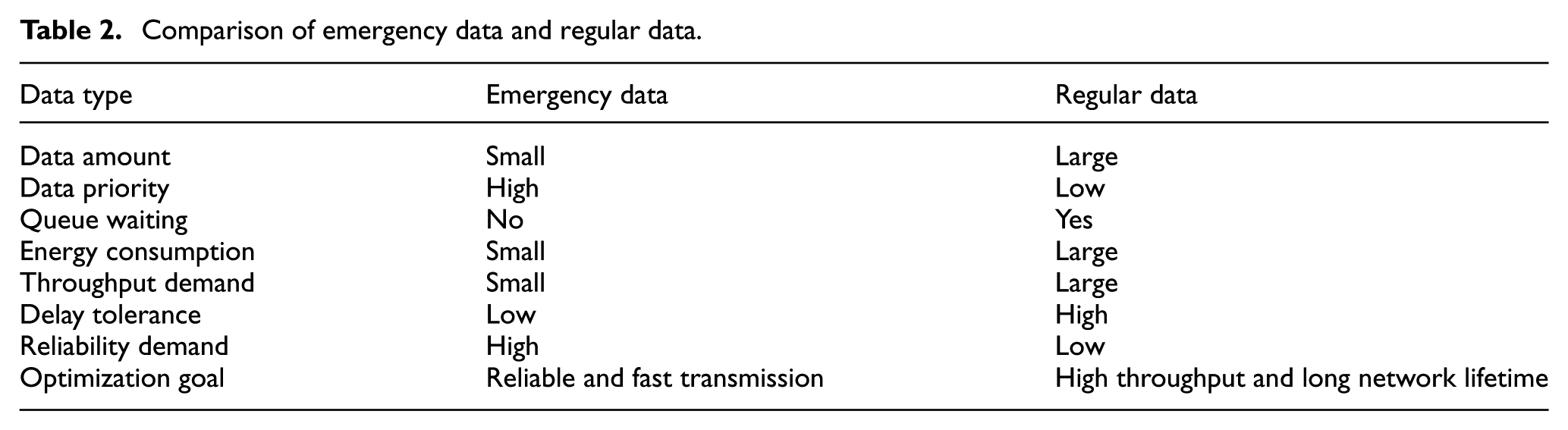
As shown in the comparison, the transmission of regular data requires higher throughput, balanced energy consumption, and load pressure. However, regular data do not require real-time transmission and are tolerant of a certain degree of packet loss. Emergency data have strong bursts and small data sizes. Their transmission requires higher real-time performance and reliability, but without a large throughput. When there are both emergency data and regular data, the emergency data will be pushed to the front of the buffer queue and sent first because of their higher priority. If there are multiple emergency packets, they will be sent in the order of first-in-first-out (FIFO). Regular data are sent in the normal FIFO order.
Fuzzy decision model
FDT is used to achieve multi-QoS constrained routing decisions in this article. The FDS mainly contains the fuzzifier, fuzzy inference engine, and defuzzifier. First, the fuzzifier transforms the crisp inputs into linguistic values through membership functions. Then, the fuzzy inference engine, which contains a rule base (a series of IF-THEN rules) and reasoning methods, will execute the reasoning computation with linguistic variables obtained by fuzzification. 34 Finally, the defuzzifier transforms the results into crisp outputs to make decisions.
The FDS for emergency data is shown in Figure 3. The crisp inputs are the hop count (HC), path transmission quality (PTQ), and path residual energy (PRE). HC indicates the real-time and stability performance of the path. The PTQ and PRE represent the reliability of data transmissions and path lifetime, respectively. The path trust value (PTV), as the routing metric, is the crisp output of the FDS.

FDS of emergency data.
The FDS for regular data chooses the PRE, HC, and path buffer quality (PBQ) as crisp inputs. The crisp output is the PTV. The PBQ indicates the load balance of the path. The main variables used in this article are shown in Table 3.
Variables table.

FDDSP
FDS for emergency data
The transmission of emergency data requires low delay and high reliability to alarm the danger quickly. Three parameters are set in an emergency FDS: HC, PTQ, and PRE.
HC
The delay of data transmission mainly comes from the time consumed with node forwarding and queue waiting. Emergency data have higher priority and are forwarded directly by nodes instead of being added to the end of the waiting queue. Therefore, the transmission delay of emergency data is mainly related to the HC. Besides, the stability of path is greatly influenced by HC. The path with the lower HC should have more opportunities to be selected as the routing path.
PTQ
Because wireless communications are unstable, the quality of intermediate links directly affects the data transmission. Some link quality estimation (LQE) methods are proposed in the study by Baccour et al. 35 It is difficult for nodes in the ECNUM to support the complex LQE algorithm because of its limited energy and computing power. In this article, the packet reception ratio (PRR) is used to measure the link quality. The calculation of PRR is shown as follows

The range of

where PTQ is the multiplication of the quality of all links contained in the path. The value range of PTQ is [0, 1].
PRE
Because of the serious energy limitations after disasters, it is necessary to extend the network lifetime as far as possible. The percentage of residual energy in node i at time t is shown as follows

The survival state of a path is constrained by the residual energy of the intermediate nodes. If an intermediate node dies, the path will break. Therefore, the PRE is defined as follows

The HC, PTQ, and PRE are inputs of the emergency FDS as shown in Figure 3, and the PTV is the output. Figure 4 describes the membership functions of inputs and output. The FDS contains 27 rules in its rule base and two examples are shown as follows:
If (HC = CLOSE && PRE = sufficient && PTQ = HIGH), then PTV = S (4), and
If (HC = FAR && PRE = SHORT && PTQ = LOW), then PTV = W (4).

Membership functions of an emergency FDS: (a) HC: hop count, (b) PRE: path residual energy, (c) PTQ: path transmission quality, and (d) PTV: path trust value.
The value of the PTV is calculated by the process of the defuzzifier. The path with largest PTV will be chosen to transmit the data. The centroid defuzzification method is used in this article and the mathematical expression is as follows 37

FDS for regular data
The amount of regular data is large, and it will persist in the whole lifetime of the ECNUM. The energy limitations after a disaster make the energy balance of nodes more important. In addition, the transmission of regular data demands high throughput, which requires the implementation of load balance among nodes to improve the service quality of the network. Three parameters are set in regular FDS: PRE, PBQ, and HC.
The PRE directly affects the path stability and network lifetime. For the large amount of regular data transmissions, it can effectively reduce the energy holes in the network when choosing paths with larger PRE.
Compared with emergency data, the transmission of regular data has fewer limitations for delays. Regular data will join in the waiting queue when the load of the transmitting node is large. The PBQ reflects the amount of the path residual buffer (PRB) and the equilibrium degree of the used buffer. The residual buffer ratio of intermediate nodes is defined as follows

where the value range of

The value range of the PRB is [0, 1].
The balance degree of the residual buffer in the path can be expressed by the standard deviation

where

pbq is defined as follows

Because the range of

When the value of PRB is large and
The membership functions of the regular FDS are shown in Figure 5. There are 27 rules in the rule base and some examples are shown as follows:
If (HC = CLOSE && PRE = SUFFICIENT && PBQ = HIGH), then PTV = S (4), and
If (HC = FAR && PRE = SHORT && PBQ = LOW), then PTV = W (4).

Membership functions of the regular FDS: (a) HC: hop count, (b) PRE: path residual energy, (c) PBQ: path buffer quality, and (d) PTV: path trust value.
Implementation of FDDSP
Algorithm process
To distinguish the data types, FDDSP adds the data type (DT) field to the route request (RREQ) packets. There are also other fields, such as HC, PTQ, PRE, and PBQ, that store the corresponding parameters mentioned in sections “FDS for emergency data” and “FDS for regular data.” These fields will be inputted into the FDS when making routing decisions. The structure of a RREQ is shown in Table 4.
Structure of an RREQ.
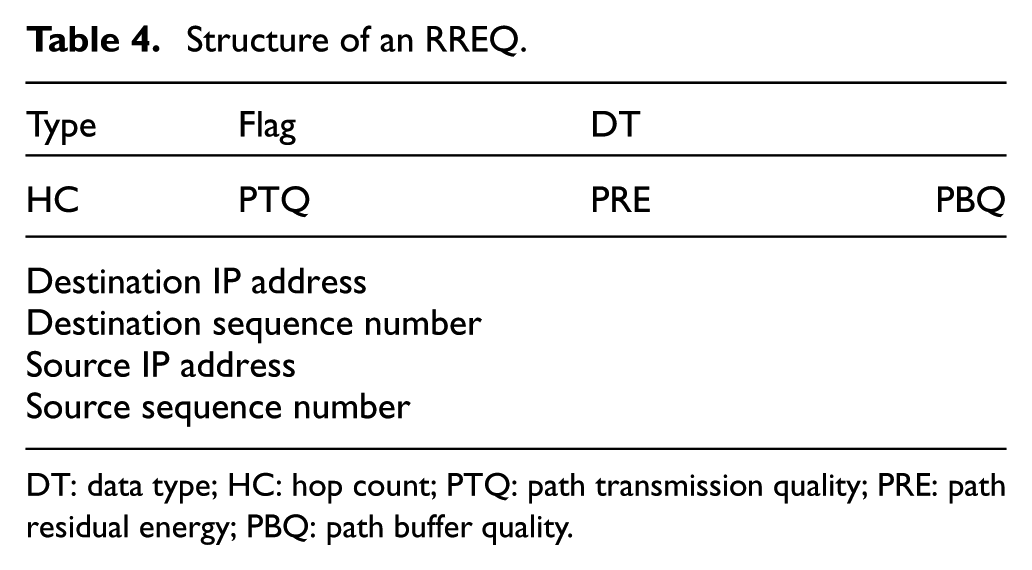
DT: data type; HC: hop count; PTQ: path transmission quality; PRE: path residual energy; PBQ: path buffer quality.
FDDSP fills the DT field according to formula (12) and initiates the routing requests

FDDSP will select different FDSs according to the value of DT when receiving an RREQ. The path selection process is shown in Figure 6.

Path selection process of FDDSP.
FDDSP may choose different transmission paths to transmit different types of data, even though the data are coming from the same source. To distinguish the path as being for emergency data or regular data, the routing type (RTT) field is added to the routing table. The value of RTT is defined as follows

The structure of the routing table is shown in Table 5.
Routing table.

RTT: routing type; PTV: path trust value.
The PTV field is used to store the output of the FDS in sections “FDS for emergency data ” and “FDS for regular data.” PTV is used as the routing metric and is updated as the following rule

where
Soft handoff strategy
The quality of the path will decrease and the value of PTV will change with the running of the network. To ensure that the energy balance and loads are proportionate, there are two trigger conditions to start the path handoff process for node i at time t.
The node has a heavy load.
Due to the fluctuation of the node loads, in order to avoid frequent path switching, it is necessary to evaluate the load condition and divide the node loads into light loads and heavy loads, as shown in Figure 7. The buffer occupancy

Load determination curve.
When a path requires a handover, node i will send a path rebuild request to the source node S, but the original transmission path is still active, as shown in Figure 8(a) and (b). When S receives the request, a new path construction process will be started to build a spare path, as shown in Figure 8(c). When the new path is ready, the data will be transferred to the new path. A seamless soft handoff has been achieved, as shown in Figure 8(d).

Process of a path soft handoff: (a) original path, (b) path rebuild request, (c) new path construction, and (d) path soft handoff.
Simulation experiment
Simulation environment and experimental parameters
Based on the NS2 simulation platform, the performance of FDDSP has been tested on average end-to-end delay, delivery ratio, throughput, and network lifetime, which are compared with AODV, 38 MRM, 20 and FUZZY-AODV. 29 The performance indicators are defined as follows.
Average end-to-end delay
The average value of constant bitrate (CBR) packets delays from each source node to the gateway node. The average end-to-end delay can be defined as follows

where
Delivery ratio
Delivery ratio is the ratio of CBR packets arriving at the gateway node to the total packets sent by source nodes. The delivery ratio can be defined as follows

Throughput
Throughput is the amount of data received by the gateway node in 1 s.
Network lifetime
The time when the first node dies is defined as the network lifetime.
The parameters of the simulation network are listed in Table 6.
Simulation parameters.
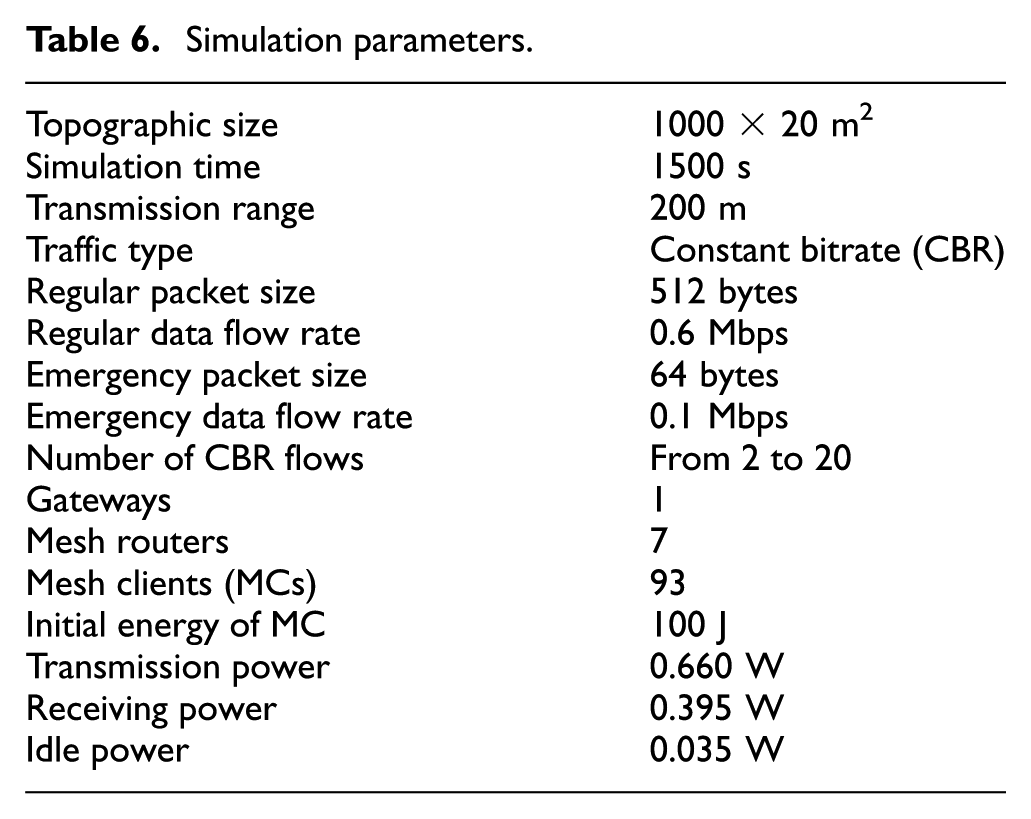
The network has been set in a long and narrow area of 1000 × 20 m2 to simulate the network scene in Figure 1 and deploy seven MRs, one gateway, and the number of MCs is [50,150] in the network. Different packet sizes and data flow rates are set to simulate the different amounts of data. The packet size of emergency data is 64 bytes, and its data flow rate is 0.1 Mbps. The size of regular data is 512 bytes, and its data flow rate is 0.6 Mbps. The experiment sets three transmission scenarios: emergency data transmissions, regular data transmissions, and mixed data (emergency data and regular data coexisting in the network) transmissions. With a fixed network size (MRs = 7, MCs = 93), the performances of the aforementioned protocols in the three scenarios are tested under different load pressures by increasing the number of CBR data streams (from 2 to 20). Each data point is the average of 20 experiments.
Besides, we test average end-to-end delay and network lifetime with different network sizes (MRs = 2, MCs from 50 to 150). Each point is the average of 20 experiments. In every 20 experiments, we fix the number of MCs (such as MCs = 50 or MCs = 60) and change the number of CBR streams (1–20 CBRs).
Performance analysis
Delivery ratio
The delivery ratios of protocols in three data transmission scenarios are compared in Figures 9–11. Regardless of whether emergency data, regular data, or mixed data exist, the delivery ratio of FDDSP is the highest, followed by the FUZZY-AODV and MRM, and AODV is the lowest. AODV selects the path with the lowest hop count to transmit data but cannot avoid the congestion or unbalanced energy consumption. When the path is broken or the transmission quality is substantially reduced, a new path request will be initiated by AODV. The path rebuild strategy of AODV causes time waste and packet loss. FUZZY-AODV considers the residual energy and hop count to select the path and can reduce the packet loss caused by node death. However, it is not sensitive to the congestion because the load factor is not involved in the routing metric. The transmission of emergency data in MRM only considers the delay. This single routing metric makes MRM unable to efficiently adjust the routing, thus resulting in some packet losses. MRM considers the hop count and link load when transmitting regular data. However, the metric does not contain the energy factor and cannot avoid the excessive use of MCs with low residual energy. Therefore, some packets are lost due to the death of nodes. When transmitting emergency data, FDDSP takes PTQ and PRE as fuzzy inputs to avoid choosing the path with low transmission quality and less residual energy. When selecting the path for regular data, the PBQ and PRE are used as fuzzy inputs to avoid the packet loss caused by congestion and node death. In addition, when the path quality changes, the path soft handoff can maintain the continuity of data transmission and choose a new path to reduce the packet loss further.
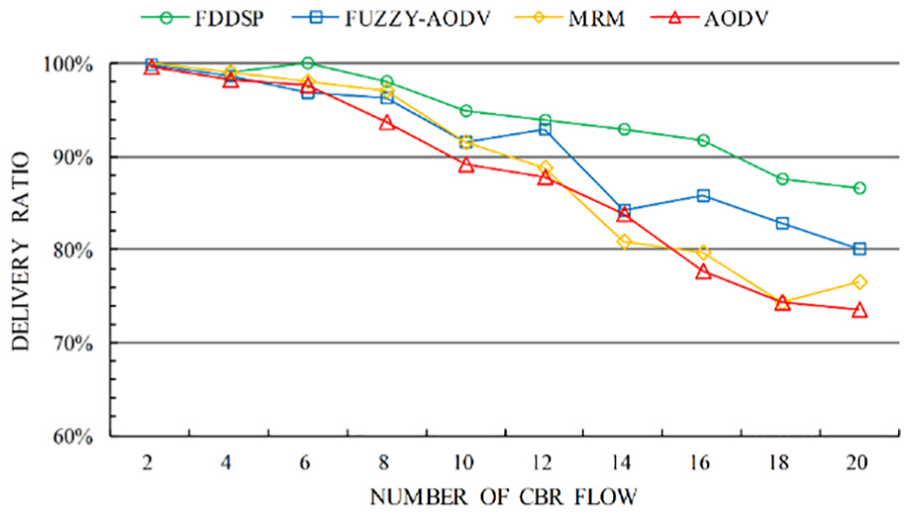
Delivery ratio of emergency data.
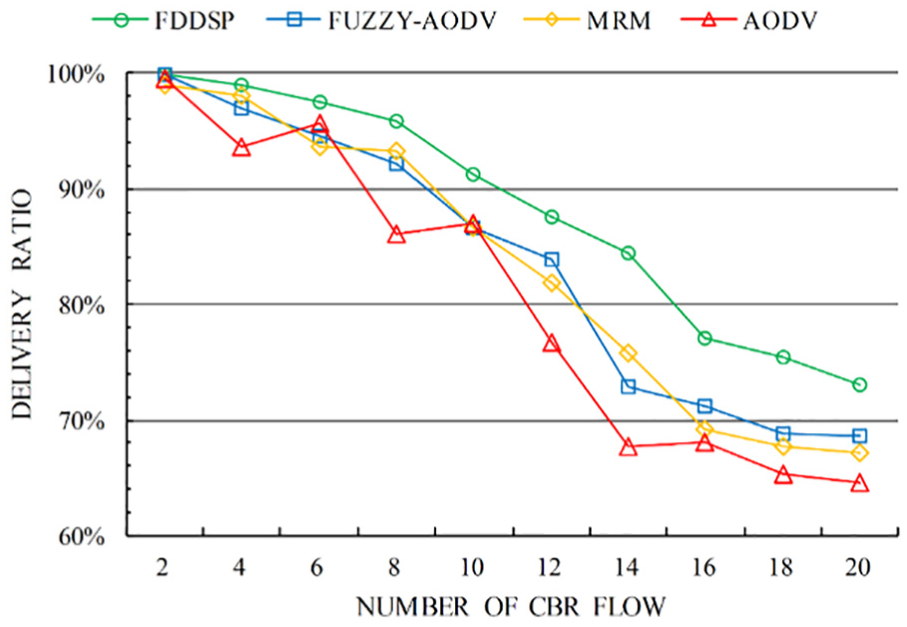
Delivery ratio of regular data.

Delivery ratio of mixed data.
The delivery ratios of FDDSP in three data transmission scenarios are shown in Figure 12. The results show that the emergency data transmission has a higher delivery ratio than that of the other two data transmission scenarios. There are two main reasons for this result: (1) the amount of emergency data is small and (2) the optimization goals of the transmission of emergency or regular data are different. The transmission of emergency data emphasizes the reliability, while regular data can tolerate a small amount of packet losses.

Delivery ratio in different scenarios.
Average end-to-end delay
Figures 13–18 show the comparisons of end-to-end delay in three scenarios. Whether the network size is fixed or not, FDDSP has the lowest delay. When the network size changes, the delay decreases with the number of nodes increasing. The path selection mechanism of AODV cannot avoid the heavy load or congestion nodes effectively. In addition, AODV may choose low-energy nodes to transmit data, which results in the premature death of nodes as well as path breaking and reconstruction. Therefore, AODV has the highest end-to-end delay, especially under high loads. FUZZY-AODV considers the residual energy to avoid choosing the low-energy nodes. Therefore, it can reduce the delay caused by a broken path when the load is heavy. However, the node’s current load pressure is not considered (e.g., the node with sufficient residual energy may carry a heavy load), and thus FUZZY-AODV may still cause delays due to congestion. MRM selects the path with the lowest delay when transmitting emergency data. When the load is light, MRM has lowest end-to-end delay. However, it cannot effectively avoid the delays caused by congestion and cannot change the transmission path in time when the load pressure is increased. The transmission of regular data can effectively avoid the use of heavy load nodes in MRM, but the delay caused by node early death cannot be solved because of using a low-energy node. FDDSP can send emergency data first without waiting. In addition, FDDSP uses the emergency FDS to choose a path with a high delivery ratio and short length. Therefore, FDDSP has lower end-to-end delay when transmitting emergency data. When transmitting regular data, FDDSP can avoid the congestion area and reduce the delay efficiently through the use of the regular FDS.

End-to-end delay of emergency data versus CBR.

End-to-end delay of regular data versus CBR.

End-to-end delay of mixed data versus CBR.
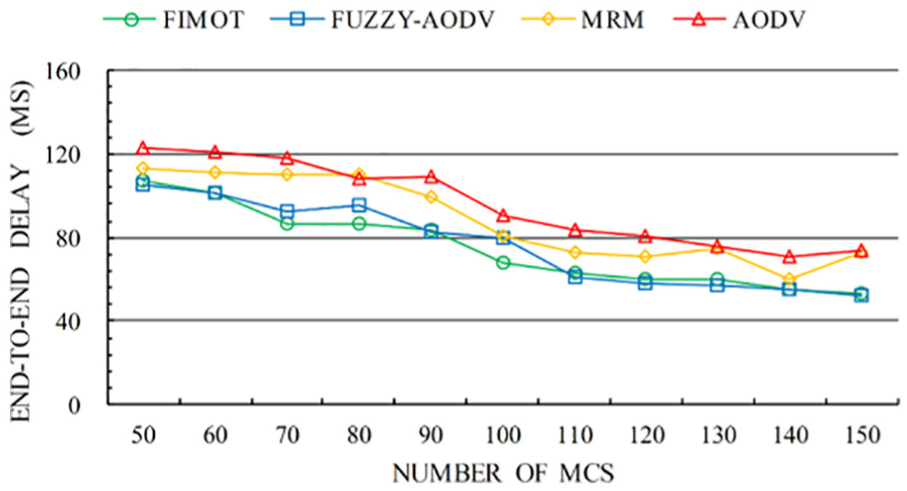
End-to-end delay of emergency data versus MCs.

End-to-end delay of regular data versus MCs.

End-to-end delay of mixed data versus MCs.
The end-to-end delays of FDDSP in the three data transmission scenarios are shown in Figures 19 and 20. The transmission of the emergency data has minimal end-to-end delay, which meets the real-time requirement. While the transmission of regular data tolerates a certain delay, the results show that it is still within the acceptable range.
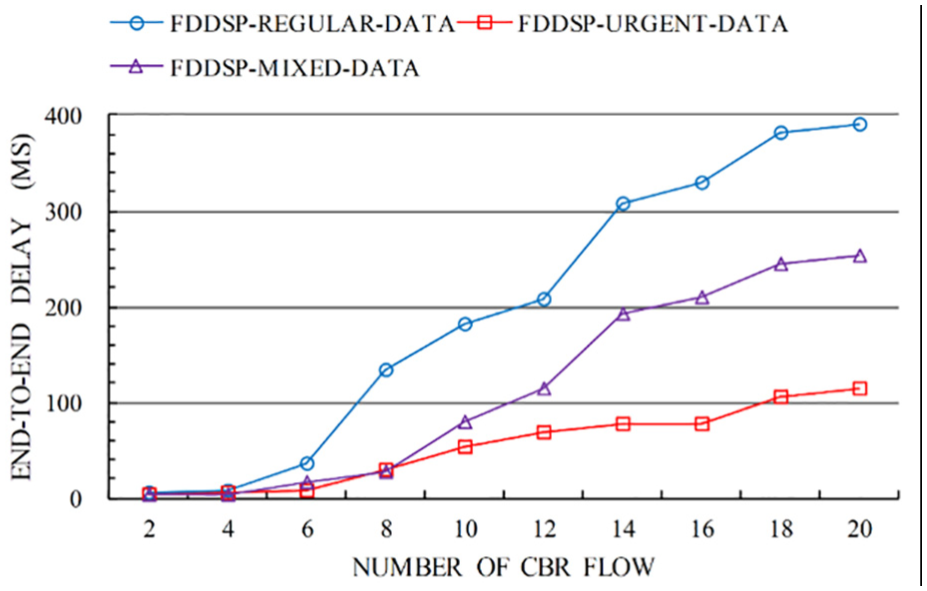
End-to-end delay in different scenarios versus CBR.

End-to-end delay in different scenarios versus MCs.
Throughput
As shown in Figures 21–23, FDDSP has the highest throughput, followed by FUZZY-AODV and MRM, and AODV has the lowest. From the analysis of sections “Delivery ratio” and “Average end-to-end delay,” it can be concluded that high latency and more packet loss result in lower throughput in AODV. FUZZY-AODV can reduce the network overhead caused by path breaking, and thus, its throughput is higher than that of AODV. MRM considers the path load in routing decisions, and thus, it can effectively avoid congestion when transmitting regular data. However, the reduction in the throughput has not been effectively prevented, which is caused by link breakage and path reconstruction. FDDSP has taken full account of the energy and load of the path and can reduce the frequency of path breakage and reconstruction. In addition, the soft handoff strategy of FDDSP can maintain the continuity of data transmission. Therefore, FDDSP has higher throughput than that of other similar protocols.

Throughput of emergency data.

Throughput of regular data.

Throughput of mixed data.
Network lifetime
Whether the network size is fixed or not, FDDSP has the longest network lifetime. The network lifetime extends as the network scale increases. FDDSP and FUZZY-AODV consider the residual energy as the routing metric to achieve the energy balance, and thus, their lifetimes are longer than those of AODV and MRM. The regular FDS of FDDSP can distribute the network load more evenly than FUZZY-AODV can. Therefore, FDDSP has a longer lifetime than the FUZZY-AODV does. In addition, the path soft handover strategy of FDDSP can detect and switch off low-quality paths in time, which can avoid overusing paths with heavy loads and prolong the network lifetime (Figures 24–29).
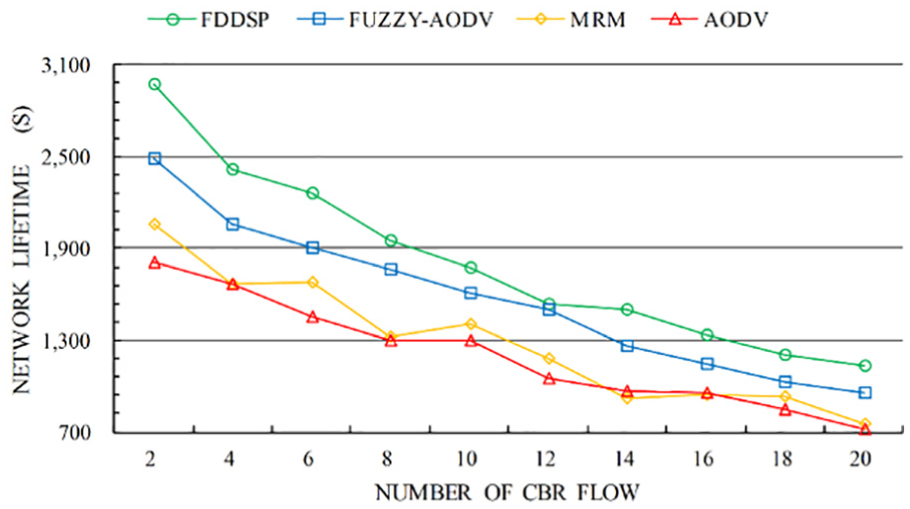
Network lifetime of emergency data versus CBR.
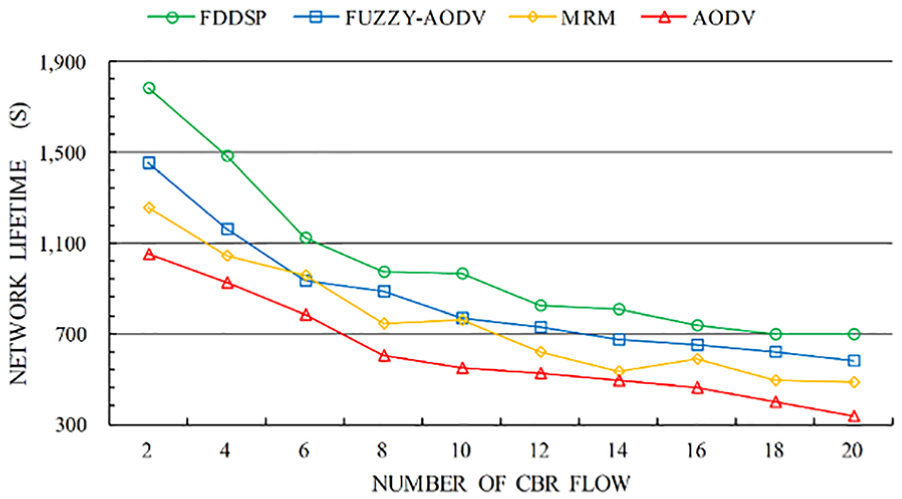
Network lifetime of regular data versus CBR.

Network lifetime of mixed data versus CBR.
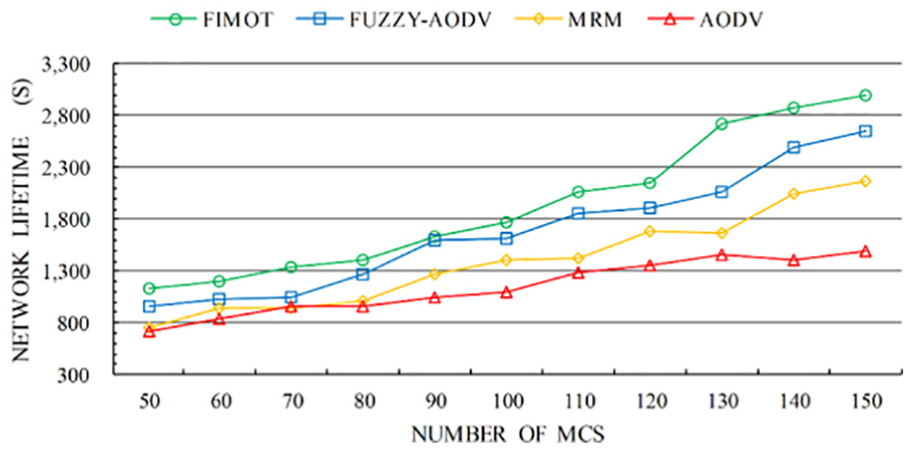
Network lifetime of emergency data versus MCs.

Network lifetime of regular data versus MCs.
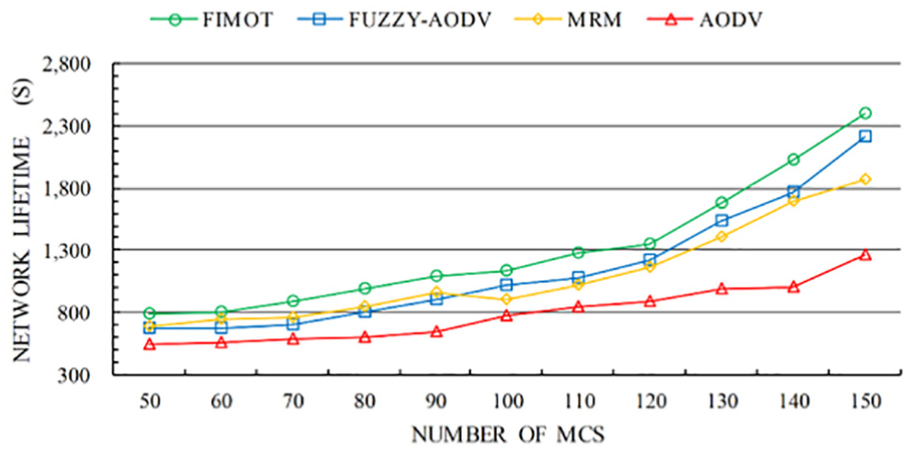
Network lifetime of mixed data versus MCs.
Conclusion
It is necessary to build the ECNUM on time to accelerate rescue progress after a disaster. There are some special problems in the ECNUM, such as different data types, the destruction of infrastructure, and the limited energy of nodes. To satisfy different data transmission requirements and solve the post-disaster problems, this article has solved the routing decision problem with multiple QoS constraints based on FDT and the proposed FDDSP. In this article, the data types are divided into emergency data and regular data. Emergency data require real-time and reliable transmissions. Regular data require a high throughput and balanced energy consumption. FDDSP chooses different FDSs to make routing decisions for different types of data and provides differentiated data services to optimize the transmission quality. In addition, the soft handoff strategy of FDDSP has achieved the reliability and continuity of data transmissions. The performances of FDDSP in three data transmission scenarios under different load pressures and network size are simulated and compared with those of AODV, FUZZY-AODV, and MRM. The results show that FDDSP has the best performance in end-to-end delays and the delivery ratio when transmitting emergency data. When transmitting regular data, FDDSP can achieve high throughput on the basis of guaranteeing fewer end-to-end delays and a higher delivery ratio.
To ensure the personal safety in the affected area and avoid secondary damage, the mobility of client nodes held by miners is assumed to be low in this article. However, in practical applications, node movement is inevitable, which will cause unstable network topology and affect the network’s performance. In future work, more attention will be paid to the node mobility in the ECNUM to improve the network performance under real application scenarios in underground mines.
Footnotes
Handling Editor: Sergio Toral
Declaration of conflicting interests
The author(s) declared no potential conflicts of interest with respect to the research, authorship, and/or publication of this article.
Funding
The author(s) disclosed receipt of the following financial support for the research, authorship, and/or publication of this article: The financial support for this work provided by the Fundamental Research Funds for the Central Universities (no. 2017XKQY077) is gratefully acknowledged.
