




Abstract
With the advancement in communication technologies, Internet of vehicles presents a new set of opportunities to efficiently manage transportation problems using vehicle-to-vehicle communication. However, high mobility in vehicular networks causes frequent changes in network topology, which leads to network instability. This frequently results in emergency messages failing to reach the target vehicles. To overcome this problem, we propose a data dissemination scheme for such messages in vehicular networks, based on clustering and position-based broadcast techniques. The vehicles are dynamically clustered to handle the broadcast storm problem, and a position-based technique is proposed to reduce communication delays, resulting in timely dissemination of emergency messages. The simulation results show that the transmission delay, information coverage, and packet delivery ratios improved up to 14%, 9.7%, and 5.5%, respectively. These results indicate that the proposed scheme is promising as it outperforms existing techniques.
Introduction
The emerging domain of Internet of things (IoT) has transformed many fields, among them, the traditional vehicular ad hoc networks (VANETs) have transformed into a new paradigm of connected vehicles known as Internet of vehicles (IoV). IoV plays an important role in building a dynamic network of vehicles for improving the intelligent transport system (ITS), focusing on efficient information exchange among vehicles. It provides support for new applications such as road safety, entertainment, and traffic management, which were previously difficult to realize. With IoV, this revolution in VANETs can easily be seen now as vehicles can share data and information with other vehicles and road side units (RSUs). IoV essentially extends structure by improving stability of VANETs to enhance ease of travel and improve driver awareness of traffic conditions, particularly, to help avoid road accidents, find less congested routes, and reduce fuel consumption and air pollution. 1 An illustration of a high-level IoV communication model is shown in Figure 1. This model improves the stability of vehicular networks and supports an application to facilitate drivers in avoiding congested routes. 2
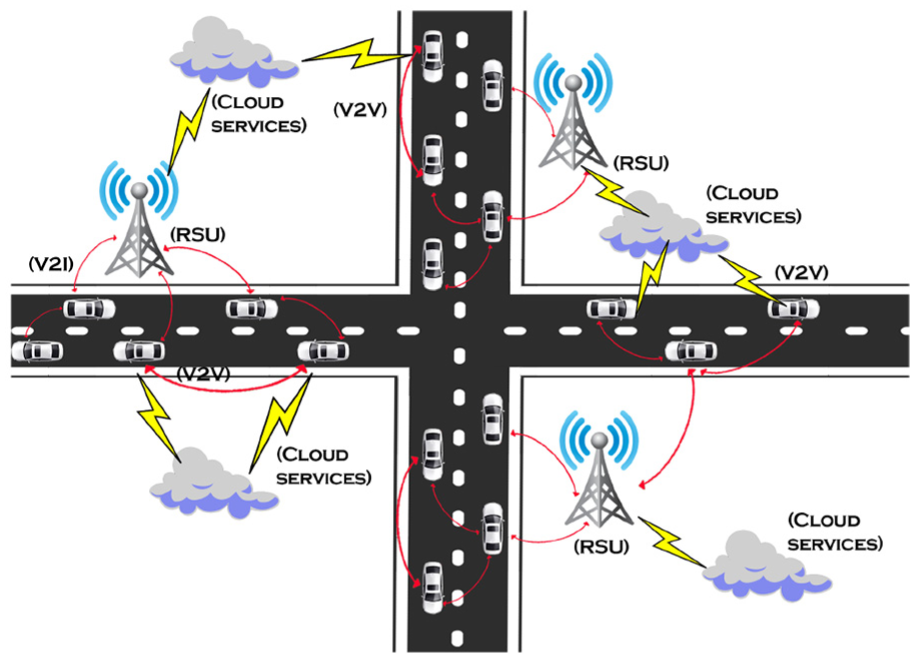
Internet of vehicles—communication paradigm.
A steady increase in the number of vehicles on highways, owing to a reduction in initial ownership cost, has led to more congested roads and increased risk of accidents. In addition, weather conditions such as fog can also contribute to road congestion and inhibit driver response, leading to serious accidents. According to the reports published in 2011, in the United States, $121 billion is wasted in 498 urban areas, and 56 billion pounds of additional CO2 is produced due to congestion. The concept of connected vehicles is a promising approach to reduce road congestion via intelligent traffic control and management. 3 In traditional VANETs, information is exchanged directly or indirectly through vehicle-to-vehicle (V2V) and vehicle-to-infrastructure (V2I) communications. Unlike mobile ad hoc networks (MANETs), the challenge in VANETs is handling high mobility and rapid topology changes that cause frequent network disconnections.4,5 Moreover, these factors lead to excessive transmission delays, packet loss, and spectrum scarcity, leading to lower overall network performance. Vehicles rely on multi-hop mechanisms for message forwarding to other vehicles because of limited wireless communication range. Inherently, the radio signals used for such communication are likely to interfere with each other as vehicle density on roads increase. In such situations, a simple approach like broadcasting via flooding is costly and results in redundancy, contention, and collisions in the underlying network. This phenomenon is known as the broadcast storm problem, and it wastes significant spectrum resources, leading to spectrum scarcity. 6 From a public interest point, efficient dissemination of information among vehicles is desirable, as drivers are often interested in getting real-time traffic-related information. 7 Without any central control, the dynamic positioning of vehicles on roads causes network instability and broadcast issues, resulting in overall performance degradation. One possible solution is to install RSUs, which would be responsible for scheduling and managing dynamic networks. However, these access points add additional deployment and maintenance costs. Another possible solution is to dynamically build clusters based on parameters common to a set of vehicles on the road. These clusters can help to increase connection lifetime by grouping together vehicles with similar attributes, such as speed, physical location, and direction of travel. In such clusters, the vehicles send messages to the cluster head (CH), which in turn broadcasts them to other cluster members (CM). In this solution, however, certain issues, such as cluster stability, need to be addressed to enhance the network lifetime and channel fading affects.8,9
In this article, we propose an emergency message (EM) dissemination scheme using dynamic clustering and position-based cross-cluster communication. The clusters are formed primarily on interest compatibility (IC) and destination similarity among vehicles, that is, vehicles sharing EMs based on the position of the target vehicle. In this approach, the position of a vehicle is known through beacon messages, and the optimum candidate for EM sharing is the vehicle moving in the opposite direction on the road. This is optimum because the opposite vehicle can spread information much faster. However, communication with such vehicles suffers because of reduced connection times, adversely affecting the data sharing rates. Though this can reduce the success rate, a successful communication decreases the delay and increases the coverage significantly as compared to other schemes. The rest of the article is organized as follows: section “Literature review” presents an overview of existing research on dissemination of EMs. Section “Methodology” covers the system model where the proposed position-based dissemination scheme is presented and evaluated. Section “Discussion” discusses the results and limitations of the proposed model. Finally, section “Conclusion” concludes the article.
Literature review
The dissemination of EMs, especially in VANETs, is an active area of research, with many techniques proposed for efficient data dissemination. However, many of these techniques are application dependent, generate a large number of messages to increase the coverage area, and add significant delays to find a suitable candidate for forwarding. Owing to their ad hoc nature, the main challenge of VANETs is their network lifetime. 10 Besides these, reliability, latency, and lack of device compatibility are other factors with serious implications on VANETs. 11
With the inception of IoT, conventional VANETs have transformed into IoV, promising an improvement in road safety and traffic-related issues. In this regard, many protocols have been proposed for effective data dissemination among vehicles. In Dua et al., 12 a protocol with the objective of quality-of-service (QoS) is proposed, where data packets are sent to a destination using the best possible routes. In addition, weights are assigned to different routes based on the information received from other vehicles. An improved approach in Wahab et al. 13 introduces a cluster-based data dissemination protocol, which makes a trade-off between QoS and mobility in order to form stable clusters for effective data dissemination.
A delay-based data dissemination technique proposed in Akamatsu et al. 14 deals with the broadcast storm problem. The technique selects relay nodes in a distributed manner that are used to broadcast messages based on the distance from the source vehicle. A similar work involves selection of relay nodes for EM dissemination in VANETs in Rehman and Ould-Khaoua. 15 The ad hoc mechanism results in improved performance while reducing network congestion.
For broadcast communication, different dissemination techniques are proposed to suppress the undesired broadcast problem in dense networks. In Schwartz et al., 16 a carryforward model is proposed to address the broadcast problem as well as to present a solution for frequent network disconnections. The solution works for both dense and sparse networks. In Salvo et al., 17 a protocol for efficient and robust data dissemination is introduced to address the issue of spurious dissemination, which generally occurs in such time-based dissemination schemes. Here, the information obtained from the received packet headers is used to make forwarding decisions. Similarly, Baiocchi et al. 18 have discussed the impact of spurious message forwarding on available bandwidth in timer-based VANET protocol. The spurious message forwarding affects the overall achievable throughput rate and degrades the network performance.
Other techniques use probabilistic and timer-based broadcasting techniques to control packet loss and network congestion while maintaining a reasonable end-to-end delay, as demontrated in Wisitpongphan et al. 19 A similar study in Tonguz et al. 20 proposes the distributed vehicular broadcast (DV-CAST) protocol for both dense and sparse traffic scenarios. The protocol works in a distributed manner, with messages sent on the basis of local topology and success measured in terms of packet delivery ratio (PDR). In Panichpapiboon and Cheng, 21 a technique to reduce the number of redundant packets using inter-vehicle spacing distribution in real traffic scenarios is introduced, whereas Mostafa et al. 22 proposed a probabilistic rebroadcasting scheme for packet forwarding with reduced number of collisions. Factors affecting the rebroadcast probability are derived from the vehicle’s environment such as the vehicle density, the distance from source to destination, and its transmission range. The resulting probability determines whether a particular vehicle receives a rebroadcast successfully or not. Further to this, in Zhang et al., 23 a smart geo-cast algorithm is proposed, which reduces redundant messages at the receiver end without compromising the important information.
A protocol with an emphasis on road safety in Liu and Chigan 24 implements a directional greedy broadcast routing technique to reduce the delay in the EM dissemination. Moreover, the technique allows vehicles to disseminate data as response to data requests. However, such techniques add an additional delay, as discussed in Mondal and Mitra. 25 More recent works, for instance, in Shah et al., 26 propose a data dissemination approach that defines a time barrier based on the distance from source vehicle. The objective is to reduce message overhead, which can congest the network and affect the overall performance. Other studies in Ata et al. 27 and Shumayla et al. 28 explore the possibility of using fog computing for congestion avoidance in VANETs and IoVs.
The aforementioned key issues in VANETs such as mobility, connection lifetime, and network stability affect EM dissemination. To overcome these issues, some techniques have been proposed, but these fail to adequately address all these problems. This article attempts to fill this gap in the literature by proposing a position-based EM dissemination technique. Specifically, the approach shares information with vehicles moving in the opposite direction. This is an attempt to improve dissemination performance of incident-related information (e.g. accident or congestion) to every vehicle passing through the incident zone.
Methodology
The proposed methodology focuses on V2V communication without requiring any additional assistance such as RSUs. Vehicles moving in the same direction, with similar speed, and in the vicinity are dynamically grouped as clusters. Each cluster is lead by a CH, and all other vehicles in the cluster are referred to as CM. Interest compatibility (IC) matrices are calculated to the CM suitable for CH. It is also possible for vehicles to be left out of clusters if they fail to meet the cluster membership criterion. Such vehicles are referred to as inferior nodes (IN). Besides vehicles, every road is assigned a unique
System model
This section describes the system model used by the proposed technique. For this model, we assumed that all vehicles are equipped with wireless communication and they periodically exchange information with each other. The information includes vehicle location, current speed, and direction of travel. Moreover, destinations are known and shared among the vehicles. 29 Notably, the proposed scheme does not require any RSUs to relay this information. The symbols/notations used in the system model are listed in Table 1.
List of notations.

The proposed technique is designed for urban areas where traffic density is usually high and many of the roads have multiple lanes and support two-way traffic, as shown in Figure 2. Vehicles can join an existing cluster based on their parameters such as speed and direction of travel. Thereby, multiple clusters may exist on a road segment at any given time, and each cluster comprises a designated CH with its CMs. For EM dissemination, a vehicle (usually the CH) would transmit the messages to other clusters to enhance the overall coverage area and reduce communication delay. In fast-moving vehicles, the packet drop rate increases due to the wireless fading channel, affecting the probability of successful transmissions. This probability between vehicles i and j is modeled using the Nakagami-m distribution 30 represented as

where

Dynamic cluster formation illustrating cluster head, cluster members, and inferior nodes in a realistic scenario.
The model uses configurable fading parameter l to represent channel conditions.
31
The parameter depends on the distance

We consider three different values for the fading parameter depending on the distance between vehicles, such as distance below 50 m, between 50 and 150 m, and above 150 m. These fading values are assumed based on the Nakagami-m distribution.
We also take into account the interests of a vehicle, that is, interest in parking, accidents, or traffic congestion information. Let

An IC model is used for CH election based on compatibility among vehicle interests. For instance, the compatibility IC between vehicles i and j with interest vectors

To improve the network lifetime, a CH is selected using the cluster head eligibility score

The average compatibility

The average distance

The average velocity

Here, N shows the total number of vehicles. Moreover, the average relative distance between the destinations of vehicle i and its neighboring vehicles j is computed using

In summary, the election step involves using the cosine similarity matrix to determine a vehicle’s interests to other vehicles, which is used to compute the IC weighted matrix. 32 The vehicle having the highest IC is selected as the CH. Furthermore, as the relative destination information is shared among vehicles (both intra- and inter-cluster), a CM can change its cluster membership to another cluster, in case it finds a CH with better destination similarity.
Position-based data dissemination
The section details the proposed EM dissemination scheme using cluster and position-based target vehicle selection. In the scheme, vehicles traveling on the road are grouped using parameters including vehicle direction, speed, and relative location. The clustering technique is adapted to handle the broadcast storm problem while enhancing the vehicular network lifetime achieved through network stability. This is difficult to attain unless vehicles with similar interests are grouped. Furthermore, in contrast to MANETs, the mobility of vehicles is high owing to frequent connection timeouts in vehicular networks.
A typical approach for vehicles in a network is to broadcast the received EMs. However, due to spectrum scarcity of the vehicular network, these redundant messages can cause network congestion, thereby affecting the performance of EM dissemination. This is because the messages, being time-critical, need to be sent out as soon as possible to alert other vehicles. The traditional probability-based techniques cause additional delays that are unacceptable in emergency situations. In the proposed technique, EMs are disseminated based on the position of vehicles; that is, a target vehicle for EM dissemination is identified based on its position and direction, especially a vehicle moving in opposite direction. This choice can help quick dissemination of emergency information to other vehicles as compared to sending the message in the backward direction. The goal is to provide early warning, for instance, receiving vehicles can take alternative routes to avoid traffic congestion or emergent situations.
In the proposed scheme, when the CH receives an EM, it first verifies the sender. There are four cases: first, if the message is received from a CM, the CH disseminates the EM among its CMs, any neighboring clusters (if within reach), and any vehicles outside the cluster moving in a suitable direction for dissemination. Second, if the message is received from a neighboring cluster, the CH checks
In addition to sending EMs, all vehicles periodically broadcast beacon messages
In vehicular networks, maintaining a stable cluster is a challenging task due to frequent network topology changes owing to the high mobility of vehicles. In order to overcome this issue, we propose to build a cluster of vehicles with similar destinations as detailed in Algorithm 1. The destination-based clustering provides benefits of cluster stability and improved network lifetime. We assume that vehicles are installed with Global Positioning System (GPS), which is used to identify destination similarity and traveling direction. Vehicles can join clusters by responding to cluster head advertisement (CHA) messages. On receipt of a cluster membership request (CMR), the CH checks the destination and direction of the vehicle before accepting the request. Thereafter, the CH sends its location, speed, and direction through beacon messages at regular intervals. If any CM fails to receive a beacon message from its CH during a

Following cluster formation, Algorithm 2 is used for CH election. Each vehicle i starts by computing its IC value using the equation (4) and broadcasts it to all of its neighboring vehicles j through beacon messages. Each vehicle then sets a timer to a predefined

The proposed EM dissemination scheme is described in Algorithm 3. In this scheme, every CH maintains a list of neighboring CHs, including clusters on the opposite side of the road. If it receives an EM with the same

The maximum connection time

where
It is pertinent to note that the maximum connection time is inversely proportional to the sum of vehicle speeds. However, in emergency scenarios, either side of the road may get congested, resulting in increased connection times between CHs and better dissemination performance using the proposed technique.
Performance evaluation
For evaluation, we used OMNeT++, VEINS, 33 and SUMO 34 to design the simulation. SUMO was used to illustrate traffic movement on roads connected to VEINS via Transmission Control Protocol (TCP) socket, while the movement of vehicles was reflected in OMNeT++ (https://omnetpp.org/). VEINS includes implementations of IEEE 1609.4 and IEEE 802.11p communication standards. The other parameters used for the simulation are shown in Table 2.
Simulation parameters.
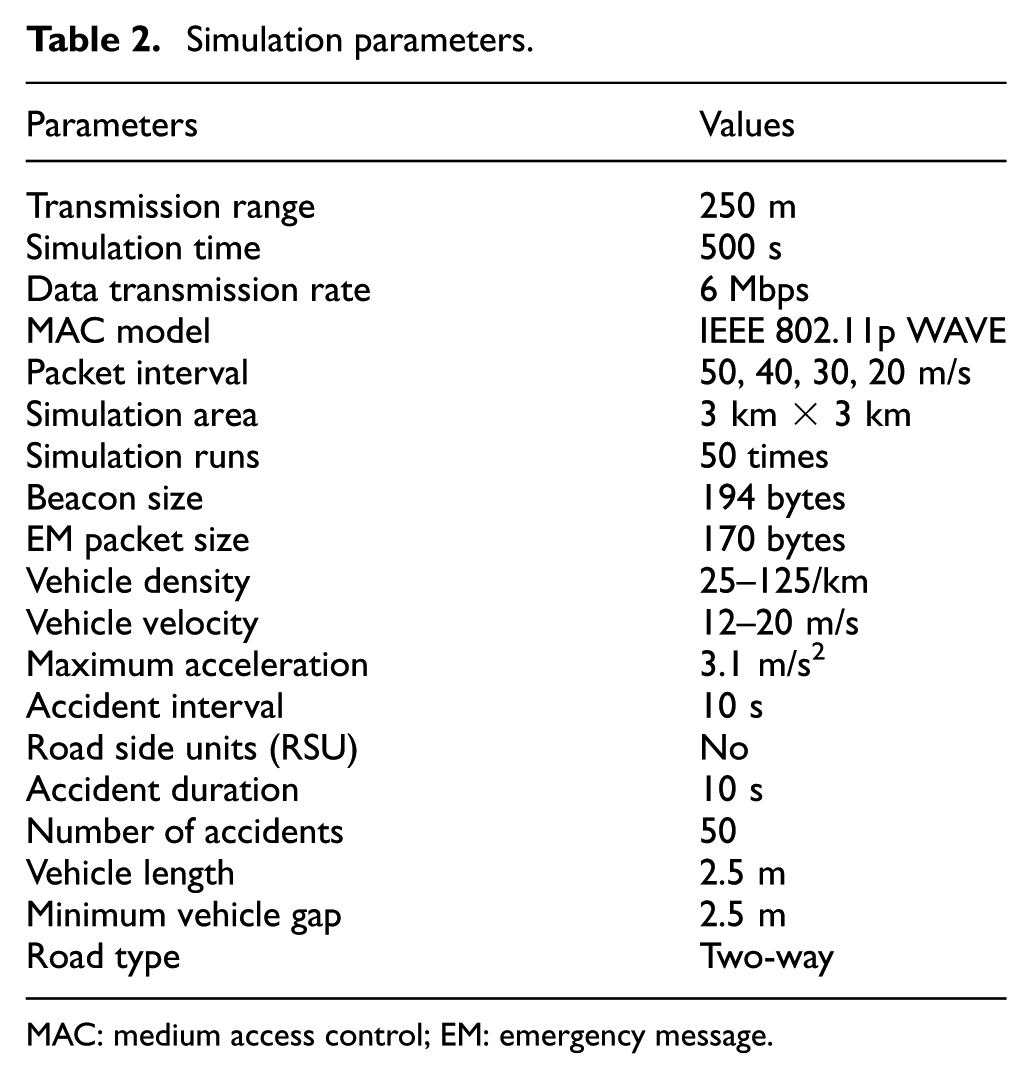
MAC: medium access control; EM: emergency message.
In the simulation scenario, we used custom maps imported through the open street map (OSM). The vehicle movements were scheduled from source to destination via different edges, and the routes of vehicles were designed to last at least 500 s. The number of vehicles per kilometer was kept between 25 and 125. The vehicle speed varied from 12 to 20 m/s, and the transmission range of each vehicle was set at 250 m. The simulation was repeated 50 times, and the averages were reported. The results were compared with three techniques: clustering and probabilistic broadcasting (CPB), 29 DV-CAST, 20 and traditional flooding. 35 First, CPB is based on directional clustering and probabilistic broadcasting techniques. It calculates the probability of packet forwarding using the count of identical messages received within a specific time interval. Second, DV-CAST uses a distributed vehicular broadcast protocol to overcome re-transmissions using local topology information. Last, in the traditional flooding technique, each vehicle rebroadcasts the messages it receives.
Information coverage
Information coverage is defined as the number of vehicles receiving an EM in a vehicular network comprising N vehicles. In other words, it is the total geographical area covered by an EM. Figure 3(a) illustrates a comparison of EM coverage area between our proposed technique and existing approaches. For the proposed technique, the coverage area initially increases with increasing vehicle density but starts decreasing as the vehicle density reaches 125 vehicles per km. This is due to the fact that with increasing vehicle density, more delays are incurred because of congestion. In comparison to CPB, DV-CAST, and flooding, the proposed technique performs better in a dense environment. With vehicle density between 75 and 125 per km, the proposed technique exhibits more coverage area compared to CPB. As an indicative measure, at 100 vehicles per km, we observe 9.7% more coverage area compared to CPB.

(a) Information coverage versus vehicle density, (b) average transmission delay versus vehicle density, (c) packet delivery ratio versus vehicle density, and (d) packet delivery ratio versus velocity.
Transmission delay
Transmission delay is the amount of time required to send an entire EM to other vehicles. Figure 3(b) shows the average transmission delay with respect to vehicle density. CPB requires computation on every node due to its probabilistic forwarding approach, and hence, suffers from additional delay. This delay increases with increasing vehicle density. Moreover, CPB requires CMs to send packets to their CH, causing congestion in a dense network, high packet loss, and frequent re-transmissions. In the case of DV-CAST, vehicles disseminate EMs with high probability to vehicles farther apart. Thus, this probability to forward a message increases linearly with increasing distance, leading to the broadcast storm problem because of the number of redundant messages. The proposed technique results in reduced transmission delays by 14%, 25.7%, and 4.4% compared to CPB, DV-CAST, and flooding, respectively.
PDR
PDR is the ratio of the number of packets sent by the source vehicle to the number of packets received at the next hop destination vehicle. Figure 3(c) shows the effect of increasing vehicle density on PDR. In the proposed technique, initially, when the network coverage is low, some messages fail to deliver. However, with increasing vehicle density, PDRs are improved. The result shows flooding with the lowest PDR followed by DV-CAST and CPB. Overall, the proposed technique shows 5.5%, 19%, and 41% improvement in PDRs compared to CPB, DV-CAST, and flooding, respectively.
Figure 3(d) shows the impact of velocity on PDR. The ratio is good at lower speeds, but declines as the vehicles accelerate. This decline is due to the fact that high mobility reduces network lifetime. In comparison to CPB, DV-CAST, and flooding, the proposed technique performs well at all reported velocities. As discussed earlier, the proposed technique disseminates messages based on the position of vehicles when they are moving in the opposite directions, further reducing the connection times and therefore lowering the PDRs at higher speeds. The results indicate that flooding has the lowest performance, DV-CAST is better than flooding, and CPB and the proposed technique are comparable. To summarize, the proposed technique shows improved PDR by 3.3%, 12.6%, and 38% compared to CPB, DV-CAST, and flooding techniques, respectively.
Impact of beacon messages
Figure 4(a) shows the average transmission delay with respect to vehicle density at different beacon intervals. With shorter beacon intervals, more messages are generated on the network, which increases the network congestion and adversely impacts the EM transmission delay. Figure 4(b) and (c) show the impact on PDR with varying vehicle density and velocity, respectively. In both cases, the PDRs are lowered when beacons are generated more frequently. Thus, the beaconing rate needs to be carefully tuned to avoid unnecessary network congestion.

(a) Average transmission delay versus vehicle density/km at different beacon intervals, (b) packet delivery ratio versus vehicle density/km at different beacon intervals, and (c) packet delivery ratio versus velocity (m/s) at different beacon intervals.
In all of the evaluation parameters, the proposed solution performs better as compared to existing techniques. With the increase in vehicle density, the proposed technique performs much better, as it is able to avoid network congestion that would be caused if every vehicle broadcasts the packets it had received. Moreover, the proposed scheme reduces the transmission delay as compared to traditional techniques, where vehicles send messages to CH and it is always the responsibility of CH to further disseminate the message. In the proposed position-based data dissemination technique, it is possible to identify suitable vehicles moving in the opposite direction for carrying EMs. This choice is more effective in reducing the dissemination delay for EM delivery to the desired vehicles, as opposed to sending messages in the backward direction using hoping mechanism.
Discussion
Table 3 summarizes the current techniques used in comparison to the proposed model. As mentioned earlier, the main issues faced when designing a data dissemination approach are information coverage and the broadcast storm problem. Notably, as illustrated in the summary table, most of the existing works focus on PDR, delay, and broadcast problem; however, limited works cover information coverage. Moreover, many works focus on low density scenarios (e.g. highways), reducing the effects of the broadcast storm problem. The result is an improved PDR but low coverage due to low number of vehicles serving as relay nodes. In contrast, the issues become more challenging in an urban environment. With high vehicle density, a large number of concurrent transmissions, the vehicular network is more prone to get choked.
Data dissemination schemes.

PDR: packet delivery ratio.
In the proposed technique, we observed significant improvements in terms of coverage area, PDR, and average transmission delays in comparison to the state-of-the-art solutions including CPB, DV-CAST, and traditional flooding. Since EMs are time-critical and need to be disseminated as soon as possible, the proposed solution improves the PDR and information coverage, addressing the problem of EM dissemination effectively.
The proposed technique works fine at lower speed and in high density environments. However, high mobility and transmission delay of vehicles can limit its effectiveness. For instance, the coverage area of EMs is reduced with increasing vehicle speeds due to reduced contact times among vehicles moving in opposite directions on the road. This further deteriorates for sparse environments, where transmission range limits the information coverage. To resolve this, we need the connection times to be enhanced between vehicles moving in opposite directions at high speeds, for instance, using cloud services.
The major limitation of the proposed work is efficient transmission between fast-moving vehicles. At the moment, with increasing vehicle speeds, the packet error rate also increases, thus affecting the performance of the entire system that involves forwarding of regular position updates to and from clusters. We presume that widespread adoption of 5G technologies can improve device-to-device communication, in turn, high data rates. Furthermore, enhancing the stability of clusters can improve the performance of the proposed system. Note that for this study, we consider vehicle speed, direction, and relative distance for cluster formation. These clusters can be further strengthened by the addition of more attributes. In the future, apart from the aforementioned limitations, security is a major concern for EMs dissemination. In this work, we left this aspect open for resolution through the use of techniques like blockchain and artificial intelligence, that is, to identify the credibility of the source vehicles.
Conclusion
In this article, we propose a novel EM dissemination scheme. In IoV context, it is a challenging task to disseminate data in high mobility conditions with frequently changing topologies. We used a clustering scheme based on IC metrics to form clusters and elect the CHs. This resulted in more stable clusters with reduced packet loss, enhancing the connection lifetime in vehicular networks. With the goal to disseminate EMs with minimum possible delay to a large number of vehicles on the same route, we proposed dissemination via vehicles traveling in the opposite direction on the same road. Our simulation results show better results for both normal and emergency data dissemination. The transmission delay, information coverage, and PDR improved up to 14%, 9.7%, and 5.5%, respectively.
Footnotes
Handling Editor: Amiya Nayak
Declaration of conflicting interests
The author(s) declared no potential conflicts of interest with respect to the research, authorship, and/or publication of this article.
Funding
The author(s) received no financial support for the research, authorship, and/or publication of this article.
