




Abstract
In this article, an emergency message reception power quantization–based time-slot broadcast scheme is proposed for vehicle-to-vehicle multihop communications. The power quantization–based time-slot broadcast scheme derives the optimal reception power quantization size such that time-slot assignments can be made to minimize the average time delay to support quick multihop emergency message broadcasting. The mathematical and simulation performance analysis demonstrates that the proposed power quantization–based time-slot broadcast protocol can reduce the average time delay when compared to the infrastructure-less framework, binary-partition-assisted broadcast, and the trinary-partitioned black-burst-based broadcast schemes.
Introduction
Intelligent transportation system (ITS) services are becoming available through technologies based on IEEE 802.11p, IEEE 1609, wireless access in vehicular environment (WAVE), and dedicated short-range communications (DSRC) standards, with the objective to provide higher levels of vehicle accident prevention and various information services.1,2 Safety systems used to avoid emergency situations in vehicle traffic have very strict time-critical operation requirements. When an emergency situation occurs (e.g. car accident or road collapse), alerting approaching vehicles to avoid additional accidents (especially multiple vehicle chain collisions) is important. In alerting approaching vehicles, emergency messages (EMs) are most effective.3–5 In order to avoid a collision, the drivers reaction time to the EM alarm, as well as the EM delivery time, needs to be considered together. Due to this reason, the EM delivery time is recommended to be less than 0.1 s to provide the required time for a driver to react to the upcoming hazard and prevent an accident. 6
In recent testing on EM vehicle-to-vehicle (V2V) relaying, in some cases, it was experienced that there was difficulty in vehicles determining their absolute and/or relative location/distance to the vehicle that sent the EM message when using global positioning satellites (GPSs) due to the margin of error and occasional loss of GPS signals. Based on this perspective, development of a V2V multihop EM broadcasting scheme that did not rely on GPS signals was attempted, which leads to the reception power quantization–based time-slot broadcast (PQTB) scheme proposed in this article. The PQTB scheme partitions the reception power into quantization levels and assigns retransmission time-slots based on the received signal’s quantization level to avoid EM packet collision. In the PQTB scheme, among the vehicles in the communication range
The remaining of this article is structured as follows. First, the related works are presented in section “Related works,” which is followed by section “Proposed PQTB scheme” that presents the operations of the proposed PQTB scheme and the mathematical derivations of the optimal received signal quantization step size that minimizes the average propagation delay time of multihop EM delivery. In section “Performance analysis,” the performance of the PQTB is compared to other schemes, which is followed by section “Conclusion” that presents the conclusion of the article and the references.
Related works
There are three fundamental ways to conduct EM broadcasting. The first method is to use V2V multihop broadcast transmission, which is a representative vehicle ad hoc network (VANET) technology. The V2V multihop scheme is very effective because the forerunning vehicle that detects an accident or a problem in the road/vehicle condition can directly broadcast an EM to approaching vehicles as soon as possible, such that approaching vehicles can slow down and take necessary precautions. Since a single vehicle’s transmission range is limited, the V2V multihop scheme must be fast and reliable for the relayed EM to cover a sufficient range. The second method would be to send the EM to a road side unit (RSU) through vehicle-to-infrastructure (V2I) communication and have the RSU broadcast the EM to approaching vehicles.1,2 This method has an advantage in providing stable EM broadcasts to all vehicles that enter the RSU’s communication range. However, the time consumed in delivering the EM to approaching vehicles via V2I is longer than the time consumed in V2V communications. In addition, a local RSU may not be available, in which V2V multihop communication may be the only option for collision prevention EM broadcasting. The third method is to use a combination of V2I and V2V communications, where V2I is used where a RSU is available and V2V multihop communication is used where the RSU’s communication range cannot reach. This third method could be effective for roads and highways that have sparsely distributed RSUs. As can be seen, V2V multihop communication plays an essential role in EM broadcasting for accident prevention, and therefore is the focus of this article.
In EM broadcasting via V2V multihop relays, a technical challenge of reliably overcoming packet collision among EM relaying vehicles exists. An EM packet collision results in a loss of all collided packets, and the V2V relaying process may stop or be seriously delayed such that the emergency information dissemination to approaching vehicles cannot be accomplished in time. In Chen et al., 3 an infrastructure-less framework (ILF) scheme that consists of a distributed warning protocol that works with a location-based backoff scheme is proposed. The ILF scheme uses a distributed warning protocol and V2V communication to form warning groups, which are sets of vehicles driving in the same direction that are within a certain distance. In a warning group, if a sudden brake event is detected then the location-based backoff scheme is used to quickly propagate warning messages among group members. In Chen and Chou, 4 a lane-level, beacon-less, infrastructure-less, and GPS-less cooperative collision avoidance (BIG-CCA) scheme for vehicular sensor networks (VSNs) is proposed to prevent chain vehicle collisions. Since GPS is not used in BIG-CCA, the inaccuracy and unavailability of GPS is avoided. Like ILF, BIG-CCA uses a distributed grouping mechanism and also uses a receiver-based forwarding scheme to warn the vehicle group of sudden breaking events. In Taleb et al., 5 a cluster-based risk-aware cooperative collision avoidance (C-RACCA) scheme that avoids flooding through a cluster-based organization of target vehicles is proposed. C-RACCA uses clusters that are formed based on vehicle movement (i.e. directional bearing and relative velocity) and inter-vehicular distance and also uses a risk-aware MAC protocol to control the medium-access delay of each vehicle based on its emergency level.
In terms of multihop V2V performance, there are several schemes that have been proposed. One of the earliest optimized models is the urban multihop broadcast (UMB) scheme, which maximizes the EM multihop relaying speed by selecting the vehicle farthest away to relay the EM. 7 In order to enhance the multihop speed, when V2V relaying the EM, vehicles intentionally broadcast a channel jamming signal called the black burst where the UMB scheme enables the vehicle farthest away (that transmitted the longest black burst) to perform the EM relaying. Due to using the longest black burst, the UMB scheme has a relatively high multihop latency. In Fasolo et al., 8 smart broadcast (SB) is proposed which also maximizes the EM multihop speed by minimizing broadcast relaying delay based on dividing the communication area into multiple sectors and correspondingly assigning different contention window values to minimize the average latency.
Among the existing transmission range partitioning EM broadcasting technologies, the binary-partition-assisted broadcast (BPAB) 9 and the trinary-partitioned black-burst-based broadcast (3P3B) 10 schemes perform the best in terms of multihop V2V relaying average time. These schemes divide the EM broadcasting range into multiple sections, where these sections are used to determine what vehicle can relay the EM to approaching vehicles while avoiding packet collision. For more effective EM broadcasting, the BPAB scheme equally divides the transmission range based on binary partitioning and selects the farthest vehicle to broadcast the EM using black burst signaling and a modified contention mechanism to effectively support vehicle transmission in the far segments. 3P3B consists of a mini DIFS-based MAC protocol (that enables time-critical EMs to more quickly access the communication channel) and a communication range trinary partitioning mechanism (that enables the vehicle farthest away to relay the EM), so the number of hops required to reach the desired broadcast range is minimized. As a result, 3P3B effectively reduces the contention period jitter and the multihop relaying average time.
Proposed PQTB scheme
The proposed PQTB scheme is applied to vehicles equipped with WAVE or DSRC, which are based on the IEEE 802.11p and 1609 standards. The proposed PQTB scheme can operate using request-to-broadcast (RTB) and clear-to-broadcast (CTB) packets, as well as the basic IEEE 802.11 mode (which does not use RTB or CTB packets). IEEE 802.11p uses request-to-send (RTS) and clear-to-send (CTS) packets to avoid the hidden terminal problems, where in Sahoo et al. 9 and Suthaputchakun et al., 10 RTS and CTS are, respectively, changed to RTB and CTB packets, which include the broadcasting message’s transmission directional information. In an RTB packet, the transmission duration is included in addition to the position and intended broadcast direction of the source node. When the vehicle that needs to send an EM needs to transmit the RTB message in multiple directions, then a new RTB packet needs to be transmitted individually in each direction.
PQTB basic mode directly transmits EM packets without using RTB/CTB before EM packet transmission and uses the relaying vehicle’s EM packet (that includes a 1 increased hop count) as its acknowledgment. An example operation of the PQTB basic mode is presented in Figure 1, where vehicle

Reception power quantization–based region division and time-slot assignment example.
Applying the PQTB RTB/CTB mode to Figure 1, after
For the opposite case where there is no vehicle to relay the EM signal in the first time-slot, the vehicles in the next farthest region
In the following, the optimal quantization level size for PQTB will be derived. PQTB scheme consists of the following four time intervals.
To avoid packet collision during initial access of the EM signal for vehicles that may use the same time-slot, in this article, the same mini-DIFS scheme is applied as in Suthaputchakun et al.
10
The IEEE 802.11 standards use the DCF to control transmission access, where a station can transmit a frame if the channel is continuously idle for a DIFS duration. However, if the channel is used by another station during the DIFS interval, then the station will defer frame transmission to avoid frame collision. In the mini-DIFS scheme, the DIFS is divided into mini-slots. When an EM arrives at the MAC layer, for immediate initial channel access, instead of waiting for the whole DIFS period before contending for the channel, the EM packet waits only for
In the following, the time parameter derivations for PQTB RTB/CTB mode will be provided first, which will be followed by a description of changes in time parameters required to represent the performance of the PQTB basic mode.
In the RTB/CTB mode, after the mini-slot’s period expires, the sender transmits an RTB packet and waits for the corresponding CTB packet from the next-hop forwarder. The average time duration from the moment the EM arrives at the front of the transmission queue until the time the RTB packet has been transmitted is defend as the initial time
The PQTB basic mode (which does not use RTB and CTB) uses the same equations as the RTB/CTB mode above with only the following parameters changed.
In order to obtain
In this article, the PQTB analysis is conducted based on a two-ray-ground path-loss (2PL) model that includes the effect of shadowing path loss. This model is based on the parameters of transmitted power

where
Applying the expansion of power series
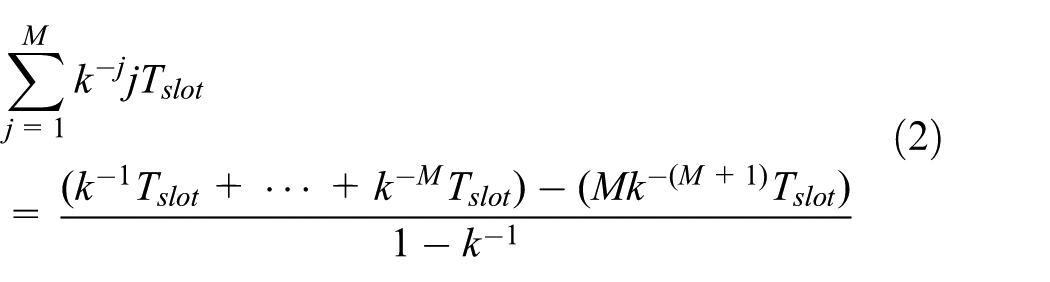
and using the parameter substitutions of

Applying
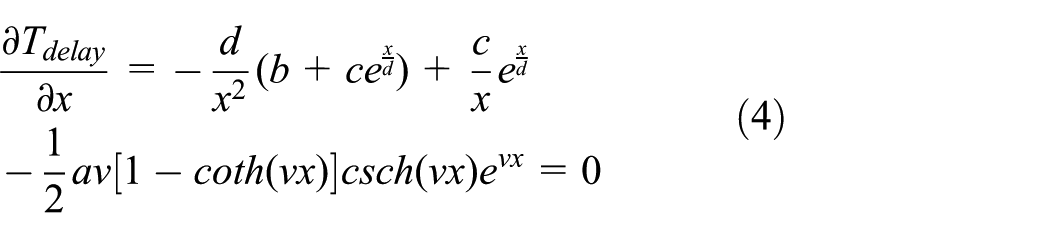
where for representation simplification in equation (4), the parameter substitutions of

Among the

where
Performance analysis
The proposed PQTB scheme is different from ILF, BIG-CCA, and C-RACCA based on the fact that it does not require group formation or clustering to execute EM broadcasting. Since vehicles change locations frequently, the additional time required in forming a group or cluster is saved in PQTB, resulting in less network structuring requirements that lead to faster EM broadcasting. However, the infrastructure-less characteristic of ILF is similar to PQTB, and therefore, ILF is included in the performance analysis of this article. In addition, in terms of optimal multihop V2V EM relaying performance, in Suthaputchakun et al., 10 it is shown that 3P3B can outperform BPAB and can significantly outperform SB and UMB. Considering this fact, in this article, PQTB is compared with 3P3B and BPAB in terms of average EM propagation delay. In the following performance analysis, the PQTB scheme was applied to the WAVE IEEE 802.11p MAC sublayer, where the initial contention access transmission mechanism was designed based on the DIFS, and the average EM propagation delay performance of PQTB, IFL, BPAB, and 3P3B is compared.
In Figure 2, a comparison of the average delay performance of multihop EM delivery over a 1-km distance was conducted using ns2 and MATLAB simulation for PQTB RTB/CTB mode, PQTB basic mode, ILF, BPAB, and 3P3B. Simulation was based on the number of vehicles per unit area (

Average 1 km propagation delay performance comparison.
Conclusion
In this article, a reception PQTB scheme is proposed for multihop V2V communications of EMs for accident prevention. Based on the performance results, it can be concluded that the proposed PQTB scheme (and especially the basic mode) provides a gain in average time delay when compared to ILF,4,5 BPAB, 9 and 3P3B 10 for the range of interest tested.
Footnotes
Academic Editor: Kye-Shin Lee
Declaration of conflicting interests
The author(s) declared no potential conflicts of interest with respect to the research, authorship, and/or publication of this article.
Funding
The author(s) disclosed receipt of the following financial support for the research, authorship, and/or publication of this article: This work was supported by the Institute for Information & Communications Technology Promotion (IITP) grant funded by the Korean Government (MSIP) (B0101-17-1276, Access Network Control Techniques for Various IoT Services).