




Abstract
Unlike many other Internet of Things applications, in addition to the limited power of Internet of Medical Things devices, the safety aspect and reliability are the major concerns while designing wireless body area network routing solutions. In fact, the heat dissipation from Internet of Medical Things devices and changes in body posture cause tissue damage and frequent wireless links breakage, respectively. Hence, designing an efficient routing solution is extremely challenging in wireless body area network. Considering the safety aspects of human body, the power constraint of Internet of Medical Things devices, and topological variations in wireless body area network environment, this article presents a thermal-aware, energy-efficient, and reliable routing protocol named thermal and energy aware routing. In the given perspective, thermal and energy aware routing considers the weighted average of three costs while selecting the routing path: energy consumption, heat dissipation, and link quality (between communicating nodes). The proposed protocol is validated by a comparison with a state-of-the-art wireless body area network routing protocol. Simulation results demonstrate that the proposed protocol is efficient in terms of energy consumption, thermal impact, and packet reception rate.
Keywords
Introduction
Contemporary health care systems are dealing with demanding situations due to the rapid growth of the aged population and restricted monetary resources. As stated by the US Department of the Census, the people having age between 65 and 84 years are predicted to be twofold by 2025. The overall financial resources spent in the United States for health care were US$1.8 trillion in 2004, and this figure is predicted to be tripled by 2020. 1 These are the alarming statistics, which attract the researchers across the globe to improve the quality of life and to make innovations in health care sector. A wireless body area network (WBAN) consists of many miniature Internet of Medical Things (IoMT) devices which are either implanted inside a human body or wearable to take critical body readings like heartbeat, body temperature, blood pressure, sugar level, muscular motion, and many more. These readings are communicated to the respective doctors and health monitors to take timely necessary actions. This results in improved quality of life by taking decisions on life-threatening parameters without wasting time.
Like wireless sensor networks (WSNs), WBANs require connectivity with other networks to deliver data to their destination where they can be processed and analyzed. Hence, communication architecture of a WBAN can be classified into three tiers: Tier 1 represents the intra-BAN communication, that is, communication among IoMT devices within body premises, whereas Tier 2 collects body data wirelessly and forward it to Tier 3 using existing network infrastructure like cellular network or Internet. In Tier 3, general practitioner (GP) or any authorized staff at a hospital or medical center analyzes the sensed parameters remotely. The last two tiers do not belong to WBAN; however, these are integral part of a health care system.
The focus of this research arena lies in Tier 1, where it is hard to establish communication among IoMT nodes due to faded environment. Although a variety of protocols have been proposed, yet the design challenges of routing protocols for such networks need further investigation.
Variable data rate is one of the most critical issues for designing WBAN routing protocols. The applications having multimedia content require high data rate; whereas the acquisition of data from temperature sensor requires low data rate. In either case, quality of service (QoS) is the main concern in WBAN. 2
WBAN research is in transition state and a lot of work is required to ensure efficient, reliable, and on-time data acquisition, transmission, and processing while facing certain challenges. Energy preservation is one of the major and widely studied WBAN topics.3–6 In addition, the effect of thermal dissipation on human tissues is another prominent and neglected issue required to be properly addressed. In fact, tiny IoMT nodes implanted beneath the skin or placed on-body emit heat mainly due to the following three operations:7–10 transmission and reception of radio signals, computations within IoMT, and sensing operations.
This article aims at minimizing the energy emissions during the process of transmission and reception to potentially reduce the tissue damage and to ultimately enhance the network lifetime. In the given perspective, limiting the number of transmissions and receptions without compromising the reliability, correctness, and timely information processing is one of the desired outputs of this research. Finally, this work proposes and rigorously evaluates an energy-efficient and thermal-aware routing strategy.
The rest of the article is organized as follows. The “Related work” section gives a brief insight of history and state-of-the-art work considering thermal and energy aware routing (TEAR) in WBANs. The “WBAN—generic architecture” section discusses generic WBAN system architecture focusing thermal and power issues in the routing process. In the “TEAR—power and thermal computations” section, power and thermal framework of the proposed routing model, TEAR, is presented, while the “TEAR: route cost estimation model” section presents route cost estimation framework of TEAR. The proposed routing model which is composed of two phases is explained in the “TEAR—routing model” section, whereas the results and discussion are provided in the “Results and discussion” section. Finally, the “Conclusion” section concludes the article.
Related work
Routing in WBAN can be divided into five major classes: cluster-based, cross-layered, postural, QoS-based, and temperature or thermal-aware routing. 11 Among all these classes, temperature or thermal-aware routing is crucial especially where implanted IoMT nodes are used. As discussed earlier, minimum transmissions and receptions result in low temperature rise. Thermal-aware routing protocols consider temperature rise mainly as a parameter for selecting routes.
Thermal-Aware Routing Algorithm (TARA) 12 is the pioneer protocol that considers a node’s temperature as a performance metric. TARA considered electromagnetic (EM) radiations from the antenna; however, heat generation inside the circuit board of an IoMT node due to different electrical operations has largely been neglected.
Least temperature routing (LTR) 13 follows the basic routing strategy of TARA. Specifically, route calculation process is similar to that of TARA. These routes are constantly updated and those routes are selected that contain less heated IoMT nodes on the routing path but result in delay and longer routes. To address this issue, LTR presents a hop count threshold within re-routing process. When this threshold is reached, packets are discarded. LTR protocol has been further extended to adaptive LTR (ALTR). This extended protocol addressed the packet drop problem in the predecessor’s version, LTR. Moreover, ALTR introduced the concept of “proactive delay.” However, a trade-off between delay and temperature is found in ALTR.
LTR protocol in conjunction with shortest hop count routing results in least total route temperature (LTRT). 14 LTRT algorithm used temperature as a major performance metric. Measuring temperature rise of IoMT devices and updated route calculation are conducted when network initiates. For route calculation process, shortest hop count routing is considered; however, only those routes are finalized which have less number of heated nodes.
As stated earlier, there is a hot spot node problem in TARA, which still exists in LTR and ALTR. LTR and ALTR protocols tend to reduce this problem by re-routing and maintaining average network temperature; however, it does not eliminate the problem. In Bag and Bassiouni, 15 a Hot spot Preventing Routing (HPR) is presented. Major objectives of HPR are as follows: (1) prevention of hot spot nodes and (2) prevention of sub-optimal routes in order to reduce the delay. HPR also works in two phases: setup and routing phases. In the setup phase, IoMT devices exchange routing information and start-up temperature values. Based on these data, routing tables are established. In the routing phase, initially data are forwarded using shortest hop count until a hot spot node is found. If a hot spot is found within the selected routing path, then the packet is re-routed using those IoMT devices which avoid routing loops.
Chen et al. 16 proposed a cross-layer energy-efficient algorithm, which utilizes different characteristics of different layers, including Physical Layer, Media Access Control (MAC), and Network Layer. The proposed structure also uses optimal power control on a single link to reduce the power consumption which in turn prolong overall network lifetime.
Maymand et al. 17 proposed a thermal-aware routing protocol. To control the temperature of sensor nodes, two thresholds are defined for avoidance and recovery of heat-up devices. Once these thresholds are reached, node is declared as hot spot node and its usage is temporarily blocked. After cooling procedure, the node will once again take participation in data routing procedure. The proposed protocol is compared with Thermal-Aware Localized Quality of Service (TLQoS) and Thermal-Aware Shortest Hop Routing (THSR) protocols and is found efficient in terms of minimizing temperature and lowering packet drop ratio. However, there is no major difference in energy consumption by the three routing protocols.
Energy hole problem is addressed emphasizing energy aware routing in WBAN. 18 In the proposed work, a secondary base station is selected, which helps to reduce the temperature of the neighbor nodes, as these neighbor nodes will not be a part of the new data routes. In this time, the sensor node will transmit only the priority packets to the secondary base stations. Keeping this strategy, authors not only limit energy hole problem but also keep the temperature of sensor nodes low nearer to the base station. However, this protocol works only in network of low and intermediate traffic and reduces the delay of packets. If data traffic increases, delay is increased. Moreover, the energy of the secondary base station decreases faster than other network nodes.
In Kathe and Deshpande, 19 a TARA is proposed to reduce the number of transmissions from hot spot nodes or the nodes bearing more traffic by assigning the priorities. In this way, routing is conducted only by the nodes having a temperature lower than threshold. Once that threshold is reached, such nodes stop relaying packets, instead transmit only highest priority packet. However, authors used buffer to store packets of low priority once the node temperature is above the threshold value, but, on the other hand, sensor nodes are memory constrained. Loss of packets is probable for a hot spot node that will reduce the performance of the network.
Motivation and problem statement
Extensive research has been carried out to develop efficient routing strategies for WBANs. Majority of the works focused on finding energy-efficient solutions. Considering the nature of WBAN, besides energy consumption and link optimization, there exists an important metric of thermal cost. The IoMT devices implanted in the human body or placed over the skin have a thermal effect and can damage the body tissues due to continuous operations. If a route is selected keeping link quality metric in focus, it not only ensures reliability but also limits the number of re-transmissions and temperature rise of nodes.
Energy is consumed mainly due to an increase of number of transmissions and receptions. In other words, continuous operations of transceiver subsystem of an IoMT device cause energy degradation. The intensity of electrical signal also contributes to excessive energy consumption. In addition, whenever energy is consumed, heat is produced. Limiting the number of transmissions and intensity of radio frequency (RF) signal is a solution to both constraints in WBAN, that is, energy preservation and heat minimization.
Hence, there is a dire need to orchestrate such a routing mechanism that is not only energy efficient but also reduces the heat produced during routing operations. Routing metrics must include link quality, temperature rise, and energy drainage. Optimizing the intensity of transmitted RF signal in accordance with the required level considering link quality is also one of the key features of proposed energy and thermal-aware routing protocol.
WBAN—generic architecture
In WBAN, as discussed earlier, nodes can be implanted beneath the skin or placed on-body to examine certain attributes of a body. Within a body, there can be a scenario where cluster head routes information received from all IoMT devices and passes it to the sink. In another scenario, a gateway node with high energy level is utilized that transmits data to the outer world via Internet. Majorly, the energy consumption of a node depends on the transceiver operations and other processes like computations, sensing and data aggregation, and so on. The transmission and reception of signals are considered the most energy consuming processes in WBAN. In this article, this issue has been focused to preserve the energy and reduce the thermal effect on body tissues considering the fact that a routing protocol with minimum routing overhead not only gives efficiency in energy management but also reduces the thermal effects.
In addition, using equal power level by an IoMT device for all its neighboring nodes located at varying distances is not a feasible way in terms of power saving and reliable communication. Dynamic power levels based on distances and received signal strength indicator (RSSI) among the nodes can play a key role in orchestrating an efficient routing strategy.20,21 However, the existing protocols like Mahmood et al. 20 and Ahmed and Khan 21 are designed for terrestrial WSN. The dimensions and characteristics of WBANs are different from terrestrial IoT networks. For instance, in WBAN, the scalability is not such a big issue as it is in terrestrial IoT networks. On the other hand, thermal dissipation, energy efficiency, and link quality are the major issues in WBAN that need to be addressed. The objective of this work is to introduce such a routing protocol that is capable of addressing the aforementioned issues. Thermal-aware technology refers to the mathematical techniques that can compute the temperature rise in masses due to the IoMT device nodes’ operations. There are three major techniques used for measuring such thermal changes:
Specific absorption rate (SAR) method,
Pennes bioheat equation method,
Finite-difference time-domain method.
TEAR—power and thermal computations
In this section, transceiver, channel, and thermal change calculation models used to design the proposed protocol (TEAR) are presented.
Transceiver model
The process of transmitting and receiving data is the major energy consuming process in WBANs. Moreover, it is one of the major reasons of heat generation by an IoMT device that ultimately affects the sensitive tissues. There are two major factors of such thermal changes:
Number of transmissions and receptions,
Intensity of electrical signal which is being transmitted or received.
In the following sections, transmitter and receiver models are presented.
Transmitter model
The transmitter subsystem of an IoMT node contains a frequency synthesizer

Modulator is the least energy consuming module of an IoMT node. The most critical component in transmitter subsystem is the power amplifier component, that is, a major source of energy drainage. The transmitting power is solely dependent on the efficiency of the power amplifier

where
For

The ultimate goal of this research is to optimize the RF output power in such a way that RF signal may reach the destination with minimal required energy. Consequently, thermal change can be tackled efficiently by minimizing the intensity of the signal.
Reception model
For receiving a signal, major components that consume energy are amplifiers (such as intermediate frequency amplifier, RF amplifier, and noise amplifier) in addition to oscillator, mixer, demodulator, and frequency synthesizer. The power consumption on receiving a signal at time

where
Energy consumed by a node due to

Channel model
Every transmitted RF signal faces fading due to certain environmental factors. Such fading may distort the amplitude as well as the phase of a signal that may result in a loss of complete information. However, due to faded signal, one can understand the characteristics of the channel which is affecting the signal. In this work, Rayleigh fading channel model is utilized.22,23
Receiving (RSSI) model
It is established and proven that RSSI value reduces with the increase in distance. Hence, RSSI can be denoted in terms of distance. To model received signal power, log-normal shadowing path loss model is used.
24
It is a fact that fading disturbs the RSSI; hence, RSSI should be measured considering the channel impairments. RSSI, denoted by

where
Thermal computation model
SAR is used to compute the thermal change in human tissues. It is measured in terms of Watts per kilogram (W/kg) or milli-Watts per gram (mW/g). It is defined as the rate at which radiation energy is absorbed by tissue per unit weight. SAR is formulated as 25

where EF is the induced electric field,

where
The attenuation constant

The typical values of all the parameters discussed above are at room temperature (25°C) and body temperature (37°C).
TEAR: route cost estimation model
In the proposed routing protocol, routes are identified using gradient cost establishment model as given in Khan et al. 27 Analytical modeling that represents the cost estimation metrics, including link quality, energy consumption, and thermal value, is briefed in the following sections.
Link quality
RSSI, Expected Transmission Count (ETX), and channel state information are the most widely studied parameters to assess the link quality in wireless environment. In the proposed protocol, the link quality

where
Energy consumption
Receiver energy consumption
The receiver consumes energy due to frequency synthesizer, voltage-controlled oscillator (VCO), and some other components. 28 Equation (11) shows the energy consumption by the receiver

where
The rate at which data are received by the receiver plays an important role in the consumption of energy. Considering the rate, equation (11) becomes

where
Transmitter energy consumption
The major consumption of energy by the transmitter is due to the power amplifier. Equation (13) shows the transmitter energy consumption

where
There is a direct relationship between

where

where
There is a direct relationship between network energy consumption and network lifetime. Limiting IoMT node operations up to the required level may increase the network lifetime. To calculate an optimum route, it is necessary to know the difference between residual power
Thermal change
As stated earlier, SAR is used to compute thermal changes in the proposed protocol. The thermal change

where
TEAR—routing model
The proposed protocol follows hybrid routing model. Consequently, it acts proactively in the setup phase, while in data transmission phase, it acts reactively to attain benefits of either class of WBAN protocols.
Considering e-Health solutions, two types of IoMT nodes have been considered: the health monitoring nodes and the nodes that may act as relays for only forwarding the information. It is also assumed that source and destination nodes are not misbehaving nodes. The proposed scheme considers homogeneous IoMT nodes that possess the same amount of energy initially.
The proposed protocol works proactively to mitigate overheating of IoMT nodes due to periodic transmissions and receptions of route discovery packets. It is based on a gradient route cost establishment, 27 where the route cost is calculated from the sink. At the sink, its value is zero and it increases when we move away from the sink. This route cost is not only based on the distance and number of hops from sink. The overall route cost values used for route selection are based on thermal, energy, and link quality as well. TEAR works in two phases: setup phase and data transmission phase. In the following sections, the estimation of the route cost is discussed in detail. Setup phase of TEAR is a proactive part of the protocol; whereas data transmission phase behaves reactively. The changes in cost values according to the changes in IoT environment are also handled in the data transmission phase. Hence, this cost establishment mechanism is a stochastic process that varies randomly. The values of thermal impact, energy consumption, and link quality for cost establishment can be varied within a range of [max, min].
Setup phase
Initially, the gradient cost is established in such a way that the cost at the sink is zero, while it is infinite at rest of the nodes. The route cost starts from the sink. Whenever a node receives cost values from its neighbor nodes which reflect the cost to reach the sink, it adds the link quality of corresponding links to find the final cost to send data through each neighbor node. After getting all the final costs from each of its neighbors, a node selects the minimum of these costs and forwards it as an advertisement packet to its neighbors.
Based on this advertisement packet, route calculation is conducted as shown in Figure 1. Here, the link cost is established through RSSI; remaining power


Setup phase: route calculation.
Based on this scheme, each node transmits its advertisement packet and one-hop neighbors compute the cost accordingly.
In addition, the transmission power level (TPL) of a node is set during this phase. TPL refers to the amount of power to be utilized to transmit data based on the distance and the link quality metrics. Once links are established and power control for each neighboring node is set, the network enters the data transmission phase.
Data transmission phase
In the data transmission phase, a source node selects the least cost neighbor node among the set of neighbors. Furthermore, it sends data to the least cost neighbor according to the adjusted transmission power (TP). After receiving the packet, the receiver sends the acknowledgment. This acknowledgment packet contains the updated cost value of the least cost neighbor. Hence, using this acknowledgment from the least cost neighbor, the sender node adjusts two things. First, it updates the cost value. Second, it adjusts the new TPL. To eliminate the problem of minimizing the number of transmissions of the periodic hello packets (it may result in an increase in thermal effect), TEAR updates the cost values of the transmitting node in transmission phase.
In addition, TEAR behaves as a reactive protocol. Hence, the data are transmitted only when some event occurs, that is, when a sensed value crosses the predefined threshold value. Periodic hello packets are not advertised; however, whenever the topology changes, route is recomputed for the specific node and path. Figure 2 illustrates the major steps involved in routing process anticipating setup as well as transmission phases.

Routing process.
Results and discussion
Simulation setup
To verify the performance of TEAR, rigorous simulations are performed. In the simulation, 12 nodes are implanted at different body parts. The wireless link between the transmitter and receiver nodes depends upon the state of a body and may be degraded due to postural changes. The initial energy of each IoMT node is 160 mAHr. The TPL of each node ranges from 0 to −25 decibel-milliwatts (dBm). Table 1 shows the summary of simulation parameters. The extensive simulations are conducted in MATLAB 2017 to analyze the TPL, RSSI, and the relationship of RSSI with packet reception rate (PRR). In order to validate the significance of proposed TEAR protocol, it is compared with a state-of-the-art WBAN protocol proposed in Kim and Eom, 29 keeping above-mentioned metrics in focus.
Simulation parameters.

RSSI: received signal strength indicator.
Heated versus non-heated nodes
To ensure the safety of body tissues, hot spot nodes must be avoided from the route established. The proposed approach (TEAR) ensuring such avoidance selects such routes that do not include hot spot nodes. In addition to the energy constraint and link quality issues, it considers the heating factor while selecting the best path. In the proposed work, a heated node is ignored even if the node has high value of residing energy. TEAR tends to create an equilibrium among energy, link quality, and thermal value giving each an equal weightage. This is the reason that in TEAR, 30% of the nodes are non-heated in contrast to the existing approach, where 100% of the nodes become heated after specific interval of time due to excessive utilization in transmission and reception of data packets, as shown in Figure 3.

Ratio of heated and non-heated nodes using the proposed protocol.
Relationship of RSSI with PRR
There is a strong relationship between RSSI and PRR. The strong RSSI results in high PRR. In Figure 4, it is clear that the PRR depends heavily on RSSI. The figure shows a general trend between RSSI and PRR. However, optimizing the TP based on the information taken by RSSI is one solution that not only preserves energy but also reduces heat emission from the node.

Relationship of RSSI with PRR. The green * shows the different PRR values for corresponding RSSI values. The blue line interpolates the behavior of the relationship between PRR and RSSI.
Tuning TPL
As stated earlier, power-level adjustment is a key player of the TEAR protocol. However, adjusting power level in such a way that packet loss or drop ratio is minimized is a critical task. The proposed protocol (TEAR) selects a TPL, provided the PRR is maintained to 100%. Whenever PRR declines due to the environmental noise and other factors like path loss, it increases the TPL to avoid the packet loss. Figure 5(a) shows the relationship among Heating Ratio (H-Ratio), TPL, and data rate. Here, H-Ratio is defined as the ratio between the time during which a node’s SAR is above a threshold level (0.35 W/kg) with the total time till the node’s death. It is clear from the figure that using high TP results in high H-Ratio. Moreover, H-Ratio is increased when data rate is high. Figure 5(b) shows the power-level adjustment and its usage. The proposed protocol potentially selects the TPL to its minimum(–20 dBm) such that energy is preserved and heat emission is minimized. However, when PRR drops down, the TPL is increased to maintain the PRR. It is clear from the figure that the proposed protocol uses minimum TP majority of the time during its lifetime.
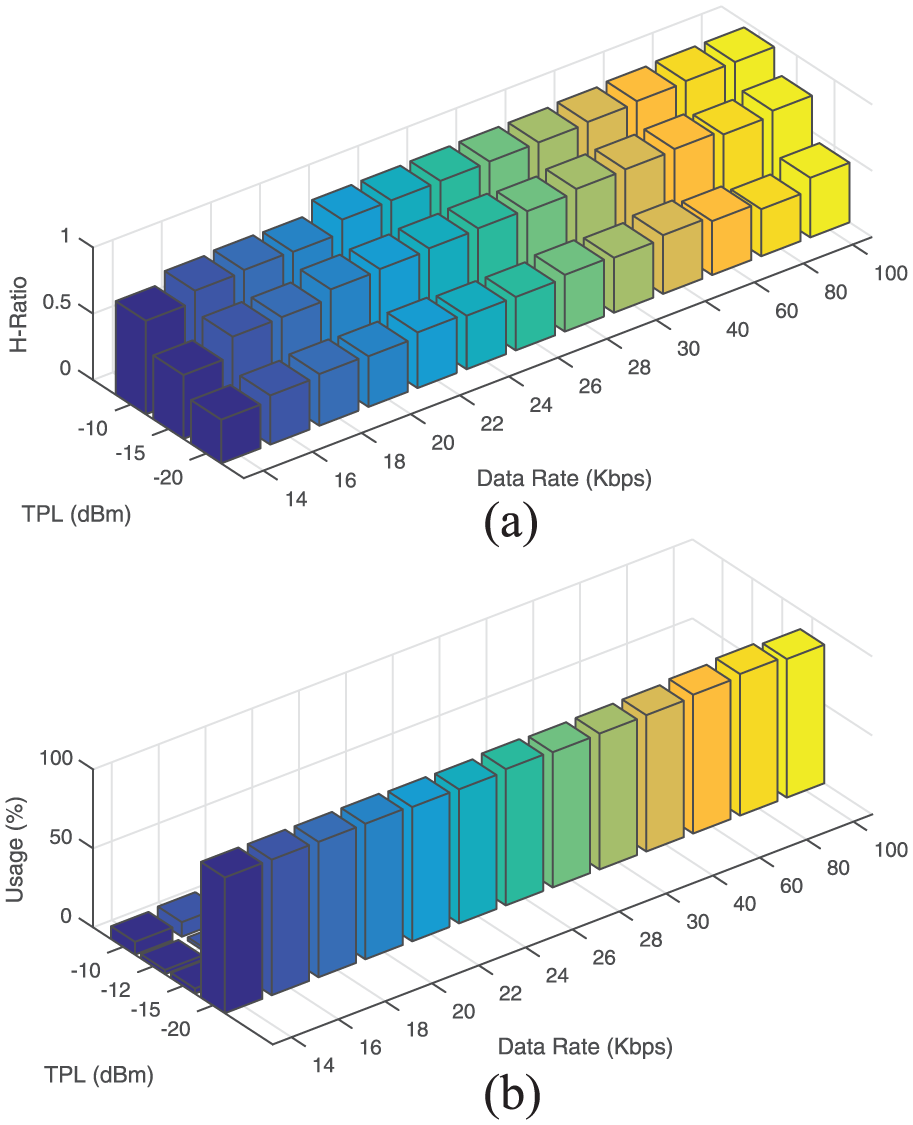
Relationship among Heating Ratio, data rate transmission power level, and its usage in %. (a) Heating Ratio, transmission power level, and data rate, and (b) transmission power level, its usage, and data rate.
TP has a direct impact on RSSI. The high values of TPL result in strong RSSI. However, maintaining RSSI at a high level is not required all the time. Only the acceptable RSSI is required to receive packets without loss. The proposed protocol works on the same principle due to which the RSSI using the proposed protocol is low as compared to the Kim and Eom 29 approach. From the above discussion, it is clear that although the Kim and Eom protocol uses TPL control strategy, it does not maintain a good balance between RSSI and PRR. Due to this reason, packet loss occurs. Moreover, the thermal dissipation is high in the Kim and Eom protocol as compared to the proposed protocol.
H-Ratio
It is very important to reduce H-Ratio as low as possible to avoid any tissue damage. The proposed protocol controls the H-Ratio using TP control strategy. Figure 6(a) shows that the H-Ratio of the proposed protocol is lesser than the Kim and Eom protocol with respect to data rate. The reason is that the proposed protocol controls the TPL optimally. It uses high TPL only when required which results in low H-Ratio. Figure 6(b) shows the behavior of H-Ratio using a fixed low data rate. Here, the difference between two protocols is remarkable. This is due to the reason that the proposed protocol avoids heated nodes in routing path. Figure 6(c) shows the H-Ratio of individual nodes using the proposed protocol. Almost all the nodes have the same behavior except one node which is placed at a location where it only transmits its own data. The node is not used as a forwarder node, and thus, it is not utilized heavily in transmission and reception.

Relationship of Heating Ratio, data rate, and simulation time: (a) Heating Ratio versus data rate, (b) Heating Ratio versus simulation time, and (c) Heating Ratio of individual nodes.
Conclusion
In this article, a novel thermal-aware and energy-efficient routing protocol for WBAN is proposed. The routing decisions are based on thermal, energy, and link costs. This results in a reliable, energy-efficient, and thermal-aware routing in WBAN environment. The simulation results show that the heated nodes reduced to 70% as compared to the existing considered strategy where all the nodes become heated. In addition, the proposed protocol results in high throughput. The reduced TPL leads to low RSSI which in turn reduces the packet collision. One of the reasons of low packet loss is the use of link quality indicator in making routing decisions.
In future, extensive simulations for the proposed protocol will be performed on well-known network simulators like Glomosim, NS2, OMNET, and OPNET. The proposed protocol will also be evaluated using real sensor testbed.
Footnotes
Handling Editor: Joel Rodrigues
Declaration of conflicting interests
The author(s) declared no potential conflicts of interest with respect to the research, authorship, and/or publication of this article.
Funding
The author(s) received no financial support for the research, authorship, and/or publication of this article.
