




Abstract
One of the core technologies of wireless body area networks (WBANs) is the routing technology. For effective routing in WBANs, various network operations such as lifetime extension and energy efficiency are required to be considered. However, the characteristics of the body serve as the most important management elements for stable operation and for guaranteeing effective WBAN management. Therefore, in this study, a routing protocol, even energy consumption and backside routing, is proposed and designed for stable operation of WBANs; it considers even energy consumption for the lifetime extension of the network and the path loss of the node located at the back of the body. For this study, the Mobile-ATTEMPT (M-ATTEMPT) as a recent routing technology is analysed, and an improved algorithm is proposed. Finally, the excellence of the proposed protocol is proved through a variety of experiments. The results show a significant improvement than previous routing technologies in terms of network lifetime, throughput and residual energy.
Introduction
Recently, as interest in the integration of information and communication technology and medical technology has increased, wireless body area network (WBAN) research has been actively promoted in an attempt to apply sensor networks to the human body. From the literature, 1 we know that recent studies on WBANs, since 2001, have focused on hardware and device technology, media access control (MAC) layer technology, network layer technology and security and WBAN technology. In other words, the above-mentioned fields are important technical fields constituting WBAN technology and indicate that they have become a subject of interest for researchers. One of the most important elements of WBANs in the research on the subjects listed above is routing technology.
The routing technology in WBANs should consider the number of physical environments, because the networks are configured in the body. First, because of the physical characteristics, the networks can easily cause free-space attenuation (fading), noise and interference compared to the free-space networks; thus, the bandwidth is variable, and the communication control according to the protocol is limited. Second, the sensor of each node should be harmless to the human body and consume minimal transmission power. Third, the devices attached to the body are movable owing to various body motions. In view of the characteristics described above, there is a need for routing technology of another form of conventional wireless sensor networks (WSNs).
In view of these circumstances, to perform efficient routing, the routing technology of WBANs must meet critical operational requirements such as lifetime extension, energy efficiency, characteristics of the body and posture change control. Particularly, lifetime extension must be considered including the characteristics of the body for stable operation and guarantee of effective WBAN management.
Therefore, in this study, a routing protocol for stable operation of WBANs is proposed and designed considering even energy consumption for the lifetime extension of the network and the path loss of the node located at the back of the body. In particular, we analyse the most recent routing technology, Mobile-ATTEMPT (M-ATTEMPT), and propose additional improved strategies.
In section ‘Related works’, related works are reviewed. In section ‘Routing strategies of the proposed protocol’, the strategies for efficient routing are introduced. In section ‘Design of the proposed routing protocol’, the proposed routing protocol is designed, and the improved algorithm is introduced. In section ‘Experiment’, various experiments are carried out to prove the excellence of the proposed protocol, and the conclusion of this study is summarized in section ‘Conclusion’.
Related works
WBAN technologies
A WBAN is a collection of wireless sensor nodes that is internal or external to the body for monitoring human body functions and the surrounding environment. 2 It is composed of small-sized, low-power and lightweight devices capable of wireless communication. The devices constituting a WBAN allow for continuous health monitoring of the body and real-time feedback to the user or physician. 3 Moreover, a WBAN can be defined as a wireless network technology based on radio frequency in which sensors or actuators can be connected.
Following the first introduction of the concept of WBANs, interest in the integration of information and communication technology with medical technology has increased, and research has been actively promoted by a number of researchers.
Although many protocols and algorithms for conventional wireless sensor networks have been developed, such technology cannot be used by direct application to WBANs because of the body’s unique network environment. As described above, the wireless network environment of the body has different characteristics from that of networks in free space. 2
Discovery of several major research themes is possible through the examination of research on WBANs. The major research themes include hardware and device technology, MAC layer technology, network layer technology and security-related technology. 1 Typically, one of the core specific technologies of WBAN management among them is the routing technology.
WBAN routing protocols
After the introduction of the concept of WBANs in the mid-2000s, there has been continued research on WBAN routing protocols. Studies on WBAN routing protocols can largely be classified into five categories: QoS-aware, temperature-aware, cluster-based, postural-movement and cross-layered routing protocols. Table 1 shows the classification of routing protocols.
Classification of WBAN routing technologies. 1

WBAN: wireless body area network.
QoS-aware routing protocols are used to satisfy the user’s specific QoS by integrating various modules. There are some typical protocols such as energy-aware peering routing (EPR), 6 QoS-aware peering routing for reliability-sensitive data 7 in this category. Temperature-aware routing protocols are used for achieving balance in communication among the sensor nodes by heat generation from the sensor, which is not concentrated on a specific node. The use of cluster-based routing protocols attempts to utilize the energy of the sensor efficiently by using clustering and reducing the direct communication frequency of adjacent base stations. Typically, there are some protocols such as thermal-aware routing algorithm, 8 adaptive least temperature routing 9 and M-ATTEMPT 10 in this group.
Cluster-based routing protocols are intended to use the energy of the sensor efficiently by using the clustering to reduce the direct communication count of the adjacent base stations. In typical studies, AnyBody 11 applies LEACH to WBAN and hybrid indirect transmissions. 12 A WBAN can be disconnected between its nodes for a change in posture. Therefore, the postural-movement routing protocol is used for detecting a change in posture and solving disconnection problems. There are typical protocols such as energy-efficient thermal and power aware routing 13 and exploiting prediction to enable secure and reliable routing) 14 in this category. The cross-layered routing protocol comprehensively considers two or more layers rather than treating only one of the seven layers of the network to improve the efficiency of energy use and data transmission. Wireless autonomous spanning tree protocol 15 and cascading information retrieval by controlling access with distributed slot assignment 16 are typical protocols.
From the recent research trend, we can find that protocols cannot be classified into any single above-mentioned group for a variety of reasons. Therefore, it is difficult to classify the protocols into only one of the groups. For example, M-ATTEMPT 10 has been classified as a temperature-aware routing protocol for responding to temperature changes, while it can also be classified as a cross-layered routing protocol because it contains several methods to work with various network layers for stable network operation.
Routing strategies of the proposed protocol
Main objectives of the proposed protocol
In this study, we propose and design an improved routing protocol satisfying the most important operating conditions required in a WBAN environment. In particular, the proposed routing protocol is developed to satisfy the requirements of network lifetime extension, energy efficiency and the path loss of the node located at the back of the body, which are the core operating conditions of WBANs. Therefore, the main purposes of proposing the routing protocols in this study are as follows: The first purpose is to extend the lifetime of the network. Energy consumption must not concentrate on only one of the nodes; the entire network is properly operated for a long time without dead nodes as much as possible. The second purpose is to increase the probability of successful data transmission – in other words, to ensure that all data are delivered successfully without any data loss during transfer. The third purpose is to ensure that the proposed routing protocol can facilitate postural-aware routing. Owing to the disruption of the network due to the human-body-motion, the network requires effective reconstruction.
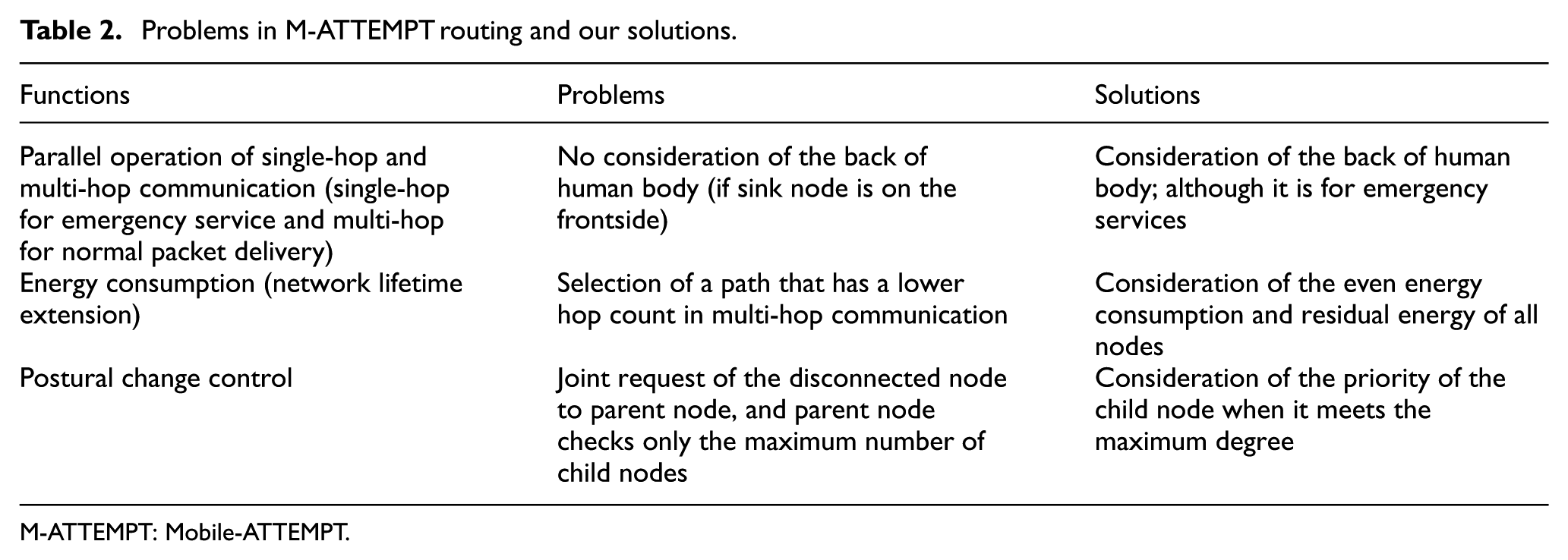
In particular, while analysing the problems of the M-ATTEMPT routing protocol, which is a recent study, we induced the routing strategy of the proposed protocol. Table 2 summarizes the main problems of the M-ATTEMPT routing protocol and their solutions.
M-ATTEMPT is operated in parallel single-hop and multi-hop for the rapid transmission of data. In other words, in the case of an emergency packet, it uses single-hop; however, in the case of a normal packet, it uses multi-hop. However, if the sink node is in front of the body, it is difficult for the sensor on the back of the body to transfer the data of the single-hop through the body to the sink node. Therefore, this must be considered if it occurs at a node on the back, even if it is an emergency packet.
M-ATTEMPT has selected the minimal number of hop count paths in multi-hop communication to minimize energy consumption. However, instead of simply considering only the hop count, energy consumption must be distributed among the nodes evenly by considering the residual energy of nodes and transfer energy between nodes. By doing so, extending the overall lifetime of the network is possible.
In relation to the control of posture change, in M-ATTEMPT, a disconnected node sends a joint request to the closest parent node; then, a parent node that has received the request will permit or deny it by simply considering the number of children that can be added. However, this is a necessary strategy in the consideration of the priority of the child nodes to move lower priority nodes elsewhere.
In this study, we focus on the first two of the problems listed above and present strategies to solve them.
Problems in M-ATTEMPT routing and our solutions.
M-ATTEMPT: Mobile-ATTEMPT.
Energy consumption strategy for network lifetime extension
Extending the lifetime of the network through the even energy consumption of the sensors is an important goal. In many routing protocols, if there are multiple paths to the sink node, the routing protocols select the one with a smallest hop count for efficient energy consumption. However, not only the efficient use of energy but also the lifetime extension of the network must be considered during even energy consumption. Thus, instead of simply selecting the path with a small hop count, the amount of remaining energy and standard deviation of the residual energy of the sensor must be considered. For example, in Figure 1, the routing paths from C1 to P1 and C2 to P2 are calculated using the amount of residual energy and standard deviation of the nodes on the routing paths, and the path that has the smallest value is then selected.

Strategies for energy efficiency and lifetime extension of the networks.
M-ATTEMPT first selects the path that has the lower hop count; second, if two paths have the same hop count, then it selects the path with lower energy consumption, stable increased-throughput multi-hop protocol for link efficiency (SIMPLE), 17 an improved version of M-ATTEMPT, uses the distance factor between the forwarder node (P1 or P2) and the sink node in addition to the residual energy amount of the node. Therefore, the cost function of SIMPLE is expressed by as follows:

It then selects a node of the minimum cost function in the candidate forwarders. However, the algorithm proposed in this study uses the standard deviation factor for even energy consumption. In other words, it uses the standard deviation value of the residual energy of the candidate forwarders for the even energy consumption of the nodes. It then selects a candidate forwarder node that has the lowest standard deviation value. If the average of the residual energy of nodes {N1, N2, … , Nn} is m, the standard deviation function can be defined as shown in equation (2). After counting the value of the standard deviation function of each forwarder, the proposed algorithm selects a forwarder with a minimum standard deviation function value, which is defined in equation (3):


Backside node routing strategy for high connection probability
Most previously proposed studies have been avoided for use determining the connection strategy of nodes at the back of the body. M-ATTEMPT does not specify the routing strategy of a sensor node on the back. Therefore, in this study, we study the effective routing strategy of sensors on the back of the body to achieve higher connection probability. In Figure 2, for sensor nodes such as C1, C2, C3 and C4 on the back of the human body, transferring data efficiently to the sink node in a single hop is difficult, because a single hop passing through the body has a lower connection probability than multi-hop transmission. Figure 3 shows an example of the connection probability in single-hop and multi-hop scenarios. The distance between nodes ‘a’ and ‘b’ is 10 cm and that between nodes ‘c’ and ‘d’ is 20 cm.2 This figure shows that a multi-hop connection has a higher probability than a single-hop connection. Especially, when the sender node is placed on the back and the receiver node is on the front, the path loss of the connection must be considered. 2 Therefore, transmission is effective via middle nodes including P1, P2 and P3 in the multi-hop, even though it is an emergency packet.

Strategies for higher connection probability.
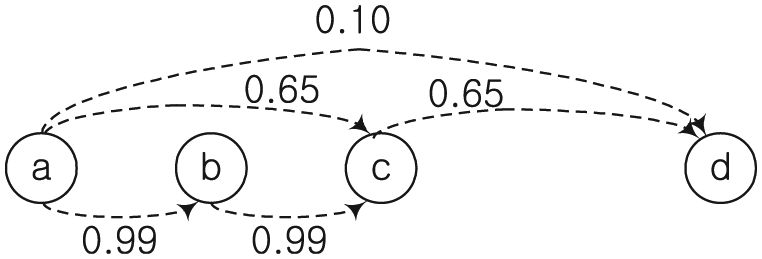
An example of a connection probability in single-hop and multi-hop connections.
Strategies for postural change control
Coping with a change in posture is one of the most prominent goals of WBAN routing protocols. When a node is disconnected from another node owing to movement of the body, the reset process is required to restore the connection disconnected by the change in body posture. If node ‘A’ is disconnected from another node, node ‘A’ will send a joint request message in the range of the signal and look for a parent node. Parent candidates receiving the request will determine whether to accept the request or reject it. In this case, if the maximum degree, which is the number of child nodes that a node can have, is set to three, after a parent candidate accepts the request for node ‘A’, it will have to exclude one of the child nodes. Additionally, the excluded child node must find a parent again and change its path to the sink node.
In the selection of the parent node, M-ATTEMPT considers only the degree limits of the parent node; however, there is a need for a better strategy. If there are a number of parent candidates within the signal range, a strategy for selecting a parent should be developed considering other conditions. Specifically, when it reaches the maximum degree, the parent node should not exclude the newly entered node unconditionally; it should select the node to be excluded according to the priority and urgency.
Design of the proposed routing protocol
In this section, we design the protocol discussed in section ‘Routing strategies of the proposed protocol’. The proposed routing protocol is composed of several phases, as shown in Figure 4: the initialization, routing, scheduling and data transmission phases. In the initialization phase, all nodes broadcast a ‘Hello’ message and record the hop count by using the distance information of the sink node and the adjacent node attached to the message. Meanwhile, each node forms the path information required for leading to the sink node. In the routing phase, each node determines the path to the sink node by using information such as hop count, location, residual energy, priority, whether it is an emergency, or the maximum degree of the parent node.

Phases of the proposed routing protocol.
In the scheduling phase, a schedule for passing data for each node is established after the data transfer path is determined. Using time division multiple access, time slots are allocated to each node. It has the on-demand period to pass the data of the sink node to the common node in the data transmission phase, and it transmits data to the sink node in the assigned time slots.
Figure 5 shows the routing algorithm for the backside node and the even energy consumption algorithm for lifetime extension. The routing algorithm for the backside node shows the routing strategy of all nodes attempting to send data. If the node is on the backside of the body, the node has to send data in multi-hops to the sink. Therefore, the node seeks a forwarder node using the ‘selection_optimal_route’ procedure. If the node is not on the backside, depending on the emergency, a routing strategy is designed as the algorithm. If there are multiple paths to the sink node, it selects the best route for even energy consumption using the selection_optimal_route procedure. In the even energy consumption algorithm, the residual energy of all candidates that can be forwarders is computed, and then the value of the standard deviation function of each forwarder is computed. Finally, the algorithm selects the minimum value among all values of the standard deviation function.

Algorithm for improving connectivity and energy efficiency.
Experiment
Experimental environment
In this section, to verify the excellence of the proposed routing protocol, various experiments are carried out. A two-dimensional area, 0.8 × 1.8 m2, is used, considering the human body as the simulation area. Eight sensors and four sensors are placed on the frontside and backside of the body, respectively. The position of the sink node in the experiment is 0.45 and 0.9 m in the x and y directions, respectively. The sink node must be at the centre of the sensors to receive maximum data efficiently from them. Further, the sink node has to be in a position that is not influenced by the movement of the body to a great extent. Therefore, in the experiment, we placed the sink node at the centre of the body and the centre of the sensor nodes.
All nodes are placed on important body parts as listed in the ‘position of nodes’ row of Table 3. Further, the thickness of the body for calculating the distance of the backside node is defined as 0.25 m. Table 3 shows the simulation parameters and environment. The experiments are performed in MATLAB R2013a.
Simulation parameters and environment.

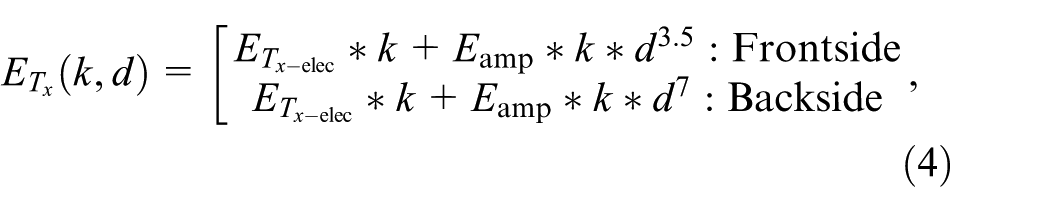
In this study, two different radio models are used to consider the frontside and backside of the body. In the case of the frontside, the power loss, d3.5, is used. Therefore, equation (4) is used in this case. Otherwise, on the backside, the power loss d7 is used. Therefore, equation (5) is used in this case. According to the literature, 2 when the sender and receiver are within a line of sight (LOS), the path loss exponent is 3–4. When the sender node is placed on the back and the receiver is on the front (non-line of sight state (NLOS)), the path loss exponent is 7. Therefore, we can know that the path loss is very high compared to free-space propagation. 2 Figure 6 shows an example of LOS and NLOS of the body. In equation (1), ETx is the energy consumed by the transmitter, and ERx is the energy consumed by the receiver. ETx-elec and ERx-elec are the energies for the electronic circuits of the transmitter and receiver, respectively. Eamp is the energy required to run the amplifier circuit, and k is the packet size:


An example of LOS and NLOS of the body. LOS: line of sight; NLOS: non-line of sight state.
Result and analysis
Various experiments in three aspects – network lifetime, throughput and residual energy, the most important element of WBAN performance – are performed. In each experiment, two types of specific tests are processed to review the effect of the proposed algorithm for even energy consumption and the routing algorithm for the backside nodes. Therefore, the first type of test in each experiment is performed considering the even energy consumption algorithm only. The second type of test is then performed considering both the even energy consumption algorithm and the routing algorithm for the backside nodes. The results of the experiments are as follows:
First, an experiment to examine the life of the network is performed to determine the number of dead nodes. On the left side of Figure 7, when the even energy consumption algorithm proposed in this study is applied, we know that the number of dead nodes appears to be much lower than in the existing two methods. On the right side of Figure 7, when both the even energy consumption algorithm and the routing algorithm for the backside node are applied together, the results are similar to that of the first test. However, it can be seen that the performance of the proposed algorithm decreases slightly in the vicinity of the 7500th round. This is assumed to be caused by the need for multi-hop communication via the neighbour nodes without communicating directly with the sink node at the front through the human body. In other words, it is assumed to be a decrease in performance due to the burden of the multi-hop routing of the backside node. The same phenomenon can be found also in the other two experiments.

Comparison of network lifetime in two experiments.
Second, to measure the throughput of the network, the number of packets that arrived on the sink node is investigated. When we apply the proposed even energy consumption algorithm, as shown in the left side of Figure 8, much better performance than the existing two methods is achieved. Even in the case of applying both the even energy consumption algorithm and the backside routing algorithm, as shown in the right side of Figure 8, better performance is again achieved than in the existing two methods. As shown in the figure, a slight decrease in performance is attributed to the burden that is due to the multi-hop communication backside node.

Comparison of throughput in two experiments.
Third, we analyse the residual energy of the node. When the proposed even energy consumption algorithm is applied, it is possible to know that there is far more residual energy than in both existing methods as shown in the left side of Figure 9. It can be seen that when the energy of each node is used equally utilizing the variance value function for each node, lower energy is consumed across the network. Similar results are achieved even in the case of applying both the even energy consumption algorithm and the algorithm that considers the node on the back of the body. A slight change in performance due to multi-hop communication of the backside node has been observed.
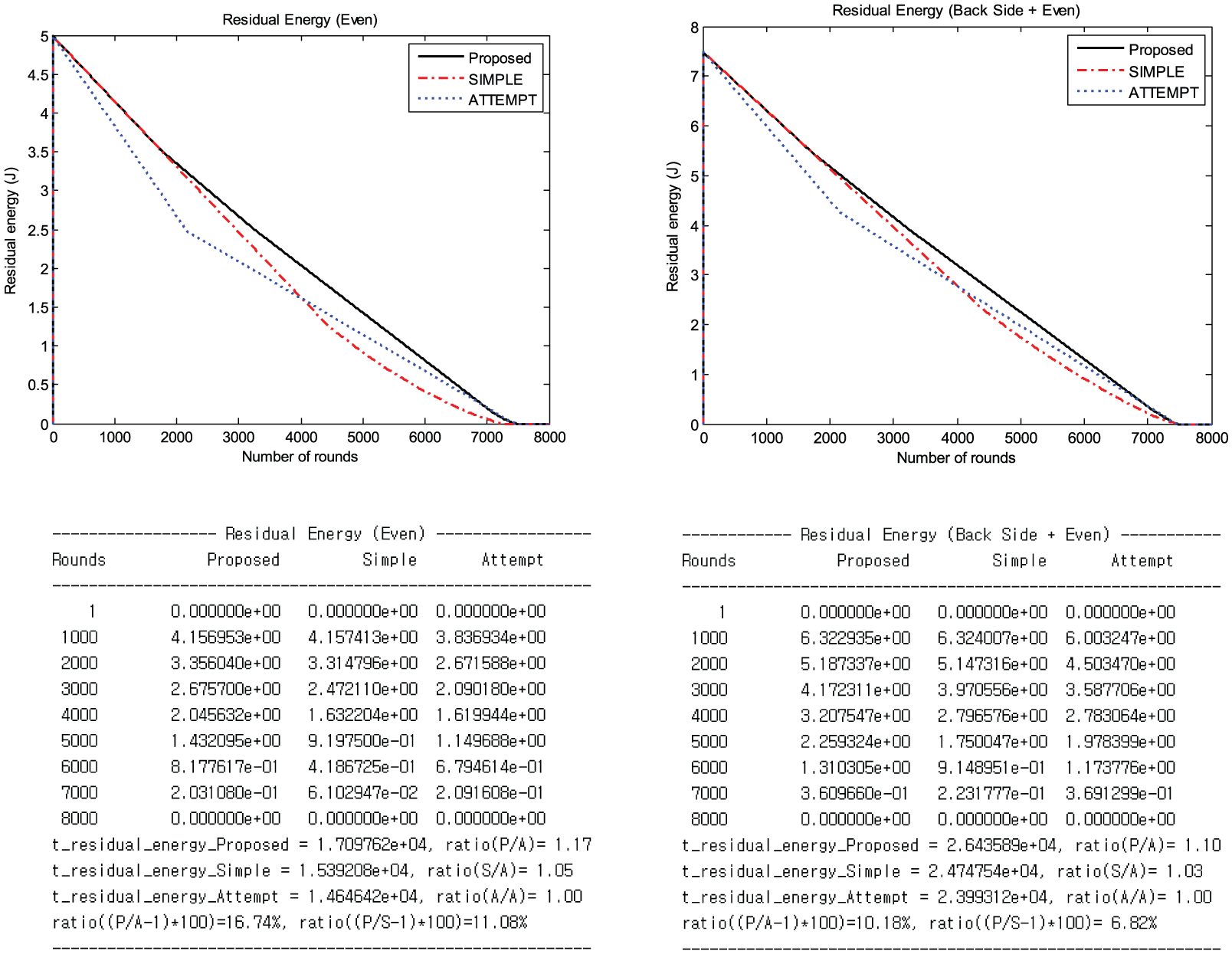
Comparison of residual energy in two experiments.
Conclusion
One of the most important elements to be considered for efficient WBAN routing is the lifetime extension, and consideration of the characteristics of the body is an important management element for the stable operation of WBANs. Therefore, in this study, a routing protocol, even energy consumption and backside routing, is proposed and designed for stable operation of WBANs; it considers the even energy consumption for the lifetime extension of the network and the path loss of the node located on the back of the body. To verify the significance of the proposed routing protocol, various experiments are carried out compared with two existing models, M-ATTEMPT and SIMPLE, of recent routing technologies. In this experiment, the proposed routing algorithm showed better performance than the two existing models in terms of network lifetime, throughput and residual energy. When the even energy consumption algorithm is applied, the performance of the proposed model shows an improvement of over 37%, 10% and 11%, respectively, in terms of the network lifetime, throughput and residual energy as compared to the performance of existing models. When both even energy consumption and routing algorithms for the backside node are applied together, the results show similar performance. In this study, experiments were conducted by placing a limited number of sensors on the major sites of the human body. As a part of future study, we will perform a similar experiment in which more sensors will be placed in diverse locations of the body. Moreover, we are planning to extend the proposed protocol so that it may control the movement of the body and changes in temperature.
Footnotes
Declaration of Conflicting Interests
The author(s) declared no potential conflicts of interest with respect to the research, authorship, and/or publication of this article.
Funding
The author(s) disclosed receipt of the following financial support for the research, authorship, and/or publication of this article: This work was supported by the 2016 Kyungil University research grant.