




Abstract
The introduction of the Information and Communication Technologies throughout the last decades has created a trend of providing daily objects with smartness, aiming to make human life more comfortable. The paradigm of Smart Cities arises as a response to the goal of creating the city of the future, where (1) the well-being and rights of their citizens are guaranteed, (2) industry and (3) urban planning is assessed from an environmental and sustainable viewpoint. Smart Cities still face some challenges in their implementation, but gradually more research projects of Smart Cities are funded and executed. Moreover, cities from all around the globe are implementing Smart City features to improve services or the quality of life of their citizens. Through this article, (1) we go through various definitions of Smart Cities in the literature, (2) we review the technologies and methodologies used nowadays, (3) we summarise the different domains of applications where these technologies and methodologies are applied (e.g. health and education), (4) we show the cities that have integrated the Smart City paradigm in their daily functioning and (5) we provide a review of the open research challenges. Finally, we discuss about the future opportunities for Smart Cities and the issues that must be tackled in order to move towards the cities of the future.
Introduction
According to the Department of Economic and Social Affairs of the United Nations, DESAP, 1 in the 1950s around 30% of the world population resided in urban areas. In 2014, this value increased to 55% and is expected to keep growing in the next couple of decades (https://www.unfpa.org/migration), reaching 68% by the year 2050 (https://population.un.org/wup/Publications/Files/WUP2018-PressRelease.pdf).
This shift from rural to urban areas occurs due to two main factors: (1) the natural growth of local population and (2) migration. The latter is motivated by the search for better opportunities, the improved quality of life and higher standards that cities provide to their residents. For example, more job offers with better economic opportunities, coverage of basic necessities, improved education, health and public transport services and urban amenities, among others.
However, the rapid and uncontrolled growth of cities brings to the table new issues that local governments and stakeholders need to pay attention to, such as increased traffic congestion and accidents, air and environment degradation due to higher amount of pollutants, higher cost of living, overcrowding, higher illness spreading, crime and security concerns.
Moreover, alongside the evolution of the society, there has been an exponential development of the Information and Communication Technologies (ICTs). Technologies such as Big Data, Internet, Internet of Things (IoT), Cloud Computing and Mobile Computing have been gaining importance during the last years, becoming a key part in the evolution of cities. Urbanisation and ICTs have resulted in the conception of the Smart City (SC) paradigm. A concept that increasingly more cities are striving to adopt by developing new SC initiatives.
This work includes over 200 papers, most of them recently published, on a wide variety of topics around SCs, for example, architectures, theoretical approaches, applications or specific domain projects. To find the most relevant works, Google Scholar was queried for papers containing ‘Smart City’ in their title or abstract, ordering them by relevance. In addition, we also queried Google Scholar and ArXiv for works with city attached to terms belonging to specific domains or applications (such as ‘healthcare’ or ‘education’). The bibliography of the selected papers was also analysed in order to extract relevant references which could enrich our study.
In order to select the cities in the Case studies section, the following methodology was used: first, we created a list of the most relevant Smart Cities by selecting those that have received the highest number of awards (Figure 1). After that, a meticulous analysis of each of the gathered cities was performed to differentiate press releases from real-life implementations, in order to study only already working Smart Cities. To do so, we searched for specific real case smart city scenarios in each of the gathered cities using reliable sources of information: city council’s websites, developed tools’ websites or developed smart city research projects in the city. Also, two other factors have been taken into account to select the use cases: cities with a specific department responsible of the development of the city as smart city and geographical location of the city so that cities from each continent were sampled.

Methodology used to select the cities for the Case studies section. The used location criterion is that cities from each continent must be sampled.
This survey aims to analyse the work done so far in the area of SCs. The article is divided into the following parts: (1) the ‘Definitions of smart city’ section gathers the multiple SC definitions that have been formulated in the literature; (2) the ‘Smart City architectures’ section describes the general technological data pipeline of a SC and some specific architectures; (3) in the ‘Application Domains’ section, we review the taxonomies of the applications to specific domains of the city (such as healthcare and education); (4) the ‘Case studies’ section provides real examples which implement the SC paradigm; (5) the ‘Open challenges’ section presents issues not yet solved in the literature that need further research; and, finally, (6) the ‘Discussion’ section compiles a discussion of each of the previous sections and a summary of the best practices for the implementation of SCs, including the next steps that should be taken inside the research field.
Definitions of smart city
Even though the SC paradigm is a promising approach, there is little consensus on what characteristics or requirements define a SC or what should humans expect of a SC, as discussed in Cocchia. 2 In this section, we review the literature on the different definitions of the smartness of a city. In order to organise this section, we follow other authors’ taxonomy of definitions. Specifically, Cocchia 2 categorises the definitions between (1) technological dimension, (2) human dimension and (3) institutional dimension. Javidroozi et al. 3 present their review of definitions according to the following categories: (1) technology, (2) visions of well-being in the future (shortened as people), (3) systems integration and (4) process. Similarly, Yin et al. 4 make use of four categories: (1) technical infrastructure, (2) domain application, (3) system integration and (4) data processing. In the first two proposals, a definition may have various focuses, therefore it can be placed in various categories. Our aim is to provide a taxonomy of definitions to avoid this multiple assignment. We opted for the following taxonomy proposed by Yin et al. 4 to avoid the later issue: (1) technology-based definitions, (2) domain-based definitions, (3) definitions based on the integration of the system and (4) definitions focused on the data.
Technology-based definitions
The definitions in this section are centred around the importance of the technology, that is, the sole inclusion of the ICTs is enough to make a city smart. Authors like Coe et al. 5 define a SC as the response for the growing pressure of globalisation. The communities around the world begin to sketch the first drafts of the networked communities, that is, networks of individuals and firms linked electronically. For Palmisano, 6 a SC is defined by the use of ICTs to sense, analyse and integrate the key information of core systems in running cities. For Washburn et al., 7 what makes a city smart is the combined use of software systems, hardware and network technologies (referred as smart computing technologies) to improve the services in seven key areas: (1) city administration, (2) education, (3) healthcare, (4) public safety, (5) real estate, (6) transportation and (7) utilities. Similarly, Hall et al. 8 also acknowledge the importance of the sensors, networks, algorithms and other technological advances to design, build and maintain the infrastructure of the city (power, water, transportation and so on). Their aim is to create a safe, environmentally green and efficient city. Although the previous two definitions aim to improve the performance of the city in some domains (which may point that they have a domain-based definition), their emphasis is put on the technologies and, thus, they are categorised as technological definitions. Harrison et al. 9 define a SC as an urban area that exploits operational data, that is, data extracted from traffic, power consumption and so forth, in order to optimise the operations. In their definition, they stress the importance of three features of the city: (1) the near-real-time data obtained from physical and virtual sensors, (2) the interconnection between different services and technologies inside the city and (3) the intelligence from the analysis of the data and the process of optimising and visualising it. Su et al. 10 explain that, in general, a SC is the product of a digital city combined with the IoT. Finally, Harrison and Donnelly 11 define a SC as an environment which is attractive to the new generations. This city should interact with its citizens using digital interfaces, allowing an instant access to the required information rather than using traditional solutions like waiting in a long queue or using paper forms for requests.
Domain-based definitions
A city comprises several domains such as healthcare, education and government. There is a part of the literature that aims to explain SCs from the point of view of those domains. For example, Odendaal 12 sets the definition of a SC as a region which capitalises the opportunities presented by ICTs in promoting its prosperity and influence. The author shows the importance of the e-governance as a way to connect citizens with the city and governments and improve the city governance. Caragliu et al. 13 believe that the smartness of a city is achieved when the human and social capital combined with traditional and modern communication systems (transport and ICTs, respectively) augment the sustainable economic growth and the quality of life, taking into account the management of natural resources and through participatory governance. Other authors like Lazaroiu and Roscia 14 propose a general definition of a SC: a city that performs well in some applied domains. For the case of Lazaroiu and Roscia, 14 the domains are smart economy, government, mobility, environment, living and people. Similarly, Giffinger et al. 15 argue that a SC is composed of or defined by 6 characteristics, 31 factors and 74 indicators. The characteristics are broad domains like governance or environment, while the factors and indicators are more specific. In the ‘Application domains’ section, a literature review of domain applications is provided to extend the possible definitions of a SC based on a taxonomy of domains.
Definitions focused on the integration of the system
In this category, the definitions are focused on the integration of all the elements that compose a city. Therefore, even though the city may have ICTs included in every sector, if the system is not integrated as a whole, the city cannot be considered smart. Cook and Youngblood 16 set the basis of SCs creating the concept of smart homes (pivotal building blocks of SCs), which are intelligent houses where smart environments can be developed. In their concept, they do not define directly what a SC is; instead, they define what a Smart Home is: a house able to acquire and apply knowledge about its inhabitants and their surroundings in order to adapt to the former and meet the goals of comfort and efficiency. This can be used as a starting point to develop the concept of SCs based on intelligent systems. Moss Kanter and Litow 17 see the city as a connected system, not just separate elements. Therefore, in contrast to the importance given to the nodes or domains of the network (healthcare, education and so on), the attention in this approach is put on the connections (between healthcare and education, for example). In Dameri, 18 the author makes a literature review of the definitions of SCs and reports a comprehensive definition based on them: a SC is a well-defined geographical area where the cooperation between ICTs, logistics, energy production and so on are able to provide benefits for the citizens such as well-being, inclusion, environmental quality and intelligent development, among others. With a novel point of view, Javidroozi et al. 3 see the city as a company. In their analogy, the suppliers of the company are the service providers of the city, the company’s systems integration (sales, marketing, finances and so on) is the city’s systems integration (transport, healthcare, education and so forth) and the customers are the citizens. Furthermore, local government or authorities are the managers of the company. Monzon, 19 with the aim of having a criterion to select SC projects, synthesises the definitions of the literature, providing the following one: a SC is an integrated system where human and social capital are combined using the ICTs in order to achieve a sustainable and resilient development with a high quality of life. Although they do not provide their own definition, Petrolo et al. 20 assume the definition of a sustainable and intelligent city thanks to the integration of the services and infrastructure into a whole and using intelligent devices for monitoring and control.
Definitions focused on the data
In these definitions, the authors put the stress in the transmission or the use of the data. For example, Al-Hader et al. 21 define the smartness as the ability of transmitting and receiving the data using the communication protocols. Although this could be categorised as a technology-based definition, as the stress is put on the data, it is classified as a definition focused on data. Yamamoto et al. 22 argue that the foundation of a SC is gathering the data first and, then, provide services using it. Moreover, they emphasise that it is pivotal to use data from houses, as these are the building blocks of a city.
Smart city architectures
In this section, the common architectures in SCs are presented, as well as specific architectures and adaptations of common ones used on several SC projects.
Common architectures
Since the creation of the SC paradigm, different researchers have tackled the creation of the most suitable architecture based on ICT solution. Due to the different requirements and daily situations in cities that have implemented SC architectures, these implementations have not been following a standard and, therefore, they have different characteristics. That is, there is not a unique and standardised architecture for SCs; however, there are some popular paradigms that fulfil the requirements cities may have. These architectures are differentiated by the characteristics of the layers in charge of acquiring, processing and making use of the data. Among them, we can distinguish the most popular ones: (1) cloud computing, (2) fog computing and (3) edge computing. These architectures are complementary and can be implemented in the same city, see Longo et al., 23 for different projects or applications. As Almeida et al. 24 discuss, architecture-level design decisions must be analysed properly, in order to gauge their effect in the final system.
Cloud computing architecture
Cloud computing is defined by the National Institute of Standard and Technologies (NIST)
25
as follows: Cloud computing is a model for enabling ubiquitous, convenient, on-demand network access to a shared pool of configurable computing resources (e.g., networks, servers, storage, applications and services) that can be rapidly provisioned and released with minimal management effort or service provider interaction.
This architecture, by default, is splitted in several layers, for example, Infrastructure-as-a-Service (IaaS) or Platform-as-a-Service (PaaS) layers. Each of the layers consumes the services provided from the other layers and also provides them with its own services. Due to the architecture being divided into services, the bases of it are in the decentralisation and computation of the information.
Regarding the projects that used this architecture, Kaur and Maheshwari 26 proposed a healthcare framework based on the presented architecture. Biswas and Muthukkumarasamy 27 developed a framework for security in smart cities that integrates blockchain with IoT devices via cloud computing architecture. Mazza et al. 28 present a mobile cloud computing framework describing the flows of data and operations taking place in the smart city. Khanna and Anand 29 proposed a monitored parking system based on IoT and cloud computing architecture.
Fog computing architecture
Fog computing was coined by Bar-Magen Numhauser 30 in CISCO as an extension of the Cloud computing paradigm. This extension is done by improving the performance and the responsibilities of the end-nodes of the network. Furthermore, the differences rely on the location of the data storage and processing devices installing them in the same local network as the devices acquiring the data and, therefore, creating a low-latency communication between them. Due to these characteristics, this architecture is used for applications where low latency is required, geographically dispersed infrastructures or applications where the data acquired is not practical to send to the cloud and wait for its processing.
Regarding the projects that used this architecture, Bruneo et al. 31 present a smart mobility use case using fog computing paradigm. Chen et al. 32 developed a dynamic video stream processing scheme based in fog computing architecture to offer real-time information processing and decision making. Santos et al. 33 proposed a fully integrated node management system to exchange application information between nodes. Barik et al. 34 created a fog computing–based framework for mining analytics from geospatial data.
Edge computing architecture
Edge computing is a paradigm that follows the statement that if the data are generated at the edge of the network it should also be more efficient to process that data at the edge of it. This is a similar approach to fog computing but with the difference that fog focuses more on the infrastructure and edge on the things side. It is important to note that the edge is not always the smallest sensor in a network but the bridge between the local network and the cloud.
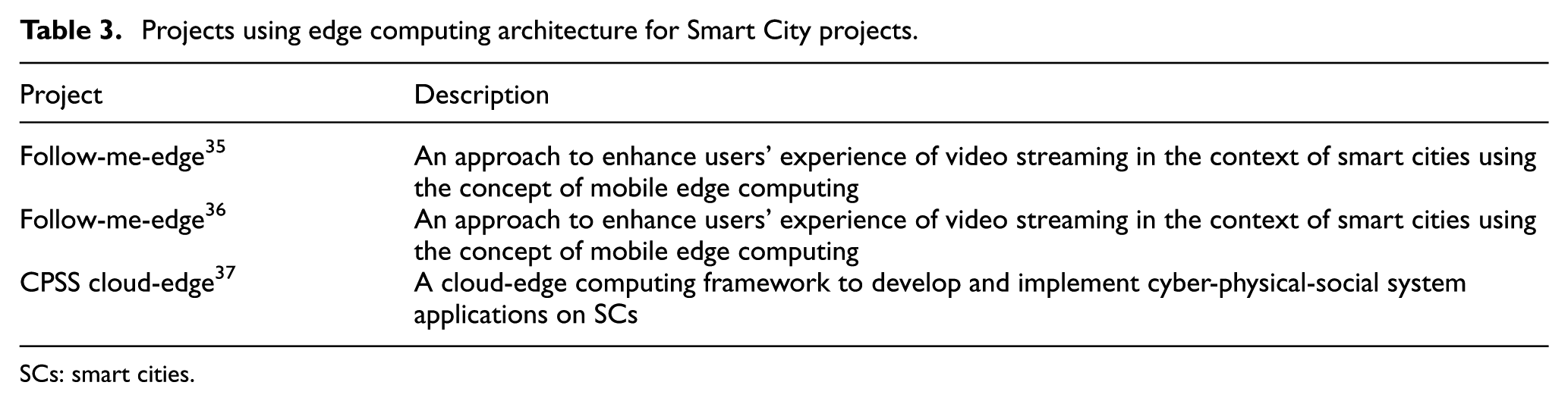
Regarding the projects that used this architecture, Shi et al. 35 explain why this paradigm is different from the ones mentioned before and in which occasions it would be convenient to implement it. Taleb et al. 36 propose a project to enhance users experience of video streaming in SCs using mobile edge computing. Wang et al. 37 present a cloud and edge architecture–based system for cyber-physical-social systems.
Several projects have used the architectures presented in this section. These projects tackled the problem of SCs providing different end-user solutions. As we have stated before every city is different so the architectures may adapt to them. Furthermore, the architectures discussed above are not excluded from each other so the same city can implement disparate architectures for different services. Tables 1–3 depict various projects and software solutions proposed in the literature that implement or support creating services in different cities and with diverse architectures.
Projects using cloud computing architecture for Smart City projects.

IoT: Internet of Things; SCs: smart cities.
Projects using fog computing architecture for Smart City projects.

IoT: Internet of Things.
Projects using edge computing architecture for Smart City projects.
SCs: smart cities.
Application domains
A SC comprises various domains where the introduction of the ICTs creates a pivotal change. The ‘Review of the taxonomies of application domains’ section compiles the different taxonomies of application domains used in the literature while the following sections review the literature on specific categories following the taxonomy presented at the end of the ‘Review of the taxonomies of application domains’ section.
Review of the taxonomies of application domains
Washburn et al. 7 reference seven critical infrastructure components and services which can be interpreted as application domains: (1) city administration, (2) education, (3) healthcare, (4) public safety, (5) real estate, (6) transportation and (7) utilities.
Giffinger and Gudrun 54 define the smartness of a Smart City with six characteristics, where the city should perform well, that can be considered general smart city application domains: (1) smart economy, (2) smart people, (3) smart governance, (4) smart mobility, (5) smart environment and (6) smart living.
In a layered fashion, Harrison and Donnelly 11 divide various subdomains into five categories: (1) social systems, (2) services, (3) resources, (4) infrastructure and (5) natural environment.
Neirotti et al. 55 create a taxonomy of domains divided into two big categories: (1) hard and (2) soft domains. In hard domains, the improvement in the sustainability is given by the deployment of ICT systems (natural resources management, public security and so forth), whereas in soft domains the ICT systems have a limited role and the users are free to use them (education, e-government and so on).
Liu and Peng 56 classify the applications of SCs into three areas: (1) life enrichment (home, community, healthcare and education), (2) public administration and service (public safety supervision, food safety supervision, smart traffic and environmental protection) and (3) widescale resource management (water, electricity and agriculture). Their approach draws on their definition of Smart City: one that enriches citizens’ lives and upgrades urban management and industry while protecting the environment.
Yin et al., 4 based on their SC definition, create four big branches in which they divide the taxonomies used in the literature: (1) business-related categories, (2) citizen-related categories, (3) environment-related categories and (4) government-related categories.
Lombardi et al., 57 after a literature review, gather 60 indicators from two focus groups with experts. These are divided between five clusters: (1) smart governance, (2) smart economy, (3) smart human capital indicators, (4) smart living and (5) smart environment. Albino et al. 58 adapt the later taxonomy and relate each cluster with an aspect of urban life: (1) smart economy with industry, (2) smart people with education, (3) smart governance with e-democracy, (4) smart mobility with logistics and infrastructures, (5) smart environment with efficiency and sustainability and (6) smart living with efficiency and sustainability.
Gharaibeh et al. 59 present a taxonomy based on their literature review including (1) smart lighting, (2) smart traffic management, (3) smart grid, (4) smart emergency and (5) smart health.
Even though different authors specify similar categories, they end up defining very tight subdomains with extensive descriptions. This may pose a problem, as specific features of SCs could be positioned inside different categories, that is, they do not belong to a single category. Therefore, for our literature review, we chose to divide the application domains into fewer categories with a broader extension following Yin et al. 4 In the following sections, we present the summary of applications of specific domains inside the SC paradigm divided into the following clusters: (1) business-related domains, (2) citizen-related domains, (3) environment-related domains and (4) government-related domains. We also present a summary of the literature on application domains in Table 4.
Domain taxonomy used to categorise different SCs approaches following Yin et al. 4

Business-related domains
This category, as defined in Yin et al., 4 includes the following subdomains: advertisement, agriculture, entrepreneurship, enterprise management, logistics and transaction. We review proposals done in each subdomain one by one.
Advertisement
Advertisement has been integrated in our lives by means of the technology, since the city becomes an advertisement showcase where the citizens are the main target. On one hand, it makes advertisement reach a wider range of the population but, on the other hand, it can make the advertisement invasive. This balance makes the difference between providing good services and creating a rejecting perception. Understanding how to address the population is paramount for getting satisfactory experiences and hence increase the engagement. Finn and Wadhwa 63 analyse the ethics of smart advertisement, as they identify smart surveillance practices behind advertising strategies. The authors mention issues with identifiability, inequality, a chilling effect, the objectification, exploitation and manipulation of consumers as well as information asymmetries. They conclude that existing and proposed regulatory initiatives do not provide adequate consumer and citizen protection. Yang et al. 62 analyse the integration advertising model that combines the effect of mobile technologies and the advertising itself. In Salo, 60 this type of advertising is called m-advertising. They inspect its value from the industry and the consumer viewpoint. Their study points out that the management of the 5Cs is the key of the value of the m-advertising: (1) content, (2) cross-media marketing, (3) campaign management, (4) customer database and (5) carrier cooperation. Another technology used in advertisement is augmented reality (AR), as in Shiva and Raajan, 61 where they employ the AR for advertising different products of the same party. To change behaviours such as smoking habits, Carter-Harris et al. 64 recruit long-term smokers for a lung cancer analysis. They found that Facebook can be a good medium for recruitment as it is more cost-effective and effective, in terms of costs and number of participants, than other channels.
Agriculture
Cities and their population are growing at an uncontrollable rate (http://www.worldometers.info/world-population/) and a consequence of this is the reduction of land used for crops and agriculture. Cities have faced this potential problem with different approaches. The first one is the control of agriculture by adding sensors and management systems to it. In Lipper et al., 65 the authors propose the Climate-smart Agriculture (CSA) as a mean to support and transform agricultural systems to ensure food security and taking into account the issue of the climate change. Also, in Baranwal et al., 66 an IoT-based device to ensure the security of crops and grain warehouses against diseases and rodents is proposed. Both systems explained above focus on the traditional agriculture located outside of cities. Otherwise, the second approach focuses on generating a new style to mitigate the loss of fertile land by the expansions of cities by introducing farming into the city itself. In Kalantari et al., 67 the authors review the insights of vertical farming through the analysis of 62 different papers. The review explains how the introduction of farming in cities can help to reduce food poverty and increase the security over its production, as well as generating jobs for the people leaving villages to join cities.
Entrepreneurship
Smart cities, through services and data generated by citizens, provide the supporting infrastructure so that new companies can be created, especially in services and knowledge economies. Harvey 68 explores the shift from managerialism (the focus on local provision of services, facilities and benefits to urban populations) to entrepreneurialism (fostering and encouraging local development and employment growth) in urban governance. With the technological advances of the last years, new ways of understanding the smart entrepreneurship have arisen. Hollands 69 discuss if there is any difference between the concept of a SC and a high-tech variation of the entrepreneurial city. Datta 70 explains the situation of Dholera, the first SC in India. In addition, the authors explain the entrepreneurial urbanisation model, which is focused on promoting audacious policies by means of laws.
Enterprise management
SCs may provide profitable opportunities for enterprises and their management. As they have both appropriate infrastructure and tools, efficient operating can lead to an increase in the city’s business activity. In this sense, Mulligan and Olsson 73 provide a review about the architectural implications of SC business models. They also give examples of possible business models that may rise in SCs. In addition, they remark that those business models create new opportunities, but also new challenges for the telecommunication and ICT players, and city leadership. In Chourabi et al., 72 the importance of smart business and enterprises for SCs is observed. Furthermore, they identify the economy as a growth engine for SCs as it does not only provide economic wealthiness but also fosters job creation and improves the life quality of their citizens. Authors in Allwinkle and Cruickshank 71 also discuss about enterprise management and the need to shift their architectures and models to fit into the SC paradigm.
Logistics
This term refers, in general, to the flow of things from one point to another, involving organisation and implementation of complex processes. In SCs, the ICT is a key factor in logistics as a competitive factor. However, only big enterprises can afford such systems and, thus, small to medium companies have limited options. In order to alleviate this, Kawa 74 proposed the SMART model, based on cloud computing and agent technologies to make (1) the management of information easier and (2) get cheaper access to logistics management systems. Nowicka 75 explains that there is an urge to make a more efficient and effective logistics management that takes into account the cost and the environmental impact (i.e. pollution, noise and so forth). They present the SC logistics on the cloud computing model as a tool to solve this problem. Regarding sustainable logistics, Pelletier et al. 76 review the current state of electric cars for goods distribution. They analyse their strengths and weaknesses and conclude that, although optimisation can be done for re-fuelling and also for delivery routes, due to the current limitations of the battery technology, their usage is only suitable for last-mile urban deliveries.
Transaction
Transactions are at the core of business processes. Simplifying and automating them for enterprises and local businesses is an important feature of SCs. Authors in Al-Hader et al. 21 identify Transaction Management as one of the main components of process management in SCs. They point out the relevance of conducting business transactions while simultaneously optimising the IT applications and infrastructure where those transactions are executed. Perera et al. 78 investigate the concept of sensing as a service model. In the later, transactions are of major relevance as they register communications between devices, being businesses one of the stakeholders involved. Blockchain technology 77 does perfectly fit for transactions in SCs. It does actually hold a distributed list of records using cryptographic techniques in a verifiable and permanent way. Few conceptual frameworks have been presented for integrating Blockchain into SCs, for example, the ones proposed by Sun et al. 79 and Biswas and Muthukkumarasamy. 27 Being Blockchain a rising topic, more work will appear in the years to come.
Citizen-related domains
Yin et al. 4 define the following subdomains inside this category: education, entertainment, healthcare, public transport, smart traffic and tourism. We review proposals done in each subdomain one by one.
Education
As cities grow, the importance of sustainability becomes more apparent as a means to solve urban issues.
The raise of SCs initiatives reveal how cities can move towards a more sustainable future. To achieve this goal, Wolff et al.
83
state that SCs require citizens with 21st-century skills in order to be able to drive SC innovations actively. Therefore, education plays a fundamental role in the formation of these smart citizens. Although traditional education has remained in proper academia environments, such as schools or universities, the learning environments have been expanded to more places around the city. Zhuang et al.
84
categorise SC learning environments as follows: (1) families, (2) schools, (3) communities, (4) workplaces and (5) public places. The decentralisation of education into different locations within the city and the inclusion of ICT elements from SCs into education opens a door to new education services with multiple interaction channels that aim to support students in their online and real-world learning activities. As a means to determine what characteristics the different learning environments should have, Hwang
82
define a context-aware ubiquitous learning framework for smart learning environments capable of instant and adaptive support to learners. The paradigm of SCs also facilitates the inclusion of citizens into scientific research studies with Citizen Science (CS). Roy et al.
80
define citizen scientists as volunteers who engage in scientific thinking, in all the steps of the scientific process and whose contributions go beyond the collection and processing of ecological or environmental data. Thanks to the benefits that CS brings to both scientist community and the citizens, the European Commission has fomented CS with the funding of multiple projects that address this topic around Smart Cities initiatives. As stated in Craglia and Granell,
81
SCs are not only about ICT, energy and transport infrastructures. SC are about smart citizens, who participate in their city’s daily governance. They are concerned about increasing the quality of life of their fellow-citizens and about protecting their environment. Technology may facilitate, but it is no solution per se. Therefore, CS projects in SC are more than collecting data: they are about raising awareness, building capacity, and strengthening communities.
Entertainment
The use of technology can also provide new ways of entertainment or enhance already existing proposals. For example, improving cultural activities through the addition of the ICTs, such as in Prandi et al. 91 In the later, the authors point out the unofficial source of data generated from tourists in cultural heritage places. They propose a system to generate personalised urban paths and share multimedia about those points of interest, engaging users using gamification elements. A mobile application prototype was created to assess the feasibility of their approach. Nijholt 86 investigates how sensors and actuators in the urban environment can create a playable city and engage users in their daily activities. In fact, these data can later be used to analyse the behaviours and preferences of the citizens. Nijholt 90 reviews some playful city proposals, analyses if these projects are adapted to users not qualified as smart and, finally, compares these cities with those that aim to be child-friendly. Inside SCs, an important source of entertainment comes from the use of augmented reality games (ARGs) that are integrated with the cities. This kind of applications, location-based, can be beneficial for the health of the players (as they motivate the users to move), although they have poor usability and privacy issues. Andujar et al. 87 discuss about the humour interaction implications from playing Pokemon GO in the real world and provide guidelines on incorporating humour in mobile ARGs based on what players have experienced. Hamari et al. 89 also analyse the case of Pokemon GO. With the results from an online survey, they argue that the game enjoyment, outdoor activity, ease of use, challenge and nostalgia are associated with reuse intention. Nijholt 88 investigated the role of humour in game environments and compared it to the humour that may appear or is created in playful and SCs. Edirisinghe et al. 85 try to go one step further from playful cities, where play is a continuous process of the city living that is integrated in the infrastructure of the SC, adapting the later to the former.
Healthcare
The rapid adoption and evolution of mobile devices that enable ubiquitous computing have opened new research domains like mobile health for remote monitoring. The recent conceptualisation of SCs is changing how we think about healthcare and brings the opportunity to offer new city oriented healthcare services. In Solanas et al., 95 they introduce the concept of smart health as a complement to mobile health; the former adds context-awareness from the sensing structure of SCs. In addition, they explore the opportunities and challenges of smart health that are to overcome yet. Holzinger et al. 96 review the application of context-aware SC structures paradigm to smart health environments applied to hospital monitoring. The former aims to enhance emergency assistance, autonomy and comfort of patients. The current trend in patient monitoring consists in deploying a network of sensors in the body of the patients (as in the work by Movassaghi et al. 94 or around the ambient. 93 This enables the capture of vital signs and the behavioural- and activity-analysis of patients for event detection, prevention, and prediction. 92 As patient monitoring use cases, Mulero et al. 45 and Almeida et al. 99 present the City4Age project, whose goal is to enable age-friendly cities. To do so, the project has created a set of ICT tools and services that can be deployed in cities in order to improve the early detection of risk related to frailty and Mild Cognitive Impairments, providing personalised interventions to promote behaviour changes. To do so, City4Age detects behaviour changes using activity recognition techniques, as stated in Azkune and Almeida. 100 Hussain et al. 97 propose a people-centric sensing framework for the healthcare real-time monitoring and emergency care of elderly and disabled people. The platform provides a service-oriented emergency response using context manipulation from the mobile devices. Bilbao-Jayo et al. 98 propose an approach for active ageing in cities by combining a social network with information inferred using in-home sensors.
Public transport
One of the main additions to public transport in the last years is the use of smart cards, which can be an important source of information. 104 Blythe 101 analyses what smart cards are, why they are being recently used and the benefits and impact on the public transport domain. Bagchi and White 102 consider their use for behavioural analysis. They identify a weak point in their use for analysing behaviours: travel length or purpose is not recorded and requires a complementary survey. Agard et al., 103 with the same problematic, present a transportation planning for their behavioural analysis that combines the use of the smart card with data mining. Devillaine et al. 105 present a method to detect and estimate the location, time, duration and purpose of the use of public transport based on the smart cards and other information. The method was put in practice in two cities: Santiago, Chile, and Gatineau, Quebec, Canada. Yonezawa et al. 106 built and tested two systems, named Eno-kama Tnfo-Surfboard and a smile coupon, which aim to avoid build-ups in main station of Fujisawa city. To do so, the systems try to convince potential passengers to take the train from the secondary station in order to distribute them over two different stations. The former system collects and visualises data about the secondary’s station area (weather, events, temperature and so on). With respect to the latter, this system provides coupons to spend in the other area depending on the weather and the smile of the user when passengers take a photograph for the system.
Smart traffic
With the increasing number of vehicles, traffic issues (jams and congestions) are becoming a common event in cities. Consequently, other problems such as the number of accidents, the pollution, time spent in the road and so forth arise. The traffic management systems (TMSs) are pivotal to solve this, although they need to be improved to become more efficient. Djahel et al. 112 present a survey on the different technologies in TMSs and a study on the security threats that can affect drivers and the efficiency of the TMSs. De Souza et al. 113 review the available TMSs in the literature, classifying them into three categories: (1) information gathering, (2) information process and (3) service delivery. Cambridge Systematics 108 research in traffic congestion trends, concretely in United States, and describe approaches to reduce it. Araújo et al. 109 propose CARTIM, a proposal to reduce traffic congestion by localising it through a fuzzy-logic system. Meneguette et al. 107 also mention that one of the consequences of the traffic congestion is economical, but it also weakens the quality of life of the citizens. They propose a smart traffic system called UNCODES, based on inter-vehicle communication. The outcome of their simulation is that the system reduces the travel time, CO2 emission and fuel consumption. Similarly, De Souza et al. 110 and De Souza and Villas 111 also use the inter-vehicle communication in their approach to reduce the greenhouse emissions. They state that, in 2012, a 28% of these emissions in the United States came from transport.
Tourism
More and more cities are embracing ICTs by starting SC initiatives. Although one the main objective of SCs is to improve the quality of life of their citizens, this paradigm also impacts other industries that focus on offer services to people that do not reside in that city, such as tourists. In Buhalis and Amaranggana, 114 they introduce the concept of smart tourist destinations, in which SC services and amenities can enrich the experiences of traditional tourism and, therefore, can attract more tourist.
In addition, they review the literature of SCs focused on tourism, where they gather a list of smart tourism oriented applications. In Gretzel et al., 116 they go deeper into the domain by defining smart tourism as a whole. They identify three main components within that concept: (1) smart destinations, which are cities that integrate ICTs to improve not only the quality of life of their residents but also the visitors’ one too; (2) smart business ecosystem that promotes the collaboration between public and private organisations for data sharing; and (3) smart experience enhancement from real-time monitoring for demand forecasting and resource coordination to interactive services that are personalised and context-aware. Another tourism-related application is the implementation of the smart kiosks. These are a kind of urban furniture that link the city and their citizens, aiming to open the city to visitors 118 and constitute an appropriate mean of providing event-aware and localised information to the right audience. 119 Smart kiosk platforms offer improved and contextual aware services for the cities, features enabling services as route finding, city guide or local events information to support travellers.115,117 A successful case of smart kiosk, the first of its kind, was implemented to replace all payphones in the five boroughs in New York. 120
Environment-related domains
Following Yin et al., 4 the following subcategories are included inside this domain: building, housing, pollution control, public space, renewable energy, smart grid, waste management and water management. We review proposals done in each subdomain one by one.
Building
In the last few years, there has been a big investment in experimentation to create services that match with SCs. This experimentation lead to isolated services and experiments because of the lack of planning to create a standardised experiments to create a homogeneous city. This situation is described by Cugurullo 125 with the example of two cities that had failed in their strategy of creating an eco-friendlier SC. The author describes this phenomenon as Frankenstein urbanism for the relation that it has with the monster created in the book written by Mary Shelley. To avoid this, Rathore et al. 123 propose an architecture based on IoT and Big Data for urban planning and building in SCs. The authors state that the use of a set of interconnected devices to acquire data from the city and its analysis would be useful for future urban decision-making. For example, the data collected from water-related sensors would be useful to create new dams or to prevent future damage by floods. Regarding the buildings that populate cities, there is a research line that tries to make them sustainable by converting them in zero energy buildings (ZEB), which produce zero carbon emissions in the period of 1 year. In Kylili and Fokaides, 122 the authors demonstrate that ZEB contribute to energy efficiency, conservation and generation of renewable energy. Marszal et al. 121 present a review of the definitions given to ZEB over time and propose a standard framework to calculate their efficiency. The paper concludes stating that the most important issues to have into account are (1) the connection to the energy infrastructure, (2) energy efficiency, (3) the indoor climate and (4) the building-grid interaction. In order to create more self-sustainable buildings and focusing in the grid of the building, Kumar et al. 124 propose an architecture based on nano-grids for buildings. The presented architecture generates energy from renewable sources as photovoltaic panels and wind. The idea of nano-grid is that every building is capable of fulfilling its energy requirements and, in the worst condition, the energy would be taken from the city grid.
Housing
The other types of buildings that, mostly, populate the cities are the dwellings. Homes have seen their capabilities increased since the creation of IoT devices, improving the quality of life of the inhabitants. In Raisul Alam et al., 126 a smart home is defined as an application of ubiquitous or pervasive computing applied in a home environment. This review explains the present taxonomies for the devices that could be included in smart homes, as well as the communication protocol and technologies used. In terms of a less technological view of smart homes, Risteska Stojkoska and Trivodaliev 127 expose the possibility of adding renewable energy generators to households in order to make them eco-friendlier and more efficient. They also discussed the lack of a unified framework for all the IoT devices that could be added to a home. Thus, the authors propose a cloud-based framework that unifies all the information gathered from the IoT devices to add value to them. Specifying more the possible applications that the smart homes could have, Tan et al. 128 propose an algorithm that monitors and classifies the events that occur in the front door of a smart home, this application is very useful for people who suffer from dementia or are developing it. Thanks to this algorithm, it is possible to detect when a person forgets something inside the house by monitoring the activities identified in the front door and, therefore, it can be used to recognise early-stage dementia. In Chen et al., 129 they propose another concept for smart homes which allows users to interconnect appliances with indoor crops. The authors explain how raising houseplant can help people to improve physical and mental health. Therefore, they propose an architecture to create a cloud-based platform to manage and visualise the interaction between inhabitants and plants.
Pollution control
Due to the increase on the number of vehicles and the population derived from it, cities have seen their air quality degraded. There are several SC research studies that have proposed different approaches to have more control over the air quality and, thus, keep citizens informed of its condition. In Mehta et al., 130 they propose an architecture based on sensor and video analytic to measure the emissions produced by traffic. Moreover, Peng et al. 131 focus their work on air and water pollution by employing air and humidity sensors. Furthermore, they propose a video monitoring system equipped with an image recognition system in order to detect fires and quickly notify the firefighters when this occurs. Dutta et al. 132 propose an architecture called AirSense that involves citizens more actively in the evaluation of air quality. Their system is based on a portable device called Air Quality Monitoring Device that collects air composition in order to determine the air quality. These devices are carried by volunteers that, connected through their phones, send the data to the AirSense project. Finally, these data are received by all the citizens that access their platform.
Public space
Apart from buildings, cities have to develop green zones as they bring benefits to both citizens and the environment. To foment this, the European Commission has awarded cities that have consistent actions in reducing environmental impact with a title and a prize (http://ec.europa.eu/environment/europeangreencapital/index_en.htm) since 2010. Cömertler 134 reviews the different green areas in the awarded cities, which even after being awarded, continue with the project of becoming friendlier with the environment. For example, Vitoria-Gasteiz, located in the north of Spain, received the award in 2012. The city has 32.67% of its area covered by green zones and it is surrounded by a set of parks called the Green Belt, which is connected with the centre of the city and highly contributes to reduce the environmental impact. Filipponi et al. 133 explain a unified system that adds technology to public spaces for their inspection and management. Furthermore, the authors introduce a use case in a subway station, where explanations on how to use the proposed system are given, instead of an older one in which devices are not interconnected, enhances communication of emergencies to passengers and operators. As Lau et al. 135 state, farther from knowing if something unusual is happening in a public space, it is also important to know the usage that the public spaces have. In this research, the authors propose a data processing model for public spaces based on sound and motion sensors. The manuscript explains how the model works in an experiment done within a public park and in different weather conditions. They also conclude that this system allows public administration to know if a public space needs changes to offer a better service to citizens.
Renewable energy
Energy generated by renewable energies is increasing rapidly and reached the 29% of all the energy generated in the European Union. However, the fossil fuels are still the biggest contributors to the power grid, being the 42% of the energy generated, as collected in a study (https://www.eea.europa.eu/data-and-maps/indicators/overview-of-the-electricity-production-2/assessment) written in 2017. Mathiesen et al. 136 focus in the actual energy generation methods and how the fuel consumed by different elements in those scenarios is used. Throughout the manuscript the authors explain the improvement that the introduction of renewable energies in the energy production cycle can make and the decrease of fuel needs for the same electricity generation. Following this work, Connolly et al. 137 present a study about the impact that the consumption of 100% renewable energy would have in the European Union and a transition plan to a smart energy system is proposed in it. The authors focus in the urge of decreasing nuclear energy until getting rid of it, the importance of heat savings and the electric vehicles. For the transition to a complete renewable model, there are multiple fields to consider: (1) energy generation, (2) storage transportation, (3) consumption and (4) the models that SCs should implement. These categories, called intervention areas, are defined by Calvillo et al. 138 Apart from the fields cited, the authors propose three more layers that are transversal to them: hardware, communication and intelligence. Throughout the manuscript, the different intervention areas are studied and a summary of different technologies is done. Finally, Kammen 139 states that as the consumers of the 75% of the created energies are the cities, there is a need of introducing renewable energies inside the components that build cities in order to make them energetically sustainable.
Smart grid
Since cities are increasing in size, the need for better and more efficient grids has arisen. In several countries, the actual grid infrastructure is still unidirectional. This entails a great loss of energy because of the wastage in the distribution and the problem of energy retention. Moreover, this old system suffers from high maintenance costs and scalability problems. Hence, the development of the Smart Grid (SG) will bring several benefits to SCs as stated by Farhangi. 140 In order to develop better grid infrastructures, Fadel et al. 142 review the most popular wireless sensor and communication protocols. In the manuscript, the authors propose a roadmap for gradually implementing SG in cities. They propose the integration of existing services in modern platforms to generate new services for citizens and energy consumers. One of those services is proposed by Moon and Lee, 143 the authors developed an algorithm to create a bidirectional communication between houses and general grid in order to lower the power consumption, achieved through the demand response model. This model incentive using the most energy consuming devices during the time the energy demand is lower so that large energy demand peaks are avoided. Mwasilu et al. 141 research the impact and interaction that electric cars have with the smart grid. The authors expose that cars can actuate as regulators for voltage and frequency in SGs. In fact, the reviewed architecture called vehicle-to-grid creates a bidirectional energy flow between cars and SG in order to fulfil the consumption and demand needs of both of them.
Waste management
Cities are growing in population and size and so is doing the waste generated by citizens. The daily collection of this waste generates traffic problem in crowded cities due to the slowness of the garbage collection process. Anagnostopoulos et al. 146 discuss about this problem and present the different approaches taken by several SCs to cut down this problem. Among these, most of the models use sensors installed in the containers to check for their status and trigger collections or repairs if necessary. Aazam et al. 144 propose an infrastructure to create smart containers capable of detecting their filling status and notifying the trash collectors when they are nearly full. Moreover, through some screens, these containers show the filling status to citizens, making them take part in recycling and showing them which are the containers that still have space. Furthermore, the data generated by the containers and trash collectors are sent to the public administrations to be used in the process of optimisation of these processes and to reduce the environmental impact. However, in cities, not all the waste generated can be collected with a collection truck; large wastes such as home appliances or furniture are discarded by citizens every day. Król et al. 145 propose a model for minimising and creating more efficient routes in large waste collection processes. Their solution is based on genetic algorithms, and these algorithms are used for route creation and web-based communication for the citizens to notify the collection service of new drop points.
Water management
Water has always been one of the most important resources for cities, that is why many of them have established and grown next to rivers or seas. The use of this important resource has to be managed and controlled in order to make a sustainable use of it. Parra et al. 147 present a sensor able to monitor the salinisation of water in aquifers. This utility allows us to know when the fresh water is becoming salty water and which are the causes. In addition to the water salinisation problem, cities and industrialised zones have experimented the leakage of heavy metals, which present a serious health problem for the live beings, including humans. To face this problem, Lin et al. 149 have developed a cheap sensor that can identify the presence of a variety of heavy metals in fresh water. As important as the water contamination detection is where the contamination is detected. Zhao et al. 148 study about optimal sensor placement, with the main purpose of managing the water distribution properly so the contaminated water consumption is reduced.
Government-related domains
As defined in Yin et al., 4 the category comprises the following subdomains: city monitoring, e-government, emergency response, public safety, public service and transparent government. We review proposals done in each subdomain one by one.
City monitoring
It is the task of local governments to monitor behaviour and activities to ensure the proper functioning of the city. Monitoring government-enabled services is responsibility of the local governance and is tightly related to other domains presented in this survey. Batty et al.
150
tackle monitoring water management and electrical grid to improve the efficiency, equity and quality of life for its citizens in real time. Filipponi et al.
133
introduce an event-driven architecture for monitoring public spaces with heterogeneous sensors. Kitchin
151
state the following: pervasive and ubiquitous computing and digitally instrumented devices built into the very fabric of urban environments (e.g., fixed and wireless telecommunication networks, digitally controlled utility services and transport infrastructure, sensor and camera networks, building management systems, and so on) that are used to monitor, manage and regulate city flows and processes, often in real-time, and mobile computing (e.g., smart phones) used by many urban citizens to engage with and navigate the city which themselves produce data about their users. Hence, city monitoring is done by capturing data from digital devices located within the city. Properly processing this data is a key factor for better decision making and automated control of SCs.
E-government
E-government (short for electronic government) is the use of electronic communications devices, computers and the Internet to provide public services to citizens and other people in a country or a region. In Gil-García and Pardo, 153 success factors for e-governments are presented. The authors identify risk understanding and management as significant properties for successful e-government initiatives. Bonsón et al. 154 introduce the concept of open government and provide principles, functions and technological enablers to achieve this participatory model of e-government. Bernardo 155 and Pereira et al. 152 start to address the concept of smart governance which goes beyond e-government. This refers to a model of governance which enables city stakeholders, particularly citizens, to efficiently participate in decision-making processes that improve the quality of life in cities.
Emergency response
This subdomain comprises the proposals of organisation and management of the resources and responsibilities for dealing with all humanitarian aspects of emergencies. The aim is to reduce the harmful effects of all hazards, including natural disasters. Local governments need to assist emergency services and assess their appropriate functioning. As previous subdomains, emergency response covers a wide spectre of applications. In Dimakis et al., 156 a simulation tool for smart emergency response scenarios is described. This tool addresses unique needs for emergency situations where appropriate decision making can save many people’s life. Other approaches, such as the one of Djahel et al., 157 engage road traffic issues such as congestion or accidents and give a solution to reduce the latency of emergency services for vehicles like ambulances and police cars when responding to emergency calls. Health and emergency-care for the elderly has also been studied by Hussain et al. 97 They state that a SC should be able to efficiently deal with emergency scenarios and elderly need special attention.
Public safety
Public safety consists in protecting citizens, people, organisations and institutions against possible threats to their well-being. A desirable characteristic for SCs is the capacity of providing ICT-powered high-quality safety measures for citizens. Various cities have already started partnerships with companies like IBM to work on different fields, with urban safety management among them. 159 Cities may apply ICTs to enhance public safety in several manners and domains, for instance Barba et al. 158 suggest ad hoc networks to facilitate communication between vehicles and the city infrastructure to increase safety. In Jin et al., 160 a framework to create SCs through IoT is proposed. One of the strengths of the framework is the ability to continuously monitor the city environment to ensure appropriate environmental health and safety standards.
Public service
Public services are those provided by local governments to people living in the cities they manage. Those services can be directly provided through public infrastructure already established in the city or injecting money into developing and providing new services for citizens. ICTs are crucial for the development of a SC. In public services, as stated in Hollands, 69 Nam and Pardo 161 and Su et al., 10 the introduction of technology within this services enhances them towards SC. For instance, Emaldi et al. 162 introduce the co-creation of urban apps based on the collaboration of different stakeholders (citizens, private companies, research institutes and public administrations), whereas Aguilera et al. 163 create an open platform for the generation of user-oriented Internet services making use of the data generated by users’ smartphones and from the different cities’ open data platforms. Therefore, users act as prosumers, producers and consumers of the data.
Transparent government
Transparent government holds that citizens have the right to access documents and proceedings of governance for public supervision. According to Nam and Pardo, 161 transparency and accountability are significant factors for institution and SCs. In the review from Paskaleva, 164 the importance of communication between the different stakeholders of the city is addressed. A proper and continuous communication is necessary for greater transparency and decision making. In fact, in recent years many governments have worked to increase openness and transparency in their actions to reduce corruption. To address this challenge, the authors from Bertot et al. 165 present the transparent government as an open and anti-corruption tool. An overview of the technologies available for transparency in SCs and lessons learned from case studies are reported in Johannessen and Berntzen. 166 Furthermore, political discourse analysis approaches could be used in order to analyse politicians’ priorities Bilbao-Jayo and Almeida. 167
Case studies
During the last decade, many cities have tried to transform from a traditional metropolitan area to a SC. However, in many cases, those attempts have been in vain even though there has been a considerable amount of both private and public investments. In this section, we are going to focus on those cities where the SC paradigm has been successfully applied or have a clear idea of which steps have to be followed to become one (summary in Table 5).
Summary of the selected cities, analysing if each city has a roadmap designed, a specific department dedicated exclusively to the evolution of the city as SC and the SC domains the city covers.

SC: smart city.
Bilbao
Bilbao (Spain) has focused its efforts to grow as SC in the following domains: citizens, environment and government.
For the purpose of promoting a sustainable transportation system, Bilbao has deployed a network of electric bicycles with 40 pick up points (https://www.elcorreo.com/bizkaia/bicicletas-electricas-alquiler-20180913225311-nt.html) and have bought two electric buses (https://www.europapress.es/euskadi/noticia-ayuntamiento-bilbao-destina-12-millones-compra-dos-autobuses-electricos-20161201162640.html).
In addition, the Bilbao City Council has an Open Data portal (https://www.bilbao.eus/opendata/es/inicio) with around 120 datasets published in several formats. Moreover, four applications have been developed and are maintained by the Bilbao City Council (https://www.bilbao.eus/opendata/es/aplicaciones): GeoBilbao (shows real-time information about the status of parkings, traffic cameras, traffic status and so on.); iBilbobus (information regarding bus stops, schedules and status); InfoBilbao (shows information and news related to the city and City Council); and Presupuestos Municipales (graphic representation of the City Council’s budget).
Moreover, Bilbao has a portal of electronic administration for both citizens and businesses (https://www.bilbao.eus/misTramites/ciudadano/preInicioCiudadano.do?lang=es) where a considerable amount of administrative procedures with the City Council can be made. In addition, there are free Wi-Fi access points through all the city.
Finally, it is noteworthy that Bilbao has four buildings called AuzoFactory where people or companies with innovative ideas can work and interchange ideas (http://bilbaogazte.bilbao.eus/es/espacio/auzofactory/).
Birmingham
For the last years, Digital Birmingham (http://digitalbirmingham.co.uk/about/), part of Birmingham City Council’s Strategic Services Directorate, has been in charge of the development of Birmingham as a SC. To do so, Digital Birmingham has acted as the bridge between the City Council and its external partners to create new opportunities for the development of Birmingham (UK) as a SC.
So far, Digital Birmingham has developed the following services:
They have supported citizens’ digital inclusion through various projects such as Computers in the Home (http://digitalbirmingham.co.uk/project/computers-in-the-home/) project, which consisted in providing a computer and Internet connection access to over 700 families to transform them into computer literates; or Keeping IT in the Family (http://digitalbirmingham.co.uk/project/keeping-it-in-the-family/), where an educational comic-book was used to help children teach their families IT skills.
Open Data Portal (https://data.birmingham.gov.uk/): A collection of 80 datasets available in several data formats.
Birmingham Civic Dashboard (http://digitalbirmingham.co.uk/project/birmingham-civic-dashboard/): an open platform where citizens can place information about incidences in the city using their smartphone.
Free Wi-Fi is available in public buildings and in several points throughout the city.
In addition, they are currently working with a roadmap designed by the City Council to achieve a smarter Birmingham. According to the roadmap (http://s3-eu-west-1.amazonaws.com/digitalbirmingham/resources/Birmingham_Smart_City_Roadmap_revised-Nov-2014.pdf), this new Birmingham will focus on three fundamental axes:
Technology and Places: providing affordable and reliable digital connectivity from anywhere in the city, investing in digital infrastructure such as fibre optic cabling or sensors.
Economy: building an energy efficient city using energy smart metres to control energy consumption and smart grids, along with a city where the mobility is accessible to anyone, through an improved journey planning to reduce traffic congestion and pollution city.
People: promoting digital inclusion, building a city where every citizen has the advantages of being online. To do so, people and companies must work together to design innovative solutions.
Bristol
Awarded as the leading SC in the United Kingdom by the UK SCs Index 2017 (https://e.huawei.com/uk/special_topic/solution/smart_cities_index_2017). Three different initiatives are being carried out in Bristol (UK):
SC Research and Development–Bristol is Open (https://www.bristolisopen.com): a joint effort between Bristol City Council and the University of Bristol, resulting in a platform of multiple communications technologies installed all around the city. Furthermore, as it is stated in Bristol Is Open website, Bristol currently offers three different types of networks which are integrated through software controls: fibre in the ground, wireless het-net and a radio frequency mesh network. Moreover, this communication platform can be used by companies to test their innovations in a real-world scenario instead of inside a laboratory.
City Operations Centre: this operations centre handles the traffic management and control, Close Circuit Television (CCTV) monitoring for safety and security, tele-care services and alarm monitoring. Moreover, the data are available in the Open Data platform of the city itself.
Citizen-Centric Solutions: to do so, they have created The Bristol Approach Program to promote people to work together to create new opportunities. In addition, they are carrying out some projects to develop smart districts to help citizens to be energy efficient, use new ways of transportation or assist citizens to measure and combat damp problems.
Cape Town
Even though their development as SC is in a very early stage, they have already several initiatives that could define Cape Town (South Africa) as a SC while they encourage people to propose new initiatives (https://www.iol.co.za/business-report/technology/cape-town-needs-your-ideas-to-become-a-smart-city-12869012). Some of these initiatives are (http://ventureburn.com/2017/10/heres-cape-town-using-iot-smarter-safer-sustainable/):
Open Data portal: the Open Data portal has datasets about budgets, tourist routes, tenders, air quality and damp levels. However, others could be available on request.
Gunshot detection system: this real-time gunshot detection system has been able to reduce gun crimes (https://www.cbsnews.com/news/africawatch-gunshot-detection-system-helping-police-).
Cape Town FMS: a free service that informs about traffic flows on some roads.
CCTV: Cape Town has a large number of CCTV cameras all over the city.
Public Wi-Fi: more than 500 Wi-Fi zones with 100MB of free data (https://www.news24.com/SouthAfrica/Local/Peoples-Post/connecting-the-city-through-wi-fi-20170313).
Water Map: due to the water crisis, Cape Town City Council launched Water Map which marks residential areas with different colours depending on the expenditure of water (https://citymaps.capetown.gov.za/waterviewer/).
Cleveland
In 2016, Cleveland (USA) participated in the Beyond Traffic: The SC Challenge with a an ambitious proposal. However, Cleveland did not win the challenge and most of their ideas have not been applied yet (for instance, there is not an Open Data portal yet).
Nevertheless, Cleveland has carried out two small SC projects:
Safe Smart CLE (https://clecityhall.com/2018/04/26/mayor-jacksons-safe-smart-cle-will-upgrade-citys-technology-): this initiative consists in installing energy-efficient LEDs and cameras in 61,000 streetlights in order to be more energy efficient and provide neighbourhoods a better monitoring system that will send images directly to the police department.
Infrared cameras to detect and warn the connected buses if a pedestrian or another vehicle enters their lanes (https://statescoop.com/cleveland-buses-test-infrared-cameras-to-improve-pedestrian-).
Copenhagen
According to the Easy Park’s 2017 SC Index (https://easyparkgroup.com/smart-cities-index/) Copenhagen (Denmark) was ranked in 2017 as the best SC in the world. As it is stated in Hashem et al., 168 the objective of Copenhagen is to become the world’s first zero carbon footprint capital by 2025. To do so, they have started to implement a variety of innovative projects related to transport, waste, water, heating and alternative energy sources.
One of the biggest entities related to this success is the Copenhagen Solutions Lab (https://cphsolutionslab.dk/). According to their website, Copenhagen Solutions Labs is the bridge between external companies and the Municipality of Copenhagen when it comes to initiatives linked to the development of Copenhagen as SC.
The Lab has divided their work in four different topics:
People and Flows: their goal is to create the best urban spaces based on the data gathered about how people use the city (such as movement data from pedestrians and cyclists). Nowadays, they support the prioritisation of traffic for pedestrians and cyclists and provide a smart planning of physical initiatives in the city.
Digital Services: they provide Wi-Fi and information screens in urban areas. Moreover, they have also developed digital services to guide citizens and visitors through the city.
Data-Driven Operation and Supervision: the aim of this process is to collect information about city maintenance tasks, which are performed manually to search for potential opportunities where new services could be designed in order to facilitate those manual processes. For instance, they are currently finding new ways of catching rats above ground or searching for new procedures to improve the supervision of roads and signage.
Environment and Climate: as it has been previously mentioned, Copenhagen has ambitious inspirations when it comes to city sustainability. Some of the solutions Copenhagen Solutions Lab is currently working on are: prioritising traffic and managing rainwater.
Furthermore, Copenhagen has an Open Data platform, an innovation challenge to design new IoT platform for cities and three urban laboratories where new SC solutions can be tested in a real environment.
Fujisawa Smart Town
The Fujisawa Smart Town (a residence area inside Fujisama City in Japan) is a SC joint project between the private and public sectors (Fujisawa’s City Council) (https://fujisawasst.com/EN/project/). Its goal is to build a sustainable and lifestyle-based smart town. To do so, they have focused on improving the following domains: environment, government and citizens.
Every house in the Fujisawa Smart Town has a solar power generation system and storage batteries. Moreover, the energy consumption is managed by a system named Smart HEMS (Home Energy Management System). Furthermore, since the energy consumption of each of the houses is managed, in order to promote energy efficiency and sustainability, support is provided to those houses which use an excessive amount of energy.
With respect to actions related to the governance of the town, they are working with several initiatives such as disaster prevention push notification TV system, surveillance cameras, lights, and human patrols in order to ensure the security of the town. Moreover, sensored LED street lights are installed in the town. These lights regulate their brightness if a passer-by or a car is detected.
Regarding the initiatives related to citizens, Fujisawa smart town provides the Wellness Square to promote social interaction. In this area, several services such as pharmacies, clinics, nursery centres, libraries, after school care centres or a place where resident can exchange knowledge are available. Moreover, a community platform named SOY LINK is used in order to communicate with other members of the town.
Melbourne
Melbourne’s (Australia) City Council is currently carrying out several SC related initiatives:
CityLab: consists in a community space for devising and testing new services in the city (re-designing council services for instance). Their design is focused on human centred design in order to maximise community’s involvement.
Open data: Melbourne’s Open Data platform has around 100 datasets (data related to parking bays, accessibility needs, sensor feeds from across the city, census, commercial and residential development, Melbourne’s environment and park, employment projections, population forecasts, traffic and so on).
Free Wi-Fi: 250 MB per device a day.
24-h pedestrian counting system in order to know which are the busiest locations at any given time.
Ottawa
Ottawa (Canada) has an extensive history of SC initiatives:
Salt management system: the salt spreaders are managed by an automated salt management system which takes into account several factors (ambient and road temperature or weather forecast) (https://cira.ca/blog/state-Internet/canadians-connected-sneak-peek-smart-communities-panel).
Water metering system: the system consists of 210,000 smart water flow meters in order to have real time access to water consumption data, leaks or consumption patterns (https://www.smart-energy.com/regional-news/north-america/city-of-ottawa-selects-itron-s-smart-water-meter-technology/).
However, they are currently implementing their Ottawa SC 2.0 strategy approved by the City Council (https://documents.ottawa.ca/sites/default/files/smart_city_strategy_en.pdf). The later has designed a roadmap to promote new SC initiatives in the city in collaboration with other local organisations such as Invest Ottawa or Hydro, which have been historically involved in the creation of SC initiatives in other cities. Their strategy has three goals:
Connected city: in order to promote a city where all the business and citizens are connected, several solutions are being implemented: (1) a fibre broadband strategy with industry stakeholders, (2) promoting community pilots to evaluate new initiatives and their consequences, (3) expanding their sensor deployment, (4) improving their LED lighting system and (5) exploring new initiatives related to data analytics.
Smart Economy: stimulating local entrepreneurs and start-ups through innovation centres, marketing efforts to promote Ottawa as a destination for investments and establishing the city as a precision agriculture node.
Innovative Government: continuous improvement of the Open Data program, enable online channels such as mobile apps or websites to have an easy access to city information and procedures.
Santander
From 2012 to 2014, one of the most ambitious SC research projects was conducted in Santander (Spain) by Cheng et al. 40 During this project, around 2000 sensors for environmental monitoring and 400 parking sensors; 2000 RFID tags and QR codes; and 60 devices for traffic monitoring were installed to be analysed in real time in Santander (http://www.smartsantander.eu/index.php/testbeds/item/132-santander-summary). This project promoted new SC initiatives which are currently being applied in the city of Santander.
Santander City Brain (https://www.santandercitybrain.com/): an open platform where citizens can place their ideas or rate and comment other citizens’ suggestions to improve the city. This way, Santander City Council encourages the participation of its citizens.
Santander Open Data Portal (http://datos.santander.es/): it contains 90 datasets in several formats. The portal also promotes the creation of applications, advertising those which take advantage of the offered data.
Pulso de la Ciudad (http://maps.smartsantander.eu/#page3): an open platform where citizens can place information about incidences in the city using their smartphone. Those incidences that require an intervention from the City Council are transferred to the appropriate department.
Portal of Electronic Administration (https://sede.santander.es/)
Seattle
Since 2016, Seattle’s (USA) efforts to become a SC have been centralised in the Seattle Information Technology Department (Seattle IT) (https://www.seattle.gov/tech/about/publications/2017-18-strategic-agenda).
Regarding how the transportation has changed in Seattle to become smarter, two main initiatives have been applied:
Bike-sharing service: there are three different companies providing bike-sharing services through smartphone apps (https://www.geekwire.com/2017/hello-yellow-bikes-testing-ofo-third-bike-sharing-service-hit-seattles-streets/).
Improving traffic flow using external data such as highway vehicle volumes or travel times to adjust traffic lights (https://w3.usa.siemens.com/mobility/us/en/road-solutions/traffic-management/Documents/NextGeneration_ITS_Seattle_Flyer.pdf, https://www.seattletimes.com/seattle-news/transportation/new-software-to-help-seattle-streets-respond-to-traffic/?utm_source=The+Seattle+Times&utm_campaign=43f7c02a26-Morning_Brief_5_17_2016&utm_medium=email&utm_term=0_5beb38b61e-43f7c02a26-121055389).
Regarding Open Data and its use, Seattle also has an Open Data portal (https://data.seattle.gov/) with more than 1300 datasets and the possibility to request new datasets. Moreover, since 2017, Seattle’s City Council is promoting the use of Open Data by both public administration and private companies to develop new solutions that could improve citizens’ quality of life (e.g. fight crime, reduce greenhouse gases, foster economic development, reduce traffic congestion and so on).
It is also remarkable how Seattle’s City Council is trying to earn citizens trust in how they collect and use information with the development of a Privacy Program (http://www.seattle.gov/Documents/Departments/SeattleIT/DigitalEngagement/OpenData/FPF-Open-Data-Risk-Assessment-for-City-of-Seattle.pdf) in collaboration with universities. Moreover, they made public a list of surveillance technologies which are currently in use (http://www.seattle.gov/tech/initiatives/privacy/surveillance-technologies) (e.g. emergency scene, traffic or hazmat cameras, license plate readers and so on) with their correspondent Surveillance Impact Reports.
Finally, it is worth noting the city council’s efforts to achieve a Digital Equity offering citizens opportunities to gain technological skills, improving Internet availability and connectivity and discounts in computer and smartphones.
Seoul
Created by the Seoul (South Korea) Metropolitan Government in 2016, Seoul Digital Foundation is responsible for the development of Seoul as SC (http://sdf.seoul.kr/eng/about/greeting.jsp). According to its director, Seoul has five pillars as SC (https://oascities.org/wp-content/uploads/2018/01/Seoul-Smart-City-Initiatives-Cases-_Dr.-Jungwoo-Lee.pdf): (1) ICT infrastructures, which connect and empower citizens; (2) an Open Government focused on communication, participation and sharing; (3) promotion of public–private partnership for sustainable development; (4) the use of latest technologies (Big Data, IoT, GiS or Cloud) to solve city problems; and (5) to share the developed solutions.
Among the available services we can highlight the following initiatives:
Open Data Plaza: more than 4700 open datasets in formats such as spreadsheets, visualisations or Open API.
Set up late night bus routers after analysing 3 billion taxi-call data.
IoT Pilot Project: using IoTs to resolve several challenges (e.g. fire prevention, garbage collection, share parking lot, safety and so on) through the cooperation of public-private entities. By 2020, the project will be implemented in 50 places throughout Seoul.
Direct communication between citizens and government through e-platforms such as a smartphone app for city-wide voting on municipal issues or to ask for ideas or receive feedback from citizens (https://www.clc.gov.sg/docs/default-source/commentaries/smart-city.pdf).
Singapore
Nowadays, Singapore is following the milestones set by Smart Nation Initiative in 2014. This initiative has led Singapore to win several prizes such as the second position on Easy Park’s 2017 Smarty City Index (https://easyparkgroup.com/smart-cities-index/) or the sixth place in the IESE Cities in Motion Index (https://www.ieseinsight.com/doc.aspx?id=2124&ar=&idi=2&idioma=2).
The Singapore Smart Nation Initiative consists of five strategic projects (https://www.smartnation.sg/why-Smart-Nation/transforming-singapore) and each of them has several milestones which are distributed over 3 years:
National Digital Identity (NDI): the NDI is a digital identity system for Singapore’s citizens and businesses so that they can perform online transactions with the government or other private companies. In order to use the NDI, Singapore has developed the SingPass authentication system with a mobile application. Moreover, the NDI system gives developers the opportunity to use SignPass as login option in their applications.
E-payments: the project provides an open, accessible, secure and simple e-payments structure for citizens and businesses. To do so, they have created the PayNow platform where both citizens and businesses can transfer money to other citizens, businesses or administrations. Moreover, Singapore government has also launched the Singapore Quick Response Code to perform payments scanning QR codes.
Smart Nation Sensor Platform (SNSP): the SNSP is an integrated nation-wide sensor platform whose goal is to use sensor’s data to improve aspects such as urban planning, public transport or public security. So far, they have launched three different trials: (1) a wireless sensor network, which is being used by over 500 sensors to transmit water usage data and promote water saving; (2) drowning detection system at swimming pools using computer vision; and (3) a personal alert or help button for elderly people. In 2019 a new trial will start; its objective is to place different type of sensors in lamp posts.
Smart Urban Mobility: this project’s goal is to enhance the comfort and reliability of Singapore’s public transport analysing anonymised data collected from commuting cards or using hands-free ticketing technology. Smart Nation Singapore claims that they have been able to achieve a 92% reduction in the number of bus services with crowding issues or decrease the average waiting time (https://www.smartnation.sg/what-is-smart-nation/initiatives/Transport/open-data-and-analytics-for-urban-transportation-1). For 2019 they are planning trials with autonomous buses.
Moments of life: this project attempts to deliver the services and information that citizens need as soon as possible and through a single platform. One of the life moments that has been already tested in a real scenario is the case of a couple that has a new child and a large list of administrative processed have to be carried out. This first trial has been very successful among parents (https://www.smartnation.sg/what-is-smart-nation/initiatives/Strategic-National-Projects/moments-of-life). Moreover, this application is being created taking into account citizens’ suggestions.
Stockholm
In 2017, Stockholm (Sweden) City Council approved a roadmap for the further development of Stockholm as SC, having as final goal becoming the world’s smartest city by 2040 (https://international.stockholm.se/governance/smart-and-connected-city/). The roadmap has three main goals: (1) security for the elderly, (2) efficient mobility and (3) accessible clean water. To do so, the Digital Demo Stockholm partnership has been created, where actors from public sector, academia and industry are working to fulfil the roadmap.
However, even before this roadmap was approved, Stockholm had already taken the path of SC with initiatives such as (https://international.stockholm.se/governance/smart-and-connected-city/how-the-smart-city-develops/):
Smart Bins: solar powered bins that report when they are about to get fully charged. Moreover, the bins are capable of packing the waste.
Make a suggestion app: a smartphone application where citizens can directly report any incident related to traffic or town planning that are found in the city.
Smart street lights: street lights with LED technology and motion sensors able to adjust light intensity.
Promotion of public transport controlling traffic lights: buses are able to send requests to the TMS in order to have priority at traffic light when they are behind schedule.
Open data portal (http://dataportalen.stockholm.se/dataportalen/).
Toronto
Currently, the city of Toronto (Canada) has several smart initiatives working (https://www.toronto.ca/city-government/accountability-operations-customer-service/city-administration/city-managers-office/key-intiatives/smart-cities-challenge-2/):
MyWaterToronto: an online website where users can view their total and average water use per day, month or year. Moreover, users are able to detect leaks using this platform.
Smart traffic signal technology trial: these smart traffic signals can be adjusted at any time in order to avoid traffic congestions.
DineSafe: the platform displays in a map all the establishments serving and preparing food with their corresponding inspection results (pass, conditional pass or closed).
Partnership with a private company owner of a navigation app: they have access to each other’s real-time data, providing motorists the best routes to navigate the city depending on the traffic.
Open data portal (https://portal0.cf.opendata.inter.sandbox-toronto.ca/): a recently renovated portal with 30 datasets in several formats.
Toronto has also sent a proposal to the Canadian SCs Challenge (http://www.infrastructure.gc.ca/cities-villes/index-eng.html) in which they aim to reduce poverty among children empowering their families with the necessary tools to reduce the digital divide.
Open challenges
Due to the intrinsic multidisciplinary nature of the SCs, several research challenges arise. In this section, a literature review of open challenges is done. As some authors focus their work on a specific domain, we have divided this section into two parts: (1) in the Review of open challenges we made a literature review of the different challenges or taxonomies of challenges and (2) in the Domain-specific challenges we only review proposals that focus on a specific domain, such as government, traffic and so forth.
Review of open challenges
Chourabi et al. 72 separate the challenges into eight categories, providing challenges inside each of them and some separate strategies to tackle them:
Managerial and organisational challenges: including project size; managers attitude and behaviour; users or organisational diversity; lack of alignment of organisational goals and projects; multiple or conflicting goals; resistance to change; and turf and conflicts.
Technological challenges: including IT skills (lack of employees with integration skills) and organisation-related challenges (lack of cross-sectoral cooperation and inter-departmental coordination, unclear vision of IT management, politics and culture issues).
Government: including collaboration; leadership and champion; participation and partnership; communication; data exchange; service and application integration; accountability; and transparency.
Policy context: including challenges related to the integration of the ICT with political and institutional components, as each one has its own agenda.
People and communities: including digital divides; information and community gatekeepers; participation and partnership; communication; education; quality of life; and accessibility.
Economy: including factors around economic competitiveness such as innovation, entrepreneurship, productivity and so on.
Built infrastructure: including IT infrastructure (internal systems restrictions; lack of knowledge regarding interoperability; availability and compatibility of software systems and applications); security and privacy (threats from viruses, worms and Trojans; privacy and personal data); and operational cost (high cost of IT, IT professionals and consultancies; cost of installation and maintenance).
Natural environment: including all the challenges related to the sustainability of the introduction of the ICT.
Monzon 19 define challenges according to the geographical position where the city is. They categorise them within the following taxonomy: governance, economy, mobility, environment, people and living.
In European Cities, the governance models should become more flexible while the economy must become resilient to downturns (especially after an economic crisis due to the past focus on only one economical sector). The mobility inside the city has to move towards a more sustainable, inclusive and efficient system. For this aim and to preserve the environment, the author argues that cities should avoid urban sprawl and become more dense and liveable cities. This would reduce the need of a car and, thus, the pollution and CO2 emissions. Finally, three major challenges in this setting are related to the supply of housing, health conditions and crime rate situation.
South and East Mediterranean cities, due to their conditions and being highly urbanised areas, should focus on providing basic services to their inhabitants. Moreover, they also face some critical challenges: scarcity of resources, such as fresh water and food supply; poverty; urban insecurity; government instability and even high levels of violence and corruption. All these affect the economy too. In order to move towards a better urban future, these concerns must be addressed. In addition, Southern countries have a lower amount of smartphone users compared with European cities and more technology-illiterate people, which can delay the integration of the ICT in the cities.
Yin et al. 4 review three major challenges in SCs: (1) city traffic, (2) citizen behaviour and (3) city planning.
City traffic. There are a variety of sources of data (such as GPS or GIST data) and also a challenge in the algorithms to efficiently use all of them. This includes real-time processing of data or analysis of traffic conditions and traffic behaviour.
Citizen behaviour. Research in mathematical models to understand the human behaviour is reviewed. In addition, with the introduction of the ICT, new ways to analyse the behaviour have arisen, such as the use of mobile phones and the GPS system.
City planning. Another major challenge is how to guide the urban development and construction based on data, as there is not a specific function to do this. Some researchers first separate the different urban areas in categories, such as residential area, industrial area and administrative area; although this is not adequate for large cities.
Van den Bergh and Viaene 169 explore some challenges that cities are facing in order to transform into a SC. Based on extensive interviews, six challenges were identified: (1) defining the city administrations ecosystem position; (2) having an expert team lead the SC growth; (3) establishing an internal coordination mechanism (as there was no structure to discuss about SC projects); (4) managing the relation between IT and business; (5) the need for motivated workers that have a forward-thinking attitude is a prerequisite for a SC; and (6) going from the experimental phase (in which SC projects get stuck) to a real implementation.
Pierce and Andersson 170 propose a taxonomy for SC challenges focusing on the municipal decision making, in which they analyse them from both theoretical background and based on interviews they made. They organised the challenges as non-technical, which include (1) collaboration, (2) financial, (3) governance, (4) awareness and technical issues as (5) interoperability and (6) privacy.
Collaboration. Includes weak collaboration with external stakeholders.
Financial. Includes challenges with limited funds for SC initiatives, large up-front investment, lack of business model and difficulties in monetisation SC investments.
Governance. Challenges that surge from outdated rules and regulations that interfere with SC initiatives.
Awareness. Includes challenges regarding the lack of knowledge and experience in SC-related technologies.
Interoperability. Includes challenges regarding SC integration.
Privacy. Includes the problematic of big data while at the same time preserving citizen privacy.
Centred in the Indian situation, Anand and Anand 171 analyse various domains where challenges for the implementation of SCs arise. In the water sector, they do not have enough drinkable water and lack of a system to collect rain water. In the energy sector, they also fail to provide electricity in all urban areas and do not have enough hydrocarbon even though they are largely consumed. In waste and sanitation sector, there is not an efficient waste collection system, an open defecation issue, not all houses are connected to the sewerage and there is not citizen participation in the management and segregation of waste. In the mobility sector, there is an inadequate public transport system which makes the citizens rely on private transport, and this is even worse considering that the road infrastructure has not been adapted for congestions. In the built environment sector, house prices have increased leading an underprivileged part of the population to be unable to own a house (the consequence is the creation of informal dwellings without basic services) and cities have not updated their infrastructure with the growth of the population. In the education sector, India falls behind in literacy rate compared to other countries in Asia and, even though the enrolment in schools has increased, the quality of the education is still poor and there is a large gap between the level of the school and the industry. Moreover, little funding is given to research, making researchers leave India to be able to continue their career. In the healthcare sector, there is a lack of public and private services, a small percentage of the population is covered with a health insurance and the cost of it is very high, and the government does not promote preventive health and wellness programmes. Most of these challenges could be extrapolated to other cities in developing nations. Therefore, all these challenges must be addressed in order to be closer to the SC paradigm where citizens have their basic needs satisfied.
More recently, Silva et al. 172 describe 10 concerns in designing a realistic SC: (1) connectivity, (2) big data, (3) waste management, (4) performance, (5) sustainability, (6) heterogeneity, (7) cost operation, (8) information security, (9) system failures and (10) carbon footprints. A major challenge is the cost of deploying the city (the lower the cost, the higher the chances of implementing it in the real world) and the maintenance cost (again, the lower the cost, the higher the probability of being sustainable). Other critical issues between these 10 concerns are the ability to integrate the heterogeneous software and hardware together (interoperability) and environmental concerns such as waste management, minimising the carbon footprint and the introduction of renewable energies.
Domain-specific challenges
Agriculture
The agricultural sector has recently advanced forward thanks to the development of new systems and machinery but still poses some problems when it comes to fitting it into the SCs. Among these problems is that cities are occupying land that was previously fertile, so they should be responsible for generating food that could have been received from the land. In addition, the shipment of imported foods from the places where they are produced spend more quantities of resources than they nutritionally provide (https://blogs.scientificamerican.com/plugged-in/10-calories-in-1-calorie-out-the-energy-we-spend-on-food/). Vertical farming (https://en.wikipedia.org/wiki/Vertical_farming) is a paradigm that tries to tackle these problems through crops inside buildings. Al-Chalabi 173 conducted a study evaluating the viability of different architectures for buildings dedicated to vertical farming. The consumption of light and water and the size of the buildings are some of the main challenges when creating these buildings due to the search for an ecological solution. Riffat et al. 174 make a review through the farms that already exist nowadays in the world. In the manuscript, authors explain how cities with farms are using them to help solving other challenges. For example, in Vancouver they have developed a project that recovers minerals from waste water to create soil fertiliser (http://ostara.com/about/).
Citizen
In order to optimally achieve SCs’ objectives, the engagement or participation of citizens is pivotal. This way, the city can satisfy their needs following their feedback and/or including them as active agents in the city. In fact, Simonofski et al. 175 identify three ways in which citizens can be involved in the city: (1) as democratic participants, (2) as co-creators and (3) as ICT users. In the first case, for example, Irvin and Stansbury 176 analyse the advantages and disadvantages of including citizens in the decision-making process of the city. As stated by Arnstein, 177 this participation can consist on: (1), (2) and (3). Research done in Emaldi et al. 162 bet on the citizens as co-creators of the city (second case), that is, they are not anymore passive agents but crucial stakeholders to develop ideas, tools and so on. They also provide citizens (as ICT users, third case) with open data to allow them to create apps to offer new services for the city.
Education
Education is always changing and being adapted to the necessities of society. As the concept of SCs evolves, Zhu et al. 178 state that it will create new challenges on how to extend and interconnect the learning services that smart education provides with other contextual aware systems of the SCs. In addition, they also foresee new technologies in smart learning environments will introduce new challenges to the foundations of education itself that will require adapt and introduce topics such as: (1) new pedagogical theories, (2) educational technology leadership, (3) learning leadership of teachers, (4) educational structures and (5) educational ideology.
Apart from the education of the future generations, there are also some challenges regarding the education of the grown-up citizens already interacting with the services that SCs provide. As some authors state,84,179 SCs are creating and providing new services and platforms for users to take part into cities life. These services are based on ICTs and therefore we must educate the citizens in two different tasks: (1) change the way we interact with the city and become proactive citizens and (2) learn to use the tools that governments have to take part in the decisions of the cities.
Energy
Energy efficiency is also a major challenge, there is a need to motivate and involve citizens in reducing the energy intensity in order to achieve energy efficiency and, thus, a sustainable growth. 180 In the domestic sphere of the SCs, the integration of ICTs may be energetically unsustainable and not available for all the citizens. 181 This stresses the importance of considering the energy consumption when introducing ICTs in the SCs.
From the smart micro-grids perspective, Yoldaş et al. 182 identify two main challenges: regulation, which prevent the proper usage of micro-grids, and technical challenges. For the later, they distinguish the following issues: (1) operation, (2) components and compatibility, (3) integration of renewable generation and (4) protection.
Environment
Concerning the environmental challenges, Colding and Barthel 183 offer an urban-ecology viewpoint of various issues of SCs: (1) the resiliency and cyber-security of the paradigm itself in order to avoid unwanted surprises and, specially, safeguarding basic human needs (food, energy and water security); (2) an analysis of benefiters and losers within the paradigm, as the SCs may create a segregated part of the population which are technologically marginalised; and (3) that SCs may disconnect humans from the nature, as our ties to physical places shape our pro-environmental behaviour. Thus, new tools to let humans reconnect with nature are needed.
Due to the rapid growth of some countries such as China, the need to expand the urban area has become increasingly more important. Thus, former industrial areas have been adapted for living, causing health risks due to the contamination of those areas. A major environmental challenge is readopting those places to be safe for living. 184 In addition, new pollutants are emerging and, therefore, a strategic plan to assess their consequences must be created. According to Gavrilescu et al., 185 the research challenges in order to bio-monitorise and assess the risk of the emerging pollutants are (1) identification and preparation of comprehensive lists of emerging contaminants; (2) characterisation of the consequences of the chemicals or biological emerging pollutants in ecosystems (e.g. soil and water); and (3) assess the water or soil system with the presence of the emerging pollutants (Table 6).
Literature review of domain-specific challenges.

IoT: Internet of Things; ICT: Information and Communication Technologies.
The creation of green public spaces is challenging to implement without benefitting an affluent community and causing the gentrification of a neighbourhood (due to the increase of the housing costs and the displacement of the residents). Therefore, whenever green spaces are created, they must take into account the protection of the social sustainability in addition to the ecological sustainability. 186
Government
In the domain of government, centred in e-government, Gil-García and Pardo 153 propose a taxonomy for the challenges of government initiatives: (1) information and data, (2) information technology, (3) organisational and managerial, (4) legal and regulatory and (5) environmental and institutional. AlEnezi et al. 187 present three challenges related to IoT-based governance: (1) mindscaping or the process of convincing entities to change, as administration systems tend to be rigid; (2) investment in ICT; and (3) security and privacy in order to safely implement a smart government.
Healthcare
Concerning health monitoring, Chen et al. 188 focus on challenges of wearable sensors. They identify the following main issues to overcome: (1) bionic smart cloth fabrication, (2) health big data, (3) control system design for multimodal body sensors, (4) intra-body area network communication, (5) impact of body human interference and (6) contextual data interpretation. Mshali et al. 189 review the challenges of homes as a smart environment for health monitoring. They distinguish the following main issues: (1) monitoring accuracy, (2) context-awareness, (3) human factors, (4) heterogeneity, (5) availability and reliability, (6) data transmission, (7) security and privacy, (8) intrusiveness and (9) power consumption.
IoT
IoT-based Smart city introduces a paradigm in which all the devices are connected. This means that all the critical infrastructure we rely on, such as electric grids, healthcare or home automation, are connected to a single and global network. This exposure to the Internet and the interconnection of infrastructure introduces the risk that a failure of single infrastructure could bring down the whole network. To mitigate this problem, it is essential to incorporate resilience mechanisms to the modelling of SC IoT architectures to ensure resilience among interdependent infrastructure. Sterbenz 191 identifies the main challenges of modelling as (1) abstracting the architecture complexity for tractable graph-theoretic analysis and (2) the availability of model simulations that include all the protocols used on SCs.
Ahmed et al. 190 review the challenges of the IoT-based SCs as: (1) big data, (2) compatibility, (3) investment, (4) precision and (5) security and privacy. In addition, Mehmood et al. 200 also contemplate the following research challenges: (6) risk management, (7) low-power and low-cost communication, (8) connectivity and (9) trust.
Balsamo et al. 192 focus on the challenges of autonomous IoT wearable devices for IoT-based SCs. They address the following perspectives: (1) IoT wireless communication infrastructure and reliability; (2) energy management; (3) wearable electronic fabrication, interconnection and reliability in day life and washing; and (4) smart software design that can handle redundant or unwanted noise, encourage participation and achieves situation awareness.
Security
Regarding security of a SC, Elmaghraby and Losavio 193 point out the major issues related to privacy with the stored data, such as the location (GPS data can provide information about daily itinerary or home address), contact lists and messages. Baig et al. 194 summarise the challenges for the SC data landscape as (1) smart grids, (2) building automation systems, (3) unmanned aerial vehicles, (4) smart vehicles, (5) IoT sensors and (6) cloud, in which they list the data sources and security threads. Zhang et al. 195 identify three security challenges: (1) the crowdsensing (using sensing devices of local residents) requires to incentive or motivate citizens to participate but also taking into consideration the trustworthiness and their privacy; (2) identifying false data injections; and (3) due to the new era of big data, there is a need for new policies of data privacy, availability and management.
Sustainability
The sustainability in SCs is an underdeveloped concept which requires to solve several challenges. Höjer and Wangel 196 present five issues to address: (1) strategic assessment of the indicators to define the importance of a SC and help to define priorities; (2) mitigate the effect of the ICT in the improvement of the infrastructure, as their benefits also come with a deterioration of the ecosystems; (3) products, services and systems that are created by big companies may monopolise and harm the sustainability of the city while the ones managed by small initiatives are difficult to take them to the next level in order to create a big change; (4) cities ICT knowledge must be increased in order to equal big companies and be able to make adequate ICT requests; and (5) a specialised group to assess the investment in ICT should be created to aid the city government in order to focus on a sustainable growth.
Traffic
In the domain of smart traffic, concerning the TMS, Djahel et al. 112 observe some open challenges. There is a critical challenge in the synchronisation of the information gathered, as it is difficult to correlate information from different sources. Some steps towards the standardisation have been taken, but its application is still very limited. The storage is also a challenge related to the gathering of data. In addition, the amount and complexity of data is exponentially increasing, which poses another challenge. In fact, the exchange of the data and its processing are also part of the problem. A domain inside smart traffic is the smartness of the roads, for example for automatically detecting incidents. Some challenges in these approaches are the natural contingencies such as glare, snow, rain and shadow. 197
Waste management
In underdeveloped or developing countries, waste management is still an issue to be addressed. However, various gaps make difficult to implement waste management programmes. For example, for the case of India, Joshi and Ahmed 198 point out the following gaps: (1) there is not an organised or scientifically planned segregation of the waste at household and community bin level; (2) collection strategies should be improved, as community bins are used by households and the surrounding commercial sector; (3) recycling is impossible as all the waste goes to the same bin, even though the material could be reused to create new products; (4) the available transportation systems is not adequate to cover the whole system and is not efficient; (5) they follow unscientific disposal of waste, some of it may get lost in the cities without ever reaching the dumping site; and (6) public private partnership usually does not fulfil both sides’ goals and aspirations with their stakeholders.
With respect to electronic waste (e-waste), in India they started talking about this topic in 2011 and nowadays there are still some challenges to tackle in order to fully implement the e-waste management: 199 (1) lack of infrastructure, (2) the rules for e-waste management must be changed, (3) eco-awareness training for citizens, (4) poor people in India cannot be engaged in waste management when they are more worried about money, (5) people in India are not willing to hand over obsolete electronic equipment, (6) waste management programmes are an additional cost for the budget of India and (7) products have a longer life time due to all the reparations done, even though those products may be polluting the environment.
Discussion
Throughout this document, we have reviewed the main components of a SC: (1) starting with the different definitions given to the concept of SC in the ‘Definitions of smart city’ section; then (2) the technological pipelines and data flows of the literature in the ‘Smart city architectures’ section; after that, (3) an overview of the different domains of applications used in the literature is provided in the ‘Application domains’ section; (4) the ‘Case studies’ section presents an updated summary of the implementations of SCs around the world; followed by (5) the review of open research challenges and issues that are delaying the SCs to become a reality in the ‘Open challenges’ section.
Even though the SCs are getting popular and more real-world implementations are being developed, there is still a lack of a proper basis; starting from standardising a formal definition of what a SC is. From the literature review of definitions, it is clear that there is not a consensus on the requirements or attributes that characterise the smartness that those cities strive to achieve. Therefore, a major advance in the field would be given by applying the same definition for every research in order to follow the same direction.
As an effort to provide a first approach, we can argue that the first issue is to consider if the introduction of the ICTs is what makes a city smart or the technology is a key addition but not the basis. Authors who support technology-based definitions of SCs (1) use the ICTs as tools to improve their performance in various domains or (2) argue that the use of ICTs inherently makes the city smart. In the former, the technology is used as a support rather than as the main driver of the smartness while, in the latter, the essence is rooted in the ICTs. Despite the benefits of the ICTs, solely the introduction of technology does not make a city secure and safe, it does not provide food, water, electricity and other basic needs and it does not protect the environment by itself (this can be seen in Monzon, 19 in which it is stated that specific regions suffer from this issue). For example, even though the entire traffic system may be monitored and the data may be shared with the citizens, basic needs and services might not be provided by the government. Can a city like that be considered a SC?
The point is that the technology is a major tool to make a city smart, but it does not create a SC only by itself. However, it does help to improve services such as education, healthcare, security and so forth, as seen in the ‘Application domains’ section, and also to connect the city and its citizens. Therefore, a definition of a SC needs to include the requirements of (1) the satisfaction of the basic needs (water, food, electricity and so on) and (2) the introduction of the ICTs to make a significant improvement in several areas. Nevertheless, both elements are not separable: without the basic needs satisfied, the technology is useless; and without the technology, even though citizens may be fully satisfied, the city is not smart. To summarise, the integration of the ICTs and the fulfilment of basic needs and services as a whole, without separation, create the basis for a SC.
By the literature review done in the ‘Definitions of smart city’ section, it is clear that the technology-based definitions or the ones that focus on the data or the integration of systems do not fit our cosmovision of SCs, as they focus on the technology rather than the satisfaction of basic needs. The domain-based definitions are closer to our definition proposal, taking into account citizens’ needs and their well-being. The definition given by Caragliu et al. 13 would be the most promising one following our proposal: one of the main goals is promoting the quality of life and the technology is used alongside the human and social capital to achieve that goal.
Moreover, whenever a city plans to become smart, it must tackle the issues arising from the definition itself. The literature mentions a wide range of challenges, divided by domains. However, there must be a priority assigned to each challenge. First of all, following our definition proposal, a city must cover its inhabitants’ needs and provide basic services. For underdeveloped or developing countries this should be the top priority. Second, following our definition of a SC, the next step should be the introduction of the ICTs. Nonetheless, this may be a mistake in some cases, as there may be a challenge to tackle before taking this step: training the technologically illiterate citizens. Otherwise, the ICTs are going to be an obstacle rather than a helpful tool. These people are usually the elderly or people from underdeveloped countries where the access to technology is limited. 19 Even though some cities have started to address this issue (as mentioned in the ‘Case studies’ section), this challenge is not widely covered in the literature and should be addressed better. 201
In addition, the introduction of the ICTs comes domain-wise, that is, they are applied to specific domains (healthcare, transport, education and so forth). Based on the taxonomies of the literature, some applications can be assigned to multiple domains, which would be interesting to avoid. A solution we propose here is establishing a hierarchy of domains in order to avoid the issue (see Figure 2). The atomic domains would be citizen-related domains (entertainment, tourism or healthcare, among others), natural resources-related domains (water and waste management, food waste management, smart grids, renewable energies and so on) and infrastructure (building, housing, public spaces and so forth). These depend on the government of the city, which manages them. We argue that these domains must be considered from the viewpoint of sustainability and the protection and promotion of the environment. In the majority of taxonomies proposed in the literature, the environment protection and sustainability are considered as specific categories. However, other domains also take into account environmental measures, which creates the problem of multiple possible assignments of a subdomain to various categories. Nonetheless, if both sustainability and environmental protection are considered requirements and not domains, the multiple assignment issue is no longer a challenge. Furthermore, all the challenges arising in the literature should be ordered by priorities; future work should cover how to address this task and provide guidelines to go from a basic city which covers basic needs and services to a SC.

Our proposed domain taxonomy, grouping atomic domains within categories (purple, green and red boxes), to avoid the multiple assignment of domains to various categories. Examples of atomic categories are given in the right part of the figure. The orange box shows the requirement of sustainability and environmental protection that affects all three categories and their domains. Then, the yellow box includes all the previous domains and requirements inside as the government is the one on charge of managing them.
After planning the process to become a SC, a question arises: is it possible to optimise the pipeline? In the ‘Common architectures’ section, we have presented the most common architectures and paradigms to build an IoT-based SC. However, depending on the cities, the architectures are modified to adapt it to their specific needs and requirements. However, we believe that defining the architecture and protocols that a smart city will use before starting with projects and works for its implementation will help reduce costs and problems in the future.
To tackle this challenge, there are various potential solutions which can be used to standardise the architecture. First, the creation of a committee to set up the best practices to implement the basic technical structure in each city 196 and provide the basic tools to gather data from different IoT devices and exploit it. This committee would create a convention to unify the communication interoperability between IoT devices, sensors, actuators and so on forth with the storage layer as presented by Kafle et al. 202 Second, an agreement between different hardware companies to create a unified communication system to consolidate the process of data extraction and storage. This agreement would be critical to ensure that different devices are capable of sending information and storing it in the same way, providing a unified data representation format. Third, the definition of the data exploitation, making decisions about the granularity of the data that it is possible to consume based on different roles, for example, governments, companies and researchers. This would ensure that the proposed third-party solutions would exclusively use the data that they have been granted access to.
Regarding how the SC paradigm is being implemented nowadays, after analysing several cities, we consider it is worth noticing that most of the cities have not been able to go further than creating an open data portal yet, providing free Wi-Fi and some smartphone applications to receive feedback from citizens. Thus, very few cities have been able to use their own data to offer new utilities to the city and its citizens by their own means or through private companies. Therefore, we believe that SCs should be able to successfully use all the collected data to offer innovative services to their citizens. This could be promoted either using public investment or encouraging private companies through incentives to use publicly available data or infrastructures to create smart city utilities.
Furthermore, we also believe that it is very important for cities to define a SC roadmap where future steps that the city should take are clearly planned and designed. There are some cities which have carried out some interesting initiatives unrelated with each other and without long-term planning. However, these approaches do not allow a long-term maintenance of the initiatives and prevent any collaboration between the different groups working on them.
Therefore, one of the main conclusions drawn from this article is that those cities aiming to become a SC should design a long-term roadmap and create a specific department assigned to coordinate that task, as previously mentioned in this section.
Best practices
For the sake of designing better roadmaps, an analysis of the best practices in implementing SCs should be taken into account. For example, in the case of data privacy: the development of SCs involves the acquisition, processing and analysis of data from the activities that people carry out in cities. How all the gathered data by public and private companies is used is a raising concern in our society. These data contain any kind of sensitive information of people’s daily habits and routines. Public and private entities could misuse the collected citizens’ data on their favour, going against data protection laws (https://www.google.com/url?q=https://informationisbeautiful.net/visualizations/worlds-biggest-data-breaches-hacks/&sa=D&source=hangouts&ust=1544702056223000&usg=AFQjCNE5vYGuF8YpWIAFVCvz_SDo0cTedw). For instance, cities could use the gathered data to create a social control condition in which these data are used to monitor citizens and restrict their freedom. We believe that this approach is not ethically correct, as it transgresses against the privacy of people, a right recognised in the Universal Declaration of Human Rights (http://www.un.org/en/universal-declaration-human-rights/).
However, the data privacy problem is not an issue that has been widely addressed in most of the cities we have analysed in the ‘Case studies’ section with the exception of Seattle, where this concern is being addressed in a very interesting way. Seattle’s privacy programme obliges to analyse, from a privacy standpoint, any proposed dataset to become public.
Moreover, Seattle publishes a report of each and every one of their surveillance technologies. In these reports, questions such as how and when the data are gathered and used, how and where is the data stored and deleted or who can use the data are answered. In addition, each of these technologies is presented in public meetings where any citizen can ask questions or express their concerns regarding the technology.
Therefore, we believe that programmes such as the one proposed by Seattle’s City Council are much needed to promote transparency and facilitate citizens information about how these technologies work, reducing the possibilities of the misuse of the information by third parties. In fact, promoting transparency in procedures, technology and data is key to gain the trust of the citizens in the SC.
Another major best practice is creating specific programmes for the inclusion of immigrants, individuals who lack housing and people in risk of exclusion. There should not exist second-class citizens and the government of the city must take responsibility for them. Moreover, the ICTs may ease or difficult the accessibility to move around the city or access its infrastructure. For example, buildings with no lifts, ramps and so on; applications not prepared for people with health conditions or impairments; and so forth. This should be taken into account within the inclusion programmes as pivotal practices and, besides, they should be considered too in the urban planning of the city.
The constantly changing employers’ needs and demands require re-thinking the education. As stated by Zhu et al., 178 education will have to cope with the evolving technology, this includes preparing the population for the rapidly growing demands of the market in terms of technologies such as the IoTs or the Artificial Intelligence. Even though it is a challenging task, it is necessary to connect the education with the evolution of the technology. Building a bridge between both worlds is a task that has to be addressed in a SC roadmap.
Regarding the architecture and infrastructure to develop a SC, cities should start by designing the architecture and the standards that projects and applications implemented in the city will use. This plan will help to implement future projects and services in a quicker and easier way. This plan should include the communication standards and requirements that new infrastructures should have. Thanks to the standardisation and planning of the SC architecture new projects will have some guidelines to meet in their development and the implementation will be smoother.
Research opportunities
Given the knowledge acquired through the literature review, we are presenting now the research opportunities that we believe that are promising and relevant in the area. As the list of pending research lines have been proposed taking into account the references shown in this article, we are not providing specific references as it is content created by merging all the ideas presented here. In fact, other authors have also discussed research opportunities in the area. For example, Lim et al. 203 state there is a need of (1) policy development and ICTs application towards developing smart cities with big data; (2) more reference models of applications with big data, challenges and considerations should be identified based on other analysis and projects; and (3) more review papers that integrate the existing studies. The following paragraphs show the lines of research that still need more analysis and development.
Even though more actions should be taken towards the better management of sensible information, more research should be done in techniques (such as AI) that can handle encrypted information without any loss in terms of performance with respect to the original data. For example, using encrypted images from surveillance cameras would alleviate the feeling of being monitorised. In fact, edge and fog computing (discussed in the ‘Smart city architectures’ section) can also help to solve this problem by keeping all the computations done locally, preventing data to be leaked to a third person. Furthermore, there is a new technology that was devised to build trust between different stakeholders, Blockchain. In this regard, Blockchain is also a potential technology for solving privacy and data management issues in the context of SCs. However, most of the Blockchain implementations are not conceived for SCs and citizens’ data management. Besides, to the best of our knowledge, no development providing a framework to integrate Blockchain with other SC services has been proposed. This is a whole area where researchers can contribute working on frameworks, standards and theoretical approaches.
Moreover, there is some research to be done in the field of education. SCs are continuously adding new services and applications for citizens to use. However, some citizens may not have the training to use these ICT-enabled services and applications. Therefore, an opportunity to research would be to look for an effective way in which cities could train their citizens and teach them how to use and understand the new concepts.
It is possible that the most relevant research effort is done in the healthcare domain, as knowledge fields such as bioinformatics and biomedical image analysis are becoming increasingly popular. ICTs are planned to be steadily included in this domain in order to improve services in clinics and hospitals, but more research is needed to improve the performance and accuracy of that technology in order to be fully accepted by patients and normalise the introduction of ICTs in the domain. In fact, research done in the field of human–computer interaction can be helpful to ease the acceptance of technology.
Computer Vision research is quite important in the healthcare domain but can be applied in other domains such as smart traffic (to improve TMSs), city monitoring (for safety purposes, taking into account the issue of privacy), logistics and advertisement. Pushing this field forward and applying new techniques within SCs could be a major improvement.
Other major research lines involve food and water management around the globe. Regarding the latter, there is some research done in the field of water management and its control in places where it is a common resource but few of them have focus in the management and its storage in places with difficult access to it. In the field of food, as we stated in the ‘Business-related domains’ section, there has been some research conducted in the field of vertical farming. This field has not been very well explored yet, so it is possible to advance along this line in several areas (construction of buildings, crop management, transgenic research, and so on).
In conclusion, the implementation of SCs is still lacking some basis: the definition of the concept and the standardisation of its pipeline; addressing the biggest challenges (such as providing basic needs and services and promoting the sustainability and environmental protection) and following a roadmap which satisfies a best practice guideline that is still not settled in the field of SCs. This article has comprised the information extracted from the state of the art in order to answer the above issues and to be a helpful resource for the scientific community.
Footnotes
Acknowledgements
We gratefully acknowledge the support of the Basque Governments Department of Education for the predoctoral funding of some of the authors.
Handling Editor: Paolo Bellavista
Declaration of conflicting interests
The author(s) declared no potential conflicts of interest with respect to the research, authorship, and/or publication of this article.
Funding
The author(s) disclosed receipt of the following financial support for the research, authorship, and/or publication of this article: This work has been supported by the Spanish Government under the FuturAAL-Ego project: RTI2018-101045-A-C22 and by the Basque Government under the Deustek project: IT-1078-16-D.
