




Abstract
A wireless body area network is a collection of Internet of Things–based wearable heterogeneous computing devices primarily used in healthcare monitoring applications. A lot of research is in process to reduce the cost and increase efficiency in medical industry. Low power sensor nodes are often attached to high-risk patients for real-time remote monitoring. These sensors have limited resources such as storage capacity, battery life, computational power, and channel bandwidth. The current work proposes a multi-hop Priority-based Congestion-avoidance Routing Protocol using IoT based heterogeneous sensors for energy efficiency in wireless body area networks. The objective is to devise a routing protocol among sensor nodes such that it has minimum delay and higher throughput for emergency packets using IoT based sensor nodes, optimal energy consumption for longer network lifetime, and efficient scarce resource utilization. In our proposed work, data traffic is categorized into normal and emergency or life-critical data. For normal data traffic, next-hop selection will be selected based upon three parameters; residual energy, congestion on forwarder node, and signal-to-noise ratio of the path between source and forwarder node. We use the data aggregation and filtration technique to reduce the network traffic load and energy consumption. A priority-based routing scheme is also proposed for life-critical data to have less delay and greater throughput in emergency situations. Performance of the proposed protocol is evaluated with two cutting-edge routing techniques iM-SIMPLE and Optimized Cost Effective and Energy Efficient Routing. The proposed model outperforms in terms of network throughput, traffic load, energy consumption, and lifespan.
Introduction
A wireless body area network (WBAN) is an example of communication between individual and machines. As per the IEEE 802.15.6:2012 1 standard, a WBAN is “A communication standard optimized for low power devices for their operation on, in or around the human body (but not limited to humans) to serve a variety of applications including medical, consumer electronics or personal entertainment and other.” WBANs are capable of monitoring physiological vital signals through the use of IoT-based sensor nodes anytime, anywhere through Internet. The small size sensors are comfortable in use and do not impair normal life activities. 2 Many lives expire just because of delay in provisioning the medical services to the patient. A properly established BAN can alert the doctor or hospital early before the actual incident happens. If any unusual changes in detected, then the physician is informed through different types of alarms or messages. In time medication may result in saving a precious life. 3 The objective is to improve the user quality of life.
These heterogeneous IoT-based WBANs have a large potential to bring an incredible revolution to future health care applications. It is expected that these networks will bring a revolutionary change in the disease detection and management procedures for better procurement. WBAN is a wonderful application of information technology for the benefit of mankind. 4 In case of any abnormality, sensed data by various heterogeneous sensor nodes will be sent to a central point (sink) that will ultimately forward it to an emergency treatment center via Internet. Doctors will be able to take better decision as they will get data from the natural life environment of the end user. This remote monitoring of patients will provide them an opportunity to continue their normal activities instead of staying at home or hospital. 5
These IoT-based networks are not without problems and common challenges include larger throughput, minimum delay, greater network lifetime, and minimum energy consumption for better efficiency. Because of size constraint and portability issues, sensor nodes are often equipped with limited battery supply. Network lifetime plays a critical role in these networks because devices are expected to perform over a longer period of time. 6 Apart from the limited battery supply, WBANs have limited channel bandwidth and buffer space. Sensors will also have two types of data packets based upon priority level, that is, one is the normal observed data and the other is emergency or life-critical data. Life-critical data require high priority, less delay, and error-free data delivery within defined time limits. 7 The working principle of sensor networks is based on event-driven approach and leads to many-to-one communication. The nodes closer to the sink will have higher packet arrival rate than their service rate and results in node-level congestion (buffer overflow). Consequently, network lifetime and availability will be reduced.
Several routing techniques have been used for communication in WBANs to address above discussed problems. These techniques can be categorized into clustering-based routing techniques, proactive routing techniques, and reactive routing techniques.
In clustering, the network is divided into logical groups called clusters. The purpose is to reduce the number of direct transmission from the sender to the destination. In every cluster, a cluster head (CH) is elected and all the communication happens through this CH. 8 All the communication within the cluster and with other clusters happens through the CH. CH maintenance and frequent mobility are two main disadvantages attached to clustering. Heavy computational algorithm of artificial intelligence (AI) domain for the selection and maintenance of CH is not suitable for limited resource BANs.
In proactive routing, routing tables are maintained before the start of actual communication and the communication happens on the hop-by-hop basis. 9 Routing tables are updated through the periodic exchange of hello messages between neighbor nodes. A new route is found on the expiry or loss of existing route from the routing table.
In reactive routing, routes are selected at run-time, that is, whenever a node wants to send a data, it will calculate a new route to the destination. On the disruption of a current route, again it will find the new route. Frequently finding a new route reduces throughput, introduces additional delays, and wastes limited energy supply. So, it is not suitable for life-critical real-time monitoring applications.
Traditional routing protocols work on the principle of end-to-end path-finding. They are not suitable for WBANs because of resource constraints. Shorter communication range and higher path loss pose certain limitations on the direct communication between sensors and sink node. Higher transmission range also requires high transmit power that will consume more energy. 10 Hence, the direct communication between sensor nodes and the sink is not a better choice for energy constrained WBANs. Multi-hop communication routes data through intermediate forwarder nodes used as relay nodes. 11 Also, the existing routing protocol does not select next-hop that satisfies the energy consumption, data urgency, and QoS requirements efficiently. It is therefore desirable to have a routing protocol that efficiently delivers the sensed data to the sink node within defined time limits and with limited resource utilization.
In this article, we propose a Priority-based Congestion-avoidance Routing Protocol (PCRP) using IoT-based heterogeneous medical sensors for energy efficiency in multi-hop WBANs. Data criticality and QoS requirements are the prime importance of the proposed work. Communication will happen on a hop-by-hop basis, and the node with greater fitness value will be selected as a next-hop node. We divided the data packets into normal and emergency data packets depending upon the importance of data packet with respect to human life. For normal data packet, the fitness function will be calculated based on three parameters, that is, signal-to-noise ratio (SNR), residual energy (RE), and node congestion level (NCL). SNR parameter is used for better selection of path between sender and receiver.
The idea behind using RE parameter is that the nodes with a greater amount of RE participate more in the routing process than the other remaining nodes. This will balance the use of energy resource and increase the overall network lifetime. NCL parameter is used to see the status of the forwarder node whether it has ample space to process my packet. Also, the greater traffic load on a node will consume more computational resources and result in quick drainage of energy supply. For life-critical data, a priority label is attached to the data packet. Each node will schedule data packets based on their priority label, that is, packets with a label will be scheduled first before the normal data. Figure 1 shows WBANs communication structure. By keeping in view, the limitations of network lifetime, data criticality, and congestion problems of above proposed techniques, we devise a new routing protocol PCRP. Our contribution includes the following:
Our proposed protocol will choose congestion-free path and will ensure efficient resource utilization;
Emergency data will get higher priority and less delay over normal data;
Data aggregation will result in less energy consumption and longer network lifetime.

Communication in wireless body area networks.
Related work
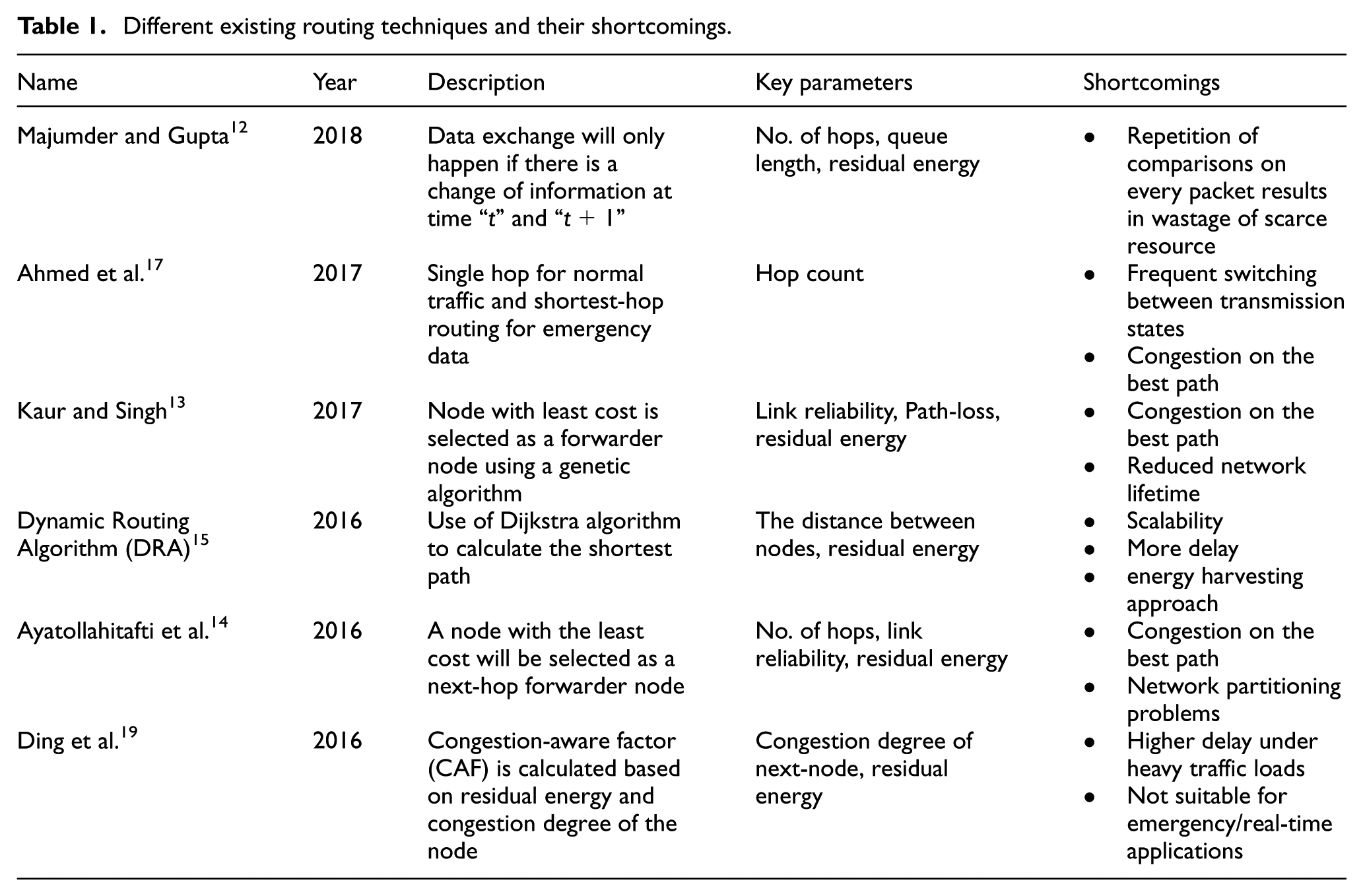
Although BAN is under the umbrella of WSN, however, unique characteristics of the BAN does not allow the use of direct implication of WSN routing techniques. Rather, new techniques are to be developed or variants of existing techniques are required which consider the unique attributes of IoT-based WBANs. In literature, several routing techniques have been proposed for WBANs with different objectives; thermal-aware routing (routing data away from link hotspots), congestion control techniques, energy-aware routing techniques, and maximizing network lifespan for better efficiency. AB Majumder and S Gupta
12
use a number of hops, RE, and queue length on next-hop node parameters in their proposed work. The proposed protocol by Majumder and Gupta
12
only exchange measuring values whenever there is any difference between sensed values at time interval
On the other hand, N Kaur and S Singh
13
proposed Optimized Cost Effective and Energy Efficient Routing (OCER) protocol for routing decisions in WBANs. Routing decisions are formed based on link reliability, RE level, and path loss parameters. Every source node calculates the cost to each of the neighboring or forwarder node using the genetic algorithm (GA). The neighbor with least cost is selected as a next-hop node. The drawback associated with the proposed scheme by N. Kaur and S Singh is the decision of next-hop selection purely based on the RE of the forwarder node. This will shift network load on least cost path just like in shortest hop routing and result in network partitioning problems. As a result, latency increases, and network lifetime reduces. In comparison with our proposed method, NCL parameter will be considered to reduce the congestion on best path and ensure efficient resource utilization. V Ayatollahitafti et al.
14
proposed an efficient next-hop selection algorithm for multi-hop WBANs. The parameters used in the selection of next-hop node are the minimum hops to the sink node, link reliability, neighbor node queue length, and RE. Queue length and link reliability are used to ensure QoS parameters while minimum number of hops was employed to help in energy optimization. Authors in Li et al.
15
have used the Dijkstra algorithm to select shortest path to all nodes within the network using RE and distance to the sink. Once the energy level of any relay node in the forwarding path falls below the threshold, it will stop forwarding and broadcast to choose another path. Dijkstra algorithm is not very scalable because the complexity of the algorithm is proportional to
G Ahmed et al. 17 proposed Priority-Based Energy-Efficient Routing Algorithm (PERA) for WBANs. Normal data are sent using shortest-hop routing and emergency data are directly sent to the sink. The authors assign the highest priority to emergency data, medium level priority to on-demand data, and the lowest priority to normal data. Shortest-hop routing causes congestion on best path, whereas frequent switching between transmissions states may result in wasting of energy scarce resource. Annur et al. 18 use tree algorithm with priority-aware routing in WBAN. The proposed method dedicates a channel for emergency data. Normal data are delayed until successful delivery of emergency data. However, channel reservation results are a waste of limited bandwidth resource and result in starvation for normal data. We will use the same path for emergency and normal data traffic. The only difference is that a priority label is attached with priority data just like the ambulance passes from the same path but with an emergency alarm sound so that all other vehicles clear it path. In the same manner, the emergency data will travel from the same path but with an emergency label so that it gets less delay and higher throughput over normal data.
A network queuing model equivalent to the physical model represented by G (E, V) where E is a node and V is the link between two neighboring nodes is proposed in Ding et al. 19 Authors categorized the traffic on a node into three different types; traffic generated by the node, relayed traffic received, and traffic generated due retransmissions. A congestion-aware factor (CAF) is calculated based on RE and congestion degree of the node. The proposed routing algorithm works on link gradient and traffic radius basis. Link gradient is calculated using node location, and traffic radius is calculated on packet service rate and congestion degree. The protocol has shown higher delay under heavy traffic loads that is a flaw for life-critical time constraint monitoring applications of healthcare.
Another Energy-aware and Stable Routing (ESR) is proposed to achieve the objective of energy optimization and QoS parameters. 20 These parameters are measured by absolute measurement of received signal strength indicator (RSSI) and using multi-agent reinforcement-learning algorithm. Delay is increased due to data aggregation, processing and sending by the forwarder to the sink. Also, a large number of broadcast packets involved will consume more energy as well as waste more scarce resources.
A Ahmad et al. 21 proposed Energy-Efficient Routing Protocol (RE-ATTEMPT) for WBANs. The working principle of the scheme protocol is based on shortest hop routing for normal data and single-hop for emergency data. Also, the concept of relay nodes is introduced for data aggregation. The relay nodes increase the delay as well as the hardware cost of the network. A master and slave base approach is adopted in Nadeem et al. 22 where the sink is the master node and all other nodes are slaves. In each round, a new forwarder node is selected by the sink based on RE and distance to the sink. The shortcomings of proposed protocol are an increase in delay and wastage of bandwidth resources and energy scarce resource. Table 1 summarizes the above discussed routing techniques and their shortcomings.
Different existing routing techniques and their shortcomings.
Proposed model
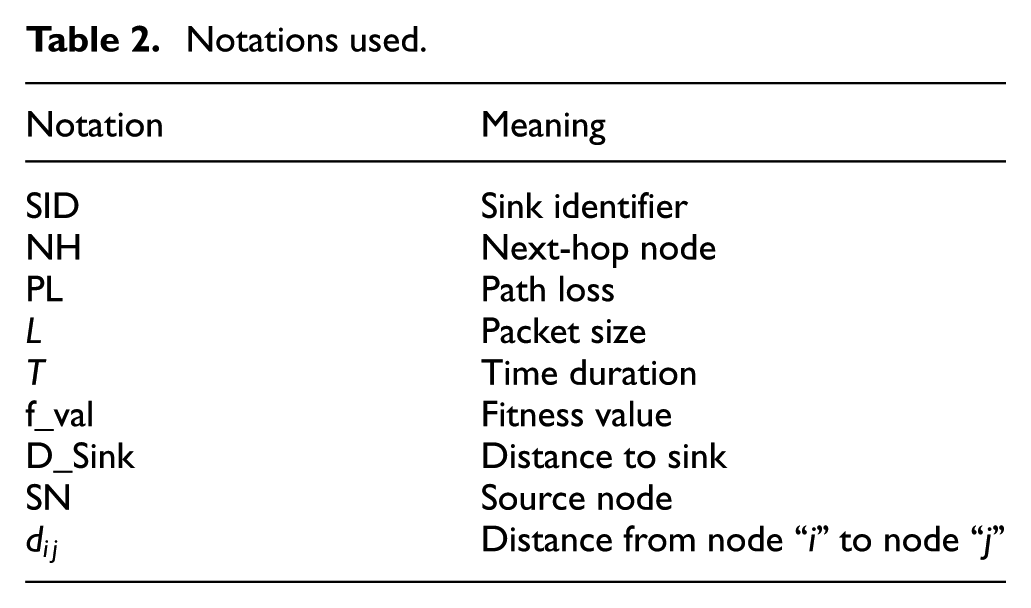
In this work, we proposed the PCRP network communication model for WBANs. The objective is to reduce the computational complexity and routing overhead among the sensor nodes deployed for sensing various vital signals. PCRP is a multi-hop routing protocol based upon hop-by-hop routing. A next-hop node with a least cost is selected using RE, SNR, and NCL parameters. The RE and NCL parameters are shared among sensor nodes through periodic exchange of hello messages, whereas SNR parameter is calculated by the source node itself. Every sensor node selects the next-hop node using least cost function and transmits the sense data to the selected next-hop node. The same process continuous until the sensed data reaches the destination, that is, Sink node. Table 2 shows the basic notations used in the proposed model. The explained steps of the proposed model are described below.
Notations used.
Setup phase
In our routing model, sink is placed at the center of the human body. Rest eight sensor nodes are statically deployed in a two-to-three-meter body area. All the sensors have equal communication and power capabilities. It is also assumed that all sensor nodes have fixed positions and transmission range regardless of body or moving organs of patients. Sensor nodes are connected through the wireless medium and send their data to central node sink. Sink acts as a central hub node and all the communication to the outside world happen through the sink node. Any node in our proposed model is at maximum two hops away from sink node as per network topology of IEEE 802.15.6:2012 1 standard. Table 3 shows the location of body sensors in case of 8 nodes on patient’s body
Location of sensors on patient body. 23

In sensor deployment, only x and y coordinates are considered. The reason is that we are using two dimensions for the calculation sensor relative position using equation (1). Whenever there is a change in the position of any sensor node, the change in the z-axis will be very minor and after applying the above equation it will result in zero. Considering this, we do not include z-axis for the sensor deployment. Table 4 shows the location of body sensors in case of 12 nodes on patient’s body.
Location of sensors on patient body.

Initialization phase
At the start of the network, the sink will broadcast a short information packet that contains its ID and location information. Every sensor node will save the location information of sink. Later, every sensor node will send hello packets that will contain its ID, location information, RE level, and NCL.
Select transmission power
Transmit power of each node will be selected by calculating the distance from the source node to farthest next-hop node (closest to sink). The distance between sender and receiver node is calculated using the equation as follows

where i, j are the node numbers, and d is the distance between the nodes. The strength of transmit signal should be fair enough such that it can be interpreted by the farthest node if it is selected as a next-hop. Transmission power is calculated using the transmission equation

where
Path loss model
As the electromagnetic signal travels from the source to the destination it will attenuate, that is, it loses power. The amount of power that we lose during traveling depends on distance and some other factors. 24 The loss that we will consider in our model is the attenuation because of the distance the electromagnetic waves travel through the medium. In wireless sensor networks, body moving parts and clothes also affect the transmitted power. The basic mathematical model to relate the distance and frequency is given by the equation

where PL is the path loss, d is the distance between transmitter and receiver,

Where f is the frequency and c is the speed of light.
Energy model
Energy plays a key role in network operation of WBANs. Sensor nodes in BANs are equipped with a standard battery which is the only source of energy. The battery not only provides energy resource to the node but also influences node weight and size. The standard formula to calculate energy consumption in terms of voltage, current and time is given by the following equation

where
Sensing energy
A sensor measures certain parameters in/on the human body. The energy consumed during the sensing process is called sensing energy. Considering “V” is the constant supply voltage, ISENS is the current drawn during the sensing process, and “T” the time consumed during the sensing process then the energy consumed for sensing “L” bit packet is calculated as follows

A sensor node senses the changing parameters for certain active time period denoted with

The active period in our work is assumed to be 1 ms and sleep period is 299 ms.
Processing energy
In our model, the energy consumed for processing is the sum of energy consumption for processing and data aggregation. Energy consumed by the sensor node during the processing/aggregation process for the “L” size packet is calculated by the following equation

where
Transmission and reception energy
Communication is the major cause of energy consumption in WBANs. The energy consumed in communication is the sum of energy consumed during transmission and reception. The energy required for sending an “L” bit packet from one node to another node in is given by the following equation

Similarly, energy used during reception is shown as follows

where
After taking into account the path loss coefficient “n” for WBANs, the above equation can be re-written as follows

Energy consumed
It is the total sum of energy consumption in all different sensor states. So, energy consumed is given by the following equation

RE
It is the remaining energy in the node after subtracting energy consumed during the network operation from the initial energy at the start of the network. The equation for calculating the RE is as follows

NCL
Congestion occurs when the offered data rate exceeds the available capacity at any point in the network. It not only affects QoS parameters but also has a profound impact on scarce energy resources. It increases packet loss ratio and reduces overall throughput of the network. There are two types of congestion in wireless sensor networks; node-level congestion (buffer overflow) and link-level congestion. 26 In our work, we are only considering the node-level congestion. The reason is the use of SNR for path selection that results in the selection of the better link. In node-level congestion, the data packet arrival rate is higher than the data packet service rate and it mostly occurs at sensors closer to the sink. It increases the packet loss and more energy consumption in the network. As a result, it has a direct impact on network lifetime and availability. Congestion on a node can be calculated by following formula

where
SNR
SNR is the value of desired signal level to that of noise signal at the receiver antenna. WBAN may interact with other technologies like Bluetooth, ZigBee, Wireless Personal Area Network (WPAN), Wireless Local Area Network (WLAN), cellular and other surveillance systems. These adjacent technologies may interfere with WBAN and reduce the signal strength at the receiver. The basic equation to calculate SNR is as follows

where
Calculation of fitness function
In this step, each node will call fitness function to select next-hop in its transmission range. The fitness function will be called based upon the packet type in the transmission queue. For normal packet, fitness function will be calculated using three parameters named RE, a congestion level on forwarder node, and SNR with the following equation

where FV is the fitness value for node “j,” NCL is node congestion level, RE is RE, and SNR is signal-to-noise ratio from node “i” to node “j,” and w1, w2, and w3 are parameters weights, respectively. The values of the weights are subject to

where w1 = 0.4, w2 = 0.4, and w3 = 0.2.
The values of parameters are normalized using the min-max normalization by using the formula

where min and max are the minimum and maximum values of x given in its range

where SNR_Nij is the value of SNR after normalization, RE_Njisthe value of RE after normalization, and NCL_Nj is the value of NCL after normalization. The value of SNR may vary from a minimum of 0 dB to a maximum of 20 dB.27,28 The value of RE may vary from minimum of 0 to maximum 10,700 mJ, and the value of NCL may vary from a minimum of 0 packets to a maximum of 20 packets. 29
The value of FV will vary between 0 and 1. The value of 0 means node is not suitable as next-hop node and the value of 1 means the node is best suitable among next-hop nodes. The choice of weights is application specific of WBAN. In some applications, energy parameter may be more important than any other parameters and the value of its weights may be adjusted accordingly. The weights are used to adjust the parameters influence in the fitness function calculation. In literature, two types of approaches have been adopted for the calculation of weights. One is the static weights assignments and the other is through iterative process of AI techniques. 28 In AI techniques, a search space of multiple solutions of the problem is created. Each solution contains all possible nodes that can be elected as a next-hop forwarder node. Numbers of solutions are selected from search space according to population size.
As per IEEE standard 802.15.6, 255 nodes are possible per network. Excluding the source and sink node, 253 next-hop selection nodes are possible that is a very large population size for a scarce resource WBAN. The use of any AI technique is very computationally expensive and is not a feasible choice to run on any sensor node. Another reason is that the WBAN is used to monitor patients. The life-critical data packets require high priority, less delay and error-free delivery within defined time limits. The AI technique may take several minutes and in some cases hours to converge and is not a suitable choice for life-critical WBANs. So considering the above, we adopted the static weight assignment and the value of weights is taken as stated in Majumder and Gupta. 12
Fitness function for life-critical data is calculated as follows

Subject to

Where w1 = 0.5 and w2 = 0.5.
The values of parameters are normalized using the min–max normalization by using the formula

Where min and max are the minimum and maximum values of x given in its range

Where RE_Nj is the value of RE after normalization, and NCL_Nj is the value of NCL after normalization. The value of SNR may vary from a minimum of 0 dB to a maximum of 20 dB and the value of RE may vary from minimum 0 to maximum 10,700 mJ. Now the normalized fitness function will be

The value of FV will vary between 0 and 1. The value of 0 means node is not suitable as next-hop node, and the value of 1 means the node is best suitable among next-hop nodes.
In case of life-critical data, the NCL parameter is excluded from the computation of fitness function. The reason is to reduce the computation complexity and timely delivery of critical data. The calculation of fitness function on every sensor node consumes scare resources as well as increases delay. Another reason is that a priority number is attached with every packet that has life-critical data. The packet with a high priority number will get higher priority throughout the path.
Routing phase
Communication will happen on a hop-by-hop basis using multi-hop communication. The node with the greater fitness value among the neighbor nodes will be selected as a forwarder node toward the sink. The next-hop node will be selected based upon the packet type in the transmission queue. For normal data traffic, sensor continuously senses data but send data periodically. This method will only be used on those sensors that are not very critical for patient life. For example, blood pressure sensor will continuously sense the data but will send data to sink after a specific time interval called data aggregation time interval. The sensor will store all packets in its buffer space during this time interval. This process is called data aggregation. Figure 2 shows the routing steps in PCRP.
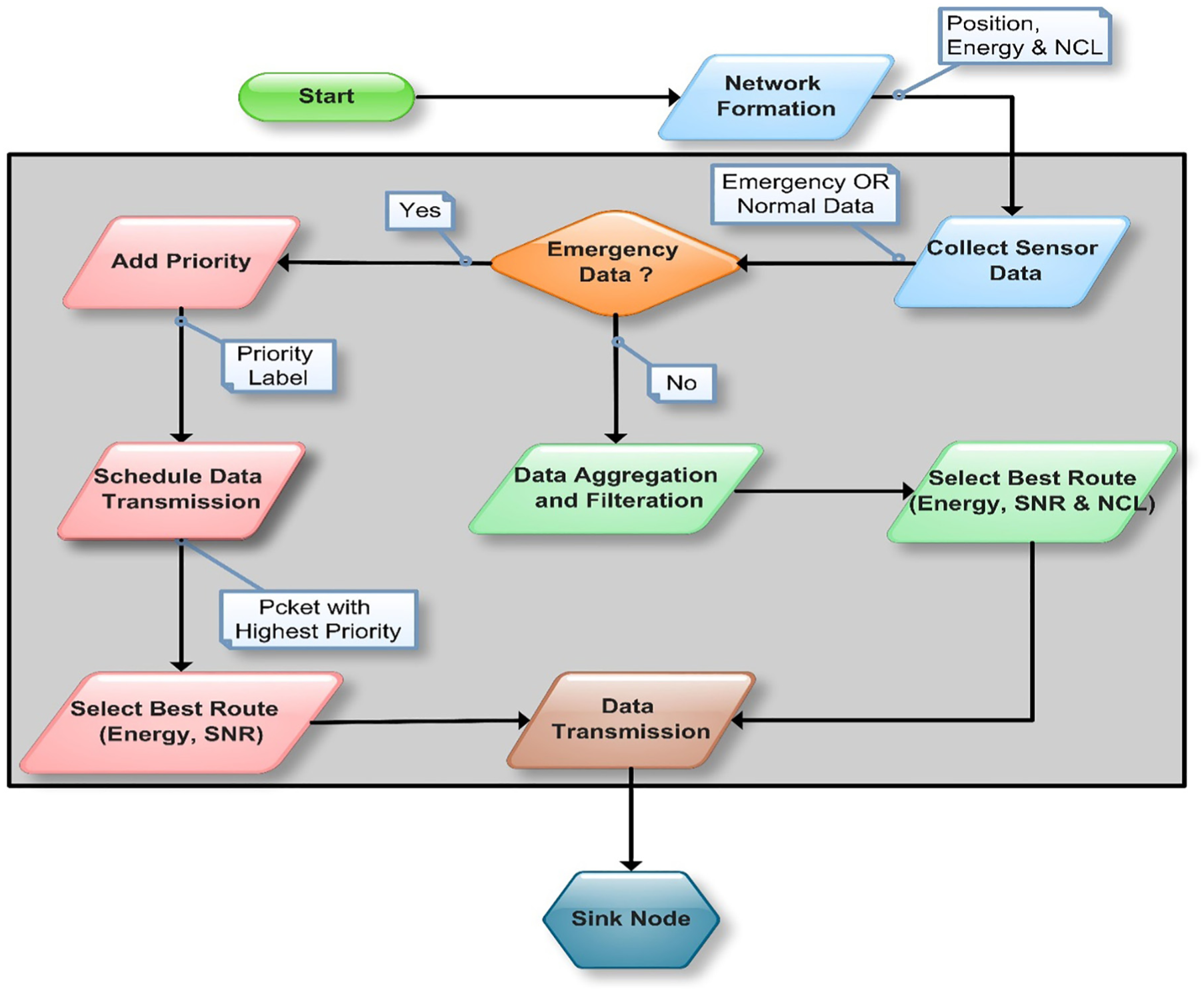
Flow diagram of routing phase in PCRP.
If any data packet comes with an emergency during this time interval, the packet will not be aggregated. Rather, the data packet will be labeled with a priority number and will be routed through the emergency path. After the expiry of the data aggregation time interval, sensor will process all stored packets and filters the lowest, highest and average value data packet. This process is called filtration. The sensor will only send these three filtered packets to the sink. Data aggregation and filtration processes will reduce individual sensor energy consumption, network traffic load, and enhance network lifetime.
For normal data packet, the next-hop with a maximum fitness value will be selected using the equation (16). For emergency data, a priority number is attached to the data packet based on its importance to patient life, that is, higher the number higher will be the data packet priority.
Every sensor node will maintain multiple queues for different priority packets. Sensor node will schedule data based upon its priority level. For emergency data, the next-hop node with a maximum fitness value will be selected using equation (18). The detailed algorithm of the PCRP for routing data is as follows
Priority-aware Routing Protocol using Congestion-free for WBAN.

If two packets have same priority level, then the packets will be scheduled based on first come first serve basis. After the execution of the above algorithm, a fitness value will be returned. The calculation of the next-hop node will be based on the returned fitness value. After the execution of the above algorithm a fitness value will be returned. The calculation of the next-hop node will be based on the returned fitness value. The algorithm to find the next-hop forwarder node is as follows
Next-hopSortedfunction.

Computation complexity for PCRP
The computation complexity of AI-based techniques is always more complex and time consuming as compared with the simpler presented routing protocol PCRP. AI-based techniques starts with a local best and searches the entire solution space for global best. The proposed algorithm is very simple, and has very low computational complexity as compared with other AI proposed routing techniques. The computation cost for the proposed work is calculated as follows.
Computation cost for fitness function
Fitness function calculates and returns cost fitness for every “n” nodes. Constant time “c” is required to calculate fitness of “n” nodes.
Time consumed for computing fitness for “n” nodes = n×c∈O (n).
Complexity for Next-hopSortedfunction
This function takes fitness value of “n” nodes as input and returns NH at output. Time complexity for the best case is when all nodes are located much close to each and have direct connectivity with all nodes. On average, it divides the network into two portions, that is, half number of nodes lie in the transmission range because any node as per IEEE standard can be two hops away from the sink node. In the worst case, when no node lies in the transmission range of any other node, it produces “n” number of next-hop nodes.
Body of the While loop in Next-hopSortedfunction function can run: (n– 1) ∈O (n)
Time complexity for While loop:
Best case O (n) × 1 ∈ O (n)
Average case O (n) × k/2 ∈ O (kn)
Worst case O (n) × n ∈ O (n2)
Total computation time for complexity of PRCP
T(PRCP) = T(fitness function) + T(k-Next-hopSortedfunction)
Best caseT(PCRP) = O (n) + O (n) ∈ O (n)
Average caseT(PCRP) = O (n) + O (k/2)n)) ∈O (kn)
Worst caseT(PCRP) = O (n) + O (n2) ∈ O (n2)
Experimental results and discussion
In this section, a performance comparison is presented for three different routing techniques: iM-SIMPLE, OCER and PCRP. The time taken for comparison in all three algorithms is in the number of rounds. One round is the unit time in which every sensor node sense one data packet, select the next-hop forwarder node, and then transmit the sensed data to the next-hop forwarder node. For the calculation of network stability and energy consumption, the round number in case of first node and last node died is shown. Similarly, for other metrics, we only use the round numbers. Parameters used for experiments are shown in Table 5.
Simulation Parameters.

The working principle of iM-SIMPLE is based on master and slave topology. All nodes first calculate their RE and distance to sink in each round. The values of two parameters are further communicated to the sink node. In each round, a new forwarder node is elected by the sink node based on the RE and distance to the sink node. All nodes send their data to the forwarder node and then collect, aggregate and then communicate the processed data to the sink node. A large number of broadcasts are noted in each round from both sides, that is, from sensor nodes to sink and from sink to sensor nodes.
OCER works based on the shortest-hop routing. Communication is based on the multi-hop approach. A link cost function is used to select a next-hop node. The calculation of link cost function is based on link reliability, RE, and path loss. The GA is used for the calculation of parameter proportional weights. The shortest-hop routing results in congestion on shortest path toward the destination sink node. Furthermore, the use of AI technique of GA for is life-critical.
WBAN is not a suitable choice. Although the results of AI techniques are better, but it consumes a lot of resources and also takes much time for result calculation. This results in delay and also wastage of scarce resources. As a result, it is not suitable for WBANs.
In addition, some differences among the PCRP, iM-SIMPLE, and OCER are as follows
iM-SIMPLE considers the mobility of hands, whereas PCRP considers all nodes as static;
OCER works for all types of WBAN communications including the external system, whereas PCRP only works for intra-body communication
For the comparative analysis, we do not include the mobility part of iM-SIMPLE, and second, we only consider the intra-body communication part of OCER. The metrics used for performance evaluation of the three protocols are node lifetime, network energy consumption, network traffic load, and throughput and delay for emergency data. Numbers of experiments were carried out in MATLAB using a different number of nodes and transmit power levels. In our simulation setup, rate of occurrence of normal and emergency data is dependent upon the number of nodes. In case of 8 nodes, 4 nodes generate normal data, and rest 4 remaining nodes randomly generate emergency data. So, the probability of normal data is 50%, whereas the probability of emergency data varies between 0% and 50%. In case of 12 nodes, same ratio exists where 6 nodes generate normal data, and rest 6 nodes randomly generate emergency data. Furthermore, 20 experiments were conducted in each case, and the average results of these experiments are shown on the result graphs.
RE
The accumulative sum of all nodes’ initial energy minus energy consumed during network operation at any point in time is the RE of the network. It is directly proportional to the network lifetime. The remaining energy after each round is present in Figure 3. The RE of PCRP is more than OCER and iM-SIMPLE after each round. The reason is the use of RE parameter in the selection of forwarder node that balances the energy consumption in the network. Another factor is the use of path loss parameter for optimal transmission range selection has an indirect effect on energy consumption. Lower transmission range requires less transmit power, thereby consuming less amount of energy. The use of SNR parameter helps in better selection of path from the sender to forwarder node. Path with least path loss is selected from the sender to forwarder node and results in less wastage of energy supply. Increase in number of nodes, for example, from 8 to 12 nodes results in less energy consumption and longer network lifetime. The reason is that accumulated sum of 12 nodes initial energy is larger than the 8 nodes. So, it will sustain for longer period and network lifetime increases as depicted from figures.

Network energy consumption: (a) results of energy consumption with 8 nodes and (b) results of energy consumption with 12 nodes.
Network traffic load
A total number of packets sent in each round. It represents the network load at a particular instance of time. A number of rounds VS Total number of packets sent is shown in Figure 4 with different number of source nodes. The results show that PCRP has lower network traffic load as compared to iM-SIMPLE and OCER at any round during network lifespan. The reason is that the PCRP is using aggregation and filtration process for normal data traffic. PCRP does not send every data packet rather it buffers normal packets and sends only three filtered packets. As a result, the total number of packets sent by PCRP at any point in time is smaller than the other two competitor routing protocol. This reduces the network traffic and helps in efficient scarce resource utilization. It is also clear from the figures that the network traffic increases with the number of nodes.

Network traffic load: (a) result using 8 nodes with different techniques and (b) results using 12 nodes with different techniques.
Network stability
Time elapsed from the start of the network till the first node die is the stability period of the network. Figure 5 illustrates that the stability period of PCRP is more than OCER and iM-SIMPLE. The reason is the use of RE parameter in the selection of next-hop forwarder node. RE parameter ensures a balanced use of energy consumption and enhances the node lifetime. The use of NCL parameter by the PCRP protocol reduces the network traffic load on an individual node and balances the load across the whole network. As a result, network stability and lifespan increase. Increase in number of nodes also increases network lifespan as shown by the graphs.

Network Stability.
Network lifetime
It is the total operational life of the network from the start of the network till the death of last node. Figure 6 shows the average life time of the PCRP as compared with iM-SIMPLE and OCER. It is clear from the figure that the proposed protocol performs for longer periods of time as compared with the other two. The reason is the use of data aggregation and filtration process that reduces the energy consumption. Aggregation technique reduces the number of packets transmitted and saves the energy required for packet transmission. The second factor is the use of NCL parameter that helps in load balancing the network traffic and enhances overall network operational life.
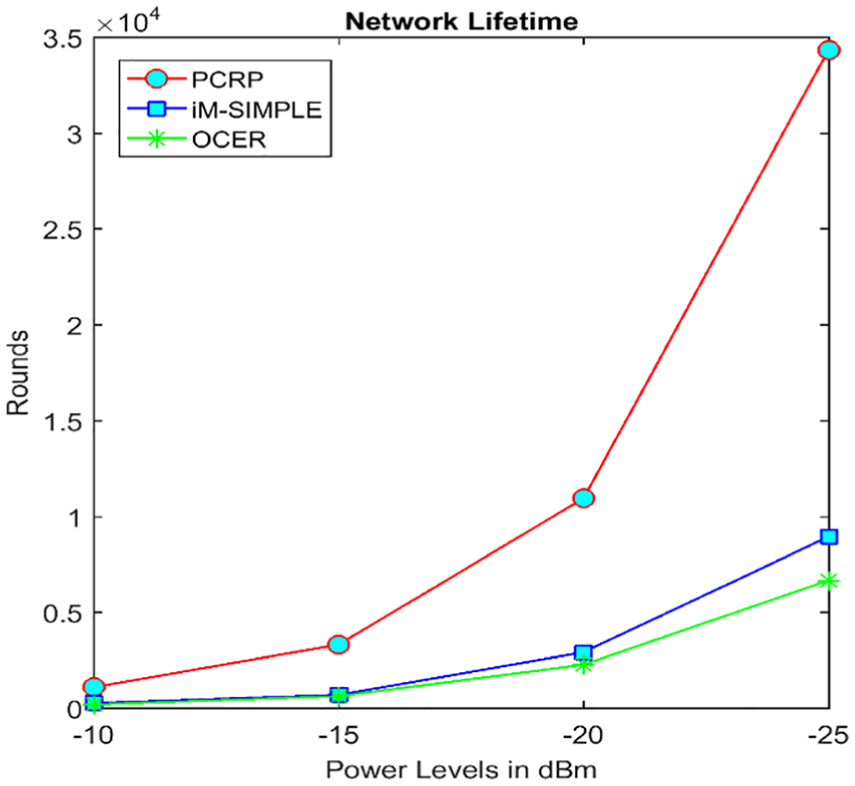
Network Lifetime.
Throughput
It is the total number of packets successfully received at the sink. A WBAN has a patient life-critical data, so it requires a protocol that has maximum throughput and minimum packet loss. In PCRP, we classify the data packets into emergency and normal data packets based on the packet priority to human life. Emergency packets have higher throughput than the normal data packets as shown in Figure 7. The reason is the use of the emergency label for packet prioritization. The emergency packet will get higher priority and less computational overhead in the next-hop selection. As a result, the throughput is higher than the normal data packet.

Throughput.
Delay
It is the total time taken by the packet to move from the source node to the destination sink node. Emergency data require error-free delivery within defined periods of time so delay is an important parameter for emergency situations. It is accumulative sum of the time spent by the packet in queuing delay, processing delay, transmission delay, and propagation delay. Figure 8(a) shows the comparison of PCRP delay for normal, less emergency, and emergency data packets. The delay for emergency data packets is less than the both other type of data packets. The reason is because of priority given in the scheduling of data packets. High-priority data packet is scheduled before the less emergency data packet and less emergency data packet is scheduled before the normal data packet. As a result, the delay for emergency data packet is less than other types of data packets. Figure 8(b) shows the comparative analysis of PCRP delay with OCER and iM-SIMPLE. The reason is the use of emergency label with life-critical data. As a result, the emergency data gets less delay and higher throughput. The delay in case of normal data is very much higher than the OCER and a little bit difference to iM-SIMPLE. For normal data packets, OCER does not use any aggregation technique so it has lower delay from the other two routing protocols. PCRP and iM-SIMPLE small difference of delay.

Average end to end packet delay vs number of nodes: (a) in case of normal and emergency data and (b) in case of normal, less emergency, and emergency data.
Conclusion
In the current work, we proposed PCRP routing model using IoT based sensors for efficient selection of next-hop forwarder node in WBANs. Longer network lifetime and efficient emergency data delivery within defined time constraints are the two fundamental requirements for smooth functioning of WBANs. A priority number is attached with every data packet based on its significance to patient life. Emergency data packets are scheduled before the normal data packets throughout packet traveling path. Furthermore, we have maintained multiple queues on every sensor node to reduce delay for priority data packets. As a result, the waiting time in processing and transmission queues for emergency data packets is reduced. Even in case the critical data packet has passed on a congested path, it has been scheduled before all other packets and our proposed method has ensured timely delivery.
We evaluated our results with two cutting-edge routing techniques: OCER and iM-SIMPLE. The results showed that the proposed protocol outperforms with the other two routing techniques in terms of network lifetime, stability, traffic load, throughput, and delay. The reason was that the use of data aggregation and filtration processes reduced the processing and number of transmitted packets to a large extent. As a result, energy consumption of every sensor node reduced and network stability increased. In future, we will devise a routing protocol that considers the mobility of sensor nodes due to body movement.
Footnotes
Handling Editor: Suleman Khan
Author’s Note
Author Asim Zeb is now affiliated with Department of Information Technology Abbottabad University of Science and Technology, Pakistan. Author Ali Safaa Sadiq is also affiliated with School of Mathematics and Computer Science, University of Wolverhampton, UK.
Declaration of conflicting interests
The author(s) declared no potential conflicts of interest with respect to the research, authorship, and/or publication of this article.
Funding
The author(s) received no financial support for the research, authorship, and/or publication of this article.
