




Abstract
Wireless communication and power line communication are extensively applied in various fields, such as household Internet of things. For cooperative communication of amplify–forward relay using wireless access and power line transmission, the hybrid model of universal Nakagami wireless fading and lognormal power line fading was used in this study. A comparative analysis of similarities between Gamma and lognormal distributions and lognormal distribution characteristics of relay link signal-to-noise ratio was also carried out. Given the deficiencies of lognormal variable add approximation method, lognormal distribution parameters combined computing method based on moment generation function was proposed. Theoretical formulas of outage probability and bit error rate after amplify–forward relay and maximal-ratio combining was derived on the basis of moment generation function of the total output signal-to-noise ratio of the system. Effectiveness and reliability of the algorithm and theoretical formula were verified through simulation, and influence rules of hybrid channel fading and power distribution on the system performance were analyzed.
Keywords
Introduction
Power line communication (PLC) and wireless communication are widely applied in various fields, such as smart power grid and household Internet of things (IoT).1–5 Although wireless communication can realize mobile access, a radio frequency signal of 2.4 GHz can be easily affected by obstacles with great signal attenuation. Taking household IoT as an example, in rooms far from the router, people often find that the signal strength of WLAN is relatively weak, thus a usage of PLC and wireless hybrid network may increase the coverage area and reliability of the access network. Power line and wireless cooperative communication technology2–5 can integrate advantageous resources and save construction cost. Using diversity combining technologies, such as dual-media parallel communication,2–4 maximal-ratio combining (MRC), 3 and dual-hop hybrid relay, 5 can improve the remote and reliable communication ability of the system.
The power line channel in the studies by Lee and Kim 2 and Lai and Messier 3 was a deterministic compound fading channel coefficient without consideration of the influence of time-domain impulse noise during the diversity combining process. The power line channel was modeled into a fading model presenting lognormal (LogN) distribution in a recent study.4–7 In the study by Chen et al., 4 the reliability of the indoor wireless and power line dual-media hybrid communication system was investigated after the use of amplify–forward (AF)/decode–forward (DF) relay and selective combining (SC). Influence rules of channel fading and power distribution on the system performance were also analyzed. However, this work was inapplicable to other fading scenes, such as outdoor wireless communication (e.g. Nakagami fading). In the study by Qian et al., 5 theoretical formulas, such as system capacity and outage probability, were obtained for double communication interface system models of power line and wireless with AF relay in the IoT scene. Dubey and Mallik 6 analyzed the performance of the PLC system when using AF relay under LogN fading and impulse noise conditions, but they ignored the cooperation of wireless communication. Studying theoretical expressions of Nakagami–LogN hybrid fading and dual-media cooperative communication system performance under impulse noise conditions is theoretically important in the universal wireless communication scene. Mathur et al.7,8 studied the performance of wireless Nakagami fading and power line LogN fading two-hop relay system under DF relay and SC conditions. However, the influence of direct link was ignored in the studies by Mathur et al.,7,8 and Bernoulli secondary noise model was adopted for the power line, which was not as comprehensive and objective as the Mid-A impulse noise model. 4
The AF protocol and MRC technology have favorable performance and are sensitive to channel parameter change. This study comprehensively analyzed the performance restriction mechanism of hybrid fading and impulse noise by investigating the performance of the AF relay and MRC combination-based dual-media cooperative relay system, which is different from DF relay and SC technology specified in the studies by Mathur et al.7,8 The influence of wireless direct link was also considered. Some research contents will involve signal processing under LogN–LogN fading, but MRC will be used for signal combining, which is also different from the research method in the studies by Chen et al. 4 and Qian et al. 5
The innovative contributions of this study are summarized as follows.
Similarities between two probability density functions (PDFs) of Gamma to LogN and LogN distribution characteristics of relay link signal-to-noise ratio (SNR) were verified through physical and numerical simulation.
Two computing methods of system performance, namely, LogN variable add approximation method and moment generation function (MGF) equation set method, were proposed to address the lack of closed expression in the integration process of LogN hybrid fading.5,6
The first method equivalently transformed Gamma distribution of wireless SNR into LogN distribution and transformed the system performance computation under Nakagami–LogN hybrid fading into LogN variable add approximation computation problem under LogN–LogN fading. As a result, a computing method of the system performance based on LogN distribution parameter of system total SNR was obtained.
The second method used the combined computing method based on MGF equation set because LogN variable add approximation method needed multiple approximation computations with low accuracy. LogN distribution parameters of relay link SNR were solved through MGF equation set without transforming Gamma distribution of wireless SNR into LogN distribution. This method provided an analytical idea for the system performance based on MGF.
System model and signal processing
Figure 1 shows the three-node two-hop relay system model under wireless and power line dual-media cooperative communication used in this study. Mobile end S realizes wireless communication with relay node R and target node D, whereas relay R conducts PLC with node D. The system is under half-duplex mode. 8 Specifically, end S sends signal XS to nodes R and D at the transmitting power PS in the first time slot. In the second time slot, relay R forwards the received signal using the AF protocol to obtain the relay signal XR and then send it to node D at the power PR through the power line channel.
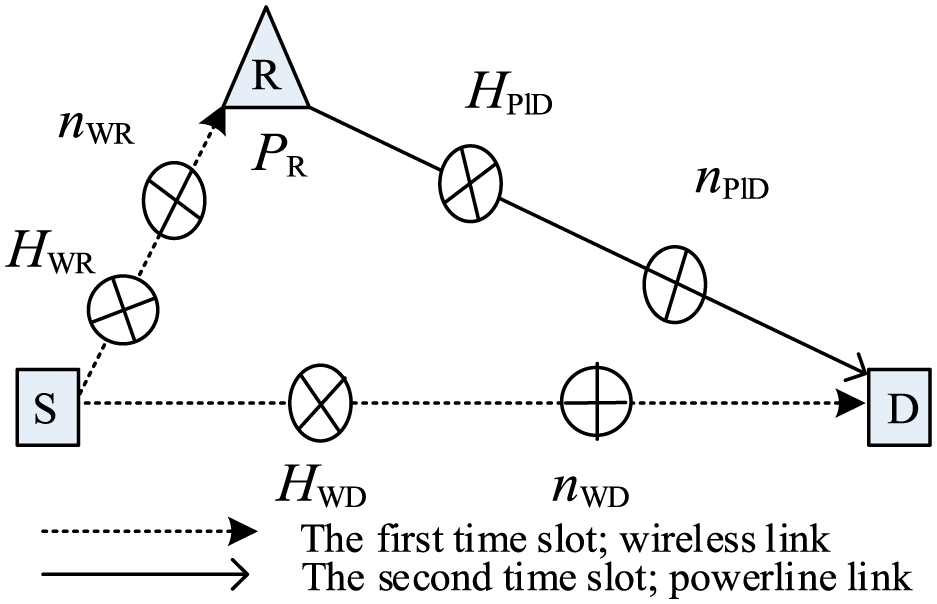
System model.
Figure 1 corresponds to the typical application scenario; that is, PLC cannot access wireless communications, high-band radio wave penetration ability is limited, and the fading is serious. Thus, the smart meter or the sensor (S) and the gateway D use wireless access (S→R) and PLC relay (R→D) hybrid cooperation to achieve wireless access and long-distance communication. PLC relay can overcome the influence of obstacles, such as walls, doors, and windows, make up for the defects of high-frequency signal fading in wireless communication.
In Figure 1, node D carries on a signal combination from the wireless and PLC link. The channels and standards of the links are different. For example, The PLC adopts IEEE 1901 standard and the wireless link uses IEEE 802.11n. The frequency bands of two links are unequable; however, the physical layer of both standards adopt orthogonal frequency division multiplexing (OFDM) modulation. After a radio frequency signal downconversion for wireless link, signal combining and noise reduction processing can be performed on the same baseband or intermediate frequency signal processing framework, thereby making dual-medium hybrid cooperation possible. 9 In order to investigate a performance analysis method over hybrid fading, we consider a similar modulation parameter and frame structure.
In the system model, three communication branches are affected by multiplicative fading and additive noise, where;
In wireless branches SR and SD in the first time slot, noises nWR and nWD satisfy normal distribution N (0, NW), wireless channel fading coefficient HWI satisfies Nakagami distribution, and I∈{D, R}. mI ≥ 0.5 is the Nakagami shape factor, and

Power line relay link RD in the second time slot and power line fading coefficient HPlD satisfy LogN distribution LogN(µPlD,
Power line channel noise nPlD is impulse noise, and Mid-A impulse noise model is adopted. The model consists of Gaussian background noise NG and impulse noise NI, and PDF of impulse noise amplitude z is

where Nk = N0(k/A+T)/(1+T) is the transient total noise power of the power line, T = NG/NI is the ratio of background noise power to impulse noise power, and N0 = NG+NI is the average total noise power. At concrete sampling time, impulse noise of the Mid-A model is formed through superposition of k Gaussian noises, and each noise model satisfies N (0, NI/A). The number k of pulses complies with Poisson distribution with the mean value denoted as A.
Average SNR of the power line branch is defined as ΔPl,k = PR/Nk. Under high SNR value (ΔPl,k >> 1, ΔW >> 1), transient SNR

After relay link RD and direct link SD are combined using MRC at node D, the total output SNR

The transient mutual information of the system is

Relay system performance analysis under dual-media cooperation
Theoretical formulas of the system under hybrid fading and impulse noise conditions were determined by analyzing the probability density distribution characteristics of transient SNRs of different branches and system total output SNR. Similarities between Gamma and LogN distributions were verified on the basis of PDF of various branches and system total SNRs (section “Characteristic analysis of probability density of SNR in the relay end-to-end link”). The receiving-end SNR of actual AF relay link complied with LogN distribution as obtained by the Monte Carlo simulation method.
A traditional performance analysis method, which was abbreviated as LogN variable add approximation algorithm, was proposed (section “System performance computation based on LogN variable add approximation method”). In this algorithm, Gamma distribution of wireless link SNR was approximated as LogN distribution, and the system performance analysis under Nakagami–LogN hybrid fading was transformed into analysis problem under LogN–LogN. Moreover, sum of LogN variables was used in computing system performance, such as outage probability, which also satisfied LogN distribution. An approximate calculation method for solving MGF equation set was proposed to further improve theoretical formulas of the system (section “MGFs of dual-variable harmonic means based on Gamma–LogN distribution and system performance computation”). MGF of receiving-end SNR was solved through reducing approximation times to calculate theoretical formulas of the system.
Characteristic analysis of probability density of SNR in the relay end-to-end link
Gamma and specific LogN distributions have high similarities under different parameter conditions.
12
Figure 2 shows the comparison curve between Gamma distribution corresponding to actual



Comparison chart of PDFs before and after the approximation (solid line: actual Gamma distribution; dotted line: approximated LogN distribution).
As shown in Figure 2, parameters obtained through secondary moment approximation are µR = –0.14 and
Sample data (106) of transient SNR

Comparison chart of PDFs of receiving-end SNR in the AF relay link (solid line: actual PDF curve of the SNR of the receiver; hybrid line: similar LogN distribution curve; dotted line: similar Gamma distribution curve).
System performance computation based on LogN variable add approximation method
In general, SNR
Secondary moment approximation method is used to approximate
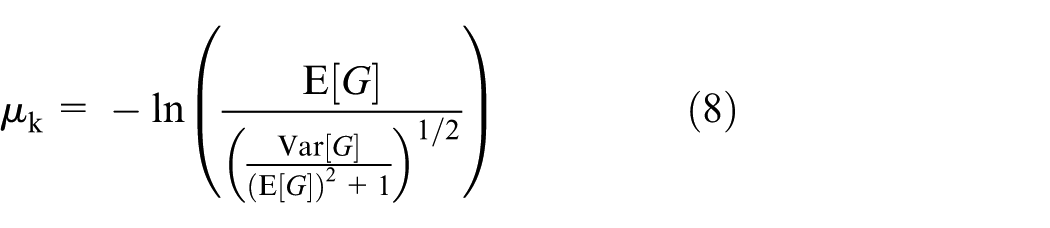
The LogN distribution properties indicate that SNRs

The sum of LogN variables also conforms to LogN distribution, that is,

where
Considering that
We set

where
Notably, the first method mainly provides the computing idea of LogN distribution parameters of the system total SNR. In accordance with the main algorithm steps, approximation from Gamma to LogN distribution and approximation of sum of LogN variables to LogN distribution should be carried out twice when this method is used to compute the system performance. The follow-up simulation indicates that this algorithm has low accuracy. Therefore, in consideration of influence factors on the accuracy, such as PDF parameter solving and approximation times, a system performance analysis algorithm featuring first-order approximate calculation based on MGF equation set was further proposed as the main contribution of this study.
MGFs of dual-variable harmonic means based on Gamma–LogN distribution and system performance computation
The approximation times were decreased, and the accuracy of the performance computation was improved by proposing a high-accuracy analysis algorithm based on first-order MGF parameter approximation by virtue of PDF distribution characteristics of the system total SNR in section “Characteristic analysis of probability density of SNR in the relay end-to-end link.” The main aim was to calculate MGFs of dual-variable harmonic means under Gamma and LogN distributions.
In general,

where
The analysis in section “System performance computation based on LogN variable add approximation method” indicates that


where wn and an are the weight and zero point of Gauss–Hermite formula.
MGF of the sum of two variables is equal to the product of MGFs of two variables. F(11) and F(12) show that MGF of

Substituting equation (13) into equation (14) yields

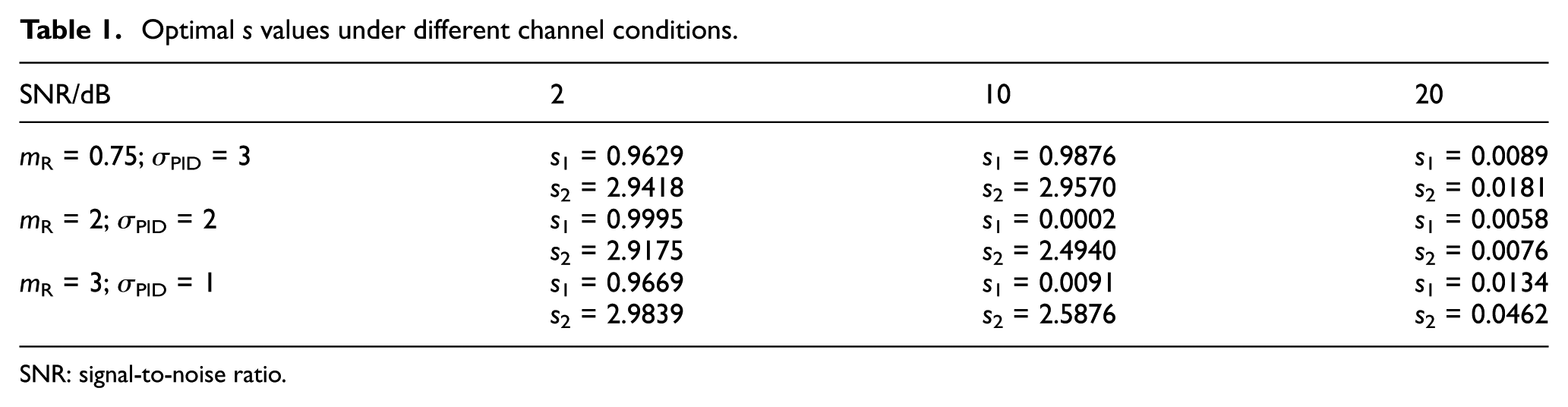
Two fixed values (s1 and s2) are selected. Under different channel fading conditions, selection of s value will be different.
13
When
The value of s in the abovementioned conclusion is obtained through a numerical experiment. In the actual application, numerical modeling is conducted with the minimum difference of generation function curves at two sides of equation (14), and optimal s1 and s2 combination is solved

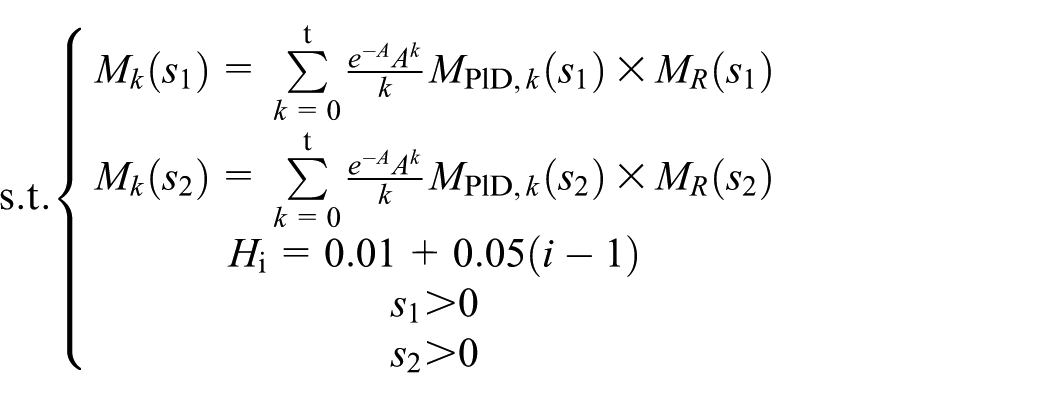
where Hi is the sampling value of MGF, M is the total number of sampling points (M = 1000 in this study), and t is the maximum number of impulse noises (t = 100 in this study).
This numerical model takes goodness of fit of MGF curves as the optimization goal to calculate absolute value of difference value between two MGFs corresponding to sampling value Hi of each s for weighing processing. This numerical model can use multiple groups of s values to seek for optimal s1 and s2 combination for solving. First, we can randomly generate a sufficient number of pairs of s (105) by simulation. Then, the pair of s with the minimum difference of MGF is selected and used to obtain the approximation parameters of LogN. The model can also be solved by a multiobjective optimization such as fgoalattain function of MATLAB. The aforementioned method can be used to establish a list of optimal s values under different SNRs and fading coefficients (Table 1).
Optimal s values under different channel conditions.
SNR: signal-to-noise ratio.
Evidently, this method is the only first-order PDF parameter approximate calculation in the second algorithm. SNR

In general, SNR of SD direct link is

On the basis of MGFs of SNRs

The MGF of
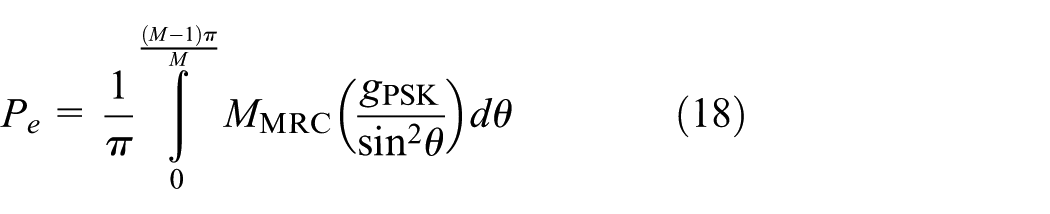
where

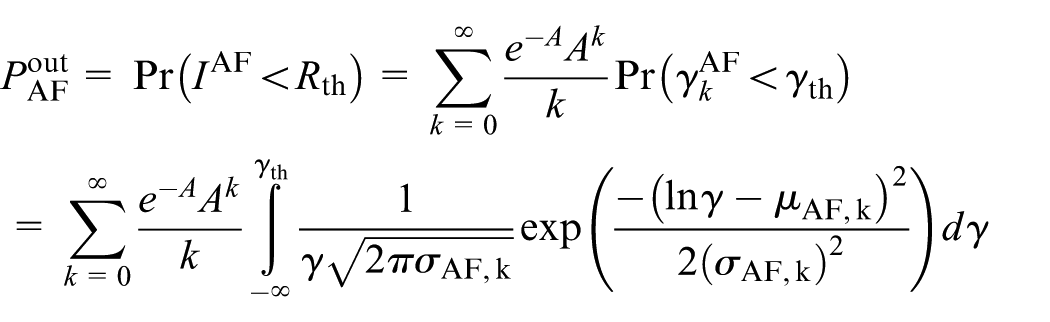
When the system information rate is smaller than the required minimum rate threshold γ0, normal communication of the system will be interrupted. The system outage probability

where

where
Simulation results
The accuracy of the theoretical formula was verified by Monte Carlo simulation experiment in MATLAB and by conducting a comparative analysis with theoretical expressions in the numerical simulation. Without loss of generality, parameters in the model shown in Figure 1 use the following default setting if no special instructions are necessary during the simulation and calculation process. After power normalization, the system total power is 2, PS = 1, and PR = 1. The influences of channel fading and noise distribution on the performance are highlighted under the assumption that average SNR of the system channel is SNR, namely, ΔPl,k = Δw = Δ. Parameters of impulse noise are set as A = 1 and T = 0.2, and the maximum value of k in the formula is Max_k = 100. Under different channel fading conditions, selection of s value will be slightly different. 13
Figures 4 and 5 show the PDF distribution diagram and cumulative distribution function (CDF) distribution diagram of simulation data of receiving-end SNR

Comparison of PDF approximation effects under different parameters: (a) mR = 2, σPlD = 2.8, and SNR = 8; (b) mR = 2, σPlD = 2.8, and SNR = 18; (c) mR = 3, σPlD = 2.1, and SNR = 8; and (d) mR = 3, σPlD = 2.1, and SNR = 18.

Comparison of CDF approximation effects under different parameters: (a) mR = 1.7, σPlD = 2.8, and SNR = 8; (b) mR = 1.7, σPlD = 2.8, and SNR = 18; (c) mR = 3, σPlD = 2.1, and SNR = 8; and (d) mR = 3, σPlD = 2.1, and SNR = 18.
The default parameter setting is adopted. Figures 6 and 7 compare outage probability and BER performances when MRC is used for the AF relay system under different channel fading parameters. mD value is set as 1 and mR value is greater than 1 in the simulation because direct link SD is not as good as channel conditions of close-range wireless link SR in actual application. The following conclusions can be obtained from the analysis: (1) MGF-based equation set approximate calculation has higher accuracy than LogN variable add approximation algorithm when approximation times are decreased and approximate calculation of MGF is adopted. The result is identical to the simulation performance. Therefore, the reliability of the theoretical formula is further verified. (2) mR value increases (i.e. wireless channel fading degree decreases), system outage probability and BER decrease under fixed SNR and power line channel parameter
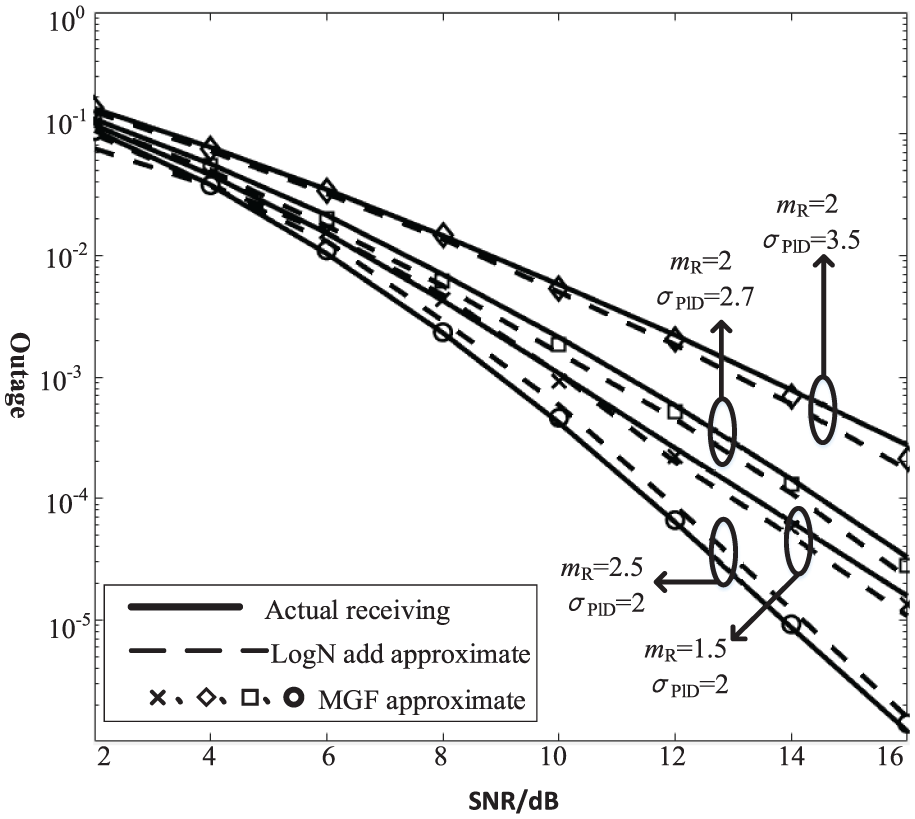
Outage probability performances under different channel parameters.

BER performance under different channel parameters.
Figure 8 shows the relationships of the system outage probability performance with fading parameters mR, σPlD, and SNR under default parameter setting. The figure shows that when mR and σPlD are unchanged, the increase in the system average SNR evidently improves the system reliability. When mR and SNR remain unchanged, fading of the power line branch becomes serious and the overall system performance becomes poor as power line fading coefficient σPlD increases. When σPlD and SNR are unchanged, wireless channel fading becomes negligible and the overall system performance enhances as the wireless fading coefficient mR increases. When SNR = 10 dB and σPlD increases from 0.01 dB to 5 dB, system outage probability increases from 10–4 to 10–2. When mR increases from 0.01 to 5 dB, system outage probability decreases from 10–1 to 10–3. Evidently, the system performance is highly sensitive to the change in parameter mR because parameter mR influences the fading degrees of two wireless branches SR and SD.

Relationship between theoretical outage probability performance and fading parameter mR/σPlD.
The channel fading energy is normalized to analyze the influence of unbalance of branch channels on the system performance. Figure 9 shows the schematic of the relationship of theoretical (Theo) and simulated (Simu) system performance with different relay transmitting powers PR when the total power remains unchanged. In the figure, Oute is system outage probability, and BER is system BER. SNR = 8 dB, SNR = 18 dB,

Relationship between system performance and transmitting power.
In dual-media hybrid cooperative communication, the optimal transmitting power distribution problem with minimum system performance as the target can be described using the following numerical model

where
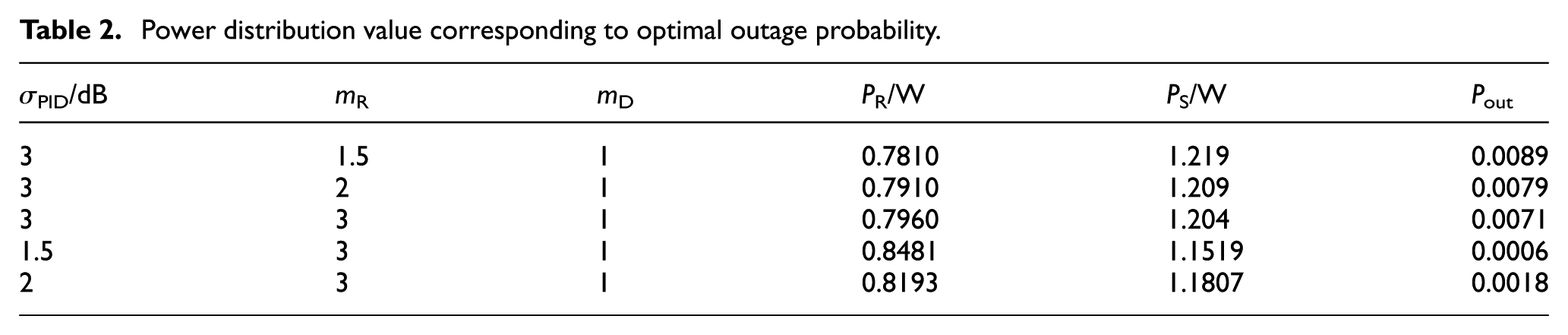
As shown in Figure 9, system outage probability performance is a continuous smooth curve as the transmitting power PR changes, and only an extreme point exists within the interval (0, 2). Therefore, outage probability and BER functions with transmitting power as the variable are continuously differentiable, and a global optimal solution exists. The solution obtained through numerical optimization algorithms, such as golden section, can be repeated. Accordingly, golden section and quadratic interpolation method are combined to solve the optimal power distribution coefficient. Golden section is used for global searching, whereas quadratic interpolation is used for refined searching. Tables 2 and 3 show the optimal power distribution parameters and corresponding outage probability and BER performance solved through golden section and quadratic interpolation methods. The proposed distribution algorithm can effectively optimize optimal power coefficient and has high accuracy.
Power distribution value corresponding to optimal outage probability.
Power distribution value corresponding to optimal bit error rate.

Tables 2 and 3 show that when power line fading coefficient remains the same (e.g. σPlD = 3 dB), wireless channel fading weakens as mR value increases. Thus, the power of PLC branch should be increased to obtain optimal system performance. When index mR of the wireless link is unchanged, wireless communication power should be increased to optimize the system performance as σPlD value increases (i.e. channel condition becomes poor).
Conclusion
Power line and wireless dual-media cooperative relay can improve the remote and reliable communication ability of the system. For the AF relay system under dual-media cooperation, hybrid channel fading and multidimensional impulse noise model based on Nakagami and LogN distribution was used in this study. A system performance analysis framework based on relay link LogN distribution hypothesis, and MGF calculation was established. MGF equation set approximation algorithm was used to solve LogN distribution parameters and obtain theoretical system performance. The results provide necessary theoretical support for the application of dual-media cooperative communication.
Subsequent studies can be extended to the usage of mixture LogN approximation in analysis. For example, the MGF equation approximation together with a mixture LogN of two elements can be used to derive the PDF parameters of the SNR at the receiving end of the AF transmission system, and the outage probability and BER of the system can be further derived with an improved accuracy. Besides, we can investigate a more general analysis method for the other hybrid fading system except the group of Nakagami and LogN in this article.
Footnotes
Handling Editor: Michel Kadoch
Declaration of conflicting interests
The author(s) declared no potential conflicts of interest with respect to the research, authorship, and/or publication of this article.
Funding
The author(s) disclosed receipt of the following financial support for the research, authorship, and/or publication of this article: The research was supported by the National Natural Science Foundation of China (Nos 61601182 and 61771195), Natural Science Foundation of Hebei Province (Nos F2017502059 and F2018502047), and Fundamental Research Funds for the Central Universities (No. 2019MS088).
