




Abstract
Being of high importance, real-time applications, such as online gaming, real-time video streaming, virtual reality, and remote-control drone and robots, introduce many challenges to the developers of wireless networks. Such applications pose strict requirements on the delay and packet loss ratio, and it is hardly possible to satisfy them in Wi-Fi networks that use random channel access. The article presents a novel approach to enable real-time communications by exploiting an additional radio. This approach was recently proposed by us in the IEEE 802.11 Working Group and attracted much attention. To evaluate its gain and to study how real-time traffic coexists with the usual one, a mathematical model is designed. The numerical results show that the proposed approach allows decreasing the losses and delays for the real-time traffic by orders of magnitude, while the throughput for the usual traffic is reduced insignificantly in comparison to existing networks.
Keywords
Introduction
Many applications that can be classified as real-time applications (RTAs) have been gaining momentum during the recent years. These applications include Internet video surveillance, Internet gaming applications, and virtual and augmented reality. According to Cisco forecasts, all the mentioned categories will increase their traffic approximately 10-fold from 2017 to 2022.
1
Such a demand for real-time services affects the activities of the telecommunication standardization bodies; for example, the IEEE 802 LAN/MAN Standards Committee considers RTA as a highly important use case for the next generation of Wi-Fi networks. Triggered by our proposal in November 2017,
2
in July 2018 the IEEE 802.11 Working Group created an RTA Topic Interest Group (TIG), which aims at determining and classification of the most essential RTAs for Wi-Fi networks; at formalizing their requirements in terms of data transmission delay, packet loss rate (PLR), packet error rate (PER), bandwidth and network density; and at proposing solutions for real-time data transmission.
3
Possible RTAs include online gaming, video streaming, virtual reality, and remote control. Their delay requirements vary from 1 ms (force control) to 100 ms (logistics), while the PLR requirements vary from
Requirements for some real-time applications considered in RTA TIG.

PLR: packet loss rate; PER: packet error rate.
Obviously, such heterogeneous requirements need different means to satisfy them. For example, heavy flows require a stable high-rate channel. If the packet flow has a constant bit rate (CBR), the devices can arrange a scheduled transmission using several schedule-based packet transmission mechanisms included in the Wi-Fi standard, for example, Hybrid Coordination Function Controlled Channel Access (HCCA). 7 When the packet flow is sporadic, that is, the packets arrive at the transmitter unpredictably, a fixed long schedule is inefficient, and such a case is the most challenging for wireless networks developers and is studied in the article.
A similar problem has been carefully studied by 3GPP which aims at enabling Ultra-Reliable Low Latency Communications (URLLC) as an essential feature for the upcoming 5G Cellular Systems. Although similarly to RTA TIG, they consider a wide palette of use cases with different requirements, typically, URLLC means the packet losses less than
Wi-Fi networks do not suffer from the time granularity problem relevant to LTE, but reliable data delivery is still a challenge since Wi-Fi stations (STAs) operate in unlicensed spectrum and use random channel access for transmission. Naturally, frame collisions cause packet losses and increase delay. Another significant issue is that a Wi-Fi STA should wait for the channel to become idle before starting its transmission; however, transmissions of other STAs can be rather long, the upper bound being approximately 5 ms. Since a legacy Wi-Fi STA has no means to stop an ongoing long frame transmission of another STA, with the current Wi-Fi it is impossible to satisfy the delay requirement of 1 ms.
In the article, we consider the ways (discussed in the literature and RTA TIG) which can be used to reduce the latency in future Wi-Fi networks. The main contribution of this article is the following. First, we propose a new method that can provide instant channel access for RTA traffic. Second, we develop a mathematical model of the proposed method that provides accurate estimates of the PLR and delay distribution as functions of the network and traffic parameters. Third, we use the developed mathematical model to evaluate the efficiency of the method and to find the maximal load, for which our method satisfies the requirements of RTAs. Finally, we evaluate the impact of the proposed method on non-RTA traffic. Specifically, we show that throughput degradation for non-RTA traffic is rather small.
RTA challenges
Channel access in Wi-Fi networks
In modern Wi-Fi networks, the STAs access the channel to transmit a frame with the Enhanced Distributed Channel Access (EDCA), which works as follows. Every STA adds newly generated frames to its transmission queue. If a frame arrives in an empty queue, the STA senses the channel, and if the channel is free, the STA transmits the frame at once. If the channel is busy, the STA initializes a backoff counter with an integer random variable equiprobably drawn from the interval

Here
When the channel is busy, the STA suspends its backoff counter. If the channel becomes idle for time AIFS, the STA resumes its backoff counter and decrements it every time interval
EDCA distinguishes between four access categories (ACs): voice, video, best-effort, and background. The STA has a separate queue for each AC and a separate backoff function. Moreover, each backoff function has its own parameters
Note that EDCA can only provide probabilistic quality of service (QoS) guarantees, that is, the ability to guarantee QoS requirements is subject to the channel load and interference. Even if the AP tries to change the EDCA parameters, there is no guarantee that all the associated STAs follow the recommendation, to say nothing about the STAs associated to the neighboring APs but sharing the same channel. Thus, it is hardly possible to satisfy the RTA requirements in a highly loaded network with aggressive contention. Therefore to support RTA, the Wi-Fi developers need to consider two problems: (1) how to satisfy tight delay and PLR requirements of RTA traffic in a “friendly” environment that supports RTA and (2) how to reach the best possible performance for RTA in an aggressive environment with highly loaded legacy STAs.
IEEE 802.1 TSN
The problem of providing highly reliable real-time transmission has already been considered in fixed networks. For example, for the Ethernet technology, a set of IEEE 802.1 TSN (Time Sensitive Networking) standards 11 have been developed. These standards describe general approaches to achieve reliability by frame replication (802.1CB), path control and stream reservations (802.1Qat), while the low latency is achieved by tight synchronization (802.1AS), time-aware scheduling, traffic shaping (802.1Qbv), and frame preemption service. However, the solutions proposed for the Ethernet do not fully solve the problems arising in the wireless networks, since the modern Ethernet networks consist mostly of point-to-point links and do not suffer from the problem of frame collisions during the channel access in such as extent as Wi-Fi networks. Below, we evaluate how different approaches designed in 802.1 TSN (basically for Ethernet networks) can be used in Wi-Fi networks.
RTA traffic identification
To provide reliable real-time service for a subset of transmitting packets, we need first of all to identify and differentiate them from other types of traffic. This can be done with a Virtual Local Area Network (VLAN) tag field which is added to the header of Layer 2 frames as specified in 802.1Q. This tag assigns the frame to one of eight traffic classes defined in 802.1Q. Finally, these traffic classes are mapped to different EDCA ACs. Thus, real-time traffic can be mapped to one of four existing ACs. Currently, there is a discussion in RTA TIG on introducing a new AC for RTA traffic, which should have highly prioritized channel access.
Admission control
In Wi-Fi networks, channel access may take much time because of high congestion. For emerging RTA traffic, high congestion may violate QoS requirements. To avoid channel overload, in 802.11 networks admission control can be used. Moreover, it can also be used across overlapping networks if they are managed by the same entity. Unfortunately, because of the unlicensed spectrum, it is possible that at least one overlapping Wi-Fi network is unmanaged, which can spoil admission control decisions. However, there are many scenarios where the network can be managed. Moreover, the requirement to support admission control across overlapping networks may be introduced to the recently released for Wi-Fi operation 6 GHz band, where no legacy devices operate.
Time-aware shaping
Introduced in the IEEE 802.1Qbv standard, time-aware shaping allows the scheduler to define the times when packets from each queue are served in order to avoid congestion among them.
The scheduling problem is being solved at the switch, which has to serve frames from multiple flows arriving at the switch in such an order that guarantees them a specific worst-case latency, which can be formulated as an optimization problem. 12
Time-aware shaping can be extended to an 802.11 network. In this case, it is important not only to eliminate contention among all the queues within a STA but also to avoid congestion for all STAs operating in the same area, including those associated to another AP. For that, the 802.11 standard provides several mechanisms which allow defining network-wide service periods reserved for RTA traffic and synchronize these periods between several APs. For example, HCCA Transmission Opportunity (TXOP) Negotiation can be used. However, HCCA TXOP Negotiation has several drawbacks which shall be eliminated to guarantee fast and reliable schedule distribution among all STAs.
Time-aware shaping is especially fruitful for regular RTA streams, where the scheduler can predict time instants when the next RTA packets come. In contrast, for random, for example, Poisson flows, time-aware shaping may be inefficient since either the RTA packet needs to wait a lot till the next scheduled time or the scheduler needs to reserve too much time for RTA transmissions.
Frame replication
Transmission of a packet can be delayed or damaged in a Wi-Fi network because of high contention and interference. Both factors are unpredictable and out of control. Thus, to reduce the delay and increase the reliability of RTA packet transmission, the same packet can be replicated and transmitted over several radio interfaces which operate in different channels and thus, can be statistically independent. Such a dual-link capability has been enabled for Ethernet by the 802.1CB standard and could be extended to 802.11. Dual link can be easily used by devices which operate in two channels (2.4 and 5 GHz). Although such a feature does not enable reliable low latency communication, it can be used in conjunction with other methods to improve their performance.
Frame replication can also be done with several wireless technologies. For example, Grigoreva et al.
13
use a heterogeneous network which exploits LTE, Wi-Fi, and TETRA (terrestrial trunked radio) connectivity to significantly boost the reliability in emergency scenarios. Specifically, they aim at providing the PLR less than
Another solution to guarantee the reliability in a local area network is the IEC 62439-3 Parallel Redundancy Protocol (PRP). 14 Its idea is quite straightforward: the reliability is achieved by doubling the network infrastructure and using two interfaces on each device, and every packet in the network is sent simultaneously via both interfaces. Initially designed for industrial Ethernet networks, it has been adapted for wireless networks as well, 15 in which case the parallelization is achieved by making two wireless interfaces use non-intersecting frequency bands. Such an approach has proven to significantly decrease the PLR since the packet is lost only when both channels experience failure at the same time. The PRP is built on top of a link layer solution, that is, it is implemented by connecting a redundancy box to the interfaces used in parallel, which doubles the packets and sends each packet to the corresponding interface. On one hand, it is convenient, because such a box can be used with off-the-shelf devices. On the other hand, processing of the packet at the redundancy box introduces an additional delay which grows with the packet length. Another disadvantage of using an independent box in the network is that the interfaces have separate medium access control (MAC) queues and thus cannot track successful deliveries made by each other, which leads to unnecessary transmissions, increased channel occupancy and the time that the frames spend in the transmitter’s queue, and thus leads to packet losses. In general, PRP over Wi-Fi consumes twice as much channel resources than the ordinary Wi-Fi.
This problem has several solutions, one of which is the reactive duplicate avoidance.
16
Its idea is to modify the standard EDCA procedure in such a way that when a Wi-Fi interface on a device successfully delivers a frame, that is, receives an ACK from the recipient, it generates a cross-acknowledgments by which it notifies the second interface that it can drop the corresponding frame from its queue. The performance of this method has been evaluated
17
in a wide set of experiments in realistic industrial environments, and it has been shown that it allows achieving an average latency less than 1 ms. However, the presented experimental results show that the portion of packets that miss the deadlines of 1 ms or 3 ms is still greater than
The reactive duplicate avoidance can be complemented by the proactive duplicate avoidance, 18 which relies on intentionally displacing operations on physical channels. For example, frames on the second Wi-Fi interface can be deferred for some time relative to the transmission on the first interface. Thus, the probability that the frames will be discarded on the secondary interface is increased, but it introduces a tradeoff between latency and channel usage. Experimental results show that the usage of proactive duplicate avoidance decreases the channel resource over usage to 10% in comparison with ordinary Wi-Fi, while the latency is increased by approximately 100 µs.
Preemption
Defined in 802.1Qbu and 802.3br, preemption is the ability of the sender to immediately stop the transmission of a low-priority frame, when a real-time frame is enqueued. Preemption is especially important if the packets arrive for transmission in random time instances and the delay budget is smaller than or comparable to the duration of the ongoing transmission. Thus, no schedule can be done in advance, and the only way to satisfy the delay requirement is to stop ongoing transmission. If the RTA packet comes to the device which currently transmits, preemption can be implemented very easy. Otherwise, it is a challenging task in Wi-Fi networks, since there is no way in the current Wi-Fi standard to reliably notify another STA being transmitting to stop the transmission. In the article, we propose and evaluate a way how to implement preemption in Wi-Fi.
Proposed preemptive access scheme
To enable preemption in Wi-Fi networks, we propose to add an AC for the RTA traffic and to use an auxiliary radio. The auxiliary radio works in a narrow band, providing low-rate signaling, but being very robust. It is only used in the service channel, which is separate from the main transmission channel.
The are many ways to implement the auxiliary radio since its only functionality is to transmit and to detect a busy tone. It can be a continuous busy tone, similar to the one proposed for the busy tone multiple access in. 19 Another way to implement such functionality is to use a simplified radio similar to the one considered in the IEEE 802.11ba 20 standard. The 802.11ba radio provides control information transmission using the on–off keying modulation over some subcarriers of the traditional 20 MHz Wi-Fi channels. Such a modulation could be used to transmit a synchronization sequence easily discernible by the receiver.
When the RTA queue is empty, the STA processes other queues and transmits packets in the main channel. In parallel, the STA is sensing the service channel using the secondary radio. As long as it is idle, the STA may use the main channel to transmit non-RTA frames according to the legacy EDCA method.
When the RTA queue becomes non-empty, the STA starts sending a busy tone in the service channel. Having received the busy tone, all the STAs that transmit non-RTA frames should free the main channel at once to let the RTA frames be transmitted (see Figure 1). The STA senses the main channel, and if it becomes idle within a short time

Preemptive access for RTA frames.
It is important that the first transmission attempt is made without waiting for backoff. Such behavior is similar to EDCA transmission when a frame arrives in an empty queue. Since such transmission is made asynchronously, it has the minimal delay and a much lower probability of collision in comparison to a transmission made after the backoff countdown.
In our approach, we also introduce a delay budget
The final remark about the proposed approach is relevant to non-RTA queues. When the service channel is busy, the EDCA function of non-RTA queues should treat the channel as busy, so the corresponding backoff counters should be frozen. If a STA detects a busy tone during its transmission of a non-RTA frame, it should consider such an event as a frame collision.
The state machine for a STA supporting the preemptive access is shown in Figure 2. On the scheme, states are shown as rectangles; their names are written in bold in the top. Transitions between states are shown with arrows, and labels at the beginning of arrows indicate the events that cause the transitions.

State machine for a STA supporting the preemptive access scheme.
Considered scenario and problem statement
The proposed approach reduces the RTA frame delays at the cost of the throughput degradation for non-RTA frames. At the same time, it does not eliminate the contention between the STAs that transmit RTA frames, so it is essential to find the RTA traffic intensity, for which the proposed approach can satisfy the requirements on the RTA traffic delay and PLR.
To evaluate the performance of the proposed approach, we consider a network that consists of M STAs that generate non-RTA traffic (briefly, regular STAs) and N STAs generating RTA traffic (referred to as RTA STAs).
Regular STAs transmit data in the saturated mode, that is, they always have frames for transmission. RTA STAs are non-saturated: after successful transmission of a frame, a new frame arrives at an RTA STA in random time, distributed exponentially with parameter

All the STAs are in transmission range of each other, so there are no hidden STAs.
We consider two cases. In the preemptive access case, both RTA and regular STAs support the preemptive access scheme described above. In other words, regular STAs stop their own transmissions once the busy tone appears.
In the legacy access case, regular STAs do not have auxiliary radio. Thus, they do not sense busy tone, do not stop ongoing transmission and do contend for the channel with the RTA STAs.
By default, all the analysis and results are presented for the preemptive access case, unless additionally specified.
The goal of this article is to evaluate the proposed preemptive access approach in terms of frame delivery delay and PLR for the RTA STAs. Apart from that, we need to find the limits of the proposed approach, that is, such RTA traffic intensity, which makes the scheme viable. An additional goal is to compare the results for the preemptive access scheme with legacy channel access and thus to estimate the possible gain from using the proposed approach.
Analytical model
To evaluate the proposed approach, we develop a mathematical model of the described network. The modeling approach that we use to describe the behavior of the RTA STAs is similar to the study by Bianchi.
21
The main difference between our model and the one presented by Bianchi
21
is that Bianchi describes the transmission of saturated data flows, that is, the STAs in the network always have frames for transmissions, while we describe the transmission of non-saturated data flows generated by the RTA STAs. Another important difference is that in our model RTA frames are dropped if their delay reaches
The interval between the time instants when we observe the network is denoted as a slot. Similarly to Bianchi,
21
there are several types of slots of different duration. There are empty slots, in which no STAs try to transmit their frames and which last for
Let us select an RTA STA and describe its operation with a discrete-time Markov chain, the time unit of which is a slot. When the STA has no frame for transmission, it is in the Idle state. When the STA generates a frame, and the channel is free, it instantly transmits its frame and remains in the Idle state. Such a transmission is called the asynchronous transmission. If the channel is busy, the STA starts counting down its backoff counter. During the backoff countdown, its state is described with a pair
To derive the probabilities of passing from one state to another, we introduce the probabilities
Let us find the probabilities of an empty, successful, and collision slot, provided that the considered STA does not transmit. The probability of an empty slot is the probability that none of the remaining

A successful slot is a slot in which only one STA makes a transmission attempt and its probability is

The first summand is the probability that out of
A collision slot is neither successful nor empty, therefore

The STA passes from the Idle state to backoff countdown if during a successful or a collision slot it generates a frame. The probability of such an event equals

In a similar manner, we find the probability of an asynchronous transmission

Let us now describe the synchronous transmission of RTA STAs. Let the STA be in the state

Then the STA passes to the Idle state with probability

Let us find the stationary distribution of the chain. Let

which has an explanation that the STA makes a transmission attempt with retry counter i only when it has generated a frame, transmitted to the backoff countdown mode, and has made i unsuccessful transmission attempts. The intermediate state probabilities for all

Thus we have expressed all the probabilities through

which yields

and for

We express the transmission probabilities in terms of


Equations (2)–(7) and (13)–(16) form a system which can be solved numerically to find all the aforementioned values.
The main purpose of our model is to find the PLR for RTA frames. An RTA frame is lost when it cannot be transmitted within
Let the STA generate an RTA frame. The delay equals to its minimal value

which is the portion of time when the channel is idle.
With probability


where x denotes the time from the beginning of the transmitted frame to the instant when the new frame has been generated.
When the channel becomes idle, the STA starts the backoff countdown and the following transmission attempts. Let

if
With


which leads to the delay cumulative distribution function (CDF)
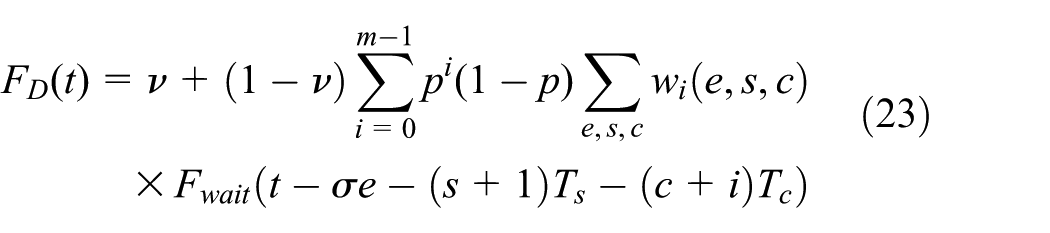
if
With the CDF of the RTA frame delay, the PLR for the RTA frames is found as
Numerical results
To verify the developed mathematical model and to evaluate the efficiency of the proposed approach, we have carried out extensive simulation of the considered scenario.
We consider a network with an AP, 10 regular STAs that generate non-RTA frames in the saturated mode, and several RTA STAs. Each RTA STA generates a Poisson flow of packets with rate
Figures 3 and 4 show how PLR and the average delay of delivered frames depend on the number of RTA STAs, and consequently on RTA load. First of all, we emphasize that the values obtained with the mathematical model are very close to the values obtained by simulation, the relative error not exceeding 3%. The discrepancy between the mathematical model and the simulation increases with the number of RTA STAs. With a high number of RTA STAs, and consequently a high load, the probability of a slot being occupied by an RTA transmission increases. So, the probability that the STA has to discard its frame long before reaching the limit on attempts m becomes notable, while our mathematical model does not consider such a case. At the same time, the number of STAs and
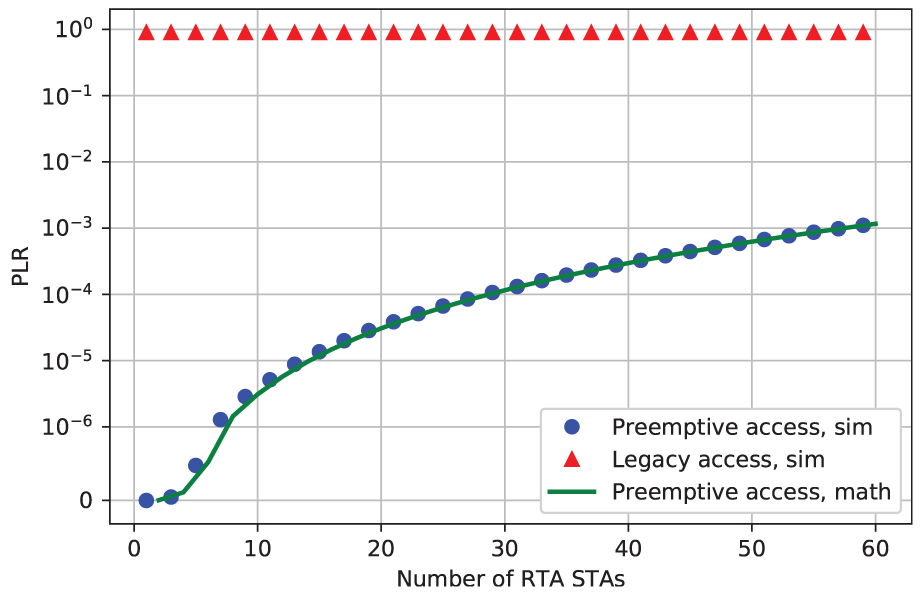
Dependency of PLR for RTA frames on the number N of RTA STAs,
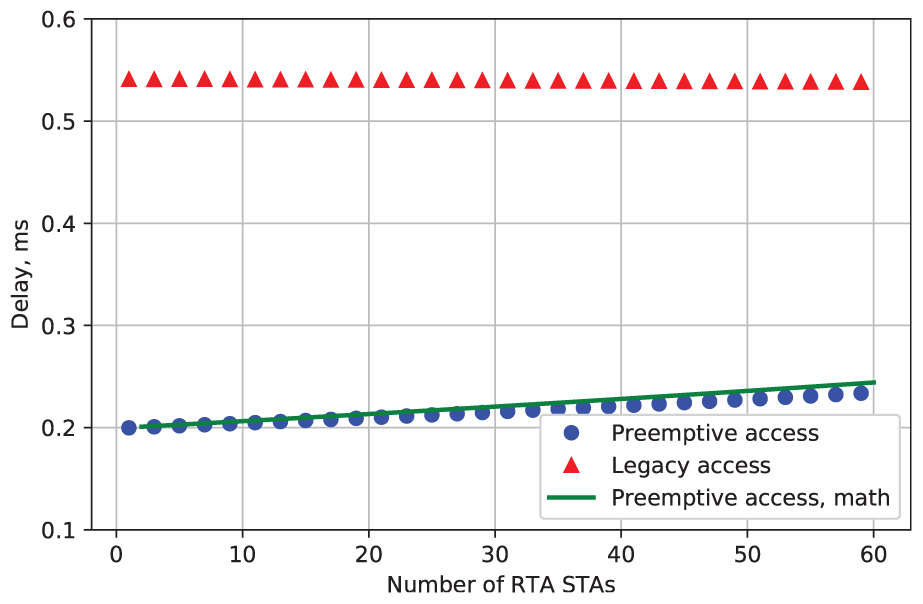
Dependency of average delay for RTA frames on the number N of RTA STAs,
When the number of RTA STAs is low, the losses in the network are negligible. While the number of RTA STAs increases, their transmissions start to collide more and more often. It leads to additional transmission attempts and increases packet delays. Although the average delay remains well below the required value of 1 ms, the distribution of delays has a heavy tail, and the PLR grows. Note that in the legacy case, almost all RTA frames are discarded because the RTA STAs cannot access the channel within the packet delay budget. At the same time, for those RTA frames which are successfully transmitted within 1-ms delay in the legacy case, the obtained average delay is slightly lower than

where
Figure 5 shows that in the preemptive access case, the throughput of regular STAs almost linearly decreases with the load of RTA STAs. Since the load of RTA traffic is low, approximately, each RTA packet reduces the channel time available for regular traffic by half of the average duration of a regular packet plus the duration of the RTA packet. Indeed, RTA packet appears asynchronously (equiprobably during the duration of the regular packet), and stops transmission of the regular packet for the duration of the RTA transmission. After that, the regular packet can be transmitted again from the very beginning.

Dependency of the throughput available for non-RTA frames relative to the legacy access on the number N of RTA STAs,
Figure 6 presents capacity region for RTA traffic in the considered scenario, that is, all points below the curve correspond to the scenario parameters, namely the number of RTA STAs and the traffic of each RTA STA, for which the requirements on the delay less than 1 ms and PLR less than

Dependency of the traffic intensity corresponding to
Conclusion
RTAs present a significant challenge for the new generation of Wi-Fi networks since they impose strict requirements on latency and reliability. Modern Wi-Fi networks, with their current architecture and channel access procedure, can barely satisfy these requirements, so new approaches to the new traffic service need to be devised.
An essential issue for real-time traffic is how to provide immediate channel access. In this article, we have proposed a preemptive service approach for RTAs. This approach is based on the usage of two radio interfaces, the primary interface being the same as in traditional Wi-Fi networks, and the secondary interface being a narrow band, low rate but very robust. The primary interface is used for data transmission, while the secondary interface is used only to signalize about the presence of the RTA traffic.
We have developed a mathematical model of the proposed approach, which shows that the approach can provide data delivery within 1 ms with PLR less than
As a future direction of research, we plan to consider a combination of the preemptive access scheme with the OFDMA (orthogonal frequency-division multiple access)-based channel access, introduced in the Wi-Fi networks with the new IEEE 802.11ax amendment, as a solution to provide real-time service to numerous applications.
Footnotes
Handling Editor: Honglin Hu
Declaration of conflicting interests
The author(s) declared no potential conflicts of interest with respect to the research, authorship, and/or publication of this article.
Funding
The author(s) disclosed receipt of the following financial support for the research, authorship, and/or publication of this article: The research was done in National Research University Higher School of Economics (NRU HSE) and supported by the Russian Science Foundation (agreement no. 18-19-00580).
