With the wide deployment of new computing paradigms, such as cloud computing and edge computing, the people can access services provided by remote servers more conveniently via the Internet. To preserve the security of those messages transmitted over the public channel, remote user authentication protocols are popularly implemented in various information systems. Recently, Park et al. pointed that Cao and Ge’s three-factor authentication scheme suffers from offline identity guessing attack and server impersonation attack. They also proposed a new scheme after presenting the corresponding cryptanalysis. However, we found that Park et al.’s scheme is vulnerable to offline password guessing attack, which is the most serious threat against this kind of authentication scheme. In addition, their scheme cannot provide complete correctness due to the misuse of bio-hashing and also fails to achieve user untraceability and perfect forward secrecy. To conquer these security pitfalls, we put forward a password, smart card, and biometrics-based three-factor remote user authentication scheme using the extended Chebyshev chaotic maps. The security analysis indicates that the proposed scheme can withstand various well-known attacks including offline guessing attack, impersonation attack, and so on. The performance evaluation shows that the proposed scheme provides stronger security guarantee at the cost of acceptable computation overhead. Thus, the proposed scheme is more desirable for securing communication in mobile networks.
The emergence of new computing paradigms (e.g. cloud computing and edge computing) brings great convenience for the daily life of human being, such as cloud-assisted e-healthcare that employs sensors to collect health information. This enables users to remotely access these services and transmit data at anytime and anywhere through wireless sensor networks connected to the Internet. To ensure services are legally accessed and users’ private information transmitted over the public channel are well protected, remote user authentication protocols1–5 are essential for these information systems.
Informally, with the help of a remote user authentication scheme, a user (or a sensor node) and the remote server can check the validity of each other. That is, the user can be sure that the server is the intended server rather than a malicious one, and the remote server can ensure that the user is a registered legal user. In addition, after they authenticate each other, a shared session key can be established to secure subsequent communications between them. Early remote user authentication protocols6,7 only use human-rememberable passwords and thus are inherently vulnerable to offline password guessing attack and insider attack.
To further strengthen the security of remote authentication scheme, smart card–based password authentication scheme8,9 was introduced. In the setting of this kind of authentication scheme, a user holds a password and a smart card containing related secret values. Only those users, who provide correct password and the corresponding smart card simultaneously, can pass through the authentication of the remote server. Meanwhile, the remote server no longer needs to maintain a verification table. Since the introduction of password and smart card–based two-factor authentication scheme, toward to different application environments, many related schemes10–16 have been presented. On the other hand, due to the uniqueness of biometrics (e.g. fingerprint and irides), biometrics are recently introduced into the design of smart card and password-based authentication scheme, as the third authentication factor. Such a scheme is named as three-factor remote user authentication scheme. Naturally, biometric-based three-factor authentication scheme is more secure than previous authentication schemes.
In 2010, Li and Hwang17 used hash function to construct a three-factor authentication scheme with low computation overhead. But Das18 found that Li-Hwang’s scheme suffers from various attacks and presented an improved scheme. However, An19 pointed out that Das’ scheme also cannot withstand impersonation attack and server spoofing attack. Although An19 put forward a new three-factor authentication scheme, Khan and Kumari20 demonstrated that this scheme cannot resist offline guessing attack, Cao and Ge21 showed that this scheme is vulnerable to replay attack. Subsequently, Yeh et al.22 and Wu et al.23 further analyzed the security of these schemes.
Recently, Park et al.24 pointed out that Cao and Ge’s21 authentication scheme suffers from off-line identity guessing attack and server masquerading attack. Then, a new three-factor authentication scheme with user untraceability was put forward after criticizing. Unfortunately, we found that Park et al.’s24 scheme is vulnerable to offline password/identity guessing attack and in fact fails to achieve untraceability and perfect forward secrecy. In addition, their authentication scheme has serious shortage in terms of correctness and usability owning to the misuse of bio-hashing. To overcome these security pitfalls in Park et al.’s scheme, we propose a security-enhanced three-factor remote user authentication scheme based on the extended Chebyshev chaotic maps. We show that the proposed scheme can withstand various well-known attacks including offline password guessing attack, impersonation attack, replay attack, and so on. In addition, the proposed scheme also enjoys several desirable security properties, such as mutual authentication, key agreement, and perfect forward secrecy. The performance discussion indicates that the proposed scheme provides stronger security guarantees, at the cost of accepted computation overhead. Thus, it is more desirable for securing communications in mobile networks.
Preliminaries
In this section, we briefly review the preliminaries used in the proposed scheme.
Notations
Assume that is a user, and S is the remote sever. Table 1 summarizes the notation used throughout this article.
The notations used throughout this article.
Notation
Description
S
The remote server
The master secret key of S
The ith system user
The user Ui’s identity
The user Ui’s password
The biometric template of the user
A biometric matching algorithm
Secure one-way hash function
Bio-hashing function
⊕
The exclusive or operation
||
The concatenation operation
Random integers picked by and S
Secret valued computed by and S
The timestamps on sides of and S
The maximum delay allowed
Chebyshev chaotic maps
The chaotic map has been widely used in the literature of cryptography, for example, chaotic map–based encryption,25 digital signature,26 and authentication protocols.27,28
Specifically speaking, the Chebyshev polynomial is a polynomial with degree x and is defined as29
Moreover, the recurrence relation of is defined as
for any integer , with and .
The Chebyshev polynomial also features of the semigroup property and satisfies
for any positive integers x and y and large prime p.
The security of the proposed three-factor authentication scheme is built upon the intractability of the chaotic map–based discrete logarithm problem (DLP) and the chaotic map–based computational Diffie–Hellman problem (CDHP), which are defined as follows
Property 1 (Chaotic map–based DLP)
Given u, r, and p, it is hard to find an integer x satisfying .
Property 2 (Chaotic map–based CDHLP)
Given , , , u, and p, where , , and p is a large prime, it is hard to compute .
Bio-hashing
Jin et al.30 combined fingerprint and pseudo-random number to achieve two-factor authentication. Specifically speaking, a user’s fingerprint image is first transformed to a vector, which is further used to perform inner product with a set of pseudo-random number. Then, depending on a given threshold value, each inner product is mapped to 0 or 1. This results in a binary string , that is, , where is the concrete bio-hashing algorithm. Lumini and Nanni31 further put forward improved bio-hashing. Now, bio-hashing has been widely used in the design of human authentication schemes.32–34
From a perspective of practicability, fingerprints imprinted from the same person are different from each other, thus the resulted bio-hashing values are also slightly different. But given a matching algorithm and two fingerprints , from the same user, the matching result is smaller than a given threshold value with overwhelming probability.
Review of Park et al.’s scheme
In this section, we briefly review Park et al.’s24 authentication scheme, which comprises four phases, namely, system user registration phase, login phase, authentication phase, and password change phase, which are performed as follows.
Registration phase
Each system user needs to register with the remote server S for legally accessing the provided service. To this end, the user and the server S execute the following procedure.
1. The user freely chooses a personal password and an identity , and also imprints his or her biometrics via a sensor. Moreover, chooses a random number K and calculates , . Then, the user sends the registration request message to the server S through a secure channel.
2. Upon receiving the registration request message , the server S picks a unique random number for , and further successively computes
Then, the server S writes into a new smart card, which is later issued to the user in a secure way. In addition, the server S stores the tuple into the registration table.
3. After receiving the smart card issued by the server S, the user rewrites the random number K into the smart card.
Login phase
A user logins into the remote server S by conducting the following steps:
The user inserts the smart card into a card reader, and imprints his or her biometric information . Then, the smart card computes and checks that if it is equal to . If not, the smart card terminates the login process. Otherwise, the smart card goes to the next step.
The user inputs the corresponding password and the identity . Then, the smart card chooses a random number and computes
where is the current timestamp.
Finally, the smart card sends the login request message to the server S via a public channel.
Authentication phase
After finishing the login process, the user and the server S need to further run the authentication procedure for verifying the validity of each other and establishing a shared session key. As indicated in Figure 1, the details of this procedure are specified as follows:
Upon receiving the login request message from the user , the server S checks that if , where is the current timestamp. If not, S terminates the authentication procedure. Otherwise, S further computes , , and checks if is equal to some stored in the registration table in the form of . If not, the server S rejects the session. Otherwise, the serve S goes to the next step.
The server S computes , , and and checks if . If not, the server S terminates this session. Otherwise, S selects a random number and calculates , , where is the current timestamp. Then, the server S returns the authentication response message to the user .
After receiving the response message from the server S, the smart card checks that if , where is the current timestamp. If not, the smart card terminates this session. Otherwise, it further computes and and verifies if . If not, the smart card terminates the session. Otherwise, the smart card computes and sends the response message to the server S, where is the current timestamp. Meanwhile, it computes a shared session key .
When receiving the message from the user , the server S checks if , where is the current timestamp. If not, the server S stops the session. Otherwise, it computes and checks if . If not, the server S also terminates the session. Otherwise, it computes a shared session key and sends to the user .
After getting the message , the smart card verifies the validity of by comparing it with . If they are equal, then the server S is authenticated by the user , and a common session key has been shared between them.
Login and authentication phase of Park et al.’s scheme.
Password change phase
In this phase, a user is allowed to freely update the original password by conducting the following steps:
The user inserts the smart card into a card reader and then inputs the original password , a new password as well as the identity . In addition, the user imprints his or her biometrics via a sensor.
The smart card recomputes and checks if . If not, the smart card stops the update procedure. Otherwise, it computes and and further checks if . If not, the smart card also terminates the update process. Otherwise, the smart card goes to the next step.
The smart card recomputes , , . Then, the smart card replaces and with and , respectively.
Cryptanalysis of Park et al.’s scheme
In this section, we first demonstrate that Park et al.’s24 scheme cannot be implemented in practical applications due to the incorrect usage of user biometrics. Moreover, we point out that this scheme even suffers from offline password/identity guessing attack and impersonation attack and therefore fails to provide the claimed security properties. In addition, Park et al.’s scheme cannot preserve user anonymity and provide perfect forward secrecy.
Before giving the details of the above-mentioned attacks, we capture the capacity of an adversary by the following attack model, which is widely accepted and adopted in the literature of multi-factor authentication scheme. Specifically, in this attack model, the adversary is allowed to perform the following operations:
The adversary completely controls the communication channels between any user and the remote server. This implies that can eavesdrop any message transmitted over these public channels. Moreover, it can intercept, modify, replay, and insert any message in these public channels.
The adversary can get any user’s either password or smart card, but not the both. In addition, after obtaining the smart card, the adversary can extract those secret values stored in the smart card using some particular technologies.35,36
An insider user or server might be malicious. That is, the adversary can collude with such a malicious one.
Correctness and usability of Park et al.’s scheme
We note that in the login phase of Park et al.’s scheme, the user is required to imprint his or her biometrics via a sensor. Then, the smart computes and checks if it is equal to , where is Ui’s biometrics imprinted in the registration phase. If not, the smart card will stop the login procedure.
Now we recall that is assumed to be a one-way secure hash function. This implies that it is sensitive of its inputs. In other words, if then it must be . However, by the property of the bio-hashing function , we have that the equality only holds with a low probability when . On the other hand, from the perspective of practicability, it is intractable for the sensor to capture the same biometrics every time. Therefore, the correctness of Park et al.’s scheme requires a user to imprint the same biometrics in each login instance and makes it unusable in practical applications. So we conclude that the correctness and usability of Park et al.’s scheme collide with each other.
Offline guessing attack
To launch offline password guessing attack against an insider registered user , the adversary needs to record these messages , , , transmitted in an instance of the login and authentication procedure executed between and the remote server S. Then, the adversary obtains the user Ui’s smart card, from which the adversary can further extract using particular technologies.35,36 After that, the adversary performs the attack by conducting the following steps:
Step 1. Establish the candidate password set according to the user Ui’s personal information.
Step 2. Select a candidate password from the set and successively compute , , .
Step 3. Check that if is equal to . If yes, the user Ui’s password is correctly recovered as . Otherwise, repeat Step 1 and Step 2 until the correct one is captured.
In fact, the adversary can also utilize those publicly transmitted messages to launch the offline password guessing attack. Specifically speaking, the adversary first computes and . Then, can check the validity of by verifying if it holds that .
Denote by the running time of one hash operation and the running time of one XOR operation. Then, we can see that the computation cost of one loop of the above attack is roughly , and the complexity of completing the offline password guessing attack is , where is the size of the candidate set . This implies that the adversary can correctly recover Ui’s password in polynomial time, which may be only several minutes on a PC.
After recovering the correct password , the adversary can further extract the user Ui’s real identity by launching offline identity guessing attack. Specifically, first selects a candidate identity from the candidate identity set and computes . Then, it further calculates . As a result, the adversary can verify the validity of by checking if . Similarly, the adversary can get the user Ui’s identity in minutes on a PC. In practice, the establishment of the candidate password set is related to personal information and depends on social engineering.
Other security pitfalls
First, with the recovered password and the identity as well as the knowledge of the smart card, the adversary can naturally impersonate the just by running the original scheme regularly. Second, although a user uses a different dynamic identity in each authentication instance, the value is the same in all instances. Thus, the scheme in fact fails to provide untraceability. In addition, the server S is required to maintain a registration table for verifying the identity validity of system users, which would make the scheme vulnerable to insider attack. Third, we note that the generated session key is derived from the random numbers contributed by the protocol participants with the hash function . Thus, the scheme cannot provide perfect forward secrecy. That is, once either the user’s secret values or the master secret key of the server S get exposed, those previously shared session keys would be recovered, which will result in the disclosure of the private information transmitted over those secure channels based on these session keys.
The proposed three-factor authentication scheme
In this section, we propose a new three-factor authentication scheme to overcome the above-mentioned security pitfalls in Park et al.’s24 scheme. Informally, we utilize chaotic map–based Diffie–Hellman key exchange to achieve perfect forward secrecy and mutual authentication. In addition, the smart card no longer locally checks the validity of the user password, which prevents the proposed scheme from being vulnerable to offline password guessing attack. The collision-resistant hash function and timestamp are used to guarantee the freshness of transmitted messages. Particularly, we do not consider user anonymity. In fact, this can be achieved by extending our scheme with a symmetric cryptosystem, as illustrated in existing schemes.14,37,38
Specifically, the proposed scheme consists of four phases, that is, initialization, registration, login and authentication, and password change. The details of these phases are as follows.
Initialization phase
Initially, the remote server S picks a large prime p and defines Chebyshev polynomial . In addition, it chooses a random number u to compute the polynomial , and let the master secret key be . Moreover, the remote server S selects a cryptographically secure hash function , and a bio-hashing function associated with a matching algorithm .
Registration phase
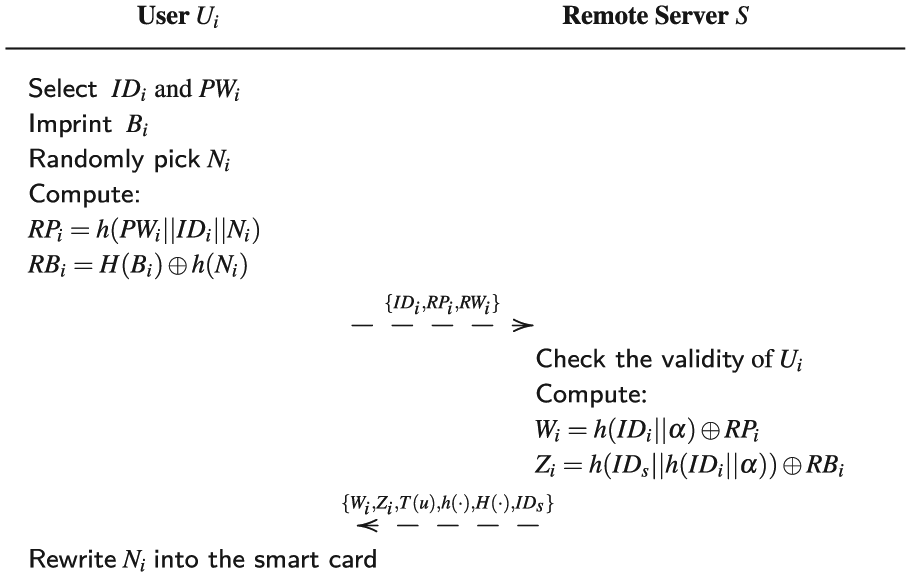
In this phase, as indicated in Figure 2, each system user needs to register with the remote server S by conducting the following steps:
The user selects an identity and a password that are both easy to remember, and imprints biometrics via a sensor. Then, picks a random number , and computes , . Moreover, the user sends the registration information to the remote server S via a secure channel.
Upon receiving the registration requirement from , the remote server S checks Ui’s validity, and then computes , . The server S further writes into a new smart card and issues it to in a secure way.
After obtaining the smart card, the user rewrites the random number into it. This completes the registration procedure.
User registration phase of the proposed scheme.
Login and authentication phase
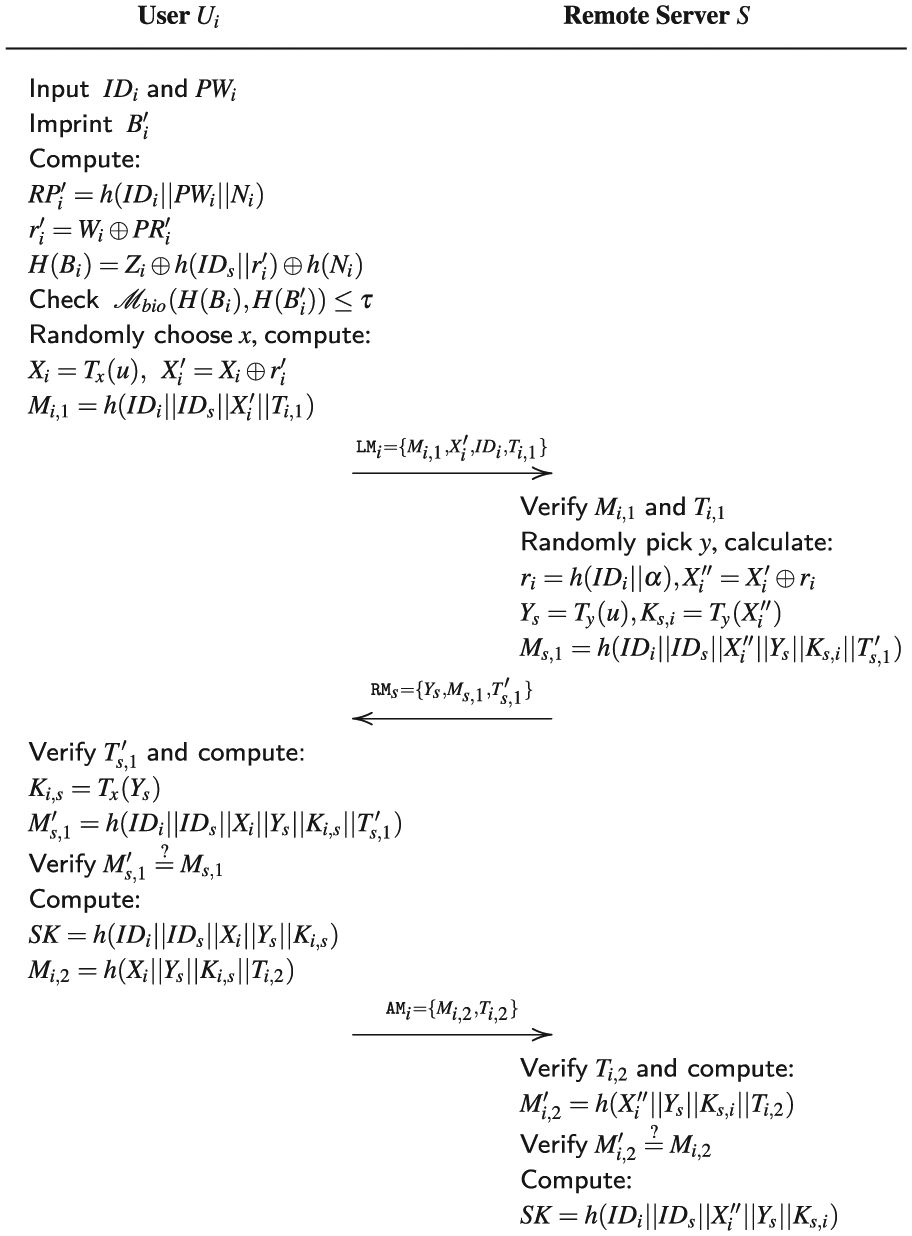
If a registered user wants to access the service provided by the server S, then they have to interactively perform the login and authentication process to check the validity of each other. Meanwhile, a shared session key would be established to secure subsequent communications between them. More precisely, as illustrated in Figure 3, this process is specified as follows:
1. The user attaches his or her smart card to a card reader and inputs the password and identity . At the same time, imprints his or her biometrics via a sensor.
2. The smart card successively recomputes
Then, the smart card performs the matching algorithm and checks if the result is beyond the given threshold value . If yes, the smart card stops this session. Otherwise, it goes to the next step.
3. The smart card selects a random integer x and computes , and , where is the current timestamp. Then, the smart card sends the login message to the remote server via a public channel.
4. Upon the receipt of the login request from , the server S checks if it holds that and , where is the current timestamp. If not, the server S terminates this session. Otherwise, it selects a random integer y and computes
where is the current timestamp. Then, S further sends the login response message to the user .
5. After receiving the response from the server S, the smart card first checks the validity of in a similar way. If it cannot pass through the check, the smart card terminates this session. Otherwise, it recomputes and . Then, if verifies that if is equal to . If not, the smart card also stops the session. Otherwise, the remote sever S is authenticated by the user . The smart card further computes and sends the authentication message to the sever S.
6. Upon receiving the authentication message from , the server directly checks if and , where is the current timestamp. If yes, then the user is authenticated by the remote server. Finally, both and S computes a shared session key . This completes the procedure of login and authentication.
Login and authentication phase of our scheme.
Password change phase
In this phase, a system user is allowed to update his or her original password in an online way. That is, the user first passes through the authentication of the remote server S and then conducts the following steps to update the password:
The user inputs the currently used password , the identity , and a new password .
The smart card chooses a new random number and computes
Then, the smart card replaces , , and with , , and respectively.
Formal proof
In this section, we formally prove the security of the improved protocol in the random oracle model. We first specify the security model and then provide proof details.
Security analysis
In this section, we demonstrate that the proposed three-factor authentication scheme can withstand various attacks, including offline password guessing attack, impersonation attack, known-key attack, and so on. We also illustrate that the proposed authentication scheme captures several desirable security properties, such as mutual authentication and perfect forward secrecy. Although the formal security proof is more desirable, it is still difficult to formalize the scheme within well-studied security models.39–41 This is mainly because that the computation capacity of the smart card is limited, and we employ different design principles to decrease the computation overhead. In fact, if there are no such restrictions, we can directly employ those authentications proved to be secure in CK model. On the other hand, we also note the security of some protocols24,28,42–48 are discussed with the BAN logic or AVISPA. However, the BAN logic and AVISPA also cannot guarantee the security of the protocol. For example, although Park et al.’s24 protocol is proved to be secure with the BAN logic, we show that it still has security flaws. To this end, we utilize an informal and heuristic manner to discuss the security of the proposed authentication scheme. Such a manner is widely accepted and used in the literature of multi-factor authentication scheme.10–13,49–52
Offline password guessing attack
If an adversary wants to launch the offline password guessing attack against the proposed scheme, then it has to obtain a related value to verify the validity of a candidate password. Now we show that the adversary cannot get such a value, even it holds those secret values stored in the smart card.
First, in the login message , the value is the output of the hash function on input of , , , and , which are all transmitted on the public channel. Thus, cannot be used to verify the correctness of a candidate password. On the other hand, we note that the value is derived from the user’s password , namely, . When the adversary corrupts the user’s smart card, it can get the values . However, if wants to utilize to check the validity of a candidate password , it has to know the value , which is not directly transmitted over the channel. Moreover, to get the value , the adversary has to obtain the master secret key of the server and recover it as . But when the master secret key is disclosed, the attack is trivial.
Second, in the response message from the remote server S, we can see that although the value contains the value of , the adversary cannot employ it to verify the validity of a candidate password since the value is unknown to it. In fact, if can compute , then it breaks the chaotic map–based Diffie–Hellman assumption. Similarly, the adversary also cannot use the message to check the validity of a candidate password. Therefore, the proposed scheme can be free from the offline password guessing attack.
Impersonation attack
If an adversary wants to impersonate a registered system user , then it needs to generate a correct login message and response message that can pass through the verification of the remote server S. However, without the knowledge of the password , the adversary cannot compute a secret value equal to that is computed by the remote server S, since the computation of involves and the adversary cannot compute it correctly. Thus, the adversary fails to impersonate a registered user, and the proposed scheme can withstand user impersonation attack.
On the other hand, if the adversary tries to impersonate the remote server S, then it has to generate correct response message . From the protocol flow, we can see that the adversary has to correctly recover with the value , otherwise it cannot pass through the verification of the user . However, without the knowledge of the master key or the user Ui’s password, it is intractable for to correctly compute . Thus, the adversary cannot impersonate the remote server, and the proposed scheme can withstand server impersonation attack.
Replay attack
In the attack model, an adversary is allowed to eavesdrop any messages transmitted over the public channel. To prevent the adversary from launching a replay attack by resetting these messages , , and , the proposed scheme uses random nonces and timestamps to ensure the freshness of these messages.
Specifically speaking, if the adversary directly replays the message , then it fails to pass through the verification of the server S since the timestamp would be obsolete. Alternatively, if the adversary chooses to replay a modified message by employing the current timestamp, then it has to produce a new message . However, as explained above, without the knowledge of the password , the adversary subsequently cannot produce a correct response message and thus cannot pass through the verification of the remote server S. Consequently, the proposed scheme is secure against replay attack.
Insider attack
In the context of insider attack, a malicious service provider tries to obtain registered users’ private information, such as password. In the registration phase of the proposed scheme, a user sends the message to the server S, where and . We can see that the remote server S cannot get any information about the user Ui’s password and biometrics without the knowledge of the random number . In addition, the remote server S also does not hold and store any information about registered users’ password. Thus, the proposed scheme can resist insider attack.
Known-key attack
In the setting of known-key attack, an adversary can obtain the information of other session keys from a corrupted session key. In the proposed authentication scheme, a session key is computed as , which is derived from fresh values , , and , where x and y are random numbers. Hence, all session keys are independent of each other. This implies that the revelation of a session key does not influence the security of other session keys, and the proposed authentication scheme can be free from known-key attack.
Mutual authentication and key agreement
Mutual authentication requires that the protocol participants check the validity of each other. In the proposed scheme, when a user sends the login message to the server S, he or she in fact launches a challenge. That is, only the one that holds the master secret key can correctly recover the value . As a result, if the response message generated by the remote server S can pass through Ui’s verification, then ensures that the remote server is the authorized one. Similarly, if the user can produce a correct response message , then the remote server S can be sure that is a registered legitimate user. Thus, they authenticate each other and the proposed scheme achieves mutual authentication.
From the generation way of the session key, we can see that both a user and the remote server S contribute to the derivation of the session key, where is a random value produced by the user and is a random value independently generated by the remote server S. This implies that neither the user nor the remote server S can control the value of the session key. Therefore, the proposed authentication scheme realizes the functionality of key agreement.
Perfect forward secrecy
Perfect forward secrecy ensures that the disclosure of a user’s secret information (password and smart card) and the master secret key of the remote server S does not affect the security of those previously established session keys. In the proposed authentication scheme, the session key is calculated as , where . After either the user Ui’s password and the smart card get exposed, or the master secret key is revealed, an adversary can recover the values and . However, due to the intractability of the chaotic map–based Diffie–Hellman problem, it is impossible for to compute . As a consequence, even if the master secret key gets exposed, the adversary cannot recover those previously used session keys, which implies that the proposed scheme features of perfect forward secrecy.
Three-factor authentication
The proposed authentication scheme provides the security guarantee of three-factor authentication. More precisely, in the login and authentication phase of the proposed scheme, a user is required to provide correct password , actual biometrics , and the corresponding smart card containing secret values. Now we show that if the user fails to provide one of the three authentication factors, then he or she cannot pass through the authentication of the server S.
First, if the password is not correct, then the value will not be equal to , which is directly computed by the remote server S. Second, if the smart card does not match inputted password , then the user also cannot pass through the authentication due to the same reason. Moreover, if the imprinted biometrics is not sampled from the same user , then it must be that , and the smart card will terminate the login process. Therefore, the proposed scheme achieves three-factor authentication and provides stronger security guarantee than two-factor authentication scheme.
Performance evaluation
In this section, we briefly evaluate the performance of the proposed authentication scheme by comparing it with several existing schemes in terms of computation cost and security properties.
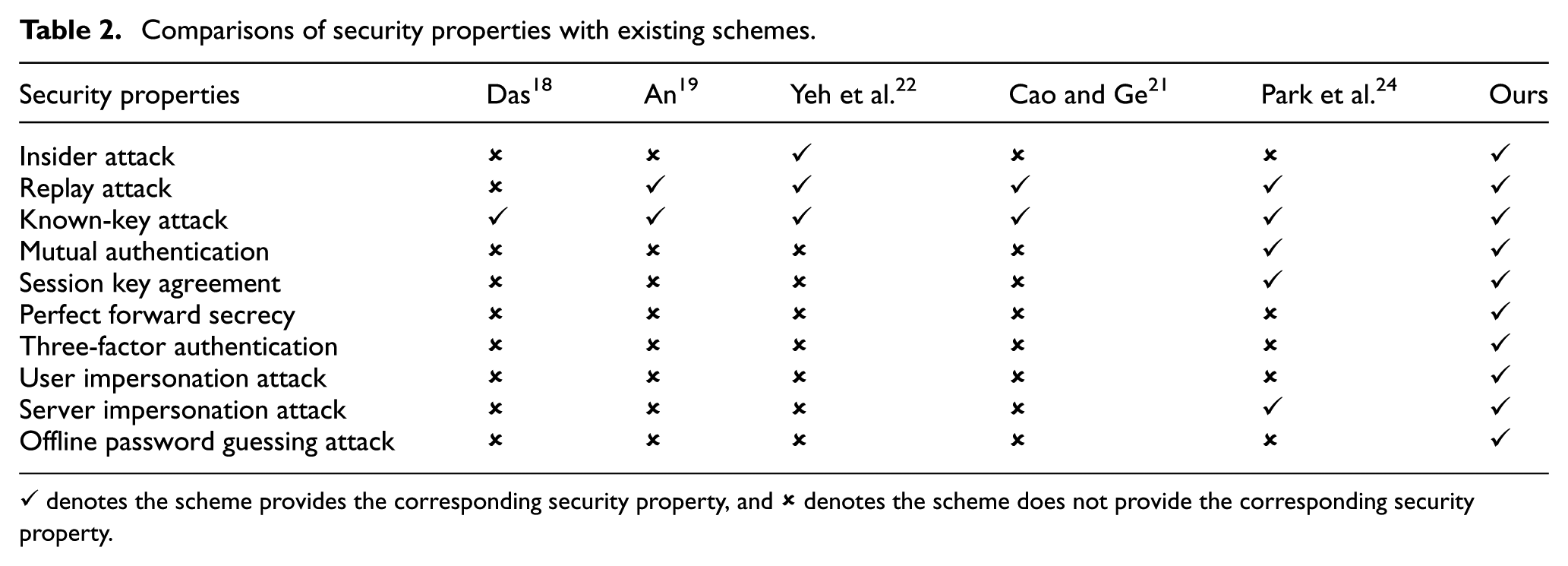
As illustrated in Table 2, early three-factor authentication schemes18,19 directly employ biometrics as an authentication factor and do not consider the security properties of session key agreement and perfect forward secrecy. Yeh et al.22 used elliptic curve cryptography to achieve the functionalities of mutual authentication and perfect forward secrecy. However, Wu et al.23 pointed out that this scheme fails to achieve the claimed security goals. In Cao and Ge’s21 scheme and Park et al.’s24 scheme, the login and authentication procedure only involves cryptographic hash operations, and thus they cannot provide perfect forward secrecy. In addition, as discussed previously, Park et al.’s scheme suffers from offline password guessing attack and fails to achieve the security requirement of three-factor authentication scheme. In short, we can see that only our scheme can withstand various well-known attacks, without missing several desirable security functionalities, such as mutual authentication, key agreement, and perfect forward secrecy.
Comparisons of security properties with existing schemes.
✓ denotes the scheme provides the corresponding security property, and ✘ denotes the scheme does not provide the corresponding security property.
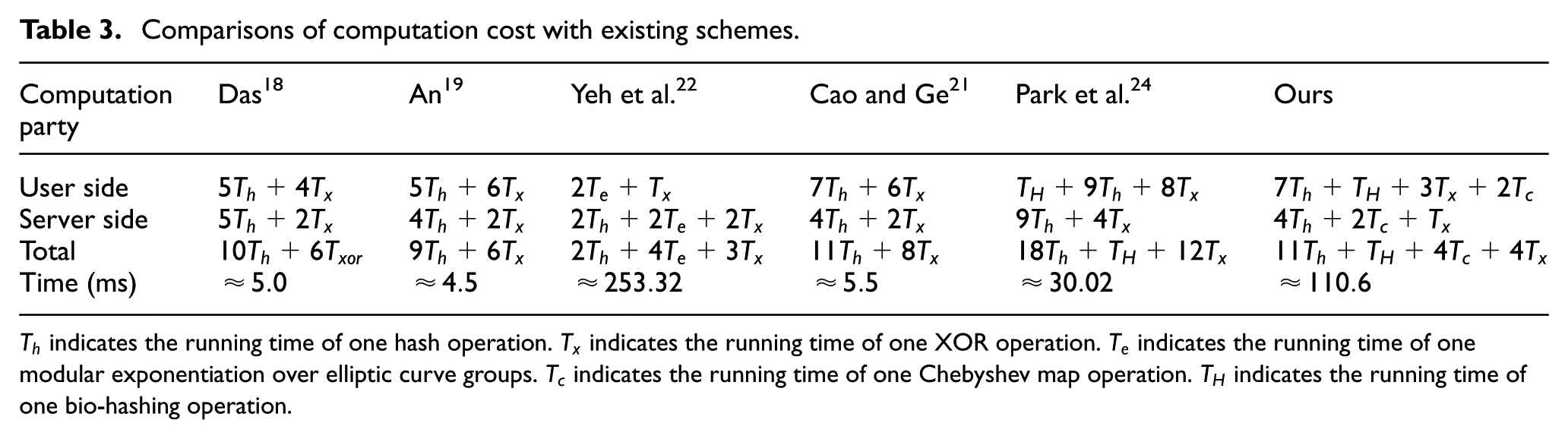
Table 3 summarizes the computation cost of these listed schemes. As performed in Kocarev and Lian,29, , and (on an Intel Pentium4 2600 MHz processor with 1 GB RAM). Since the registration procedure is performed in an offline manner, we only consider the computation overhead of the login and authentication process. In addition, the running time of XOR operation is rather low, and we thus ignore the timing results. We can see that previous schemes18,19,21 are more efficient than other schemes since they do not use Diffie–Hellman key exchange. Compared with Park et al.’s24 scheme, our scheme consumes more computation resources for providing stronger security guarantee, but we think the additional computation cost is acceptable and worthwhile. In addition, our scheme is more efficient than Yeh et al.’s22 scheme. In conclusion, Tables 2 and 3 indicate that the proposed three-factor authentication scheme provides stronger and desirable security guarantees, at the cost of acceptable computation overhead.
Comparisons of computation cost with existing schemes.
indicates the running time of one hash operation. indicates the running time of one XOR operation. indicates the running time of one modular exponentiation over elliptic curve groups. indicates the running time of one Chebyshev map operation. indicates the running time of one bio-hashing operation.
Conclusion
With the wide use of remote services (e.g. e-healthcare, e-learning) through the Internet, the remote user authentication scheme is absolutely essential for securing communications over the public channel. Three-factor remote user authentication schemes can provide stronger security guarantees than traditional authentication schemes and attract much attention in recent years. Although lots of such schemes have been proposed, most of them suffer from various attacks. In this article, we pointed out that Park et al.’s three-factor remote user authentication scheme is vulnerable to offline password guessing attack and also fails to provide several necessary security properties. Moreover, we put forward a security enhanced scheme to overcome these security flaws. By presenting security analysis and performance evaluation, we demonstrate that the proposed scheme is more suitable for practical applications.
Footnotes
Handling Editor: José Camacho
Declaration of conflicting interests
The author(s) declared no potential conflicts of interest with respect to the research, authorship, and/or publication of this article.
Funding
The author(s) disclosed receipt of the following financial support for the research, authorship, and/or publication of this article: This work was supported by National Natural Science Foundation of China (No. 61372172).
ORCID iD
Yan Zhao
References
1.
DasMLSaxenaAGulatiVPet al. A novel remote user authentication scheme using bilinear pairings. Comput Secur2006; 25(3): 184–189.
2.
HeDChenYChenJ.Cryptanalysis and improvement of an extended chaotic maps-based key agreement protocol. Nonlinear Dynam2012; 69(3): 1149–1157.
3.
LiXNiuJWangZet al. Applying biometrics to design three-factor remote user authentication scheme with key agreement. Secur Commun Netw2014; 7(10): 1488–1497.
4.
LiuDNingP.Multilevel μTESLA: broadcast authentication for distributed sensor networks. ACM T Embed Comput S2004; 3(4): 800–836.
5.
ShiWGongP.A new user authentication protocol for wireless sensor networks using elliptic curves cryptography. Int J Distrib Sens N2013; 9(4): 730831.
6.
LamportL.Password authentication with insecure communication. Commun ACM1981; 24(11): 770–772.
7.
SandirigamaMShimizuANodaMT.Simple and secure password authentication protocol (SAS). IEICE T Commun2000; 83(6): 1363–1365.
8.
YangWHShiehSP.Password authentication schemes with smart cards. Comput Secur1999; 18(8): 727–733.
9.
HwangMSLiLH.A new remote user authentication scheme using smart cards. IEEE T Consum Electr2000; 46(1): 28–30.
10.
LiaoYPWangSS.A secure dynamic ID based remote user authentication scheme for multi-server environment. Comp Stand Inter2009; 31(1): 24–29.
11.
WeiJLiuWHuX.Cryptanalysis and improvement of a robust smart card authentication scheme for multi-server architecture. Wireless Pers Commun2014; 77(3): 2255–2269.
12.
XueKHongPMaC.A lightweight dynamic pseudonym identity based authentication and key agreement protocol without verification tables for multi-server architecture. J Comput Syst Sci2014; 80(1): 195–206.
13.
WeiJLiuWHuX.Secure control protocol for universal serial bus mass storage devices. IET Comput Digit Tec2015; 9(6): 321–327.
14.
WangDHeDWangPet al. Anonymous two-factor authentication in distributed systems: certain goals are beyond attainment. IEEE T Depend Secure2015; 12(4): 428–442.
15.
KumariSLiXWuFet al. A user friendly mutual authentication and key agreement scheme for wireless sensor networks using chaotic maps. Future Gener Comp Sy2016; 63: 56–75.
16.
KumariSKhanMKAtiquzzamanM.User authentication schemes for wireless sensor networks: a review. Ad Hoc Netw2015; 27: 159–194.
17.
LiCTHwangMS.An efficient biometrics-based remote user authentication scheme using smart cards. J Netw Comput Appl2010; 33(1): 1–5.
18.
DasAK.Analysis and improvement on an efficient biometric-based remote user authentication scheme using smart cards. IET Inform Secur2011; 5(3): 145–151.
19.
AnY.Security analysis and enhancements of an effective biometric-based remote user authentication scheme using smart cards. Biomed Res Int2012; 2012: 519723.
20.
KhanMKKumariS.An improved biometrics-based remote user authentication scheme with user anonymity. Biomed Res Int2013; 2013: 491289.
21.
CaoLGeW.Analysis and improvement of a multi-factor biometric authentication scheme. Secur Commun Netw2015; 8(4): 617–625.
22.
YehHLChenTHHuKJet al. Robust elliptic curve cryptography-based three factor user authentication providing privacy of biometric data. IET Inform Secur2013; 7(3): 247–252.
23.
WuFXuLKumariSet al. A novel and provably secure biometrics-based three-factor remote authentication scheme for mobile client-server networks. Comput Electr Eng2015; 45: 274–285.
24.
ParkYParkKLeeKet al. Security analysis and enhancements of an improved multi-factor biometric authentication scheme. Int J Distrib Sens N2017; 13(8). DOI: 10.1177/1550147717724308.
25.
JakimoskiGKocarevL.Chaos and cryptography: block encryption ciphers based on chaotic maps. IEEE T Circuits: I2001; 48(2): 163–169.
26.
ChainKKuoWC.A new digital signature scheme based on chaotic maps. Nonlinear Dynam2013; 74(4): 1003–1012.
27.
HeDKumarNChenJet al. Robust anonymous authentication protocol for health-care applications using wireless medical sensor networks. Multimedia Syst2015; 21(1): 49–60.
JinATBLingDNCGohA.Biohashing: two factor authentication featuring fingerprint data and tokenised random number. Pattern Recogn2004; 37(11): 2245–2255.
31.
LuminiANanniL.An improved biohashing for human authentication. Pattern Recogn2007; 40(3): 1057–1065.
32.
MishraDDasAKMukhopadhyayS.A secure user anonymity-preserving biometric-based multi-server authenticated key agreement scheme using smart cards. Expert Syst Appl2014; 41(18): 8129–8143.
33.
KumariSLiXWuFet al. Design of a provably secure biometrics-based multi-cloud-server authentication scheme. Future Gener Comp Sy2017; 68: 320–330.
34.
JiangQZeadallySMaJet al. Lightweight three-factor authentication and key agreement protocol for internet-integrated wireless sensor networks. IEEE Access2017; 5: 3376–3392.
35.
KocherPJaffeJJunB.Differential power analysis. In: WienerM (ed.) Advances in cryptology—CRYPTO’99: 19th annual international cryptology conference, Santa Barbara, California, USA, August 15-19, 1999 proceedings. Berlin; Heidelberg: Springer, pp.388–397.
36.
MessergesTSDabbishEASloanRH.Examining smart-card security under the threat of power analysis attacks. IEEE T Comput2002; 51(5): 541–552.
37.
JiangQMaJWeiFet al. An untraceable temporal-credential-based two-factor authentication scheme using ECC for wireless sensor networks. J Netw Comput Appl2016; 76: 37–48.
38.
KumariSLiXWuFet al. A user anonymous mutual authentication protocol. KSII T Internet Inf2016; 10(9): 4508–4528.
39.
CanettiRKrawczykH. Analysis of key-exchange protocols and their use for building secure channels. In: Proceedings of the international conference on the theory and applications of cryptographic techniques: advances in cryptology (EUROCRYPT’01), Innsbruck, 6–10 May 2001, pp.453–474. London: Springer.
40.
WeiJHuXLiuW.Two-factor authentication scheme using attribute and password. Int J Commun Syst2017; 30(1): e2915.
41.
OdeluVDasAKWazidMet al. Provably secure authenticated key agreement scheme for smart grid. IEEE T Smart Grid2018; 9(3): 1900–1910.
42.
LuYLiLZhangHet al. An extended chaotic maps-based three-party password-authenticated key agreement with user anonymity. PLoS ONE2016; 11(4): e0153870.
GaoGPengXTianYet al. A chaotic maps-based authentication scheme for wireless body area networks. Int J Distrib Sens N2016; 12(7). DOI: 10.1177/155014772174720.
45.
ZhangMZhangJTanW.Remote three-factor authentication protocol with strong robustness for multi-server environment. China Commun2017; 14(6): 126–136.
46.
DhillonPKKalraS.Secure multi-factor remote user authentication scheme for internet of things environments. Int J Commun Syst2017; 30(16): e3323.
47.
SunJZhongQKouLet al. A lightweight multi-factor mobile user authentication scheme. In: Proceedings of the IEEE INFOCOM 2018 – IEEE conference on computer communications workshops (INFOCOM WKSHPS), Honolulu, HI, 15–19 April 2018, pp.831–836. New York: IEEE.
48.
SharmaGKalraS.A lightweight multi-factor secure smart card based remote user authentication scheme for cloud-IoT applications. J Inform Secur Appl2018; 42: 95–106.
49.
WuFXuLKumariSet al. An efficient authentication and key agreement scheme for multi-gateway wireless sensor networks in IoT deployment. J Netw Comput Appl2017; 89: 72–85.
50.
WangYLiuJXiaoFet al. A more efficient and secure dynamic ID-based remote user authentication scheme. Comput Commun2009; 32(4): 583–585.
51.
OdeluVDasAKGoswamiA.An effective and robust secure remote user authenticated key agreement scheme using smart cards in wireless communication systems. Wireless Pers Commun2015; 84(4): 2571–2598.