




Abstract
Machine-type communications have suffered serious congestion, overload, and poor quality of service problems in cellular networks, since the cellular networks are designed for human-to-human communications. Moreover, current solutions just focus on the congestion for single base station and cannot adaptively work in the dynamic and complex conditions. In this article, we provide an autonomous and adaptive attractor-selection-based congestion control scheme for massive access from machine-type communication devices based on the resource separation scheme. First, we introduce a feasible and self-adaptive extended attractor-selection mechanism to decide which base station to be chosen. Simultaneously, an effective estimation algorithm for the traffic load of base stations is also designed to represent the network traffic load without frequent information exchanges among devices or base stations. With the available access resources and estimated traffic load taken into consideration, massive access attempts can receive the decisions via the broadcast and adaptively choose proper stations for alleviation of the congestion and overload. Finally, simulation results show that the proposed attractor-selection-based congestion control scheme achieves better performance in terms of average access delay, collision probability, and throughput of the whole system, adaptively accommodating to unpredictable environments under cellular networks.
Keywords
Introduction
Machine-type communications (MTCs) mean information exchanges among miscellaneous objects or between the ubiquitous devices and servers without human interference. It has been regarded as a new type of communication in the next-generation network (NGN), which may widely renew our day-to-day living styles. Plenty of machine-to-machine (M2M) applications have emerged, such as e-health, smart metering, intelligent transportation, and smart grid. Likely in the future, everything around us will be equipped with the ability to connect with the Internet and communicating with each otunicating with each other, constituting the giant network frame which is the so-called Internet of things (IoT).1,2 The number of connected devices has exceeded the number of people on earth. 3 According to the estimation report of the wireless world research forum (WWRF), there will be 7 trillion wireless devices connected to various network for serving billion people in the future. 4 This massive machine-type communication (mMTC) scenario is also the key use case in future fifth-generation (5G) cellular network. Massive access from a large number of energy-, complexity- and computation-constrained MTC devices need to be handled by 5G network.5,6
MTC over cellular networks have a large market potential for the sake of their wide applications. 7 The huge potential of this market will generate prominent revenues which exceeds $300 billion. 8 The compound annual growth rate (CAGR) would exceed 25% for the MTC devices and corresponding connectivity segments over the next few years. 9 Apparently, MTC has promising economic and strategic prospects in the future mobile market. 10
Pervasive MTC devices can connect to the network via all kinds of communication technologies, such as ZigBee, Wi-Fi, LoRa, and narrow band IoT (NB-IoT). So far, the cellular network is the most ideal solution for MTC due to its higher capacity, broader coverage, and more flexible radio resource managements, especially the long-term evolution (LTE) infrastructure. 7 Aiming at providing low power and wide area network (LPWAN) for mMTC devices, the 3rd Generation Partnership Project (3GPP) has carried out the improved standard based on the traditional LTE/LTE-A network. The LTE-Cat 0, LTE-Cat 1, LTE-M, and NB-IoT are simplified with narrower bandwidth, lower data rate, high link budget and so on, which forms the key components of cellular IoT network and cooperatively supports the mMTC scenario under 5G network.11,12 In this article, we would mainly focus on the access congestion and overload resulted from the typical slotted ALOHA-based random-access procedure (RAP) which is widely used in cellular networks. The research can also be applied to NB-IoT network with slight alterations due to the new design in the access procedure. Maybe the achievable data rate of cellular IoT network is sufficient for almost all the M2M services, but it cannot support the giant amount of simultaneous access attempts, even sacrificing the quality of service (QoS) performance of human-to-human (H2H) communications. 13 Unlike the traditional voice and data traffic for human-type communications (HTC), there are always infrequent and small-data transmissions in MTC. 2 Besides, billions of MTC devices would generate a great deal of signaling and data process information under different scenarios, resulting in serious congestion and overload for both the radio access network (RAN) and core network (CN). It is evident that serious congestion and overload from mMTC devices would seriously affect the normal communications among humans, even leading to the network collapse. Therefore, MTC need new, scalable, compatible, and stable solutions for disposal of congestion and overload.
Related work
There have been many leading standardization organisms working on the solution for insuring both the M2M and H2H communications, like the International Telecommunications Union (ITU), the European Telecommunications Standards Institute (ETSI), 3GPP, the Telecommunications Industry Association (TIA), the Chinese Communications Standard Association (CCSA) and the global initiatives such as OneM2M. 14 So far, the key emphasis of this work lies on the MTC improvements without jeopardizing the traditional H2H communications under cellular network, especially dealing with the signaling congestion and overload problem in front of massive access of MTC devices.
There have also been numerous researches focusing on the congestion and overload solutions for M2M services under cellular networks. Dawy et al. 15 introduced the development background of M2M and the common solutions to the network congestion and overload, such as the group-based method and slotted transmission. Soltanmohammadi et al. 16 explored the issues, solutions, and the remaining challenges to enable and improve M2M communication over cellular networks. The comprehensive discussions about the advantages and disadvantages of solutions proposed in recent years are presented in detail. In few previous studies,17,18 a series of effective methods for network congestion and overload are also summarized and analyzed, like the typical access class barring (ACB), evolved access barring (EAB), back-off scheme, and resource separation scheme (RSS). Zhao et al. 19 proposed a random-access algorithm based on statistics waiting for energy saving. In addition, few authors20–22 designed and analyzed the distributed queuing–based random-access (DQRA) protocol. Based on a tree-splitting algorithm, devices are organized into contention resolution queue (CRQ) and data transmission queue for collision avoidance. Alavikia and Ghasemi 23 proposed a multiple power level random-access mechanism for M2M communications. Based on the capture effect, collided devices can be decoded by base stations via assigning different levels of power, which implements the multiplexing in the power domain. 24 Few authors25–27 investigated the transmission repetitions in the random channel access (RACH) procedure of NB-IoT and also gave the analysis in terms of successful access probability, average access delay, or throughput. An enhanced access reservation protocol (ARP) with a partial preamble transmission mechanism was proposed to avoid the preamble transmission collisions in NB-IoT. 28 The proposed method leveraged the trade-off between mis-detections and collisions and alleviate the congestion puncturing the preamble sequence through the partial preamble transmission mechanism.
However, what the above studies focused on are constrained to solutions of congestion happened in single base station, ignoring the cooperation and dynamic environmental fluctuations among heterogeneous base stations. They put excessive attentions on improving the access mechanisms for MTC devices which are attached to only one base station. All the decisions are determined by only one individual base station without cooperation with others.
The state-of-the-art cellular systems, such as LTE/LTE-advanced networks, are always under a heterogeneous multi-tier network architecture. 29 Various cellular base stations are widely deployed for good coverages and high capacity, like macro cell, femto cell, and pico cell, forming an ultra-dense network. 30 Massive MTC devices are likely to be served in the highly dynamic heterogeneous wireless environments where multiple base stations are simultaneously available, running various applications. Due to the instability of wireless communications and fierce competitions among mMTC devices and applications for the limited network resources, the characteristics of wireless networks would always dynamically change with time and be hard to keep a stable state. Obviously, it is vital to choose the most suitable wireless network taking into account the conditions of wireless networks. Since the outside conditions of wireless networks have high degree of freedom, deriving that the optimal base station selection solution is likely to suffer from state space explosion and time- and energy-consuming computation. 31 More efficient, self-adaptive, and robust base station selection solutions are needed in order to smoothly adapt to unstable network conditions, so as to alleviate the congestion and overload with high spectrum efficiency. 32
Researches on the MTC devices under heterogeneous base stations have also attracted lots of attentions. Due to the differences of traffic load and access resources for each base station, cooperation among base stations are needed for congestion and overload control. Especially under RSS, it is more evident, since the radio access resources, like the preamble sequences and physical downlink control channel (PDCH) resources, may be fixed or adjusted dynamically and adaptively.33–35 Improper base station–selection scheme may aggravate the congestion and overload of some base stations with an extremely low resource efficiency. Lien et al.
36
introduced the cooperative access class barring (CACB) scheme for M2M communications and proposed an ACB-based congestion solution. Via the information exchanges among base stations, the ACB parameters can be decided jointly to realize the global stabilization and access load sharing. But frequent data exchanges among base stations are still needed, putting more load and interferences on base stations and devices. Likely, Hsu et al.
37
proposed an enhanced cooperative access class barring (ECACB) and traffic-adaptive radio resource management for M2M communications. The number of devices connected to a base station is used to determine the probability that devices can access to the base station. However, MTC devices are always in sleep mode or
In summary, the above cooperation schemes need frequent information exchanges to support the decision-making. Every node in such schemes needs to maintain the up-to-date information by frequent essential message exchanges from other devices. Even if the task to derive the optimal resource allocation is distributed among the devices, it would generate frequent and large amount of information exchanges among these devices to obtain the latest information of the current status of outside network environments. From a viewpoint of dynamic features of wireless networks and cost, for example, transmission bandwidth, energy consumption, and complexity, such mechanisms are not at all feasible and efficient under this scenario.
Contribution and organization
Therefore, in this article, we propose a robust and self-adaptive attractor-selection-based congestion control (ASCC) mechanism for base station selections. Based on the proposed congestion control mechanism, base stations derive their probabilities to be selected for network access by devices. No data exchange among devices or base stations are needed. Derived results would be broadcast by base stations to mMTC devices under their coverage. Then, after receiving derived access probabilities, devices would probabilistically select their targeted base stations. Ultimately, massive access attempts of MTC devices are separated among several base stations adaptively and robustly. Optimal access allocations would be obtained, mitigating the congestion and promoting the resource efficiency.
In order to accomplish robust and adaptive access attempts allocation in the dynamically changing environment, we characterize the base station–selection scheme via a nonlinear mathematical model based on autonomous and adaptive biological reactions. This model is named as the attractor-selection mechanism (ASM). It is a noise-driven metaheuristic to derive a stable solution of optimization problem in an adaptive way. 40 Once the current solution is suitable, a basin of attractor corresponding to the solution becomes deep, and the state of whole system statically stays there. When the outside environment changes and the solution becomes inappropriate, the basin of attractor turns unstable and fluctuates. Then the state will choose another suitable solution driven by the outside noise. In order to reflect the dynamic variations of the traffic load for each base station, we also propose a traffic estimation mechanism. Base station can learn about the scale of network attempts via the status of radio access resource utilizations. The degree of congestion for each base station and available access resources would be taken into consideration for the attractor-selection model. Hence, devices are able to dynamically choose the right base station for network access according to the current conditions. The main contributions of this article are summarized as follows:
We present an ASCC mechanism for MTC devices under multiple base stations. By means of choosing the appropriate base stations, massive access attempts would be separated among multiple base stations according to the external conditions. Congestion and overload caused by massive accesses can be alleviated, and the resource efficiency would also be promoted.
We propose an effective estimation method to predict the number of access attempts for base stations. Base stations can learn about the scale of access requirements via the status of radio access resource utilizations. No information exchanges among M2M devices or base stations are needed.
We apply the biology-based attractor-selection model for base station selection 41 due to its self-adaptation to the complex and changeable environments. The network system could adaptively accommodate to external unstable wireless network conditions driven by the system noise. By taking the allocated resources and traffic load of base stations into consideration, congestion and overload of the LTE network would be significantly relieved.
We evaluate the proposed scheme via computer simulations. Both the accuracy of the proposed estimation algorithm and the effectiveness of proposed congestion control scheme are proved with better performance.
The rest of this article is organized as follows. Section “System model” describes the details of system model about the cellular network and RAP. The details about algorithm of ASCC would be introduced in section “ASCC.” In section “Simulation and results,” the proposed estimation method and the results and analyses of the simulation are presented. In the end, section “Conclusion” concludes this article.
System model
In this section, the network model and RAP would be elaborated in detail.
Network model
As shown in Figure 1, the LTE network consists of

Scenario of MTC devices under multiple base stations.
According to 3GPP specifications, before sending its access attempt to base stations, eNodeB would broadcast the detailed configuration about the RAP, like number of available preamble sequences for contention-based random access and corresponding subframe numbers when devices can send their attempts for network access. Devices can only acquire their transmission opportunities in their authorized available time slots and channels.
If the probabilities of base stations to be selected can be included in the broadcast information, MTC devices can receive them and decide which base station is better to access. Then massive devices can be separately assigned into different base stations, with the congestion status and available resources of each base station taken into consideration. The access resources can be efficiently used and the congestion of the network can also be well mitigated.
RAP
In this subsection, we briefly describe the RAP under the cellular network system. The RACH is mostly initialed by a cellular device before the network connection establishments. There are two categories of RAP as specified in 3GPP standardization: the contention-based RAP and the contention-free RAP. When a device is just turned on or has not obtained or lost the timing synchronization, the contention-based RAP would be needed to establish the network connections. For the contention-free RAP, eNodeBs inform devices of specific configured resource information for network connection establishments, and devices need to stay in

Contention-based random-access procedure.
First, as shown in Figure 2, devices with network access attempts would randomly choose one preamble sequence from
Then the eNodeBs would send the random-access response (RAR) message with Msg2 in reply to the received preamble sequence. After receiving the Msg1, the eNodeB would calculate the time spent on the path transmission and include this information in the RAR message. The RAR message conveys at least RA-preamble identifier, timing alignment (TA) information for the time adjustment of next transmission and initial upper limit (UL) grant. If devices cannot receive the RAR message within the RAR time window, the access attempts would be regarded as access failures and retransmitted after a random back-off time period. Meanwhile, devices would increase number of retransmission times by one and promote the transmission power to raise the probability that the preamble is detected by the eNodeB.
Once the Msg2 is received, the device would synchronize its transmission time with the TA information and continue to the next Msg3 stage. If devices cannot receive the RAR messages within the RAR window, they would give up this transmission, perform a random back-off algorithm, and wait for next access opportunity for retransmissions. In the scheduled transmission stage, the radio resouorce control (RRC) connection request message would be sent by devices to the eNodeB with the
Finally, the eNodeB sends resource allocation information during the collision resolution stage. If the eNodeB can decode various RRC connection messages from different devices in previous stage, it broadcasts the identifier (i.e.
The detailed description above is the whole contention-based RAP. Then the connections between M2M devices and eNodeB could be established for subsequent data transmissions. 18 However, the available access resources for MTC devices and traffic load statuses for different base stations may be different from each other.34,35 Devices randomly choose the base stations for network access, which leads to severer congestion with low resource efficiency. Hence, we need an autonomous and adaptive mechanism for mMTC devices to select proper base stations for congestion alleviations.
ASCC
In order to alleviate the congestion resulted from the mMTC access attempts under dynamic and unstable network conditions, autonomous and adaptive mechanism is urgently needed. In this section, we would introduce the ASM. It originated from autonomous and adaptive behaviors of biological systems which are well known for their robustness and adaptability to various and dynamic environments. The ASM is a mathematical model characterizing the adaptive and robust reactions for Escherichia coli cells in front of the nutrient changes in the outside environments. Via the autonomous and adaptive biology-based mechanism, massive access attempts from MTC devices can be adaptively and robustly distributed to different base stations with the dynamic and unstable environmental conditions taken into account. Consequently, the access congestion and overload can be significantly alleviated, giving guarantees to the QoS requirements of MTC applications and enhancing the utilization efficiency. Here, this biology-originated ASM would be introduced and extended to fit our application scenarios for the congestion control.
Concept of attractor selection
The ASM was proposed in 2006 by Kashiwagi et al., 41 who present the dynamics of gene expression in E. coli cells in response to outside changing and complex nutrient conditions. It is a metaheuristic optimization method showing what cells should do in order to keep the high cell activity under given nutrient conditions, where some necessary nutrients may decrease or run out. 40 The attractor in the biology means the gene expression of a cell. Cells would reliably choose the adaptive attractor driven by the gene expression noise with the two mutually inhibitory operons which govern the gene expressions. When one of the necessary nutrients outside becomes scarce, the cell activity would be significantly weakened. Then the mRNA concentration rate would be raised, generating a sequence for synthesis of missing nutrient to make up for the outside nutrient shortages. Cells adaptively accommodate to the external environments by self-regulations. The basic model characterizing the biological reactions of cells to external environments can be expressed as follows 41

where
The attractors of a dynamic system, defined as the above equations shown, has two stable status, where
Extended attractor selection for base station selections
In order to apply the original ASM to the higher dimension space for elections among multiple candidate base stations, we introduce the extended attractor-selection model as the following 43

where
In the proposed system model,
Through the adaptive and autonomous alternations made by base stations, the whole system state value converge to a stable state. The outside environment changes do affect the access congestion of RAN, that is, the available preambles are kept relatively stable. We can make a hypothesis about the stable state where there are no noises (the noise term,

Easily, we can get the solutions as

Apparently, the first solution is negative which is not realistic. Hence, we can derive the results of this solution in the following

where

where
As shown in Figure 3, an example with three base station candidates to be chosen is given over 2000 time epochs to elaborate how the extended attractor-selection model works. The parameter setting for this experiment is shown in Table 2 and the access attempts per random-access slot is
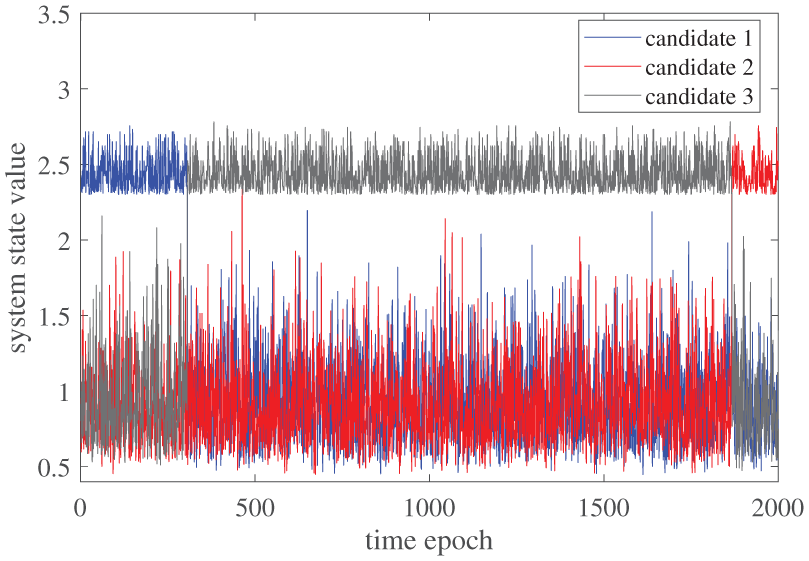
The state values for different candidates under dynamic conditions.
Derivation of activity
Activity of system-state value,

where
The instant activity,

where
The traffic load of target base stations,
According to preliminary experiments, there is a threshold of activity. When
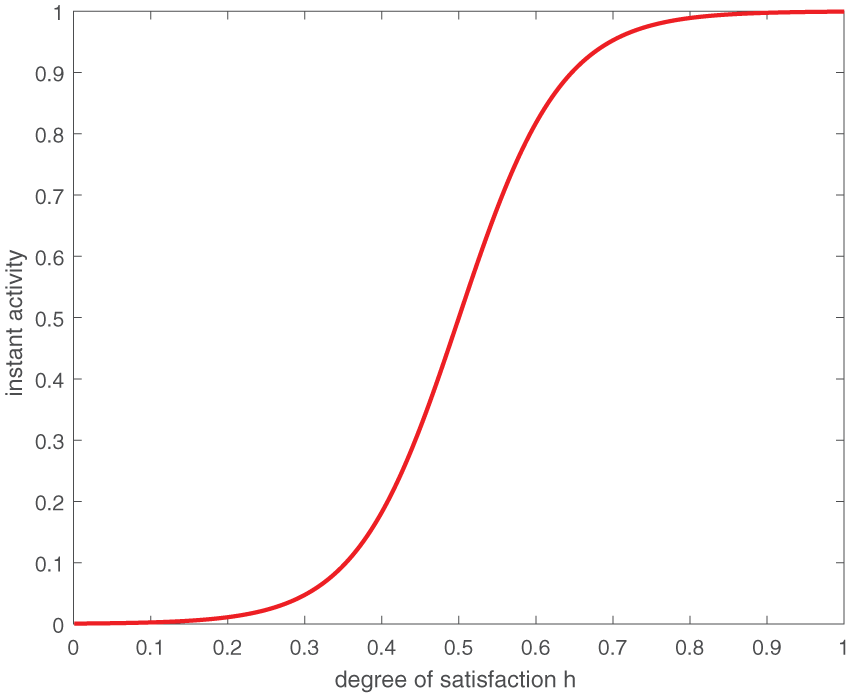
Relationship between the degree of satisfaction and the instant activity.
The activity of whole system status is low when the degree of satisfaction grows from zero. Until
Proposed estimation method of number of access attempts
As the traffic load and available RACH resources are considered for the ASCC scheme, base stations need to learn these two variables in advance. Obviously, the available RACH resources are known, but the traffic load for each base station is unknown. Hence, we propose a feasible and effective estimation mechanism to offer the details about current congestion status in the perspective of RAN. Moreover, the accuracy of this estimation mechanism would also be verified in this part.
In the process of uplink connection establishments, devices randomly select one of available preamble sequences and send it to the target base station in the access slot as described in RAP above. The
When

Hence, via the idle probability of preamble occupations, the estimated number of overall MTC devices for the uplink access in this slot

However, this estimation model is of no use when the number of access attempts is large. This is because the constrained number of preamble sequences is not sufficient with respect to the massive access attempts. There would be a situation where all preambles were occupied causing the 10 unable to work. Hence, we propose an improved estimation method for this issue.
When

The number of access time slots where devices can successfully access the network, which is also the number of success devices,

Then we can get the enhanced estimation scheme as

where
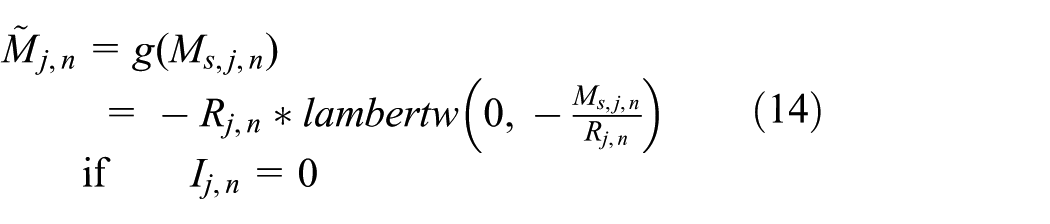
When there are no idle preambles, base stations can obtain the number of access attempts via equation (14). Finally, we can derive the successful access probability indicating the traffic load of the target base stations

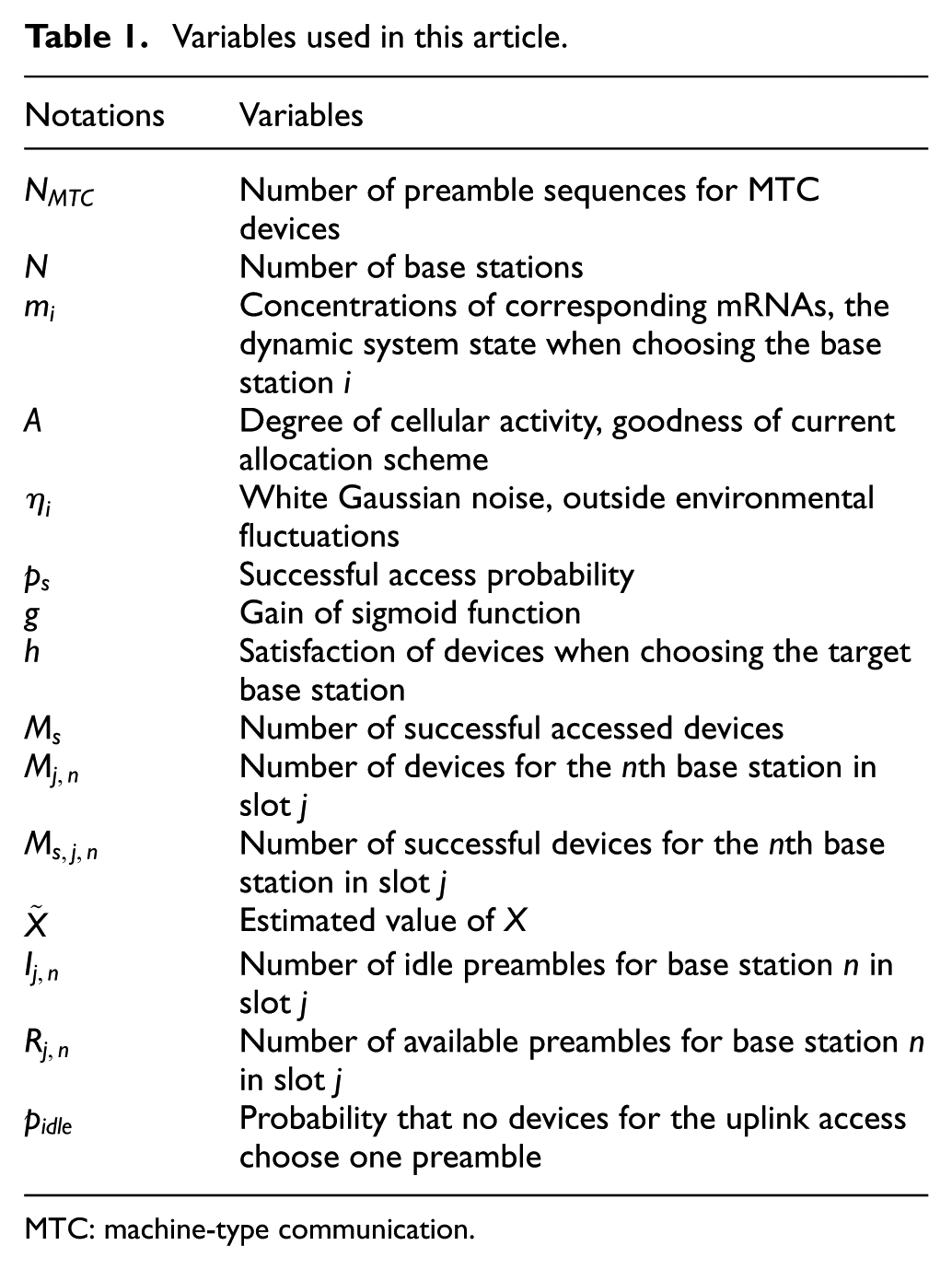
Hence, with the proposed estimation method, base stations can learn the traffic load as the process presented in Algorithm 1. As Figure 5 shows, when the real number of access attempts is small, this estimation algorithm matches well. When the access attempts keep increasing, it becomes a little worse, fluctuating slightly around the real values. In short, the proposed estimation algorithm can assess the amount of access attempts with minor deviations. With the traffic load derived, base stations can execute the ASCC scheme with the congestion status and available resources taken into consideration, adaptively and dynamically adjusted to the outside environments. In addition, Table 1 summarizes the variables to be used in this article for clarity.


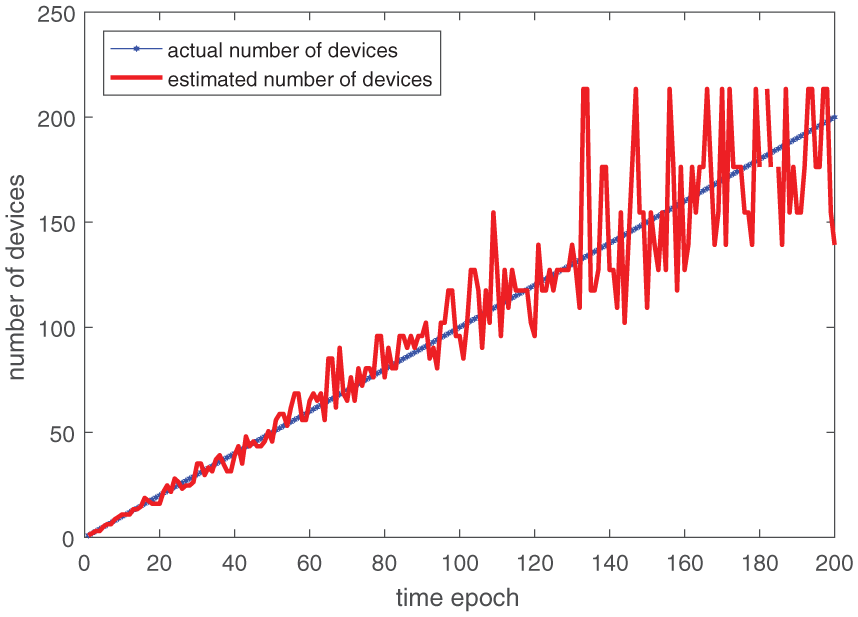
Simulation of the estimation method.
Variables used in this article.
MTC: machine-type communication.
Simulation and results
In this section, we would introduce the simulation and analysis of the performances to demonstrate the efficiency and superiority of our proposed ASCC algorithm. We assume that access requests from MTC devices to the network follow Poisson distribution.
18
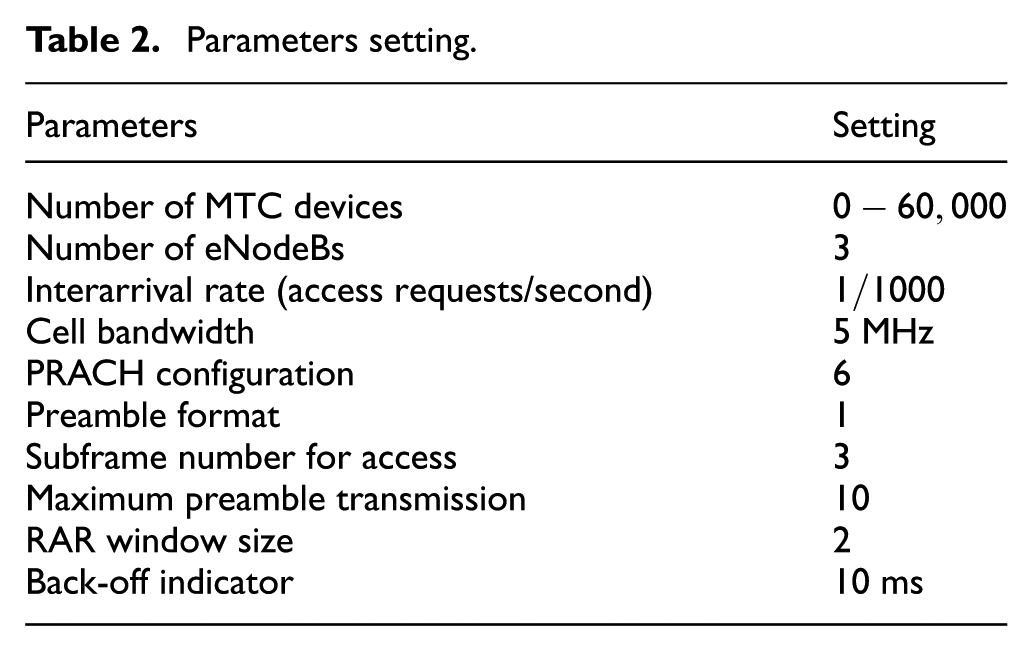
The system parameters used in the simulation are set based on 3GPP LTE specifications as shown in Table 2. The noise item in the extended ASM is set to follow uniform distribution, that is,
Parameters setting.
Computer simulations are conducted on top of the MATLAB simulator to verify the effectiveness of the proposed congestion control model. The simulations are developed based on a Monte Carlo approach. We use a computer equipped with Intel Core-5 central processing unit and 8-GB random-access memory. In order to focus on the performance of contention-based RAP, we omit the transmission failure caused by the channel fading and loss. The access failures are all from the collisions of selecting the same preamble sequences. What’s more is that we run the proposed algorithm for the M2M applications for more than 3000 times and get the average values in order to acquire the accurate and reliable results.
We choose the legacy access scheme that devices select the base station with the same probability as the compared scheme in simulations. Massive access attempts from MTC devices are separated equally for different base stations. Moreover, in order to verify the effectiveness of our proposed ASCC scheme, we also run the Q-leaning-based base station–selection scheme as another baseline method for comparisons. 38 The proposed ASCC congestion control scheme would be investigated in two perspectives. First, the instant performances with fixed number of access attempts would be simulated in terms of access delay and collision probability. Then the performances under different number of access attempts would be presented to verify the capacity of connecting to mMTC devices.
As shown in the Figure 6(a), we first evaluate the instant performance of the access delay for the proposed congestion control scheme, Q-learning-based scheme and the legacy one. In this scenario, there are
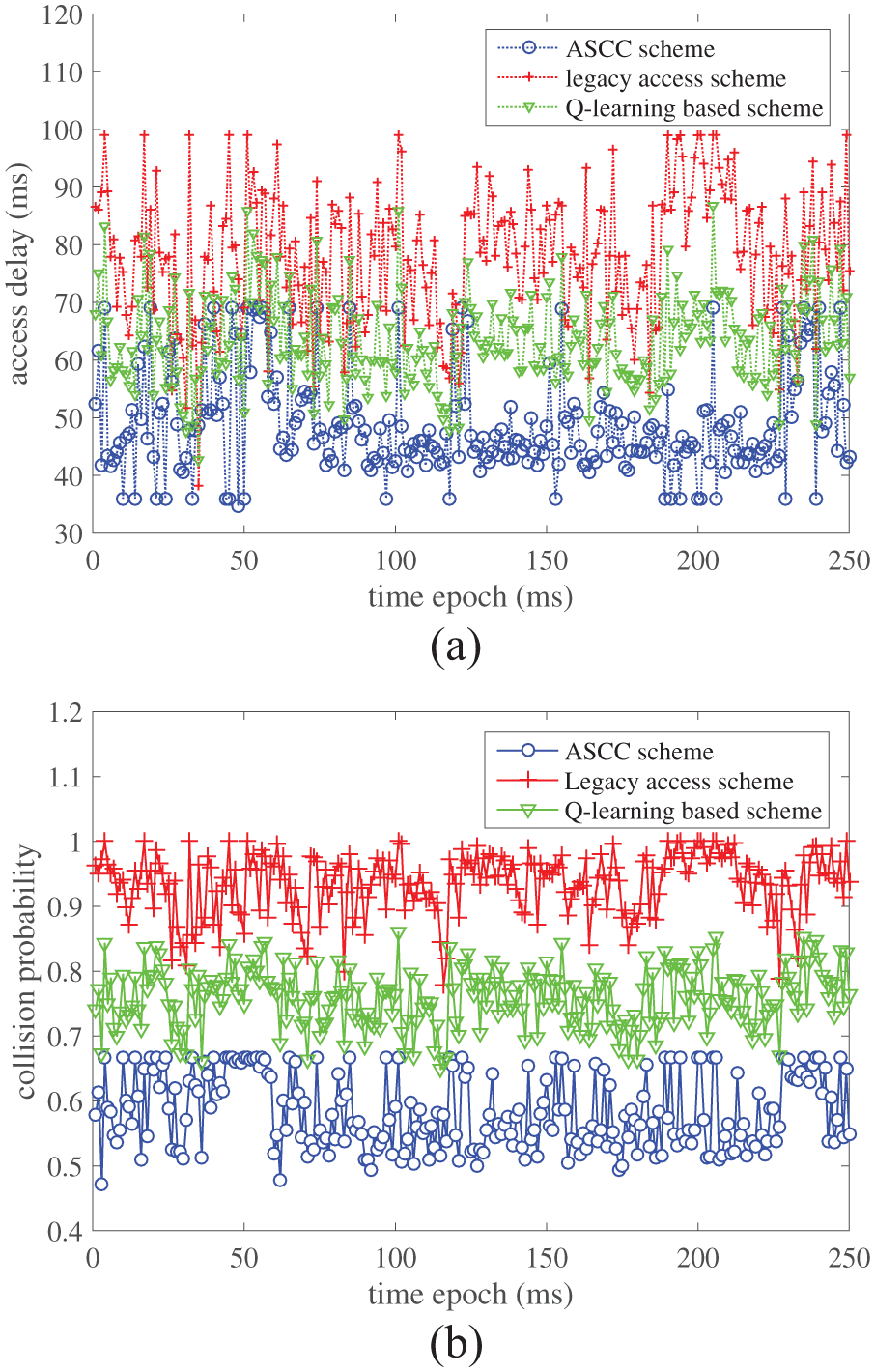
Simulation results for
In addition, we evaluate the throughput and average access delay for different numbers of access attempts per second. The throughput here is defined as the number of MTC devices which successfully complete the RACH process per second for the whole system, including all three base stations in this simulation. The average access delay is the delay performance averaged over all devices which execute the RAP. As shown in Figure 7(a), throughput of all three schemes increase when the number of MTC devices increases intially. This is because RACH resources are sufficient when the number of devices is small. The throughput is exactly the number of access attempts and increases with more arrivals. No collisions happened in RAP. For the same reason, the average access delay keeps stable and low at the beginning as shown in Figure 7(b). With more access arriving, collisions would happen during the RAP, and devices need back-off and retransmissions for the completion of connection establishments. The throughput and average access delays would gradually increase as shown in Figure 7. However, when more network requirements arrive, as we can see, the throughput of three schemes begin to decrease. The difference is that the point where they began to decrease is different. The number of access attempts where the throughput begins to reduce is more than the other two schemes. Devices under the legacy access scheme and the Q-learning-based scheme suffer from severe collision due to the improper base station selections. Once the amount of access attempts becomes more, the whole access resources become insufficient with respect to the number of access attempts. Hence, the throughput of three schemes begin to decrease and the average access delays also keep increasing. However, the whole throughput of the proposed ASCC scheme always keeps being higher than the other two schemes and would reach about

Simulation results with augment of MTC devices for the proposed mechanism and comparison when
Obviously, the dynamic system reacts adaptively and robustly with the external fluctuating and complex environments. Base stations can derive the accessed probabilities with proposed ASCC mechanism and enable massive access attempts to choose proper base stations, realizing the whole network congestion alleviation. Unlike the Q-learning-based scheme, no information exchanges among devices would be needed, which would cause long delay in the face of massive devices. What’s more is that the proposed ASCC scheme is of low computation complexity, as the access probability calculation load would be derived with explicit equations by base stations. Only during the estimation process when there are no idle preambles, the transcendental equation (16) would be solved by numerical approximations which is negligible with respect to the powerful computation and processing capability of base stations. In summary, the ASCC scheme can enable devices to choose optimal base stations, significantly alleviating the congestion and overload with high resource efficiency. Moreover, it also provides a precious and reliable inspiration for researchers to handle the massive access attempts in 5G network.
Conclusion
Based on the attractor-selection model, this article proposed a solution for signaling congestion and system overload for mMTC access attempts. Simultaneously, an estimation algorithm was proposed for base stations to figure out their traffic load. Then with the traffic load status and available preamble sequences taken into consideration, the ASCC scheme could derive the base station–selection probabilities to be selected without frequent information exchanges among mMTC devices. Then MTC devices would adaptively and robustly select the appropriate base station, and massive access attempts are assigned to different base stations. Hence, the congestion and overload would be significantly mitigated with enhanced resource efficiency. Simulations are also given, which verifies that massive access congestion is significantly alleviated in this proposed scheme. In our future work, we would aim to study the congestion control scheme under bursty traffic.
Footnotes
Handling Editor: James Brusey
Declaration of conflicting interests
The author(s) declared no potential conflicts of interest with respect to the research, authorship, and/or publication of this article.
Funding
The author(s) disclosed receipt of the following financial support for the research, authorship, and/or publication of this article: This research was supported in part by the National Science and Technology Major Project (2018ZX030110004), in part by the WLAN Achievement Transformation based on the software-defined networks (SDNs) of the Beijing Municipal Commission of Education (201501001), in part by Beijing Municipal Science and Technology Commission (Z171100005217001) and in part by Nation Natural Science Foundation of China (61671073).
