




Abstract
This article aims to employ an improved simulated annealing algorithm to accurately and efficiently identify parameters of a nonlinear model which describes the nonlinear vortex-induced vertical force. In the general simulated annealing for vortex-induced vertical force models, the energy difference between the new and current solutions is very small so that the acceptance probability is close to 1. Almost all poorer solutions are accepted, which makes simulated annealing inefficient. To improve the performance of simulated annealing, an improved simulated annealing is proposed. First, the energy difference between the new and current solutions is amplified to put the acceptance probability in the interval of [0, 1]. Second, the length of the Markov chain is set as a function of the current temperature instead of the fixed value. Third, the generation criterion of the new solution is revised so that new solutions satisfy constraints and fully explore the neighborhood of the current solution. Simulation results show that improved simulated annealing has good performance in run-time and fitting. According to the results of Wilcoxon’s test, improved simulated annealing outperforms the other algorithms.
Introduction
Because of their low damping and lightweight, long-span bridges are often sensitive to vortex-induced vibrations (VIVs) at a certain critical wind speed, examples of which are Second Severn Bridge, 1 Trans-Tokyo Bay Crossing Bridge, 2 and Xihoumen Bridge. 3 This type of vibration can generate mildly large amplitude response, 4 which may cause discomfort for the users, and result in fatigue problems of structures.5–7 After the collapse of the Tacoma Narrows Bridge, more attention was paid to the research activities of VIV. Since the 1970s, many semi-empirical models that estimate the maximum response of bluff bodies have been proposed.8–13 Although these models can qualitatively or quantitatively describe vortex-induced forces, improper parameters may invalidate these models and result in inaccurate prediction of the maximum displacement of structures. Therefore, for a certain model, the most important task is that parameters are accurately and efficiently identified from experimental data.
In order to well describe the complex nonlinearities of the fluid–structure interaction, many models are nonlinear. It is very hard to identify parameters of this kind of model, which restricts its application in real engineering. The traditional identification is the decay-to-resonance (DTR), which is used to identify parameters according to the maximum response at different moments in a free decay test. The assumption of the DTR is that the VIV system is weakly nonlinear, so the parameters in the nonlinear model can be approximated by slowly varying parameters. 8 However, noises in tests and the small amplitude of vibration responses have a great influence on the accuracy of the identified parameters. 14 There are significant differences between vortex-induced vertical forces (VIVF) measured in tests and reconstructed with the identified parameters when the identified parameters are inaccurate. 13 Gupta et al. 14 thought the least-square method should be used to mitigate the effect of inaccurate measurement and noises. Marra et al. 5 pointed out that parameters in Scanlan’s nonlinear model could be identified by nonlinear differential equations. Zhu et al. 13 used the Levenberg–Marquardt algorithm (LMA) based on the nonlinear least-square method to identify parameters of their model. The VIVF reconstructed with the identified parameters is in basic agreement with the measured VIVF. However, the LMA may converge to a local minimum when an inappropriate initial solution is provided. More importantly, the appropriate initial solution corresponding to the global optimal solution is difficult to know in advance. To break the limit of the initial solution, Tian et al. 15 presented a hybrid algorithm based on the genetic algorithm (GA) and the LMA. In this hybrid algorithm, the GA is utilized to search for an appropriate solution as the initial solution of the LMA. Although GALMA is a good method, it has high complexity due to operations of crossover and mutation. Hence, it is necessary to seek a simple and effective identification algorithm.
Simulated annealing (SA) is a stochastic optimization algorithm. SA is less sensitive to the initial solution. It randomly scans the entire solution space and converges to the global optimal solution by iterations. Most importantly, SA uses the probability to accept poorer solutions, and these solutions help the algorithm to escape from the local optimal solution. Its effective searching strategy makes it a potential algorithm for solving different optimization problems in a wide variety of applications.16–18 The application of SA has been tested with promising results.19,20 However, when SA is used to solve a specific problem, it may need further improvement in order to enhance the algorithm performance. Palubeckis 18 proposed a hybrid algorithm based on a variable neighborhood search and SA.
For the parameter identification of VIVF models, the energy difference between the new and current solutions is very small so that the probability of accepting poorer solutions is close to 1, which means that almost all the poorer solutions may be accepted by SA. SA is busy jumping from one point to another in the solution space and spends a lot of time seeking the global optimal solution. To improve the performance of the identification algorithm, an improved simulated annealing (ISA) is proposed. In ISA, the probability of accepting poorer solutions is rewritten according to the characteristic of VIVF problems, so that the poorer solutions can be properly accepted. The length of the Markov chain adaptively changes with the current temperature to improve the efficiency of the algorithm. Simulation results show that ISA can effectively and efficiently identify parameters of the nonlinear model.
The rest of the article is organized as follows. In section “Related work,” Zhu’s nonlinear model and SA are briefly described. In section “ISA,” ISA for VIVF models is illustrated in detail, including its criteria. In section “Simulation results,” first, ISA shows its good performance compared with SA. Second, ISA is compared with GALMA to show its simplicity and reliability. Finally, the parameters identified by ISA are verified by comparing the reconstructed data with the measured data. Section “Conclusion” summarizes the article.
Related work
Problem description
Scanlan 21 employed the linear mechanical oscillator term to express periodic force caused by vortex shedding and proposed an empirical linear model with linear aerodynamic damping and stiffness. In order to underline the self-excited and self-limiting characteristics of VIVF, Scanlan added a cubic term describing the nonlinear damping force to the linear mode. The nonlinear model is as follows 8


where m is the mass per unit span, D is the across-flow dimension of the structure,
By analyzing of test data, Zhu et al. 13 improved Scanlan’s nonlinear model by adding a new quadratic term and amending the nonlinear damping term. Zhu’s nonlinear model is given by

Formula (3) includes seven parameters

where
The goal is to find an x which minimizes formula (4). The minimum value of formula (4) occurs when the gradient is zero. Due to the seven parameters in formula (3), there are seven gradient equations
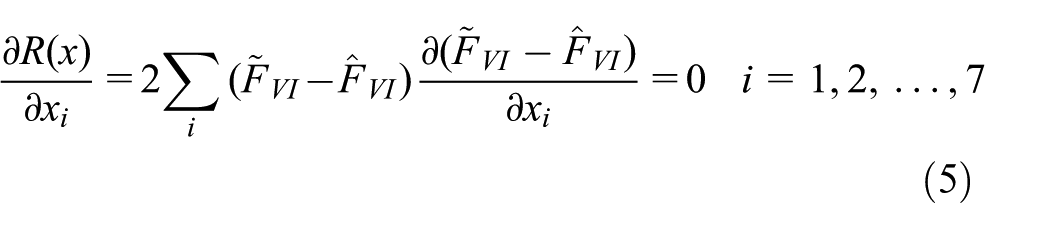
The derivatives
For Zhu’s model, the parameters can be accurately identified as follows

SA
SA algorithm originates from the principle of solid annealing. Kirkpatrick et al. 19 applied this algorithm to solve combinatorial optimization problems in 1983. SA achieves a large range rough search and a local fine search by controlling the initial temperature, cooling factor, and the energy function. SA searches the solution space without relying on initial conditions. As long as the initial temperature is high and the probability of accepting poorer solutions is appropriate, SA can obtain the global optimum.
Figure 1 shows the optimization process of SA. Starting from point A, the energy function value continues to decrease and the heuristic process continues. When SA arrives at point B, it falls into the local minimum point. SA accepts poorer solutions with a certain probability, so it may jump out of the local optimal solution. SA will continue to move to the right with a certain probability and jump out of the local minimum C. After several times of right movement, it will reach the peak point between C and D, and achieve the global optimal solution D.

The optimization process of SA.
Figure 2 shows the flowchart of SA. First, an initial solution

The flowchart of SA.
ISA
In this section, ISA is described in detail when applied to a real case given by Zhu et al. 13
For VIVF models, the VIVFs are very small, and when SA is applied to identify parameters, the probability of accepting poorer solutions is almost 1. In the procedure, SA jumps from one position to another position in the solution space and does not gradually converge to a point.
To improve the performance of SA, an ISA is proposed. In the ISA, these criteria need to be written for the specific problem. They include the definition of the energy function, the generation of a new solution, the acceptance probability, the length of the Markov chain, the cooling schedule, and termination rules. Parameters of ISA are shown in Table 1.
Parameters definition.

Energy function. The energy function is defined as

The length of the Markov chain. In ISA, higher the initial temperature, longer the length of the Markov chain. Therefore, the length of the Markov chain is a function of the current temperature

where
Generating criterion of a new solution. A new solution is randomly generated in the neighborhood of the current solution. Since the different range of every dimension needs to be explored, the step interval of every dimension in the solution space is preset

Since

where
The reduced frequency of vortex shedding is close to

where r is a random number in the interval [−1, 1]. Hence, the criterion to generate a new solution is

The acceptance probability. The most prominent characteristic of ISA is the acceptance probability. For the VIVF model, the energy difference

where

Cooling schedule. The nonlinear cooling strategy is adopted

where
Termination condition. ISA stops when the current temperature is smaller than the final temperature. So, the termination condition for Zhu’s model can be given as follows

So, the parameters can be obtained by solving the following optimization

As shown in Figure 3, ISA has two cycles: inner and outer. The algorithm starts with an initial solution which is randomly generated. In the inner cycle, when

The flowchart of ISA.
Simulation results
The bridge deck of Xiangshan Harbor Bridge was used as the prototype of the section model. In order to obtain the significant vortex-induced resonance in wind tunnel tests, and its length scale was set to 1:20. Four laser displacement sensors and four accelerometer sensors were mounted on each end of the two suspended arms, and they were used to record the histories of displacement and acceleration, respectively. In addition, four single-component dynamic force balances were used to measure the time histories of the dynamic forces acting on the section model. Details of the wind tunnel tests can be found in the literature.12,13
This study focuses on identifying parameters of Zhu’s nonlinear model using ISA. A data set, including 10,000 datum from the transient part of the steady stage of vibration at wind speed 9.1 m/s for the case of damping ratio
Simulated environment
The details of the operating environment were given as follows:
CPU: Intel® Core™ i5-3470@3.2 GHz;
Memory: 4.00 GB;
Software: MATLAB 2016;
Operation system: Window 10.
Comparison of SA and ISA
ISA and SA were carried out at different initial temperatures under the cooling factor

The running results: (a) run-time of SA, (b) run-time of ISA, (c)
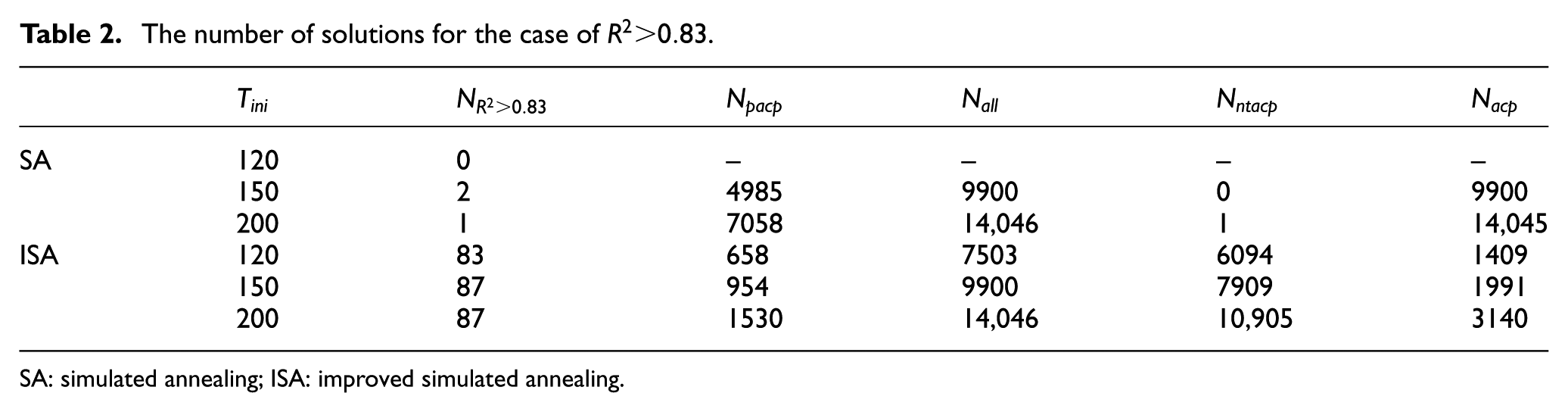
Table 2 shows the performance of SA and ISA. It can be seen from Table 2 that SA is very inefficient for the VIVF model. At
The number of solutions for the case of
SA: simulated annealing; ISA: improved simulated annealing.
Figure 5 shows the convergence of SA and ISA. Signs, such as “+”,“x”, and “★”, are used to mark a position where a poorer new solution is accepted. The marked solutions mean the algorithm has jumped out of the local minima. Figure 5(a) shows the fitness of SA changes in 300 iterations. It can be seen that the fitness of SA fluctuates rather than converges to the global optimum. Figure 5(b) displays the convergence of ISA. With the increase in the accepted poorer solutions, ISA gradually converges to the global minima. Due to the different initial temperatures and randomly initial solutions, every run has a different convergence rate. Compared with SA, ISA is a good choice for the parameter identification of VIVF models.
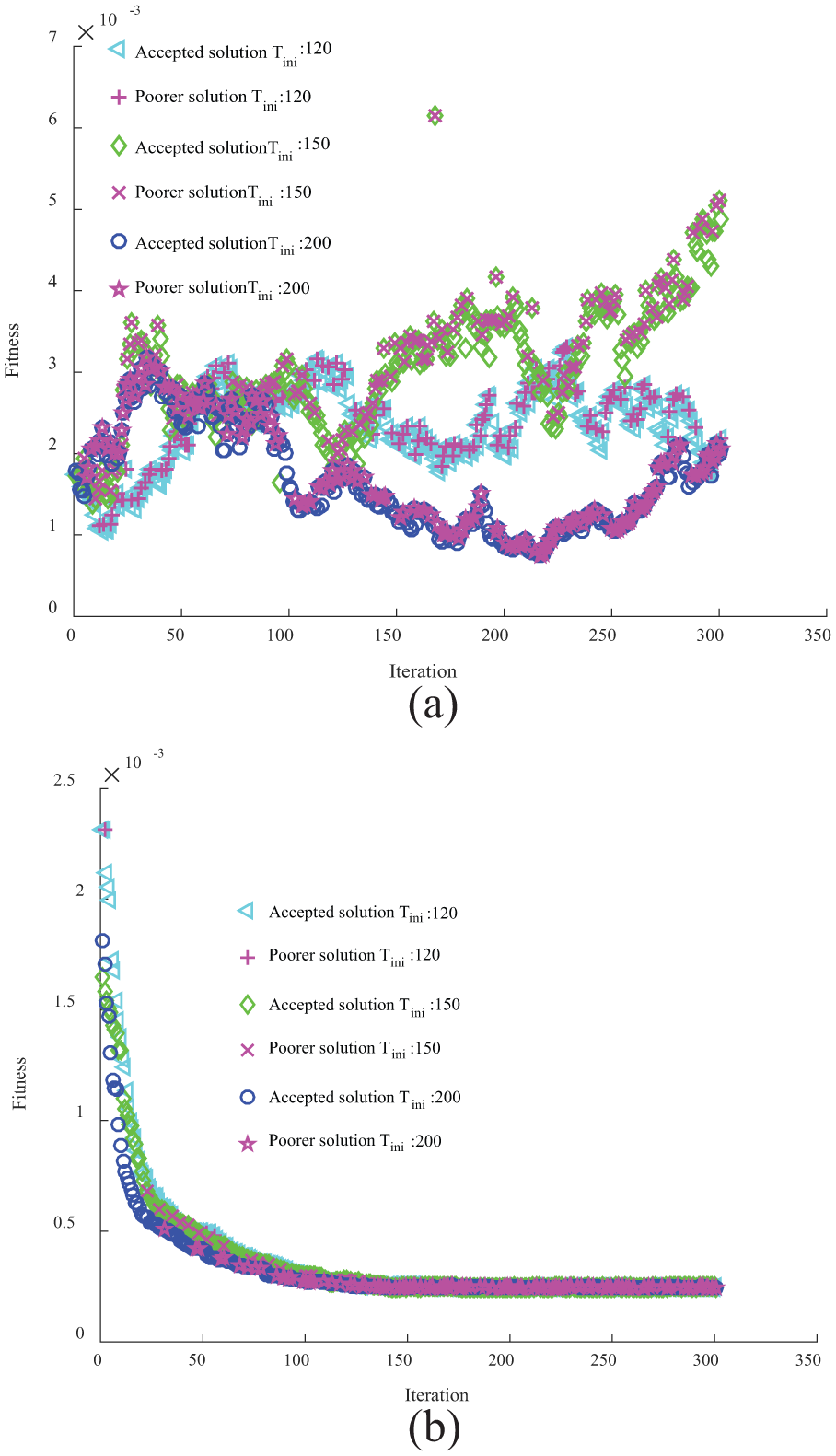
The convergence of algorithms at
Comparison of ISA and GALMA
With the same test set, GALMA was carried out in following situation: the low board of the sixth parameter was [0.3], the upper board was [0.5], and the maximum number of iterations was 100.
Table 3 shows parameters identified by GALMA and ISA. Both of
The identified parameters of Zhu’s model.

ISA: improved simulated annealing.
GALMA and ISA are stochastic optimization algorithms, and they each ran 10 times. According to
The results of Wilcoxon’s test.

The results of ISA for Zhu’s model
With the identified parameters, the time history of VIVF was reconstructed by formula (3). It can be seen from Figure 6 that the reconstructed VIVF has a pattern of the curve in common with the measured VIVF.

VIVFs in the time domain.
Figure 7 shows that VIVFs in the frequency domain have three significant frequency points: f,

VIVFs in the frequency domain.
For the engineering application, the maximum displacement response needs to be predicted in the design stage of structures, which helps to take effective measures to mitigate the effect of VIV. According to the reconstructed VIVF, the time history of displacement was predicted by the Newmark-β method at the wind speed

Comparison of the measured and predicted displacements: (a) time domain and (b) frequency domain.
It can be found from Figures 7 and 8(b) that the frequency of the measured displacement is equal to the most significant frequency of the reconstructed VIVF. For Zhu’s model, as can be seen from Figure 9, the first item, the second item, the third item, and the fifth item are responsible for f, and the first item and the third item have a major influence on the amplitude of f. Therefore, parameters
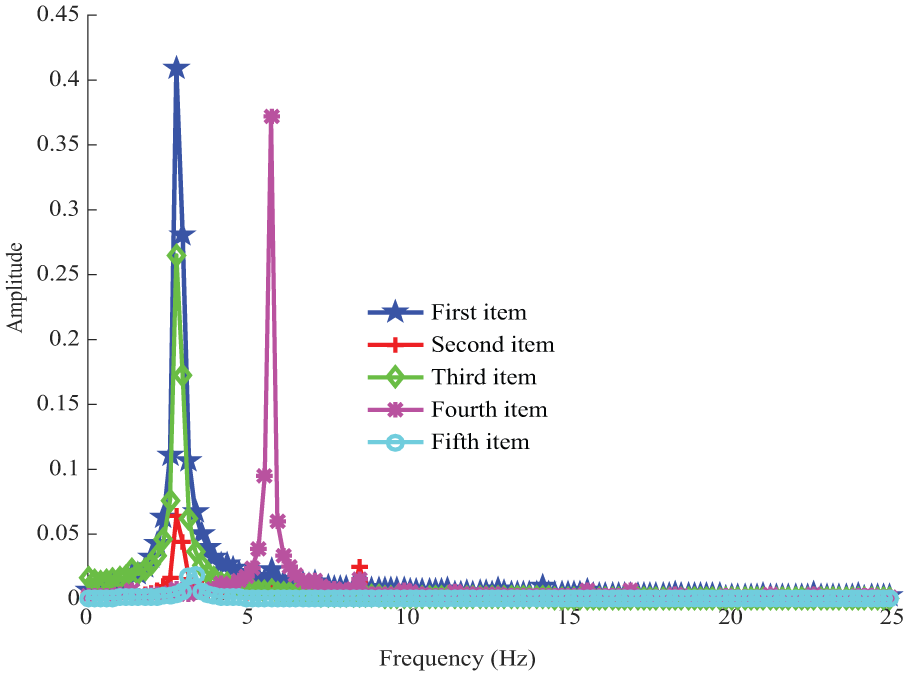
Frequency components of the reconstructed VIVF—The first item:
Conclusion
Parameter identification is of a great interest to many practitioners and researchers in engineering, since improper parameters can invalidate the model or weaken the explanatory power of the model to physical phenomena. The VIVF model aims to describe the vortex-induced force resulting from the wind–structure interaction in the lock-in range. Due to the complexity of the interaction, the model is nonlinear, and there are local minima in the solution space. LMA is apt to converge to the local minimum when a poor initial guess solution is provided. In practical application, an effective initial solution is difficult to obtain in advance. GALMA has high complexity because of mutation and crossover operations.
ISA, a simple effective method, is easily able to find the best solution. According to the results of Wilcoxon’s test, ISA is superior to GALMA. In general, ISA is a good choice when a simple and effective algorithm is needed.
Footnotes
Acknowledgements
The authors thank Dr Xiaoliang Meng, Tongji University, for test data and Dr Edward C Mignot, Shandong University, for linguistic advice.
Handling Editor: Luca Reggiani
Declaration of conflicting interests
The author(s) declared no potential conflicts of interest with respect to the research, authorship, and/or publication of this article.
Funding
The author(s) disclosed receipt of the following financial support for the research, authorship, and/or publication of this article: This work was partially supported by the 2015 Open Fund of Structure and Wind Tunnel Key Laboratory of Guangdong Province (no. 201502), Department of Education of Guangdong Province (grant nos 2017KTSCX121 and 2017KCXTD015), and State Natural Science Fund Project of China (grant no. 51308330).
