




Abstract
This article proposes a new analytical model for the low-strain integrity detection of a pipe pile embedded in a viscoelastic soil layer with radial inhomogeneity by extending Novak’s plane-strain model and transfer method of complex stiffness to consider viscous-type damping. The analytical solutions for the complex impedance, the velocity admittance and the reflected wave signal of velocity at the pile head are also derived. Extensive parametric analyses are further conducted to investigate the effects of the disturbance degree and the disturbance range of surrounding soil due to construction operation on the velocity admittance and the reflected wave signal of velocity at the pile head. It is demonstrated that the proposed model and the obtained solutions can provide extensive scope of application, compared with the relevant existing solutions.
Introduction
The dynamic response of pile–soil interaction is an important topic for geotechnical engineering and soil dynamics. It is well known that the construction operations may disturb the soil in the immediate vicinity around the pile, that is, the pile shaft is surrounded by an annular disturbed zone. In the early works of the problem of pile vibration, the surrounding soil is generally assumed to be radially homogeneous. However, this assumption may not be realistic when the construction disturbance is significant. To consider the radial inhomogeneity of the surrounding soil, Novak and colleagues1,2 proposed an analytical model to investigate the effect of reduced resistance of the soil around the pile by defining a massless annular boundary zone in their pioneering studies. Subsequently, Veletsos and Dotson3,4 extended Novak’s plane-strain model to further consider the inertia effect of the annular boundary zone. To describe the inhomogeneity of the boundary zone, Dotson and Veletsos 5 and Han and Sabin6,7 developed analytical models assuming a linear and a quadratic variation of shear modulus within the disturbed boundary zone, respectively. Furthermore, Nogami and Konagai8,9 and El Naggar and Novak 10 considered the radial inhomogeneity of the surrounding soil by obtaining the coefficients of the complex stiffness at the interface between the disturbed boundary zone and the ultimate undisturbed zone based on Novak’s model.
Furthermore, El Naggar 11 proposed an analytical model by dividing the boundary zone into N annular sub-zones to account for the radial inhomogeneity within the disturbed zone. However, Wang et al. 12 found that the effect of surrounding soil cannot be considered in El Naggar’s model. Subsequently, Wang et al. 13 and Yang et al. 14 proposed a new plane-strain model of solid pile embedded in viscoelastic soil with radial inhomogeneity by combining the complex stiffness transfer method and hysteretic-type damping model.
The aforementioned studies are mainly devoted to the solid pile. In addition, some substantial developments of the dynamic model for pipe pile have also been made by some investigators. For example, Ding and colleagues15–17 obtained an analytical solution for the vibration characteristics of large-diameter pipe piles in a viscoelastic soil under vertical excitation. Zheng et al. 18 proposed an analytical model for the vertical dynamic response of pipe piles in homogeneous viscoelastic soil accounting for the three-dimensional wave effect. Moreover, Li et al. 19 proposed an analytical solution for the dynamic impedance at the head of large-diameter pipe piles in radially inhomogeneous soil using a hysteretic-type damping model.
It is noted that hysteretic-type damping is independent of frequency to represent the material damping, and it has limitations in describing the dynamic response of related problems subjected to non-harmonic loads in the time domain. In contrast, the viscous-type damping is suitable for describing the dynamic response of pile vibrations subjected to generalized modes of dynamic load in the time domain.20,21 However, based on an extensive review of the literature, for the moment, no study has been conducted to the dynamic behaviour of a pipe pile in a viscoelastic soil layer with radial inhomogeneity using the viscous-type damping model. Consequently, the main purpose of this article is to propose a new analytical model for the low-strain integrity detection of a pipe pile embedded in a viscoelastic soil with radial inhomogeneity using the viscous-type damping model. In addition, the corresponding analytical solutions for the velocity admittance and the reflected signal of the wave velocity at the pile head are determined. Extensive parametric analyses have also been performed to discuss the effects of the disturbance degree and the disturbance range of surrounding soil due to construction operation on the velocity admittance and the reflected signal of the wave velocity at the pile head.
Formulation of the governing equations
The analytical model of the pile–soil interaction system is shown in Figure 1(a) and (b). The thickness of the soil layer is H. The inner and outer radius of the pile 0 are

Analytical model: (a) section view and (b) vertical view.
The undisturbed zone of the surrounding soil is homogeneous, isotropic and viscoelastic with viscous-type damping. Within the disturbed zone,


where
In this article, the following assumptions are used:
The pile is linear elastic with a circular cross section.
The outer surrounding soil of the interaction system consists of two annular zones, an inner disturbed zone and an outer undisturbed zone with semi-infinity.
The inner annular zone of disturbed soil is divided into a series of sub-zones. The soil properties within different annular sub-zones are radially inhomogeneous.
The frequency-dependent viscous-type damping is used to describe the inside and outside soil of pipe pile.
The deformations of the pile and surrounding soil are small. The equilibrium of shear stress and the continuity of displacement are both satisfied at the interfaces between pipe pile, adjacent annular zones and sub-zones of the surrounding soil.
Based on Novak’s plane-strain model, the governing equation for the ith inner annular sub-zone of disturbed zone is given by equation (3)

where
Similarly, the governing equation for the ith layer of inside soil can be written as follows

where
The governing equation for the ith pile segment is expressed as follows

where
Solutions of the governing equations
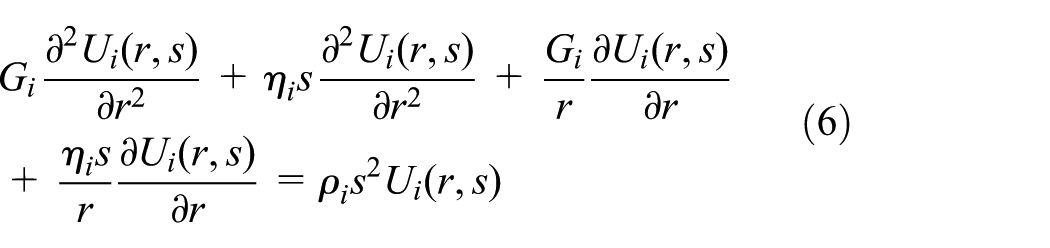
Applying the Laplace transform to equation (3) yields
where
After rearranging the terms in equation (6), equation (7) is obtained as follows

where
The general solution of equation (7) can be expressed as follows

where
The displacement at the outermost zone of the outer soil diminishes at infinity and can be written as follows

Then, it yields


The vertical shear stress of the undisturbed zone can be expressed as follows

Then, the vertical complex stiffness at the interface between the disturbed zone and the undisturbed zone can be conveniently expressed as follows

The shear stress of the ith annular sub-zone can be given by

Therefore, the vertical complex stiffness at the outer boundary (r=ri+1) of the ith sub-zone is expressed as follows

Similarly, the vertical complex stiffness at the inner boundary (r = ri)

Thus, the recursion formula of the vertical stiffness can be easily given by

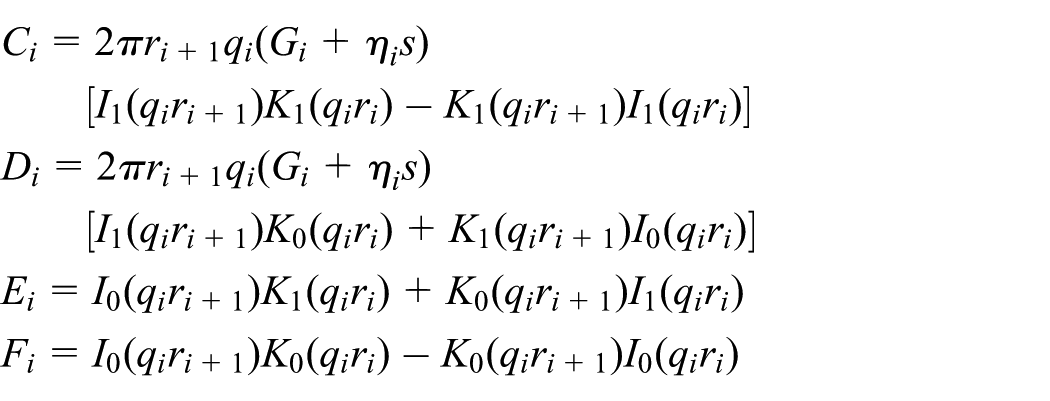
where
Applying the Laplace transform in equation (4), it yields

where
After rearranging the terms in equation (17), it yields

where
The general solution of equation (18) can be given by

The displacement of inner soil is a limited value if r = 0, namely,
Then, equation (19) can be reduced to

Combining the displacement continuity at the interface between the pile shaft and the inner soil

Performing the Laplace transform in equation (5) and combining with equations (14) and (21), it gives

where
The general solution of equation (22) can be expressed as follows

The boundary conditions at the pile toe and the pile head can be given by equations (24a) and (24b), respectively


Applying the Laplace transform in equations (24a) and (24b) and combining with equation (23), it yields


where
Substituting equations (25a) and (25b) into equation (23), it can be given by

Given s = iω, the complex impedance of the vertical displacement at the pile head can be expressed as follows


where
Furthermore,

where
The frequency response function of the vertical displacement at the pile head can be given by


where
Taking a transient semi-sine wave
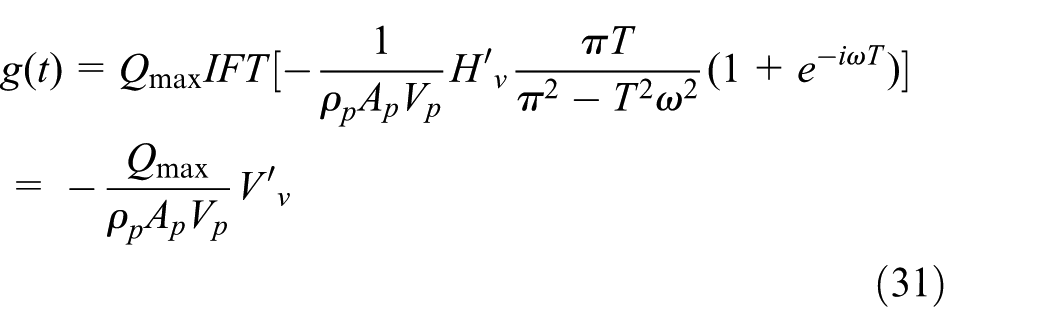

where Qmax and T are the excitation amplitude and impulse width, respectively;
Results and discussion
In this section, numerical results are presented to investigate the vertical dynamic response for integrity testing of a pipe pile embedded in a viscoelastic soil layer with radial inhomogeneity.
Unless otherwise specified, the following parameter values are used: H = 6 m, r0 = 0.38 m, r1=b=0.5 m,
Figure 2 shows the effect of soil weakening
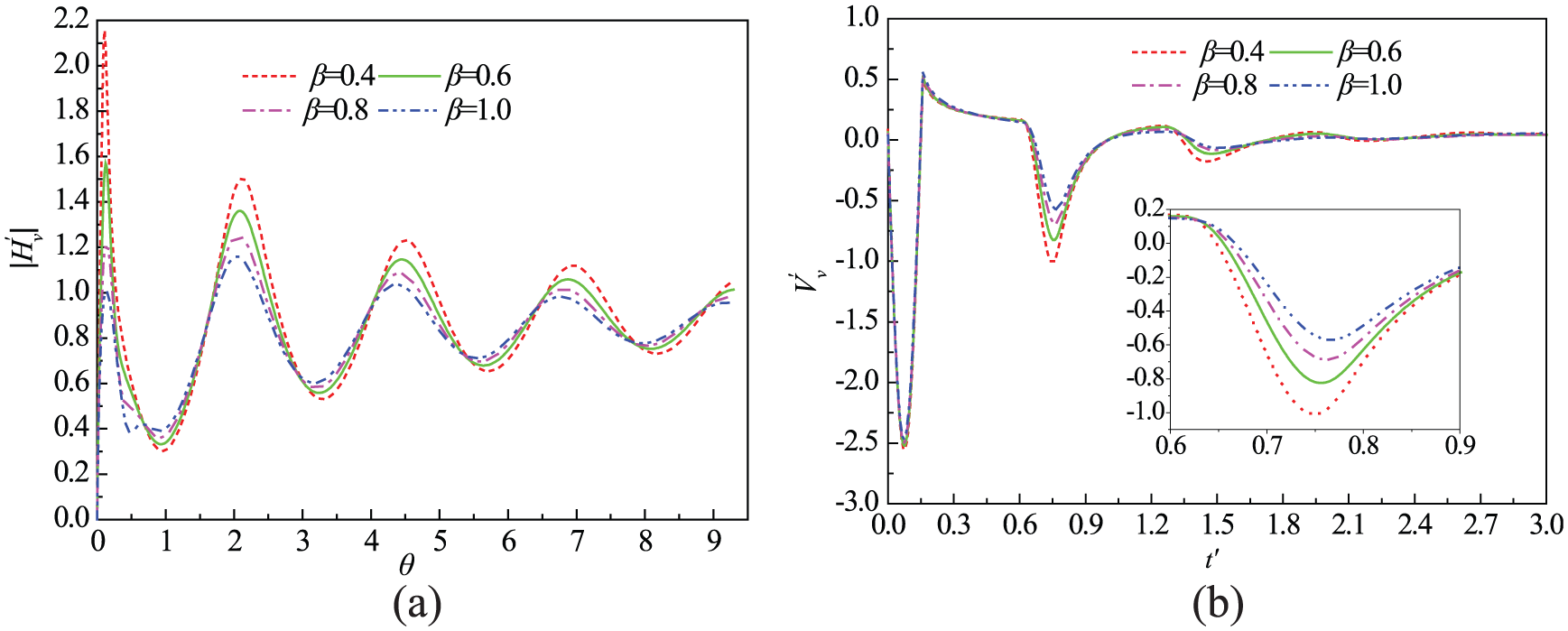
Effect of soil weakening due to construction disturbance on dynamic response at the pile head: (a) velocity admittance and (b) reflected signal.
Figure 3 displays the effect of the weakening range on the velocity admittance and the reflected wave signal of velocity at the pile head when β = 0.4. It can be seen that the oscillation amplitudes of the velocity admittance and the reflected signal increase with an increase in the weakening zone of the surrounding soil. In contrast, the change in the resonance frequencies of the velocity admittance can be practically ignored when there is an increase in the weakening range b. Furthermore, the more weakening range b of surrounding soil, the corresponding effect on the dynamic response is less at the pile head.

Effect of weakening range due to construction disturbance on dynamic response at the pile head (β = 0.4): (a) velocity admittance and (b) reflected signal.
Figure 4 shows the effect of soil strengthening

Effect of soil strengthening due to construction disturbance on dynamic response at the pile head: (a) velocity admittance and (b) reflected signal.
Figure 5 shows the effect of the strengthening range of the surrounding soil on the velocity admittance and the reflected wave signal of velocity at the pile head when β = 2.0. It is indicated that the oscillation amplitudes of the velocity admittance and the reflected wave signal increase with a decrease in the strengthening range. In contrast, the effect of the strengthening range on the resonance frequencies of the velocity admittance can also be practically ignored. In addition, the larger the strengthening range of the surrounding soil, the corresponding effect on the dynamic response is less at the pile head.
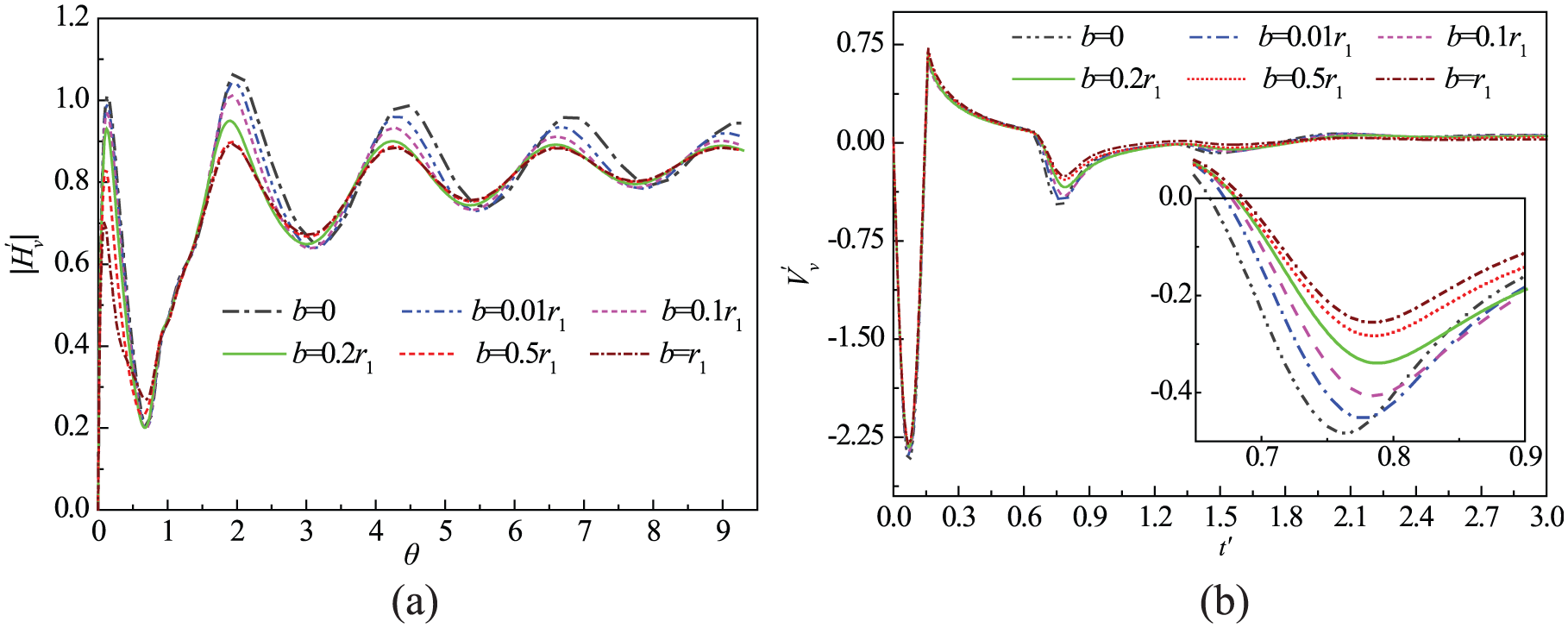
Effect of strengthening range due to construction disturbance on dynamic response at the pile head (β = 2.0): (a) velocity admittance and (b) reflected signal.
Conclusion
Based on Novak’s plane-strain model, a new analytical model for the low-strain integrity detection of a pipe pile embedded in a viscoelastic soil layer with radial inhomogeneity is proposed by extending transfer method of complex stiffness to consider viscous-type damping. The analytical solutions for the complex impedance, the velocity admittance and the reflected wave signal of velocity at the pile head are also derived.
Extensive parametric analyses are further performed to investigate the effects of the coefficient of disturbance degree, the weakening or strengthening range of surrounding soil on the velocity admittance and the reflected wave signal of velocity at the pile head. The results show that (1) the oscillation amplitudes and the resonance frequencies of velocity admittance and the amplitudes of the reflected wave signal decrease with an increase in the coefficient of disturbance degree and (2) the effect of the disturbance range on the resonance frequencies of the velocity admittance can be practically ignored.
The proposed model and obtained solutions can be reduced to analyse the integrity detection of an end-bearing pile in a viscoelastic soil described in related previous studies. In addition, the obtained solutions can also be conveniently reduced to investigate the vertical vibration problem of solid pile or pipe pile embedded in radially homogeneous medium.
Footnotes
Acknowledgements
The first author (C.C.) would like to acknowledge the support from Key Laboratory of Ministry of Education for Geomechanics and Embankment Engineering, Hohai University.
Handling Editor: Zhiwei Gao
Declaration of conflicting interests
The author(s) declared no potential conflicts of interest with respect to the research, authorship, and/or publication of this article.
Funding
The author(s) disclosed receipt of the following financial support for the research, authorship, and/or publication of this article: This work was financially supported by the National Natural Science Foundation of China (grant nos 51578100, 51722801 and 51878109) and the Fundamental Research Funds for the Central Universities (grant no. 3132018110).