




Abstract
The energy consumption of nodes is strictly limited in wireless sensor networks. The traditional direct delivery routing protocol is employed in the paging network of high-rise building construction elevators, which results in the high energy consumption and low successful delivery rate. A load-balancing equal opportunity routing protocol for wireless paging network is proposed in this work. The load-balancing equal opportunity routing protocol is a data transfer technique which maintains the network survivability by selecting the optimal path with both the lower energy consumption and the balanced network load. A load-balancing scheme gives equal opportunities for package transmission. A pager node delivers the packages by selecting a neighbor node with higher energy. The neighbor nodes in the coverage of the source node have an equal opportunity for routing. The sink node in the paging network broadcasts routing messages when moving along the track during the path selecting. The proposed load-balancing equal opportunity routing protocol is implemented and evaluated in a high-rise building construction elevator. The experimental results show that the average energy consumption of nodes is lowered with a balanced network load. It is estimated that successful delivery rate is increased by 55% but with a higher latency, and the network lifetime is prolonged.
Keywords
Introduction
A wireless sensor network (WSN)1–3 is a self-organized wireless network consisting of a large number of spatially distributed sensors or nodes to monitor physical or environmental conditions. A WSN system incorporates multiple distributed nodes and a sink node that provides wireless connectivity compared to the wired networks. WSN can be widely used in the areas such as remote monitoring, logistics, construction, underwater environment, 4 surveillance, home security, agriculture, 5 and structural health monitoring.6,7
In the construction engineering, WSN is employed to monitor the work status of construction mechanism devices and provide the information exchange for the workers. One of the applications in high-rise construction scenario is the wireless paging network (WPN) in a construction hoist. A construction hoist is a lifting vehicle for transporting the staff and construction materials in high-rise building construction. Usually it has no digital wireless message transmitting systems in the traditional old construction hoist in China. The workers in the building often call the operator of the elevator by hitting the steel tube of the track of the elevator with a hammer or by throwing stones at the elevator track. Consequently, the elevator runs with low efficiency in an inconvenient and unsafe condition. It is specified that a message communication device must be installed in an elevator in Chinese construction specification JGJ55-99.
A WPN is an alternative better solution for message delivery and condition monitoring between an elevator and workers. WPN is embedded in the controlling system of the construction hoist and transfers the message between floors and the elevator. WPN is a ZigBee-based WSN8–10 which employs IEEE 802.15.4 protocol. However, as in a WSN, the nodes in WPN also contain several technical challenging issues. These may include the radio, battery, microcontroller, analog circuit and the lifetime constraints imposed by the limited energy power of the nodes in the network. Unreliable communication, due to the wireless medium, results in higher power consumption of WSN node. In battery-powered systems, higher radio data rates and more frequent radio use will consume more power. 11 The pagers may need to transfer the message frequently. Since the battery life in WSN is a constraint, the pagers are designed based on ZigBee due to its low power consumption in this work. The lifetime of WSN is probably dependent on the average power consumption of the nodes in the WSN. In addition to the lifetime of WSN, the quality of service (QoS) of WSN must be considered. It is a trade-off between the power consumption and the QoS of WSN, which makes how to extend the lifetime of WSN with better QoS an attractive and challenging problem. For example, the direct delivery (DD) algorithm is in practice an available solution to reduce the package collision rate in the WPN. But it shows some limitations in terms of QoS. A large number of broadcast packages are produced in the paging process because the packages that are transmitted with DD algorithm result in low successful delivery rate (SDR) of data, and increase time delay and energy consumption.
The limited coverage of the pager node and the sink node makes it important that each node works as long as possible in a WPN of a construction hoist. Therefore, energy conservation and network lifetime are more important than SDR and per-node latency. According to the construction hoist’s working environment, a load-balancing equal opportunity (LBEO) routing algorithm is presented in this article to reduce the power consumption and ensure the fair and balanced energy consumption among nodes. The nodes with higher energy are able to join in the path selecting in LBEO. Each node has equal opportunity in power consumption to transmit the packets, and the network load is balanced as well as the lifetime is prolonged. However, the SDR is increased and the average energy consumption of the node is lowered but with higher packet latency.
Related works
In order to improve the survivability and performance of WSN, both lower end-to-end delay and load balancing have been deployed by a multi-path delivery resolution. The nodes may deliver the data along multiple paths. 12 A shortest path selecting algorithm is often used in WSN. However, it may not consume the minimum energy and the network traffic load may be increased. Alternatively, the data are probably forwarded along different paths to reduce energy consumption and avoid heavy traffic. 13 Most of the previous works on routing deal with the problem of finding and maintaining correct routes to the destination in mobility topology. In recent years, the problem of minimum energy routing has been addressed, including minimum energy consuming of paths and energy sensing of nodes. Considering the scenario of the networks working with high traffic, a congestion- and interference-aware energy-efficient routing technique for WSN is proposed which is named as survivable path routing. 14 Fouchal et al. 15 present a study on power management optimisation over a sensor network, which is dependent on the energy status and the network energy. The minimum energy consuming path of multiple routing paths is the optimal path, therefore, the total energy consumption of the network is reduced.16,17 The nodes with low energy are discarded when designing the routing construction in the nodes’ energy sensing algorithm.18,19 Considering power saving, which is the most important challenge, Bernard and Fouchal 20 propose a distributed and adaptive gossiping technique that guarantees communications over all sensors and saves a high amount of energy. An energy-balanced routing protocol for WSNs is proposed by Li and Donghui 21 with this algorithm, where the network is divided into several clusters usingK-means++ algorithm. A dynamic slot scheduling in WSN is proposed by Al-Ghamdi et al., 22 which has different time constraints and is able to provide a dynamic scheduling procedure for all tasks. Huo and Wang 23 present an improved probabilistic routing algorithm based on the received signal strength indication (RSSI), which lowered the switching packages but it is assumed that the coverage of the sink node is able to access all nodes in WSN. Lindgren et al. 24 propose a probabilistic routing algorithm, which relies on the successful delivery ratios of different routing paths. Jiang et al. 25 propose an energy-delay-constraint adaptive routing for intermittently connected mobile WSNs. Chessa et al. 26 give a routing protocol that works on the space of virtual coordinates which guarantees delivery in both two-dimensional (2D) and three-dimensional WSNs.
All of these works have provided a reliable basis for deep research of routing in WSN. However, the central node of the WPN in a construction hoist continuously and randomly moves in the cage along the elevator track. Therefore, the sink node is mobile in the WPN topology, as well as the coverage of sink node also moves.
In our study, the network has mobile topology and the routing paths are constructed with equal and balanced energy-consuming opportunity. The objective of LBEO algorithm is to (1) lower the energy consumption of each node on the basis of traffic load balancing of the network, (2) improve the QoS in WSN, and (3) ensure routing algorithm is simple enough to be able to apply in the high-rise construction industry.
Industrial design of WPN
The WPN in a construction hoist is actually a wireless network which employs the ZigBee protocol stack. In order to simplify the design process, a ZigBee protocol integrated microcontroller CC2530 is selected as the processor in the pager design. The CC2530 is a system-on-chip (SoC) solution produced by Texas Instruments, which is specifically tailored for IEEE 802.15.4 and ZigBee applications. 27 The CC2530 combines the CC2530 RF transceiver with an enhanced 8051 MCU, as well as the industry ZigBee protocol stack (Z-Stack).
The sink node (also named receiver) mounted in the cage of the elevator is powered by an industry power of 380 V AC which is available in the cage of a construction hoist. The pager node is located on each floor, which is powered by a DC battery. The workers on each floor are able to contact the elevator operator by pressing the button on the pagers. The battery used in the pager node is an alkaline battery with 3 V and 2800 mAh. The scenario of WPN is indicated in Figure 1.

Scenario of wireless paging network application.
The sink node is the central device, as well as the data collection and management system of the WPN. The sink node always moves linearly on the track of a construction hoist in WPN. A CC2530 processor for radio frequency communication is embedded in both the pagers and the sink node. The multiple interfaces are designed for debugging, displaying, and message transmission in the sink node circuit. The microcontroller of sink node is a STM32 controller produced by STMicroelectronics. The internal diagrams of the receiver module and pagers are shown in Figures 2 and 3, respectively.
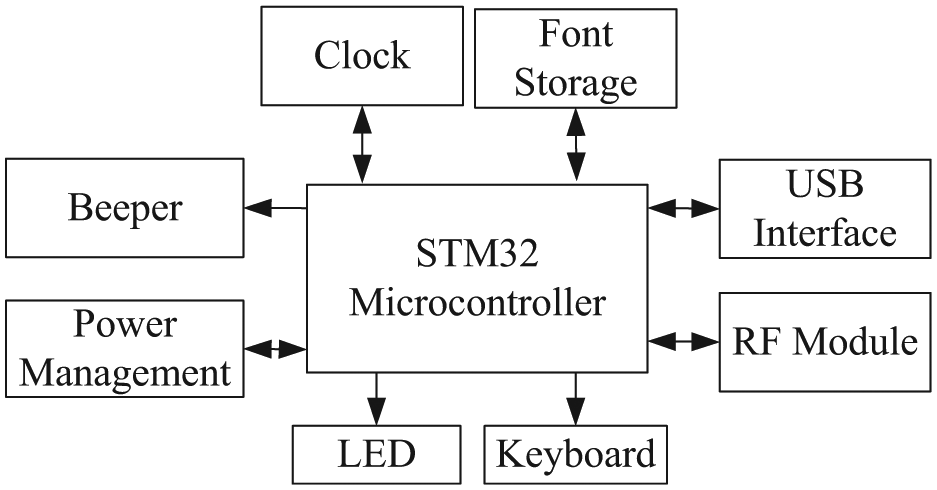
Diagram of sink node.

Diagram of pager.
A pager will transmit the message with formatted packets to the sink node when there are any requests initiated by the staff on each floor. When the sink node receives the package from the pager, the floor number is shown on an LED screen to inform the operator, which is shown in Figure 4. Hence, the operator in the cage then drives the elevator to its destination floor.
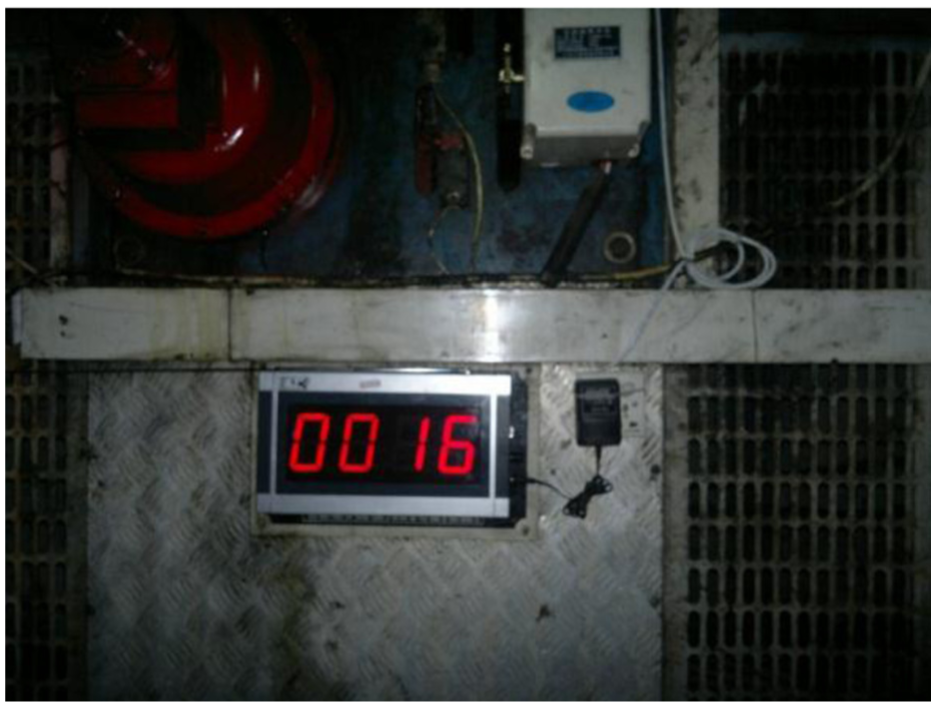
Sink node in the cage.
When the ZigBee-based WPN is applied in the construction hoist, its quality is improved from the following aspects. The production time is shortened and the efficiency is improved by the development of ZigBee embedded CC2530 controller. Safety in the construction work is also ensured due to the elimination of wired media, which may be hazardous or unsafe and may result in severe injury if the cable is exposed at each floor on the construction site. The cost is lower in comparison with a wired one by reducing assemble/disassemble, cable cost, and so on.
LBEO routing descriptions
Network topology and conditions
A WPN is a special WSN application in a construction hoist. The wireless pager nodes are linearly distributed in an area shown in Figure 5. The sink node is mobile and moves along with the line of pager nodes in this area.
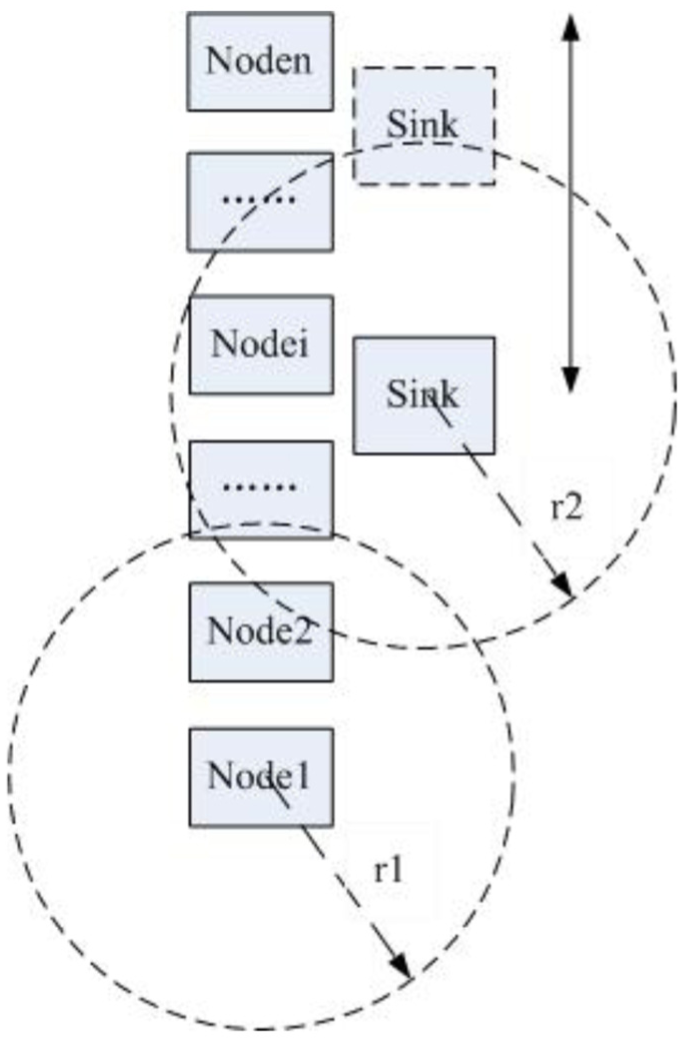
WSN topology in construction hoist.
The packets are delivered to a mobile sink node by pagers in the network coverage. All pagers in WSN are assumed to have the same capability of packet forwarding, that is, relaying an incoming packet to one of its covered neighbor nodes, and the transmitted energy level can be adjusted to the same level which is appropriate for signal coverage in their communication range. The sink node is able to receive the data correctly if the pager is within its transmission range. Consequently, the WPN topology is characterized as follows:
All pager nodes are immobile, and the sink node is mobile;
Only one sink node exists in the wireless network;
All pagers are with the same coverage diameter r1, and the sink node coverage is r2;
The mobility of the sink node does not consume energy for itself;
The speed of packet delivery is far greater than that of the moving sink node (which is rational in the WPN scenario);
Each pager node knows its coverage and the ID number of neighboring pager nodes in this coverage (which can be tested and programmed in the software);
Each pager node transmits or receives the same length packet with the same energy consumption.
Hops are usually used to define how many nodes it took for a message to go from a source to a destination or sink node. In this article, the number of transmitting or forwarding a packet by one node is also defined as a hop. Given a set of sensors, U ={u1, u2, …, un}, in a 2D area A. Each sensor ui, (i = 1, 2, …, n), is located at point (xi, yi) inside A and has a communicating range of ri which is usually called the communicating radius. Any point in A is said to be covered by ui if it is within the communicating range of ui, and any point in A is said to be k-covered if it is within at least k sensors’ communicating ranges. Some rules in this study are defined as follows. 28
Definition 1
Suppose that two sensors u1 and u2 are located inside a 2D area A. u1 and u2 are connected for they can communicate with each other. Nodes u1 and u2 are with connectivity for information transmission.
Definition 2: WSN
On plane A, if any node ui is with connectivity, all the nodes and their links are together called as WSN
Definition 3: routing path
WSN
Definition 4: communication distance
In the WSN
Definition 5: accessible node set
In the WSN
Definition 6: network lifetime
In the WSN
LBEO scheme
It is discussed in section “Related works” that numerous protocols have been presented for mobile networks. Most of the protocols are developed to deal with the typical limitations including high power consumption, low bandwidth, and high error rates in WSNs. However, the WPN topology is not similar to a normal mobile network. The WPN is composed of only one linearly moving sink node and a large number of static pager nodes. When a pager node expects to send a packet to the destination node and does not have a valid and fixed route to the destination, then the pager node has to start a path discovery process to select the neighbor node. The sink node is mobile and the distance from the pager node is variable, which may cause the accessible node set of the sink node to change. Consequently, the route path from a pager node to a sink node is variable in each routing process.
For the traffic load balancing and improving the performance, the equal opportunity of transmitting for those nodes with higher energy is considered in the LBEO routing scheme. The total energy of WSN is composed of the total power of all the nodes which are joined in the routing process. It is assumed that each pager node has the equal initial energy and consumes equal power for every data packet transmitted and received on condition of the same coverage. Thus, the forwarding of every packet from a pager node consumes equal energy. 29 It is concluded that the energy consumption of a node is proportional to the number of packets transmitted and received. This means the energy consumption is proportional to the hops in the routing process. Therefore, the number of data packets transmitted or received is considered when computing the energy consumption.
Given that the total number of transmitting or forwarding a packet by a node
The energy consumption on any path is related to the path length. The number of hops is the path length. In this work, the shortest path is not a priority for the purpose of equal and balanced energy consumption of the pager node. The more energy that is consumed will result in less power remained in the network. The LBEO scheme aims to make trade-off to reduce energy consumption and makes sure that the energy on each node is consumed fairly. Since the sink node moves randomly along with the track of the hoist, the optimal minimum path is able to be predicted during this process. In order to minimize the hops, the farthest pager in the accessible node set is considered to be the next relay node. If the residual energy of each node in the network is enough, the energy impact on each path is trivial. However, the increasing energy consumption means the network is getting worse, and the node with higher energy is preferred to be the next relay node in the routing process. The path routing is a dynamically optimized process. Generally speaking, a node in an accessible neighbor node set with higher energy has more opportunities to join the path routing discovery process. In this way, the energy consumption is able to be balanced among nodes.
Assuming that a relay node is randomly selected and a packet is delivered using a DD scheme, the probability of a pager becoming the next relay node is

where
The traffic load of the network and the fairness of energy consumption are primary considerations for the path selecting in LBEO. The node with higher residual energy, which means with more hops, is preferred when selecting the relay node. The probability of a node in this article is given by

where
The end-to-end packet latency is another QoS parameter in WSNs. The importance of latency depends on the applications or the node status. Per-node latency is less important in WPN, and we can trade it off for energy savings. The average time delay is the average one-path latency observed from a source node to a sink node. This latency defines the estimated time consumption of transmitting a packet in WSN. Theoretically, the shortest path is with the minimized delay. LBEO algorithm tries to reach a compromise between packet latency and energy savings. However, the lower delay path is not reliable because of the mobility of the sink node. In order to simplify the routing process for construction hoist application, a node will relay the packet immediately when the node receives it. In this way, the average time delay in the routing path is the total forwarding time delays generated in each node. The forwarding delay

The pagers are linearly arrayed in WPN, and the sink node moves along with the track line. The source node is unable to estimate the moving direction of the sink node. If only one node is selected as the next hop relay, the routing path may be unsuitable or even leads to failure. Consider the left model (case 1) in Figure 6, where the sink node moves down. Node
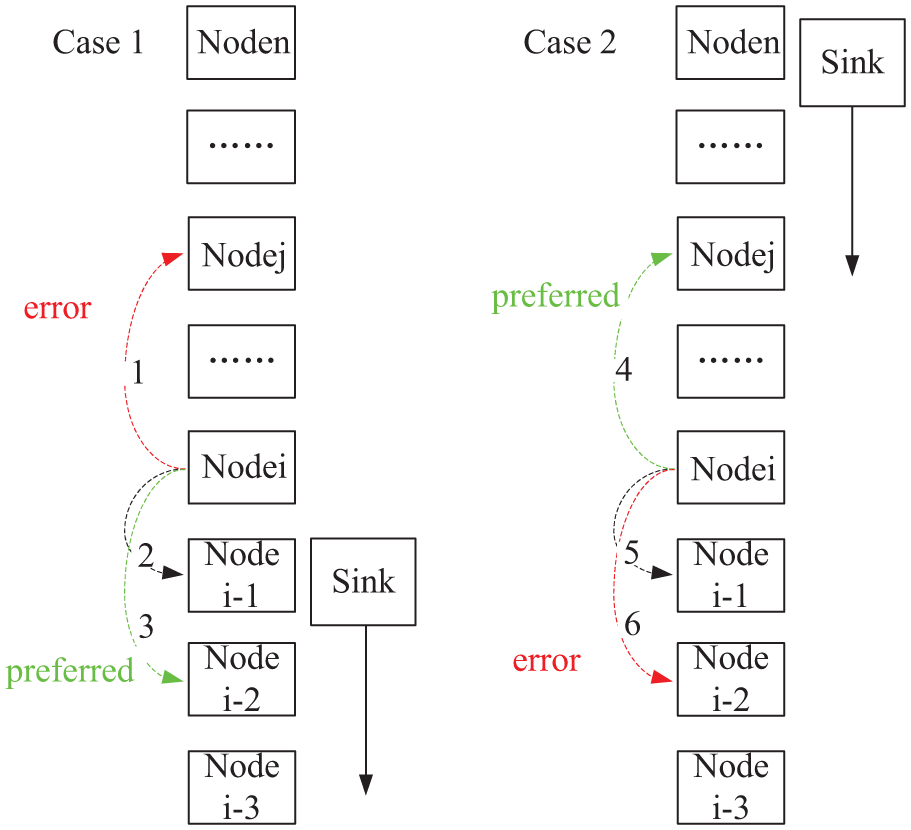
Routing model of LBEO.
The LBEO scheme focuses on reducing the energy consumption and tries to achieve a traffic load balance in WPN. The objective function is given by

This equation investigates the compromise between the shortest communication distance and the maximum residual energy.
The packet in WPN contains the necessary information in the LBEO routing process. The packet format is indicated in Figure 7.

Package format of LBEO.
There are seven segments in the package. Each section is interpreted as follows:
ID-sou: ID of source pager node (1 byte);
ID-relay: ID of relay node; this section is refreshed when the package is forwarded (1 byte);
ID-des: ID of destination pager node in WPN; it is often represented by the sink node (1 byte);
Seq-num: the routing sequence number. It specifies the sequence number of each different routing process. The routing sequence number, ID of source node, and ID of destination node are used to maintain up-to-date information about the forward route to the destination 30 (2 bytes);
Route-path: it is stored with an array, denotes all the ID number which the package has passed through from the source node to the current node. Hence, the ID number sequence depicts the path of the current routing process. The length of this section is variable, but has a maximum length of 20 bytes.
Hops: the package hops (hi) from the source node to the current node; when the package arrives at the current node, hi + 1 (1 byte);
Hops-sum: it is expressed as hti; this section is filled with an array, which denotes the total number of transmitting or forwarding a packet of a node (3 bytes);
In a multihop network, the node which is selected as cluster head with high probability will have its energy increasingly consumed and the network lifetime will sharply reduce. Instead of a cluster of multihop network, 31 LBEO routing scheme selects the node with higher energy as the relay node. The sink node broadcasts a residual energy (RE) packet to the nodes in the network to inform them of the energy information of all nodes every 5 s. Therefore, all nodes in the network know the energy of their accessible neighbors. However, traffic load is a major consideration to estimate network congestion or availability. We also consider traffic load balance among nodes to optimize energy consumption, so as to prolong network lifetime as long as possible. By the two considerations, the routing process is that the pager computes the probability of forwarding a packet from itself and selects the nodes with both higher energy and lower traffic load in two moving directions in its accessible node set. In brief, both power consumption and traffic load are considered in LBEO scheme. When its neighbors receive the packet, the node in the accessible set will first judge if the path destination of this frame is itself. If it is, this node will compute and select the next relay node with the same rule denoted by equation (4) by refreshing the ID number in the packet. The selected node is with higher priority to forward the package to the selected neighbor. This relay process is continued until the destination node is found. If it is not, the node will discard the packet and wait for the next packet. LBEO scheme combines the sequence number of all nodes including source node, relay node, and destination node to ensure all paths are containing the correct and necessary information for any real-time forwarding nodes. During the path selecting process, there are four kinds of packets which may be received by a pager node: RE-Quest, Broadcast, Sink-Ack, and Paging packets. When a pager node receives one frame, it resolves the packet and judges its type. The pager node deals with the packet in accordance with various package types. The flowchart of path routing solution is shown in Figure 8.

Flow chart of LBEO.
When a node receives a packet, it will compare the relay ID number in the frame with its own ID number. The same ID number proves that this node is the destination relay node of the packet route. This node will search and compute the nodes with higher energy but lower traffic load in the accessible set by the following pseudo-code
Searching
ID-relay = i;
Forwarding:
LBEO algorithm is an improvement compared with DD routing because it can minimize the number of required broadcasts by selecting path on a demand basis and it achieves fairness and balanced energy consumption by energy information collection and routing information refreshing. Nodes which are not on a selected path do not maintain routing information and they only participate in energy information refreshing broadcasted by a sink node.
Experimental evaluations
We evaluate the LBEO algorithm in a WPN in the construction site in Chongqing, China. The experiment aims to explore the LBEO route establishment and estimate both energy consumption and successful data delivery rate compared with a routing scheme based on DD. In addition, the end-to-end delay and the power consumption are discussed. It is expected that LBEO algorithm is able to prolong network lifetime and improve survivability.
As we know, energy consumption and network lifetime are not easy to be acquired in real time. Most of the energy consumed by a node is the packet transmitting and receiving power with radio frequency. The total packet hops (transmitting or forwarding a packet) of a node, hti, is a better parameter which is more easily to be sampled to estimate the energy consumption because more packets are relayed or forwarded, the much energy are consumed by radio frequency. For the same reason, we use the total hops’ number as the indirect indicator of network lifetime. The network system lifetime is often defined as the length of time until the first battery drains out among all nodes. Therefore, the network lifetime is proportional to the total hops’ number of a node.
Experimental environment
A high-rise building on the Hubinyuan construction site located in Yubei district, Chongqing, China, was chosen as the experiment building. Before the sensors can work correctly, they should be calibrated in a WSN. 32 The sensors in this network include one sink node and pagers. The sink node of the WPN is installed in the cage of a construction hoist, and the pagers are linearly installed on each floor of the building which is 85.66-m high and totally 28 floors. The construction hoist is manufactured by Chongqing Yingfengshen Machinery & Equipment Co., Ltd. The construction hoist moves up and down along the track mounted on the building with a velocity of 34 m/min, approximately 0.57 m/s. It is about 152 s for a round trip of the elevator on the building. The distance between each node is about 3 m. Since the gap between the track of the sink node and the linear track of pagers is very short compared with the coverage diameter of the pager, the moving track of sink node is regarded as the linear track of the pagers. According to the packet format, ID number of source pager node is 1 byte which means the maximum pager number in the network is 256. Most high-rise building in Chongqing covers from 12 to 33 floors. Actually, a typical number of pager from 12 to 33 is often used in construction site. The building in this experiment is with 28 floors. The experimental environment is shown in Figure 9.

Experimental environment.
There are 28 pager nodes and 1 sink node in the WPN. The energy consumption of each node is replaced by the total packets that a node has forwarded. The sink node broadcasts the energy consumption packet to pagers every 5 s. The length of each routing packet is 32 bytes. The transmitting power of the pager is limited to a coverage diameter of 5 pagers, that is about 15 m, and that of the sink node is about a coverage diameter of 30 m. It is statistically computed that the average packet-forwarding time delay
Parameters of experimental environment.

In order to find the relationship between the QoS parameters and the packet transmission period, the packet is sent at different time intervals. The initial transmission time for a packet of each pager is randomly decided with binary exponential back-off (BEB) algorithm, but it is limited within 30 s from the beginning of the experiment. The experiments are conducted for 40 times for computing the average values. The construction hoist moves a round trip for each experiment. The packet transmission period is changed with eight groups that are shown in Table 2.
Packet transmission period distribution.

Actually, pagers are randomly triggered by workers on construction sites when there is a transfer request. The pagers in the experiment are defined as the paging nodes that initially send the transfer request to the elevator which contains the source nodes. The other pagers in the paging network will join the path-selecting or the packet-forwarding process. The total number of participating paging nodes is shown in Table 3. The number of pager nodes in the network in the eight groups of testing is 2, 3, 4, 5, 6, 8, 10, and 12, respectively. When the pager number is smaller, the SDR is higher. With the increasing pagers, the SDR is lowered. The ID numbers of the source nodes are randomly generated for the simulation of a real application scenario.
Participated paging node distribution.

The parameters evaluated in this article include the following:
SDR. SDR is the percentage of packets received successfully by the sink node. It is computed by

where
2. Delays. The average time delay of valid packet from source node to sink node

where
3. Energy consumption. This parameter is expressed as the average network load that is given by following equation

where
4. Network lifetime. It is the total number of the packet hops from source node to sink node until the first pager node “died.”
Results and discussion
The LBEO algorithm is validated in the experiment. Since we do not at this time know exactly an optimal value for successful data delivery rate (SDR), we varied initializing participated pagers from 2 to 12 nodes. Figures 10 and 11 plot the average successful delivered data rate of the sink node on condition of different pagers and packet transmitting periods, respectively. The result in Figure 11 is computed with three participated pagers. It is observed that as the participated pagers got larger, the performance became worse. Note that in the worst case, when it has 12 participated pagers, the SDR may be reduced to less than 10%. The curves are almost monotonically increased when the number of pagers gets smaller. This phenomenon can be best explained as follows. When the number of pagers increases or the package transmitting cycle reduces, the traffic flow in the network becomes much heavier so as to increase the network load. Some packets may be discarded or lost if there is congestion in the network. The packet delivery failure rate becomes severe and intolerable when the network load increases to more than 10 initiative nodes. In Figure 10, the average SDR of 55% in LBEO is much higher than that of DD with variant BEB, which is approximately 37%. It is probable that a large amount of broadcasts in routing discovery produced in DD and variant BEB were eliminated in LBEO. Therefore, the network traffic load is reduced and packet loss is effectively alleviated.

SDR in different number of pagers with DD and LBEO.

SDR in different transmitting period with DD and LBEO.
The results of the time delay when participated pagers range from 2 to 12 is shown in Figure 12. Figure 13 shows the results in the case of three participated pagers with the packet transmitting period from 5 to 25 s. For these two cases, the time delay of the LBEO is higher than that of DD, which may probably be caused by the packet forwarding and the waiting time of timeout. When the package fails to arrive at the sink node or the relay node in LBEO scheme, the source node will resend the package after 0.5 s timeout. But the routing package in DD is delivered to the sink node after a back-off time is produced by variant BEB. The average delay between LBEO and DD is about 1 s. The curves in Figure 13 show a slightly descending trend with the transmitting period increasing for both DD and LBEO. This can be clearly interpreted that if the forwarding time and the timeout are constant, the impact on delay is trivial on condition of a low network traffic load.

Delay in different paging nodes with DD and LBEO.

Delay in different transmitting period with DD and LBEO.
As discussed above, the energy is mainly consumed by the transmission power. The energy consumption of a pager is basically proportional to the hops and the packets transmitted or received. For simplicity, it is suggested that we use the total transmitted or received packets by pager nodes instead of the absolute energy consumption to replace the energy consumption. The packages transmitted or received of two algorithms are presented in Figure 14. For each algorithm, a total number of 2–12 randomly generated pagers were joined in the paging process. When the number of participating pagers is smaller, the performance of DD is comparable to LBEO and the energy consumption is also lower. When the number of pagers increased, the average energy consumption became higher. In a congestion situation of 8–12 pagers in the network, DD algorithm shows a sharp increasing of packets to 5 or 8 packages per node. The lower average energy consumption in the WPN is obtained by the proposed LBEO algorithm which is about 1–3 packets compared with DD.
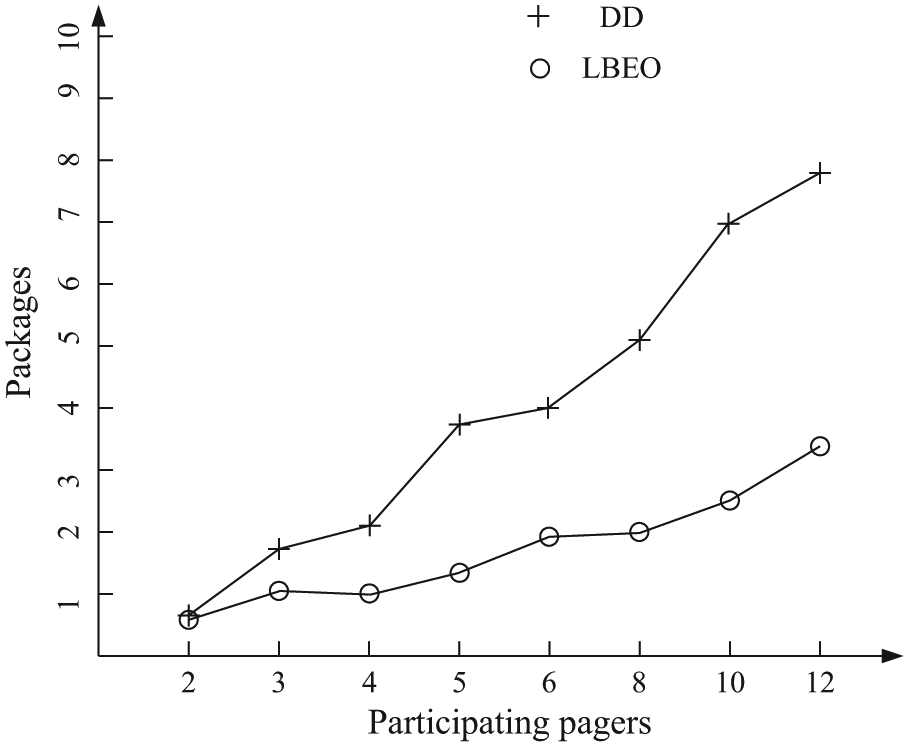
Transmitted or received packages of DD and LBEO.
The network lifetime is tested in this work. The sink node counts the total hops of a package from a source node to it during a continuously initiated paging process. It is assumed that the energy of the pager is completely drained out (died) when that pager emits an alarm to indicate a low battery. The network lifetime in hops is presented in Table 4. According to the table, the lifetime of LBEO is larger than that of DD. The LBEO lifetime is 13,732 and 11,919 hops when two and three pagers participated in the WPN, respectively.
SDR of DD and LBEO (%).
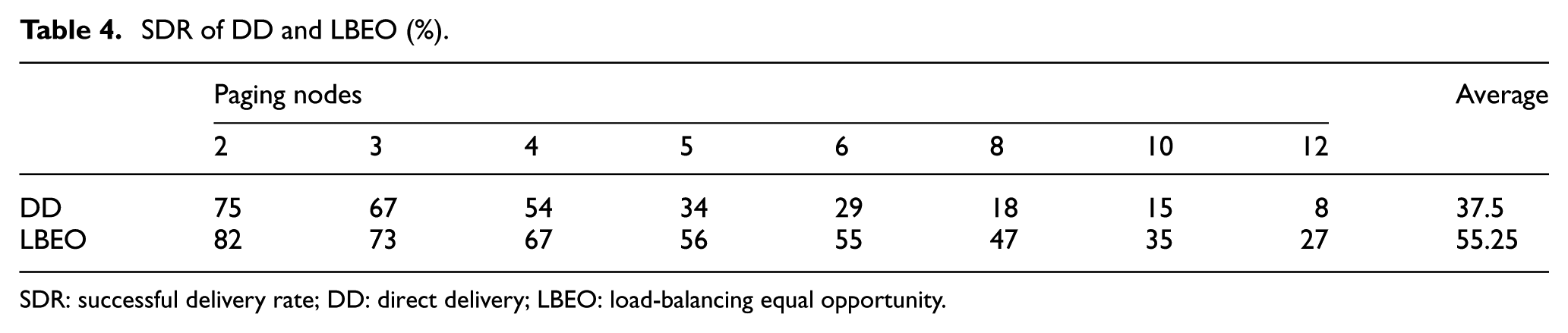
SDR: successful delivery rate; DD: direct delivery; LBEO: load-balancing equal opportunity.
The data in Table 5 show that the network lifetime becomes worse with the increasing initiatively participated pagers. This result is reasonable because more intermediate packets joining the routing discovery will make more energy consumed by the pagers.
Network lifetime of DD and LBEO.

DD: direct delivery; LBEO: load-balancing equal opportunity.
Think about the battery usage of pagers in the WSN. A battery with 3 V and 2800 mAh is employed in the pager. Given that the total work time of pager is about 10 h/day, an average transmitting times of 500 and receiving times of 7200 is estimated and obtained when using LBEO algorithm. Each transmitting and receiving process may consume 0.23 and 0.11 s, respectively. Based on the testing data by engineers, the transmitting current and receiving current for a pager is about 29 and 24 mA, respectively. The consumed current of a pager in working mode is about 124 mA and that of in sleep mode is about 0.002 mA which are detected by engineers. Therefore, the current consumed can be approximately computed and the electricity power is also able to be computed. Hence, the working time of battery is able to be estimated.
The electricity power consumed in transmitting and receiving mode is given by

The electricity power consumed in working mode is given by

The electricity power consumed in sleep mode is given by

The continuous work time of the battery can be computed by

It is theoretically concluded that the battery can be used for about 96 days.
The SDR and network lifetime are lowered using DD algorithm, and the average transmitting times of 640 and receiving times of 9936 are estimated in this article. Similarly, the continuous working time of the battery can be computed by

The actual continuous working days fed back from three costumers is about an average of 87 and 93 days, respectively, when using DD and LBEO algorithm.
The performance of LBEO is evaluated in the WPN. The QoS parameters such as SDR and time delay of LBEO are acceptable for the application in a construction hoist. Though the packet latency of LBEO scheme is slightly high, it is acceptable and tolerable for the insensitive time-delay application on a construction site. It is most important that the SDR has been increased, the energy consumption is lowered, and the network lifetime is prolonged using LBEO algorithm. Now the LBEO algorithm is used in many WPN applications produced by Chongqing Lexu Electronic Technology Co., Ltd.
Conclusion and future work
In a power-controlled WPN, battery energy of network nodes is a very limited resource that needs to be considered efficiently. Some of the conventional routing approaches may drain out the batteries on certain paths, which is the result of unequal consumption of node energy in WSN. A simple LBEO algorithm is proposed in this article to minimize the total consumed energy and balance the traffic load of network. The WPNs have approximately equal opportunity to transmit packets from each pager. LBEO routing algorithm provides better results than DD algorithm with regard to the SDR, system lifetime, and balanced traffic load in a network. Though the time delay is slightly increased which is acceptable in construction elevator application, the lower average energy consumption for nodes may balance the energy consumption rate among the nodes in proportion to their energy reserves.
In the future work, the routing algorithm of multiple sink nodes in the WPN should be taken into consideration for the purpose of multiple elevators’ application in construction site.
Footnotes
Acknowledgements
The experimental environment and construction hoist were constructed and provided by Chongqing Yingfengshen Machinery & Equipment Co., Ltd. The wireless paging network was provided and sponsored by Chonqing Lexu Electronic Technology Co., Ltd. Because the experiment was really a time-consuming job, the authors thank the efforts made by Mr Liu Xudong and Mr Jiang Jixun. The authors also thank Ms Jennifer Johnson, who worked in Chongqing Technology and Business University, for her paper revision work.
Handling Editor: Valerio Freschi
Declaration of conflicting interests
The author(s) declared no potential conflicts of interest with respect to the research, authorship, and/or publication of this article.
Funding
The author(s) disclosed receipt of the following financial support for the research, authorship, and/or publication of this article: This work was in part funded by Chongqing Science and Technology Commission, China (cstc2015jcyjA90003) and Chongqing Education Committee Cooperation Foundation, China under contract KJ1500620.