




Abstract
Currently, wearable devices are developing prosperously in the fields of global communication electronic products and personal intelligent terminals, but their information security problem cannot be ignored. Based on quantum security communication principle and combined with the special requirements of wearable devices for information security technology, this article gives a safe transmission scheme used for protecting the sensitive information of wearable devices. This scheme is to realize the safe transmission of sensitive information about wearable devices through quantum key distribution, quantum teleportation, and other quantum information security technologies and this scheme has an unconditional security than the traditional encryption methods based on algorithmic complexity.
Introduction
As the name implies, wearable devices are kinds of portable small and micro-type electronic equipment which can be directly worn on the user’s body or integrated into the user’s clothes, like intelligent glasses, smart watch, smart bracelet, and smart shoes for daily life and sports health as well as insulin pump, cardiac pacemaker, and other wearable medical devices. In 2012, “Google Glass” was launched, indicating that wearable devices actually enter into the people’s daily life. Afterwards, wearable devices have been developing prosperously in the fields of global communication electronic products and personal intelligent terminals. In China, Baidu, Mi, 360, and other large information technology (IT) companies and small and medium-sized innovative enterprises have also kept up with the pace of international development, and they have launched Baidu Eye, smart sports shoes, smart sports bracelet, and other wearable devices.1,2 It is generally agreed in academic circles that wearable devices will certainly be the development direction of future electronic products, and become the subverter of smartphone, tablet PC, and other existing information terminals. In the future, wearable devices will be further linked to the Things of Internet on the rise, and people can control the smart office, smart home, and smart car through the devices they wear, so as to realize the control of real world, making our work and life more convenient and comfortable.
However, the information security problem of wearable devices cannot be ignored. The more powerful the functions of wearable devices are, the more worrying the information security problem of wearable devices will be. If the information security lacks reliable guarantee, living habits, health information, or personal privacy may be leaked resulting in some hidden dangers such as theft of property, personal identity tracking, telecommunication fraud, and induction of other criminal acts. At the worst, wearable medical devices like cardiac pacemaker may be hijacked, to directly endanger the patient’s life safety. Nowadays, wearable devices are just in the start-up stage, and their system architecture and product characteristics are significantly different from the traditional information equipment. Reports on wearable devices being attacked are few, because hackers need to spend some time on technology tracking and crack research. With the quick development of intelligent wearable devices, however, the transient safe period will soon pass so that the information security problem will be highlighted gradually. In the future, it is very likely to become a critical weakness restricting further development and wide application of wearable devices.3,4
Considering the importance of the information security of wearable devices, we certainly can adopt the currently mature cryptography of computer networks. 5 However, the modern cryptogram system based on the intractability of complexity questions via mathematical calculation has its inherent defects: from a mathematical perspective, as this system is based on mathematical calculation complexity theory, with the continuous improvement of network computing power, it will be broken through or gradually become unsafe; from a physical perspective, the classical cipher system of current computer networks adopt the classic attribute of electronics or photonics to load information, and even a simple eavesdropping attack cannot be detected, which is another inherent defect it has.
Now, quantum cryptography has left the laboratory and is being continuously developed and perfected in actual applications. A quantum cryptosystem can just make up the defects of classical cryptography above. The security of quantum cryptography is not based on the mathematical computational complexity problem, but is guaranteed by the physical properties of the quantum states. Therefore, it has nothing to do with the attacker’s computing conditions (computing power or computing resources), which is called “unconditional security” of quantum cryptography. In addition, the attacker’s behavior will be discovered as it may cause disturbance to the quantum state of information carrier. This is the detect ability of quantum cryptography to eavesdropping attack. 6
At present, we have not seen the report of using quantum cryptography to solve the information transmission security problem of wearable devices, but some researchers have studied the application of quantum cryptography in the wireless sensor network. 7 Inspired by this idea, based on quantum security communication principle and combined with the special requirements of wearable devices for information security technology, this article gives a safe transmission scheme used for protecting the sensitive information of wearable devices.
Basic principle
Measuring basis and quantum measurement
In this article, two kinds of quantum measurements are needed: single-quantum bit measurement and double-quantum bit Bell combined measurement. In single-quantum bit measurement, basis
In the double-quantum bit system, the commonly used one group of complete orthogonal basis is Bell-basis, marked as


The double-quantum bit quantum measurement conducted on two-particle quantum system by use of one group of orthogonal complete measuring basis is called the Bell-basis combined measurement.
The four types of quantum states (Bell state) given in formulas (1)–(4) cannot be expressed as the tensor product formal of the single-quantum bit basis vector {|0〉,|1〉}. These quantum states are the maximally entangled states in the double-quantum bit system, which is also called as EPR (Einstein–Podolsky–Rosen) entangled pairs, playing a very important role in quantum privacy communication,
Quantum teleportation
The rough process of “quantum teleportation” 8 can be described thus: to transmit the unknown quantum state of an information photon, the information of such photon can be divided into classical information and quantum information, and then transmitted to the receiver in the remote, respectively, via classical channel and quantum channel. The receiver will, based on the classical information, adopt corresponding unitary transformation of the photon in its hands, to recover the quantum state to transmit, therefore, realizing the remote transmission of quantum state. It is required to notice that, the information photon is still in the hands of the receiver, however, the original quantum state of such photon has already been damaged in the process of Bell-basis combined measurement of teleportation, so quantum teleportation does not violate the no-cloning theorem of unknown quantum state. The unknown quantum state to transmit information photon in the hands of sender Alice is set as

Information photon 1 is in the state

Photon 2 is at the place of Alice, and photon 3 is at the place of Bob; at this time, the mixed state of the three photons is expressed as
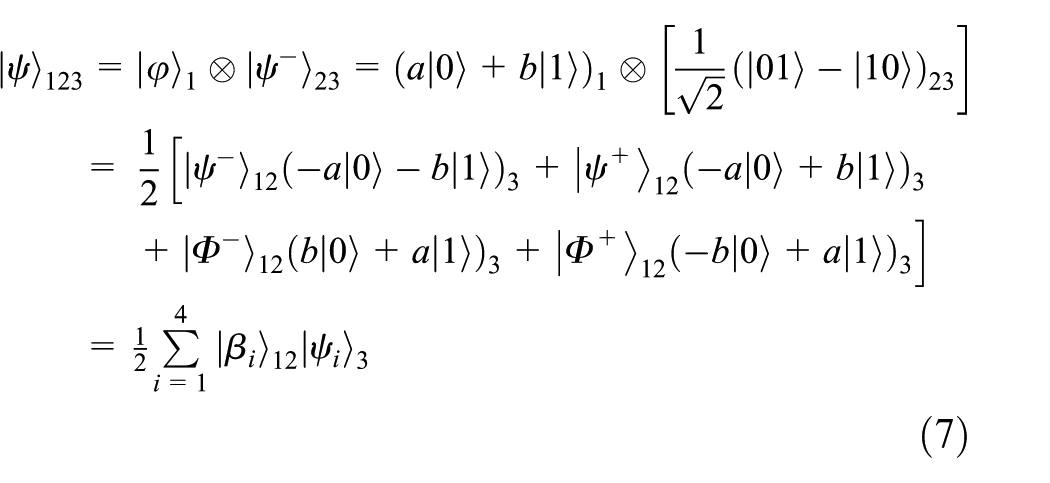
In the formula

Alice conducts Bell-basis combined measurement on photons 1 and 2, and sends the measuring result to Bob via classical channel. According to the principle of quantum measurement collapse, it can be known from formula (7) that photon 2 in the hands of Bob will instantly collapse to the corresponding quantum state given in Table 1 after measurement. According to the third column in Table 1, Bob adopts the corresponding quantum transformation, to restore the transmission of the unknown quantum state a of photon 1 on photon 3, and also the original quantum state

Corresponding quantum states and quantum operations of Alice and Bob.

Quantum teleportation has the following three features: (1) the transmission of quantum state is realized instantly, (2) there is no need to know where the opposite side is during the transmission, and (3) the transmission process will not be obstructed by any barrier. Based on such features, very important sensitive information may be loaded on the quantum state in the wearable devices for quantum communication. In this way, if the attacker intercepts and decodes the classical information, it is meaningless, for that such attacker only knows the quantum operation of photon 3 that Bob will take for the purpose of recovering the quantum state to transmit, and this is unrelated to the information loaded on the quantum state.
Quantum security communication in wearable devices
It is set that, the transmission of important sensitive information
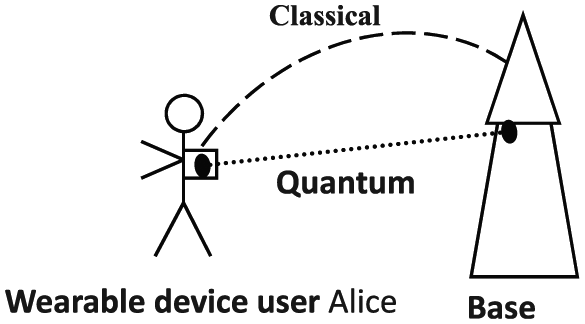
Quantum security communication model of wearable device and BS.
System initialization
Step 1: quantum channel preparation and security detection.
Step 2: quantum key distribution. BS may establish a sharing key KAB (2 N-bit) with the user Alice through well-known BB84, BBM92, or other mature quantum key distribution agreements.10–14 It is set as
Sending of sensitive information
Step1: preparation of information photon. The user prepares N-qubit information photon 1 sequence according to the sensitive information

or,

The two sides of communication may negotiate to determine to adopt formula (9) or (10). For example, the two sides agree to determine the rules of preparation with the key value k(n) of odd number bit
Step 2: Sending of information quantum state. The user Alice will conduct Bell-basis combined measurement to two photons corresponding to information photon 1 sequence in her hands and photon 2 sequence from BS. The measuring result is one of four Bell states

Step 3: Alice encrypts the Bell-basis measuring results of photon sequences 1 and 2 by use of the shared key KAB (2 N-bit), and then sent to BS.
Receiving of quantum information
Step1: after receiving the encrypted classical information sent by Alice, BS will decode with shared key KAB (2 N-bit), so as to know the result of Bell-basis measurement conducted by Alice to photon sequences 1 and 2, and then, according to Table 1, it will take the corresponding quantum transformation Ui to photon sequence 3 in its hands in sequence, so that the quantum state of information photon sequence 1 to transmit will be recovered on photon sequence 3.
Step 2: BS will, according to the agreement on adoption of formula (9) or (10) given in section “Sending of sensitive information,” correctly use basis
Security analysis
Security of quantum key distribution protocol: the security of QKD protocol is based on the principle of quantum mechanics rather than strong one-way encryption mathematical function, so it has “unconditional security” in theory. As for the BB84 protocol, GLLP theory 15 has proven that it can resist any attack; as for the decoy pulse QKD protocol, some scholars have given the security certificate of experimental hypothesis for realistic conditions.16,17
Since the unconditional security of key distribution is guaranteed with quantum key distribution technology, why not use these keys to directly encrypt sensitive information via one-time pad (OTP), to reach the purpose of unconditional security, rather than taking the additional means of teleportation and non-orthogonal basis quantum measurement. We hold that, according to OTP, a random and non-reusable key of the same length as the message should be used, and transmitting a sensitive message requires a new key. To guarantee the unconditional security of key distribution, one operation of quantum key distribution is needed in every communication, and the efficiency is very low. In this scheme, a shared quantum key is used for encrypting classical information, the key can be reused, and we also adopt the existing quantum encryption method18,19 to guarantee the unconditional security of classical information transmission.
Security of quantum state transmission: according to no-cloning theorem of unknown quantum state, whether it is the quantum state of information photon 1 prepared by the user Alice to transmit, or the quantum state recovered by BS through quantum U conversion, the attacker cannot reach the purpose of information eavesdropping by copying it. In the process of quantum teleportation, the classical information transmitted via classical channel is only the information of quantum unitary operation the receiver shall adopt to photon 3 in the receiver’s hands for recovering the quantum state to transmit, and it is unrelated to the sensitive information loaded on quantum state. In addition, such classical information is encrypted by shared key KAB of quantum key distribution in the transmission process, and the attacker cannot decode and tamper it, and KAB can also be reused.
Using the above scheme, we can solve the unconditional security of the sensitive information transmission between the wearable device and the BS, and even hackers with powerful computing power cannot steal the sensitive information of the users. Therefore, our quantum solution is safe and effective on the transmission of sensitive information of wearable devices.
Conclusion
Currently, wearable devices are increasing, having a promising development future, which are expected to become mainstream electronic products indispensable in the daily life of people after smartphone; however, their security is likely a critical weakness for their development. This article, considering the demand characteristics of wearable devices for information security, develops a prospective discussion on the transmission of sensitive information in wearable devices by use of the advantage that quantum information security technology has unconditional security without complex mathematical encryption algorithm.
Next, we will further optimize the scheme to study the perfect combination of the quantum secure communication technology and the wearable device. Of course, in terms of the current quantum information technology, quantum information transmission equipment is still difficult to apply to wearable devices because of its large volume and high cost. But just like computers, the original giant is getting smaller and smaller. With the development of quantum information technology, the application of quantum information transmission equipment to wearable devices is not an impossible thing.
Footnotes
Handling Editor: Suat Ozdemir
Declaration of conflicting interests
The author(s) declared no potential conflicts of interest with respect to the research, authorship, and/or publication of this article.
Funding
The author(s) disclosed receipt of the following financial support for the research, authorship, and/or publication of this article: This work was partially supported by the National Natural Science Foundation of China (No. 61771222), Science and technology projects of Guangdong Province (2016A010101017,2016A030313023), Science and Technology Project of Guangzhou (201707010253), 2018 Shenzhen Discipline Layout Project (JCYJ20170815145900474), and Shenzhen Basic Research Project (No. JCYJ20170818115704188).