




Abstract
In this article, the inhomogeneous energy consumption is characterized by the concept of information density, which is defined as the number of bits per unit time passing through a specific region. With information density, it is possible to derive the energy consumption of each region and determine the energy configuration scheme to maximize the network lifetime. The information density of pure ad hoc network and hybrid ad hoc network is derived. It is discovered that the information density of pure ad hoc network is inhomogeneous and the information density of hybrid ad hoc network is homogeneous, except for the regions near the edge of the entire area. With information density, the energy-limited capacity of pure and hybrid ad hoc networks is derived. The information density introduced in this article provides more insights into the information transfer of ad hoc networks, which may be applied in the energy configuration of ad hoc networks.
Introduction
Ad hoc networks are widely applied in the civil and military domains, since they can be deployed flexibly. Due to the fact that wireless nodes in ad hoc networks generally contain limited energy supply, the energy-limited performance analysis and energy-efficient protocol design have been widely studied.
The capacity of wireless networks was extensively studied in the area of network information theory.1,2 The energy-limited ad hoc networks were introduced by Giovanardi and Mazzini, 3 where the impact of limited battery energy on the performance of ad hoc networks was evaluated. Besides, the routing protocols were investigated by Giovanardi and Mazzini. 3 Zhao et al. 4 studied the energy-limited capacity of wireless networks, where two types of traffic models were considered: the sensor-type traffic and ad hoc-type traffic. Rodoplu and Meng 5 defined a new concept called bits-per-Joule capacity, which is the number of bits that can be delivered per Joule of energy. Then they studied the bits-per-Joule capacity of energy-limited ad hoc network. Negi and Rajeswaran 6 studied the capacity of power-constrained ad hoc network with arbitrarily large bandwidth, such as ultra-wide hand (UWB)-enabled ad hoc network. The analysis results of Negi and Rajeswaran 6 showed that the throughput of power-constrained ad hoc network increases with the number of nodes. Tang and Hua 7 derived a tighter capacity bound of power-constrained ad hoc networks than Negi and Rajeswaran. Liu et al. 8 studied scaling laws of energy efficiency in massive multiple-input multiple-output (MIMO) system. Urgaonkar and Neely 9 studied the energy efficiency of delay-tolerant mobile ad hoc network (MANET). They found that besides pure energy constraint, the energy consumption of ad hoc network is also related with the delay. Byun et al. 10 derived delay and energy-constraint capacity of the ad hoc network.
Energy efficiency is critical in the protocol design of ad hoc network. Jin et al. 11 proposed an energy-efficient multiple access control (MAC) protocol based on reservation and scheduling ad hoc network. Malekshan et al. 12 reduced the energy consumption of ad hoc network by adding a sleep state and reducing the transmission collisions. 11 Huang et al. 13 proposed delay and power aware routing scheme, where the routing was established to minimize the end-to-end delay and power consumption. Malekshan and Zhuang 14 studied the joint MAC design and power control to optimize spectrum efficiency and energy efficiency of ad hoc network simultaneously. 14 The energy-efficient design was also studied in MANET. Taha et al. 15 applied the fitness function technique in MANET to minimize the energy consumption of multi-path routing protocol. Specifically, in cognitive radio ad hoc networks, the energy consumption is more severe than that in traditional ad hoc networks. Zhang et al. 16 proposed a cooperative spectrum access scheme for secure information transmission. Zhang et al. 17 studied spectrum sensing and spectrum sharing in multi-channel cognitive radio networks (CRNs). Overall, spectrum sensing, spectrum access, spectrum handover, cooperative spectrum detection, and access schemes in CRNs will result in more energy consumption. Hence, there were also literatures studying the energy-efficient CRNs. Ren et al. 18 proposed an enhanced dynamic spectrum access method to improve the energy efficiency of cognitive radio sensor networks (CRSNs).
However, the traffic pattern of ad hoc network is rarely considered in these literatures. Actually, there is a trade-off between the delay and energy consumption. The routing adopted by Gupta and Kumar, 1 Zhao et al., 4 and Zhang et al. 19 will result in inhomogeneous routing distribution and inhomogeneous energy consumption, which will further determine the energy distribution of ad hoc network. In routings that minimize the delay of ad hoc network, energy consumption of ad hoc network is inhomogeneous. There exist hot spots where the number of routings is large and the energy consumption is heavy. However, these issues are rarely addressed. In this article, the concept of information density is proposed. Information density is defined as the number of bits passing through a specific region per unit time. Notice that the information density is related with the energy consumption, which will further determine the energy configuration of ad hoc network. In order to reveal the feature of information density, we address two types of ad hoc network: pure ad hoc network and hybrid ad hoc network. It is derived that the information density of pure ad hoc network is inhomogeneous and there exists a hot spot where the information density is maximum. However, the information density of hybrid ad hoc network is homogeneous, except for the regions near the edge of the entire area. Hence, the energy consumption of hybrid ad hoc network is less than that of pure ad hoc network because the infrastructure layer will offload traffic from the ad hoc layer. Finally, the energy distribution of ad hoc network is designed to match the information density to maximize the network lifetime.
The remainder of this article is organized as follows. In section “System model,” the system model is introduced. In section “Distribution of routings and information density,” the distribution of routings and the information density are derived. In section “Energy-limited capacity,” the energy consumption is analyzed. The energy configuration scheme to maximize network lifetime is proposed in Section “Network lifetime maximization via energy configuration.” In section “Discussions,” discussions on theoretical results are provided. Finally, we summarize this article in section “Conclusion.”
System model
A network with
For pure ad hoc network, source and destination are uniformly selected. According to Gupta and Kumar,
1
the formation of lattice-based network utilizes Voronoi polygon network division. In order to coordinate the possible transmission conflicts and ensure network connectivity, the unit square is divided into small squares with area
As to the routing scheme, the data are transmitted by first hopping to an adjacent cell on the horizontal data path (HDP), then on the vertical data path (VDP), which is denoted as HDP-VDP routing
20
as illustrated in Figure 1. Conversely, the data can also be transmitted first on the VDP, then on the HDP, which is denoted as VDP-HDP routing. A data source selects the HDP-VDP routing and VDP-HDP routing with equal probability. Each node in a cell transmits in turn when the cell is active. The transmit power of a TX is
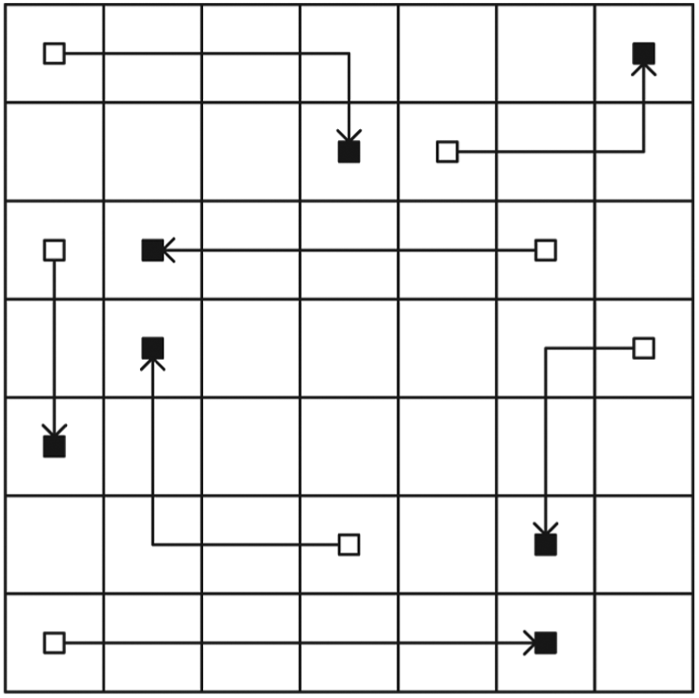
The HDP and VDP.
Network protocols of hybrid ad hoc network are the same to Zhang et al.
19
In hybrid ad hoc network, there are
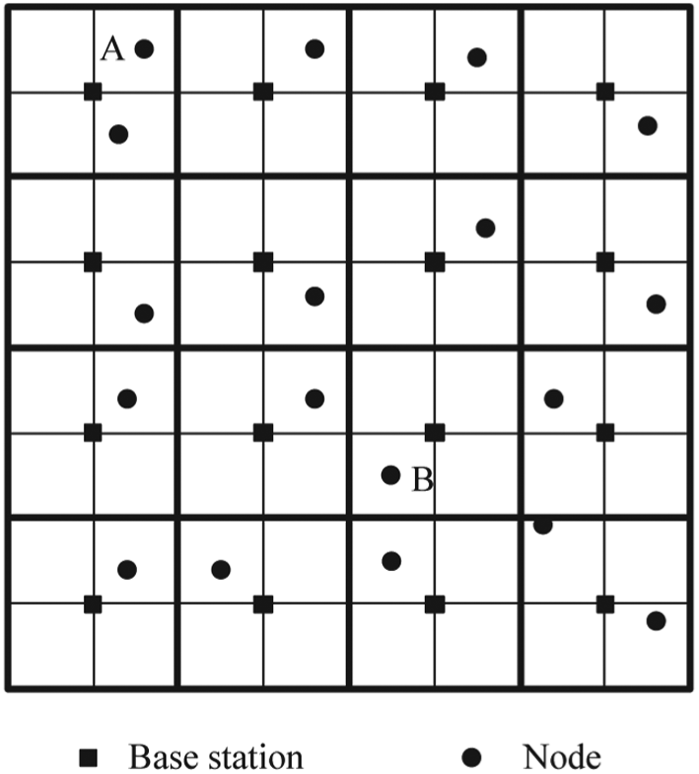
The hybrid network model.
In this article,
Distribution of routings and information density
In this section, we derive the distribution of routings for pure ad hoc network and hybrid ad hoc network. Moreover, the information density is derived.
Pure ad hoc network
In ad hoc network, there are multiple sources and destinations. Each node has a chance to be a source or destination. We analyze the probability that a routing passes through cell
Lemma 1
The probability that a routing passes through the cell

where

Proof
According to the system model in section “System model,” the square of a unit area is divided into
The cell containing the TX and the cell containing the RX are not in the same row. In this case, according to the routing scheme in section “System model,” TX selects HDP-VDP routings and VDP-HDP routings with the same probability. The routing connecting TX and RX has a probability of

2. The cell containing the TX and the cell containing the RX are in the same row. There is only one type of straight-line routing and the routing connecting TX and RX has a probability of

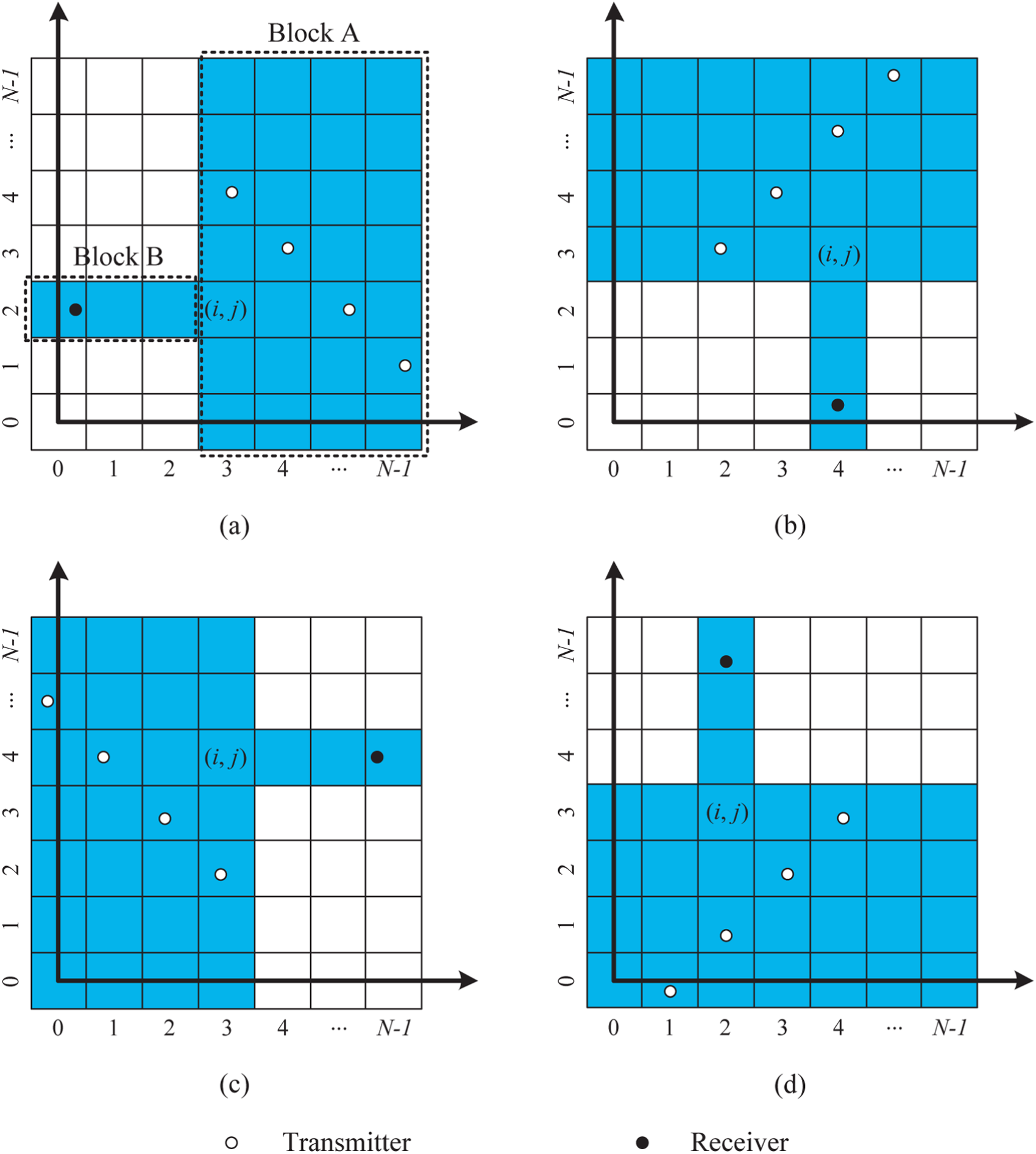
The routings passing through cell
Overall, the probability that a routing passes through cell

Notice that (3) is a quadratic function with respect of
In the case of Figure 3(b), a routing passes through cell

In the case of Figure 3(c), a routing passes through cell

In the case of Figure 3(d), a routing passes through cell

Finally, we can derive (1) in Lemma 1.
According to Lemma 1, when

Thus, when

With Lemma 1, we further investigate the number of routings passing through cell
Lemma 2 22
According to Lemma 2, the number of routings passing through cell

where the function
When

The number of routings generated from cell
With the per-node capacity of ad hoc network

where
Hybrid ad hoc network
In hybrid ad hoc network, the traffic can be offloaded to the base station layer. Therefore, the traffic load of ad hoc layer is relieved. For hybrid ad hoc network, we consider the ad hoc layer and have a lemma as follows:
Lemma 3
When

where
Proof
The maximum number of hops in ad hoc layer is
The cell containing the TX and the cell containing the RX are not in the same row or column. As a result, the routing connecting TX and RX has a probability of
The cell containing the TX and the cell containing the RX are in the same row or column. Then the routing connecting TX and RX has a probability of

The routings passing through cell
As illustrated in Figure 4(a), the RX falls into the cell with lattice distance

Similar to the case of Figure 4(a), in Figure 4(b)–(d), the probability that a routing passes through cell

With some manipulations, equation (12) in Lemma 3 can be derived.
According to Lemma 3, the probability

which is in the same order with the
Similarly, the number of routings passing through cell

Assume that the per-node capacity of ad hoc network is

Energy-limited capacity
The network lifetime is defined as the time period before a cell runs out its energy. If nodes are uniformly distributed in the network and the battery capacity is also uniform, the cell at the center will run out of energy first. Thus the cell at the center is the bottleneck of the network lifetime.
The energy consumption to deliver a bit is

where
Pure ad hoc network
A cell contains

Therefore, we have

It can be observed that the network lifetime is a decreasing function of the number of routings and the per-node capacity. The number of bits that a node can transmit before a cell runs out of its energy is

which is defined as the energy-limited capacity.
4
According to equation (21),
For pure ad hoc network, when

Thus the network lifetime is mainly impacted by the number of routings passing through a cell. Because

Hybrid ad hoc network
For hybrid ad hoc network, when
Similar to the derivation in pure ad hoc network, before a cell runs out of its energy, the number of bits that cell

where

Thus there is a watershed for the value of

When

As shown in equation (25), the energy-limited capacity is constrained by the value of
Network lifetime maximization via energy configuration
To maximize the network lifetime, the time period before a cell exhausts its energy needs to be extended. The number of routings at the center cell is maximum, which means that the traffic load at the center cell is heaviest. Thus more energy needs to be allocated at the center cell of the network.
The maximum network lifetime is the time period that all cells run out of energy simultaneously. According to equations (20) and (24), the network lifetime for pure ad hoc network and hybrid ad hoc network is proportional to
Assuming the total energy capacity of the network is
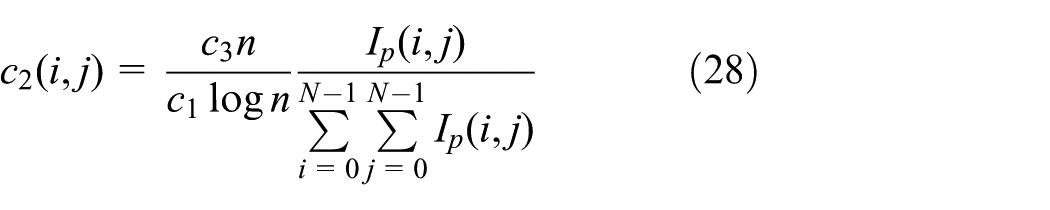
For hybrid ad hoc network, the per-node energy-limited capacity at cell

In this way, it can be guaranteed that the nodes with heavy traffic load have more energy. Thus the network life can be maximized, namely, all the nodes in ad hoc network exhaust energy simultaneously. Equation (28) can also be applied to the hybrid ad hoc network, since in hybrid ad hoc network, the cell
Discussions
Pure ad hoc network
The value of
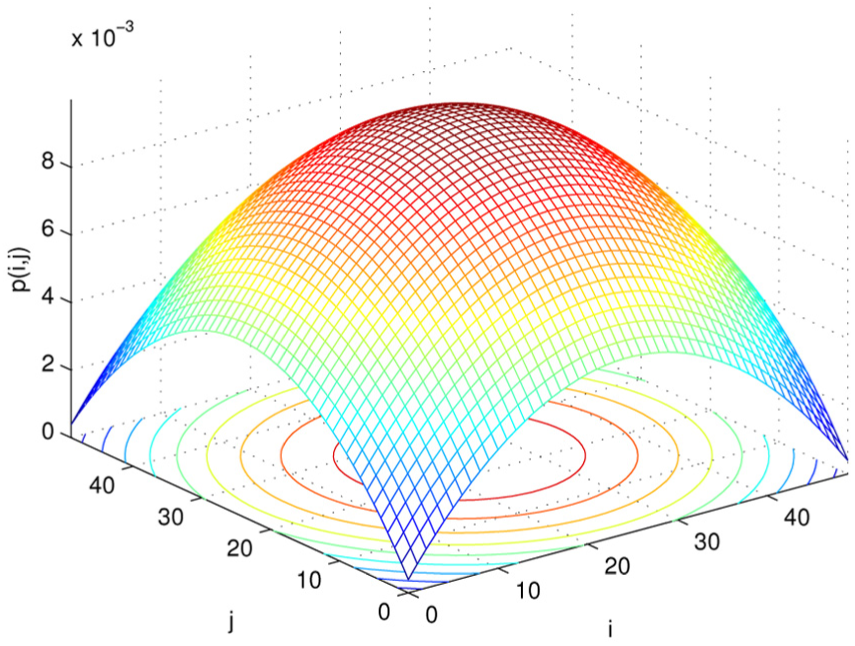
The probability

The contours of the probability
Hybrid ad hoc network
It is noted that we have ignored the boundary effect in Lemma 3. With considering the boundary effect, there are 64 cases that need to be considered. Hence, we provide the simulation results to demonstrate the probability that a routing passes through cell
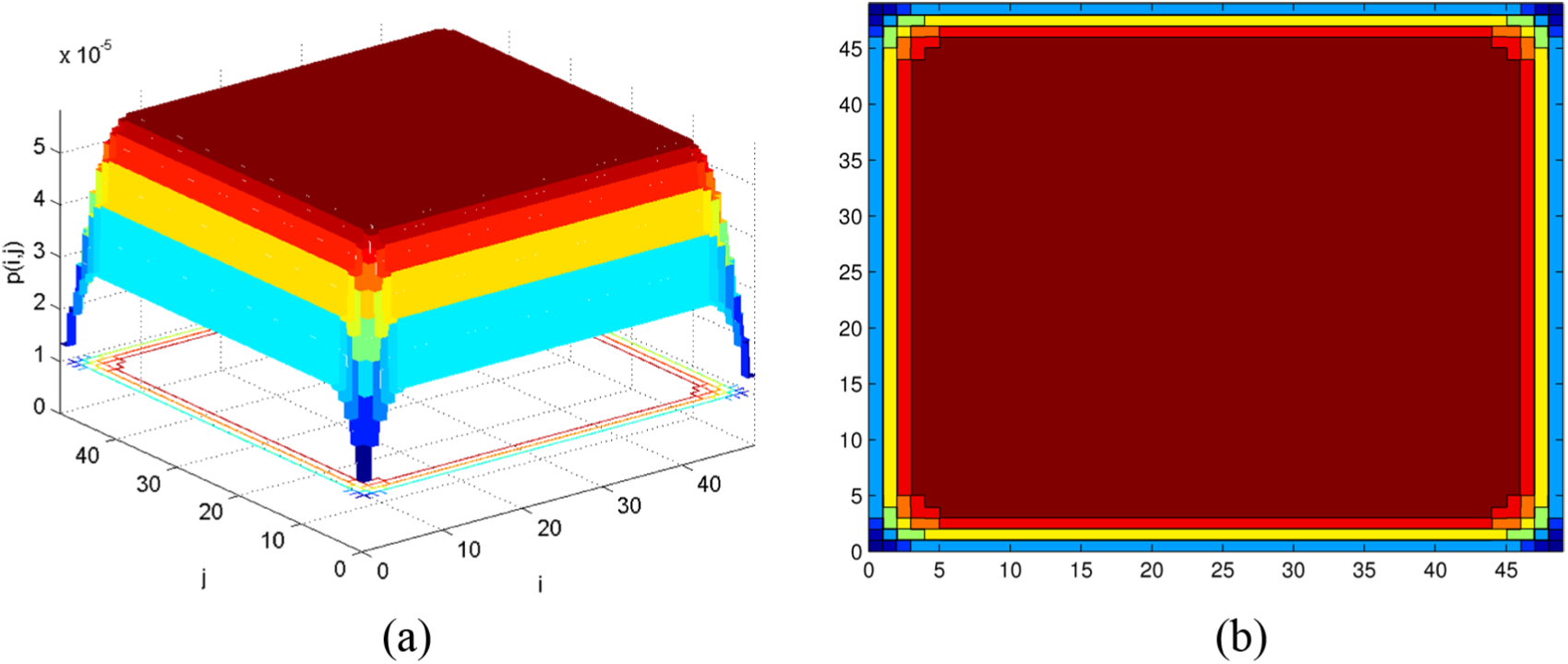
The probability

The probability
Figure 7 illustrates the results with
Conclusion
In order to characterize the energy consumption of ad hoc network, we propose the concept of information density. First, the entire region is divided into cells. Second, the probability that a routing passes through each cube is derived. The number of routings passing through a cell is obtained and the information density is achieved. Third, with the energy consumption model, the energy configuration to maximize the network lifetime is designed, with which all the nodes in the ad hoc network exhaust energy simultaneously. In order to present the information density of more general wireless network, we derive the information density of hybrid network. The theoretical results show that the information density of hybrid network is more homogeneous than pure ad hoc network. Besides, hybrid ad hoc network consumes less energy than pure ad hoc network because the base station layer will offload traffic from ad hoc layer. The information density proposed in this article shows more details of the information flow in ad hoc networks, which may be applied in the analysis and optimization of ad hoc networks.
Footnotes
Acknowledgements
The authors appreciate editor and anonymous reviewers for their precious time and great effort in handling this paper.
Handling Editor: Nan Cheng
Declaration of conflicting interests
The author(s) declared no potential conflicts of interest with respect to the research, authorship, and/or publication of this article.
Funding
The author(s) disclosed receipt of the following financial support for the research, authorship, and/or publication of this article: This work is supported by the National Natural Science Foundation of China (No. 61631003, No. 61601055).