




Abstract
The joint reconstruction of nonsparse multi-sensors data with high quality is a challenging issue in human activity telemonitoring. In this study, we proposed a novel joint reconstruction algorithm combining distributed compressed sensing with multiple block sparse Bayesian learning. Its basic idea is that based on the joint sparsity model, the distributed compressed sensing technique is first applied to simultaneously compress the multi-sensors data for gaining the high-correlation information regarding activity as well as the energy efficiency of sensors, and then, the multiple block sparse Bayesian learning technique is employed to jointly recover nonsparse multi-sensors data with high fidelity by exploiting the joint block sparsity. The multi-sensors acceleration data from an open wearable action recognition database are selected to assess the practicality of our proposed technique. The sparse representation classification model is used to classify activity patterns using the jointly reconstructed data in order to further examine the effectiveness of our proposed method. The results showed that when compression rates are selected properly, our proposed technique can gain the best joint reconstruction performance as well as energy efficiency of sensors, which greatly contributes to the best sparse representation classification–based activity classification performance. This has a great potential for energy-efficient telemonitoring of human activity.
Keywords
Introduction
In recent years, wireless body area networks (WBANs) that consist of wearable multi-sensor nodes have received wide attention in the field of telemonitoring of human activity because they have great advantages in practical applications such as remote diagnosis, real-time monitoring, and rehabilitation evaluation.1–4 In such applications, the multi-sensor nodes equipped with accelerometer are usually used to acquire the acceleration data simultaneously, and then, the acquired data are transmitted via the Internet to the remote terminal for further data processing such as activity classification with high quality, in order to perfectly achieve the telemonitoring of human activity.4,5 Unfortunately, due to the limited energy of battery in each node, WBANs cannot continually collect the acceleration data during larger periods of time. Thus, energy efficiency of sensors has traditionally been a challenging endeavor in the telemonitoring of human activity. In views of the fact that the dominant source of energy in WBANs is wasted during data transmission, most of previous studies only focused on regulating the data packet size to be sent for the design of wireless communication protocol with low energy consumption, and they do not consider to greatly reduce a larger amount of data during transmission for energy efficiency of sensor.1,4 Over the past decade, the compressed sensing technique, an advanced methodology for data compression and reconstruction based on data sparsity, has been applied for energy efficiency of single-sensor, and its basic idea is that the collected data to be transmitted are significantly compressed on sensor node, and the compressed data received are reconstructed on remote terminal. Although the traditional compressed sensing technique can greatly decrease the energy consumption of single-sensor node during data transmission, it has no ability to jointly process the multi-sensor data for capturing the spatiotemporal correlation information associated with human activity.1,4 Recently, the distributed compressed sensing (DCS) technique,2,3 an emerging extension of CS framework for multi-signal case, has been successfully applied in many fields such as video coding, image fusion, and multichannel electrocardiograph monitoring. Its basic idea is to perform the joint compression and reconstruction of multi-sensors data on the assumption of the joint sparsity model.5–7 Theoretically, DCS technique has a great potential for capturing the high-correlation information from multi-sensors data, while the energy efficiency of sensors is potentially produced. However, since activity data such as acceleration data are nonsparse enough in time domain or the transformed domain, the traditional joint reconstruction algorithms do not gain the best performance of joint reconstruction of multi-sensors activity data. It motivates us to find the effective techniques for jointly processing multi-sensors activity data.
Recently, multiple-measurement vector (MMV) model–based joint reconstruction algorithms have been popular for multi-signals based on joint sparse model (JSM).3,8 Especially, MMV-based block sparse Bayesian learning (MBSBL), as a powerful tool to jointly reconstruct nonsparse multi-signals by exploiting joint block sparsity, has been successfully applied for jointly reconstructing biomedical signals such as electroencephalogram (EEG) and electromyography.6,7 Inspired by the recent related works, in this study, we proposed a novel joint reconstruction algorithm combining DCS with MBSBL for multi-sensors activity data based on the joint sparsity. Its advantages are to overcome the limitations of poor performance of DCS joint reconstruction of multi-sensors activity data. This can greatly contribute to further human activity classification with high quality.
In our proposed method, based on the joint sparsity model, DCS technique is first applied to simultaneously compress multi-sensors activity data for gaining the more high-correlation information regarding activity as well as the small number of compressed multi-sensors data during transmission for energy efficiency of sensors. And then, the MBSBL algorithm is utilized to jointly reconstruct the compressed multi-sensors data in order to gain the reconstruction data high fidelity. The multi-sensors acceleration data are selected from the open wearable action recognition database (WARD) 9 with regard to the feasibility of our proposed algorithm. Based on the jointly reconstructed multi-sensors data, the sparse representation classification (SRC) algorithm 10 is adopted to perform the human activity classification task in order to further validate the practicality of our proposed method. The results showed that our proposed algorithm can produce the superior performance of joint reconstruction as well as energy efficiency of sensors, which contributes to further activity classification with high quality.
The rest of this article is organized as follows. The detailed description of our proposed method is presented in section “DCS-based MBSBL for joint reconstruction of multi-sensors.” The experimental results are presented in section “Experiment and results.” The discussion and conclusion are given in section “Discussions and conclusions.”
DCS-based MBSBL for joint reconstruction of multi-sensors acceleration data
In this section, we describe the DCS-based MBSBL algorithm for joint reconstruction of multi-sensors acceleration data. The block diagram of the proposed DCS-based MBSBL model is shown in Figure 1. Its basic idea is to take advantage of the joint sparsity for achieving the simultaneous compression and joint reconstruction of nonsparse multi-sensors data. That is, with the joint sparsity model, the DCS technique is first applied to simultaneously compress multi-sensors data. And then, the MBSBL technique is employed to jointly reconstruct the compressed multi-sensors data by exploiting the joint block sparsity. Theoretically, DCS technique generalizes the CS technique to the multi-signals case by combining the distributed source coding theory with compressed sensing theory. In order to clearly describe our proposed algorithm, we first briefly introduce the CS technique for acceleration data.
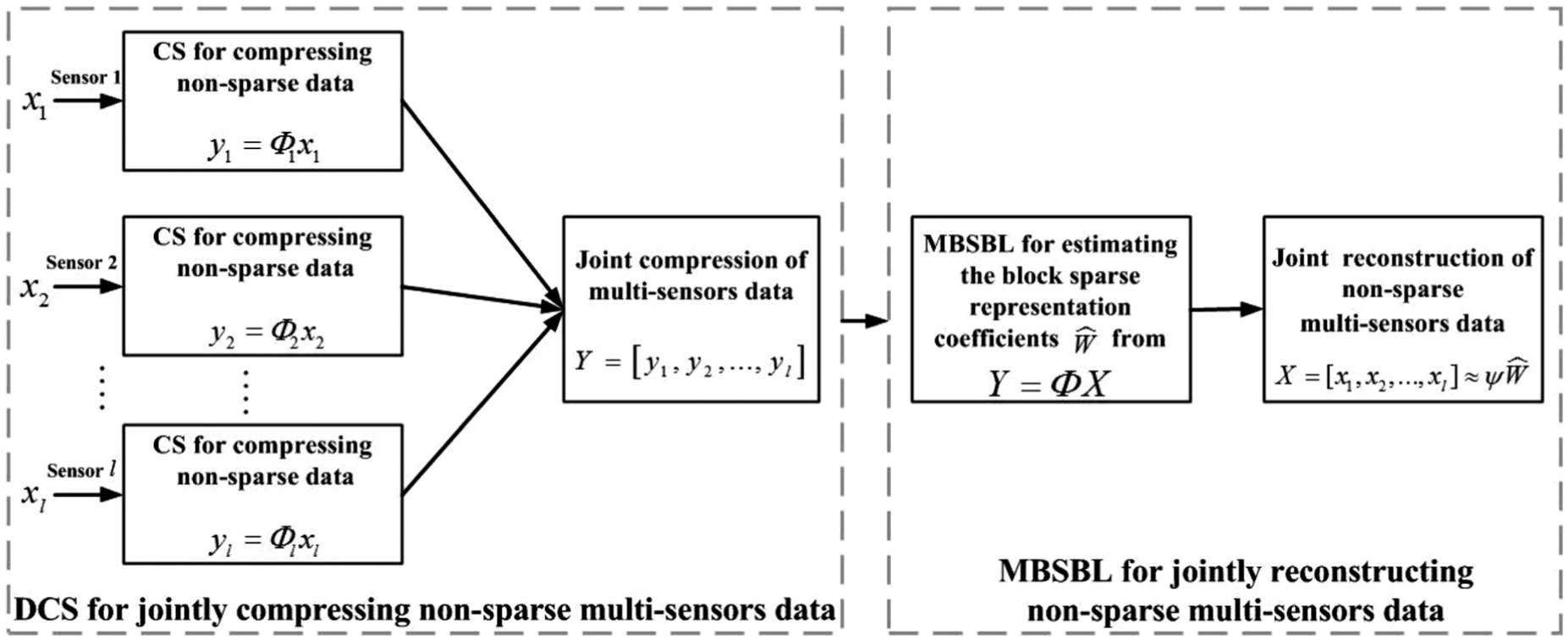
The block diagram of the proposed DCS-based MBSBL model for joint reconstruction of nonsparse multi-sensor data.
Compressed sensing for acceleration data
Unlike the traditional data compression methods, the CS technique is to take advantage of a measurement matrix to compress and reconstruct data that can be represented by sparse basis. That is, the acceleration data

where
And then, we can define a measurement matrix

The acceleration data

where
In CS theory, the data reconstruction is an important task based on the data sparsity. As we know, because the measurement matrix

Due to the nondeterministic polynomial-time hard problem (i.e. NP-hard problem) in equation (4), the estimation of sparse coefficient

The above-mentioned detailed procedure of solution can be found in previous studies.2,3 Unfortunately, the CS technique cannot perfectly reconstruct acceleration data that are poorly sparse.
DCS for multi-sensors acceleration data
Theoretically, DCS technique is to take advantage of combining the distributed source coding theory with compressed sensing theory in order to achieve joint compression and reconstruction of multi-signals. In DCS theory, the multi-signals is assumed as an ensemble of signals being jointly sparse (i.e. joint sparsity model), and joint reconstruction of multi-signals is achieved while each individual signal is independently compressed by a simple linear projection algorithm (as shown in Figure 1). The DCS technique has the superior ability to capture both the inter- and intra-signal correlations information from multi-sensors data. In this study, we employ the DCS technique to capture the more spatiotemporal correlation information from multi-sensors acceleration data. In DCS technique, the commonly used JSM includes JSM1, JSM2, and JSM3 because each signal exists itself sparse.2,3 In JSM1, all signals consist of the two different sparse components: a common sparse component and a sparse innovation component. In JSM2, all signals can be constructed by the common sparse supports model, that is, all signals are linearly represented by the same sparse set of basis vectors and the different coefficients. In JSM3, all signals include the two different components: a nonsparse common component and a sparse innovation component. In the practical application, the three different joint sparsity models are applied in different situations. In this study, considering that all sensors acquire the same acceleration data, we adopt JSM2 to quantitatively analyze multi-sensors acceleration data. That is, given that there are

where

where the compressed multi-sensors data
In DCS technique, the joint reconstruction of multi-signals data is also a challenging task. Similar to the CS technique, the typical DCS technique also takes advantage of the best data sparsity to achieve joint reconstruction task. That is, the joint reconstruction task can be achieved by solving the

Once the solution of joint sparse representation coefficients
MBSBL algorithm for joint reconstruction of multi-sensors acceleration data
In this study, the multi-measurement vector (MMV)-based BSBL (MBSBL) algorithm is applied to jointly reconstruct the nonsparse multi-sensors acceleration data by exploiting block sparsity structure.3,8,9 Considering that the multi-sensors acceleration data are usually contaminated by noise in the practical application, equation (8) can be expressed as

where

And all multi-sensors acceleration data

where each block contains the same data length

where the block sparse representation coefficients
In this study, all partitioned blocks are assumed to satisfy mutual uncorrelation, and each block

And then, equation (13) can be rewritten as

where

where
Also, the measurement noise vectors

where the unknown parameter
According to equations (15) and (16), the posterior density of

where the means
And then, the unknown parameters (

where
Here, a fast marginalized likelihood maximization with low computation complexity is applied for solving the optimization problem of equation (18), and parameters

where
Based on Woodbury identity, equation (18) can be rewritten as

where
The learning rules for

where
Experiment and results
The selection of multi-sensors acceleration data
In this study, the multi-sensors acceleration data are selected from a public WARD from University of California 9 in order to assess the effectiveness of our proposed method. The selected database is usually used to compare the existing algorithms for human activity classification using multi-sensor data. In the selected database, all multi-sensors acceleration data are acquired from a total of 20 subjects (7 women and 13 men subjects), and each subject is asked to wear five motion sensors that are positioned on right wrist, left wrist, right ankle, left ankle, and waist. All participants are asked to perform 13 human activity patterns such as stand, sit, lie down, walk forward, walk left-circle, walk right-circle, turn left, turn right, go upstairs, go downstairs, jog, jump, and push wheelchair. The details of data collection can be found in http://www.eecs.berkeley.edu/~yang/software/WAR/. 9
Evaluation of the practicality of our proposed method
In the experiment, the length of each acceleration data is set to 256 points, and each data are divided into the same 24 blocks. A sparse binary matrix with size of 128 × 256 is selected as measurement matrix where each column contains 12 non-zero entries. Discrete cosine transform (DCT) basis is chosen as sparse basis. For comparison, some traditional MMV-based joint reconstruction algorithms such as Temporal MMV Focal Undetermined System Solver (TMFOCUSS) 11 and Temporal MMV Sparse Bayesian Learning (TMBSL)5,8 algorithms are performed in the experiment. Besides, Compressive Sampling Matching Pursuit (CoSaMP), an emerging iterative recovery algorithm with the best optimization-based approaches, is also performed in the experiment 12 in order to further validate the effectiveness of reconstruction performance of our proposed method. Here, some common criteria are employed to objectively evaluate the performance of joint reconstruction, and they are defined as follows:
1. The percentage root-mean squared distortion (PRD) is used to measure the joint reconstruction error between the original data and the reconstructed data, and it is defined as follows

where
2. The relative root-mean squared error (RMSE) is employed to assess the performance of joint reconstruction of multi-sensors acceleration data, and it is defined as follows

3. Compression rate (CR) is used to quantitatively assess the ability of the compression of acceleration data, and it is defined as follows:

where
In this study, the defined CR is also considered as the energy metrics that is adopted to evaluate the potential effectiveness of energy efficiency of sensors. This is because the dominant source of energy of sensors is wasted for multi-sensors data transmission in human activity telemonitoring application. That is, a large number of acquired multi-sensors data on sensor are significantly compressed in order to gain the small number of compressed multi-sensors data during transmission for energy efficiency of sensors.
All programs in the experiment are performed on MATLAB R2014 environment—computer with Intel® Core™ i5-3470 3.20 GHz CPU, 4.00 GB RAM and Windows 7 operating system.
First, according to the criteria of RMSE, we evaluate the performance of joint reconstruction of multi-sensors acceleration data based on the different CRs. Figure 2 shows the comparison results from four different joint reconstruction algorithms based on the different CRs. From Figure 2, we can observe that all RMSE values from four different algorithms decrease with the increase in CRs. In comparison, our proposed method (i.e. DCS-MBSBL) can produce the minimal RMSE value. This suggests that the multi-sensors activity data compressed by DCS technique can contain the more spatiotemporal correlation information associated with activity pattern, which greatly contributes to improving the joint reconstruction performance of MBSBL. In addition, we also find that when CR is 40%, all RMSE values obtained by the different methods are higher. This suggests that although the highly compressed data can gain the smaller number of multi-sensors data during transmission for the lower energy consumption, it possibly destroys the joint reconstruction performance of multi-sensors acceleration data because of the potential losses of the more valuable information associated with human activity. In contrast, when CR reaches 90%, all RMSE values are lowest. This demonstrates that although the multi-sensors data with higher compressed rates can contain the more useful information related to human activity for best joint reconstruction performance, it possibly waste the more energy of sensors due to the larger number of multi-sensors data to be transmitted. However, when CRs change from 50% to 70%, the lower RMSE values obtained by our proposed method significantly decline when compared with TMFOUSS, TMSBL, and CoSaMP. This suggests that when the compressed rates are selected properly, our proposed technique not only can take advantage of the compressed multi-sensors activity data to gain the superior performance of joint reconstruction but also can potentially help to achieve the energy efficiency of sensors. This is because the large amount of acceleration data prior to transmission are significantly compressed to reduce the energy consumption of sensor as much as possible.

The comparison results of joint reconstruction performance with different compression rates.
At the same time, we also evaluate the computational time of the above-mentioned four reconstruction algorithms based on the different CRs. All comparative results are presented in Table 1. As shown in Table 1, we can obviously observe that the computation time cost of each reconstruction algorithm increases by the compressed rate. When the compressed rate is 40%, the computation time cost of each selected algorithm spends lower. However, when the compressed rate is more than 40%, the computation time cost of each selected algorithm spends increases. When the compressed rate reaches 90%, the computation time cost of each selected algorithm spends reaches maximum. The possible reason is that the higher compression ratios could yield the more multi-sensors acceleration data to be processed, thus possibly resulting in the high computation complexity. In comparison, based on the different compressed rates, our proposed technique (DCS-MBSBL) spends the almost same lower computation time as the CoSaMP technique with the lower computation complexity, whereas TMFOCUSS technique spends the higher computation time cost, followed by TMSBL. This demonstrates that our proposed technique can gain the lower computation complexity for the best performance of joint reconstruction of multi-sensors acceleration data.
The comparison results of computation time from different reconstruction methods based on different compressed rates.

TMFOCUSS: Temporal MMV Focal Undetermined System Solver; TMSBL: Temporal MMV Sparse Bayesian Learning; DCS-MBSBL: distributed compressed sensing with MMV-based block sparse Bayesian learning; CoSaMP: Compressive Sampling Matching Pursuit.
In addition, we further assess the joint reconstruction performance of multi-sensors acceleration data based on the PRD criteria. For comparison, the traditional single-measurement vector–based BSBL (i.e. SMV-BSBL) is also selected in the experiment. Figure 3 shows that the comparison results between DCS-MBSBL and SMV-BSBL algorithms. As illustrated in Figure 3, the probability density function (PDF) value of each algorithm decreases with the increase in CRs. When the compressed rate is 40%, the PDF values can obtain the maximum. However, when the compressed rate is more than 40%, the PDF values gradually reduce. When the compressed rate increases to 90%, the PDF value decreases. The possible reason is that while the compressed rates increase, the more valuable information about human activity can be provided for the two reconstruction algorithms, which helps to improve the reconstruction performance. In comparison, it is obvious that the PRD values obtained by our proposed method are less than those of SMV-BSBL algorithm. This suggests that our proposed technique can take advantage of the more valuable high-correlation information for the best joint reconstruction performance of multi-sensors acceleration data in the multiple-measurement vectors (MMV) case. In conclusion, as shown in Figures 2 and 3 and Table 1, when the CRs are selected properly, our proposed technique has the superior ability to produce the best joint reconstruction performance, the lower computation time cost, as well as the energy efficiency of sensors by jointly processing multi-sensors acceleration data.
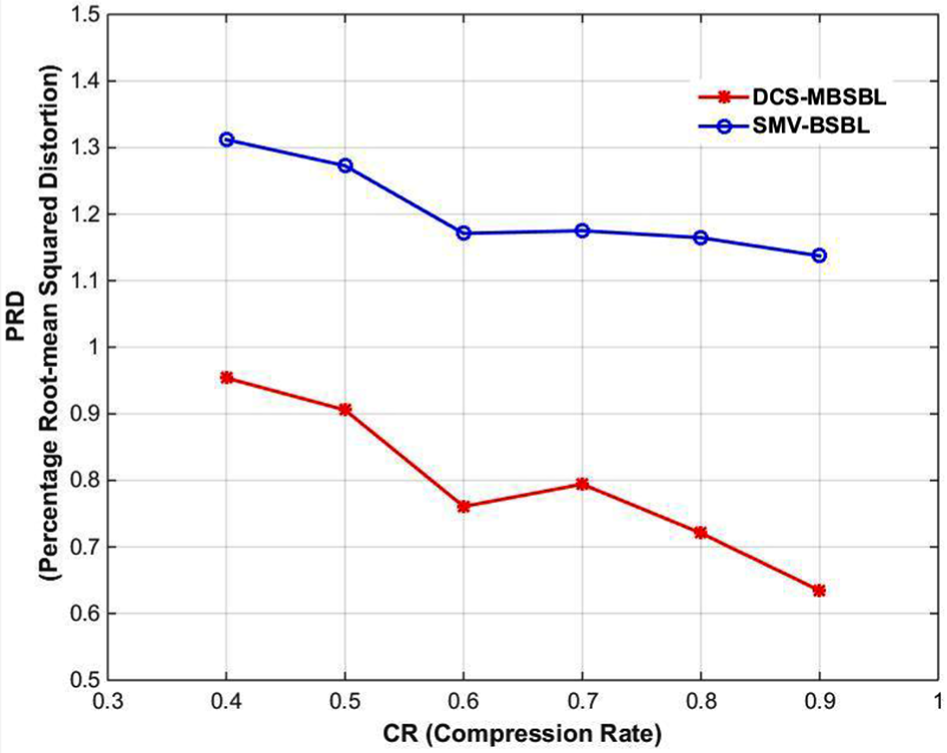
The comparison results between DCS-MBSBL and SMV-BSBL algorithms.
Evaluation of the effect of our proposed technique on activity classification
In this experiment, with the reconstructed multi-sensors acceleration data by our proposed technique, we developed the activity classification models based on the different learning classification algorithms in order to further evaluate the effect of our proposed method on the activity classification performance. Here, the eight different activity classes are selected, and the CRs are set to more than 40%. Due to the small sample data, the leave-one-subject-out cross validation strategy is used to evaluate the classification performance. The detailed training and testing procedure is presented as follows; 13 subjects’ data are randomly selected as training set, while the remaining one is used to test. The above procedures are repeated until each subject is tested. Finally, the whole averaged classification results are obtained for all subjects. For comparison, we also use the reconstructed activity data obtained by the following joint reconstruction algorithms: TMFOUSS, TMSBL, and CoSaMP.
SRC for activity classification
First, we adopt the advanced classification model such as SRC algorithm to perform activity classification task. Here, we briefly introduce the SRC algorithm for activity classification in a clear fashion.
Unlike the traditional classification algorithm, the basic idea of SRC model is that the testing sample is assumed as a linear combination of just those training samples with same class. The class of test sample can be determined by the residual error obtained by solving sparse representation coefficients.9,10 Here, all training samples are directly used to construct over-complete dictionary. Assuming that a total of training samples from class

where
Given that there are sufficient training samples from

where all training samples
Then, according to the over-complete dictionary

where
Usually,

Next, the approximation of test sample can be defined as

where
And then, the minimal residual between

Finally, according to the minimal residual of class in equation (30), we can identify the test sample belonging to activity class. The detailed description of SRC model is found in Wright et al. 10
Table 2 presents that the comparison results of the classification performance of SRC models are based on the different joint reconstruction algorithms. As illustrated in Table 2, the SRC model based on our proposed technique (i.e. MBSBL-SRC) can reach the best accuracy, followed by TMFOCUSS-based SRC (i.e. TMFOCUSS-SRC), CoSaMP-based SRC (i.e. CoSaMP SRC), and the TMBSL-based SRC (i.e. TMBSL-SRC). In terms of the different CRs, the performance of each SRC classification model increases by the CRs. When the CR is 40%, the accuracy of each SRC-based model is poor. This demonstrates that the highly compressed multi-sensors data difficultly gain the superior performance of activity classification because of the poor joint reconstruction performance. However, when the CRs are more than 40%, the accuracy of each SRC-based model can be gradually improved. Especially, when compression ratio increases to 60% or 70%, our proposed SRC model can gain the almost same accuracy as the CR of 100%. This suggests that our proposed method can produce the best activity classification performance while more energy of sensors is saved. In comparison, our proposed SRC model is significantly superior compared to the other two models. Moreover, our proposed SRC method can keep higher stable accuracy. These results demonstrated that with the reconstructed activity data by our proposed technique, the SRC algorithm can take advantage of the more high-correlation information associated with human activity to improve activity classification performance.
The comparison results of the SRC-based classification methods with compression rates.

TMFOCUSS: Temporal MMV Focal Undetermined System Solver; TMSBL: Temporal MMV Sparse Bayesian Learning; DCS-MBSBL: distributed compressed sensing with MMV-based block sparse Bayesian learning; CoSaMP: Compressive Sampling Matching Pursuit.
Support vector machine for activity classification
Meanwhile, for comparison, we also developed activity classification models based on the traditional machine learning algorithm such as support vector machine (SVM). 13 The basic idea of SVM classification algorithm is that the data to be classified are first mapped into the high-dimensional feature space via a kernel function, and then, an optimal separating hyperplane that separates the data can be found between the data classes in the mapped space. The detailed description of solution of the optimal separating hyperplane can be found in Vapnik. 13 Here, the sequential minimal optimization algorithm with the polynomial kernel function is employed in our developed SVM model based on an open mine suite WEKA. 14 The comparison results of the four SVM-based activity classification models are given in Table 3. From Table 3, we can obviously see that the accuracy of all SVM-based activity classification models are poor based on the different CRs. When the compressed rate is 40%, the accuracy of each SVM-based activity classification model is poor. When the compressed rates are more than 40%, the accuracy of each SVM-based models increases slowly. Also, when the compressed rate reaches 100%, the best accuracy is equal to 69.84%. In comparison, SVM model based on our proposed joint reconstruction method can gain the best performance when the different CRs change. Especially, when compared with the results in Table 2, our proposed model (i.e. MBSBL-SRC) obviously outperforms MBSBL-SVM model. This suggests that SRC algorithm has the superior ability to capture the more distinctive and high-correlation information hidden in multi-sensors activity data than SVM classification algorithm, which helps to improve the activity classification performance. In addition, from Table 3, we also observe that TMFOCUSS-SVM model yields the worst accuracy, suggesting that the combination of TMFOCUSS with SVM cannot gain the more valuable high-correlation information for accurately classifying multi-sensors activity pattern.
The comparison results of the SVM-based classification methods with compression rates.

TMFOCUSS: Temporal MMV Focal Undetermined System Solver; TMSBL: Temporal MMV Sparse Bayesian Learning; DCS-MBSBL: distributed compressed sensing with MMV-based block sparse Bayesian learning; CoSaMP: Compressive Sampling Matching Pursuit; SVM: support vector machine.
Discussion and conclusion
The results demonstrated that our proposed DCS-based MBSBL algorithm can jointly reconstruct nonsparse multi-sensors acceleration data with high fidelity, which helps further activity classification with high quality. Currently, in the WBANs-based activity telemonitoring application, there exist some challenging issues such as the joint reconstruction performance with high quality as well as energy efficiency of sensors. It is essential to find the effective techniques for tackling these challenging issues.
As we know, human activity is the locomotion yielded by the interaction among the central nervous system, peripheral nervous system, and musculoskeletal effector system. There possibly exists high-correlation information regarding human activity among several sensors located on body.1,4 So, it is very vital to simultaneously process multi-sensors acceleration data for exploiting the inner- and inter-sensors correlation information associated with human activity. Theoretically, DCS technique has the powerful ability to simultaneously compress multi-sensors data, but it can produce the best joint reconstruction performance based on multi-sensors data that exist sparse enough. Because multi-sensors acceleration data are poorly sparse in time domain or the transformed domain, the DCS technique do not produce the best performance of joint reconstruction of multi-sensor acceleration data. So, in this study, in view of acceleration data with block structure, we investigate the feasibility of MBSBL algorithm that is applied to jointly reconstruct multi-sensors acceleration data with high fidelity by exploiting block sparsity of multi-sensors data.
Therefore, in this study, based on the joint sparsity of multi-sensors data, we investigate the feasibility of hybrid of DCS and MBSBL for jointly reconstructing multi-sensors acceleration data. The aim of our study is that the DCS technique is first applied to simultaneously compress multi-sensors acceleration data for obtaining the inner- and inter-sensors correlation information as well as energy efficiency of sensors. And then, the MBSBL algorithm is utilized to exploit the block sparse structure of multi-sensors acceleration data for the best joint reconstruction performance.
First, we evaluate the effectiveness of joint reconstruction of our proposed technique based on the different compressed rates. As illustrated in Figures 2 and 3, our proposed technique can produce the best joint reconstruction performance when compared with TMFOUSS, TMSBL and CoSaMP algorithms. The possible reason is that the DCS technique can gain the more spatiotemporal correlation information associated with human activity by simultaneously processing the inner- and inter-sensors acceleration data. And MBSBL technique can take advantage of the sparse data block containing these valuable spatiotemporal correlation information for jointly reconstructing multi-sensors acceleration data with high quality. The possible reason is that in our proposed technique, each partitioned block is assumed as a multi-sensors acceleration data ensemble that has same joint sparsity pattern but with different coefficients, and the block sparse Bayesian learning algorithm is applied to estimate the block sparse representation coefficients by exploiting the correlation structure in multi-sensors data block. This greatly contributes to improve the joint reconstruction performance of multi-sensors acceleration data in the context of multiple-measurement vectors (MMV). On the contrary, CoSaMP, TMFOUSS, or TMSBL techniques only obtain the spatial or temporal information regarding human activity from multi-sensors acceleration data5,11 not to take advantage of exploiting the high-correlation information hidden in multi-sensors acceleration data. This possibly destroys the joint reconstruction performance of multi-sensors acceleration data.
At the same time, we also evaluate the computational time cost corresponding to all reconstruction algorithms based on the different compressed rates. In all selected algorithms, unlike TMFOUSS and TMSBL, CoSaMP, as a emerging iterative recovery algorithm, can offer rigorous bounds on computational cost and storage. In terms of the compressed data, the running time of CoSaMP is only
In addition, we also focus on the problem of energy efficiency of sensors. In this study, DCS technique is applied to simultaneously compress multi-sensors acceleration data for significantly decreasing the amount of multi-sensors acceleration data during wireless transmission. This helps to reduce the energy consumption of sensors as much as possible. In the experiment, we evaluate the effect of the different compressed rates on joint reconstruction performance and computational time cost based on four reconstruction algorithms. As shown in Figure 2 and Table 1, when the compressed rates are properly selected, our proposed technique can gain the best joint reconstruction performance as well as the lowest computation time cost. This is because the more number of multi-sensors data during transmission are produced while the CRs are higher based on the definition of compressed rates of equation (24), which possibly yields the high energy consumption on sensors. These results suggest that our proposed technique can simultaneously compress multi-sensors acceleration data for significantly decreasing the number of multi-sensors data during transmission, which potentially reduce the energy consumption of sensors. The main reason is that the dominant source of energy on sensors is usually wasted in wireless communication for a large amount of multi-sensors data transmission.8,9 Similar studies on the energy-efficient telemonitoring of electrocardiogram (ECG) or EEG can be found in Zhang et al.6,7
In this study, with the reconstructed multi-sensors acceleration data, we also further evaluate the effectiveness of our proposed technique for activity telemonitoring application by developing some activity classification models based on learning algorithm. For comparison, an advanced SRC-based model and a traditional SVM-based model are developed to perform activity classification task. As shown in Tables 2 and 3, with our proposed technique, the SRC-based activity classification performance is best. The main reason is that the reconstructed multi-sensors acceleration data obtained by our proposed method can contain the more valuable high-correlation information associated with human activity, which greatly contributes to solving the optimal sparse representation coefficients related to activity classes for the best activity classification performance. However, the SVM-based activity classification model only can gain the coefficients of the generalized optimal separating hyperplane by solving the quadratic programming problem. It does not take advantage of the high-correlation information regarding activity to define the nature of the decision surface that will separate the activity classes. It is possible to produce the poor performance of SVM for multi-sensors activity classification. Similar results of researches on activity classification using wearable sensor have been also reported in Yang et al. 9 and Zhang and Sawchuk. 15
In conclusion, our proposed technique can take advantage of the block sparsity of multi-sensors data for the best performance of joint reconstruction of nonsparse multi-sensors data as well as the lowest computational time cost. This helps to further activity classification with high quality. Moreover, multi-sensors acceleration data can be simultaneously compressed by DCS to significantly decrease the amount of multi-sensors data during transmission. This potentially produces energy efficiency of sensors. Our proposed technique greatly contributes to improve the further energy-efficient telemonitoring of human activity. Future efforts focus on greatly enhancing the activity classification performance based on the different CRs.
Footnotes
Acknowledgements
The authors are thankful for the acceleration data from human daily activity database WARD 1.0 supported by the University of California, Berkeley.
Handling Editor: Giacomo Oliveri
Declaration of conflicting interests
The author(s) declared no potential conflicts of interest with respect to the research, authorship, and/or publication of this article.
Funding
The author(s) disclosed receipt of the following financial support for the research, authorship, and/or publication of this article: This work was supported by the Natural Science Fund Project of Fujian Province (JK2016006 and 2017Y0028) and the Humanities and Social Sciences Fund Project from Ministry of Education, China (No. 17YJAZH091).